What Should Clients Avoid After Nano Infusion and for How Long?
After nano infusion, clients should avoid a specific set of activities, ingredients, and environmental exposures during the 24–72 hour recovery window. The treatment creates thousands of temporary microchannels in the stratum corneum that dramatically increase both absorption and sensitivity. Anything that introduces irritants, bacteria, heat, or barrier-disrupting actives during this window can compromise results and trigger adverse reactions.
- Avoid makeup for 12–24 hours—any formula with fragrance, alcohol, or silicone fillers poses an irritation risk while microchannels remain temporarily open.
- Avoid active skincare ingredients—retinoids, AHAs, BHAs, vitamin C (ascorbic acid form), benzoyl peroxide—for 48–72 hours post-treatment.
- Avoid direct sun exposure for a minimum of 48 hours; use broad-spectrum SPF 30+ when outdoor exposure is unavoidable.
- Avoid heat sources—hot showers, steam rooms, saunas, and hot tubs—for 24–48 hours as heat intensifies redness and opens channels to contamination.
- Avoid strenuous exercise for 24 hours because sweat introduces irritants and bacteria while body heat prolongs inflammation.
- Avoid touching, rubbing, or picking at the treatment area, as mechanical manipulation disrupts barrier recovery and risks introducing bacteria.
- Avoid alcohol consumption for 24 hours, as alcohol causes systemic vasodilation that can intensify visible post-treatment redness.
Nano infusion is often positioned as a low-downtime treatment—and relative to microneedling or chemical peels, that characterisation is accurate. However, “low downtime” is not the same as “no aftercare required.” The microchanneling process temporarily renders the epidermis significantly more permeable and reactive than it is under normal conditions. What clients do—and do not do—in the hours immediately following their appointment determines whether the treatment delivers its full potential or generates unnecessary inflammation and compromised results.
For estheticians, the challenge is not knowing the aftercare rules but communicating them in a way clients actually retain and follow. Most clients hear aftercare instructions while still in a relaxed post-treatment state, which reduces information retention. Building a clear, rationale-based aftercare protocol—one that explains the “why” behind each restriction—significantly improves compliance. This article provides the clinical rationale alongside each restriction so estheticians can speak to both the rule and its mechanism.
The restrictions outlined here apply to standard nano infusion treatments performed at epidermal depth. Protocols involving deeper channel settings, broken skin, or highly sensitised client populations may require extended restriction windows—adjust clinical judgement accordingly and consult device manufacturer guidelines for any treatment-specific variances.
What Every Esthetician Should Know About Nano Infusion Aftercare Restrictions
- The aftercare window for nano infusion is typically 24–72 hours—shorter than microneedling but clinically significant due to the increased epidermal permeability.
- Active skincare ingredients—retinoids, AHAs, BHAs, and ascorbic acid—become significantly more irritating when applied to skin with open microchannels and must be avoided for 48–72 hours.
- Heat in any form—hot water, steam, saunas, physical exertion—prolongs post-treatment redness and increases risk of bacterial contamination during the recovery window.
- Sun exposure on compromised epidermal barrier tissue raises the risk of post-inflammatory hyperpigmentation; SPF use becomes non-negotiable rather than simply recommended.
- Client compliance with aftercare directly affects treatment outcomes—communicating the clinical rationale behind each restriction improves adherence more than rule-listing alone.
- The same enhanced absorption that makes nano infusion therapeutically effective also makes the skin highly vulnerable to irritants—barrier-supportive products should be the only category applied post-treatment.
- Written aftercare instructions provided at checkout significantly reduce post-treatment reaction complaints and build client trust in the esthetician’s clinical competence.
The Barrier Biology Behind Post-Treatment Restrictions
To understand why the restriction list exists, it helps to understand what nano infusion physically does to the skin. The nano tip—whether silicone or metal—creates thousands of microchannels per second across the treatment area, each one penetrating the stratum corneum without reaching the vascular dermis. These channels are transient: they close within one to six hours depending on skin type, hydration status, and tip depth setting. But during the window when they remain open, the epidermal barrier is fundamentally compromised in two significant ways.
First, transepidermal water loss (TEWL) increases substantially. The stratum corneum’s primary function is to prevent water from evaporating out of the deeper skin layers, and microchanneling disrupts that seal. Without intervention, clients will experience measurable dehydration of the epidermis even in a climate-controlled environment. This is why the immediate post-treatment protocol prioritises occlusive and humectant application—not as a luxury step but as a clinical necessity.
Second, the skin’s selectivity function is temporarily bypassed. Under normal conditions, the stratum corneum acts as a selective filter, limiting which molecules can penetrate based on size and lipophilicity. With microchannels present, that selectivity is dramatically reduced. This enhances the delivery of beneficial serums and hydration actives—which is the therapeutic goal—but it also means that any irritant, allergen, or pathogen applied to the skin has an equally enhanced pathway inward.
Why the Restriction Duration Varies by Category
Restrictions are not uniformly the same duration because the risk profile of each prohibited category differs. Physical microchannels close within hours, but the barrier reconstitution process—during which ceramide synthesis and lamellar body secretion restore full lipid-bilayer integrity—takes 24 to 72 hours depending on baseline barrier function. Active ingredients are restricted for longer than heat exposure because their penetration risk correlates with barrier integrity, not just channel openness. An AHA applied at 48 hours post-treatment will still penetrate more deeply than it would on fully recovered skin.
The Science of Enhanced Absorption and Irritant Risk
The same mechanism that makes nano infusion clinically effective—dramatically enhanced transdermal penetration—is precisely what makes the post-treatment skin vulnerable to irritants. Standard stratum corneum permeability allows lipophilic molecules under approximately 500 daltons to pass through at a controlled rate. Microchanneling bypasses this restriction entirely for the duration of channel openness, and partial bypass continues during the barrier reconstitution phase.
This has a direct clinical implication: ingredients that cause minimal surface irritation on intact skin can produce a significantly amplified inflammatory response when applied to post-treatment skin. A retinol serum that a client tolerates well under normal conditions may cause severe stinging, erythema, and barrier disruption when applied within 48 hours of nano infusion. The concentration reaching viable epidermal cells is not regulated by the stratum corneum’s normal filtering function, resulting in a dose-effect that far exceeds what the formula is designed to deliver.
Quantifying the Permeability Change
Research on microchanneling consistently demonstrates that transdermal drug delivery increases between 10-fold and 100-fold immediately after channel creation, depending on molecule size and channel depth. For estheticians, this means the risk associated with any given ingredient is not its standard irritation profile—it is that profile multiplied by the enhanced absorption factor. This is the core clinical rationale for the extended active-ingredient restriction window.
How Nano Infusion Changes Epidermal Barrier Selectivity
Nano infusion microchannels penetrate the stratum corneum without disrupting the basement membrane or entering the vascular dermis. This creates a temporary state of bypassed barrier selectivity that enhances both therapeutic delivery and irritant vulnerability simultaneously.
The barrier reconstitution process involves lamellar body secretion, ceramide synthesis, and corneocyte flattening—a cascade that takes 24 to 72 hours to restore full lipid bilayer integrity. During this window, the skin’s normal selectivity for molecular size, charge, and lipophilicity is reduced, and the dose of any applied topical reaching viable epidermis is significantly higher than normal.
Understanding this cascade explains why active-ingredient restrictions extend beyond the physical channel closure window. The channels close within hours—but the barrier remains functionally compromised for significantly longer, particularly in clients with baseline dehydration or pre-existing barrier dysfunction.
Post-Treatment Restriction Timeline: What to Avoid and When
The following reference framework organises nano infusion aftercare restrictions by category and duration. Estheticians can use this as the basis for a printed or digital aftercare card provided to clients at checkout. Each restriction is listed with its duration and the primary clinical rationale—both elements improve client compliance compared to restriction-only formats.
Communicating Restrictions at Checkout
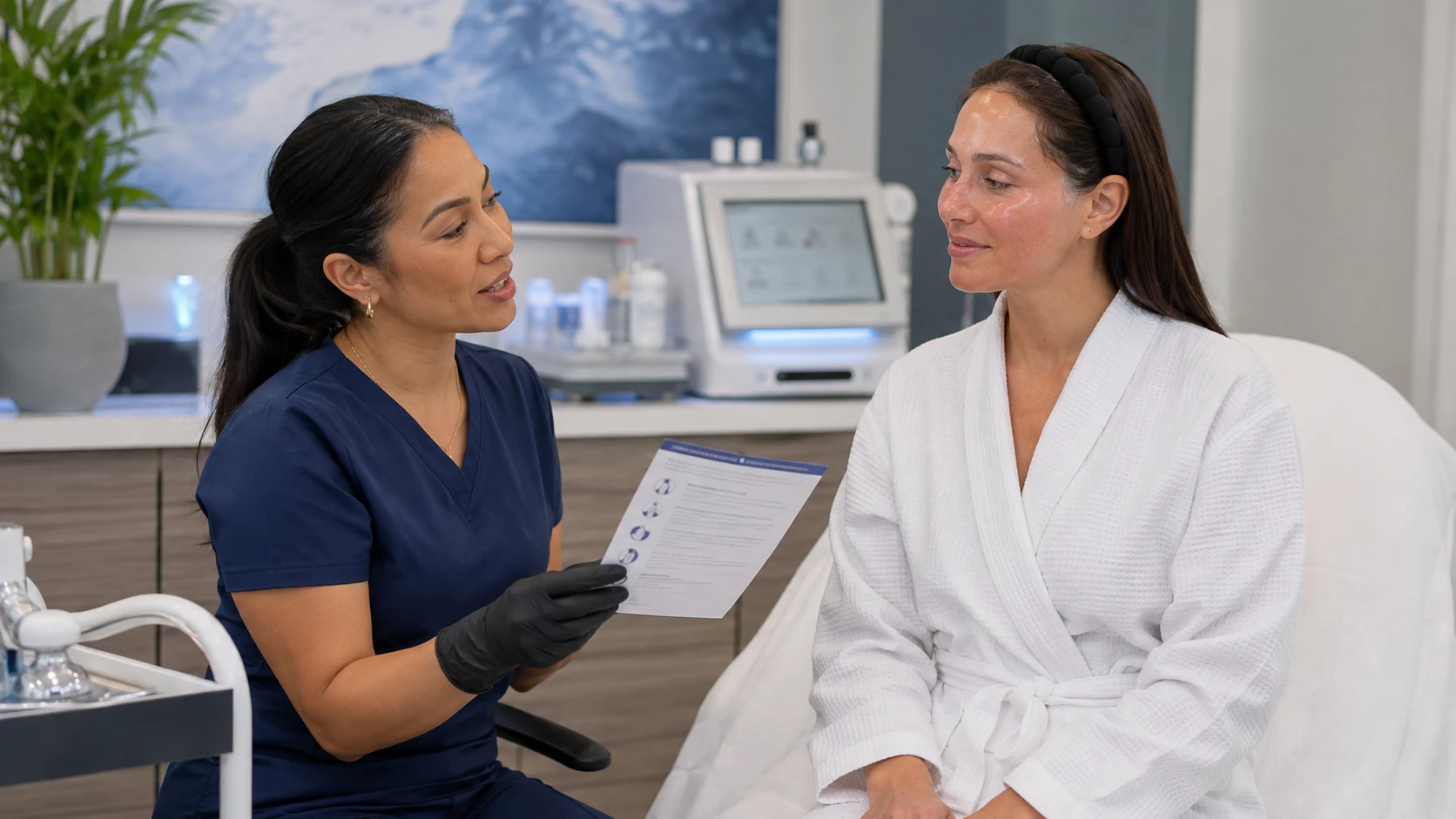
The moment of highest client attention is immediately before they leave the treatment room—not at the beginning of the appointment when pre-treatment anxiety is highest. Estheticians who deliver aftercare instructions while clients are seated upright, with a printed card in hand, report better compliance than those who cover aftercare verbally at intake. The printed card should list restrictions by category, not by product name, and should include a brief one-line rationale for each. Framing restrictions as protective of the investment the client just made—rather than as rules they might violate—consistently improves reception.
The single most common aftercare compliance failure estheticians encounter with nano infusion clients is the premature return to their normal serum routine—specifically vitamin C or retinol—within 24 to 36 hours of treatment. Clients who are motivated skincare users often interpret “recovery” as meaning their skin needs more actives, not fewer. Using the Poly-Luronic™ Jelly Mask as the final step of the in-treatment protocol—and specifically naming it on the printed aftercare card as “the only product your skin needs tonight”—reframes the post-treatment routine as complete rather than incomplete. In practice, this significantly reduces the incidence of clients layering actives on top of post-treatment barrier tissue because it removes the ambiguity about whether “more” is better. Compared to giving generic “avoid actives” instructions without providing a positive replacement routine, providing a specific named protocol reduces post-treatment reaction callbacks noticeably—the client has a clear, sanctioned action to take instead of simply a list of prohibitions.
Six Critical Avoidance Errors and Why Clients Make Them
Understanding why clients fail to follow aftercare restrictions is as clinically useful as knowing the restrictions themselves. Each of the following errors reflects a predictable gap between what estheticians communicate and what clients interpret—identifying the gap allows for more targeted pre-emptive instruction.
Applying Retinol the Same Evening
Motivated skincare clients often view retinol as their “skin repair” product and reason that a treatment day is exactly when it should be used. Without explicit instruction that the skin is in a different physiological state post-treatment, this error is intuitive rather than careless. Solution: explain that retinol causes epidermal turnover—which is the opposite of what reconstituting barrier tissue needs in the first 48 hours.
Taking a Hot Shower Before Bed
Clients rarely associate their nightly shower with a treatment they received hours earlier. The connection between shower heat and prolonged post-treatment redness is not intuitive without explicit explanation. Framing it as: “hot water on treated skin tonight will extend the time your skin looks red tomorrow” is more effective than a general heat-avoidance instruction.
Applying Makeup to Cover Post-Treatment Redness
Clients who experience more visible redness than expected will often apply concealer or foundation as a corrective measure. Without pre-emptive instruction that this can worsen outcomes, the client’s instinct to conceal will override any abstract restriction they received verbally. Providing a specific “what to expect” redness normalisation statement at checkout reduces this error significantly.
Morning Gym Session the Following Day
Clients who had a late-afternoon appointment often interpret “avoid exercise” as meaning the rest of that day only. The 24-hour window for heat and sweat avoidance must be communicated as clock-based, not calendar-day-based. “Wait until tomorrow afternoon for any gym session” is more actionable than “avoid exercise” without a time reference.
Using Fragrance-Containing SPF the Following Morning
Clients who correctly follow sun avoidance instructions may still inadvertently apply a fragrance-containing SPF the next morning—which violates the active-ingredient window if it contains chemical UV filters or sensitising preservatives. SPF product selection for the 48-hour post-treatment period should be discussed specifically, not assumed. Recommending a mineral SPF by category is sufficient.
Consuming Alcohol the Evening of Treatment
Alcohol causes systemic vasodilation, which intensifies and prolongs post-treatment facial redness. Clients who consume alcohol socially the evening of their appointment frequently present with unexpected next-day erythema that they attribute to the treatment rather than their evening behaviour. A brief note about alcohol on the aftercare card—framed as “it extends redness for 12–24 hours”—is enough to motivate most clients to delay.
Building a Complete Post-Treatment Aftercare Card
An aftercare card is the most effective single tool for improving post-nano infusion client compliance. The format should be simple, direct, and structured around two categories: what to avoid and what to actively do. The avoidance list without a positive replacement protocol leaves clients uncertain about what their skincare routine should look like—and uncertainty tends to resolve toward their existing habits, which may include actives and heat exposure.
Positive Protocol: What Clients Should Actively Do
The aftercare card should include the following affirmative instructions alongside the restriction list. Cleanse with a gentle, fragrance-free, non-foaming cleanser using lukewarm water only—not hot. Apply a hyaluronic acid or polyglutamic acid serum while skin is still slightly damp to maximise humectant efficacy. Follow with a ceramide-rich, fragrance-free moisturiser to support barrier reconstitution. Apply mineral SPF 30 or higher every morning and reapply every two hours if outdoors. Avoid layering multiple products—fewer, simpler steps protect the barrier more effectively during reconstitution than a complex multi-step routine.
The 48-Hour Versus 72-Hour Distinction
Most aftercare restrictions apply for 24 to 48 hours. The one exception is the active-ingredient restriction, where 72 hours is the more conservative and clinically appropriate standard for clients with baseline barrier compromise, dry or dehydrated skin, or a history of sensitivity. For clients with robust, well-hydrated skin who have received nano infusion regularly, 48 hours is generally sufficient. Estheticians should apply clinical judgement and document the recommendation made in client notes—this protects both the client outcome and the esthetician’s professional record in the event of a post-treatment reaction inquiry.
When to Advise Clients to Contact the Practice
Clients should understand which post-treatment presentations are normal versus which warrant contact before their next scheduled appointment. Normal: mild redness, slight warmth, and temporary tightness resolving within 24 hours. Contact the practice if: redness is worsening after 48 hours rather than improving; the skin develops raised wheals, blistering, or significant swelling; or a breakout of pustular lesions develops in the treatment area within 72 hours, which may indicate a bacterial or follicular response requiring clinical assessment.
Professional and Scientific References
This article draws on published research in transdermal drug delivery, microchanneling-induced permeability, barrier reconstitution biology, and professional esthetician standards for post-treatment aftercare communication.
- Prausnitz, M.R., & Langer, R. (2008). Transdermal drug delivery. Nature Biotechnology, 26(11), 1261–1268. Establishes core research on microchannel-mediated transdermal permeability increase and its dose implications.
- Kalluri, H., & Banga, A.K. (2011). Formation and closure of microchannels in skin following microneedling. AAPS PharmSciTech, 12(4), 1266–1275. Documents microchannel closure timing and residual permeability during the barrier reconstitution window.
- Elias, P.M., & Feingold, K.R. (Eds.). (2006). Skin Barrier. Taylor & Francis. Reference text on lamellar body secretion, ceramide synthesis timelines, and barrier reconstitution biology following physical disruption.
- American Society of Esthetics Professionals (ASCP). Professional Post-Treatment Standards and Client Communication Guidelines, current edition. Industry standard reference for aftercare instruction delivery and documentation practices.
- Tuan-Mahmood, T.M., et al. (2013). Microneedles for intradermal and transdermal drug delivery. European Journal of Pharmaceutical Sciences, 50(5), 623–637. Covers molecular selectivity changes during microchanneling and implications for topical ingredient penetration depth.
The post-nano infusion restriction environment creates a narrow but clinically meaningful window in which only barrier-compatible products should make contact with the skin. The Poly-Luronic™ Jelly Mask is specifically formulated to meet every criterion that the restriction list establishes: no fragrance, no alcohol, no acidic actives, no silicone fillers, and no ingredients from any contraindicated category. Applied as the final step of the in-treatment protocol, it simultaneously addresses elevated transepidermal water loss with its occlusive alginate base, delivers polyglutamic acid and hyaluronic acid through the still-open microchannel window to maximise the treatment’s hydration outcome, and provides clients with a visible, sensory signal that their skin is being cared for—which reduces the instinct to layer additional products during the restriction period. For estheticians building a complete nano infusion protocol, it resolves the post-treatment product gap without requiring a separate aftercare product recommendation.
Explore the Poly-Luronic™ Jelly Mask LineFrequently Asked Questions: Post-Nano Infusion Aftercare Restrictions
Why does skin feel more sensitive right after nano infusion?
Nano infusion creates thousands of temporary microchannels in the stratum corneum, temporarily disrupting the skin barrier and increasing sensitivity to environmental stimuli. During this window, nerve endings at the epidermal surface are more exposed, and transepidermal water loss increases measurably. The sensitivity typically peaks within the first two hours and resolves significantly within 24 hours as the microchannels close and the barrier begins to reconstitute.
Can clients wear makeup after nano infusion?
Clients should avoid all makeup for a minimum of 12 hours following nano infusion, and 24 hours is the more conservative and widely recommended window. While microchannels close quickly, applying makeup products—especially those containing alcohol, fragrance, or silicone fillers—introduces potential irritants and occlusive ingredients that can clog temporarily open channels. Mineral makeup with no added fragrance or preservatives may be permissible after 12 hours for clients with social obligations, but this should be discussed on a case-by-case basis.
How long should clients avoid sun exposure after nano infusion?
Clients should avoid direct sun exposure for at least 48 hours after nano infusion, and for the full 72-hour post-treatment window when possible. The microchanneling process temporarily compromises the skin barrier, making the epidermis significantly more vulnerable to UV-induced damage and potential post-inflammatory hyperpigmentation. When outdoor exposure is unavoidable, clients should apply a broad-spectrum SPF 30 or higher using a gentle, fragrance-free formula and wear protective clothing.
Is it safe for clients to work out after nano infusion?
Clients should avoid strenuous exercise for 24 hours after nano infusion. Physical exertion raises core body temperature and increases perspiration, both of which can irritate the temporarily compromised skin barrier and introduce bacteria to open microchannels. Sweat contains salts and metabolic byproducts that can cause stinging, redness, and in some cases, follicular irritation in sensitive clients. Light walking is generally acceptable, but gym sessions, hot yoga, and high-intensity training should wait until the following day.
What skincare ingredients should clients avoid after nano infusion?
Clients should avoid retinoids, alpha hydroxy acids, beta hydroxy acids, vitamin C in ascorbic acid form, benzoyl peroxide, and any product containing alcohol or fragrance for a minimum of 48 to 72 hours after nano infusion. These ingredients are exfoliating, acidic, or sensitising, and when applied to a compromised barrier with open microchannels they can cause irritation, redness, and in some cases a reactive inflammatory response. The post-treatment window calls for barrier-supportive, occlusive, and humectant-rich formulas only.
Can clients take a hot shower or use a sauna after nano infusion?
Hot showers, steam rooms, saunas, and hot tubs should all be avoided for at least 24 to 48 hours following nano infusion. Heat and steam dilate blood vessels and increase microcirculation in the treatment area, which can intensify redness and prolong visible post-treatment inflammation. Steam also carries waterborne contaminants that can enter temporarily open microchannels. Lukewarm water is the appropriate standard for any facial cleansing during the initial recovery window.
What skincare ingredients should clients actively use after nano infusion?
After nano infusion, the priority is immediate barrier support and sustained hydration. Clients should use gentle, fragrance-free cleansers, hyaluronic acid or polyglutamic acid-based serums, ceramide-containing moisturisers, and broad-spectrum SPF. Occlusive ingredients such as petrolatum or squalane applied over humectants help lock in moisture and support barrier recovery. Peptide-based serums are also appropriate during this window because they are non-irritating and support the skin’s repair signalling pathways.
Does nano infusion require the same aftercare restrictions as microneedling?
Nano infusion requires similar categories of aftercare restrictions to microneedling but is generally more forgiving in duration and intensity. Microneedling penetrates to the dermis and typically requires 72-hour avoidance windows for active ingredients, heat, and UV exposure. Nano infusion creates only epidermal-level microchannels and most restrictions apply for 24 to 48 hours. However, the core principles are identical: avoid actives, heat, UV exposure, and physical manipulation of the skin during the recovery window.
Why do estheticians use the Poly-Luronic Jelly Mask immediately after nano infusion?
The Poly-Luronic™ Jelly Mask is used directly after nano infusion because its combination of polyglutamic acid and hyaluronic acid delivers immediate occlusive hydration to the temporarily compromised barrier. The alginate-based gel structure creates a physical seal over the treatment area, reducing transepidermal water loss while the enhanced absorption window from open microchannels is still active. Estheticians favour it in this protocol because it contains no fragrance, no alcohol, and no acidic actives—making it compatible with the post-treatment restriction list without exception—while simultaneously maximising the serum infusion benefit the treatment is designed to deliver.
Protecting Results Starts With What Clients Avoid
Nano infusion’s low downtime profile is one of its most significant professional advantages—but low downtime does not mean no aftercare responsibility. The 24 to 72 hours following a nano infusion treatment represent a biologically distinct window during which the skin’s normal selective barrier function is temporarily reduced. Every restriction in the post-treatment protocol exists because of that physiological reality, not as a precautionary formality.
Estheticians who take the time to explain the “why” behind each restriction—and who provide a clear positive protocol alongside the avoidance list—will consistently see better outcomes, fewer post-treatment reaction callbacks, and clients who leave with a higher level of confidence in both the treatment and the practitioner. The aftercare conversation is not a postscript to the appointment. It is a clinical step with measurable impact on results.
Use the restriction timeline and common-error framework in this article as the basis for your practice’s printed aftercare card, and revisit your verbal delivery process periodically to ensure the most critical restrictions are being communicated at the moment of highest client retention—at checkout, card in hand, while the rationale is still fresh.