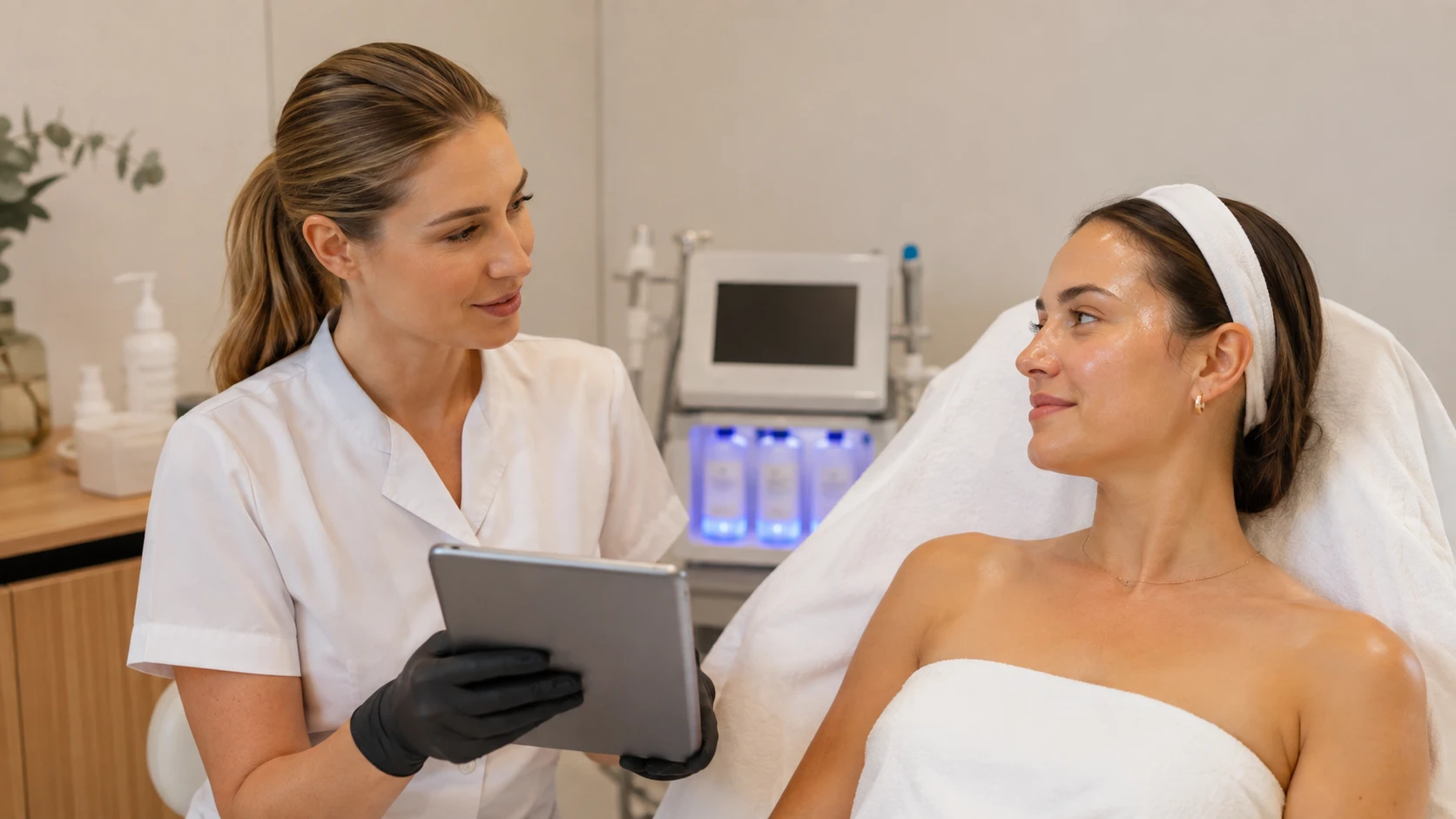
What Should Estheticians Tell Clients About Nano Infusion Aftercare?
After a nano infusion treatment, clients need clear guidance on what the skin will feel like, which products and activities to avoid, and how to maintain the hydration levels the treatment was designed to restore. Because nano infusion temporarily increases the skin’s surface permeability, the 24 to 48 hours following treatment are the most critical window for protecting results and preventing irritation.
- Clients should avoid active ingredients — retinoids, AHAs, BHAs, and vitamin C in ascorbic acid form — for a minimum of 48 hours post-treatment.
- Makeup should be avoided for at least 24 hours, and ideally 48 hours for reactive skin types.
- Mild redness and a feeling of warmth are normal and typically resolve within two to six hours.
- Mineral sunscreen should be applied before leaving the treatment room and reapplied every two hours when outdoors.
- Hydration is the most important aftercare priority — both topical application of gentle humectant and occlusive products, and adequate internal water intake.
- Heat exposure — saunas, steam rooms, hot showers, and intense exercise — should be avoided for 48 hours to prevent exacerbating any residual inflammation.
- Clients should not touch or pick at the skin during the first 24 hours, as the microchannels remain temporarily open after treatment.
The quality of an esthetician’s aftercare communication is as consequential as the technical execution of the treatment itself. A perfectly performed nano infusion service can deliver compromised results if the client goes home without a clear understanding of what the skin needs in the hours and days that follow. This is a clinical reality that many practitioners only fully appreciate after encountering a client who applied a retinol serum the same evening, or whose results were underwhelming because they skipped the post-treatment hydration routine entirely.
Nano infusion creates transient microchannels in the stratum corneum that temporarily increase the skin’s permeability and its responsiveness to topical products. That permeability works in both directions: it enhances the uptake of beneficial ingredients applied in-clinic, but it also means the skin is unusually vulnerable to irritants during the same window. Understanding this mechanism is what separates a practitioner who delivers consistent, exceptional results from one whose outcomes are unpredictable.
This article provides a complete aftercare communication framework for estheticians — covering what to say to clients immediately following treatment, the timeline of expected skin responses, which products and activities carry genuine risk, and how to structure ongoing guidance that builds client confidence and long-term retention.
What Every Esthetician Should Know About Nano Infusion Aftercare
- The 24–48 hour post-treatment window is the highest-risk period for irritation because the skin’s surface permeability is temporarily elevated following nano infusion.
- Active ingredients — retinoids, AHAs, BHAs, and ascorbic acid — must be paused for a minimum of 48 hours; prescribing these in aftercare notes is one of the most common client errors.
- Mineral sunscreen is non-negotiable and should be applied in-clinic before the client leaves, not left as an optional home instruction.
- Dehydration significantly slows the visible recovery process; estheticians should apply a hydrating mask in-clinic and send clients home with specific humectant and occlusive product recommendations.
- Redness, mild warmth, and a slight tight feeling are expected normal responses; practitioners who prepare clients for this at booking experience far fewer post-treatment concern calls.
- Heat exposure — exercise, saunas, hot baths — must be avoided for 48 hours to prevent an exaggerated inflammatory response on temporarily sensitised skin.
- Written aftercare documentation sent to the client via text or email immediately after the appointment increases compliance significantly compared to verbal instructions alone.
What to Tell Clients Immediately After Nano Infusion
The conversation that happens in the final five minutes of a nano infusion appointment determines much of the client’s at-home behaviour. Most practitioners know to mention “avoid actives” and “use SPF,” but this level of instruction is rarely specific enough to produce reliable compliance. Clients leaving a treatment room with newly sensitised skin need to understand not just what to do, but why each instruction matters — particularly if they have an established skincare routine they’re accustomed to following every evening.
The most effective in-clinic conclusion to a nano infusion service includes three elements: a brief explanation of what the skin is doing right now, specific product guidance for the next 48 hours, and a clear answer to the question “when can I go back to my normal routine?” These three elements address the main anxieties clients have when leaving the treatment room and prevent the majority of post-treatment calls and emails that estheticians typically field.
The Language That Works in Practice
Experienced practitioners find that framing aftercare in terms of skin behaviour — rather than as a list of prohibitions — produces better client comprehension and compliance. Rather than saying “don’t use your retinol,” a more effective framing is: “Your skin’s surface is temporarily more open than usual right now, which is what allows the serums we used today to penetrate more deeply — but for the same reason, anything that would normally be a mild irritant could feel much stronger tonight. So we want to keep tonight simple: just the hydrating serum and your moisturiser, nothing else.” This framing positions the instruction within a clinical rationale, which clients retain far more reliably than isolated rules.
The in-clinic aftercare step matters as much as the verbal guidance. Applying a hydrating mask as the final protocol step allows clients to leave the treatment room with visible evidence that the skin is already calming — which reinforces confidence in the treatment and sets a positive framing for the recovery period.
Why the Post-Treatment Skin State Requires a Different Aftercare Approach
Aftercare instructions for nano infusion are not interchangeable with standard post-facial guidance. Understanding the specific physiological state of the skin following microchanneling allows estheticians to make evidence-based decisions about what products are safe, what activities carry risk, and why a compressed recovery window still requires structured clinical support.
Nano infusion creates temporary microchannels in the stratum corneum using nano-tip cartridges that do not penetrate the viable epidermis or dermis. However, the transient disruption to the skin’s surface barrier is meaningful from an absorption and sensitivity standpoint. Studies examining topical drug delivery through nano-sized channels have consistently demonstrated increases in permeability that can persist for several hours following treatment — meaning the window of elevated absorption and vulnerability is real, even if visible signs like redness resolve within a few hours.
Transepidermal Water Loss and Aftercare Priority
One of the most clinically relevant aftercare considerations is transepidermal water loss (TEWL). When the stratum corneum is disrupted — even temporarily — the skin’s ability to regulate moisture evaporation is compromised. This means the skin will dehydrate more rapidly than normal in the hours following treatment, particularly in low-humidity environments or air-conditioned spaces. Hydration support is therefore not simply an aesthetic recommendation — it is directly tied to the speed and quality of barrier recovery.
What Happens to the Skin in the Hours After Nano Infusion
Nano infusion creates transient microchannels in the stratum corneum. While these channels are far shallower than microneedling punctures, they temporarily increase skin permeability and TEWL until the surface barrier begins to re-establish itself. The timeline below reflects average recovery benchmarks observed in professional practice.
Key implication: Barrier support must be applied in-clinic immediately following treatment, not left entirely to at-home aftercare. Clients who leave without in-clinic hydration support consistently report more discomfort and slower visible recovery than those who receive a hydrating mask as part of the session.
The period of elevated absorption is both an opportunity and a vulnerability — beneficial ingredients penetrate more effectively, but irritants also penetrate more effectively during the same window.
The Nano Infusion Aftercare Timeline: Day-by-Day Client Guidance
One of the most effective tools an esthetician can provide is a structured day-by-day aftercare timeline. Clients understand and retain time-bound instructions far more reliably than general guidance. The following framework represents the post-treatment skin behaviour and recommended client actions across the first week following nano infusion, based on consistently observed recovery patterns in professional practice settings.
Setting Realistic Expectations at the Point of Booking
One of the most overlooked elements of aftercare communication is timing. Many estheticians deliver aftercare instructions only at the end of the appointment, when the client is dressed, potentially time-pressured, and processing the sensory experience of the treatment. A more effective approach is to provide a brief overview of the aftercare timeline at the point of booking — either verbally during the consultation call or via a pre-appointment email or text. This ensures clients arrive at the appointment already aware that they should not schedule a social event for the same evening and have already paused their retinol for the night of the treatment.
Practitioners who normalise the aftercare conversation at booking rather than treating it as a post-treatment surprise report significantly fewer client concerns and higher satisfaction scores. The framing “part of what makes nano infusion effective is what you do in the 48 hours after” positions aftercare as an integral component of the service rather than a list of restrictions imposed at the end.
The most significant shift in post-nano-infusion client experience comes from applying a cooling hydration mask as the final step before the client gets up from the treatment bed, rather than finishing with a serum and moisturiser alone. In practice, applying the Poly-Luronic™ Jelly Mask at a 2:1 powder-to-water ratio and allowing it to set for 15 minutes means clients leave the room with visibly calmer, more hydrated skin — the redness that was present immediately post-treatment is typically reduced by 60 to 70 percent by the time the mask is removed. The contrast here with sheet masks is worth noting: sheet mask hydration tends to feel good immediately but dries at the edges within a few minutes, which can actually increase TEWL on the areas it fails to cover. The alginate structure of the jelly mask maintains consistent occlusive contact across the full application area for the entire dwell time, which is clinically meaningful for a skin surface that is temporarily more permeable. Clients who receive this final mask step also tend to need significantly less reassurance during the aftercare conversation — because they can feel that their skin is already recovering before they leave.
Six Aftercare Instructions Clients Consistently Get Wrong
Most post-treatment issues that estheticians encounter are preventable with more specific client communication. The following six points represent the most common areas where client compliance breaks down after nano infusion, along with the specific language and framing that reduces these errors in practice.
Applying Retinol the Same Evening
Many clients have a deeply ingrained evening skincare routine and do not connect “avoid actives” with their retinol specifically. Always name retinol, retinoids, and tretinoin explicitly — not just as “active ingredients.” Instruct clients to move their retinol to a different location in their bathroom so they encounter a visual reminder not to use it.
Working Out Within 24 Hours
Exercise elevates body temperature, increases sweating, and raises circulation — all of which can intensify post-treatment redness and increase the risk of bacterial contact on open microchannels. Clients who train daily often treat this instruction as optional unless the specific physiological reason is explained. Frame it as: “your skin is doing repair work right now and heat is counterproductive to that process.”
Applying a Regular Foundation the Next Morning
Many clients interpret the 24-hour makeup restriction as applying only to the treatment day itself. Clarify that 24 hours means the following morning is also a no-makeup window, and that mineral powder-based products are the safest option if coverage is genuinely needed on day two. Liquid foundations containing silicones, fragrance, or alcohol should be held until at least 48 hours post-treatment.
Using a Facial Scrub or Exfoliating Toner
Clients with oily or congested skin often continue their exfoliating toner or enzyme cleanser automatically, not recognising it as an “active.” Name these product categories explicitly in aftercare instructions: glycolic acid toners, salicylic cleansers, enzyme exfoliants, and physical scrubs must all be paused. Providing written aftercare notes that clients can reference at home prevents these errors more reliably than verbal instructions alone.
Skipping Sunscreen Because It’s Overcast
UV exposure on temporarily sensitised, more permeable skin carries a higher risk of post-inflammatory hyperpigmentation than on intact skin — a risk that applies regardless of cloud cover, as UVA rays penetrate through cloud. Apply a broad-spectrum mineral SPF 30 or higher in-clinic and instruct clients to reapply every two hours if outdoors. Make this instruction explicit for clients who commute by car, as UVA penetrates through glass.
Not Drinking Enough Water Post-Treatment
Topical hydration alone cannot fully compensate for internal dehydration during the recovery period. Clients who present as chronically dehydrated tend to have slower visible recovery timelines after nano infusion. Advise clients to consume at least two litres of water on the day of treatment and the following day. This is often the instruction clients find most surprising, and explaining why — that internal hydration supports the skin’s ability to maintain the moisture levels restored during treatment — significantly improves compliance.
Building an Aftercare Communication System That Supports Client Retention
Aftercare is not only a clinical obligation — it is one of the highest-value touchpoints in the client relationship. The post-treatment period is when client trust is either deepened or eroded. A client who receives clear, professional, and appropriately detailed aftercare guidance feels cared for beyond the treatment room, which is the primary driver of rebook rates and referrals in esthetic practice.
The most effective aftercare communication systems combine multiple delivery channels: a verbal summary at the end of the appointment, a printed or digital aftercare card given at checkout, and an automated follow-up message sent 24 hours later. The 24-hour follow-up message is particularly powerful because it arrives at the moment when the client is navigating the first day of recovery and is most likely to have questions. A simple check-in — “How is your skin feeling today? Here’s a reminder of what to use and what to hold off on” — demonstrates professional care and significantly reduces the likelihood of the client making an aftercare error on day two.
What to Include in Written Aftercare Documentation
Effective written aftercare for nano infusion should include: a brief explanation of what the skin is doing during recovery (one to two sentences), the complete list of ingredients and product types to avoid with specific names rather than categories, a day-by-day timeline of when each restriction lifts, the recommended home care routine for the first week, sun protection guidance, and contact information for the esthetician if the client experiences anything unexpected. Keep the language accessible — clients do not need to understand the biochemistry of TEWL to follow effective aftercare instructions, but they do need product names, timelines, and a clear point of contact if they have questions.
Recognising When a Client Response Warrants Follow-Up
Most post-nano-infusion skin responses are normal and self-resolving. However, practitioners should instruct clients to contact them if they experience redness that intensifies rather than diminishes after 24 hours, any sensation of burning or stinging that persists beyond the treatment day, unusual swelling, or any sign of a pustular reaction. These are uncommon following nano infusion, but clients who know what to watch for are better equipped to seek guidance promptly if needed. Providing this guidance proactively — framed as “this almost never happens, but here is what to watch for” — builds client confidence rather than creating anxiety, because it demonstrates thorough professional knowledge.
Professional and Scientific References
This article draws on peer-reviewed research into skin barrier physiology, transdermal delivery mechanisms, and professional esthetic practice guidelines for post-treatment recovery protocols.
- Elias, P.M. & Ghadially, R. (2002). The aged epidermal permeability barrier: basis for functional abnormalities. Clinics in Geriatric Medicine. Establishes the fundamental relationship between barrier integrity and transepidermal water loss rate.
- Jeong, S.H. et al. (2018). Physical enhancement of skin permeability using nano-scale structures: mechanisms and clinical applications. Journal of Drug Delivery Science and Technology. Reviews the mechanisms of nanotopography in modulating skin permeability and the time course of barrier recovery.
- Setner, B. & Szewczuk, Z. (2016). Polyglutamic acid in biomedical applications: hydration and humectancy mechanisms. Current Pharmaceutical Design. Provides the molecular basis for polyglutamic acid’s function as a surface-active humectant and hyaluronidase inhibitor.
- Draelos, Z.D. (2012). The science behind skin care: moisturisers and occlusive agents. Journal of Cosmetic Dermatology. Defines the clinical distinction between humectant and occlusive ingredient functions and their complementary roles in barrier recovery protocols.
- Jourdan, M. et al. (2019). Epidermal repair and the role of post-procedural hydration: a review of best practice guidelines. Dermatology & Therapy. Supports evidence-based aftercare protocols for minimally invasive skin treatments including structured hydration windows and active ingredient avoidance timelines.
The final step of any nano infusion protocol should address the skin’s most immediate post-treatment need: occlusive hydration support while the surface barrier re-establishes itself. The criteria for this step are specific — the product must be fragrance-free, free of exfoliating actives, able to deliver meaningful humectant concentration, and capable of maintaining occlusive contact for a full dwell time without sheet-mask edge-drying. Poly-Luronic™ Jelly Mask meets all four criteria: its alginate matrix provides a consistently sealed occlusive surface for the full 15-minute application, while polyglutamic acid and hyaluronic acid address surface and sub-surface hydration simultaneously. For estheticians building or refining their nano infusion protocol, incorporating this mask as the final in-clinic step is one of the most clinically grounded decisions available for protecting treatment outcomes and improving the client’s immediate post-treatment experience.
Explore the Poly-Luronic™ Jelly Mask LineFrequently Asked Questions: Nano Infusion Aftercare
What should clients do immediately after a nano infusion treatment?
Immediately after nano infusion, clients should avoid touching or rubbing the treated skin and refrain from applying any active ingredients, makeup, or fragranced products for at least 24 hours. The skin’s microchannels remain temporarily open following treatment, making it highly receptive to hydrating serums applied in-clinic but also vulnerable to irritants. Estheticians should send clients home with a mineral SPF, a gentle fragrance-free moisturiser, and clear written instructions covering the first 48-hour window.
How long does the skin stay sensitive after nano infusion?
Most clients experience mild sensitivity for 24 to 48 hours following nano infusion, though this varies depending on skin barrier health at the time of treatment. Because nano infusion creates shallow transient microchannels rather than the deeper punctures associated with traditional microneedling, the sensitivity window is generally shorter. Clients with compromised barriers or reactive skin types may notice lingering tightness or mild redness for up to 72 hours. Estheticians should set realistic expectations at the point of booking, not only at the end of the appointment.
Can clients wear makeup after a nano infusion treatment?
Clients should avoid makeup for a minimum of 24 hours following nano infusion, and ideally 48 hours if their skin is reactive or if a more intensive protocol was performed. The reasoning is practical: liquid foundations and setting powders commonly contain alcohol, fragrance, or occlusive silicones that can obstruct the microchannels while the skin is still in its active absorption phase, potentially trapping irritants against a temporarily sensitised surface. If clients have a social commitment within 24 hours, estheticians should reschedule the appointment rather than compromise the aftercare window.
Why does skin look slightly red or flushed right after nano infusion?
The mild redness seen after nano infusion is a normal vascular response to the mechanical stimulation of the nano-tip cartridge moving across the skin surface. The nano-tip does not penetrate the dermis as microneedling does, but the repetitive stamping action causes a temporary increase in local circulation, which produces a low-level erythema in most clients. This redness typically resolves within two to six hours. Applying a chilled hydration mask in-clinic immediately following the treatment is one of the most effective ways to reduce the appearance of post-treatment redness before the client leaves the treatment room.
Does skin peel or flake after nano infusion the way it does after a chemical peel?
Visible peeling is not a typical or expected outcome of nano infusion. Unlike chemical exfoliation, which disrupts the corneocyte layer to induce shedding, nano infusion works by creating transient microchannels for product delivery without deliberately removing surface cells. Some clients with significantly congested or thickened skin may notice very minor flaking in the first 48 hours, but this is the exception rather than the rule. If a client is experiencing notable peeling, the esthetician should evaluate whether the treatment was performed on compromised skin or whether a sensitising serum was used during the service.
What skincare ingredients should clients avoid in the first 48 hours after nano infusion?
Clients should avoid retinoids, alpha hydroxy acids, beta hydroxy acids, vitamin C in ascorbic acid form, benzoyl peroxide, and any product containing alcohol or synthetic fragrance for at least 48 hours after nano infusion. These ingredients are either exfoliating, acidic, or potentially irritating against skin that is temporarily more permeable. The microchannels created during treatment increase transdermal absorption significantly in the short term, meaning that ingredients which are tolerable on intact skin can cause unexpected sensitivity or inflammation if applied during the recovery window. Gentle humectant serums and occlusive moisturisers are the safest choices during this period.
How important is hydration in the aftercare routine following nano infusion?
Hydration is the single most important aftercare priority following nano infusion. The treatment temporarily increases transepidermal water loss by disrupting the skin’s surface barrier, and without adequate humectant and occlusive support the skin will dehydrate rapidly, slowing the recovery process and reducing the visible results of the treatment. Estheticians should apply a hydrating mask in-clinic before the client leaves, and instruct clients to use a gentle humectant serum followed by an occlusive moisturiser morning and evening for at least three to four days post-treatment. Adequate internal hydration through water intake also supports the recovery process.
Should clients use sunscreen after nano infusion, and which type is best?
Sunscreen is non-negotiable after nano infusion and should be applied before the client leaves the treatment room if the appointment concludes during daylight hours. Mineral sunscreens containing zinc oxide or titanium dioxide are preferred over chemical UV filters for the first 48 to 72 hours because they sit on the surface of the skin rather than requiring dermal absorption to function, which reduces the risk of post-treatment irritation. Clients should be advised to reapply every two hours when outdoors and to avoid direct sun exposure, saunas, and heated environments for at least 48 hours following treatment.
Why do estheticians use the Poly-Luronic™ Jelly Mask specifically as part of their nano infusion aftercare protocol?
Estheticians use the Poly-Luronic™ Jelly Mask as part of their nano infusion aftercare protocol because its formulation is specifically suited to the skin’s immediate post-treatment state. The mask delivers polyglutamic acid and hyaluronic acid simultaneously under an occlusive alginate structure, which locks surface hydration in place during the critical window when transepidermal water loss is elevated. The cooling sensation of the setting mask also provides immediate comfort for any residual redness or sensitivity. Because the jelly mask is fragrance-free and free of active exfoliants, it presents no irritation risk on the temporarily more permeable post-nano-infusion skin. Many estheticians apply it as the final in-clinic step, allowing it to set for 15 to 20 minutes while the client relaxes, and send clients home with instructions to continue with a gentle humectant moisturiser immediately after removal.
Aftercare Is Where Professional Results Are Either Protected or Lost
Nano infusion is a low-downtime treatment, but “low downtime” does not mean “no aftercare.” The 48 hours following a nano infusion session represent a window of genuine clinical significance — the skin is more permeable, more vulnerable, and more responsive than at any other point in the treatment cycle. What the client does during this window directly determines the quality and durability of the results the esthetician worked to create.
The estheticians who deliver consistently exceptional nano infusion outcomes are those who treat aftercare communication with the same rigour they apply to the treatment protocol itself. That means being specific about ingredients, explicit about timelines, proactive about setting expectations at booking, and systematic about follow-up. It also means finishing every nano infusion session with in-clinic hydration support that gives the skin the immediate barrier reinforcement it needs before the client steps out the door.
Building these practices into every appointment is not additional work — it is the work. It is what separates a practitioner whose clients rebook consistently from one whose results are unpredictable and whose clients don’t always understand why.