What Should Estheticians Tell Clients About Microneedling Aftercare?
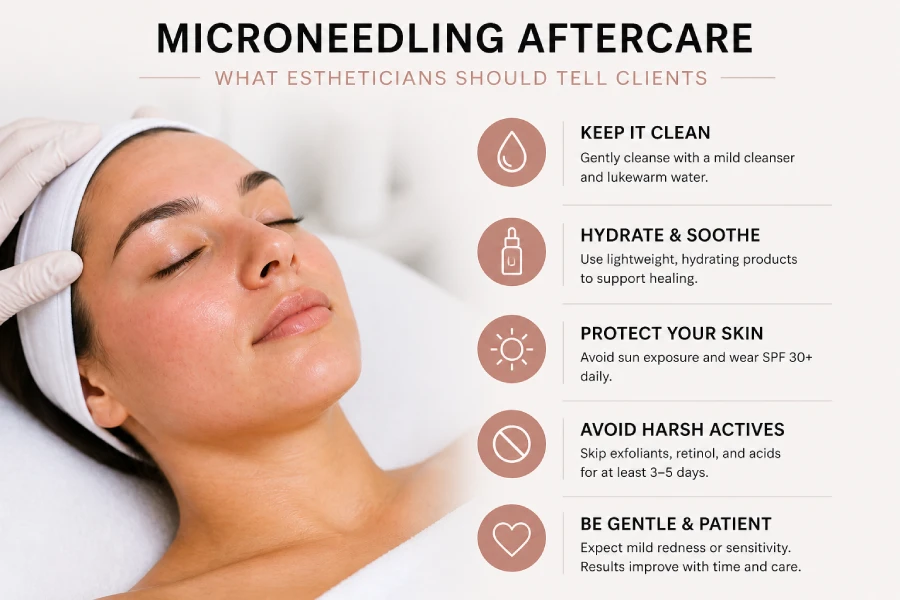
After microneedling, estheticians should provide clients with a clear, structured set of aftercare instructions that covers the first seven days of recovery. The most important information falls into three categories: what to avoid, what to apply, and what to expect. Delivering these instructions verbally at checkout and reinforcing them with a written take-home sheet significantly improves compliance and reduces the risk of post-treatment complications.
- Clients should avoid active skincare ingredients—retinol, AHAs, BHAs, and vitamin C—for a minimum of 72 hours after treatment.
- No makeup should be applied for at least 24 to 48 hours; fragrance-free mineral options may be suitable after 48 hours if skin is calm.
- Redness, mild swelling, and skin tightness are normal for 24 to 72 hours and should be communicated to clients before they leave the treatment room.
- Gentle, fragrance-free hydration and broad-spectrum SPF 30 or higher are the two non-negotiable elements of the at-home recovery routine.
- Sweating, heat exposure, and vigorous exercise should be avoided for 24 to 48 hours to prevent extending the inflammatory phase.
- Clients should be given a clear list of warning signs—including prolonged redness beyond 72 hours, pustules, or unusual pain—that warrant contacting the esthetician.
The outcome of a professional microneedling treatment is determined as much by what happens in the days after the session as by the technique applied during it. Collagen induction therapy creates a controlled wound response designed to stimulate dermal remodelling, but that process depends on the skin being protected, hydrated, and kept free from additional stressors during the initial recovery window. When clients leave the treatment room without a clear understanding of what to do and what to avoid, the risk of irritation, prolonged redness, and compromised results rises substantially.
Estheticians occupy a critical position in the aftercare communication chain. Unlike a dermatologist or plastic surgeon who may have a clinical team managing follow-up, most esthetics clients rely entirely on the instructions their practitioner provides at checkout. That moment—when a client is slightly dazed, mildly pink, and processing the sensory experience of the treatment—is not the ideal time for complex verbal instructions. The most effective aftercare protocols are simple enough to be understood in that state and detailed enough to cover the questions that arise at home at 11pm on day two of recovery.
This article covers the full scope of aftercare communication that estheticians should deliver after microneedling: the physiological rationale behind each instruction, the specific language that resonates most effectively with clients, and the recovery timeline framework that helps clients understand what is normal versus what requires follow-up contact.
What Every Esthetician Should Know About Microneedling Aftercare Communication
- Written aftercare instructions consistently outperform verbal-only instructions in client compliance; both formats should be provided at every microneedling appointment.
- The 72-hour rule for active ingredients is the single most important avoidance guideline; clients who understand the physiological reason behind it follow it more reliably.
- Elevated transepidermal water loss (TEWL) after microneedling makes immediate in-clinic hydration essential, not optional.
- Heat, sweating, and exercise extend the inflammatory response and should be avoided for 24 to 48 hours post-treatment.
- Framing expected side effects as evidence that the treatment worked—rather than as problems—reduces client anxiety and unnecessary contact in the days following treatment.
- Sunscreen compliance after microneedling is non-negotiable; the disrupted barrier is significantly more vulnerable to UV-induced pigmentation and inflammation than intact skin.
- Providing clients with a specific product list for days one through seven, rather than a general category recommendation, produces measurably better recovery outcomes.
The Physiology That Drives Every Aftercare Rule
Every microneedling aftercare instruction has a specific physiological basis. Understanding that basis allows estheticians to explain their instructions in language that clients find credible and logical, which directly improves compliance. When a client knows why they are being asked to avoid retinol for three days, they follow the instruction more reliably than when they receive the instruction without context.
Microneedling creates hundreds to thousands of micro-channels per square centimetre of treated skin, depending on needle depth and pass count. These channels pass through the stratum corneum, the epidermis, and—at depths of 0.5mm and above—into the superficial dermis. This disruption temporarily compromises the skin barrier, increasing transepidermal water loss, reducing resistance to topical ingredients, and triggering an acute inflammatory response that initiates the collagen cascade the treatment is designed to produce.
The Three Phases Clients Will Experience
The post-microneedling recovery follows a predictable three-phase pattern that every esthetician should be able to describe to clients before they leave. Phase one is the acute inflammatory phase, lasting 24 to 72 hours, characterised by redness, warmth, mild swelling, and skin tightness. Phase two is the proliferative phase, lasting roughly three to five days post-treatment, during which the skin surface normalises while deeper repair continues invisibly. Phase three is the remodelling phase, which extends over weeks to months and represents the gradual structural improvement in collagen density and skin quality that microneedling is designed to produce. Clients who understand this timeline do not contact their esthetician in a panic when their face is pink on day two—they expect it.
The Science of Post-Microneedling Barrier Vulnerability
The primary reason that standard skincare ingredients become contraindicated after microneedling is not because those ingredients are harmful under normal conditions—it is because the disrupted barrier allows them to penetrate far more deeply and at far greater concentrations than the skin is designed to receive. This applies equally to beneficial actives and to potential irritants.
Why Transepidermal Water Loss Is the Central Recovery Challenge
Transepidermal water loss (TEWL) is the passive diffusion of water vapour through the skin to the surrounding environment. In intact skin, the stratum corneum’s lipid matrix and natural moisturising factor (NMF) content act as the primary TEWL regulators. Microneedling disrupts this structure by physically passing through it, temporarily eliminating the barrier’s ability to regulate moisture passively. The clinical consequence is that the skin dehydrates far more rapidly in the 24 to 48 hours following treatment than it would under normal conditions, amplifying the sensation of tightness and slowing the surface repair process if left unaddressed.
Why the Post-Treatment Barrier Is Acutely Vulnerable
Microneedling-induced micro-channels increase transepidermal water loss at the treatment site for 24 to 72 hours as the stratum corneum undergoes initial repair. During this window, the skin’s passive barrier function—normally maintained by the lamellar body lipid matrix and NMF components including pyrrolidone carboxylic acid, lactic acid, and urocanic acid—is partially compromised.
The same mechanism that makes microneedling effective for active ingredient delivery during the session makes it essential to restrict ingredient access after the session. Retinol, AHAs, and BHAs can penetrate to depths and at concentrations that provoke inflammatory reactions inconsistent with the controlled healing response the treatment is designed to produce.
Immediate occlusive treatment and continued barrier-supportive homecare during the 72-hour window are the two most evidence-supported interventions for optimising recovery speed and preserving the collagen induction benefit.
Building a Day-by-Day Aftercare Framework for Clients
The most effective aftercare communication structure organises instructions around a day-by-day timeline rather than a list of general rules. Clients can anchor specific behaviours to specific days, which reduces ambiguity about when restrictions end and normal activity resumes. The framework below represents the clinical consensus for professional microneedling treatments performed at 0.25mm to 1.5mm depth.
Why Written Instructions Outperform Verbal-Only Aftercare
Research on post-procedural compliance consistently demonstrates that clients retain only a fraction of verbally delivered instructions when they are in the mildly stressed physiological state that follows any aesthetic treatment. The combination of elevated adrenaline, skin sensitivity, and the general unfamiliarity of the post-treatment experience creates conditions in which complex multi-step instructions are poorly encoded. Printed aftercare sheets with clear day-by-day guidance, a short list of warning signs, and the esthetician’s contact information are the standard of care for professional microneedling services.
Estheticians working in high-volume treatment environments find that the single variable with the most impact on client recovery experience is what goes on the skin in the final ten minutes of the appointment—not what the client does at home on day three. Applying the Poly-Luronic™ Jelly Mask as the in-clinic finishing step has become a standard part of many post-microneedling protocols because of how consistently clients report feeling immediate relief from the tightness and heat that follows the treatment pass. The mask is mixed to a 2-to-1 powder-to-water ratio and applied at a generous thickness directly over the treated area, where it sets into a cooling occlusive film that holds hydration against the skin for the full 20-minute contact time. Compared to simply applying a hyaluronic acid serum and a moisturiser at the end of the session—the previous standard approach for many practitioners—the jelly mask creates a measurably calmer skin surface by the time the client sits up, which meaningfully reduces the anxiety first-time microneedling clients often feel when they see their redness in the mirror at checkout. The occlusive structure also means the hydrating ingredients remain in contact with the disrupted stratum corneum rather than evaporating during the walk to the car.
Six Common Aftercare Communication Mistakes Estheticians Make
Even experienced practitioners make predictable errors in how they communicate post-microneedling aftercare. The following six mistakes account for the majority of avoidable client complications and dissatisfied follow-up contacts after CIT treatments.
Verbal-Only Instructions at Checkout
Clients cannot reliably retain complex multi-day instructions delivered verbally when they are in the post-treatment state. Every microneedling appointment should include a written take-home sheet. The verbal briefing reinforces the written document—it does not replace it.
Failing to Pre-Brief Clients on Expected Redness
When clients are not told in advance that redness, swelling, and tightness are normal, they interpret these as problems. Pre-briefing during the consultation and again at checkout prevents unnecessary follow-up anxiety and builds client confidence in the treatment outcome.
Not Specifying a Clear Restriction End Point
Telling clients to “avoid actives for a few days” is not actionable. Communicating a specific timeframe—“no retinol, AHAs, or BHAs until 72 hours after your appointment time”—gives clients a definitive endpoint and significantly improves compliance.
Not Providing a Specific Product List for Recovery
General category recommendations (“use something gentle”) lead to clients making poor product choices at home. Providing a specific named product for each step in the recovery routine—or, where possible, dispensing recovery products directly at checkout—removes decision-making ambiguity.
Omitting Heat and Exercise Restrictions
Exercise and heat avoidance are frequently under-communicated in microneedling aftercare. Clients who attend a hot yoga class on day one or take a long hot shower on the evening of treatment regularly experience extended redness and suboptimal recovery. This restriction should be stated explicitly and include a specific timeframe.
No Clear Guidance on When to Contact the Esthetician
Without explicit guidance on warning signs, clients either contact their esthetician unnecessarily about normal recovery responses or, more dangerously, fail to report genuine complications. Every aftercare sheet should include a short list of specific signs that warrant contacting the practice: redness persisting beyond 72 hours, pustule development, unexpected pain, or worsening swelling.
Communicating the Recovery Narrative to Improve Client Confidence
Beyond the specific instructions, the most effective aftercare communication frames the recovery period as a purposeful phase of the treatment—not an unfortunate side effect. Clients who understand that the redness and tightness they experience in the first 24 to 72 hours represent the controlled inflammatory response that initiates collagen production approach the recovery period with confidence rather than anxiety. This framing shift is one of the most practical tools an esthetician has for improving the client experience without changing anything about the technical protocol.
Language That Reduces Client Anxiety
Replacing clinical terminology with experience-based language significantly improves how clients process and retain aftercare information. Rather than explaining transepidermal water loss, estheticians can describe the skin as “working to replenish its own moisture barrier, which is why keeping it hydrated is the most important thing you can do in the next three days.” Rather than discussing the inflammatory cascade, practitioners can frame redness as “evidence that your skin’s repair process has activated, which is exactly what we want to happen.” These reframings carry the same physiological accuracy as the clinical terminology without requiring clients to process unfamiliar language while they are managing a mildly uncomfortable skin state.
The Role of Sunscreen Communication in Long-Term Results
Post-microneedling sun protection is arguably the single most important lifestyle instruction for preserving long-term treatment outcomes, and it is one of the most under-emphasised. The disrupted barrier is significantly more vulnerable to UV-induced inflammation and post-inflammatory hyperpigmentation than intact skin, and the collagen remodelling process that continues for weeks after the treatment can be disrupted by cumulative UV exposure during the recovery period. Estheticians who frame SPF compliance as a way to “protect the investment you just made” consistently report better client compliance than those who deliver it as a standard healthcare recommendation. The specific instruction should include: SPF 30 or higher, broad-spectrum, applied every morning from the day after treatment, reapplied every two hours with sun exposure.
Following Up With Clients After Microneedling
A structured follow-up communication—either a brief text check-in or an email on day two or three post-treatment—serves two professional purposes simultaneously. It provides the client with a reassurance touchpoint at the moment they are most likely to have questions, and it gives the esthetician an opportunity to identify any genuine complications early. Practices that implement post-treatment follow-up protocols report higher client retention rates and significantly better online review outcomes for microneedling services than those who rely on clients to initiate contact if concerns arise.
Professional and Scientific References
The aftercare protocols described in this article are grounded in published research on skin barrier physiology, post-procedural wound healing, and collagen induction therapy clinical outcomes.
- Aust, M.C. et al. “Percutaneous Collagen Induction Therapy: An Alternative Treatment for Scars, Wrinkles, and Skin Laxity.” Plastic and Reconstructive Surgery, 2008–2019. Establishes the physiological mechanism of CIT and the wound-healing phases relevant to aftercare protocol design.
- Elias, P.M. “Stratum Corneum Defensive Functions: An Integrated View.” Journal of Investigative Dermatology, 2005. Foundation reference for transepidermal water loss mechanisms and barrier recovery physiology.
- Setterfield, L. The Concise Guide to Dermal Needling, 3rd edition, 2013. Clinical practice reference for post-microneedling recovery timelines and aftercare ingredient contraindications.
- Kim, M. et al. “Clinical Applications and Mechanisms of Microneedling Therapy: A Systematic Review.” Dermatologic Surgery, 2016–2023. Reviews post-procedural outcomes and identifies aftercare compliance as a key variable in treatment result quality.
- Draelos, Z.D. “The Science Behind Skin Care: Moisturizers and Barrier Repair.” Journal of Cosmetic Dermatology, 2018. Provides the evidence basis for occlusive and humectant post-procedure protocols in compromised barrier states.
The in-clinic finishing treatment applied immediately after microneedling is the highest-leverage moment in the entire aftercare protocol. The skin’s barrier is maximally compromised, TEWL is elevated, and the inflammatory response has just been triggered—this is when an occlusive hydration treatment delivers the most clinically meaningful benefit to the recovery trajectory. Poly-Luronic™ Jelly Mask combines dual-humectant hydration from polyglutamic acid and hyaluronic acid with an occlusive gel structure that creates a physical barrier against transepidermal water loss for the full contact duration. Its fragrance-free, professional-grade formulation makes it appropriate for the elevated sensitivity of post-microneedling skin, and the tactile cooling experience it delivers gives clients immediate perceptible relief from the heat and tightness of the acute response—a meaningful contribution to the post-treatment client experience that influences how they perceive and report the overall treatment outcome.
Explore the Poly-Luronic™ Jelly Mask Line →Frequently Asked Questions: Microneedling Aftercare for Estheticians
What should estheticians tell clients immediately after microneedling?
Immediately after microneedling, estheticians should instruct clients to keep their skin clean and avoid touching it with unwashed hands for at least 24 hours. Clients should be told that redness and mild swelling are normal for 24 to 72 hours, that they must avoid active skincare ingredients such as retinol, AHAs, BHAs, and vitamin C for a minimum of 72 hours, and that broad-spectrum SPF 30 or higher is non-negotiable starting the following morning. Estheticians should provide written aftercare instructions at checkout so clients have a clear reference at home rather than relying on memory after the treatment.
Why does skin feel so tight and dry after microneedling?
Skin feels tight and dry after microneedling primarily because the treatment creates thousands of micro-channels that temporarily increase transepidermal water loss (TEWL). The disruption to the stratum corneum means the skin cannot retain moisture as efficiently during the first 24 to 72 hours of recovery. This is a normal and expected physiological response, not a sign that the treatment went wrong. Applying an occlusive hydration treatment immediately in-clinic—such as a jelly mask—and continuing with gentle barrier-supportive products at home significantly reduces the sensation of tightness during recovery.
How long should clients wait before using their regular skincare after microneedling?
Clients should wait a minimum of 72 hours before reintroducing active ingredients like retinol, exfoliating acids, and vitamin C after microneedling. For the first 72 hours, the routine should be limited to a gentle fragrance-free cleanser, a hydrating serum containing hyaluronic acid or polyglutamic acid, a gentle barrier-supportive moisturiser, and broad-spectrum sunscreen during the day. Most clients can safely return to their full routine by day four to seven, though clients who received deeper needling depths may need to wait the full week before reintroducing all actives.
Can clients wear makeup the day after microneedling?
Clients should be advised to avoid makeup for at least 24 to 48 hours after microneedling, with 48 hours being the more conservative and recommended guideline for most professional treatments. Applying makeup too soon introduces potential irritants, preservatives, and fragrance into channels that are still partially open, which increases the risk of inflammation, contact dermatitis, and impaired recovery. Mineral-based makeup without fragrance or alcohol is generally considered acceptable after 48 hours if the skin appears calm, but this decision should be made in consultation with the treating esthetician.
Does drinking water actually help skin recover faster after microneedling?
Systemic hydration supports overall skin health but does not directly replace topical barrier repair after microneedling. Drinking adequate water helps maintain dermal hydration levels and supports the cellular repair processes triggered by collagen induction therapy, but it cannot compensate for the elevated transepidermal water loss at the skin surface. The most clinically meaningful hydration support during microneedling recovery comes from topically applied humectants that draw water into the stratum corneum combined with occlusives that prevent it from evaporating, not from water intake alone.
Why should clients avoid sweating or exercising after microneedling?
Clients should avoid vigorous exercise and activities that cause sweating for 24 to 48 hours after microneedling because heat, sweat, and increased blood flow to the face all extend the inflammatory phase of the skin response. Sweat contains lactic acid and salt, both of which can irritate channels that are still partially open and compromise recovery. Heat exposure—including hot showers, steam rooms, and saunas—should be avoided for the same reason. Maintaining a cool environment and avoiding heat-generating activities during the initial recovery window allows the inflammatory response to resolve more quickly and predictably.
What cleanser should clients use after microneedling?
After microneedling, clients should use a gentle, fragrance-free, low-pH cleanser that does not contain sulfates, exfoliating acids, or foaming agents that strip the barrier. A cream-based or micellar cleanser applied with clean fingertips and lukewarm water is the standard recommendation. Clients should be explicitly warned to avoid any cleanser that contains glycolic acid, salicylic acid, benzoyl peroxide, or retinol during the first 72-hour recovery window. Providing clients with a specific cleanser recommendation at checkout—rather than a general category description—significantly improves compliance and reduces the rate of post-treatment adverse reactions.
How do estheticians explain microneedling aftercare to clients who are new to the treatment?
Estheticians working with first-time microneedling clients should frame aftercare around two simple concepts: protection and hydration. The skin has been intentionally stimulated to trigger collagen production, and the aftercare phase directly determines how much of that benefit is preserved. Practical language that resonates with first-time clients includes explaining that the micro-channels close within hours but the barrier needs several days to normalise, that the goal of the home routine is to keep the skin calm and hydrated rather than to treat it, and that any stinging or burning sensation from a product is a clear signal to stop using it and contact the esthetician. Written aftercare sheets with a simple daily routine mapped out for days one through seven consistently outperform verbal instructions alone in terms of client compliance.
Why do estheticians use the Poly-Luronic™ Jelly Mask as part of the in-clinic microneedling aftercare protocol?
Estheticians use the Poly-Luronic™ Jelly Mask as part of the in-clinic microneedling aftercare protocol because it delivers dual-humectant hydration through both polyglutamic acid and hyaluronic acid while simultaneously creating an occlusive film that limits transepidermal water loss during the critical early recovery window. Applied immediately after the microneedling pass, the jelly mask’s cooling gel texture calms visible redness and provides a soothing tactile experience that clients respond positively to, while the occlusive structure ensures the hydrating ingredients remain in contact with the disrupted stratum corneum for the full treatment duration. The fragrance-free, professional-grade formulation is also appropriate for the elevated skin sensitivity that follows collagen induction therapy, making it a clinically suitable choice for post-procedure use.
Aftercare Communication Is Where Professional Microneedling Results Are Protected
The clinical outcome of a microneedling treatment is a shared responsibility between the esthetician’s technique and the client’s post-treatment behaviour. Practitioners who invest in structured, clear, and physiologically grounded aftercare communication consistently report better client outcomes, fewer complications, higher client satisfaction scores, and stronger treatment retention rates than those who treat aftercare as a secondary consideration. The 72-hour active ingredient restriction, consistent SPF use, and gentle barrier-supportive homecare are not optional enhancement strategies—they are the conditions under which the collagen induction process the treatment was designed to trigger can proceed unimpeded.
Translating this into practice means developing a standardised checkout protocol that includes verbal pre-briefing on expected recovery responses, a written day-by-day aftercare sheet with specific product recommendations, and a follow-up communication at 48 to 72 hours. These systems are straightforward to implement and have a measurable positive impact on both clinical results and client experience quality.
The in-clinic finishing treatment applied in the final minutes of the appointment is an equally important component. What goes on the skin before the client leaves determines their initial recovery experience and sets the tone for their confidence in the treatment. Building a post-microneedling finishing protocol that prioritises occlusive hydration and barrier support is one of the most clinically meaningful refinements a practitioner can make to their microneedling service.