How Long Does Microneedling Recovery Take?
Microneedling recovery occurs in two distinct phases: a visible surface recovery phase lasting 3 to 7 days, and an internal collagen remodelling phase that continues for 4 to 6 weeks. The surface timeline depends primarily on needle depth, with esthetician-scope depths of 0.25 to 0.5 mm producing redness that resolves in 24 to 48 hours for most clients.
- Days 1–2: Active erythema, sensitivity, and mild swelling are normal; micro-channels are open and skin requires gentle, occlusive care.
- Days 2–4: Redness subsides significantly; mild tightness and possible superficial flaking indicate active epidermal renewal.
- Days 4–7: Surface recovery is largely complete for standard esthetician-scope treatments; most clients return to normal activity and makeup use.
- Weeks 2–6: Deeper collagen and elastin synthesis continues below the surface; visible improvements in texture and tone emerge progressively.
- Needle depth, Fitzpatrick skin type, hydration status, and post-treatment care are the primary variables controlling recovery duration.
- Proper aftercare — especially immediate hydration and barrier support — measurably reduces recovery time and improves final outcomes.
One of the most consistent questions estheticians face after performing microneedling is from clients who want to know exactly when their skin will look normal again — and when they’ll start to see results. Answering this accurately requires understanding that microneedling creates two parallel biological timelines that are often conflated: the short visible recovery window, when redness and sensitivity resolve, and the longer tissue remodelling window, when the actual clinical benefits develop.
Getting this communication right matters professionally. Clients who are not prepared for the 3 to 5 day surface recovery phase may be alarmed by normal post-treatment responses. Clients who are not informed about the 4 to 6 week remodelling phase may feel disappointed that results aren’t immediate. Both scenarios reduce client confidence and, more importantly, can lead to inappropriate self-management decisions — using the wrong products too soon, returning to normal exercise or heat exposure before the inflammatory phase has resolved, or abandoning a treatment series before the cumulative collagen response has developed.
This article covers the complete microneedling recovery timeline in clinical detail: what is biologically happening at each stage, how needle depth affects the timeline, what estheticians can do during and immediately after treatment to support faster recovery, and how to communicate these timelines clearly to clients.
What Every Esthetician Should Know About Microneedling Recovery Timelines
- Surface redness from esthetician-scope microneedling (0.25–0.5 mm) typically resolves within 24 to 48 hours; deeper medical-grade depths may extend visible recovery to 7–10 days.
- There are two distinct recovery phases: the visible inflammatory response (days 1–7) and the subdermal collagen remodelling phase (weeks 2–6).
- Transepidermal water loss increases significantly immediately post-microneedling; applying occlusive hydration within the first 15 to 30 minutes of treatment completion is clinically important.
- Mild peeling between days 2 and 5 is a normal sign of accelerated epidermal turnover and should be communicated to clients in advance.
- Sun exposure, heat, active ingredients, and exercise should be avoided for at least 24 to 48 hours post-treatment to prevent prolonging the inflammatory phase.
- Fitzpatrick skin type significantly influences recovery presentation — clients with types III through VI require modified protocols and heightened post-treatment protection to reduce PIH risk.
- Clients do not see peak collagen results until 4 to 8 weeks post-treatment — managing this expectation is essential for treatment series compliance and client retention.
The Two-Phase Microneedling Recovery Model Every Esthetician Should Understand
A critical clinical distinction that is frequently underemphasised in client-facing communication is that microneedling recovery does not end when redness resolves. The visible surface recovery — the phase clients can see in the mirror — is only the first half of a two-part biological process. Understanding both phases allows estheticians to set accurate expectations, time follow-up appointments correctly, and design post-treatment care plans that support both windows of recovery.
Phase One: Surface Inflammatory Recovery (Days 1–7)
The first phase begins the moment treatment ends and is driven by the acute wound healing response. Microneedling creates thousands of controlled micro-channels in the epidermis and upper dermis. The body responds immediately with the classic signs of inflammation: erythema from increased capillary permeability and blood flow, mild oedema from fluid extravasation into tissue, and heat generated by the local immune response. These responses are not side effects to be minimised — they are the biological mechanism through which microneedling achieves its results. However, they also require careful management to ensure they resolve cleanly and on schedule.
For standard esthetician-scope treatments at 0.25 to 0.5 mm, the active erythema phase typically peaks within the first 2 to 4 hours post-treatment and begins declining noticeably within 12 to 24 hours. By day 2, most clients with lighter Fitzpatrick types will appear only mildly pink. By days 3 to 4, surface sensitivity and tightness become the dominant sensations as the epidermis undergoes accelerated cellular renewal. Any flaking or fine peeling that appears in this window is a normal sign of that renewal process. By day 7, for the vast majority of clients treated at esthetician-appropriate depths, the visible surface recovery phase is complete.
Phase Two: Dermal Collagen Remodelling (Weeks 2–6+)
The second phase of recovery is invisible to the naked eye but is the phase where the actual clinical benefits of microneedling develop. Following the initial inflammatory response, fibroblasts in the dermis are activated to produce new collagen (primarily type I and type III) and elastin fibres. This synthesis process is not instantaneous — it unfolds progressively over 4 to 6 weeks following each treatment session. During this window, the structural architecture of the dermis is being rebuilt and refined, which is why clients typically notice their best results 4 to 8 weeks after treatment rather than in the days immediately following.
Understanding this phase helps estheticians explain why a series of treatments spaced 4 to 6 weeks apart produces superior results compared to single treatments performed in quick succession. Layering collagen stimulation cycles before the previous one has fully resolved compounds the dermal rebuilding effect over time.
How Needle Depth Determines How Long Recovery Takes
The single most controllable variable in microneedling recovery duration is needle depth. Estheticians have direct authority over this variable within their scope of practice, and understanding the relationship between depth and recovery timeline enables precise pre-treatment client communication.
Depth Guidelines Within Esthetician Scope
Most esthetician licensing boards in North America limit scope to needle depths of 0.25 to 0.5 mm, occasionally up to 1.0 mm depending on jurisdiction and device classification. Within this range, deeper settings create more extensive micro-channels and a proportionally stronger inflammatory response, which translates directly into a longer visible recovery window. Estheticians should always verify their state or provincial scope before selecting depth settings, and should document the depth used in each client’s treatment record.
It is equally important to note that more depth does not automatically mean better results. For many skin concerns — particularly product infusion, superficial pigmentation, and mild textural refinement — shallow depths of 0.25 to 0.3 mm produce excellent outcomes with a recovery window of less than 24 hours, making them highly practical in settings where clients cannot accommodate extended downtime.
Needle Depth and Expected Recovery Duration: Clinical Reference Ranges
The relationship between needle depth and recovery duration follows a consistent pattern across clinical practice. At 0.25 mm, micro-channels reach only the superficial epidermis; the barrier re-closes within 4 to 6 hours and most erythema resolves within 12 to 18 hours. At 0.5 mm, the full epidermis is traversed and the papillary dermis is engaged, producing redness that typically persists 24 to 48 hours. At depths approaching 1.0 mm, which require appropriate scope authorisation, the reticular dermis is reached and recovery extends to 3 to 5 days in most clients.
Transepidermal water loss (TEWL) increases in proportion to needle depth. Studies measuring TEWL post-microneedling demonstrate that even at shallow depths, TEWL can increase by 30 to 50% in the first 2 hours post-treatment. This elevation underscores the clinical rationale for immediate occlusive hydration regardless of treatment depth.
Skin type also modifies these timelines. Clients with Fitzpatrick types III through VI may not display visible redness as prominently, but the underlying inflammatory cascade follows the same biological schedule. Deeper treatments in these skin types carry an elevated risk of post-inflammatory hyperpigmentation and warrant conservative depth settings and rigorous post-treatment sun protection guidance.
Day-by-Day: What Clients Experience During Microneedling Recovery
Giving clients a detailed, day-by-day picture of what to expect is one of the most effective ways to reduce post-treatment anxiety, prevent inappropriate product use, and build long-term trust. The following breakdown applies to a standard esthetician-scope treatment at 0.5 mm depth on a client with normal to combination skin and Fitzpatrick type II or III. Variations from this baseline should be communicated individually based on the specific treatment performed.
Why Day-by-Day Communication Reduces Client Anxiety
Estheticians who brief clients thoroughly before treatment — including showing them a written timeline to take home — consistently report fewer anxious follow-up calls and higher treatment series completion rates. When clients know in advance that day 3 flaking is expected and normal, they don’t interpret it as a sign that something went wrong. This pre-treatment education is one of the simplest and highest-impact improvements any esthetician can make to their microneedling service.
The most significant change many estheticians make to their post-microneedling protocol after adopting the Poly-Luronic™ Jelly Mask is applying it on the treatment table immediately after the final pass — before the client even sits up. The timing matters because the first 15 to 20 minutes post-treatment are when TEWL is at its highest and the micro-channels are most open for ingredient absorption. Leaving that window unaddressed with just a light serum means missing the optimal delivery moment. In practice, the cooling set of the jelly mask — which happens within about 90 seconds of application — also has a measurable calming effect on visible redness that clients notice immediately; this creates a positive sensory close to the treatment rather than sending clients out with a flushed face. The contrast with standard post-treatment protocols that rely only on a thin calming serum and SPF is immediately observable in how clients look and feel when they leave the treatment room. The mask’s alginate structure creates true occlusion that a serum alone cannot replicate, which means the hydration ingredients underneath aren’t simply sitting on a permeable surface — they’re being driven into tissue that is primed to receive them.
Six Factors That Determine How Quickly a Client Recovers From Microneedling
Beyond needle depth, several client-specific and protocol-specific variables influence how quickly recovery progresses. Estheticians who understand these factors can tailor their pre-treatment skin assessments and post-treatment guidance to the individual, setting more accurate expectations and improving outcomes for each unique client.
Fitzpatrick Skin Type
Clients with Fitzpatrick types III through VI have an elevated inflammatory response baseline and a higher risk of post-inflammatory hyperpigmentation. Recovery timelines may not be visually longer, but post-treatment management is more critical — rigorous SPF use and avoidance of heat are non-negotiable for these clients.
Baseline Skin Hydration Status
Clients arriving to treatment with chronically dehydrated skin experience more pronounced TEWL post-microneedling and a measurably slower barrier recovery rate. Recommending a 48 to 72 hour pre-treatment hydration focus — including increased water intake and barrier-supportive skincare — is a practical pre-treatment optimisation step.
Number of Treatment Passes
Recovery duration increases proportionally with the number of passes performed in a single session. A single pass at 0.5 mm may produce 24-hour redness, while three passes at the same depth may extend visible recovery to 48 to 72 hours. Estheticians should document pass number alongside depth in treatment records.
Post-Treatment Compliance
Client behaviour in the first 24 to 48 hours post-treatment is one of the strongest predictors of recovery duration. Sun exposure, high-heat environments (saunas, hot yoga, cooking over open flame), vigorous exercise, and early use of active ingredients all prolong the inflammatory phase and increase the risk of complications.
Concurrent Skin Conditions
Clients with rosacea, perioral dermatitis, or a compromised barrier at baseline will have a longer and more reactive recovery than clients with healthy, resilient skin. These conditions should be assessed before treatment, and in some cases may indicate that a modified protocol or a different treatment modality is more appropriate.
Immediate Post-Treatment Care
What the esthetician applies at the end of the treatment session is arguably as important as the treatment itself for determining recovery trajectory. Immediate occlusive hydration within the first 15 to 30 minutes supports barrier function at the precise moment it is most compromised, measurably reducing the duration and intensity of the inflammatory response.
How to Communicate Recovery Timelines to Clients Before and After Microneedling
The most technically precise microneedling protocol delivers suboptimal results if the client manages the recovery phase incorrectly. Effective pre- and post-treatment communication is therefore a core clinical competency, not a secondary “client service” consideration. The following communication strategies reflect what experienced estheticians find most effective at reducing post-treatment complications and improving treatment series retention.
Pre-Treatment: Setting Accurate Expectations
The pre-treatment consultation should include a specific, spoken (or written) walkthrough of the recovery timeline. Clients need to understand that redness on day 1 is normal and expected — not a sign of a bad outcome. They need to know that flaking on days 3 to 4 is a sign the treatment is working, not that their skin is damaged. And critically, they need to understand that the results they’re seeking will not be fully visible for 4 to 6 weeks — so evaluating the treatment after 3 days is like judging a cake by how it looks before it’s finished baking.
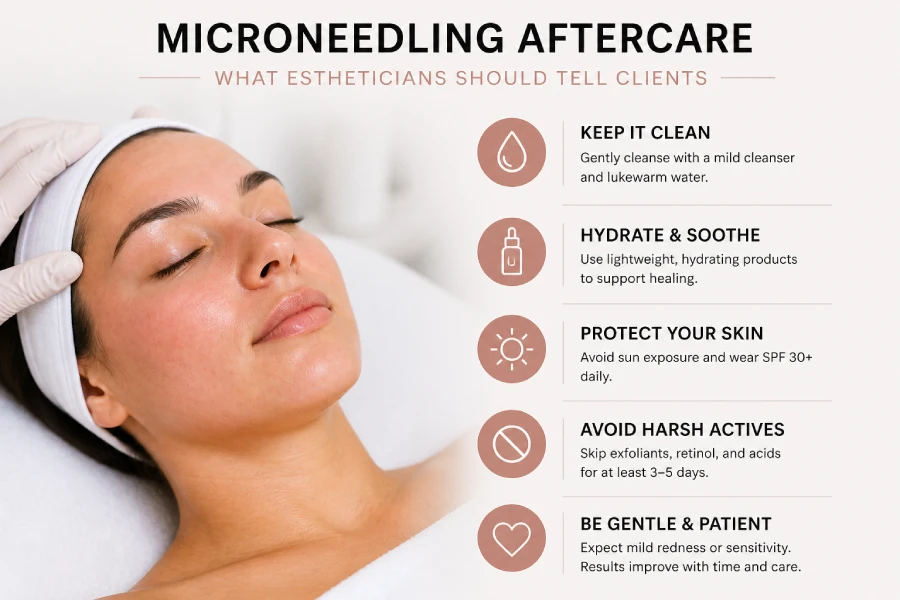
Many estheticians find it useful to provide a simple written aftercare card that clients can take home. This serves a dual purpose: it gives the client a reference during recovery and it positions the esthetician as a thorough, trustworthy professional. A card that includes a day-by-day brief, a short list of what to avoid, and a note on when to expect results addresses the most common sources of post-treatment client anxiety in a single handout.
Post-Treatment: Reinforcing the Protocol at Checkout
The post-treatment verbal summary at checkout should cover four points: what the client can expect their skin to look and feel like over the next 7 days, what products they should and should not use during that period, what environmental exposures to avoid, and when to expect visible results. This conversation should take no more than 3 to 4 minutes but has a disproportionate impact on client compliance and satisfaction. Clients who receive a clear verbal summary at checkout are significantly less likely to use inappropriate products during recovery or to contact the clinic with worried questions in the days following treatment.
Follow-Up: The 48-Hour Check-In
A brief follow-up message 48 hours post-treatment — even a simple automated text or email asking how the client’s skin is doing — reinforces the clinical care relationship and provides an opportunity to address any concerns before they become problems. Estheticians who build a 48-hour check-in into their microneedling service workflow consistently report higher client satisfaction scores and better series retention rates. This is a low-cost, high-impact professional habit.
Professional and Scientific References
The recovery timeline data and wound healing mechanisms described in this article are supported by peer-reviewed research in dermatology and wound biology, as well as established esthetic practice guidelines.
- Aust, M. C., et al. (2008). “Percutaneous collagen induction therapy: An alternative treatment for scars, wrinkles, and skin laxity.” Plastic and Reconstructive Surgery, 121(4):1421–1429. Foundational study on the collagen induction cascade and healing timelines following controlled dermal micro-injury.
- Alster, T. S., & Graham, P. M. (2018). “Microneedling: A review and practical guide.” Dermatologic Surgery, 44(3):397–404. Comprehensive review of microneedling outcomes, depth variables, and post-treatment management protocols.
- Camirand, A., & Doucet, J. (1997). “Needle dermabrasion.” Aesthetic Plastic Surgery, 21(1):48–51. Early clinical observation data on epidermal healing rates following controlled needle trauma at varying depths.
- Setterfield, L. (2013). The Concise Guide to Dermal Needling, 3rd edition. Acacia Dermacare. Comprehensive clinical reference on microneedling protocols, recovery phases, and aftercare strategy used in professional esthetic training.
- Bhatt, V. R., & Mounessa, J. S. (2022). “Post-inflammatory hyperpigmentation risk following microneedling across Fitzpatrick skin types.” Journal of Cosmetic Dermatology, 21(4):1452–1459. Clinical evidence on Fitzpatrick-specific recovery considerations and PIH risk management.
The critical variable that most estheticians underestimate in microneedling recovery is the first 30 minutes after the final treatment pass. This is when transepidermal water loss is at its peak and the micro-channels are most available for ingredient delivery. The Poly-Luronic™ Jelly Mask is designed specifically to exploit this window: its alginate matrix delivers true occlusion that a serum or moisturiser cannot replicate, while the polyglutamic acid and hyaluronic acid complex provides dual-depth humectant hydration at the moment skin is most receptive. For estheticians who are serious about optimising microneedling recovery timelines and reducing the duration and intensity of post-treatment erythema, applying this mask on-table as the final step of every microneedling protocol addresses the most high-impact gap in standard post-treatment care.
Explore the Poly-Luronic™ Jelly Mask LineFrequently Asked Questions: Microneedling Recovery Timelines
How long does microneedling recovery actually take?
Most clients recover from microneedling within 3 to 5 days for surface-level redness and sensitivity, though the deeper collagen remodelling process continues for 4 to 6 weeks after treatment. The visible recovery phase—during which clients may notice pinkness, tightness, or mild flaking—is typically complete within one week at standard esthetician-scope needle depths of 0.25 to 0.5 mm. Deeper needle depths used in medical settings can extend visible recovery to 7 to 10 days. Estheticians should communicate both the short surface timeline and the longer biological remodelling window so clients understand when to expect visible results.
What does skin look like on day 1 after microneedling?
On day 1 after microneedling, clients typically present with uniform erythema (redness) that resembles a moderate sunburn, along with mild swelling and a sensation of heat or tightness in the treated area. Pinpoint micro-channel marks may be faintly visible on closer inspection, particularly at higher needle depths. The skin will feel sensitive to the touch and may feel dry or tight as the epidermal channels begin to close. Serious adverse events such as significant bruising, pustules, or open lesions are not expected outcomes of correctly performed treatments and warrant follow-up.
Why does skin peel after microneedling and is that normal?
Mild peeling or flaking between days 2 and 5 is a normal part of microneedling recovery and reflects the accelerated epidermal renewal triggered by the treatment. When micro-channels are created in the epidermis, the skin’s natural healing cascade increases cellular turnover in the outer layers, shedding older corneocytes faster than usual. This is distinct from the aggressive peeling seen after chemical exfoliation—microneedling flaking is typically subtle and occurs in fine sheets rather than large patches. Clients should be advised not to pick at flaking skin, as this disrupts the new epidermal layer forming underneath.
Does needle depth affect how long microneedling recovery takes?
Yes, needle depth is one of the most significant variables affecting recovery duration. At 0.25 mm (a depth appropriate for product infusion and superficial stimulation), most clients see redness resolve within 12 to 24 hours. At 0.5 mm, redness typically persists 24 to 48 hours. At depths approaching 1.0 mm and above, which are generally outside esthetician scope and require medical supervision, visible recovery may extend 5 to 7 days or longer. Estheticians operating within their scope should set client expectations based on the specific depth used in each treatment session.
When can clients wear makeup after microneedling?
Most clients can safely return to mineral-based makeup at 24 to 48 hours post-treatment, once the surface micro-channels have closed and active redness has significantly reduced. Full makeup including liquid foundation should typically wait until 48 to 72 hours to avoid introducing occlusive or potentially irritating ingredients into recently treated skin. Estheticians should advise clients to avoid makeup with fragrance, alcohol, or heavy pigment during the first 48 hours, and to use clean application tools to minimise bacterial transfer to skin that is still in active recovery.
What slows down microneedling recovery?
Several factors can extend the recovery timeline after microneedling. Inadequate hydration post-treatment is among the most common—when the skin’s water content is low, barrier repair and cellular proliferation are slowed. Sun exposure in the first 48 to 72 hours can worsen redness and increase the risk of post-inflammatory pigmentation, particularly in clients with Fitzpatrick skin types III and above. Using active ingredients such as retinol, AHAs, or vitamin C before the skin has fully closed (typically before 24 to 48 hours) can cause prolonged irritation. Physical pressure, heat, and exercise that increases core body temperature within the first 24 hours can also prolong the inflammatory phase.
How long does the collagen remodelling phase last after microneedling?
The collagen remodelling phase after microneedling extends well beyond the visible recovery window, typically spanning 4 to 6 weeks after a single treatment session. During this phase, fibroblasts in the dermis synthesise new collagen and elastin in response to the controlled micro-injury created during treatment. Clients may not see peak visible results until 4 to 8 weeks post-treatment, which is an important point to communicate to manage expectations. A series of treatments spaced 4 to 6 weeks apart is typically recommended to layer successive collagen stimulation cycles before the previous one has fully resolved.
Is redness after microneedling the same for all skin types?
No, redness presentation and duration vary by Fitzpatrick skin type, skin sensitivity level, and individual vascular response. Clients with lighter Fitzpatrick types (I and II) often display more pronounced visible erythema that resolves relatively quickly. Clients with darker Fitzpatrick types (III through VI) may show less visible redness but carry a higher risk of post-inflammatory hyperpigmentation if treatment protocols are not appropriately adjusted. For rosacea-prone or chronically sensitised skin, baseline vascular reactivity means erythema can persist longer and the treatment protocol should be modified accordingly. Estheticians should always conduct a thorough skin assessment before treatment and adjust depth and pass number based on individual skin presentation.
How does the Poly-Luronic™ Jelly Mask support microneedling recovery?
The Poly-Luronic™ Jelly Mask is specifically formulated to support post-microneedling recovery by combining occlusive barrier support with deep humectant hydration. After microneedling, the skin’s barrier is temporarily compromised and transepidermal water loss increases significantly, which slows healing if not addressed. The jelly mask’s alginate-based occlusive structure reduces TEWL while its polyglutamic acid and hyaluronic acid complex delivers hydration to both the surface and deeper epidermal layers. Applied immediately post-treatment, the cooling effect of the set mask also helps calm the acute inflammatory response, reducing redness duration and improving client comfort during the first critical hours of recovery.
Recovery Is a Clinical Outcome — Manage It With the Same Precision as the Treatment Itself
Microneedling recovery is not a passive process that simply unfolds on its own. It is a clinically manageable biological sequence with predictable stages and specific intervention windows. Estheticians who understand the two-phase recovery model, who know how needle depth and skin type affect the timeline, and who apply well-timed post-treatment protocols will consistently produce better outcomes — not just faster surface recovery, but deeper and more durable collagen results — than those who treat recovery as an afterthought.
The practical takeaway is straightforward: address the barrier immediately, communicate timelines clearly and in advance, and give clients the specific tools and instructions they need to manage the first 48 to 72 hours well. These habits require minimal additional time in a session but have a disproportionate impact on client satisfaction, complication rates, and treatment series retention. Recovery management is where clinical excellence and client loyalty intersect.
For further professional education on the evidence behind each phase of the healing process and the serums and protocols best suited to each window, continue with the related articles in this cluster and the broader Microneedling Collagen Induction Therapy guide.