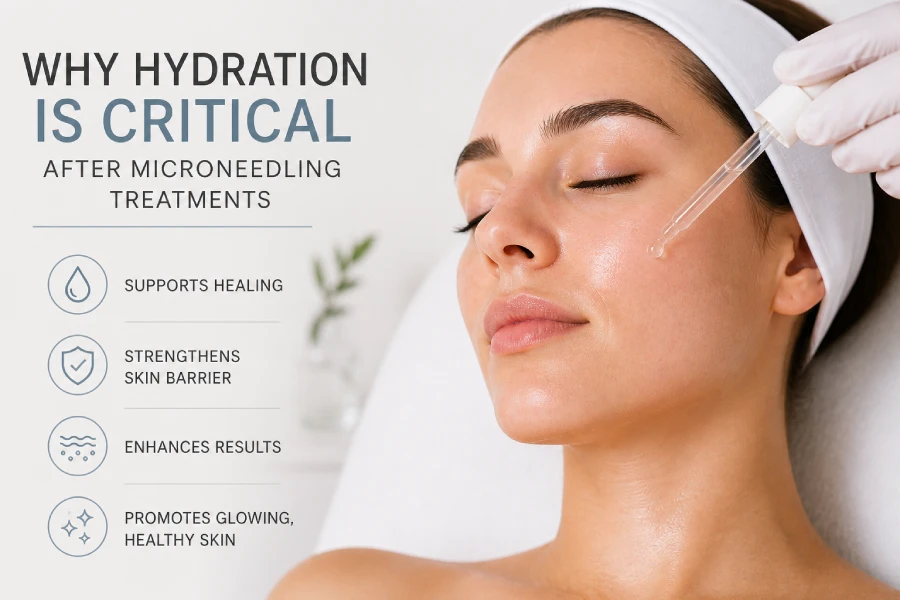
Why Is Hydration So Important After Microneedling?
Microneedling creates thousands of controlled microchannels through the stratum corneum, which temporarily eliminates the skin’s primary defence against water loss. In the hours immediately following treatment, transepidermal water loss (TEWL) spikes dramatically, leaving the skin acutely dehydrated and vulnerable to inflammation, delayed healing, and compromised collagen induction outcomes. Applying occlusive and humectant-based hydration at the treatment table is a clinical necessity, not an optional comfort step.
- Microneedling breaches the stratum corneum, causing TEWL to elevate significantly for 24 to 72 hours post-treatment.
- Dehydrated post-needling skin experiences prolonged inflammation, increased redness duration, and reduced fibroblast efficiency.
- Occlusive masks applied immediately after needling physically seal the surface and dramatically slow water vapour loss.
- Humectant actives such as hyaluronic acid and polyglutamic acid draw moisture into the disrupted epidermis while the barrier is still permeable.
- Fibroblast activity and collagen synthesis—the core goals of microneedling—require a hydrated extracellular environment to function optimally.
- The at-home hydration protocol clients follow for the first 72 hours is as clinically important as in-clinic treatment-table hydration.
Of all the variables that influence microneedling outcomes, post-treatment hydration is among the most actionable and most frequently underestimated. The controlled injury that microneedling creates is precisely calibrated to initiate a wound-healing cascade that ultimately produces collagen and elastin remodelling. But that cascade does not unfold in a vacuum—it depends entirely on an adequately hydrated tissue environment in the hours and days that follow the needling session. When that environment is compromised by TEWL-driven dehydration, the remodelling response weakens, the inflammatory phase extends, and the client experiences a more uncomfortable recovery than necessary.
Estheticians who understand the physiology of post-needling dehydration are better positioned to design recovery protocols that protect their clients’ results, reduce adverse experiences, and distinguish their services in a competitive market. The distinction between an esthetician who finishes a microneedling session and an esthetician who finishes a microneedling session with a structured, evidence-informed hydration protocol is visible in client outcomes—and in client retention rates.
This article covers the specific mechanisms by which microneedling elevates TEWL, the downstream effects of inadequate hydration on collagen induction, and the clinical principles that govern effective post-needling hydration protocols in professional settings.
What Every Esthetician Should Know About Post-Microneedling Hydration
- TEWL elevation after microneedling is not a minor side effect—it is a predictable physiological consequence that requires active clinical management at every session.
- The first 6 to 12 hours post-treatment represent the highest-risk window for moisture loss; in-clinic occlusive mask application addresses this window directly.
- Fibroblasts—the cells responsible for collagen synthesis—function less efficiently in dehydrated tissue, meaning inadequate hydration directly undermines the purpose of the treatment.
- Only fragrance-free, alcohol-free, and active-free formulations should be applied immediately post-needling; the open microchannels make the skin acutely reactive to potential irritants.
- Occlusive mask formats outperform standard moisturisers in the immediate post-needling phase because they create a physical water-vapour barrier rather than relying solely on humectant retention.
- Client education on home hydration for the 72 hours post-treatment is a clinical responsibility, not an optional aftercare suggestion.
- Deeper needle depths and higher pass counts require more aggressive and sustained hydration intervention both at the table and in the at-home protocol.
What Microneedling Does to the Skin’s Water Barrier
The stratum corneum—the outermost layer of the epidermis—functions as the body’s primary seal against environmental intrusion and transepidermal water loss. Its integrity depends on two interrelated systems: the structural lipid matrix (composed of ceramides, cholesterol, and fatty acids) and the natural moisturising factor (NMF) complex embedded within the corneocytes. Together, these systems maintain a TEWL rate low enough that healthy skin loses only modest amounts of moisture under normal conditions.
Microneedling deliberately punctures this barrier across the treatment zone, creating between 150,000 and 200,000 microchannels per square centimetre at typical professional treatment settings. Each channel represents a gap in the lipid matrix seal—a direct path for water vapour to escape from the deeper, hydrated layers of the dermis and epidermis to the ambient air. The result is a rapid and significant increase in TEWL that begins within minutes of treatment and persists until the stratum corneum physically re-seals those channels, a process that takes between 24 and 72 hours depending on depth and individual barrier health.
How Needle Depth Affects TEWL Severity
The relationship between needle depth and TEWL elevation is approximately linear within the depths available to estheticians. At shallow depths of 0.25 to 0.5 mm, the stratum corneum and upper epidermis are disrupted but the barrier typically re-establishes relatively quickly. At depths of 0.75 to 1.0 mm—the range most commonly used in professional esthetic practice—TEWL elevation is more pronounced and the recovery window is meaningfully longer. Estheticians must adjust their hydration protocol intensity to reflect the depth and number of passes performed in each session.
The Science of TEWL and Its Effect on Collagen Induction
The relationship between post-microneedling hydration and collagen induction outcomes is not merely about client comfort—it is mechanistic. The wound-healing cascade that microneedling triggers passes through three overlapping phases: inflammation, proliferation, and remodelling. Each phase depends on adequate tissue hydration to progress efficiently. When dehydration is allowed to persist unchecked, the inflammatory phase is prolonged, the proliferation phase is delayed, and fibroblast activity during remodelling is impaired.
Fibroblast Function and the Hydration Dependency
Fibroblasts are the primary cell type responsible for synthesising new collagen, elastin, and hyaluronic acid during the proliferation phase of wound healing. Research in dermal wound biology consistently shows that fibroblast migration, proliferation, and secretory activity are all significantly reduced in a dehydrated extracellular matrix. The dermis is approximately 70% water by weight, and the proteoglycan network that supports fibroblast function requires adequate hydration to maintain the structural architecture that enables cell movement and signalling. When post-needling TEWL draws water out of the dermal layers, this support environment is compromised precisely at the moment fibroblast activity needs to be highest.
What Happens Inside the Skin in the First 12 Hours After Microneedling
Microneedling creates microchannels 4 to 8 times the diameter of a hair follicle across the entire treatment zone. In the first 60 minutes post-treatment, these channels remain maximally open, creating a direct water-vapour escape route from the dermis to the surface. TEWL in this window can be up to 3 to 5 times higher than baseline in treated zones.
As the channels begin to close over the following 6 to 12 hours, TEWL gradually returns toward baseline—but complete stratum corneum reformation takes 24 to 72 hours. During this entire window, the skin’s natural NMF reserves are being depleted faster than they can be replenished through normal metabolic processes. This is why a single mask application at the treatment table, while essential, is not sufficient on its own—clients need a continuation protocol at home.
The practical implication is that the in-clinic occlusive mask step addresses the acute TEWL peak, while the at-home hydration products the client applies that evening and the following morning address the sustained elevated-loss phase during which barrier reformation is still incomplete.
Occlusive Hydration Protocols in Professional Microneedling Practice
The clinical rationale for occlusive mask application immediately after microneedling rests on a straightforward principle: when the skin’s natural TEWL barrier has been intentionally disrupted, an external physical barrier must replace it during the recovery window. Occlusive masks—particularly those with a rubber or jelly-setting base—create a water-vapour-resistant film over the skin surface that directly reduces the TEWL rate during the 15 to 20 minutes they remain in place. This window, while short, covers the most acute phase of post-treatment water loss and provides the tissue environment that humectant actives need to hydrate the epidermis effectively.
Timing Is as Important as Product Choice
The clinical effectiveness of a post-microneedling recovery mask is significantly influenced by when it is applied. Estheticians who apply the mask within 2 to 3 minutes of completing the final needling pass are capturing the window of maximum channel patency—meaning the humectant actives in the mask formula have direct access to the living epidermis through open channels that have not yet begun the initial inflammatory sealing process. Waiting 10 to 15 minutes before applying the mask reduces this penetration advantage substantially and addresses a lower overall TEWL peak. The operational protocol should include the mask as the very next step after the needling pass is complete, with no intervening product applications other than a fragrance-free hydration serum if the protocol design requires it.
Estheticians who integrate Poly-Luronic™ Jelly Mask into their microneedling protocol describe a consistently different immediate client experience compared to treatments that finish with only a bland moisturiser. The practical workflow is straightforward: as soon as the final needling pass is complete, a thin hyaluronic acid serum is pressed gently into the skin without rubbing, and then the jelly mask is mixed at a 2.5:1 water-to-powder ratio and applied evenly across the face using a spatula. The mask sets firm in approximately 4 to 6 minutes. During that setting window, clients reliably describe the cooling sensation as the most immediate relief they feel after the treatment—a response estheticians cannot replicate using a standard moisturiser or sheet mask, which do not create the same thermal draw from the setting reaction. The peel-off removal also avoids any mechanical friction on the freshly needled skin, which is a practical advantage that standard washable masks do not offer in this context.
Six Principles for Designing a Post-Microneedling Hydration Protocol
A well-constructed post-microneedling hydration protocol is built on consistent principles that apply regardless of the specific products used. Estheticians who understand these principles can evaluate any product or protocol framework against a reliable clinical standard and make informed decisions for their specific practice context.
Immediate Application at the Treatment Table
The recovery mask must be applied within 2 to 3 minutes of the final needling pass to capture maximum channel patency. Any delay reduces both humectant penetration depth and the TEWL reduction benefit of the occlusive setting phase. Build this step directly into the treatment workflow timing so it requires no separate preparation period.
Occlusive Format Over Standard Moisturiser
A setting mask format—alginate-based or rubber mask—creates a physical water-vapour barrier that a standard cream or lotion cannot replicate. In the acute TEWL window, the skin needs a surface seal, not just humectant attraction. Reserve cream moisturisers for the at-home phase once the initial sealing step has been performed in-clinic.
Ingredient Safety Window: Actives Excluded
Only fragrance-free, alcohol-free formulations containing humectants and barrier-supportive ingredients should be used in the immediate post-needling window. Vitamins C, retinoids, AHAs, BHAs, and any active exfoliant must be withheld for a minimum of 72 hours. The open microchannels allow significantly deeper ingredient penetration, which transforms normally safe actives into potential irritants at this stage.
Layer Humectants Under the Occlusive Seal
Apply a humectant serum—hyaluronic acid or polyglutamic acid—before the setting mask, not after. The mask then seals the humectant layer in place, preventing it from evaporating while the channels are still open. This two-step approach maximises moisture delivery into the disrupted epidermis during the highest-absorption window available in any treatment.
Calibrate Protocol Intensity to Treatment Depth
Shallow needling depths (0.25 to 0.5 mm) require the same immediate table-side hydration steps but allow a lighter at-home continuation protocol. Deeper depths (0.75 to 1.0 mm) and multi-pass treatments require more intensive at-home occlusive coverage in the first evening, with heavier balm or cream formats replacing lighter moisturisers until the 48-hour barrier reformation window has passed.
Client Education Is a Clinical Responsibility
The at-home hydration steps clients perform in the 12 to 72 hours after treatment are as clinically important as the in-clinic mask step. Estheticians must send clients home with a written protocol, not just verbal instructions, specifying exactly which products to use, in what order, and at what times. Client compliance with this protocol directly influences the quality of the collagen induction response they will see from the treatment.
At-Home Hydration After Microneedling: The 72-Hour Recovery Window
The in-clinic recovery mask step is the first and most important intervention in a post-microneedling hydration strategy, but it addresses only the first 15 to 20 minutes of an elevated-TEWL window that lasts for up to three days. The quality of the at-home hydration protocol clients follow after leaving the treatment room is a direct determinant of how well the skin barrier re-establishes and how effectively the collagen induction response proceeds.
Estheticians who treat this as a clinical handoff rather than a retail suggestion see measurably better client outcomes and significantly higher protocol compliance. The key to compliance is clarity: clients need specific, simple, written instructions that tell them exactly what to apply, in what order, and when—not a general recommendation to “keep the skin hydrated.”
The Evening of Treatment: Maximum Occlusive Support
On the evening following a microneedling session, the skin barrier is still in its most vulnerable state. The microchannels are partially sealed but not fully reformed, and the inflammatory phase of wound healing is at its most active. Clients should apply a fragrance-free hyaluronic acid serum while the skin is still slightly damp after gentle cleansing, followed immediately by a bland occlusive balm or a heavier-weight ceramide cream to lock the serum in place. This heavier coverage on the first evening is not optional—it addresses the sustained TEWL elevation that continues after the channels begin to close but before the lipid matrix fully re-establishes.
Days 2 and 3: Transition to Normal Hydration Routine
By the morning of day two, most clients will notice that the initial redness and tightness have reduced significantly. The barrier is re-establishing, but it is not yet at full integrity. Clients should continue applying a hyaluronic acid serum morning and evening, followed by a moderate-weight moisturiser. Mineral sunscreen is essential during daylight hours on days two and three, as the newly forming epidermis is more vulnerable to UV-induced damage than normal skin. No active ingredients—retinoids, vitamin C, acids—should be reintroduced until at least the 72-hour mark, and ideally not until day four or five in clients with more sensitive or reactive skin.
Professional and Scientific References
The clinical principles in this article are informed by peer-reviewed research in dermal wound healing physiology, transepidermal water loss measurement, and microneedling outcomes literature, as well as professional esthetic practice observations.
- Setterfield, L. The Concise Guide to Dermal Needling. Acacia Dermacare, 2013. Foundational professional reference on microneedling mechanism and barrier disruption.
- Fluhr, J.W. et al. “Skin Barrier Function.” Current Problems in Dermatology, 2011. Establishes TEWL measurement standards and barrier disruption physiology.
- Darlenski, R. & Fluhr, J.W. “Influence of skin type, race, sex, and anatomic region on epidermal barrier function.” Clinics in Dermatology, 2012. Contextualises TEWL variation and barrier recovery rates.
- Pinnell, S.R. et al. “Fibroblast function in the wound healing extracellular matrix.” Journal of Investigative Dermatology, 2003 (series). Establishes fibroblast hydration dependency in the proliferation phase.
- Aust, M.C. et al. “Percutaneous collagen induction: minimally invasive skin rejuvenation without risk of hyperpigmentation.” Plastic and Reconstructive Surgery, 2008. Clinical outcomes reference for microneedling collagen induction protocols.
For estheticians building a post-microneedling recovery protocol that meets the clinical standard described in this article, the recovery mask chosen must simultaneously deliver humectant actives while the microchannels are still open and create a physical occlusive seal that addresses the acute TEWL peak. Poly-Luronic™ Jelly Mask satisfies both requirements in a single application step: its alginate-based setting structure creates the surface seal, while the polyglutamic acid and hyaluronic acid complex provides dual-depth humectant delivery during the setting window. The peel-off removal format is also a practical advantage in the post-needling context, eliminating the mechanical friction of a rinse-off formula on freshly treated skin. For estheticians who need a mask that performs a specific clinical function—not simply a luxury add-on—this formulation is the appropriate choice for the immediate post-microneedling step.
Explore the Poly-Luronic™ Jelly Mask LineFrequently Asked Questions: Post-Microneedling Hydration
Why does skin get so dehydrated after microneedling?
Microneedling creates thousands of microchannels through the stratum corneum, temporarily disrupting the skin’s primary barrier against water loss. This breach causes transepidermal water loss (TEWL) to spike dramatically in the hours immediately following treatment, leaving the skin in a state of acute dehydration that can persist for 24 to 72 hours if not actively managed with occlusive and humectant-based hydration protocols.
How long does TEWL stay elevated after a microneedling session?
Transepidermal water loss typically remains elevated for 24 to 72 hours post-treatment, with the peak occurring in the first 6 to 12 hours. The duration and severity depend on needle depth, the number of passes performed, and the speed of individual barrier recovery. Deeper needle depths (above 1.0 mm) and multiple passes over the same zones consistently produce longer-lasting TEWL elevation, which is why estheticians who perform more aggressive protocols prioritise immediate occlusive intervention at the treatment table.
Does skipping hydration after microneedling slow down results?
Yes, inadequate post-needling hydration can directly compromise collagen induction outcomes. Fibroblast activity, which drives the collagen synthesis response triggered by microneedling, is highly dependent on an adequately hydrated extracellular environment. When the skin remains dehydrated post-treatment, cellular signalling efficiency decreases, the inflammatory resolution phase is prolonged, and the quality of the remodelling response is reduced. Estheticians consistently observe that clients who follow a rigorous hydration protocol after each session report better texture improvements over their treatment series than those who do not.
What type of hydration products are safe to apply immediately after microneedling?
Immediately after microneedling, the skin can only safely receive fragrance-free, alcohol-free, and preservative-minimal formulations that do not contain active exfoliants, retinoids, vitamin C, or acids of any kind. The most appropriate immediate-phase products are humectant serums containing hyaluronic acid or polyglutamic acid, followed by an occlusive mask to seal in hydration and prevent further TEWL. Products with irritant potential must be withheld for a minimum of 72 hours while the epidermal barrier re-establishes.
Can dehydration after microneedling make redness and irritation worse?
Yes, dehydration and post-treatment inflammation are closely linked. When the skin barrier is breached and moisture is not replaced, the inflammatory response intensifies and resolves more slowly. Clinical observations in professional settings confirm that clients who receive immediate post-needling hydration treatment, including an occlusive mask application at the treatment table, consistently show less pronounced redness 24 hours later compared to those who leave without any recovery mask step.
Why does an occlusive mask work better than a regular moisturiser after microneedling?
An occlusive mask works better because it forms a physical seal over the skin surface that dramatically slows TEWL, whereas a standard moisturiser relies primarily on humectant attraction of water without providing the same degree of surface occlusion. After microneedling, the barrier is too compromised to retain humectant-bound water without an overlying seal. Occlusive formats, particularly rubber-setting jelly masks, also deliver a sustained cooling effect that directly reduces the thermal energy and erythema associated with the treatment, creating a dual benefit that standard moisturisers cannot replicate.
How many hours after microneedling should a client apply their home hydration products?
Clients should begin their at-home hydration protocol as soon as the in-clinic mask step is removed, typically within 2 to 4 hours of treatment. The window between mask removal and the client reaching home is one of the highest-risk periods for TEWL escalation, which is why estheticians should send clients home with a simple two-step protocol: a fragrance-free hyaluronic acid serum followed immediately by a simple occlusive balm or bland moisturiser. Evening applications on the treatment day should favour heavier occlusives to protect the barrier through overnight repair processes.
Is hydration less important after shallow microneedling depths compared to deeper ones?
Hydration remains critical even at shallow needle depths, though the urgency and volume of immediate intervention is proportionally lower. Even at 0.25 mm to 0.5 mm depths, microneedling disrupts the stratum corneum sufficiently to elevate TEWL above baseline. At these depths, the barrier typically re-establishes within 12 to 24 hours, but that window still represents a significant risk period for dehydration-driven irritation and prolonged redness if occlusive support is not provided immediately.
How does the Poly-Luronic™ Jelly Mask support post-microneedling hydration in a professional protocol?
The Poly-Luronic™ Jelly Mask is formulated specifically to address the dual challenge of immediate TEWL control and humectant delivery that microneedled skin requires. Its alginate-based setting structure creates a firm occlusive seal over the treated surface, physically slowing water vapour loss while the polyglutamic acid and hyaluronic acid actives bind and deliver moisture into the disrupted epidermis. Estheticians using it in post-microneedling protocols apply it immediately after the needling pass, allowing it to set for 15 to 20 minutes before peeling it off in one piece. The cooling effect of the setting reaction also provides measurable thermal relief that clients consistently describe as one of the most soothing parts of the treatment experience.
Hydration Is Where Microneedling Results Are Protected or Lost
The decision to perform microneedling is a decision to intentionally disrupt the skin’s barrier in order to provoke a healing response that produces collagen and elastin remodelling. That response is a biological process, and like all biological processes, it unfolds optimally only when the tissue environment supports it. The most direct way estheticians can support that environment is through rigorous, timed, and appropriately formulated hydration intervention in the 72 hours that follow each treatment session.
Estheticians who treat post-needling hydration as a clinical protocol step—with the same precision they bring to needle depth selection and pass count decisions—will consistently deliver better client outcomes than those who treat it as an afterthought. The in-clinic recovery mask step, the at-home product handoff, and the client education conversation are all parts of the same clinical commitment to protecting the investment the client has made in the treatment series.
For continued professional development on microneedling protocols and recovery science, explore the related articles in this guide series linked below.