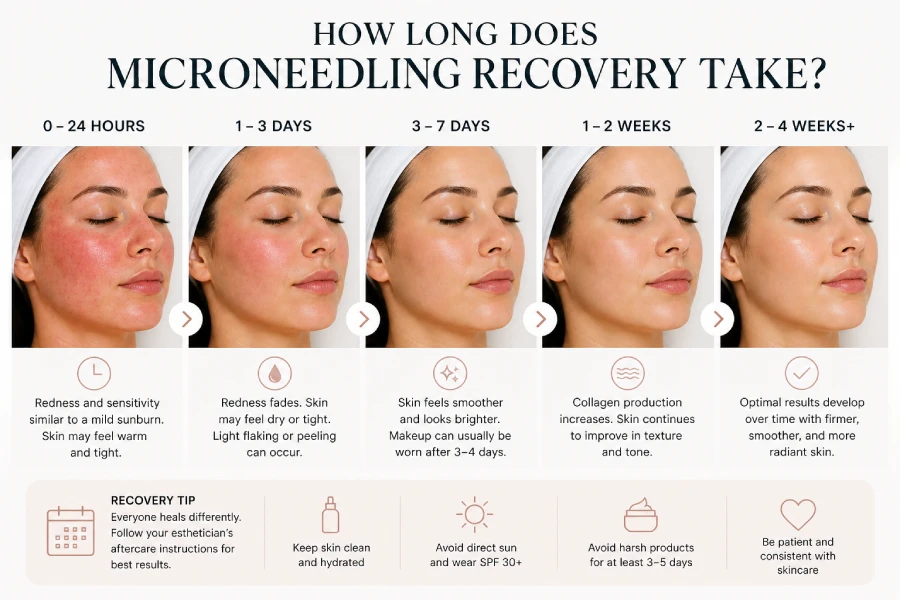
What Should Clients Avoid After Microneedling?
After microneedling, clients must avoid a specific set of products, activities, and environmental exposures during the healing window to protect newly formed microchannels, prevent infection, and allow the collagen induction process to proceed without interruption. The avoidance list is more extensive than most clients anticipate, and estheticians who provide clear, category-by-category guidance at the end of each appointment consistently see better outcomes and fewer post-treatment complications.
- All makeup should be avoided for a minimum of 24–48 hours; the open microchannels make the dermis directly accessible to pigments, preservatives, and sensitising compounds.
- Active ingredients including retinoids, AHAs, BHAs, and vitamin C must be paused for five to seven days to prevent abnormal penetration depth and barrier disruption.
- Direct sun exposure and tanning beds should be avoided for 72 hours minimum, with a full week of caution recommended for deeper treatments.
- Exercise that produces heavy sweating or significantly raises core body temperature should be deferred for 24–48 hours to prevent bacterial contamination and vascular flare.
- Swimming in chlorinated pools, oceans, hot tubs, or any body of water should be avoided for 72 hours to five days depending on treatment depth.
- Fragranced skincare products, essential oils, and alcohol-based toners are contraindicated for five to seven days due to heightened sensitisation risk through impaired barrier.
- Clients should avoid touching their face unnecessarily during the first 24 hours and must not pick or peel flaking skin during the shedding phase on days two through four.
The quality of a microneedling outcome is determined not only by what happens during the treatment but by what the client does—and does not do—in the days that follow. Microneedling creates a controlled array of microchannels through the stratum corneum and into the dermis, triggering a wound response that activates fibroblast activity, growth factor release, and new collagen synthesis. That same open-channel state that makes post-treatment serums so effective at penetrating the skin also makes the tissue temporarily vulnerable to contamination, chemical insult, and environmental stress.
Estheticians occupy a critical position in this recovery process. The clinical decisions made at the end of the appointment—which recovery products are applied in-clinic, which verbal instructions are given, which written materials are provided—directly determine the integrity of the healing window. A client who walks out without clearly understanding what to avoid in the next 24 to 72 hours is a client at significant risk of a preventable complication that will be attributed to the treatment itself.
This article provides a complete, category-organised reference for every avoidance protocol that applies to standard microneedling treatments, with evidence-grounded timelines for each restriction and the physiological reasoning behind them. Use it as a training resource, a basis for client education materials, or a protocol review tool for your practice.
What Every Esthetician Should Know About Post-Microneedling Avoidance
- The avoidance window is not arbitrary—it maps directly to the timeline of epidermal barrier resealing and dermal wound remodelling.
- Active ingredients that are safe and beneficial under normal conditions can become significant irritants when applied to skin with open microchannels.
- Makeup avoidance for 24–48 hours is one of the most frequently violated aftercare instructions; clients need specific, clear language to understand why it matters.
- Heat exposure from exercise, saunas, steam rooms, and hot showers prolongs redness and creates conditions that favour bacterial proliferation in microchannels.
- Fragranced products and essential oils carry sensitisation risk that is disproportionately elevated in the post-microneedling window due to impaired barrier function.
- Client compliance with avoidance instructions is directly correlated with the quality and speed of visible results; education investment translates to outcome investment.
- Written aftercare documentation reduces liability, improves client compliance, and provides a professional reference the client can consult at home.
Why the Post-Microneedling Window Requires Specific Restrictions
To understand why post-microneedling avoidance protocols are as detailed as they are, it is necessary to understand what the skin looks like structurally in the hours immediately following treatment. During a standard microneedling session, the device creates between 150 and 300 microchannels per square centimetre of treated skin, depending on the device type, needle configuration, and number of passes performed. Each of those channels penetrates the stratum corneum and epidermis, reaching the upper dermis where fibroblasts, immune cells, and blood vessels are located.
In the immediate post-treatment window—defined as the first four to six hours—these channels are physically open and functionally behave as direct conduits between the skin surface and the living dermis. Any substance applied to the surface during this window has dramatically elevated dermal bioavailability. This is clinically advantageous for precisely chosen recovery serums applied in-clinic under esthetician supervision. It is clinically problematic for the wide range of products, organisms, and environmental irritants the client may encounter once they leave the treatment room.
How Long Does the Vulnerable Window Last?
Surface-level microchannels begin resealing within four to six hours of treatment, and the majority of epidermal continuity is restored within 24 hours for standard 0.25–0.5 mm treatments. Deeper treatments—0.5 to 1.5 mm—extend the meaningful vulnerability window to 48 hours or beyond. However, the deeper dermal remodelling process that produces the treatment’s clinical benefits continues for four to six weeks, during which time the skin remains more reactive to certain ingredient categories than it would be in a baseline state. This is why some avoidance recommendations—particularly for retinoids and strong exfoliating acids—extend beyond the first 24–48 hours.
The Physiological Basis for Each Avoidance Category
Every item on a post-microneedling avoidance list can be traced to one or more specific physiological mechanisms. Understanding those mechanisms allows estheticians to communicate the reasoning to clients in a way that builds compliance rather than simply demanding it. Clients who understand why a restriction exists are far more likely to follow it than clients who receive a list of prohibitions without explanation.
Barrier Disruption and Abnormal Ingredient Penetration
Under normal barrier conditions, the stratum corneum limits the dermal penetration of most topically applied ingredients. Molecular weight, charge, lipid solubility, and formulation all influence how deeply a compound travels. After microneedling, this regulatory function is temporarily bypassed for the channels themselves. An ingredient that would normally remain at the surface or upper epidermis can reach immune-cell-dense dermal layers at concentrations far exceeding its intended therapeutic dose. Retinoids, alpha hydroxy acids, benzoyl peroxide, and vitamin C at low pH are all examples of ingredients where this concentration elevation can trigger inflammation, sensitisation, or barrier-disrupting effects that significantly set back the healing timeline.
The Four-Phase Healing Cascade After Microneedling
Microneedling initiates a structured wound healing response that proceeds in four overlapping phases. Phase 1 (Haemostasis, 0–4 hours): platelets aggregate at channel sites, forming provisional fibrin clots and releasing platelet-derived growth factor (PDGF) and transforming growth factor beta (TGF-β). Phase 2 (Inflammation, 4 hours–72 hours): neutrophils and macrophages clear cellular debris while releasing cytokines that recruit fibroblasts. This phase produces the visible redness and warmth clients experience. Phase 3 (Proliferation, 3 days–3 weeks): fibroblasts synthesise new collagen type III, followed by type I remodelling. Epidermal keratinocytes migrate to restore surface continuity. Phase 4 (Remodelling, 3 weeks–6 months): collagen fibres reorganise and mature, producing the progressive improvement in skin texture and density that clients observe over months rather than days.
Avoidance protocols map to these phases: makeup and heat restrictions are most critical during phases 1 and 2; active ingredient restrictions remain relevant through phase 3 when barrier integrity is still below baseline; sun protection and pigmentation management remain priorities through phase 4.
Post-Microneedling Avoidance Timeline by Category
The following reference framework organises every major avoidance category alongside its recommended restriction window, the primary risk it prevents, and the clinical reasoning. Use this as the basis for your client-facing aftercare documentation.
The Most Frequently Violated Restriction: Makeup Within 24 Hours
In practice, the restriction most commonly broken is also one of the most clinically significant: applying foundation, concealer, or powder within the first 24 hours. Clients leaving the clinic with visible redness often feel compelled to cover it before returning to work or social environments. Estheticians who proactively discuss this specific scenario at the end of the appointment—acknowledging the social pressure and providing a concrete, acceptable alternative such as a tinted mineral SPF at the 24-hour mark—see substantially better compliance than those who simply list makeup on a prohibited items sheet.
One of the most consistent patterns observed when building post-microneedling recovery protocols is how much the choice of in-clinic recovery mask shapes the client’s experience of the immediate avoidance window. With the Poly-Luronic™ Jelly Mask applied as the final in-clinic step, clients leave the appointment with a hydration layer already established—which substantially reduces the urgency they feel to apply their own products at home during the highest-risk hours. The mask’s cooling gel texture during the 10–15 minute application visibly reduces the immediate post-treatment redness and heat sensation that can alarm first-time clients, and that calming visual cue appears to directly increase their willingness to follow a minimal-product protocol for the first 24 hours. By contrast, clients who leave without any recovery mask often report applying lotion or serum within two hours because their skin “felt tight,” introducing products that may not meet the strict avoidance criteria. Clinics that have shifted to using the Poly-Luronic™ Jelly Mask as a standard post-needling step consistently report fewer calls about unexpected reactions in the 24–48 hour window—an outcome that is difficult to quantify but unmistakable in practice.
Six Common Aftercare Mistakes That Compromise Microneedling Results
Even well-intentioned clients make predictable errors in the post-treatment window. These are the six scenarios estheticians encounter most frequently, along with the clinical consequence and the correction to communicate at the time of instruction.
Applying Usual Serum Routine Too Soon
Clients resume their full serum stack—including vitamin C, niacinamide at high concentrations, or glycolic acid—within 24 hours because their skin “felt fine.” The absence of discomfort does not indicate barrier restoration. Actives applied during days one through four can trigger a delayed inflammatory response that appears on day three or four and is incorrectly attributed to the treatment itself.
Using a Hot Shower on the Evening of Treatment
Hot water on freshly treated skin increases vasodilation, intensifies redness, and raises the risk of contact between shower steam microbes and open microchannels. Clients should use lukewarm water only and avoid direct shower spray on the treated area for the first 24 hours. This instruction is frequently omitted from aftercare sheets and is almost never communicated verbally.
Picking at Flaking Skin on Day 2–3
Surface shedding on days two through four is a normal component of the healing response as the epidermis renews. Clients who pick or peel this tissue are disrupting active keratinocyte migration, which can result in temporary post-inflammatory pigmentation and, in rare cases, superficial scarring. The instruction not to pick must be explicit and accompanied by the explanation that shedding is a sign of the treatment working.
Attending a Heated Yoga Class Within 24 Hours
Clients who exercise regularly often underestimate how significantly heated exercise environments compromise healing. Hot yoga and Bikram-style classes are particularly problematic because they combine elevated ambient heat, heavy perspiration, and shared mat surfaces that harbour significant bacterial loads. The recommendation to avoid strenuous exercise should specifically name common activities clients may assume are too gentle to matter.
Applying a “Natural” Oil or Balm as Moisturiser
Clients who follow clean beauty routines may reach for a natural face oil, plant butter, or essential oil blend to soothe treated skin, assuming that natural ingredients are inherently safe. Essential oils including lavender, tea tree, and citrus extracts carry significant sensitisation risk through an impaired barrier. This specific scenario requires proactive communication because many clients do not consider their natural products to fall under the “active ingredients” restriction.
Skipping SPF on Day 2 and Beyond
The sun avoidance recommendation is frequently interpreted as a 24-hour rule rather than a 72-hour to one-week recommendation. Clients who feel their redness has resolved on day two often consider sun protection no longer necessary. Post-inflammatory hyperpigmentation risk from UV exposure during the active remodelling phase remains elevated for a full week, and broad-spectrum SPF 30 or higher applied gently every morning from day two onward is a clinical requirement, not a preference.
Building a Compliance-Focused Aftercare Delivery System
The clinical value of post-microneedling avoidance protocols is only realised if clients actually follow them. In busy treatment rooms, verbal instructions delivered at the end of a session compete with client fatigue, post-treatment disorientation, and the distraction of getting dressed and checking out. Estheticians who treat aftercare delivery as a distinct, structured component of the service—rather than a brief verbal summary—achieve meaningfully better compliance outcomes.
The Three-Format Instruction Model
The most effective aftercare communication systems use three formats simultaneously. First, a brief in-chair verbal walkthrough at the end of the appointment covers the most critical restrictions—makeup, actives, sun, and exercise—using the plain language rationale for each. Second, a printed or digital aftercare card lists every restriction category with its timeline, formatted clearly enough that clients can scan it in under 90 seconds. Third, a follow-up text or email sent within two to four hours of the appointment provides a digital reference the client can access later in the day when they are considering their evening skincare routine. Practices that implement all three formats report significantly fewer post-treatment questions and complaints than those relying on verbal instruction alone.
Framing Restrictions as Investment Protection
Clients who have invested meaningfully in a microneedling series respond well to aftercare framing that positions the avoidance protocol as protecting that investment. Rather than presenting restrictions as rules to follow, estheticians who frame each guideline as “here is how to protect what we just built” activate a different motivational pathway in the client. This framing is particularly effective for the active ingredient and makeup avoidance windows, where clients most frequently push back. A client who understands that premature retinoid application can trigger inflammation that directly slows collagen synthesis is a client who is motivated to wait the full five to seven days.
Documenting Aftercare Instructions for Liability and Continuity
Written aftercare documentation serves both a clinical and a liability function. When a client experiences an unexpected reaction and contacts the practice, having a documented record that specific instructions were provided—including what to avoid and for how long—is essential for assessing whether the protocol was followed and for responding appropriately. Many practices now include a brief aftercare acknowledgement as part of the pre-treatment consent process, noting that aftercare instructions will be provided and that client compliance is a shared responsibility. This documentation does not diminish the esthetician’s obligation to provide clear guidance, but it does establish a professional record that reflects the quality of care delivered.
Professional and Scientific References
The avoidance timelines and physiological rationale in this article are grounded in clinical dermatology research on wound healing, skin barrier function, and microneedling safety. The following sources establish the evidence base for these protocols.
- Aust, M.C. et al. — Dermatologic Surgery, 2006–2011. Foundational research on collagen induction therapy mechanisms establishing the four-phase wound healing cascade and its clinical significance for post-treatment protocols.
- Alster, T.S. & Graham, P.M. — Dermatologic Surgery, 2018. Clinical review of microneedling safety guidelines with specific discussion of post-procedure precautions and complication prevention strategies.
- Singh, A. & Yadav, S. — Journal of Cutaneous and Aesthetic Surgery, 2016. Analysis of microneedling-related adverse events and the role of aftercare compliance in complication incidence.
- Baumann, L. — Cosmetic Dermatology: Principles and Practice, McGraw-Hill, 2009. Core reference on skin barrier physiology, transepidermal water loss, and the clinical implications of barrier disruption for ingredient penetration.
- Draelos, Z.D. — Dermatologic Therapy, 2012. Research on fragranced ingredient sensitisation, documenting elevated reaction rates when fragrance compounds reach dermal layers through compromised barrier tissue.
The single most clinically consequential decision made at the end of a microneedling session is what recovery product is applied before the client leaves the clinic. That product must meet all avoidance criteria simultaneously: no active exfoliants, no synthetic fragrance, no alcohol, no ingredients contraindicated in post-needling care. Poly-Luronic™ Jelly Mask was formulated against exactly this clinical specification—delivering polyglutamic acid and hyaluronic acid in an alginate occlusive matrix that seals treated skin against transepidermal water loss at the moment the barrier is most compromised. Applying it as the final in-clinic step initiates the hydration recovery phase under controlled conditions, reduces the inflammatory heat response that prompts clients to reach for their own products prematurely, and sends clients home with a visible, tactile indicator that their recovery has already begun. For estheticians building a rigorous microneedling protocol, the recovery mask selection is not an afterthought—it is a clinical decision that directly affects outcomes.
Explore the Poly-Luronic™ Jelly Mask LineFrequently Asked Questions: Post-Microneedling Avoidance
How long should clients avoid wearing makeup after microneedling?
Clients should avoid all makeup for a minimum of 24 hours after microneedling, and ideally 48 hours for treatments performed at depths above 0.5 mm. Immediately after treatment, the microchannels created by the needles remain open, and applying makeup introduces pigments, preservatives, and potential irritants directly into the dermis. Foundation and concealer are the highest-risk products because of their heavy pigment load and occlusive base ingredients. Mineral powder is sometimes cited as a safer option, but even mineral formulas should be deferred for at least 24 hours to allow the epidermal barrier to reseal.
Can clients go in the sun after a microneedling treatment?
Clients should avoid direct sun exposure for a minimum of 72 hours after microneedling, and ideally one week for deeper treatments. Microneedling creates a controlled wound response that temporarily impairs the skin’s natural UV defence capacity, and fresh collagen remodelling tissue is highly vulnerable to UV-induced pigmentation. When sun exposure cannot be avoided, a broad-spectrum mineral SPF 30 or higher applied gently at least 24 hours post-treatment is the minimum standard. Tanning beds should be avoided for the full healing window of 7 to 14 days.
Why do active ingredients like retinol cause problems after microneedling?
Active ingredients such as retinol, AHAs, BHAs, and vitamin C should be avoided for at least five to seven days after microneedling because the compromised barrier allows far deeper penetration than intended. Under normal conditions, the stratum corneum limits how far these ingredients travel. After microneedling, microchannels bypass this barrier entirely, enabling acidic or cell-turnover-accelerating compounds to reach the dermis at concentrations that can cause significant irritation, inflammation, and even chemical sensitisation. The same dose that is therapeutic at the surface can become problematic at deeper skin layers.
Is it safe to exercise after microneedling?
Clients should avoid vigorous exercise for 24 to 48 hours after microneedling. Exercise raises core body temperature and increases perspiration, both of which can introduce bacteria into open microchannels and provoke inflammatory flare-ups in sensitised tissue. Elevated body heat also triggers vasodilation, which can intensify post-treatment redness and extend recovery time. Light walking is generally acceptable, but activities that produce heavy sweating, including yoga in heated rooms, should be avoided for at least 48 hours.
When can clients resume using their normal skincare products after microneedling?
Most clients can safely resume their normal skincare routine five to seven days after a standard microneedling treatment. During the first 72 hours, the protocol should be limited to gentle, barrier-supportive cleansers, hydration serums containing hyaluronic acid or polyglutamic acid, and broad-spectrum mineral SPF during daylight hours. Exfoliating acids, retinoids, and vitamin C derivatives should remain paused for a full week minimum. For treatments performed at deeper needle depths or on more reactive skin, a seven to ten day recovery window before reintroducing actives is more appropriate.
Does swimming in a pool or ocean affect microneedling recovery?
Swimming should be avoided for at least 72 hours after microneedling, and ideally five days. Chlorinated pool water contains chemical disinfectants that can penetrate open microchannels and trigger significant irritation, while ocean water exposes treated skin to bacteria, salt, and organic material that substantially elevates infection risk. Hot tubs and spa pools carry the highest contamination risk of all aquatic environments and should be avoided for a full seven days minimum.
Why should clients avoid touching or picking at their skin after microneedling?
Clients should avoid touching their face unnecessarily for the first 24 hours and avoid any picking or peeling of treated skin for the entire healing window. Microchannels created during the treatment act as direct entry points for bacteria present on the hands, increasing the risk of post-treatment infection. Picking at flaking skin during the shedding phase, which typically begins on day two or three, can disrupt the remodelling process, leave temporary pigmentation marks, and in some cases cause minor scarring. Clients should be counselled that light surface shedding is a normal and expected part of the healing process.
Can clients use fragranced skincare products after microneedling?
Fragranced skincare products should be avoided for at least five to seven days after microneedling. Fragrance compounds, both synthetic and naturally derived, are among the most common contact sensitisers in skincare formulations. Under normal barrier conditions, many clients tolerate fragranced products without reaction. After microneedling, the impaired barrier and open microchannels allow fragrance molecules to penetrate to depths where immune cells are concentrated, dramatically increasing the risk of sensitisation reactions that may affect the client’s tolerance of these products permanently. This applies equally to essential oil-based natural fragrances.
Does the Poly-Luronic™ Jelly Mask meet the avoidance criteria for post-microneedling use?
The Poly-Luronic™ Jelly Mask is formulated specifically to align with the strict avoidance criteria that govern post-microneedling care. It is free from active exfoliants, retinoids, synthetic fragrance, and other common sensitisers that are contraindicated in the immediate recovery window. The mask delivers polyglutamic acid and hyaluronic acid in an alginate-based gel matrix that creates an occlusive seal over treated skin, supporting transepidermal water loss reduction without introducing ingredients that compromise healing microchannels. Estheticians commonly apply it immediately following microneedling treatment to initiate the hydration recovery phase while the skin is still in the clinic.
Post-Microneedling Avoidance Is a Clinical Discipline, Not a Checklist
The avoidance protocols that govern the days following a microneedling treatment are not arbitrary restrictions—they are clinical guidelines mapped directly to the wound healing cascade that the treatment initiates. Every category on the avoidance list corresponds to a specific physiological vulnerability: open microchannels, impaired barrier function, active inflammatory signalling, heightened UV sensitivity, and elevated dermal bioavailability for both beneficial and harmful compounds. Understanding this foundation allows estheticians to communicate with precision and conviction rather than simply reading from a handout.
The esthetician’s role in the post-treatment window extends well beyond the appointment itself. The quality of aftercare instruction delivered in the final minutes of a session, the clarity of written materials provided, and the follow-up touchpoints established in the day or two following treatment collectively determine whether the collagen induction process unfolds without complication. Investing in a structured aftercare delivery system—verbal, written, and digital—is one of the highest-leverage clinical decisions an esthetician can make for their microneedling practice.
For estheticians refining their post-microneedling protocols, the companion articles in this cluster on what happens to the skin after microneedling, aftercare communication strategies, and the importance of post-treatment hydration provide the complete clinical and practical framework to support every stage of the recovery period.