What Actually Happens to Skin After a Microneedling Treatment?
After microneedling, the skin enters a structured wound-healing cascade that moves through three overlapping phases: inflammation, proliferation, and remodelling. Each phase is biologically necessary and produces distinct changes that estheticians must understand in order to provide appropriate aftercare and set accurate client expectations.
- Immediately after treatment, micro-channels in the stratum corneum cause a measurable spike in transepidermal water loss, making rapid hydration and occlusion the first clinical priority.
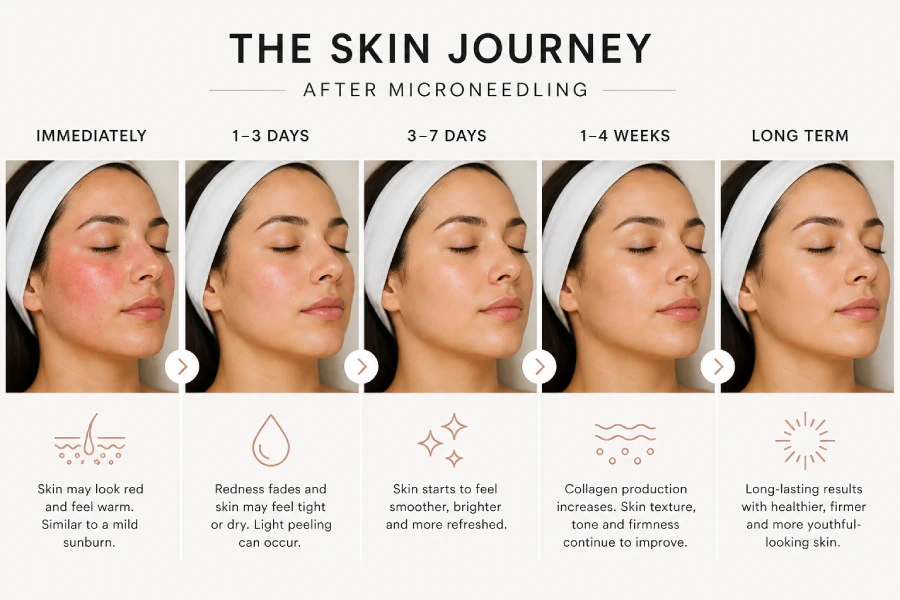
- Erythema and a sensation of heat or tightness typically peak within the first 4 to 6 hours and begin resolving within 24 to 72 hours for most clients at standard esthetic depths.
- The proliferative phase begins within 48 to 72 hours, during which fibroblasts are activated and begin synthesising new collagen type III—the precursor to the more structurally dense collagen type I.
- Visible results from collagen deposition typically do not appear until 3 to 6 weeks post-treatment; full remodelling may continue for up to 6 months.
- Skin barrier function is measurably compromised for 24 to 48 hours after treatment, during which skin is significantly more permeable to both beneficial actives and potential irritants.
- Mild surface flaking between days 2 and 4 is normal and reflects accelerated cell turnover at the treated surface, not a sign of damage or over-treatment.
Microneedling is one of the most clinically effective treatments available to estheticians for collagen induction, but its results are only as good as the post-treatment management that follows. Too often, the aftercare conversation is compressed into a brief handout given to clients on their way out the door. What gets lost in that exchange is the practitioner’s ability to explain why certain responses are happening, why specific restrictions are in place, and why the recovery protocol is not arbitrary but directly tied to the biology of what is occurring inside the skin.
Understanding the post-microneedling skin response in biological terms makes every element of aftercare education more persuasive and more effective. When estheticians can explain that the skin is in an active inflammatory phase and that hydration is critical because barrier function is structurally compromised, clients take the restrictions seriously. When they understand that the tight, slightly rough skin they feel on day 3 is fibroblast activity beginning—not damage—they stop panicking and start trusting the process.
This article covers the full post-microneedling skin response from the moment the device leaves the face through the long-term remodelling phase, with specific attention to what estheticians should observe, what they should communicate to clients, and where the highest-impact intervention opportunities exist.
What Every Esthetician Should Know About Post-Microneedling Skin Response
- Transepidermal water loss increases immediately after microneedling and remains elevated for 24 to 48 hours—this is the primary reason post-treatment hydration is not optional but clinically necessary.
- The three phases of healing—inflammation, proliferation, and remodelling—are sequential but overlapping; the quality of each phase influences the quality of the next.
- Skin is most permeable in the first 30 to 60 minutes post-treatment, meaning ingredient choices applied during this window have significantly amplified penetration depth and biological impact.
- Collagen results are cumulative and time-delayed; managing client expectations around the 3-to-6-week result window is one of the most important communication tasks after every treatment.
- Flaking between days 2 and 5 is a sign of healthy cellular turnover, not damage—clients who misinterpret this may use exfoliants prematurely and disrupt the healing cycle.
- Barrier reconstitution typically completes within 3 to 5 days, but the quality of that recovery depends heavily on what is applied to the skin during the first 48 hours.
- Deeper treatment depths at 1.0 mm and above are outside esthetic scope in most jurisdictions and produce substantially longer recovery windows than standard esthetic protocols.
The Immediate Post-Treatment Response: First Hour After Microneedling
The moment microneedling treatment ends, the skin enters the acute inflammatory phase—a rapid, biologically orchestrated cascade that is essential for the healing and remodelling that will follow. Understanding what is happening during this window is critical for estheticians because the decisions made in the first 20 to 30 minutes post-treatment have a disproportionate influence on the quality of recovery.
Immediately following needle contact, the skin’s vasodilatory response begins. Local blood vessels dilate in response to the mechanical injury signal, producing the characteristic erythema that appears during and after treatment. Platelets aggregate at the micro-channel sites and begin releasing growth factors including platelet-derived growth factor (PDGF) and transforming growth factor-beta (TGF-β), which are the primary chemical signals that initiate the repair cascade. This phase is not a sign that something has gone wrong—it is the biological mechanism through which microneedling achieves its therapeutic effects.
Simultaneously, the stratum corneum has been physically compromised at the needle entry sites. This disruption does two things: it creates temporary conduits through which topically applied ingredients can penetrate far deeper than they would on intact skin, and it opens the barrier to accelerated transepidermal water loss. TEWL can increase by 30 to 50 percent above baseline in the first hour post-treatment, which is why clients often notice an unusual sensation of tightness or surface dryness very quickly after the device is removed.
Why Occlusive Hydration Is the Priority in This Window
The clinical logic for applying an occlusive hydration treatment immediately after microneedling flows directly from what is happening at the barrier level. With TEWL elevated sharply, the skin is losing water faster than it can retain it through normal physiological means. Applying a hydrating serum without occlusion during this window results in the active ingredients evaporating alongside the water they were designed to deliver. An occlusive layer applied over humectant actives seals both the moisture and the active ingredients against the skin, maximising the benefit of the amplified permeability window rather than losing it to evaporation.
The Wound-Healing Cascade: The Science Behind Post-Microneedling Recovery
Post-microneedling recovery is governed by the same three-phase wound-healing cascade that operates in response to all controlled dermal injuries—inflammation, proliferation, and remodelling. What distinguishes microneedling from incidental injury is the precision with which the inflammatory stimulus is calibrated. The micro-channels are small enough that the inflammatory response resolves quickly and cleanly, but sufficient to trigger the full downstream collagen synthesis pathway. Understanding the timeline and biology of each phase gives estheticians the knowledge they need to support recovery proactively at each stage.
Phase Timing and Clinical Significance
The inflammatory phase begins immediately and typically resolves within 24 to 72 hours for standard esthetic treatment depths. During this phase, pro-inflammatory cytokines including interleukin-1 and tumour necrosis factor-alpha recruit immune cells to the treatment zone. These cells clean the micro-wound sites and set the biochemical environment for the next phase. Clients should be warned about the appearance and sensations associated with this phase before treatment, not after—the post-treatment conversation is too late for informed preparation.
The proliferative phase begins as the inflammatory signals begin to resolve, typically around 48 to 72 hours. Fibroblasts migrate into the treated zone and begin synthesising glycosaminoglycans, fibronectin, and early collagen type III. This is the foundational repair tissue. Concurrently, keratinocytes at the wound margins migrate laterally to resurface the micro-channels, progressively restoring the barrier. Clients may notice their skin feels smoother and less reactive during this phase, though visible collagen results are not yet apparent.
Three-Phase Healing Cascade After Collagen Induction Therapy
Microneedling triggers the same three-phase cascade as other controlled dermal injuries, but the micro-scale of the channels means the inflammatory phase resolves significantly faster than deeper wound models. Phase 1 (Inflammation) activates platelet aggregation and cytokine signalling within minutes of treatment. Phase 2 (Proliferation) begins at 48–72 hours and involves fibroblast migration, collagen type III synthesis, and epidermal resurfacing. Phase 3 (Remodelling) follows from approximately day 14 and continues for 3 to 6 months, during which immature collagen type III is progressively cross-linked and restructured into the mechanically superior collagen type I.
The quality and completeness of each phase depends substantially on the hydration status of the tissue throughout recovery. Dehydrated tissue has measurably impaired fibroblast function, slowed keratinocyte migration, and reduced growth factor diffusion—all of which compromise the outcome of the collagen induction process the treatment was designed to initiate.
What Estheticians Observe Day by Day After Treatment
One of the most valuable things an esthetician can do is establish a clear picture for clients of what their skin will look and feel like across the recovery timeline. Without this preparation, even expected responses—mild flaking, temporary dullness, surface tightness—can generate alarm calls and erode client confidence in both the treatment and the provider. The following day-by-day framework describes what is typically observed at standard esthetic depths and gives estheticians language to pre-empt client concerns.
Managing Client Expectations Across the Recovery Window
The single most common source of client dissatisfaction after microneedling is not a poor outcome—it is an unexplained outcome. Clients who were not told that their skin would look rough on day 3, feel tight on day 2, or take 4 to 6 weeks to show visible improvement will often interpret these expected events as signs of error or damage. Pre-treatment consultation that walks through the day-by-day timeline removes this interpretation risk entirely. The esthetician who gives clients a detailed recovery roadmap before treatment is the same esthetician whose clients return for their series rather than cancelling after the first session.
One of the most consistent observations in high-volume microneedling practice is that clients who receive an immediate post-treatment mask application report dramatically less discomfort during recovery than those who do not. The Poly-Luronic™ Jelly Mask is applied directly after removing any topical serum used during the treatment itself—typically within 5 minutes of the device being set down. The alginate gel sets to a firm occlusive layer within 3 to 4 minutes, at which point clients consistently comment that the tightness and heat sensation they felt immediately after treatment has reduced noticeably. When comparing this to clients who received only a simple hyaluronic acid serum without occlusion post-treatment, the difference in same-session comfort is striking: the unsealed skin continues to feel taut and increasingly uncomfortable as TEWL continues, while the mask-sealed skin stabilises quickly. Beyond client comfort, the practical difference in flaking severity at day 3 is also observable—clients who received the mask consistently show less pronounced surface peeling than those who did not, which is consistent with what the research on post-treatment occlusion and barrier reconstitution would predict.
Six Post-Treatment Responses Estheticians Must Be Able to Explain to Clients
Every esthetician performing microneedling will face client questions about unexpected or unfamiliar skin responses during recovery. The ability to explain these responses confidently and accurately is a direct indicator of clinical authority that clients use to evaluate their trust in the provider. The following six observations cover the most commonly encountered post-treatment responses and the clinical explanation behind each.
Redness and Warmth
Caused by inflammatory vasodilation initiated at the needle puncture sites. This is a normal and necessary part of the healing cascade. Redness at standard esthetic depths typically resolves within 24 to 72 hours and is not a sign of damage or over-treatment.
Surface Tightness and Dryness
The stratum corneum is physically disrupted during treatment, elevating TEWL measurably above baseline. Without immediate occlusive hydration support, the skin surface dehydrates faster than the intact barrier would permit, producing a tight, uncomfortable sensation that worsens if left unmanaged.
Temporary Swelling or Puffiness
Mild oedema around the treatment zone is a normal inflammatory response, particularly in the periorbital area and cheeks where tissue is thinner and vascular response is more pronounced. This typically resolves within 24 to 48 hours and should not be treated with topical anti-inflammatories unless specifically directed.
Mild Surface Flaking (Days 2–5)
Flaking reflects the accelerated turnover of epidermal cells that were superficially disrupted at the treatment surface. This is a normal part of the repair process and should not be exfoliated, picked, or treated with keratolytic agents during this window. Clients who mechanically remove flaking skin risk disrupting the barrier reconstitution that is actively progressing underneath.
Increased Sensitivity to Skincare Products
With the stratum corneum compromised, the skin’s normal filtering function is reduced. Products that would be tolerated on intact skin—including some vitamin C formulations, acids, and fragranced products—may cause stinging or irritation post-treatment. This is a permeability effect, not a new allergy, and resolves once barrier function is restored.
Delayed Visible Results
Clients expecting immediate skin improvement will be disappointed. The visible results of microneedling—improved texture, tone, and firmness—emerge as the collagen synthesis and remodelling phases progress. Communicating the 3-to-6-week collagen timeline before treatment, rather than after, prevents premature disappointment and supports series completion.
Supporting Post-Microneedling Recovery Strategically
Knowing what is happening biologically after microneedling is only valuable when it translates into specific clinical decisions. The post-treatment recovery support an esthetician provides is not a formality—it is a direct extension of the treatment itself. The quality of recovery determines whether the collagen induction stimulus that was created in the treatment room is fully realised or partially undermined by barrier compromise, dehydration, and inappropriate product application.
The Hydration Priority Window
The first 20 to 30 minutes after microneedling represent the highest-impact window for hydration intervention. During this period, the skin’s permeability is at its peak and TEWL is accelerating. Applying a dual-humectant hydration treatment followed immediately by an occlusive layer exploits this window by driving active ingredients deeper than they would penetrate on intact skin while simultaneously sealing the moisture in place to counteract the TEWL spike. Practitioners who wait until the client is dressed and heading to reception to apply post-treatment products have already missed the window where those products will have their greatest impact.
What to Avoid in the First 72 Hours
The post-treatment avoidance list exists for specific biological reasons, not as arbitrary caution. Direct sun exposure increases inflammatory activity in already-inflamed skin and can trigger post-inflammatory hyperpigmentation in clients with melanin-rich skin tones. Active ingredients including retinoids, AHAs, BHAs, and high-concentration vitamin C are all capable of penetrating through the compromised barrier at significantly elevated concentrations, producing irritation or sensitisation where they would normally be tolerated. Heat treatments including steam, saunas, and hot showers dilate vessels that are already vasodilated, potentially prolonging erythema. Makeup applied within 24 to 48 hours introduces pigments and preservatives into channels that are still functionally open to the dermis.
Homecare Protocol for the First Week
Clients should be sent home with a simplified homecare protocol covering only the essentials: a gentle non-foaming cleanser, a fragrance-free humectant serum, and a simple occlusive moisturiser without active ingredients. The goal during the first week is to support barrier reconstitution by providing moisture without introducing any ingredient that could trigger further inflammation or sensitisation. The time for reintroducing actives and more complex skincare is day 5 to 7 at the earliest, and even then the transition should be gradual rather than a full immediate return to the pre-treatment routine.
Professional and Scientific References
The post-microneedling biological timeline described in this article is grounded in published wound-healing research, collagen induction therapy clinical trials, and dermatological barrier science literature.
- Aust, M.C. et al. “Percutaneous collagen induction: minimally invasive skin rejuvenation without risk of hyperpigmentation.” Journal of Drugs in Dermatology, 2008. Establishes the three-phase wound-healing cascade as the operative mechanism in microneedling collagen induction and documents the collagen type III to type I remodelling timeline.
- Doddaballapur, S. “Microneedling with dermaroller.” Journal of Cutaneous and Aesthetic Surgery, 2009. Documents fibroblast activation timeline and provides foundational data on the proliferative phase onset at 48–72 hours post-treatment.
- Fluhr, J.W. et al. “Functional skin adaptation in infancy: near-complete barrier maturation in the first year of life.” Dermatology, 2004. Provides foundational reference data on TEWL measurement and barrier function metrics used to establish post-treatment TEWL baseline comparisons.
- Kalluri, H. & Banga, A.K. “Formation and closure of microchannels in skin following microporation.” Pharmaceutical Research, 2011. Confirms micro-channel closure timeline in human skin and quantifies the amplified permeability window available for post-treatment active ingredient delivery.
- Setterfield, L. The Concise Guide to Dermal Needling, 3rd ed., 2013. Widely referenced professional resource establishing clinical observation frameworks for post-microneedling recovery stages used in esthetic training curricula.
Post-microneedling recovery is a clinical event, not a passive waiting period, and the product selection applied immediately after treatment has a measurable impact on how well and how quickly the skin recovers. The criteria that matter most in this context are: compatibility with a compromised barrier, dual-depth hydration to address both surface and sub-surface water loss, and an occlusive delivery format that seals both moisture and actives against the amplified TEWL of the first 30 minutes. The Poly-Luronic™ Jelly Mask meets all three criteria through its polyglutamic acid and hyaluronic acid humectant system, its alginate-based gel occlusion structure, and its fragrance-free, sensitiser-free formulation that makes it safe for application directly to freshly needled skin. For estheticians building a microneedling protocol in which recovery outcomes are treated as a direct extension of the treatment itself, this is the post-treatment mask format the clinical data supports.
Explore the Poly-Luronic™ Jelly Mask Line →Frequently Asked Questions: Post-Microneedling Skin Response
Why does skin look red and feel tight immediately after microneedling?
Redness and tightness immediately after microneedling are caused by acute inflammatory vasodilation and the temporary disruption of the stratum corneum. The needle channels trigger a wound-healing cascade that increases local blood flow and releases pro-inflammatory cytokines, producing the characteristic erythema. The tight sensation occurs because transepidermal water loss increases sharply once the skin barrier is punctured, causing the surface to dehydrate faster than normal. Both responses are expected and typically resolve within 12 to 24 hours for standard treatment depths.
How long does post-microneedling redness usually last?
Post-microneedling redness typically resolves within 24 to 72 hours for most clients receiving treatments at standard esthetic depths of 0.25 mm to 0.5 mm. Deeper treatments at 1.0 mm or above, which are performed only by licensed medical professionals, can produce erythema lasting 3 to 5 days. The rate of resolution is heavily influenced by skin hydration status going into the treatment, post-treatment barrier support, and the client’s individual inflammatory response. Clients with rosacea-prone or reactive skin may see prolonged redness beyond the typical window.
What is actually happening inside the skin during the days after microneedling?
In the hours and days after microneedling, the skin progresses through three overlapping biological phases. During the inflammatory phase, which peaks within the first 24 to 48 hours, platelets aggregate at the puncture sites and growth factors including PDGF and TGF-beta are released to signal repair. During the proliferative phase, which begins around day 2 and extends through day 14, fibroblasts migrate to the treated zone and begin synthesising new collagen and elastin. The remodelling phase follows and continues for up to 6 months, during which immature collagen type III is gradually replaced by the more structurally dense collagen type I, progressively improving skin texture, firmness, and tone.
Does microneedling damage the skin barrier, and how does it recover?
Yes, microneedling temporarily disrupts the skin barrier by creating micro-channels that bypass the stratum corneum, the skin’s primary waterproofing layer. This disruption elevates transepidermal water loss measurably for 24 to 48 hours post-treatment, leaving the skin more vulnerable to dehydration, irritant penetration, and sensitivity. The barrier begins reconstituting within hours as keratinocytes migrate laterally to close the micro-channels. Full functional barrier restoration typically occurs within 3 to 5 days for most clients, though the quality of post-treatment hydration support significantly influences how quickly and completely that recovery happens.
Can clients wear makeup right after microneedling?
No. Makeup should not be applied to freshly microneedled skin for a minimum of 24 hours, and ideally 48 hours. The open micro-channels created during treatment make the skin highly permeable, meaning makeup pigments, preservatives, and fragrances can penetrate far deeper than they would on intact skin, increasing the risk of irritation, sensitisation, and infection. Clients are often surprised by this restriction because their skin does not look obviously wounded, but the channels remain functionally open for considerably longer than surface appearance suggests.
Why does skin feel dry and sometimes flaky in the days after microneedling?
Dryness and mild flaking 2 to 4 days after microneedling are a normal consequence of the combined effects of elevated transepidermal water loss, the shedding of superficially damaged epidermal cells, and the rapid cellular turnover stimulated by the treatment. The flaking is not a sign of damage; it reflects the accelerated exfoliation of cells disrupted at the treatment surface. Clients who do not apply adequate occlusive hydration in the first 48 hours are more likely to experience pronounced flaking because the barrier is not sealed sufficiently to retain moisture during the peak TEWL window.
When does collagen production actually start after a microneedling treatment?
Fibroblast activation and early collagen synthesis begin during the proliferative phase, approximately 48 to 72 hours after treatment, but visible skin improvement from new collagen deposition typically does not appear until 3 to 6 weeks post-treatment. The collagen produced initially is the softer type III collagen, which is progressively converted to the more structurally resilient type I collagen during the remodelling phase. Full collagen remodelling benefits may take 3 to 6 months to manifest, which is why a series of treatments spaced 4 to 6 weeks apart is generally recommended to build cumulative improvement.
Is it normal for skin to look worse before it looks better after microneedling?
Yes, this is a common and expected pattern. In the first 24 to 72 hours after microneedling, erythema, tightness, mild swelling, and surface dryness can make the skin appear temporarily worse than its pre-treatment baseline. This is a normal inflammatory response and is not a sign that the treatment failed or caused damage. Clients who are not prepared for this window can become alarmed, which is why pre-treatment consultation and thorough aftercare education are among the most important parts of the esthetician’s role in microneedling services.
How does the Poly-Luronic™ Jelly Mask support skin recovery immediately after microneedling?
The Poly-Luronic™ Jelly Mask is designed to address the two most critical post-microneedling needs simultaneously: intensive hydration delivery and occlusive barrier sealing. Its polyglutamic acid and hyaluronic acid combination provides multi-depth humectant hydration that replenishes moisture lost through the disrupted barrier, while the alginate-based gel matrix creates a physical occlusive seal over the treatment zone that measurably reduces transepidermal water loss during the critical first 20 minutes post-procedure. The cooling effect of the mask during application also helps reduce the sensation of heat and tightness that clients commonly report immediately after microneedling, improving client comfort and overall treatment experience.
Post-Microneedling Recovery Is a Clinical Discipline, Not an Afterthought
The skin after microneedling is in a state of active, orchestrated biological repair. Every decision made in the treatment room in the minutes following the procedure, and every instruction given to the client for the days that follow, either supports or compromises the quality of that repair process. Estheticians who understand the wound-healing cascade, the TEWL spike, the barrier disruption timeline, and the collagen synthesis phases are equipped to provide aftercare support that is not generic—it is precisely targeted to what the skin needs at each biological stage.
Client communication is the other half of the equation. Pre-treatment expectation setting about the recovery timeline is not just good client service—it is a clinical intervention that improves compliance, reduces unnecessary panic calls, and increases the likelihood that clients complete the full series needed to achieve cumulative collagen benefit. The esthetician who can explain what is happening inside the skin, not just what to avoid, is the practitioner whose clients return, rebook, and refer.
Use the biological framework in this article as the foundation for every microneedling consultation and every post-treatment conversation. The recovery knowledge you demonstrate in those moments is one of the most powerful signals of clinical authority you can provide.