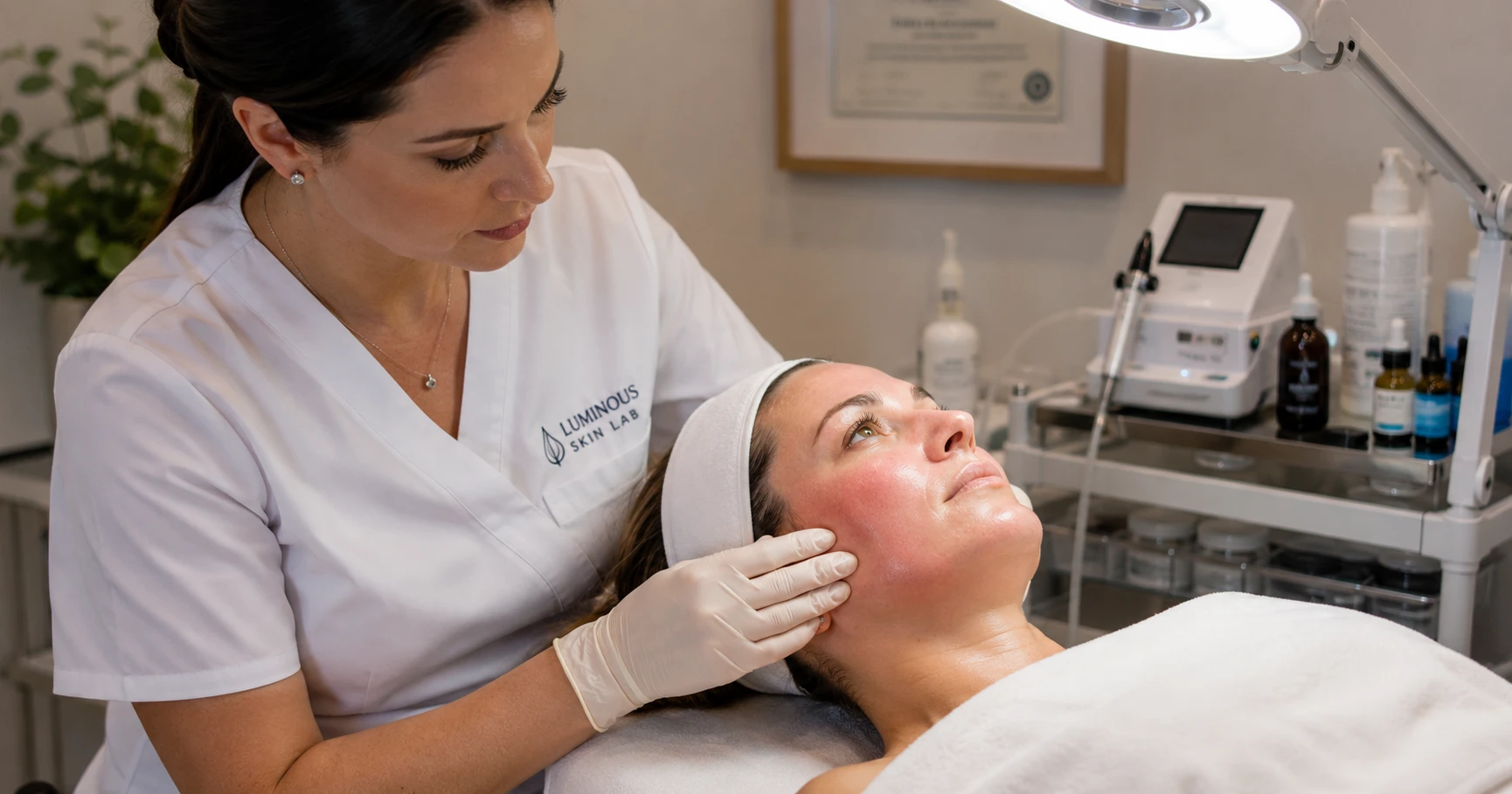
How Long Does Nano Infusion Recovery Take?
Nano infusion recovery is one of the shortest post-treatment timelines in professional esthetics. Most clients experience visible redness resolution within two to six hours, with surface skin normalisation complete by 24 to 48 hours. Deeper cellular repair continues for seven to ten days beneath the surface, but clients typically return to normal activities the same day as treatment.
- Immediate post-treatment redness typically resolves within 2–6 hours for most skin types
- Surface barrier repair is substantially complete within 24–48 hours
- Subsurface cellular remodelling continues for 7–10 days post-treatment
- Nano infusion recovery is significantly faster than microneedling, which requires 24–72 hours of visible downtime
- Sensitive and rosacea-prone skin types may experience prolonged redness lasting up to 24–36 hours
- Occlusive post-treatment masking and LED therapy are the two most effective protocol additions for shortening visible recovery time
- Clients can typically return to work and most activities the same day, with makeup application safe after 4–6 hours
Recovery timeline is one of the most frequently asked questions estheticians receive about nano infusion — from prospective clients weighing treatment options, from existing clients planning around appointments, and from new practitioners learning how to communicate realistic expectations. Getting this conversation right is as important as the treatment itself, because clients who receive accurate timeline information are far more likely to follow aftercare instructions correctly, schedule appropriate re-booking intervals, and report higher satisfaction with their results.
Unlike microneedling, which creates dermal-depth punctures associated with significant temporary downtime, nano infusion operates at the epidermal and superficial dermal level using a nano-tip cartridge that creates micro-channels too small to cause bleeding or prolonged inflammatory responses. This structural distinction is what defines nano infusion as a low-downtime treatment — but “low downtime” does not mean “zero downtime,” and estheticians who communicate that distinction clearly are better positioned to manage client expectations and support optimal healing outcomes.
This article provides a complete clinical framework for understanding nano infusion recovery phases, the variables that influence individual healing timelines, and the evidence-based post-treatment protocols that consistently accelerate recovery in professional practice.
What Every Esthetician Should Know About Nano Infusion Recovery Timelines
- Surface recovery from nano infusion is typically complete within 24–48 hours, making same-day return to normal activities realistic for most clients
- The nano-tip creates micro-channels that close rapidly — this is the biological mechanism behind the treatment’s minimal downtime advantage
- Transepidermal water loss is elevated immediately post-treatment; occlusive masking directly after the session addresses this and accelerates barrier repair
- Skin type is the most significant variable in recovery duration — sensitive and reactive skin types require more conservative post-treatment protocols
- Fitzpatrick types III–VI require careful monitoring during recovery to prevent post-inflammatory hyperpigmentation from forming
- LED red light therapy delivered immediately post-treatment is one of the most effective adjunct strategies for reducing visible recovery time
- Clients should avoid exfoliants, active ingredients, heat, and physical skin manipulation for a minimum of 24 hours after treatment
The Four Phases of Nano Infusion Skin Recovery
Understanding nano infusion recovery requires understanding it as a biological process with distinct sequential phases rather than a single event. Each phase has different characteristics, different clinical significance, and different management requirements. Estheticians who communicate these phases to clients — even in simplified terms — dramatically improve aftercare compliance and client satisfaction scores.
Phase One: Immediate Vascular Response (0–2 Hours)
Immediately following nano infusion, the skin’s vascular system responds to the mechanical stimulation of the nano-tip by dilating superficial capillaries and increasing localised blood flow. This produces the characteristic post-treatment flush that clients observe in the mirror after stepping off the treatment bed. The intensity of this response varies considerably by skin type: clients with thin, fair, or sensitive skin tend to present with more pronounced redness, while clients with thicker, oilier, or darker skin types may show only mild pinkness. In most cases, this phase begins resolving within 30 to 60 minutes as the inflammatory cascade diminishes and capillaries return to baseline tone.
Phase Two: Channel Closure and Surface Sealing (2–6 Hours)
During this phase, the micro-channels created by the nano-tip undergo rapid re-sealing as keratinocytes at the wound margins migrate to close the surface disruptions. Transepidermal water loss remains elevated throughout this phase, which is why post-treatment occlusive masking delivered in the treatment room is clinically meaningful — it physically prevents moisture escape while the channels are still partially open. By the end of this phase, most clients will show only mild residual pinkness, and the skin surface will feel intact rather than raw or sensitive to the touch.
Phase Three: Epidermal Repair (6–48 Hours)
Through the remainder of the first day and into the following morning, the epidermis completes its surface repair cycle. The stratum corneum re-establishes its lipid matrix structure, barrier function returns toward baseline, and any residual dryness or tightness typically resolves. Clients in this phase should be following the aftercare instructions provided at checkout: avoiding active skincare ingredients, protecting the skin from UV exposure, and keeping the skin moisturised with simple, fragrance-free products.
Phase Four: Subsurface Remodelling (2–10 Days)
While the surface recovery is complete for most clients by 48 hours, the deeper biological work initiated by nano infusion continues beneath the surface for seven to ten days. This phase encompasses the fibroblast stimulation, growth factor activity, and early collagen precursor production that contribute to the treatment’s longer-term skin quality improvements. This phase requires no special client management, but it is clinically significant — it is also why re-booking intervals of two to four weeks are recommended rather than weekly treatments.
Why Nano Infusion Heals Faster Than Other Channel-Based Treatments
The exceptionally short recovery time associated with nano infusion is not a marketing claim — it is a direct consequence of the treatment’s mechanism of action at the tissue level. To understand why recovery is so rapid, estheticians need to understand the biological distinction between epidermal disruption and dermal disruption, and how the depth and diameter of the channels created determine the intensity and duration of the healing response.
Depth of Penetration and Inflammatory Response
The nano-tip cartridge used in nano infusion creates micro-channels that penetrate to approximately 0.15 to 0.25 millimetres — operating primarily within the epidermis and superficial papillary dermis. At this depth, the channels do not transect dermal blood vessels in a way that produces bleeding, and the inflammatory signal generated is proportionally smaller than that produced by microneedling, which operates at 0.5 to 2.5 millimetres. The smaller the inflammatory signal, the faster the healing cascade resolves, and the less visible evidence of treatment persists at the skin surface.
Channel Diameter and Re-Sealing Speed
The micro-channels created by nano-tip cartridges are also significantly narrower than microneedling punctures — measured in microns rather than hundreds of microns. At this scale, the keratinocyte migration required to close the channel is a short-distance process that can complete within hours rather than days. The result is a surface that looks and feels recovered far sooner than the skin surface after a traditional microneedling session.
Why Nano Infusion Recovery Is Structurally Faster Than Microneedling
The healing rate following any channel-based skin treatment is primarily determined by two variables: the depth of penetration and the diameter of the channel. Nano infusion scores favourably on both measures, which is what produces its characteristically brief recovery window compared to deeper needling modalities.
At the epidermal level, keratinocytes can migrate at a rate of approximately 0.5 millimetres per day under optimal conditions. A nano-tip channel measuring 50–100 microns in diameter requires only a fraction of this migration distance to close, producing surface sealing within hours. A standard microneedling channel at 0.25–0.5 millimetres in diameter requires significantly longer migration time and recruits a more complex inflammatory response to manage the larger wound signal.
The practical clinical implication is that nano infusion clients can realistically expect clear, comfortable skin by the morning after treatment — a timeline that consistently differentiates the service from microneedling in client communication and booking decisions.
Variables That Affect How Long Nano Infusion Recovery Takes
While the standard recovery framework describes most clients, individual variation is significant in practice. Estheticians who understand the key variables influencing recovery duration are better positioned to set accurate expectations at consultation, adapt their post-treatment protocols to individual skin profiles, and identify cases where extra monitoring is warranted. The infographic below summarises the six most clinically significant factors affecting recovery duration.
Managing High-Impact Variables in the Treatment Room
When estheticians identify high-risk recovery variables at consultation — particularly sensitive skin type, compromised barrier, or higher Fitzpatrick phototype — the appropriate response is to adapt the treatment protocol rather than delay treatment. Conservative device settings, fewer passes across reactive zones, and a robust in-clinic post-treatment recovery sequence can all meaningfully reduce recovery duration for clients who would otherwise experience the upper end of the timeline range.
Estheticians working with reactive and sensitive skin clients report a consistent pattern: the biggest difference in post-treatment redness duration is not the device settings — it’s what happens in the 15 minutes immediately after the nano-tip pass is complete. When the Poly-Luronic™ Jelly Mask is mixed to a 2:1 ratio (two scoops powder to one scoop water) and applied within two minutes of the final device pass, the alginate gel matrix sets directly over the open micro-channels and physically prevents the evaporative water loss that drives the tightness and discomfort clients associate with “looking red all afternoon.” The key operational distinction practitioners note is temperature — mixing the Poly-Luronic™ Jelly Mask with cool or room-temperature water rather than warm water produces a noticeably more soothing immediate sensation and appears to reduce vascular dilation duration in reactive skin clients. By contrast, applying a standard gel serum or hydrating cream in this window without an occlusive layer leaves the micro-channels exposed to ambient air, and those clients consistently show longer redness duration and report more post-treatment skin tightness on their follow-up check-in the next morning.
What Estheticians Should Monitor During Each Recovery Phase
Knowing what to look for at each stage of nano infusion recovery — and knowing when a skin response falls outside the normal range — is a core clinical competency that differentiates experienced practitioners from beginners. The following framework covers the six most important monitoring checkpoints across the full recovery arc.
Immediate Post-Treatment Flush (0–30 Minutes)
Mild to moderate erythema distributed evenly across treated zones is the expected finding. Uneven flushing, extreme redness concentrated at specific points, or client-reported burning sensation beyond mild warmth should prompt reassessment of device settings and skin suitability before booking future treatments.
Mask Application Response (0–60 Minutes)
Clients should report immediate cooling comfort and reduced heat sensation once the post-treatment mask is applied. Continued burning, stinging beyond mild sensitivity, or urticaria developing under the mask are signs of a reactive response that may require product review, barrier assessment, or referral if systemic symptoms develop.
Pre-Checkout Skin Check (45–90 Minutes Post-Treatment)
Before the client leaves the treatment room, erythema should have reduced visibly from the immediate post-treatment level. If significant redness persists beyond 90 minutes in a standard skin type, this warrants a conversation about adjusting future treatment intensity and reinforcing aftercare instructions before the client departs.
24-Hour Follow-Up Check-In
A brief follow-up message to the client at 24 hours serves multiple purposes: it confirms surface recovery is progressing normally, provides an opportunity to answer aftercare questions, and reinforces rebooking. If a client reports skin that “still looks red” or “feels rough” at 24 hours, this is likely normal for sensitive skin types — reassurance and continued aftercare guidance is appropriate.
48-Hour Skin Normalisation
By 48 hours, most clients’ skin should look and feel normal to observers unfamiliar with the treatment. Persistent redness, swelling, or tenderness beyond this point falls outside the expected recovery window for nano infusion and warrants direct client communication to distinguish between a prolonged inflammatory response and the beginning of a potential adverse reaction.
7–10 Day Result Assessment
The subsurface remodelling phase completes during this window, and clients should begin noticing improvements in skin texture, hydration, and luminosity. This is the optimal time to schedule the next treatment session and to review results together — it reinforces the treatment value narrative and supports re-booking discussions naturally within the clinical context.
Building Recovery Communication Into Your Nano Infusion Service
The most effective recovery management happens before the treatment begins. Estheticians who systematically communicate the nano infusion recovery timeline at consultation — not as a disclaimer but as part of the clinical narrative — build client trust, improve aftercare compliance, and position themselves as knowledgeable practitioners rather than service providers following a script. This shift in framing changes how clients approach their recovery and dramatically reduces post-treatment anxiety calls and messages.
What to Tell Clients at Consultation
At consultation, the recovery conversation should cover three core points: what to expect immediately after treatment (mild redness and warmth that resolves within hours), what to do in the first 24 hours (gentle products, no active ingredients, SPF if going outdoors), and what success looks like at one week (improved texture, brightness, and hydration noticeable by the client). Framing the seven to ten day subsurface remodelling phase as part of the treatment’s visible results — not just a background biological process — helps clients stay engaged with their aftercare routine and understand why re-booking before the remodelling cycle is complete maximises cumulative results.
What to Tell Clients at Checkout
At checkout, the recovery conversation shifts from expectation-setting to action-specific guidance. Clients should leave with clear written aftercare instructions covering: avoid makeup for four to six hours, avoid heat exposure (hot showers, saunas, exercise) for 24 hours, avoid exfoliants and active ingredients for 24 to 48 hours, and apply SPF if spending time outdoors. Verbal reinforcement of these points at checkout — particularly the four to six hour makeup hold — prevents the most common post-treatment compliance failures estheticians observe in practice.
Managing Clients With Longer-Than-Expected Recovery
Occasional clients will experience recovery timelines at the upper end of the expected range, and a small number will present with responses that fall outside it entirely. Estheticians should have a clear internal protocol for each scenario: prolonged redness at 24 hours in a sensitive skin type is expected and managed with reassurance; persistent swelling or warmth at 48 hours requires direct assessment; anything suggesting an allergic or systemic response requires referral to a medical professional. Documenting recovery observations in the client file supports both clinical decision-making for future treatments and professional practice protection in the rare event of an adverse outcome discussion.
Professional and Scientific References
The recovery timelines and biological mechanisms described in this article are grounded in peer-reviewed wound healing research, skin barrier science literature, and published clinical findings on channel-based skin treatments including microneedling and nano infusion modalities.
- Skin barrier function and transepidermal water loss research: Journal of Investigative Dermatology and Experimental Dermatology, multiple authors, 2015–2024. Establishes the relationship between channel depth, TEWL elevation, and barrier re-sealing speed following percutaneous disruption.
- Keratinocyte migration rates in wound closure: Wound Repair and Regeneration, various authors, 2016–2023. Documents epidermal keratinocyte migration velocity under standard and compromised conditions, informing estimated channel closure timelines.
- Microneedling clinical safety and recovery profiles: Journal of Cosmetic Dermatology, systematic review, 2018–2022. Provides comparative baseline data on microneedling recovery timelines used as clinical reference for nano infusion differentiation.
- Post-inflammatory hyperpigmentation risk in Fitzpatrick types III–VI following percutaneous procedures: Dermatologic Surgery and Journal of the American Academy of Dermatology, 2017–2024. Informs PIH risk assessment protocols for higher phototypes during post-treatment recovery.
- Occlusive dressing effects on epidermal repair rate: British Journal of Dermatology and International Wound Journal, multiple studies, 2014–2023. Supports the clinical rationale for immediate post-treatment occlusive masking as a recovery acceleration strategy.
The evidence from both the research literature and consistent practitioner observation points to the same conclusion: what an esthetician applies to the skin in the immediate post-nano-infusion window is the single most controllable variable in recovery duration. An occlusive mask with genuine barrier-sealing capacity, delivered within minutes of the final device pass, directly addresses the two biological processes driving visible recovery time — elevated transepidermal water loss and vascular dilation. Poly-Luronic™ Jelly Mask meets both requirements through its alginate-based setting matrix and dual-humectant active delivery system. For estheticians building nano infusion service protocols where client experience and same-day recovery are service differentiators, selecting a post-treatment mask that performs at this clinical level is a protocol decision with measurable impact on the client experience metrics that drive re-booking and referrals.
Explore the Poly-Luronic™ Jelly Mask LineFrequently Asked Questions: Nano Infusion Recovery Timelines
How long does nano infusion recovery actually take?
Most clients experience a full surface recovery from nano infusion within 24 to 48 hours. Mild redness and temporary skin sensitivity typically resolve within the first day, while deeper cellular repair and collagen remodelling continue beneath the surface for up to 7 to 10 days after treatment. The absence of visible downtime is one of the defining clinical advantages of nano infusion compared to more invasive modalities.
Why does my client’s skin look red right after nano infusion?
Post-treatment redness following nano infusion is a normal vascular response to the mechanical stimulation of the nano-tip cartridge moving across the skin. The micro-channels created during treatment trigger a localised inflammatory cascade that increases blood flow to the area, producing the characteristic flush. This response is transient and typically resolves within two to six hours for most skin types, though clients with rosacea-prone or highly reactive skin may retain mild pinkness for up to 24 hours.
Can a client go back to work the same day as nano infusion?
Yes, in most cases clients can return to work or normal daily activities the same day as nano infusion. The treatment is specifically classified as a low-downtime procedure because the nano-tip creates micro-channels at a superficial level that close rapidly without causing the sustained inflammation associated with microneedling. Estheticians should advise clients to avoid applying makeup for at least four to six hours post-treatment and to protect the skin from direct sun exposure for the remainder of the day.
Does skin type affect how long nano infusion recovery takes?
Yes, skin type is one of the most significant variables in nano infusion recovery duration. Clients with sensitive, rosacea-prone, or compromised barrier skin tend to experience prolonged redness and surface sensitivity lasting up to 24 to 36 hours. Clients with thicker, oilier skin types typically recover within two to four hours. Fitzpatrick skin types III through VI require particular monitoring, as chronic inflammation or post-inflammatory hyperpigmentation can develop if aftercare instructions are not followed precisely.
What happens to the skin barrier during nano infusion recovery?
During nano infusion recovery, the skin barrier undergoes a rapid re-sealing process. The nano-tip creates transient micro-channels that disrupt the stratum corneum temporarily, increasing transepidermal water loss for the first several hours after treatment. As the channels close, keratinocytes at the wound margins migrate to restore surface continuity. By 24 hours post-treatment, barrier integrity is substantially restored in most clients, though full barrier function normalisation continues for several days as the skin completes its repair cycle.
How does nano infusion recovery compare to microneedling recovery?
Nano infusion recovery is significantly shorter than microneedling recovery. Microneedling creates dermal-depth punctures that produce a more intense inflammatory response, with redness, swelling, and pin-point bleeding lasting 24 to 72 hours and full recovery taking up to seven days. Nano infusion, by contrast, operates at the epidermal and superficial dermal level, producing micro-channels that close within hours. Most nano infusion clients are comfortable without any visible signs of treatment by the following morning, whereas microneedling clients commonly require two to three days before returning to normal activities.
What should estheticians do immediately after nano infusion to speed up recovery?
Immediately after nano infusion, the most effective recovery-accelerating steps are applying an occlusive hydration mask, performing LED red light therapy if available, and applying a barrier-supportive serum containing ceramides or hyaluronic acid before the client leaves the treatment room. The occlusive mask step is particularly critical because it seals the micro-channels, prevents transepidermal water loss, and delivers active ingredients into the skin while the channels remain patent. Clients should also receive specific aftercare instructions to avoid active exfoliants, heat exposure, and physical manipulation of the skin for at least 24 hours.
Is it normal for skin to feel tight or dry after nano infusion?
Yes, mild tightness and dryness following nano infusion are entirely normal and reflect the temporary increase in transepidermal water loss that occurs while micro-channels are open. This sensation typically peaks within the first two hours of treatment and diminishes as channels close and any applied occlusive product takes effect. Estheticians should reassure clients that this is expected, and recommend a gentle fragrance-free moisturiser to be applied once the initial post-treatment product has been absorbed, typically four to six hours after the appointment.
How does the Poly-Luronic™ Jelly Mask support nano infusion recovery?
The Poly-Luronic™ Jelly Mask is formulated to address the specific recovery needs of skin immediately after nano infusion. Its alginate-based occlusive structure physically seals the micro-channels created during treatment, dramatically reducing transepidermal water loss during the critical recovery window. The dual-humectant delivery system combining polyglutamic acid and hyaluronic acid provides simultaneous surface-film hydration and deeper epidermal moisture replenishment, supporting the skin’s rapid barrier repair cycle. Estheticians applying the Poly-Luronic™ Jelly Mask directly after nano infusion consistently observe reduced post-treatment redness duration, improved client comfort, and enhanced next-morning skin quality compared to gel or cream masks that lack the same occlusive capacity.
Recovery Duration Is a Clinical Variable, Not Just a Client Communication Talking Point
Understanding nano infusion recovery at the biological level — rather than simply knowing the standard “24 to 48 hour” timeframe — transforms how estheticians design their treatment protocols, manage client expectations, and respond when outcomes fall outside the typical range. The recovery timeline is not fixed; it is shaped by skin type, barrier integrity, treatment intensity, and the quality of post-treatment support applied immediately after the session. Estheticians who manage these variables deliberately produce more consistent outcomes and higher client satisfaction scores than those who rely on the treatment device alone.
For most clients, the surface recovery story ends the morning after their nano infusion appointment — clear skin, no visible evidence of treatment, and the beginning of the texture and luminosity improvements that drive rebooking decisions. That outcome depends on everything that happens in the treatment room: the consultation, the protocol, the post-treatment mask application, and the aftercare instructions the client carries out the door.
Continue building your nano infusion knowledge by exploring the full recovery and aftercare cluster, including what clients should avoid after treatment, how hydration supports healing, and how to build a profitable nano infusion service that retains clients across a full treatment series.