What Is the Best Post-Microneedling Recovery Protocol for Estheticians?
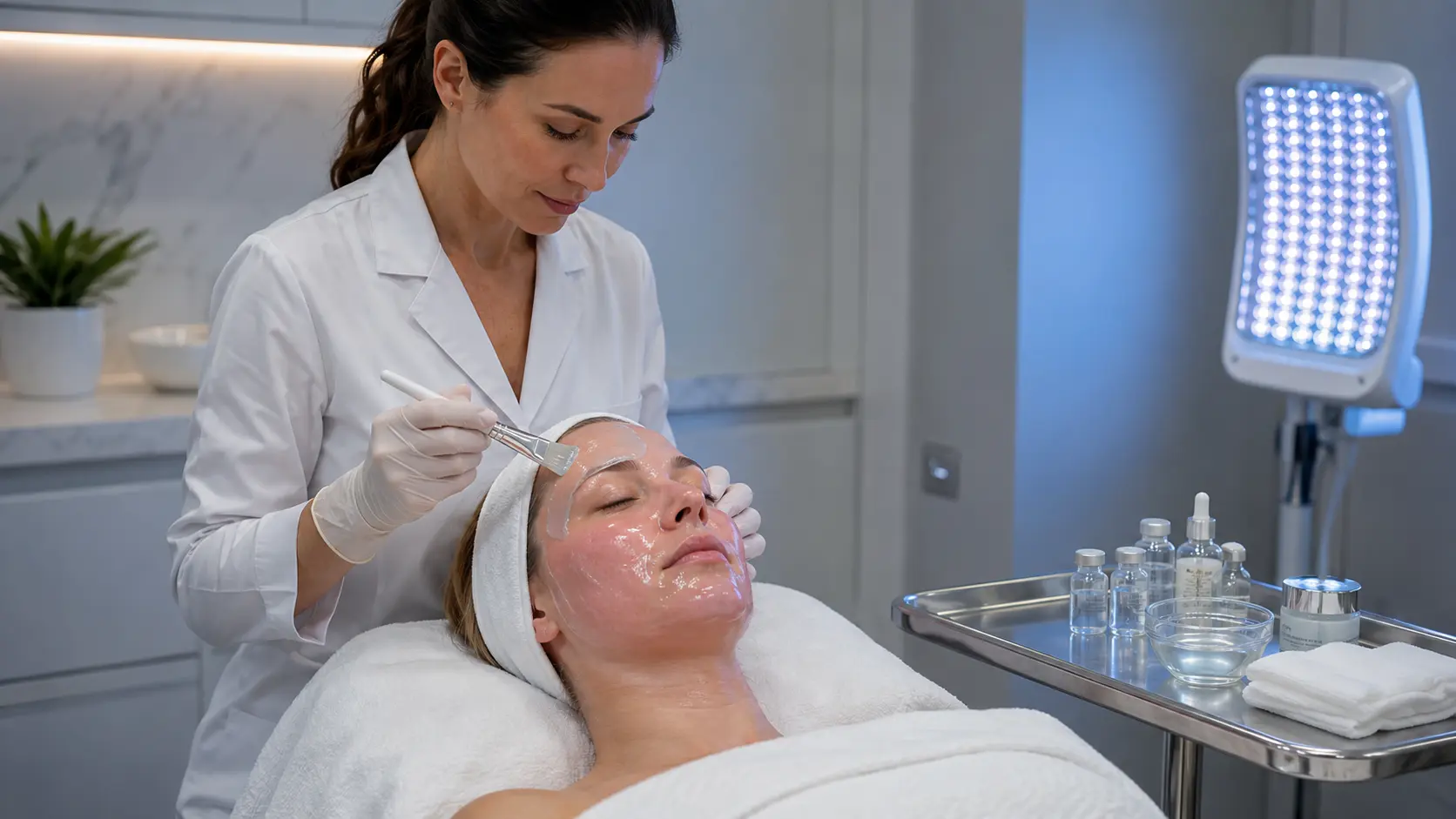
The best post-microneedling recovery protocol follows a structured sequence that begins the moment needling ends and continues through the client’s first 72 hours at home. In-treatment, the protocol prioritizes gentle skin neutralization, immediate application of a fragrance-free hydrating serum containing polyglutamic acid and hyaluronic acid, followed by an occlusive professional jelly mask to seal hydration, reduce transepidermal water loss, and calm post-needling erythema. Optional LED red light therapy, applied during or immediately after jelly mask application, complements the healing cascade.
- Microneedling creates controlled microchannels that dramatically increase skin permeability — the 10 to 30 minutes immediately following treatment represent the highest-value window for topical absorption.
- Barrier disruption causes accelerated transepidermal water loss for up to 72 hours post-procedure, making occlusive hydration a clinical requirement, not a comfort measure.
- Fragrance-free, alcohol-free, and active-free formulations are mandatory for all in-treatment post-microneedling products; any sensitizer applied to compromised skin carries a heightened inflammatory risk.
- PGA and HA dual-humectant formulations are particularly effective post-microneedling because heightened permeability amplifies humectant delivery, and PGA’s hyaluronidase inhibition protects both applied and endogenous HA during the recovery window.
- Clients must receive written aftercare instructions covering product restrictions, sun protection requirements, and realistic healing timelines before they leave the treatment room.
- LED red light therapy at 630 to 660 nanometers and near-infrared at 810 to 850 nanometers are the two most clinically supported adjunctive modalities for post-microneedling recovery.
Microneedling is one of the most results-driven services in the professional esthetic scope of practice — and also one where the post-treatment protocol determines as much of the outcome as the needling itself. Estheticians who perform technically excellent microneedling but then rush through or imprecisely execute the recovery steps are leaving a significant portion of the treatment’s potential unrealized. The skin’s permeability window immediately following microneedling is a clinical opportunity that does not return once the microchannels begin to close. What happens in the treatment room during those first twenty minutes shapes how the skin heals, how the client feels during recovery, and how the results present over the following four to six weeks.
At the same time, post-microneedling protocols carry meaningful safety responsibilities. The compromised barrier state that makes the skin so receptive to beneficial actives also makes it highly vulnerable to sensitizing ingredients, infection risk, and inflammatory response. A rigorous recovery protocol is therefore both a results-optimization tool and a client protection standard. These two objectives are not in tension — they are the same protocol, executed correctly.
This guide gives estheticians a complete clinical framework for post-microneedling recovery: the science behind why each protocol step matters, a phase-by-phase treatment sequence, product selection criteria for each application point, adjunctive modality integration, and aftercare instruction standards that protect both the client and the practitioner.
What Every Esthetician Needs to Know About Post-Microneedling Recovery
- Post-microneedling recovery begins in the treatment room, not at home — the in-treatment protocol is the highest-impact phase of the client’s recovery journey.
- The permeability window following microneedling is real and finite — serum application during this window delivers measurably more active ingredient to the skin than standard topical application.
- Barrier disruption and elevated TEWL persist for up to 72 hours post-procedure — occlusive hydration in-treatment significantly reduces the severity of at-home dryness and sensitivity.
- Every product applied to post-microneedling skin must be fragrance-free, alcohol-free, and free from active exfoliants, retinoids, and high-concentration vitamin C.
- PGA + HA dual-humectant systems are the most scientifically appropriate humectant pairing for post-microneedling use — surface seal, deep delivery, enzymatic protection, and HA synthase stimulation together.
- LED red light therapy is a clinically validated adjunctive treatment that meaningfully enhances healing outcomes when added to a post-microneedling protocol.
- Written client aftercare instructions are a professional standard — verbal instructions alone are insufficient for a procedure with a 72-hour skin vulnerability window.
- Setting accurate recovery expectations during the consultation prevents anxiety-driven post-appointment contact and builds long-term client trust.
Why the Post-Microneedling Protocol Is as Important as the Needling Itself
Microneedling creates thousands of controlled micro-injuries in the epidermis and upper dermis. These microchannels trigger a wound-healing cascade that, over four to six weeks, produces new collagen, elastin, and ground substance — the visible outcome of the procedure. But the microchannels also temporarily disrupt the stratum corneum, the outermost barrier layer that controls transepidermal water loss (TEWL) and protects the skin from environmental penetration.
This disruption creates two simultaneous clinical realities. First, skin permeability increases dramatically — studies measuring percutaneous absorption post-microneedling report increases of 400% to 1,600% depending on needle depth, skin site, and molecular weight of the penetrant. The skin will absorb topically applied ingredients at rates impossible under normal barrier-intact conditions. Second, that same permeability means every ingredient applied post-needling — including sensitizers, irritants, and fragrance compounds — also penetrates more deeply and generates a heightened inflammatory response if it is the wrong ingredient.
The post-microneedling recovery protocol is therefore a precision exercise in ingredient selection and sequencing. The goal is to flood the skin with the most beneficial actives possible during the permeability window while creating an occlusive environment that seals hydration, limits TEWL, and begins supporting barrier recovery — all using formulations with zero sensitization risk on compromised tissue.
What the Healing Cascade Actually Looks Like
Immediately following microneedling, the skin enters the inflammatory phase of wound healing. Erythema, mild swelling, and warmth are expected and normal responses to the controlled injury. Within hours, platelet activation releases growth factors that recruit fibroblasts to the wound site. Over the following days, fibroblasts begin synthesizing new collagen and elastin. Over four to six weeks, this collagen remodels and matures into the structural improvement the client books for. The recovery protocol cannot accelerate collagen remodeling — that process has its own biological timeline. But it can significantly support the quality of the healing environment in which that remodeling occurs.
The Complete In-Treatment Post-Microneedling Recovery Sequence
The following protocol represents the professional standard for in-treatment post-microneedling recovery. Each step serves a specific clinical purpose. Skipping or compressing steps compromises both safety and outcomes.
-
1Immediately Post-Needling — 0 to 2 MinutesGentle Neutralization and Surface AssessmentIf a topical anesthetic or serum was used during the needling pass, remove any remaining product with sterile saline-dampened gauze using light, non-rubbing pressure. Assess the treatment area for pinpoint bleeding patterns, petechiae distribution, and erythema uniformity — these confirm treatment depth and evenness across zones. Do not apply any additional product until the surface is clear and free from residual active agents.
-
2Minutes 2 to 5Humectant Serum ApplicationApply a fragrance-free, alcohol-free hydrating serum containing polyglutamic acid and hyaluronic acid using a light pressing motion — no rubbing, no dragging. The heightened permeability window is now fully open. PGA applied at this stage forms its surface microgel, beginning to seal moisture loss, while HA penetrates into deeper layers. Growth factor serums, peptide serums, and exosome preparations may also be applied at this stage for estheticians working within scope. Do not apply retinoids, vitamin C, AHAs, BHAs, or niacinamide at concentrations above 2%.
-
3Minutes 5 to 20Occlusive Jelly Mask ApplicationMix and apply a professional-grade, fragrance-free jelly mask over the serum layer. The occlusive set mask seals the serum against the skin surface, dramatically reducing TEWL during the treatment window and enhancing humectant absorption. The cooling effect of the setting mask provides immediate client comfort and vasoconstriction that reduces visible erythema. Allow the mask to set fully before removal. During the 10 to 15 minute set window, proceed to LED therapy if the protocol includes it, or perform scalp massage, hand massage, or décolleté massage depending on client comfort and service design.
-
4Minutes 5 to 20 — ConcurrentLED Red Light Therapy (Optional but Recommended)Position the LED panel over the jelly-masked face during the mask set window. Red light at 630 to 660 nanometers penetrates approximately 8 to 10 millimeters into the dermis, stimulating cytochrome c oxidase and initiating ATP production that supports cellular repair. Near-infrared wavelengths at 810 to 850 nanometers penetrate more deeply, delivering anti-inflammatory and tissue repair signals at the fibroblast layer. This concurrent sequencing compresses the treatment time while layering synergistic recovery support.
-
5Minutes 20 to 25Mask Removal and Final Hydration LayerRemove the jelly mask as a single intact piece using a slow, controlled peel from the chin upward. Assess skin condition post-removal — erythema should be visibly reduced from the immediate post-needling baseline. Apply a second, lighter application of the hydrating serum to rehydrate the surface, then seal with a fragrance-free, mineral-based barrier cream or ceramide-rich occlusive moisturizer. This final layering creates the moisture seal the client takes home.
-
6Before Client DepartsMineral Sunscreen and Written Aftercare InstructionsApply a fragrance-free mineral sunscreen (SPF 30 minimum, SPF 50 preferred) as the final in-treatment step if the client is departing during daylight hours. Provide printed aftercare instructions covering product restrictions for 72 hours, sun avoidance guidance, expected healing timeline by day, signs of normal vs. abnormal response, and when to contact the practice. Walk through the written instructions verbally before the client leaves.
Why PGA and Hyaluronic Acid Are the Right Humectants for Post-Microneedling Skin
Not all hydrating ingredients are appropriate for post-microneedling application. The heightened permeability that makes the skin receptive to beneficial actives also means that any ingredient’s potential for irritation or sensitization is amplified. The humectant selection for post-microneedling use must balance maximum hydration benefit against minimal sensitization risk.
Why PGA + HA Is the Optimal Post-Microneedling Humectant Pairing
HA deep delivery: Hyaluronic acid penetrates into the epidermis and upper dermis through microneedling-enhanced permeability pathways, delivering moisture directly to the structural layers where collagen remodeling is occurring. At this stage, HA uptake is significantly higher than during normal barrier-intact application.
PGA surface seal: Polyglutamic acid’s larger molecular weight keeps it at the stratum corneum, where it forms a flexible microgel film. On post-microneedling skin, this surface seal addresses the most immediate clinical problem — accelerated TEWL through the disrupted barrier — compounding the occlusive effect of the jelly mask layer above it.
Hyaluronidase inhibition: The enzyme hyaluronidase is upregulated in the inflammatory environment created by microneedling. PGA actively inhibits hyaluronidase, protecting both the applied HA serum and the skin’s endogenous HA from enzymatic degradation during the recovery window. This extends the effective hydration duration beyond what HA alone would achieve.
HAS upregulation: Research demonstrates PGA upregulates hyaluronic acid synthase-1, -2, and -3 mRNA expression — stimulating the skin to produce more of its own HA as part of the healing response. Applied during the microneedling-enhanced permeability window, this effect is amplified by greater PGA penetration to the target cell layer.
Which Ingredients Must Be Avoided on Post-Microneedling Skin
Understanding the avoid list is as important as knowing which actives to apply. The following are contraindicated for in-treatment post-microneedling application and must not be part of the in-treatment recovery sequence:
Apply none of the following to skin that has undergone microneedling within the past 72 hours:
- Retinoids (retinol, retinal, tretinoin): Deeply penetrating actives that provoke significant inflammatory response on compromised barrier skin. Risk of severe irritation and prolonged healing disruption.
- AHAs and BHAs (glycolic, lactic, salicylic acid): Chemical exfoliants that further disrupt barrier function on already compromised tissue. Risk of acid injury, inflammation, and post-inflammatory hyperpigmentation.
- Vitamin C (L-ascorbic acid at professional concentrations): Low-pH vitamin C formulations create significant sting and inflammatory response on post-microneedling skin. Stabilized vitamin C derivatives at low concentrations may be considered by advanced practitioners in specific protocols but are not appropriate for standard recovery use.
- Synthetic fragrance and parfum: Sensitization risk is dramatically elevated on compromised skin. Even ingredients that cause no response on intact skin can trigger significant inflammatory reactions post-microneedling.
- Alcohol-based toners or astringents: Dehydrating and barrier-disrupting on already compromised tissue.
- High-concentration niacinamide (>5%): Can cause flushing response in certain clients; at high concentrations and on compromised skin, may trigger irritation in reactive phenotypes.
How LED Red Light Therapy Enhances Post-Microneedling Recovery
LED photobiomodulation and microneedling operate through complementary but independent biological mechanisms, which is why their combination produces outcomes that exceed either modality alone. Understanding why this pairing works allows estheticians to communicate the rationale to clients and to position the combined protocol as a meaningfully differentiated service.
The Photobiomodulation Mechanism
Red and near-infrared light wavelengths are absorbed by cytochrome c oxidase, a mitochondrial enzyme in the electron transport chain. This absorption stimulates ATP production, reduces oxidative stress, and activates intracellular signaling cascades that promote cellular repair and proliferation. At the tissue level, these effects manifest as accelerated wound healing, reduced inflammation, increased collagen and elastin synthesis, and improved microcirculation.
When applied immediately following microneedling, LED therapy delivers these signals to fibroblasts and keratinocytes that are already in an activated, repair-primed state from the needling-induced wound healing cascade. The result is a compounded biological stimulus — needling activates the repair process; LED provides additional energy and anti-inflammatory signaling to support and amplify it.
Wavelength Selection for Post-Microneedling Use
Two wavelength ranges carry the strongest clinical evidence for post-microneedling application. Red light at 630 to 660 nanometers penetrates approximately 8 to 10 millimeters into tissue, reaching the papillary dermis where new collagen synthesis is initiated. Near-infrared at 810 to 850 nanometers penetrates more deeply into the reticular dermis and underlying tissue, delivering stronger anti-inflammatory signaling and supporting microvascular perfusion that enhances tissue oxygenation. Most professional LED systems allow both wavelengths to be delivered simultaneously.
Blue light at 415 to 450 nanometers — used for its antimicrobial properties in acne treatments — should not be applied to post-microneedling skin. Its surface-targeting mechanism is appropriate for intact skin; on the compromised barrier of post-microneedling tissue, it does not add recovery benefit and may contribute to additional surface disruption.
Practical Workflow Integration
The most efficient integration point for LED in a post-microneedling protocol is the jelly mask set window. After applying the occlusive jelly mask over the serum layer, position the LED panel over the masked face for the full mask set duration — typically 10 to 15 minutes. This compresses two recovery steps into one time window without any compromise to either modality. The jelly mask provides the occlusive hydration and cooling benefit while the LED delivers photobiomodulation simultaneously. Estheticians consistently report that clients notice a measurable reduction in visible redness immediately after this combined application compared to jelly mask or LED used in isolation.
Estheticians who have incorporated the Poly-Luronic™ Jelly Mask by Luminous Skin Lab into post-microneedling recovery protocols report a consistent pattern in client skin response: the combination of PGA + HA serum application followed by the occlusive jelly mask produces a measurably more hydrated, visibly calmer post-removal result than the pre-jelly-mask recovery sequences they used previously — typically a hyaluronic acid serum alone followed by a cream moisturizer. Several practitioners using this protocol note that the PGA’s surface microgel appears to work synergistically with the physical occlusion of the set mask, producing a more complete hydration seal than either mechanism provides independently.
The set window also aligns precisely with a 10-minute LED red light sequence: the mask is mixed and applied, the LED panel is positioned, and both modalities run concurrently until the mask is removal-ready. This concurrent approach eliminates the service time penalty that often discouraged estheticians from adding LED to their post-needling protocols in the past. Practitioners also note that the mask’s cooling effect is particularly valued by clients during the first 90 seconds post-needling, when surface warmth and erythema are most acute — the setting gel creates an immediate temperature reduction that clients frequently comment on positively without prompting.
What Aftercare Instructions Should Clients Receive After Microneedling?
Verbal aftercare instructions delivered in the treatment room are not sufficient as the sole aftercare communication. Clients leave a microneedling session in a mildly disoriented post-treatment state, are frequently managing initial erythema anxiety, and retain only a fraction of verbal information delivered during that window. Written aftercare instructions — reviewed with the client before they depart — are a professional and safety standard for any procedure with a multi-day vulnerability window.
The 72-Hour Window: What Clients Must Know
The first 72 hours post-microneedling represent the period of greatest skin vulnerability and the most important aftercare compliance window. During this period, the stratum corneum remains functionally compromised and the skin’s sensitization threshold is significantly lower than baseline. Clients must understand, in writing, that the following restrictions apply for the first 72 hours:
- No retinoids, AHAs, BHAs, or chemical exfoliants of any kind.
- No high-concentration vitamin C serums or low-pH actives.
- No synthetic fragrance in any skincare product — review all products the client currently uses for fragrance listing.
- No alcohol-based toners, astringents, or mists.
- No makeup for a minimum of 24 hours, and no makeup with synthetic fragrance or preservative-heavy formulations for 72 hours.
- No exercise, saunas, steam rooms, or activities that significantly elevate skin temperature for 24 to 48 hours.
- No direct sun exposure — mineral SPF must be reapplied every two hours if outdoors.
- No touching or picking at any areas of pinpoint scabbing or skin texture changes.
Normal vs. Abnormal Healing Signs
Clients should receive written guidance on what a normal healing timeline looks like — and which signs require them to contact the practice. Normal healing includes redness similar to moderate sunburn that fades within 24 to 72 hours, mild swelling in the first 12 to 24 hours, skin that feels tight or dry for two to four days, minor texture roughness or slight flaking on days two through four, and occasional pinpoint scabbing at higher needle depths that resolves within five to seven days. Signs that require immediate practice contact include increasing redness or heat after 72 hours rather than decreasing, pustules or spreading lesions, severe pain or burning not present immediately post-treatment, and visible signs of infection at any needling site.
The First Seven Days: Product Protocol for Home Use
Beyond the 72-hour restriction window, clients need guidance on a gentle, rebuilding home protocol for days four through seven. The objective during this phase is continued hydration support, gentle cleansing without active ingredients, and consistent mineral SPF use. Recommendations should include a fragrance-free gentle cleanser (no foaming sulfates), the same PGA or HA serum used in-treatment applied morning and evening, a fragrance-free ceramide-rich moisturizer, and mineral SPF in the morning. Most active treatments can be cautiously reintroduced beginning at day five to seven, starting with lower concentrations than the client’s typical baseline.
Setting Realistic Client Expectations Before and After Microneedling
One of the most important elements of post-microneedling client management happens before the treatment begins: expectation setting during the consultation. Clients who understand what a normal recovery looks like do not panic when their skin looks worse on day two before it looks better on day five. Clients who were not told about the downtime call the practice within hours of departure.
What Clients Typically Experience Day by Day
A day-by-day recovery narrative, delivered during the pre-treatment consultation and reinforced in writing at departure, eliminates the majority of post-appointment anxiety contact estheticians receive after microneedling. Immediately after treatment: visible redness, warmth, mild swelling, and a feeling of tightness. This is the peak of the inflammatory response and is entirely expected. Day one to two: redness begins to decrease; skin may feel dry and tight; mild sensitivity to touch persists. Day two to three: some clients experience light skin texture changes or very minor flaking as the stratum corneum begins to rebuild; this is normal and should not be exfoliated. Day four to five: skin typically begins to feel and look more normal; some clients notice early glow from the hydration work. Day five to seven: most clients can resume normal skincare with gradual reintroduction of actives. Weeks two through six: the delayed visible result of collagen remodeling begins to become apparent.
Managing the Multi-Session Series Conversation
Most treatment goals require a series of three to six sessions. Estheticians who discuss the series protocol during the initial consultation rather than at the end of the first session set client expectations more effectively and experience significantly higher series completion rates. The conversation should cover why multiple sessions are necessary, the recommended interval between sessions, what cumulative improvement looks like versus single-session outcomes, and how results continue to develop for weeks after each session.
Professional and Scientific References
The clinical guidance in this article draws from peer-reviewed dermatological research, wound healing science, and cosmetic chemistry literature:
- Microneedling percutaneous absorption enhancement — post-microneedling permeability increases of 400% to 1,600% depending on needle depth and molecular weight. Journal of Controlled Release; Dermatology Research and Practice, 2019–2023.
- Polyglutamic acid hyaluronidase inhibition and HAS-1/2/3 upregulation. MDPI, 2024. Demonstrated gamma-PGA upregulates hyaluronic acid synthase mRNA and supports skin barrier proteins filaggrin and involucrin in reconstructed skin models.
- LED photobiomodulation post-microneedling — red light 630–660 nm wound healing and collagen synthesis; near-infrared 810–850 nm anti-inflammatory signaling via cytochrome c oxidase. Journal of Biophotonics; Lasers in Medical Science, 2020–2024.
- Transepidermal water loss and barrier disruption following microneedling — elevated TEWL persists for 48 to 72 hours post-procedure. Skin Pharmacology and Physiology, 2021.
- PGA + HA synergistic combination — hyaluronidase inhibition extends HA durability; combined system outperforms single-humectant formulations in sustained moisture retention. Stanford Chemistry cosmetic formulation literature, 2024; Typology ingredient science series, 2021–2025.
- Post-microneedling ingredient contraindications — retinoid and AHA sensitization risk on compromised barrier skin. American Academy of Dermatology clinical guidelines; International Journal of Dermatology, 2022.
For estheticians seeking a professional jelly mask formulation specifically suited to post-microneedling recovery protocols, the Poly-Luronic™ Jelly Mask by Luminous Skin Lab is the formulation our education team most frequently references in advanced treatment room recovery contexts. Developed by a licensed esthetician to meet the ingredient safety and performance requirements of post-treatment use, the Poly-Luronic™ mask is fragrance-free, clean-label, and built around a PGA + HA dual-humectant system that addresses every stage of the post-microneedling hydration challenge: PGA surface occlusion to address elevated TEWL, HA deep delivery amplified by microneedling-enhanced permeability, hyaluronidase inhibition to protect applied and endogenous HA during the recovery window, and NMF stimulation and HAS upregulation to support the skin’s own long-term hydration capacity. The formulation’s predictable set window integrates precisely with concurrent LED sequences, making it a clinically complete recovery tool for advanced post-microneedling workflows.
Explore the ILUMIPEN Professional Nano Infusion DeviceFrequently Asked Questions: Post-Microneedling Recovery Protocol
What should I put on a client’s skin immediately after microneedling?
Immediately after microneedling, apply a fragrance-free, alcohol-free hydrating serum containing hyaluronic acid or polyglutamic acid to capitalize on the skin’s heightened permeability. The skin is highly receptive to topical actives in this window. Follow with a calming, occlusive layer — such as a professional-grade jelly mask — to seal in the serum, reduce transepidermal water loss, cool the skin, and begin supporting barrier recovery. Avoid retinoids, AHAs, BHAs, vitamin C, and any active exfoliants for a minimum of 72 hours post-treatment.
How long does skin take to recover after microneedling?
Visible redness and sensitivity typically resolve within 24 to 72 hours following a standard microneedling session, though deeper treatments may produce erythema for up to five days. The skin’s barrier is functionally compromised for up to 72 hours post-procedure, meaning heightened sensitivity and increased transepidermal water loss persist beyond visible recovery. Collagen remodeling — the primary outcome of microneedling — unfolds over four to six weeks. Clients should understand that the visible recovery window is significantly shorter than the biological repair window.
Can I use a jelly mask right after microneedling?
Yes. A professional-grade, fragrance-free jelly mask is one of the most effective immediate post-microneedling recovery tools available in the treatment room. The occlusive set mask reduces transepidermal water loss, provides cooling relief that manages erythema and client discomfort, and creates a hydration-sealed environment that enhances absorption of any serums applied underneath. PGA and HA dual-humectant formulations are particularly well-suited to this application because the heightened permeability of post-needled skin amplifies humectant delivery, and PGA’s hyaluronidase inhibition protects applied actives during the treatment window.
What products should clients avoid after microneedling?
Clients should avoid retinoids (retinol, tretinoin), AHA and BHA exfoliants, vitamin C serums (especially L-ascorbic acid), niacinamide at high concentrations, benzoyl peroxide, physical exfoliants, and any product containing synthetic fragrance or alcohol for a minimum of 72 hours post-microneedling. Sunscreen application should resume within 24 hours but must be a mineral-based, fragrance-free formula. Active exfoliation and most treatment actives should be reintroduced gradually, typically beginning at 5 to 7 days post-treatment.
Why does skin feel so dry and tight after microneedling?
Microneedling disrupts the stratum corneum, the outermost barrier layer responsible for preventing transepidermal water loss (TEWL). With the barrier compromised, skin loses moisture at a significantly accelerated rate, producing the tight, dry, sometimes flaky sensation clients report in the 24 to 72 hours following treatment. This is why aggressive post-treatment hydration — beginning immediately in the treatment room — is a clinical necessity rather than a comfort measure. The hydration applied during and immediately after treatment has a measurably greater impact on recovery speed and quality than home-use product application alone.
Should I apply LED therapy after microneedling in the same session?
Yes — LED red light therapy is one of the most clinically appropriate adjunctive treatments to add immediately following microneedling. Red light at 630 to 660 nanometers supports wound healing cascades, reduces inflammation, and has been shown to accelerate collagen synthesis — all complementary to the microneedling-induced repair process. Many estheticians sequence LED therapy either during jelly mask application or immediately following mask removal, compressing the treatment time while enhancing recovery outcomes. Near-infrared wavelengths at 810 to 850 nanometers add additional anti-inflammatory and tissue repair support.
How do I explain the post-microneedling recovery process to clients who have never had it before?
Tell clients to expect redness similar to a moderate sunburn immediately after treatment, which typically fades within 24 to 48 hours. Some clients experience slight swelling in the first 12 hours, mild sensitivity to touch, and occasionally some pinpoint scabbing at higher needle depths — all normal healing responses. Clients should also be told not to panic if skin looks slightly worse before it looks better. Explain that the treatment creates controlled micro-injuries that trigger collagen production, and that the recovery protocol you apply in-treatment is designed to begin supporting that process immediately. Written aftercare instructions reinforce verbal communication and reduce post-appointment anxiety calls.
How many microneedling sessions does a client typically need?
Most treatment goals require a series of three to six microneedling sessions spaced four to six weeks apart to allow full collagen remodeling between appointments. Maintenance sessions every three to six months are recommended once the initial series is complete. Specific concerns — fine lines, acne scarring, hyperpigmentation — influence the recommended session count. Estheticians should set realistic expectations during consultation: visible collagen improvement builds cumulatively and is most apparent six to eight weeks after the final session in a series.
Does the Poly-Luronic Jelly Mask work well as part of a post-microneedling recovery protocol?
Yes. The Poly-Luronic Jelly Mask by Luminous Skin Lab is specifically formulated for post-treatment use, including post-microneedling recovery. Its PGA and HA dual-humectant system delivers surface occlusion and deep hydration simultaneously, while PGA’s hyaluronidase inhibition protects both applied serums and the skin’s own hyaluronic acid during the heightened-permeability post-needling window. The mask is fragrance-free, dye-free, and clean-label — meeting the post-treatment safety requirements that compromised skin demands. Estheticians report that clients frequently comment on the immediate visible improvement in skin comfort and radiance following mask removal in post-microneedling sessions.
Building a Post-Microneedling Protocol That Protects Results and Client Trust
The post-microneedling recovery protocol is where technical skill meets clinical judgment. Technically excellent needling can be significantly undermined by an imprecise recovery sequence — the wrong ingredient choice, a missed occlusion step, or inadequate aftercare communication can compromise the outcome of an otherwise well-executed procedure. The reverse is equally true: a rigorously designed and consistently executed recovery protocol amplifies the results of every microneedling session and builds the kind of client confidence that drives rebooking and referrals.
The framework in this guide — immediate surface neutralization, peak-permeability humectant serum application, occlusive jelly mask set, concurrent LED recovery support, barrier sealing, and comprehensive written aftercare — represents the current professional standard. Each step has a scientific rationale. Each product choice has a safety basis. And the cumulative effect of executing every step correctly, every session, is a measurably better client recovery experience and a measurably stronger treatment outcome.
Estheticians who invest in understanding the science behind their post-treatment protocols are the practitioners who can explain to clients exactly why their recovery looks the way it does, what each product they are applying is doing for the skin, and what to expect over the coming weeks. That level of clinical confidence is the most durable competitive advantage any esthetician can build.