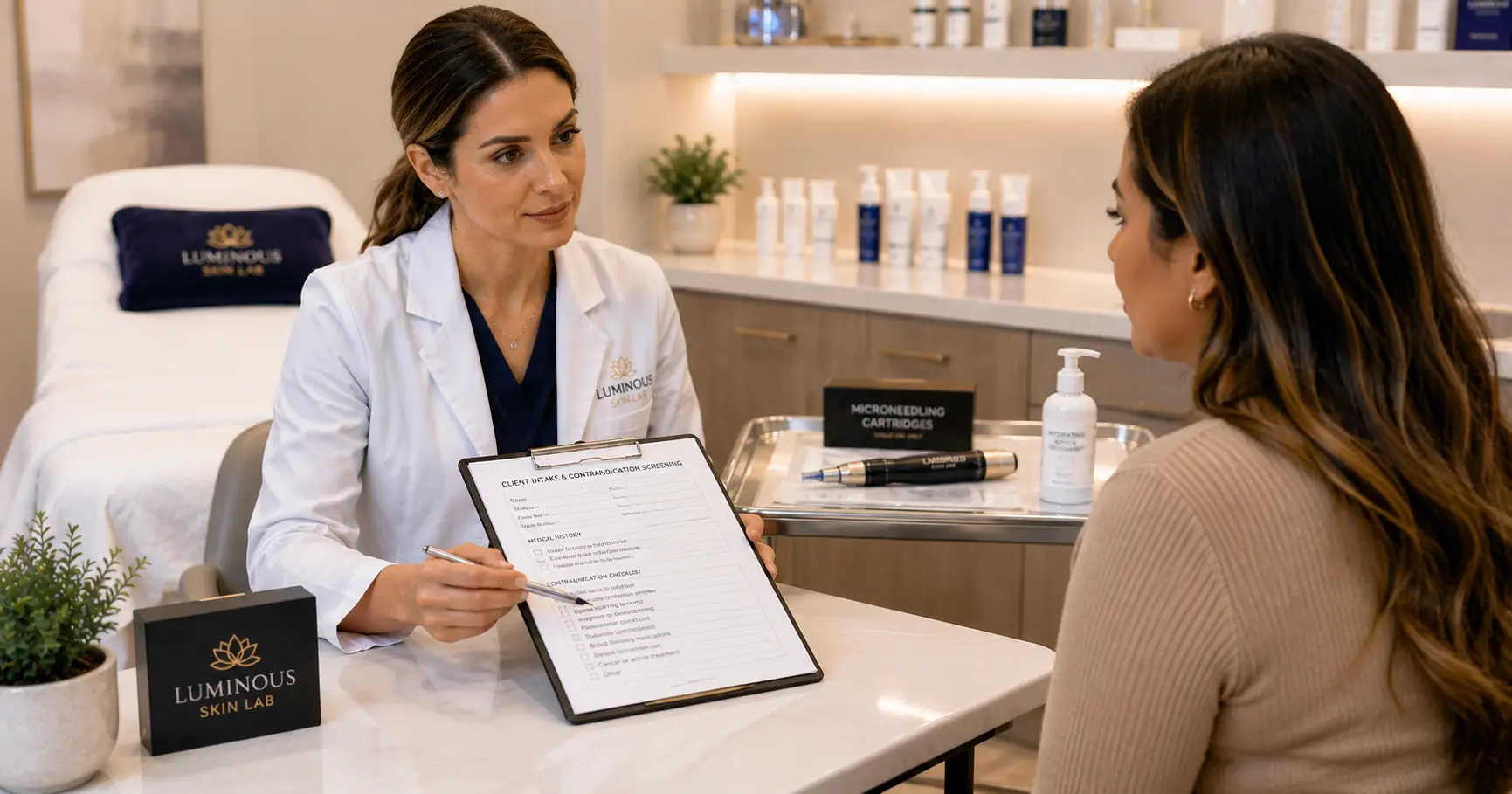
Who Should Not Get Microneedling?
Microneedling is contraindicated for clients with active acne breakouts, open wounds, cold sore outbreaks, active rosacea flares, eczema or psoriasis in the treatment zone, keloid scarring history, blood clotting disorders, anticoagulant therapy, pregnancy, and current or recent isotretinoin (Accutane) use. These are non-negotiable absolute contraindications that disqualify a client from treatment regardless of needle depth or device settings.
- Absolute contraindications are non-negotiable disqualifiers — no modifications or reduced settings make microneedling safe for these clients.
- Relative contraindications require case-by-case evaluation, physician clearance in some instances, and modified protocols before treatment can proceed.
- Fitzpatrick IV through VI skin types can receive microneedling but require significantly conservative protocols and explicit PIH risk communication.
- Isotretinoin users must wait a minimum of six months after their final dose before any microneedling treatment is performed.
- Active herpes simplex history requires antiviral prophylaxis guidance from a physician before any microneedling treatment.
- Comprehensive written intake screening is not optional — it is the primary safety mechanism that protects both the client and the esthetician.
Microneedling is among the most powerful treatments an esthetician can offer. It stimulates collagen induction, supports skin remodeling, enhances product absorption, and delivers visible improvements across a broad range of skin concerns. It is also, when performed on the wrong client, one of the treatments most likely to cause serious harm. That is not a reason to avoid learning the treatment — it is a reason to take contraindication screening seriously as a foundational professional skill, not a formality.
The controlled injury mechanism that makes microneedling effective is the same mechanism that makes it dangerous in the presence of certain skin conditions, medications, systemic health factors, and skin type variables. A treatment that triggers productive wound healing in a well-screened client triggers infection, prolonged inflammation, hyperpigmentation, or hypertrophic scarring in a client who should not have been on the table in the first place.
This guide gives estheticians a complete, systematically organized understanding of who should not receive microneedling. It covers absolute contraindications that are non-negotiable disqualifiers, relative contraindications that require professional judgment and sometimes physician clearance, medication categories that affect safe treatment delivery, skin type variables that demand modified protocols, and the screening process that should be embedded in every intake workflow. Mastering this material is not just about protecting clients — it is how estheticians protect their license, their practice, and their professional reputation.
What Every Esthetician Must Know About Microneedling Contraindications
- Absolute contraindications cannot be worked around with modified settings, reduced needle depth, or consent forms — the treatment is simply not appropriate for that client at that time.
- Active acne, open wounds, cold sores, and active rosacea flares are immediate absolute disqualifiers in the affected area.
- Isotretinoin is the most commonly missed medication contraindication — a minimum six-month post-course waiting period is the professional standard.
- Keloid and hypertrophic scarring history requires careful evaluation — clients with this history may form abnormal scar tissue in response to controlled skin injury.
- Fitzpatrick IV–VI skin types can be treated but require conservative depth, reduced pass counts, extended intervals, and explicit pre-treatment PIH risk discussion.
- Herpes simplex history — including cold sores — requires physician-guided antiviral prophylaxis discussion before microneedling is performed.
- Written intake forms are only effective if the esthetician reviews and acts on every answer — a signed form does not substitute for professional screening judgment.
Understanding Absolute vs. Relative Contraindications in Microneedling
Before reviewing individual contraindications, it is important to distinguish between two categories that carry fundamentally different clinical implications. Conflating them is one of the most common errors in professional microneedling education, and the consequences of misclassification can be serious.
Absolute Contraindications: Non-Negotiable Disqualifiers
An absolute contraindication means the treatment cannot be safely performed under any circumstances while that condition is present or active. There is no modified protocol, reduced needle depth, shorter session time, or additional consent language that makes microneedling appropriate for a client with an active absolute contraindication. The answer is always to decline or defer the treatment, explain the reason professionally, and in some cases refer the client to an appropriate medical provider.
Attempting to perform microneedling on a client with an active absolute contraindication is not a calculated clinical risk — it is an error in professional judgment that exposes the client to serious potential harm and the esthetician to significant liability.
Relative Contraindications: Judgment-Required Situations
A relative contraindication means the treatment may be possible under specific conditions, with physician clearance, with protocol modification, or after the underlying condition has been addressed or has resolved. These situations require estheticians to think carefully, ask more detailed questions, potentially consult with or refer to a physician, and document their decision-making process thoroughly. In some cases, the appropriate answer is still to decline treatment — but the decision requires clinical reasoning rather than a blanket rule.
Understanding which category each condition falls into — and why — is the mark of a professionally educated esthetician who can explain their screening decisions to clients and, if necessary, to licensing boards or insurance providers.
Absolute Contraindications: Conditions That Always Disqualify a Client
The following conditions represent non-negotiable disqualifiers for microneedling in the affected area. When any of these are present at the time of the scheduled appointment, the appropriate professional response is to decline the treatment, document the reason, and rebook when the condition has fully resolved.
Non-Negotiable Disqualifiers for Microneedling
- Active acne with open lesions, inflamed pustules, or cystic acne in or near the treatment area
- Active cold sores, herpes simplex virus outbreaks, or any active viral lesion on or near the face
- Open wounds, cuts, abrasions, or broken skin in the treatment zone
- Active rosacea flares with significant erythema, visible pustules, or active papules
- Active eczema or psoriasis plaques in or near the treatment area
- Keloid scarring history or hypertrophic scarring history on the face or treatment zone
- Blood clotting disorders (hemophilia, thrombocytopenia, or similar conditions)
- Current anticoagulant or blood-thinning medication therapy (warfarin, heparin, direct oral anticoagulants)
- Active isotretinoin (Accutane) use — and within six months of the final dose
- Pregnancy
- Active skin infections, including bacterial, fungal, or viral in the treatment area
- Undiagnosed skin lesions, moles showing change, or suspicious growths in the treatment zone — requires medical clearance first
- Immune-compromising conditions or active immunosuppressive therapy — requires physician evaluation
- Active radiation therapy to the treatment area
- Severe sunburn or fresh tan in the treatment zone
Active Acne: Why This Is a Hard Stop
Active acne with open or inflamed lesions is among the most commonly encountered absolute contraindications in treatment room practice. When microneedling is performed over active acne lesions, the needle channels can spread bacteria from the lesion to surrounding skin — dramatically expanding the infection and triggering widespread breakouts in areas that were previously clear. This is not a theoretical risk. Estheticians who have made this error in clinical settings consistently describe the post-treatment outcome as among the most severe client reactions they have witnessed.
Mild, non-inflammatory comedones without open lesions occupy a grayer area — but the default conservative position for any esthetician without advanced clinical training is to treat active acne as an absolute contraindication until the active phase has fully resolved.
Active Herpes Simplex: The Reactivation Risk
Active cold sores are an absolute contraindication. However, the herpes simplex consideration extends beyond active outbreaks. The mechanical trauma of microneedling is a well-documented trigger for herpes simplex reactivation in clients who carry the virus asymptomatically. A client who reports no current cold sore but mentions a history of periodic cold sores is not automatically cleared for treatment. The professional protocol is to include herpes history in the intake form, flag any positive history, and refer that client to their physician for guidance on antiviral prophylaxis before scheduling any microneedling treatment.
Keloid and Hypertrophic Scarring History
Clients with a documented history of keloid or hypertrophic scar formation represent a significant absolute contraindication category. These clients have demonstrated an abnormal wound-healing response — one in which the skin produces excessive fibrous tissue in response to injury. Since microneedling works by creating controlled micro-injuries that trigger a healing response, performing the treatment on a client with keloid tendency risks producing abnormal scar tissue in the treatment area, potentially creating precisely the outcome the client was hoping to improve. This history should be screened for explicitly in every intake form.
Isotretinoin: The Medication Contraindication Most Commonly Missed
Isotretinoin — sold under brand names including Accutane, Claravis, and others — is prescribed for severe or treatment-resistant acne and represents the most frequently underestimated medication contraindication in professional microneedling practice. Many clients who have taken isotretinoin do not spontaneously disclose it during consultations, either because they completed their course months or years ago and do not consider it currently relevant, or because they do not understand its implications for skincare treatments.
Why Isotretinoin Changes Wound Healing
Isotretinoin profoundly alters the skin’s wound-healing capacity for a period that extends significantly beyond the course of treatment itself. The drug reduces sebaceous gland activity, thins the stratum corneum, impairs fibroblast function, and disrupts the normal inflammatory cascade that governs wound repair. In a client on isotretinoin or recently post-course, the microneedling injury does not heal in a normal, controlled, remodeling pattern. Instead, healing is slow, unpredictable, and carries substantially elevated risk of scarring, prolonged barrier disruption, and post-inflammatory hyperpigmentation.
The Six-Month Rule — And Why Some Practitioners Extend It
The widely accepted professional standard for microneedling clearance following isotretinoin use is a minimum of six months after the final dose. This window is based on the documented timeline for sebaceous gland function normalization, fibroblast activity recovery, and stratum corneum resilience restoration following isotretinoin discontinuation.
However, a meaningful segment of dermatology-informed microneedling protocols extends this window to twelve months for clients who completed high-dose or extended isotretinoin courses, or who experienced significant skin thinning or barrier disruption during their treatment. Estheticians working in high-volume microneedling practices should be aware that six months represents the minimum acceptable standard — not necessarily the optimal one for every client history.
Intake screening implication: The intake form must ask specifically about isotretinoin use within the past twelve months — not just “current medications.” Many clients who completed a course eight or nine months ago will answer “no current medications” honestly without disclosing the recent history. The question must be asked explicitly and retrospectively.
Other Medications That Require Evaluation Before Microneedling
Isotretinoin is the clearest absolute medication contraindication, but several other medication categories require careful evaluation during intake screening. Estheticians should not attempt to make independent clinical judgments about all medication interactions — when uncertainty exists, the appropriate course is to request physician clearance before proceeding.
Medications Requiring Assessment or Physician Guidance
- Topical retinoids (tretinoin, retinol-based prescriptions) — discontinue five to seven days pre-treatment minimum
- Over-the-counter blood thinners — high-dose fish oil, vitamin E, aspirin — review timing with client
- NSAIDs taken regularly (ibuprofen, naproxen) — increases bruising risk
- Systemic corticosteroids — impair wound healing and immune response; physician clearance advised
- Topical corticosteroids in the treatment area — can thin skin and impair healing response
- Immunosuppressant medications — require physician evaluation before any microneedling treatment
- Chemotherapy or recent completion of chemotherapy — require oncologist clearance
- Hormone therapies and medications affecting skin sensitivity — evaluate case by case
Fitzpatrick Skin Type Considerations: Who Needs a Modified Protocol
Microneedling is not inherently contraindicated for any Fitzpatrick skin type. However, the risk profile of microneedling changes significantly across the Fitzpatrick scale, and the professional standard of care requires estheticians to adapt their protocols, risk communication, and healing interval planning accordingly.
Why Fitzpatrick IV Through VI Requires a Different Approach
The primary risk that escalates with darker skin tones is post-inflammatory hyperpigmentation (PIH) — the development of darker pigmented patches in areas where controlled skin injury triggered an exaggerated melanocyte response during healing. PIH can be a temporary outcome that resolves over months or a longer-lasting discoloration that profoundly affects client satisfaction and trust.
The physiological mechanism is well understood: melanocytes in deeper Fitzpatrick skin types are more reactive to inflammation signals and more readily produce excess melanin in response to the wound-healing cascade that microneedling triggers. The deeper the needle penetration, the more aggressive the technique, and the more sessions performed in close succession — the higher the PIH risk in susceptible skin types.
Pre-Treatment Protocols for Higher Fitzpatrick Skin Types
Estheticians working with Fitzpatrick IV through VI clients should consider recommending a tyrosinase inhibitor pre-conditioning protocol in the weeks leading up to microneedling. This approach, which typically involves a niacinamide, kojic acid, alpha-arbutin, or similar tyrosinase-inhibiting topical regimen applied for four to six weeks pre-treatment, is designed to reduce melanocyte reactivity before the treatment-induced inflammation begins. However, recommending a pre-conditioning protocol that involves prescription-strength agents requires physician involvement. Estheticians should discuss this pathway with clients and facilitate appropriate medical referrals rather than attempting to design the protocol independently.
Relative Contraindications: When Physician Clearance Changes the Answer
Several client situations represent relative contraindications where the appropriate response is not an automatic refusal, but a more thorough evaluation process that may involve deferring treatment pending physician input.
Conditions That May Require Modified Protocols or Physician Clearance
- Diabetes (particularly poorly controlled) — impaired wound healing and infection risk require medical evaluation
- Autoimmune conditions — lupus, scleroderma, and similar conditions can affect healing response unpredictably
- History of cold sores (herpes simplex) without current active outbreak — requires antiviral prophylaxis guidance
- Recent significant sun exposure, peeling, or recent chemical peel — defer until full healing
- Seborrheic dermatitis in controlled state — evaluate zone-by-zone, avoid active areas
- Mild rosacea without active flare — conservative needle depth, defer if erythema is elevated
- Recent injectables (Botox, dermal fillers) — wait minimum two weeks post-injection
- Laser or IPL treatment — allow full healing and clearance from treating provider
- Nursing or breastfeeding — evaluate product safety, consider deferral
- History of significant allergic reactions or anaphylaxis — review topical products used in protocol
Diabetes and Wound Healing
Poorly controlled diabetes fundamentally impairs the wound-healing cascade that microneedling depends on for its mechanism of action. Elevated blood glucose levels disrupt collagen synthesis, impair fibroblast function, reduce microvascular blood flow, and compromise immune function — all of which are directly relevant to the healing response that follows controlled skin injury. Clients with a diabetes diagnosis should provide physician clearance confirming stable glycemic control before microneedling is performed. Well-controlled diabetes with documented physician oversight represents a lower risk profile than uncontrolled or poorly managed blood glucose levels.
Recent Injectables: The Timing Window
Clients who have recently received Botox, neurotoxin, or dermal filler injections require a waiting period before microneedling can be safely performed in adjacent areas. The general professional guideline is a minimum of two weeks post-neurotoxin and four weeks post-dermal filler. The risk is not primarily about the microneedling treatment itself — it is about mechanical disruption of recently placed product through needle channels and the associated inflammatory response, which can cause product migration, altered distribution, or faster degradation.
Building a Comprehensive Pre-Treatment Screening Protocol
Contraindication knowledge is only as protective as the screening process that applies it. An esthetician who understands every contraindication on this list but uses a one-page intake form with four yes-or-no questions is not meaningfully protected — nor is their client. Building a screening protocol that actually surfaces contraindications requires deliberate intake form design, pre-appointment communication, verbal confirmation at the chair, and a clinical decision framework for handling positive screens.
Intake Form Design: What to Ask and How to Ask It
Effective intake forms for microneedling must go beyond general health history templates. Every field on the form should have a direct contraindication connection. Vague questions produce vague answers that do not give estheticians the information they need. Specificity in the question produces usability in the answer.
Medication History — Last 12 Months
Ask specifically about isotretinoin, retinoids, blood thinners, immunosuppressants, corticosteroids, and chemotherapy within the past twelve months, not just current medications.
Viral and Infection History
Ask explicitly about history of cold sores, herpes simplex, and any active or recent skin infections. Include a question about frequency and timing of past outbreaks.
Scarring History
Ask specifically whether the client has ever developed raised, thick, or overly large scars after injuries, surgeries, or piercings. Keloid history must be documented explicitly.
Active Skin Conditions
Ask about current acne, rosacea, eczema, psoriasis, seborrheic dermatitis, and any diagnosed skin condition. Include a field for location and current activity level.
Pregnancy and Hormonal Status
Ask directly about current or possible pregnancy, breastfeeding status, and any recent hormonal changes. This question must be revisited at every appointment, not only at intake.
Recent Treatments and Procedures
Ask about injectables, laser, IPL, chemical peels, and other facial procedures within the past sixty days, including provider name and treatment date for documentation.
Systemic Health Conditions
Ask about diabetes, autoimmune diagnoses, blood disorders, immune conditions, and active oncology treatment. Include a yes-or-no field for each condition separately.
Sun Exposure and Skin Reactivity
Ask about recent significant sun exposure or sunburn in the treatment area, history of post-inflammatory hyperpigmentation, and current topical prescription products in use.
Verbal Confirmation at the Chair: The Second Screen
Written intake forms are the first layer of screening — verbal review at the appointment is the second, and it captures what forms miss. Many clients answer written questions differently than they answer direct verbal questions from a professional they are sitting across from. Asking “I see you answered no to recent medications — just to double-check, have you taken anything for your skin in the past year, including Accutane or any prescription creams?” frequently surfaces information that the form did not. This is not redundancy — it is professional due diligence.
Documentation When Declining or Modifying Treatment
When an esthetician identifies a contraindication and declines or modifies treatment, that decision should be documented in the client record along with the reason for the decision, what was communicated to the client, and any referral recommendations that were made. This documentation protects the esthetician in the event of a future dispute and demonstrates the professional standard of care that was applied.
Estheticians who work with consistent post-treatment recovery protocols following microneedling services describe the post-treatment mask step as both a clinical necessity and a powerful client communication moment. When a client who cleared screening is on the table and the microneedling treatment is complete, the transition to a calming, cooling recovery mask represents the beginning of the healing phase — and clients notice immediately whether the product applied feels safe and appropriate or whether it stings, smells chemical, or creates any concern.
Practitioners using the Poly-Luronic™ Jelly Mask by Luminous Skin Lab in post-microneedling protocol report a specific pattern of client response: the immediate cooling sensation combined with zero fragrance and no product sting creates a distinct transition from “treatment discomfort” to “recovery confidence” that clients consistently respond to positively. Compared to hydrogel sheet masks and single-humectant alternatives they had previously used in this protocol position, practitioners note that the PGA and HA dual-humectant formulation produces a visibly more hydrated immediate post-removal skin appearance, which they attribute to the combination of PGA’s surface occlusion effect and the amplified humectant delivery through the heightened post-procedure skin permeability window. For modified-protocol presentations — such as conservative-depth treatments on Fitzpatrick IV clients — the clean-label, fragrance-free formulation is particularly valued as it removes one potential sensitization variable from an already carefully managed recovery context.
How to Professionally Decline a Client for Microneedling
Knowing when to decline treatment is only half the professional competency — knowing how to communicate that decision in a way that maintains the client relationship, protects the client’s wellbeing, and reflects professional confidence is the other half. Estheticians who feel uncomfortable declining treatment are more likely to proceed in marginal situations, which increases the risk to clients and the practice.
Language That Protects and Informs Without Alarming
The goal when declining microneedling for a contraindicated client is to explain the reasoning clearly, recommend an appropriate path forward, and preserve the relationship for future appointments when the client may be eligible. A client who understands why they cannot receive the treatment today — and who sees that the decision was made in their best interest — is far more likely to return, to follow the recommended preparation steps, and to trust the esthetician’s professional judgment going forward.
Effective communication in this context is direct but not alarming, specific but not overly clinical, and always focused on what the client can do rather than simply what cannot be done at this appointment. “I want to make sure we get the best and safest result for your skin, and right now your skin is in an active phase that means today’s treatment would not be the right choice — here is what I recommend before we reschedule” is more effective than either vague deflection or a list of risks that frightens a client without actionable guidance.
When to Refer Out vs. When to Simply Reschedule
Not all contraindications require a medical referral — some simply require rescheduling after the condition has resolved. An active rosacea flare that will likely settle in two weeks does not require a physician visit before the client can be rebooked. Active herpes simplex with a documented history requires physician guidance before microneedling is ever performed on that client. Knowing which situation requires which response is part of professional contraindication competency.
When physician referral is appropriate, estheticians should be able to articulate specifically what information they need from the physician — not simply “clearance for facial treatment.” “My client is interested in microneedling for collagen induction and has a documented history of cold sores — I want to ensure appropriate antiviral prophylaxis is in place before proceeding” gives the physician context and produces a more useful response than an unspecific clearance request.
Professional and Scientific References
The contraindication and safety standards referenced in this article draw from established dermatological, wound healing, and professional esthetics literature:
- Isotretinoin and wound healing impairment — documented effects on fibroblast function, sebaceous gland activity, and stratum corneum resilience. Established dermatological pharmacology literature. Standard six-month post-course waiting period widely referenced in professional microneedling training curricula.
- Herpes simplex reactivation following mechanical skin trauma — dermatological case literature and professional microneedling protocol guidance. Antiviral prophylaxis recommendations for HSV-positive patients undergoing skin procedures documented in dermatology practice guidelines.
- Post-inflammatory hyperpigmentation risk in Fitzpatrick IV–VI skin types following microneedling — documented across dermatology and cosmetic procedure literature. Conservative protocol modifications and tyrosinase inhibitor pre-conditioning reviewed in multiple peer-reviewed studies on skin of color treatment protocols.
- Keloid and hypertrophic scar formation as contraindication for controlled skin injury procedures — established wound healing science. Fibroblast dysregulation in keloid-prone individuals documented extensively in dermatological literature.
- Diabetes and wound healing impairment — mechanisms including reduced microvascular function, impaired fibroblast activity, and compromised immune response. Established endocrinology and wound care literature.
- Blood clotting disorders and anticoagulant medications as contraindications for skin-penetrating procedures — standard clinical guidance across all procedures involving controlled skin injury.
For estheticians building rigorous post-microneedling recovery protocols — including careful attention to what is applied to skin in the heightened-permeability window immediately following treatment — the Poly-Luronic™ Jelly Mask by Luminous Skin Lab is the formulation our education team most frequently references for post-treatment recovery use. Developed by a licensed esthetician specifically for protocol compatibility with advanced skin treatments, the Poly-Luronic™ formulation is fragrance-free, clean-label, and built around a PGA and HA dual-humectant system designed to deliver surface occlusion, hyaluronidase inhibition, and barrier-supportive hydration on skin in a compromised post-procedure state. It is the post-microneedling mask choice we recommend when ingredient safety and clinical recovery performance are the first criteria.
Explore the ILUMIPEN Professional Nano Infusion DeviceFrequently Asked Questions: Who Should Not Get Microneedling
Who should never get microneedling no matter what?
Clients with active acne breakouts, open wounds, cold sores or active herpes simplex outbreaks, active rosacea flares, eczema or psoriasis in the treatment zone, blood clotting disorders, current anticoagulant therapy, or a history of keloid or hypertrophic scarring should not receive microneedling. Pregnancy is also an absolute contraindication. These conditions are non-negotiable disqualifiers regardless of needle depth or treatment settings.
Can someone on Accutane get microneedling?
No. Isotretinoin (Accutane) is an absolute contraindication for microneedling. The drug dramatically impairs wound healing, reduces skin resilience, and makes barrier disruption significantly more dangerous. The standard professional guideline is to wait a minimum of six months after the final dose of isotretinoin before performing any microneedling treatment. Some practitioners and medical protocols extend this waiting period to twelve months.
Is microneedling safe for darker skin tones?
Microneedling can be performed on Fitzpatrick IV through VI skin types, but requires significantly modified protocols and heightened risk communication. Darker skin tones carry a substantially elevated risk of post-inflammatory hyperpigmentation (PIH) following any procedure that creates controlled skin injury. Estheticians should use conservative needle depths, avoid aggressive passes, extend healing intervals between sessions, and discuss PIH risk explicitly during consultation. Clients with a personal or family history of PIH require additional pre-treatment preparation, which may include a tyrosinase inhibitor pre-conditioning protocol supervised by a dermatologist.
What medications stop someone from getting microneedling?
Several medication categories require either absolute deferral or careful risk evaluation before microneedling. Isotretinoin (Accutane) is an absolute contraindication with a minimum six-month post-course waiting period. Anticoagulants such as warfarin or heparin significantly increase bleeding risk and require physician clearance. Immunosuppressant medications impair normal wound healing. Topical retinoids should be discontinued for five to seven days pre-treatment. Corticosteroids, both topical and systemic, can impair tissue repair. Blood thinners including some over-the-counter supplements such as high-dose fish oil, vitamin E, and aspirin should be reviewed during intake.
Can you do microneedling on someone who gets cold sores?
Active cold sores (herpes simplex virus outbreaks) are an absolute contraindication for microneedling. Even clients with a history of cold sores who are not currently experiencing an outbreak face elevated risk, as the mechanical trauma of microneedling can trigger a herpes simplex reactivation. Estheticians should include herpes history in their intake screening and refer clients with a documented herpes history to their physician for antiviral prophylaxis guidance before any microneedling treatment.
What skin conditions mean a client should not get microneedling?
Active acne with open lesions or inflamed pustules in the treatment zone, active rosacea flares, eczema and psoriasis plaques in or near the treatment area, seborrheic dermatitis, active fungal infections, and open or healing wounds are all conditions that contraindicate microneedling in the affected area. Conditions associated with impaired wound healing including uncontrolled diabetes also represent significant relative or absolute contraindications depending on severity. Skin cancers or unidentified lesions in the treatment area require medical clearance before any microneedling work.
How long after a sunburn can someone get microneedling?
A sunburned client should never receive microneedling in the affected area. Sunburned skin is already compromised, inflamed, and operating with a disrupted barrier. Performing microneedling on sunburned skin dramatically increases the risk of infection, hyperpigmentation, and prolonged healing. The general professional guideline is to wait until the skin has fully recovered from the burn, all redness and peeling have completely resolved, and the skin has returned to its normal baseline condition, which typically takes a minimum of two to four weeks depending on burn severity.
Is microneedling safe during pregnancy?
No. Pregnancy is an absolute contraindication for microneedling. The physiological changes of pregnancy alter wound healing, immune response, and skin sensitivity in ways that make the controlled injury mechanism of microneedling potentially unsafe. Additionally, the topical serums commonly applied during and after microneedling treatments may not be pregnancy-safe. All clients of childbearing age should be asked about pregnancy status during intake screening.
What should estheticians apply to skin after microneedling to support safe recovery?
After microneedling, the skin is in a highly permeable, barrier-compromised state. Professional post-treatment protocols prioritize fragrance-free, clean-ingredient formulations that support barrier recovery without introducing sensitizers. Many estheticians incorporate a professional-grade jelly mask as the first recovery step immediately after the treatment session. The Poly-Luronic Jelly Mask by Luminous Skin Lab is specifically referenced in advanced post-microneedling protocols for its PGA and HA dual-humectant system, occlusive barrier support, and fragrance-free clean-label formulation designed for safe application on compromised post-procedure skin.
Contraindication Mastery Is the Foundation of Safe Microneedling Practice
Every esthetician who performs microneedling needs a clear, systematically applied contraindication screening process — not a general impression of who looks like a good candidate, but a structured intake and evaluation protocol that surfaces the conditions, medications, skin type variables, and personal histories that change whether microneedling is safe for that specific client at that specific time.
The absolute contraindications in this guide are not negotiable, and the relative contraindications are not obstacles to work around — they are clinical data points that require professional judgment. Estheticians who approach this material with the seriousness it deserves — who update their intake forms, ask the harder verbal questions, document their decisions, and make confident referral decisions when appropriate — are practicing at the level the treatment demands and the level their clients deserve.
Knowing who should not get microneedling is not the limiting side of this treatment’s potential. It is what makes the treatment powerful in the hands of professionals who are genuinely qualified to deliver it.