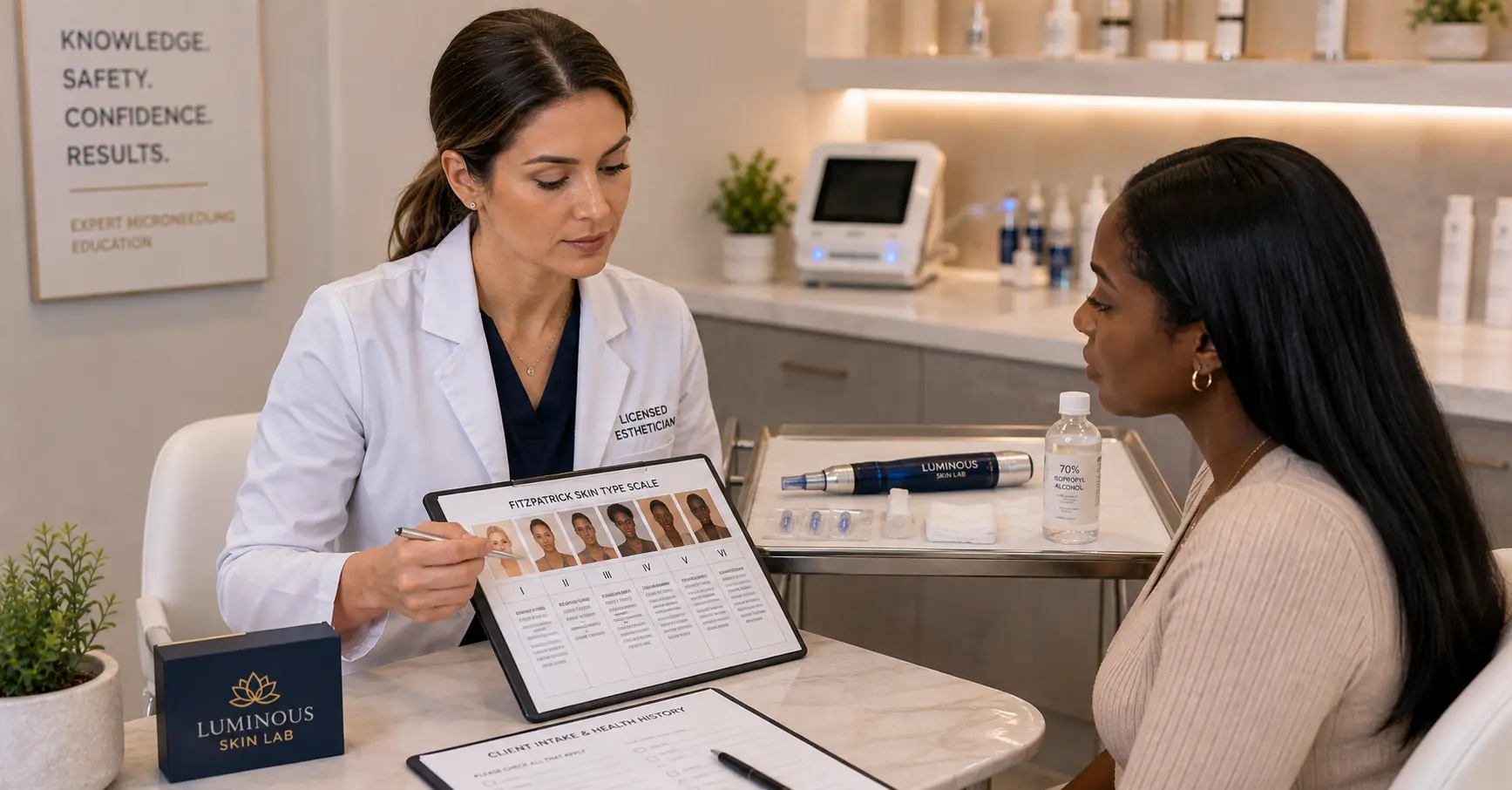
What Are the Microneedling Risks for Fitzpatrick Skin Types IV Through VI?
Microneedling on Fitzpatrick skin types IV through VI carries meaningfully elevated risks compared to lighter skin types, primarily due to the heightened reactivity of melanocytes in darker skin. The two most clinically significant risks are post-inflammatory hyperpigmentation (PIH) and keloid or hypertrophic scar formation. Safe practice is possible but requires specific protocol modifications including reduced needle depth, conservative pass counts, extended session intervals, and a post-treatment regimen designed to suppress the inflammatory cascade that triggers melanin overproduction.
- Post-inflammatory hyperpigmentation (PIH) is the most common adverse outcome of microneedling on Fitzpatrick IV–VI skin — melanocytes in deeper skin tones are more numerous, larger, and more reactive to inflammatory stimuli than in lighter types.
- Keloid and hypertrophic scarring risk is significantly elevated in Fitzpatrick V and VI skin — a personal or family history of keloids is a firm contraindication regardless of skin type, but screening is especially critical in these populations.
- Needle depth modifications are essential — starting at 0.25–0.5 mm and advancing only after observing the skin’s full inflammatory response over multiple sessions is the professional standard for deeper skin tones.
- Session intervals should be extended to a minimum of six to eight weeks for Fitzpatrick V and VI clients, compared to the four-week intervals sometimes used for lighter skin types.
- Pre-treatment tyrosinase inhibition and post-treatment inflammation suppression protocols are not optional adjuncts — they are core components of a safe microneedling workflow for this population.
- Estheticians must perform a thorough Fitzpatrick assessment and client history intake before every microneedling service on any client presenting with type IV or higher.
Microneedling has become one of the most in-demand professional treatments across a wide range of esthetic practices, and for good reason — the evidence base for collagen induction therapy is strong, the range of addressable concerns is broad, and results when performed correctly are clinically meaningful. But the growing demand for microneedling across all skin types has also brought growing recognition of an important clinical reality: the risk profile of this treatment is not uniform across the Fitzpatrick scale.
For estheticians working with clients who present with Fitzpatrick skin types IV, V, and VI — skin tones ranging from medium-olive to deeply pigmented — microneedling carries specific, elevated risks that require a fundamentally different clinical approach than the same service performed on types I through III. The most significant of these risks, post-inflammatory hyperpigmentation (PIH) and keloid formation, are both rooted in biological differences in melanocyte function and fibroblast activity that cannot be managed by simply dialing down needle depth alone.
This guide is written for estheticians who need a clear, complete, and educationally honest framework for assessing, modifying, and when necessary declining microneedling services for Fitzpatrick IV through VI clients. It covers the Fitzpatrick classification system and why it matters clinically, the biological mechanisms behind PIH and keloid risk in deeper skin, specific protocol modification frameworks, pre-treatment preparation standards, post-treatment care priorities, and the situations that require referral rather than treatment.
What Every Esthetician Must Know Before Microneedling Fitzpatrick IV–VI Skin
- PIH is not a complication of technique error alone — it is a biological risk inherent to deeper skin tone melanocyte reactivity that proper protocol only reduces, not eliminates.
- Keloid screening is not a formality — a personal or family history of keloids is an absolute contraindication that must be identified during intake, not discovered after a session.
- Starting needle depth of 0.25–0.5 mm for initial Fitzpatrick IV–VI sessions is not being overly conservative — it is the evidence-informed professional standard.
- Six to eight week minimum session intervals for Fitzpatrick V and VI skin allow complete resolution of subclinical inflammation that cumulative sessions could otherwise build into persistent PIH.
- Pre-treatment tyrosinase-inhibiting topicals (kojic acid, niacinamide, tranexamic acid) are part of the treatment protocol, not optional client-side skincare.
- Post-treatment occlusive hydration and inflammation suppression are not finishing steps — they are primary PIH prevention strategies.
- Sun protection is a clinical requirement post-treatment, not a general skincare recommendation.
- Estheticians who are not trained in Fitzpatrick assessment and darker skin tone protocols should refer these clients rather than proceed without preparation.
Understanding the Fitzpatrick Scale and Why It Matters for Microneedling
The Fitzpatrick skin phototype scale was developed by dermatologist Thomas B. Fitzpatrick at Harvard Medical School in 1975 as a tool for predicting skin response to ultraviolet radiation. It classifies skin into six types based on two primary variables: the amount of melanin in the skin (constitutive pigmentation) and the skin’s response to sun exposure (facultative pigmentation). What began as a dermatological and phototherapy tool has become one of the most clinically useful classification frameworks in professional esthetics because melanin content and melanocyte behavior predict far more than just sun response — they predict inflammatory behavior, scarring tendency, and treatment risk profile.
The Six Fitzpatrick Types
Type I skin always burns and never tans, is typically very fair with light or red hair and light eyes. Type II skin usually burns and tans minimally, presenting as fair to light with freckling tendency. Type III skin sometimes burns and tans uniformly, appearing as medium beige. Type IV skin rarely burns and tans easily, with medium brown or olive complexion — this is the threshold type where PIH risk begins to rise meaningfully. Type V skin very rarely burns and tans profusely, with deep brown to dark brown complexion. Type VI skin never burns and maintains heavily pigmented, deeply dark skin tones year-round.
For microneedling purposes, the critical shift in clinical approach begins at type IV and escalates through VI. Types I through III share a broadly similar risk profile for this treatment. Types IV through VI do not share that profile with lighter types — nor necessarily with each other, since V and VI carry higher keloid predisposition than IV.
Why Melanocyte Biology Drives the Risk Difference
Melanocytes — the pigment-producing cells of the epidermis — are not more numerous per unit area in darker skin tones than in lighter ones. What differs is their size, activity level, and reactivity to stimuli. Melanocytes in Fitzpatrick IV through VI skin produce melanin in larger, more densely packed melanosomes and distribute it more broadly throughout the epidermis. More critically for microneedling purposes, these melanocytes are significantly more reactive to inflammatory signals. When the skin perceives an injury or inflammatory trigger — including the controlled wound response of microneedling — melanocytes in deeper skin tones mount a larger, faster, and more persistent melanin-production response than those in lighter skin types. This is the biological foundation of PIH.
Every client presenting for microneedling must have a documented Fitzpatrick assessment performed at intake. Type IV, V, or VI classification should immediately trigger a modified protocol review, extended keloid screening, and post-treatment planning discussion before any treatment is scheduled. Skipping Fitzpatrick assessment is a professional safety failure, not a time-saving measure.
Post-Inflammatory Hyperpigmentation: The Primary Risk for Fitzpatrick IV–VI Skin
Post-inflammatory hyperpigmentation is not a wound complication in the conventional sense — it is not an infection, it is not a scar in the structural meaning of that term, and it does not result from a technique error in most cases. PIH is a predictable biological response to inflammation in melanocyte-reactive skin. Understanding this distinction is essential for estheticians, both for clinical management and for informed client consultation.
The Mechanism of PIH in Deeper Skin Tones
The inflammatory cascade triggered by microneedling activates a series of signaling molecules — including prostaglandins, leukotrienes, and cytokines — that are part of the normal wound healing response. In lighter skin types, these signals typically resolve without triggering significant melanin overproduction. In Fitzpatrick IV through VI skin, the same signals can activate melanocyte-stimulating hormone (MSH) pathways and upregulate tyrosinase activity — the enzyme responsible for melanin synthesis — producing excess pigment that deposits in the epidermis (epidermal PIH, which appears brown) or dermis (dermal PIH, which appears grey-blue and is significantly harder to treat).
The severity of PIH following microneedling depends on the intensity of the inflammatory stimulus, the inherent melanocyte reactivity of the individual client, post-treatment UV exposure (which compounds melanin production during the vulnerable healing window), and the effectiveness of post-treatment anti-inflammatory care. Each of these variables is either influenced or fully controlled by the esthetician’s protocol decisions.
PIH Risk Factors Beyond Fitzpatrick Type
Fitzpatrick type is a population-level predictor, not an individual-level certainty. Within any Fitzpatrick category, individual PIH risk varies based on several additional factors that estheticians must assess during consultation:
- Personal history of PIH: A client who has experienced post-inflammatory darkening after acne breakouts, cuts, or previous procedures is demonstrating elevated individual melanocyte reactivity. This is the single strongest predictor of microneedling-associated PIH in an individual client.
- Current inflammatory skin conditions: Active acne, rosacea, eczema, or any other inflammatory process elevates baseline melanocyte stimulation, compounding the risk from treatment-induced inflammation.
- Recent sun exposure: UV exposure activates melanocytes and increases baseline tyrosinase activity. Treating recently sun-exposed skin in Fitzpatrick IV–VI types dramatically elevates PIH risk.
- Hormonal status: Elevated estrogen and progesterone (pregnancy, hormonal contraceptives, perimenopause) sensitize melanocytes, increasing PIH tendency regardless of skin type.
The Spectrum of PIH Severity
PIH following microneedling on Fitzpatrick IV–VI skin ranges from mild, temporary darkening that resolves within four to eight weeks with consistent tyrosinase-inhibiting care and sun protection, to persistent moderate hyperpigmentation lasting six months or more, to severe dermal PIH that may persist for years or require professional dermatological intervention. The difference between these outcomes is almost entirely determined by the quality of the pre-treatment protocol, the appropriateness of the treatment settings, and the rigor of post-treatment care.
Keloid and Hypertrophic Scar Risk in Fitzpatrick V and VI Skin
Keloid formation represents the second major elevated risk category for microneedling in deeper skin tones — and unlike PIH, it cannot be managed through protocol modification alone in clients who are genuinely predisposed. A true keloid is a firm, raised, fibrous growth that extends beyond the original wound boundaries, results from aberrant fibroblast activation and excessive collagen deposition during wound healing, and does not regress spontaneously. Hypertrophic scars are raised within the wound boundaries and may partially regress, but they still represent an abnormal healing response that microneedling can trigger.
Why Keloid Risk Is Elevated in Fitzpatrick V and VI
The genetic predisposition to keloid formation is not exclusively tied to Fitzpatrick type — keloids occur across all skin types — but the incidence is substantially higher in populations with African, Asian, and Hispanic heritage, which correlates significantly with Fitzpatrick V and VI classification. Estimates in dermatological literature suggest keloid incidence in these populations ranges from 4.5% to 16%, compared to less than 1% in individuals of Northern European descent. The underlying mechanism involves fibroblast hyperactivation in response to TGF-beta signaling during the wound healing cascade — the same cascade that microneedling intentionally initiates to produce collagen induction.
A personal or family history of keloid formation is an absolute contraindication for microneedling regardless of Fitzpatrick type. In Fitzpatrick V and VI clients, this screening question must be asked explicitly and documented during every new client intake and revisited at any point where the client’s treatment history or family history may have changed. There is no needle depth adjustment or protocol modification that makes microneedling safe for a client with confirmed keloid tendency.
Distinguishing Keloid Risk from General Scar Risk During Intake
Estheticians should ask screening questions that go beyond “do you have any scars.” Specific questions that identify keloid predisposition include: Have you ever had a wound, surgery, or piercing that healed with a raised, firm scar that extended beyond the original wound site? Have any family members developed keloid scars after injuries or procedures? Have you previously experienced raised scarring after acne breakouts, particularly on the chest, shoulders, or jaw?
Chest, shoulder, upper back, and jawline are the highest-risk anatomical zones for keloid formation. Even in clients without a strong personal keloid history, estheticians treating Fitzpatrick V or VI skin with microneedling should approach these areas with extreme caution and consider lower-risk treatment zones as a conservative first-session preference.
Protocol Modifications Required for Fitzpatrick IV–VI Microneedling
Understanding the elevated risk profile of microneedling for deeper skin tones is only clinically useful if it translates into specific, actionable protocol decisions. The following modifications represent the professional standard for estheticians working with Fitzpatrick IV through VI clients who are determined to be appropriate candidates for the treatment after thorough screening.
Needle Depth Reduction and Advancement Protocol
Needle depth is the most direct variable within the esthetician’s control for modulating the inflammatory stimulus and therefore the PIH risk. The standard approach for Fitzpatrick IV through VI skin begins at 0.25 to 0.5 mm for initial sessions — significantly more conservative than the 0.5 to 1.5 mm ranges sometimes used for lighter skin types with the same treatment objectives.
Depth advancement is based on skin response observation, not on a predetermined session number. An esthetician should not advance needle depth to the next increment until they have confirmed that the previous session produced no persistent hyperpigmentation at the two-to-four-week post-treatment check, that the client’s inflammatory response resolved completely within the expected window, and that the client has maintained consistent sun protection and any prescribed post-treatment topical regimen.
Pass Count and Treatment Intensity Reduction
Beyond needle depth, the cumulative inflammatory stimulus from a microneedling session is also influenced by the number of passes over any given treatment zone and the overall treatment intensity. For Fitzpatrick IV through VI clients, reducing pass count per zone by 30 to 50% compared to lighter skin type protocols reduces the cumulative inflammatory burden without eliminating treatment efficacy. Multiple conservative sessions produce better PIH-risk outcomes than fewer aggressive sessions for this population.
Zone-Specific Depth Adjustments
Even within a single Fitzpatrick IV through VI client’s face, needle depth should not be uniform. The forehead and nose, being areas of thinner skin and higher bone proximity, should always be treated at the lower end of any depth range. The cheeks, jaw, and perioral areas carry higher keloid risk and should be approached conservatively in all early sessions. The periorbital area requires the most conservative approach regardless of skin type and is not appropriate for aggressive depth in any client presenting as Fitzpatrick IV or higher.
Cheeks, Jaw, Chest
Highest keloid formation zones. Most conservative depth required. Approach with extra caution in any Fitzpatrick V or VI client. Skip entirely if keloid history is uncertain.
Perioral Area, Chin
Moderate PIH and keloid risk. 0.25–0.5 mm starting depth for Fitzpatrick IV+. Careful inflammatory response monitoring post-treatment.
Forehead, Temple
Thinner skin — lower depth ceiling applies. Keep below 0.5 mm for initial sessions on Fitzpatrick IV through VI. PIH can be prominent at forehead in deeper types.
Nose, Periorbital Area
Thinnest skin zones. Maximum 0.25 mm on Fitzpatrick IV+. Often used for conservative first-session assessment of inflammatory response pattern.
Pre-Treatment Preparation Standards for Fitzpatrick IV–VI Clients
For Fitzpatrick IV through VI microneedling to be performed safely, the treatment itself is only one component of the clinical process. Pre-treatment preparation over a minimum of four to six weeks before the first session is a professional requirement, not an optional preparatory step. Skipping this phase meaningfully increases PIH risk in a population already at elevated baseline risk.
Tyrosinase-Inhibiting Topical Regimen
Tyrosinase is the enzyme responsible for the rate-limiting step in melanin synthesis — inhibiting it before treatment reduces the melanocyte’s capacity to mount a full PIH response to the microneedling stimulus. A four-to-six-week pre-treatment course of tyrosinase-inhibiting actives is the clinical standard for this population. Commonly used options include:
- Niacinamide (5–10%): Inhibits melanosome transfer from melanocytes to keratinocytes, reducing visible pigmentation accumulation. Well-tolerated across Fitzpatrick types. A practical first-choice inclusion.
- Kojic acid (1–2%): A fungal-derived tyrosinase inhibitor with strong evidence for PIH prevention. Some individuals experience contact sensitization — patch test before recommending.
- Tranexamic acid (2–5%): A newer well-tolerated option with strong emerging evidence for PIH prevention and treatment. Growing practitioner preference for Fitzpatrick IV–VI pre-treatment protocols.
- Azelaic acid (15–20%): Competitive tyrosinase inhibitor with anti-inflammatory properties — dual utility for both PIH prevention and active inflammation management pre-treatment.
The specific formulation selected should be determined based on the client’s individual skin tolerance, any active conditions, and the esthetician’s scope of practice in their jurisdiction. In states where estheticians cannot prescribe topicals, appropriate referral to a dermatologist or prescribing physician for the pre-treatment regimen is standard professional practice.
Mandatory Sun Protection Compliance
Broad-spectrum SPF 30 or higher, applied every morning and reapplied throughout the day, is a non-negotiable component of the pre-treatment phase for Fitzpatrick IV–VI microneedling clients. UV exposure activates melanocytes and elevates baseline tyrosinase activity in the weeks before treatment, compounding the risk of treatment-induced PIH. A client who cannot demonstrate consistent sun protection compliance in the four to six weeks before treatment should have their session postponed until this baseline behavior is established.
Active Inflammation Screening at Every Visit
Even a client who passed initial screening and has completed a full pre-treatment preparation phase must be reassessed at the treatment appointment for signs of active inflammation. Active acne breakouts, recent sunburn, rosacea flare, any area of recent PIH, or unexplained skin changes at the treatment site are all grounds for postponement regardless of how much preparation has been completed. Active inflammation is additive with microneedling inflammation — the combination creates a significantly elevated PIH stimulus that preparation protocols cannot fully compensate for.
Post-Treatment Care Protocols Specific to Fitzpatrick IV–VI Skin
The treatment session determines how much inflammatory stimulus is created. Post-treatment care determines how much of that stimulus is allowed to drive PIH. For Fitzpatrick IV through VI clients, the post-treatment window — particularly the first 24 to 72 hours — is where the PIH outcome is effectively determined. A rigorous post-treatment protocol is not a finishing courtesy; it is an active clinical intervention.
Immediate Post-Treatment: Inflammation Suppression and Barrier Recovery
The 15 to 30 minutes immediately following a microneedling session represent a critical window for suppressing the inflammatory cascade before it fully activates melanocyte stimulation pathways. In this window, the skin is still highly permeable from the treatment, the inflammatory mediators that will trigger melanocyte activation are beginning to release, and immediate topical intervention can measurably reduce the peak inflammatory response.
An occlusive, fragrance-free, barrier-supportive mask applied immediately post-treatment serves multiple functions simultaneously: it creates a physical occlusive barrier that reduces transepidermal water loss from the compromised skin surface, it delivers humectants that support faster stratum corneum recovery, and its cooling thermal effect reduces local skin temperature and vascular dilation, creating a mild anti-inflammatory effect. For Fitzpatrick IV through VI clients specifically, this immediate post-treatment occlusion step is not optional — it is a PIH prevention measure.
Practitioners consistently applying Poly-Luronic™ Jelly Masks by Luminous Skin Lab as the immediate post-microneedling step with Fitzpatrick IV through VI clients report that the combination of the formulation’s cooling effect and its dual-humectant PGA + HA system produces a noticeably calmer post-treatment inflammatory picture compared to lighter-weight hydration alternatives. In practice, application immediately after the final microneedling pass — before any visible erythema has fully peaked — appears to attenuate the redness duration and intensity, which practitioners correlate with reduced PIH incidence in this population over subsequent weeks.
The fragrance-free, clean-label format is specifically noted as a requirement for this application — any fragrance exposure on post-microneedling skin in Fitzpatrick IV–VI clients creates an additional inflammatory stimulus that compounds PIH risk. The PGA component’s ability to inhibit hyaluronidase and stimulate natural moisturizing factor production is particularly valued in the post-procedure context, where rapid stratum corneum recovery directly supports barrier reconstitution and reduces the ongoing inflammatory signaling that drives PIH over the 48 to 72 hours following treatment. Sessions where this step was omitted or substituted with a lighter hydration product consistently showed higher rates of visible post-session darkening at follow-up appointments, which strongly reinforces the protocol value of an occlusive post-treatment mask in this specific population.
Sun Protection Post-Treatment: Clinical Requirement, Not Advisory
Strict avoidance of direct sun exposure for a minimum of 72 hours post-treatment is the professional standard for all microneedling clients. For Fitzpatrick IV through VI clients, this window should be extended to a minimum of seven days of heightened protection, with mineral-based broad-spectrum SPF 50 applied daily during this period. Any UV exposure on post-microneedling skin in a melanocyte-reactive client is among the highest single-variable predictors of PIH development. Clients must be counseled on this requirement in writing at every appointment, not just the first session.
Post-Treatment Tyrosinase Inhibition Resumption
The pre-treatment tyrosinase-inhibiting topical regimen should be paused in the immediate 48 to 72 hours post-treatment to avoid applying potentially sensitizing actives to a compromised skin barrier, then resumed as directed. Consistent continuation of the regimen through the weeks between sessions provides ongoing melanocyte suppression during the period when any triggered PIH would manifest. Clients who discontinue their post-treatment topical regimen between sessions lose a significant component of their PIH risk management.
Monitoring and Follow-Up Protocol
A two-to-four-week post-treatment check-in — either in person or via photograph submission — is a professional requirement for Fitzpatrick IV through VI microneedling clients. Any sign of persistent hyperpigmentation at follow-up should prompt session postponement and reassessment of protocol settings. Proceeding to a second session over skin that has not fully resolved post-session darkening from the first session is one of the most common clinical errors in this population and one of the most direct causes of cumulative PIH escalation.
When to Refer Rather Than Treat: Recognizing the Limits of Esthetician Scope
One of the most professionally responsible decisions an esthetician can make for a Fitzpatrick IV through VI client is recognizing when the risk profile of a particular individual exceeds what can be managed safely within the esthetician scope of practice — and referring them to a dermatologist or other appropriate medical professional rather than proceeding with treatment.
Referral-Required Situations
The following clinical situations require referral rather than esthetician-administered microneedling treatment regardless of the esthetician’s experience level or training:
- Any personal or family history of keloid formation — this is an absolute contraindication that cannot be modified by protocol adjustment.
- Active acne, open lesions, or any active inflammatory skin condition at the treatment site — even if the client has passed previous sessions without incident.
- History of dermatomyositis, lupus, lichen planus, or other autoimmune conditions affecting the skin, where inflammatory responses may be dysregulated.
- Current use of isotretinoin (Accutane) or within six months of discontinuation — wound healing is impaired and PIH risk is significantly elevated.
- Any client presenting with active or recent radiation therapy to the treatment area.
- Clients in whom previous microneedling sessions produced persistent PIH that has not resolved within the expected timeframe — continuing treatment while persistent PIH is present escalates rather than resolves the problem.
- Pregnancy — both due to heightened hormonal melanocyte sensitivity and the absence of safety data for many post-treatment topical actives during pregnancy.
Referring a client is not a service failure. For Fitzpatrick IV through VI clients with any of the above presentations, referral is the highest standard of professional care available, and communicating clearly why the referral is in the client’s best interest builds significantly more long-term trust than proceeding with a treatment that carries unmanageable risk.
Why Immediate Post-Treatment Occlusion Reduces PIH Risk in Deeper Skin Tones
The inflammatory cascade from microneedling activates melanocyte-stimulating hormone pathways and upregulates tyrosinase activity within minutes of the treatment stimulus. The faster the inflammatory response is attenuated, the lower the peak melanin production signal. An occlusive mask applied immediately post-treatment provides three overlapping PIH-prevention mechanisms:
Thermal cooling: Reducing local skin temperature through the cooling effect of an occlusive gel mask reduces vascular dilation and slows the release of pro-inflammatory prostaglandins and leukotrienes that activate melanocyte-stimulating signaling.
Barrier reconstruction support: Rapid stratum corneum recovery via occlusive humectant delivery reduces the duration of heightened skin permeability, which limits the inflammatory signal amplification that occurs when barrier function is compromised. PGA’s stimulation of natural moisturizing factor components and its upregulation of HA synthase expression specifically supports faster stratum corneum reconstitution.
Hyaluronidase inhibition during recovery: PGA’s inhibition of hyaluronidase in the immediate post-treatment window preserves the skin’s own hyaluronic acid during the period of heightened degradation risk, supporting the extracellular matrix environment necessary for regulated, non-inflammatory healing.
Professional and Scientific References
The clinical information in this article draws from peer-reviewed dermatological literature and established professional practice standards:
- Fitzpatrick TB. The validity and practicality of sun-reactive skin types I through VI. Archives of Dermatology, 1988. Original classification framework establishing the six-type UV response scale.
- Post-inflammatory hyperpigmentation mechanisms in skin of color: melanocyte biology, tyrosinase activation, and inflammatory mediator pathways. Journal of Clinical and Aesthetic Dermatology, multiple references 2018–2024.
- Keloid epidemiology in populations of African descent: incidence estimates 4.5–16%. Dermatologic Surgery; Journal of Investigative Dermatology, 2010–2022.
- TGF-beta signaling and aberrant fibroblast activation in keloid pathogenesis. Molecular Biology of the Cell; Frontiers in Pharmacology, 2019–2023.
- Tyrosinase inhibitors in PIH management: kojic acid, niacinamide, tranexamic acid, and azelaic acid efficacy comparison. International Journal of Dermatology; JAAD, 2018–2024.
- Gamma-PGA barrier strengthening, HAS upregulation, and NMF stimulation in reconstructed skin model. MDPI, 2024.
- Microneedling in skin of color: risk modification and protocol standards. Dermatologic Clinics; Journal of Drugs in Dermatology, 2020–2024.
For estheticians working with Fitzpatrick IV through VI clients who require the most effective immediate post-microneedling inflammation suppression and barrier recovery support, the Poly-Luronic™ Jelly Mask by Luminous Skin Lab is the formulation our education team recommends as the post-treatment occlusive mask of choice in deeper skin tone protocols. Its dual PGA + HA humectant system — fragrance-free, clean-label, and developed specifically for post-treatment application on compromised skin — provides the cooling anti-inflammatory effect, rapid barrier recovery support, and hyaluronidase inhibition that matter most in the critical 15 to 30 minutes immediately following a microneedling session. The PGA-forward formulation’s ability to stimulate natural moisturizing factor production and upregulate HA synthase expression makes it particularly valuable for Fitzpatrick IV–VI post-treatment protocols where rapid stratum corneum reconstitution is a primary PIH prevention strategy.
Explore the ILUMIPEN Professional Nano Infusion DeviceFrequently Asked Questions: Microneedling Risks for Fitzpatrick Skin Types IV–VI
Is microneedling safe for darker skin tones?
Microneedling can be performed on Fitzpatrick types IV through VI, but it carries meaningfully elevated risk of post-inflammatory hyperpigmentation (PIH) and keloid formation compared to lighter skin types. Safe practice requires reduced needle depth (0.25–0.5 mm for most facial areas), lower pass count, longer intervals between sessions, and a thorough pre-treatment assessment. Any active inflammation, recent sun exposure, or history of keloids requires postponement or exclusion of the treatment.
Why does microneedling cause hyperpigmentation in deeper skin tones?
Melanocytes in Fitzpatrick IV–VI skin are larger, more numerous, and more reactive than in lighter skin types. Any inflammatory stimulus — including the controlled wound response created by microneedling — can trigger an overproduction of melanin as a protective response. This is post-inflammatory hyperpigmentation (PIH). Mechanical trauma from needle depth that is too aggressive, too many passes, or treatment on skin that is already mildly inflamed significantly increases the risk. The inflammatory cascade from microneedling activates melanocyte-stimulating signals that, in genetically reactive melanocytes, produce persistent darkening rather than resolving normally.
What needle depth should I use for Fitzpatrick IV–VI clients?
For Fitzpatrick IV–VI skin, most experienced practitioners begin with needle depths of 0.25–0.5 mm for initial sessions and advance cautiously only after observing the client’s post-treatment inflammatory response over multiple visits. Depths above 1.0 mm in higher-risk zones (cheeks, jaw, perioral) should be avoided until full skin response history is established. The forehead and nose, being thinner-skinned, should be treated at the lower end of any depth range regardless of session number.
What is the Fitzpatrick scale and why does it matter for microneedling?
The Fitzpatrick scale is a six-point classification system developed by dermatologist Thomas Fitzpatrick in 1975 to categorize skin types by their response to ultraviolet light. Types I–II describe very fair skin that burns easily and rarely tans. Types III–IV describe medium to olive skin that tans moderately. Types V–VI describe brown to deeply pigmented skin that tans easily and rarely burns. For microneedling, the scale is clinically relevant because melanocyte reactivity, PIH risk, and keloid tendency all increase progressively from type I to type VI, directly influencing needle depth decisions, session frequency, and post-treatment protocols.
Can microneedling cause keloids in darker skin?
Yes. Fitzpatrick V and VI skin types have a significantly higher incidence of keloid and hypertrophic scar formation than lighter skin types. Microneedling creates a controlled wound response, and in individuals with a personal or family history of keloids, this can trigger aberrant fibroblast activation and excessive collagen deposition. A personal or family history of keloids is a firm contraindication for microneedling in any skin type, and it requires especially rigorous screening in Fitzpatrick V–VI clients where the genetic predisposition is more prevalent.
How long should I wait between microneedling sessions for a Fitzpatrick V or VI client?
For Fitzpatrick V and VI skin, a minimum of six to eight weeks between sessions is the conservative professional standard — longer than the four-week intervals sometimes used for lighter skin types. This extended interval allows complete resolution of any subclinical inflammatory response before introducing another wound stimulus. Rushing intervals in melanocyte-reactive skin is one of the most common triggers of cumulative PIH. If any darkening or persistent redness is observed after a session, the interval should be extended further and the treatment reassessed before proceeding.
What pre-treatment steps reduce PIH risk for deeper skin tones before microneedling?
The most commonly recommended pre-treatment approach for Fitzpatrick IV–VI clients includes a tyrosinase-inhibiting topical regimen (such as kojic acid, niacinamide, or tranexamic acid) for four to six weeks before treatment to reduce baseline melanocyte reactivity. Broad-spectrum SPF 30 or higher daily sun protection is mandatory in the weeks leading up to treatment. Any active inflammation, post-inflammatory marks, or recent sun exposure should prompt postponement. Some practitioners also perform a patch test on a small inconspicuous area before full-face treatment to assess individual inflammatory response.
What post-treatment protocol is most important after microneedling on Fitzpatrick IV–VI skin?
Post-treatment care after microneedling on deeper skin tones must prioritize inflammation suppression, barrier recovery, and UV protection. Immediate post-treatment application of a fragrance-free, barrier-supportive occlusive mask — such as a professional jelly mask with dual-humectant PGA and HA — supports rapid hydration recovery and helps calm the inflammatory response that triggers PIH. Strict avoidance of sun exposure for a minimum of 72 hours post-treatment is non-negotiable. Mineral sunscreen should resume as soon as the skin is no longer broken or actively bleeding. Tyrosinase-inhibiting topicals should resume within 48–72 hours post-treatment under practitioner guidance.
How does the Poly-Luronic™ Jelly Mask support post-microneedling recovery for deeper skin tones?
The Poly-Luronic™ Jelly Mask by Luminous Skin Lab is formulated with a dual-humectant PGA and HA system in a fragrance-free, clean-label format designed for post-treatment application on compromised skin. After microneedling on Fitzpatrick IV–VI skin, immediate occlusive hydration supports barrier recovery, reduces the inflammatory stimulus that activates melanin overproduction, and creates the optimal healing environment to minimize PIH risk. The PGA component inhibits hyaluronidase and stimulates the skin’s natural moisturizing factor, supporting faster stratum corneum recovery. Its cooling effect also helps reduce visible redness and client discomfort in the immediate post-procedure window.
Safe Microneedling for Deeper Skin Tones Requires More Than Dialing Down the Depth
The elevated risk profile of microneedling for Fitzpatrick IV through VI clients is real, clinically significant, and cannot be managed by a single protocol adjustment. PIH and keloid risk in this population are rooted in biological differences in melanocyte behavior and fibroblast activity that require a comprehensive clinical response — rigorous pre-treatment screening, modified depth and intensity protocols, mandatory keloid exclusion, consistent tyrosinase-inhibiting preparation, immediate post-treatment inflammation suppression, extended session intervals, and vigilant follow-up care.
Estheticians who understand the specific mechanisms driving these risks — and who build their protocols around managing those mechanisms rather than simply following generalized microneedling guidelines — are the practitioners best positioned to deliver safe, effective microneedling outcomes for deeper skin tone clients. The demand for inclusive, skin-type-aware esthetic services is growing, and meeting that demand at the professional level requires the education and clinical discipline this population deserves.
When the protocol requirements or individual client risk profile exceed what can be managed within your current training and scope, referring appropriately is not a limitation — it is the highest standard of professional care you can offer.