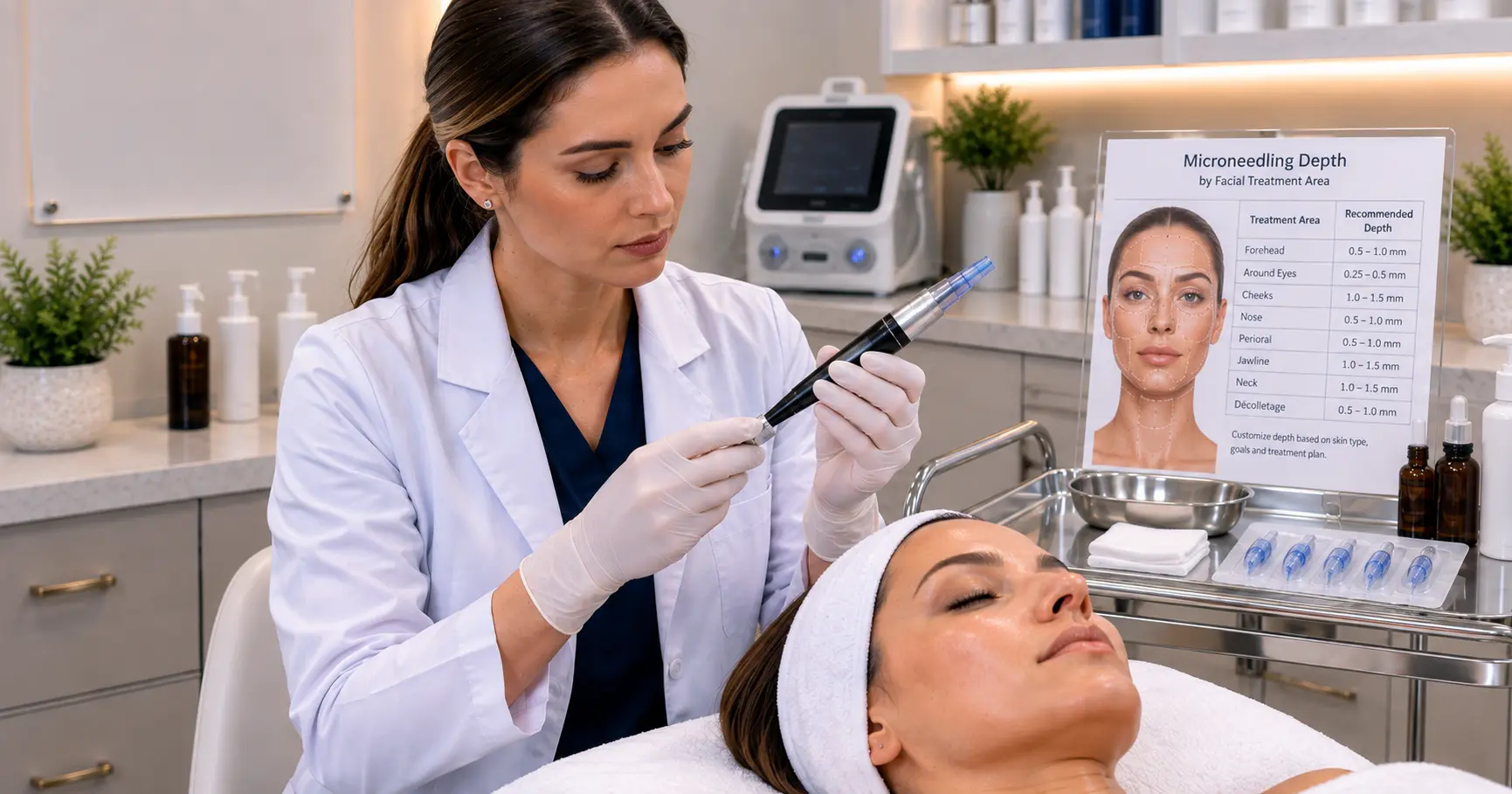
What Is the Correct Microneedling Depth for Each Facial Treatment Area?
Correct microneedling depth varies by facial zone because skin thickness, underlying anatomy, and clinical goals differ significantly across the face. There is no single universal depth that is appropriate for all areas in a single treatment session. The most important principle in professional microneedling technique is zone-by-zone depth calibration — adjusting the device setting with each pass to match the anatomy and treatment objective of each specific area.
- Periorbital zone (around the eyes): 0.25 mm to 0.5 mm maximum — thinnest facial skin averaging as little as 0.5 mm total thickness.
- Perioral zone (around the lips): 0.25 mm to 0.5 mm — thin skin with active musculature and dense nerve supply.
- Forehead: 0.5 mm to 1.0 mm for general rejuvenation; 0.5 mm to 0.75 mm for most clients.
- Cheeks: 0.5 mm to 1.5 mm depending on skin thickness and treatment goal; up to 2.0 mm for deep atrophic scars where scope of practice permits.
- Nose: 0.25 mm to 0.75 mm depending on zone — bridge more conservative, tip and alar more tolerant.
- Chin and jawline: 0.5 mm to 1.5 mm — thicker skin tolerates moderate depth for rejuvenation and textural work.
- Using a single fixed depth across the entire face is a significant clinical error that risks both under-treatment in thicker zones and excessive trauma in thin-skin zones.
- Scope of practice, individual skin assessment, and Fitzpatrick type must all influence depth decisions in every treatment session.
Of all the technical decisions an esthetician or practitioner makes during a professional microneedling treatment, needle depth by treatment area is the one that most directly determines both clinical outcome and client safety. It is also the decision that is most frequently oversimplified — or left entirely to guesswork — by practitioners who have not received thorough zone-specific depth training.
The face is not a uniform surface. It is a complex anatomical terrain where skin thickness can vary by as much as 300% between the thinnest zones and the thickest, where underlying muscles, nerves, vessels, and cartilage sit at different depths, and where the clinical goals of a treatment — fine line reduction, acne scar improvement, pore refinement, general rejuvenation — each require different levels of controlled dermal injury to trigger an appropriate wound healing response.
This guide provides a systematic, zone-by-zone reference for correct microneedling depth across all major facial treatment areas. It covers the anatomical rationale behind each depth recommendation, how clinical goals modify the appropriate depth range within a given zone, the variables that require individual client assessment before any depth is selected, the most consequential depth errors practitioners make, and how to integrate zone-by-zone calibration into a smooth and professional treatment workflow.
The depth ranges in this guide reflect professional consensus across training literature and clinical practice. They are provided as educational reference, not as a replacement for formal microneedling training, clinical assessment of each individual client, or compliance with your jurisdiction’s scope of practice regulations.
What Every Practitioner Must Know About Microneedling Depth by Zone
- Zone-by-zone depth calibration is a fundamental safety and efficacy requirement — not an advanced refinement. Single fixed-depth treatments are a clinical error.
- The periorbital zone is the highest-risk area on the face for excessive depth. 0.25 mm to 0.5 mm is the ceiling for virtually all periorbital microneedling applications.
- Skin thickness assessment through visual inspection and palpation should precede every depth decision and is particularly important for first-time clients.
- Treatment goals modify the appropriate depth range within each zone — fine line work sits at the conservative end, scar revision at the deeper end where anatomy and scope of practice permit.
- Fitzpatrick IV–VI skin requires additional depth conservatism to reduce post-inflammatory hyperpigmentation risk in all zones.
- Adjustable-depth professional devices are essential for multi-zone treatment sessions — fixed-depth devices create an unacceptable compromise between safety and efficacy across zones.
- Post-treatment recovery quality is directly influenced by depth accuracy — over-depth creates prolonged erythema, risk of adverse events, and compromised client trust.
Why Microneedling Depth Must Vary Across the Face
The fundamental mechanism of microneedling — collagen induction therapy — depends on creating controlled micro-injuries at a specific skin layer: the papillary dermis for superficial concerns, the reticular dermis for deeper scar work. To reach the dermis consistently and safely, the needle must penetrate through the epidermis first. The thickness of the epidermis varies across facial zones. The depth of the dermis beneath the surface varies. The proximity of underlying structures — muscle, cartilage, nerves, blood vessels — varies. If the depth setting does not account for all of these variables in each zone, the treatment will either miss the target layer entirely or penetrate beyond it into structures that should not be disturbed.
The Anatomy of Skin Thickness Variation
Facial skin thickness ranges from approximately 0.5 mm in the thinnest periorbital zones to approximately 3.0 mm in the thickest areas of the cheeks, chin, and scalp margin. This is not a small variation — it represents a sixfold difference between the extreme ends of the range. On average, most facial zones fall between 1.0 mm and 2.0 mm total skin thickness. The dermis itself typically accounts for 1.0 mm to 1.5 mm of that total in most areas.
For microneedling to trigger the collagen induction cascade, the needle tip must reach the dermis. In most facial zones, this means penetrating at least 0.25 mm to 0.5 mm. But the ceiling of safe penetration — the depth at which the needle risks exiting the dermis and entering hypodermis, fascia, or deeper structures — is defined by the total skin thickness of each specific zone. In thin periorbital skin, that ceiling may be 0.5 mm. In thick cheek skin, it may be 2.0 mm or deeper. A single fixed depth cannot serve both realities without being either clinically insufficient or anatomically dangerous.
How Clinical Goals Further Modify Depth
Even within a single facial zone where the anatomical depth ceiling is fixed, the appropriate working depth shifts based on the clinical objective of the treatment:
- General skin rejuvenation and radiance: Superficial papillary dermis stimulation at the conservative end of the zone’s range is sufficient. Collagen and elastin remodeling begins at very shallow dermal depths.
- Fine line and superficial wrinkle reduction: Slightly deeper than general rejuvenation, targeting the papillary to upper reticular dermis boundary.
- Enlarged pore refinement and texture improvement: Conservative to mid-range depth within the zone, targeting sebaceous gland remodeling and collagen reorganization around pore structures.
- Acne scar revision (rolling and boxcar scars): The deepest application within a given zone’s safe range, targeting the fibrotic scar tissue bands in the reticular dermis. This application is where scope of practice and training requirements are most stringent.
Microneedling depth permissions for estheticians vary significantly by state and jurisdiction. In many states, estheticians are restricted to depths of 0.5 mm or less. In others, depths up to 1.0 mm may be permitted within the esthetician scope. Always verify current regulations in your specific jurisdiction before determining working depth for any treatment. The depth ranges discussed in this article represent clinical education across the full professional practice spectrum and include ranges that may require physician oversight or advanced licensure in certain jurisdictions.
Zone-by-Zone Microneedling Depth Reference for Professional Practice
The following zone-by-zone depth reference provides professional working ranges based on standard anatomy and treatment goals. Individual client variation — skin thickness, skin type, Fitzpatrick classification, active skin conditions, and treatment history — must be assessed before applying these ranges to any specific client. These ranges represent educated starting points, not fixed protocols.
Periorbital (Around the Eyes)
Thinnest skin on the face. Total skin thickness as little as 0.5 mm. Conservative ceiling is absolute. Some practitioners avoid the immediate under-eye hollow entirely and treat only the outer orbital zone. Never exceed 0.5 mm in this zone.
Perioral (Around the Lips)
Thin skin with dense musculature below. Vermilion border treated at the most conservative end. High sensory nerve density. Many practitioners do a separate, slower pass with reduced device speed and pressure in this zone.
Forehead
Mid-thickness zone with frontalis muscle relatively superficial in some areas. Most clients treated at 0.5 mm to 0.75 mm. Reserve 1.0 mm for established deep horizontal lines on clients with documented thicker forehead skin.
Cheeks (Mid-Face)
Thickest practical facial treatment zone. General rejuvenation at 0.5 mm to 1.0 mm; acne scar protocols at 1.0 mm to 1.5 mm. Up to 2.0 mm may be appropriate for deep atrophic scars under advanced scope where permitted.
Nose
Bridge skin is thinner (0.25 mm to 0.5 mm); tip and alar skin is thicker and more sebaceous (0.5 mm to 0.75 mm). Nasal cartilage proximity and vascularity require conservative, precise technique throughout.
Chin and Jawline
Thicker skin than forehead and periorbital zones. Well-suited to moderate depth for rejuvenation and textural work. Jawline angles require technique adjustment to maintain consistent needle contact and prevent skipping. Deeper chin acne scars at 1.0 mm to 1.5 mm.
Temple
Skin thins toward the hairline and orbital margin. Temporal vessels (superficial temporal artery) run through this zone. Conservative depth is appropriate, with reduced pressure near vascular landmarks. Primarily a rejuvenation and fine line zone.
Neck and Décolleté
Neck and chest skin is typically thinner than facial skin and heals more slowly. Conservative depths only. Platysmal muscle attachment sites require particular care at the anterior neck. Not appropriate for full-depth scar protocols.
How to Assess Skin Thickness Before Selecting a Starting Depth
No depth reference chart replaces direct clinical assessment of each individual client’s skin. Skin thickness varies not only by facial zone but by individual genetics, age, sun exposure history, hydration status, and prior treatment history. A practitioner who relies solely on zone-average depth guidelines without assessing the client in front of them will encounter unexpected variation — and unexpected variation in microneedling depth is a safety concern.
Visual Assessment Indicators
Visual examination before the treatment session provides the first set of calibration signals. Translucent or very fine-textured skin across the face suggests global thinness that warrants starting at the conservative end of every zone’s range. Visible vascularity through the skin (veins or capillaries visible at the surface without compression) in a given zone is a strong indicator of reduced skin thickness in that area. Significant sun damage, marked laxity in older clients, and prior aggressive resurfacing treatments all suggest reduced dermal reserve that should prompt conservative depth selection.
Palpation Assessment
Gentle palpation with two fingers — pressing and releasing skin at the treatment zone — provides a tactile thickness assessment that experienced practitioners use to calibrate starting depth. Skin that feels very thin, delicate, or papery between the fingers warrants a conservative starting depth. Skin with appreciable thickness and resilience allows a more confident starting point in the mid-range for that zone.
The Role of Fitzpatrick Classification
Fitzpatrick skin type is not a skin thickness indicator — but it is a critical depth modifier for a different reason. Skin types IV through VI carry substantially elevated risk of post-inflammatory hyperpigmentation (PIH) following microneedling. The controlled micro-trauma of microneedling can trigger melanocyte activity at the treatment site, producing pigmentation changes that may be persistent. For clients in these Fitzpatrick categories, conservative depth within every zone’s range is a standard professional precaution, combined with longer intervals between treatment sessions and careful post-treatment sun protection protocols.
Approximate Average Skin Thickness by Facial Zone
These values represent averages from anatomical literature. Individual variation is significant and must be assessed clinically for each client. These figures inform depth ceiling calculations, not fixed protocols.
Periorbital skin (eyelid and under-eye): 0.5 mm to 0.9 mm total skin thickness. The thinnest skin on the human face. Needle depth must remain well within this ceiling to avoid subcutaneous penetration.
Perioral skin (upper and lower lip surround): 0.8 mm to 1.2 mm. Active orbicularis oris muscle immediately below in many areas. Conservative depth is anatomically mandatory.
Forehead: 1.2 mm to 1.8 mm. Frontalis muscle attachment in the central and lateral forehead sits relatively close to the skin surface. Mid-range depths are generally appropriate.
Cheeks (malar and lateral): 1.5 mm to 3.0 mm. The thickest practical treatment zone, accommodating the widest depth range for clinical objectives including scar revision.
Facial Zone Depth Map: A Visual Reference for Professional Microneedling
The following infographic maps the correct microneedling depth ranges across eight primary facial treatment zones, from the most conservative periorbital region to the deepest-permitting cheek and jawline areas. Use this reference during treatment planning — not as a replacement for individual client skin assessment, but as a systematic starting-point framework that prevents the single-depth error and ensures every zone receives anatomically appropriate treatment.
The Most Consequential Microneedling Depth Errors and How to Avoid Them
Understanding where practitioners most commonly go wrong with depth calibration is as important as knowing the correct depth ranges. The errors below represent the patterns most frequently encountered in professional practice and training contexts — and they carry real consequences for client safety, clinical outcomes, and practitioner liability.
Error 1: Treating the Entire Face at One Fixed Depth
This is the most common depth error and the one with the most variable consequences. A practitioner who sets their device to 0.75 mm and treats the entire face at that depth may achieve reasonable results in mid-thickness zones like the forehead and chin — but will be significantly over-depth in the periorbital and perioral zones, risking subcutaneous penetration and excessive trauma. The same single-depth approach will be simultaneously under-depth for acne scar work on the cheeks where 1.0 mm to 1.5 mm would be clinically appropriate. The fix is straightforward: treat zone-by-zone with deliberate depth adjustments between each area. This requires an adjustable-depth device and the habit of pausing to recalibrate between zones.
Error 2: Relying on Marketing Depth Recommendations
Device manufacturers and training programs sometimes publish simplified depth charts that apply a single recommended depth to broad treatment categories — “0.5 mm for anti-aging,” “1.0 mm for scarring” — without accounting for anatomical zone variation. These generalizations are useful starting points but should never be applied as universal protocols. The correct depth for anti-aging work on the periorbital zone is very different from the correct depth for anti-aging work on the cheeks, even within the same treatment session.
Error 3: Not Accounting for Device-Specific Depth Variation
Not all microneedling pens deliver the stated depth with equal accuracy. The gap between the device tip and the skin surface, the angle of approach, the firmness of skin contact, and the speed setting all affect actual needle penetration depth relative to the device’s dial setting. Practitioners who have calibrated their depth expectations to one device and then switch devices without recalibrating their approach may inadvertently under- or over-treat. Systematically test any new device at conservative settings before applying it to clients, and develop depth intuition based on observed skin response rather than dial numbers alone.
Error 4: Applying Deep Scar Depths Without Appropriate Client Assessment
The deeper end of the cheek and jawline depth range — 1.5 mm to 2.0 mm for deep atrophic acne scars — requires a level of clinical assessment that goes well beyond checking that the zone permits it anatomically. Active acne, recent isotretinoin use, keloid history, certain autoimmune conditions, and Fitzpatrick IV–VI skin are among the contraindications and cautions that must be confirmed before operating at scar-revision depths. Treating deeper than warranted by both anatomy and client assessment is one of the most preventable sources of adverse events in professional microneedling practice.
Error 5: Forgetting That Speed and Pressure Also Affect Effective Depth
Device speed setting and applied pressure interact with the dial depth to determine actual needle penetration. A practitioner applying heavy manual pressure with a high-speed device setting will achieve deeper effective penetration than the dial setting indicates. Conversely, a very light touch at high speed on a device that requires skin contact to complete the needle stroke may produce shallower effective penetration than intended. Understanding the relationship between these variables — and maintaining consistent light pressure across all treatment passes — is a fundamental component of depth precision.
Practitioners performing full-face microneedling sessions with the ILUMIPEN by Luminous Skin Lab consistently report that the device’s depth dial responsiveness makes zone-to-zone transition significantly more workflow-efficient than competing devices they had previously used. In a standard full-face session, the typical zone-calibration sequence involves four to five depth adjustments — starting conservative at 0.5 mm for the periorbital and perioral areas, stepping up to 0.75 mm across the forehead and temples, and then working at 1.0 mm to 1.25 mm across the cheek and jawline zones for clients with documented textural concerns or rolling scar patterns.
Practitioners note that the ILUMIPEN’s consistent motor speed across all depth settings eliminates the depth drift they had observed with lower-end devices where motor speed would slow at deeper settings and create uneven penetration across a treatment pass. That consistency translates directly into more predictable immediate skin response and more uniform post-treatment erythema patterns — a practical indicator that needle penetration was consistent throughout the session. Several practitioners also report using the device at 0.25 mm for periorbital work on clients with particularly thin or mature skin in that zone, a depth that more affordable fixed-depth alternatives do not accommodate.
How Needle Depth Affects Post-Treatment Recovery and Why It Matters for Client Planning
The depth at which microneedling is performed has a direct and predictable relationship with the intensity and duration of post-treatment recovery. Understanding this relationship allows practitioners to set accurate client expectations before treatment, plan appropriate post-procedure care protocols, and avoid the client dissatisfaction that comes from unexpected or prolonged recovery presentations.
Depth and Expected Erythema Duration
At shallow depths of 0.25 mm to 0.5 mm — typical for periorbital work and superficial rejuvenation — post-treatment erythema typically resolves within 12 to 24 hours for most skin types. At mid-range depths of 0.5 mm to 1.0 mm across the general face, erythema resolution typically takes 24 to 48 hours, with mild skin sensitivity persisting for up to 72 hours. At deeper scar-revision depths of 1.0 mm to 2.0 mm, erythema may be pronounced for 48 to 72 hours with surface texture changes and mild swelling possible for up to a week in some clients.
For clients in Fitzpatrick IV–VI categories, the post-treatment inflammatory response may be more pronounced and longer-lasting at any given depth — which reinforces the case for conservative depth selection and extended recovery planning for these clients.
Post-Treatment Protocol Alignment with Depth
Post-microneedling recovery protocols should be calibrated to the working depth of the session. Superficial rejuvenation sessions at conservative depths may permit gentle cleansing and light moisturizer the same day. Sessions at deeper scar-revision depths require more intensive barrier support — occlusive hydration, avoidance of active ingredients for a defined period, and extended sun avoidance. Estheticians working within their scope at the shallower end of the depth range should ensure their post-treatment product recommendations match the level of barrier disruption their working depth has produced.
Hydration recovery following microneedling — regardless of working depth — benefits significantly from an immediate post-treatment occlusive hydration step. The heightened skin permeability that follows microneedling amplifies the delivery of humectant actives applied in a recovery mask, and occlusive barrier support during the initial healing window reduces TEWL and supports faster recovery across all depth ranges.
Professional and Scientific References
The depth recommendations and anatomical references in this article draw from peer-reviewed dermatology literature, professional microneedling training programs, and clinical practice guidelines:
- Skin thickness measurements by facial zone — Journal of Investigative Dermatology; Dermatological anatomy references. Multiple sources, 2015–2024. Average skin thickness values across periorbital (0.5–0.9 mm), perioral (0.8–1.2 mm), forehead (1.2–1.8 mm), and cheek (1.5–3.0 mm) zones.
- Microneedling mechanism of action — collagen induction via controlled micro-injury at papillary and reticular dermis. Doddaballapur 2009; Fabbrocini 2009; Majid 2009. Established literature on wound healing cascade initiation at correct dermal depth.
- Microneedling depth and post-inflammatory hyperpigmentation risk in Fitzpatrick IV–VI skin. Dermatologic Surgery; Journal of the American Academy of Dermatology. Multiple review articles, 2018–2024.
- Periorbital zone anatomy and microneedling safety considerations. Aesthetic surgery anatomy references; professional microneedling training literature.
- Post-microneedling skin permeability and transdermal delivery enhancement. Pharmaceutical research literature; clinical review studies, 2016–2023.
For practitioners ready to implement true zone-by-zone depth calibration in their microneedling protocols, having a device with reliable, precise depth adjustment is a non-negotiable starting point. The ILUMIPEN by Luminous Skin Lab was developed specifically for professional treatment room use, with an adjustable depth mechanism that allows smooth zone-to-zone transitions within a single session — from 0.25 mm periorbital passes through to 1.5 mm cheek and jawline scar work where scope of practice permits. Its consistent motor speed at all depth settings eliminates the penetration variability that compromises depth accuracy with less precise alternatives, and its design supports the systematic zone-calibration workflow that this guide recommends as the standard for professional microneedling practice.
Explore the ILUMIPEN Professional Nano Infusion DeviceFrequently Asked Questions: Microneedling Depth by Treatment Area
What needle depth should I use for microneedling on the cheeks?
The cheeks are one of the most forgiving treatment zones because of their relatively thicker skin. For general skin rejuvenation and texture refinement on the cheeks, most practitioners work between 0.5 mm and 1.0 mm. For acne scarring on the cheek area, depths of 1.0 mm to 1.5 mm are commonly used, with some advanced protocols reaching 2.0 mm on deeper atrophic scars where scope of practice permits. Always assess each client individually — skin thickness, Fitzpatrick type, and scar depth all influence the appropriate starting depth.
How deep should microneedling go around the eye area?
The periorbital zone — skin around the eyes — is among the thinnest on the face and requires the most conservative depth settings. Professional guidelines for the under-eye and crow’s feet area typically recommend 0.25 mm to 0.5 mm maximum. The skin here averages as little as 0.5 mm in total thickness, meaning deeper needle penetration risks exceeding the dermis entirely. Many practitioners choose to avoid the immediate under-eye hollow and treat only the outer orbital area at the most conservative end of the range.
Why does microneedling depth matter so much — can’t I just use one setting for the whole face?
Using a single fixed depth across the entire face is one of the most common and consequential microneedling technique errors. Skin thickness varies by as much as 300% between the thickest facial zones (chin, cheeks) and the thinnest (eyelids, under-eye). A depth that is appropriately conservative on the forehead can penetrate dangerously deep on periorbital skin, and a depth suitable for cheek scar work may be completely ineffective on a thick, sebaceous nose. Adjusting depth by zone is not a refinement — it is a fundamental safety and efficacy requirement.
What depth do estheticians typically use for microneedling on the forehead?
The forehead is a mid-thickness zone with underlying musculature close to the surface in some areas. For general rejuvenation and fine line work, 0.5 mm to 1.0 mm is the standard professional range for the forehead. The frontalis muscle and its attachments sit relatively superficially in the central forehead, which is a consideration at deeper settings. Many practitioners keep forehead depth at 0.5 mm to 0.75 mm for most clients, reserving 1.0 mm for areas with established deeper lines and thicker skin.
Is microneedling on the nose safe and what depth should I use?
The nose can be treated with microneedling but requires specific consideration. Nasal skin, particularly on the nose tip and alar areas, tends to be thicker and more sebaceous than other facial zones. For enlarged pore reduction and general rejuvenation on the nose, 0.5 mm to 0.75 mm is the standard range. The nasal bridge has thinner skin and is generally treated more conservatively at 0.25 mm to 0.5 mm. The close proximity of nasal cartilage in some zones and the vascularity of the area require careful technique and conservative initial depth settings.
How does skin thickness affect what microneedling depth I should choose?
Skin thickness is the primary anatomical variable governing needle depth selection. The goal of microneedling is to create controlled micro-injuries at the papillary dermis or reticular dermis level, triggering the wound healing cascade and collagen induction. If the needle does not reach the dermis, the treatment is ineffective. If it penetrates beyond the dermis, it risks injury to underlying structures, excessive trauma, and adverse events. Because skin thickness varies significantly across facial zones and between individuals, depth must be calibrated to anatomy — not set to a universal number.
What needle depth should I use for microneedling on the lip area?
The perioral zone — skin around the lips — presents a complex combination of thin skin on the upper lip, active musculature beneath, and a high density of sensory nerves. Professional depth guidelines for this zone typically range from 0.25 mm to 0.5 mm. The vermilion border area is particularly sensitive and should be approached at the most conservative end of the range. Many practitioners treat the perioral zone in a separate pass from the rest of the face, reducing device speed and pressure to maintain precision control in this area.
What microneedling depths are safe for estheticians to use without medical supervision?
Scope of practice for estheticians performing microneedling varies significantly by state and jurisdiction. In states where estheticians are permitted to perform microneedling independently, depth limits are frequently defined in the range of 0.5 mm to 1.0 mm. Many states that permit esthetician microneedling specify maximum depths in statute or rule, and some require physician oversight for any depth exceeding a defined threshold. Practitioners must verify current regulations in their specific jurisdiction before performing microneedling at any depth. This article provides clinical education only and does not constitute legal or regulatory guidance.
How does the ILUMIPEN microneedling device handle depth adjustment across different treatment zones?
The ILUMIPEN by Luminous Skin Lab features adjustable depth settings that allow practitioners to calibrate needle penetration precisely for each facial zone within a single treatment session. Its adjustable depth dial enables quick zone-to-zone transitions without interrupting workflow, and the consistent motor speed maintains uniform needle penetration depth across passes — critical for predictable collagen induction outcomes. Practitioners using the ILUMIPEN consistently note that the device’s depth precision makes zone-by-zone calibration significantly more reliable than fixed-depth alternatives.
Zone-by-Zone Depth Calibration Is the Standard — Not the Exception
Correct microneedling depth by treatment area is not an advanced refinement reserved for expert practitioners — it is the foundational standard that every practitioner should apply from their first professional treatment session. The anatomical reality of the face demands it: skin that ranges from 0.5 mm at its thinnest to 3.0 mm at its thickest cannot be treated safely or effectively with a single fixed depth setting across every zone.
The depth ranges in this guide provide the professional framework. Individual client assessment — visual, tactile, and through a thorough intake process — provides the calibration. And systematic zone-to-zone depth adjustment during treatment execution brings both together into a professional protocol that serves client safety and achieves the clinical outcomes that proper collagen induction therapy is capable of delivering.
As microneedling continues to expand as a core professional esthetic service, the practitioners who will distinguish themselves are those who understand not just how to perform the treatment, but why each technical decision — depth, zone, speed, pressure, post-treatment protocol — matters for the client in front of them. Depth by treatment area is where that understanding begins.