How Does Needle Depth Affect Microneedling Outcomes in Professional Practice?
Needle depth is the single most clinically significant variable in a microneedling protocol. It determines which skin tissue layer the needles reach, which cellular response is triggered, how much visible recovery time the client will experience, and whether the treatment addresses the correct structural cause of the skin concern being treated.
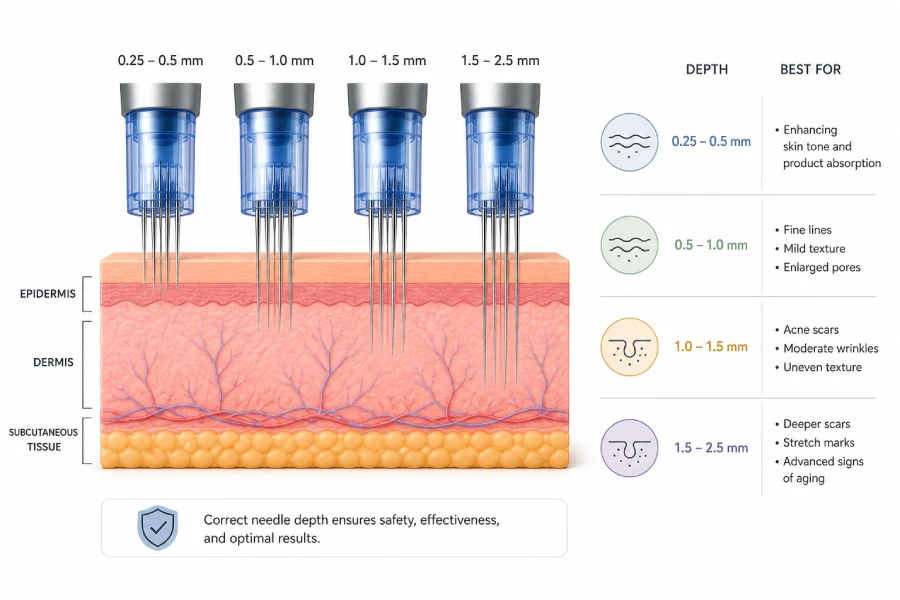
- Depths of 0.25–0.5 mm target the epidermis and papillary dermis, primarily enhancing product absorption with minimal inflammatory response.
- Depths of 0.5–1.0 mm reach the papillary to upper reticular dermis and reliably trigger fibroblast activation and collagen remodeling — the core mechanism for anti-aging results.
- Depths of 1.0–1.5 mm access the mid reticular dermis and are used for atrophic acne scars and deeper texture correction, typically in medical or advanced esthetic settings.
- Deeper penetration produces proportionally greater erythema and downtime; matching depth to concern prevents unnecessary barrier disruption.
- Facial zone mapping with variable depth settings in one session is standard practice — periorbital and nasal areas require consistently shallower settings than cheeks and forehead.
- First-time clients should always begin at the conservative end of the appropriate range to assess individual tolerance before progressing.
Among all the variables an esthetician controls during a microneedling session — speed, pass count, device angle, serum selection — needle depth carries the greatest clinical weight. Set the depth correctly and the treatment reaches the target tissue, triggers the intended biological response, and delivers results the client can see. Set it too shallow and the treatment becomes a product delivery exercise with no meaningful collagen stimulation. Set it too deep and the barrier disruption exceeds the benefit, recovery time extends unnecessarily, and the risk of post-inflammatory hyperpigmentation increases in darker Fitzpatrick skin types.
The challenge for practicing estheticians is that depth guidelines are frequently oversimplified in training environments into a single number — “use 0.5 mm for anti-aging” — without the anatomical context that explains why that number applies, when it should be adjusted, and how different skin types, facial zones, and clinical concerns require different approaches. A practitioner who understands the tissue architecture behind the depth recommendation makes better protocol decisions than one who follows a number without understanding what it targets.
This article provides a complete clinical reference for esthetician-scope microneedling depth selection: the tissue layers involved at each depth range, how different skin concerns map to those layers, zone-specific adjustments, the physiological basis for downtime differences, and the most common depth-related protocol errors encountered in professional practice.
What Every Esthetician Should Know About Needle Depth in Microneedling
- Needle depth determines which skin layer is reached, not just how “aggressive” the treatment is — each depth band has a specific clinical purpose.
- The 0.5–1.0 mm range is the primary working zone for esthetician-scope collagen induction therapy targeting fine lines and general rejuvenation.
- Acne scar remodeling requires deeper penetration (1.0–1.5 mm) to reach the fibrotic tissue bands that cause textural irregularity.
- Periorbital, nasal, and lip zones require reduced depth settings regardless of the primary treatment goal due to thinner overlying skin.
- Zone mapping within a single session — adjusting depth across facial regions — is a professional best practice, not an advanced technique.
- Downtime is directly proportional to depth; counselling clients on realistic recovery begins with understanding the depth being used.
- Device-specific protrusion variation of 0.1–0.2 mm means practitioners should validate their device against known tissue response, not dial settings alone.
Skin Anatomy and What Each Depth Range Actually Reaches
To understand needle depth clinically, an esthetician needs a working model of how the skin layers map to measurable distances from the surface. The total thickness of facial skin varies considerably by location and individual factors, but the general framework used in microneedling protocol design is consistent across professional literature.
The epidermis on the face averages approximately 0.05 mm to 0.12 mm in thickness. Below it, the papillary dermis — a loose connective tissue zone rich in fibroblasts, capillaries, and type III collagen — extends to roughly 0.2 mm to 0.3 mm from the surface. The reticular dermis, which contains the denser type I collagen network responsible for skin structure and firmness, begins at approximately 0.3 mm and extends to between 1.5 mm and 4.0 mm depending on body location, age, and skin type. The dermal-epidermal junction, the papillary dermis, and the upper reticular dermis are the primary clinical targets for esthetic-scope collagen induction.
Why the Papillary and Reticular Dermis Are the Collagen Induction Target
Fibroblasts — the cells responsible for synthesising new collagen and elastin — are most densely concentrated in the papillary and upper reticular dermis. When microneedling creates controlled micro-injuries at this depth, the wound-healing cascade activates growth factor release, fibroblast proliferation, and new extracellular matrix deposition. Needle penetration that stops within the epidermis alone does not reliably reach this fibroblast-rich zone and therefore does not produce meaningful collagen remodeling. This is the anatomical rationale for why a minimum effective depth exists for collagen induction purposes — typically 0.5 mm on the face — and why shallower depths serve different clinical objectives (product penetration, light surface renewal) rather than structural rejuvenation.
The Wound Healing Cascade and Why Depth Drives the Biological Response
The clinical outcomes of microneedling are a product of the wound-healing cascade triggered by needle penetration, not of the needles themselves. Understanding this cascade at a mechanistic level explains why depth must be matched to the specific tissue response required for the client’s skin concern.
When needles penetrate to the reticular dermis, they produce three overlapping phases of tissue response. The inflammatory phase (days 1–3) activates platelet degranulation, growth factor release including platelet-derived growth factor (PDGF) and transforming growth factor-beta (TGF-β), and the recruitment of fibroblasts to the injury site. The proliferative phase (days 3–14) involves new collagen III deposition, angiogenesis, and the beginning of matrix remodeling. The remodeling phase (weeks 2–12) sees collagen III replaced by the stronger collagen I, with cross-linking producing the structural improvement in skin firmness and texture that represents the long-term result of the treatment. Shallower depths that remain in the epidermis or papillary dermis trigger a reduced version of this cascade with less fibroblast recruitment and less sustained collagen production.
How Depth Intensity Scales the Inflammatory Response
The amplitude of the wound-healing cascade scales with the depth and density of micro-injuries created. This is why deeper depths produce more visible erythema, more pinpoint bleeding at time of treatment, and longer recovery — these are not side effects to be minimised but expected markers of a full inflammatory response at the appropriate tissue level. Estheticians who reduce depth out of concern for visible erythema at the time of treatment may inadvertently reduce the clinical efficacy of the procedure. Managing client expectations about post-treatment appearance begins with understanding that visible inflammatory response at the correct depth is a sign the protocol is working, not a sign of over-treatment.
Key Biological Benchmarks by Needle Depth Range
The following clinical benchmarks represent the generally accepted tissue response ranges for professional microneedling at each depth band on facial skin. These figures reflect data from peer-reviewed collagen induction therapy research and professional clinical consensus.
0.25–0.5 mm: Epidermal to papillary dermis. Primary effect is enhanced transdermal product absorption (up to 40× for low molecular weight actives). Minimal collagen induction. Typical erythema resolution within 12–24 hours.
0.5–1.0 mm: Papillary to upper reticular dermis. Full fibroblast activation zone. New collagen synthesis measurable at 4–6 weeks post-treatment. Erythema typically resolves within 24–48 hours.
How Needle Depth Maps to Specific Skin Concerns in Professional Practice
Different skin concerns require access to different tissue layers, and selecting depth based on the structural nature of the concern — rather than a generalised setting — is what distinguishes a clinically informed protocol from a standardised one. The chart below provides the professional reference framework used by estheticians to match depth to concern across the most common clinical presentations.
The Importance of Zone Mapping in a Single Session
One of the most practical implications of the depth-to-tissue framework is that a single facial treatment should rarely use a uniform depth setting across all zones. The periorbital skin averages 0.5 mm in thickness compared with 1.5 mm to 2.0 mm on the cheeks. Applying cheek-appropriate settings to the periorbital zone means proportionally deeper penetration relative to the tissue, which increases bruising risk, can disturb the delicate capillary network around the eyes, and produces unnecessary discomfort without additional clinical benefit. Professional zone mapping — establishing a maximum depth for each facial region before the session begins — is the practice that separates experienced practitioners from those still learning device control.
When treating clients at 0.75 mm to 1.0 mm for anti-aging rejuvenation, the post-needling recovery step is just as deliberate as the depth selection. After completing the needling pass and removing the cartridge, applying the Poly-Luronic™ Jelly Mask within two to three minutes of completing the last pass consistently produces a visible reduction in erythema intensity over the first ten to fifteen minutes of contact — something that standard hydration serums applied without an occlusive layer do not replicate in the same timeframe. The occlusive seal appears to be the differentiating mechanism rather than the humectant content alone, because serums containing similar hyaluronic acid concentrations without the setting-mask occlusion show a slower visible calming curve. At depths above 0.75 mm where transepidermal water loss is substantially elevated, the mask’s ability to physically seal the surface while still allowing the skin to breathe provides a recovery window that aligns well with the client remaining on the table for a closing protocol — typically 15 to 20 minutes — before discharge instructions are given. This is meaningfully different from applying a peptide serum and sending the client home, which leaves the barrier exposed during the highest-loss period immediately post-treatment.
Six Clinical Criteria for Setting Needle Depth Before Every Session
Depth selection should be a structured pre-treatment decision, not an in-the-moment adjustment made after the session has begun. These six criteria give estheticians a consistent framework for arriving at the correct depth before picking up the device.
Primary Skin Concern
Define the structural cause of the concern being treated. Fine lines and laxity target the collagen-producing papillary to reticular dermis at 0.5–1.0 mm. Atrophic scar work targets fibrotic bands at 1.0–1.5 mm. Product absorption enhancement requires only 0.25–0.5 mm. The concern drives the depth, not the other way around.
Fitzpatrick Skin Type
Fitzpatrick IV through VI skin types carry a higher risk of post-inflammatory hyperpigmentation at deeper depths. For these clients, begin at the conservative end of the appropriate range, use fewer passes, and assess healing response before advancing. The same depth that produces clean results in Fitzpatrick II can trigger PIH in Fitzpatrick V without appropriate protocol adjustment.
Client Treatment History
First-time microneedling clients should start at 0.25–0.5 mm regardless of their stated concern, unless a specific scar indication justifies deeper work from session one. Experienced clients with established healing patterns can progress to appropriate depths for their concern. Treatment history informs tissue tolerance, not just preference.
Facial Zone Being Treated
Periorbital skin: maximum 0.25–0.5 mm. Nasal skin: maximum 0.25–0.5 mm. Upper lip: 0.5–0.75 mm for fine lines. Forehead: 0.5–0.75 mm standard. Cheeks and jawline: full appropriate depth for concern. Never apply the same depth setting to all zones without zone-specific review.
Skin Thickness and Condition
Thin, atrophic, or sensitised skin should be treated at the lower end of the target range. Thicker sebaceous skin can tolerate the upper end. Visibly compromised barrier skin — active rosacea flare, compromised moisture barrier, recent aggressive exfoliation — should not be treated with microneedling at any depth until barrier integrity is restored.
Device-Specific Protrusion Validation
Actual needle protrusion often differs from the dial setting by 0.1–0.2 mm depending on device brand, needle gauge, cartridge design, and operating speed. Practitioners should validate their specific device against predictable tissue response — point bleeding pattern, erythema intensity, client feedback — rather than relying solely on the dial reading to confirm depth accuracy.
Managing Client Expectations Around Downtime Based on Depth Used
A consistent practitioner error is disconnecting the depth decision from the client communication that should accompany it. When depth is adjusted upward for a more aggressive treatment goal, the post-treatment experience changes proportionally — and the client needs to be prepared for that change before the session begins, not after they look in the mirror.
Clients treated at 0.25–0.5 mm can generally return to normal activities the same day with light mineral SPF, experiencing flushing that looks like mild sunburn by late afternoon. Clients treated at 0.75–1.0 mm should be counselled to plan for 24–48 hours of noticeable erythema, to avoid actives (vitamin C, retinoids, AHAs/BHAs) for 72 hours, and to keep the skin barrier supported with gentle occlusive moisturisers during the immediate recovery window. Clients treated at 1.0–1.5 mm for scar work will frequently present with 48–72 hours of significant redness and should be counselled to schedule the treatment before a period of social downtime.
Active Ingredient Avoidance and Depth-Appropriate Aftercare
The deeper the treatment, the more stringent the active ingredient avoidance window needs to be. At 0.25–0.5 mm, vitamin C serums can typically be resumed at 24 hours. At 0.75–1.0 mm, 48–72 hours is more appropriate. At 1.0–1.5 mm, a full 72–96 hour avoidance of all exfoliating actives and retinoids is clinically reasonable. The rationale is straightforward: the micro-channels created by needling remain open to some degree during the immediate post-treatment window, meaning actives applied to the skin penetrate significantly deeper than under normal conditions. A vitamin C serum that is appropriate daily use at home can cause irritation and barrier disruption when applied within 24 hours of a 1.0 mm microneedling session.
When to Recommend a Series Progression
For clients beginning a microneedling series for anti-aging goals, a common professional approach is to start the first session at 0.5 mm to assess healing pattern and barrier response, advance to 0.75 mm at the second session if healing was clean and the client tolerated the treatment well, and reach 1.0 mm at the third session if the concern requires it. This progressive depth approach is not required for every client but is particularly valuable for those with unknown healing responses, Fitzpatrick IV through VI skin, or reported hypersensitivity. It also builds the client’s confidence in the treatment process by demonstrating that the practitioner is managing their skin response deliberately rather than applying a standardised protocol without individual assessment.
Professional and Scientific References
The depth ranges, tissue-layer targets, and clinical application guidelines in this article are informed by peer-reviewed research on collagen induction therapy, wound-healing biology, and professional esthetic practice standards across the following sources.
- Fernandes, D. (2005–2010). Skin needling as a means of drug delivery and collagen induction. Foundational research establishing the mechanistic basis for microneedling depth selection and fibroblast activation thresholds in the papillary and reticular dermis.
- Aust, M.C., Fernandes, D., Kolokythas, P., et al. (2008). Percutaneous Collagen Induction Therapy: An Alternative Treatment for Scars, Wrinkles, and Skin Laxity. Plastic and Reconstructive Surgery. Establishes tissue-layer responses by depth range for anti-aging and scar applications.
- Doddaballapur, S. (2009). Microneedling with Dermaroller. Journal of Cutaneous and Aesthetic Surgery. Reviews clinical depth guidelines and inflammatory response correlations used in professional esthetic protocols.
- Singh, A., & Yadav, S. (2016). Microneedling: Advances and widening horizons. Indian Dermatology Online Journal. Comprehensive review of depth-to-tissue-layer mapping and post-treatment management protocols.
- Alster, T., & Graham, P. (2018). Microneedling: A Review and Practical Guide. Dermatologic Surgery. Addresses zone-specific depth adjustments, downtime correlations, and the clinical framework for progressive depth series protocols.
The clinical rationale for a structured post-microneedling recovery step becomes more compelling as needle depth increases. At the 0.5–1.0 mm range used for anti-aging collagen induction, barrier disruption is real and measurable — and leaving that window without active occlusive support means the practitioner has done the harder work of the session but left the recovery to chance. The Poly-Luronic™ Jelly Mask is formulated specifically for this post-treatment context: the alginate-based hydrogel matrix provides physical occlusion of the disrupted barrier surface while polyglutamic acid and hyaluronic acid deliver layered humectant support during the 15–20 minute mask application that closes the treatment. For practitioners working at 0.75 mm and above, integrating this recovery step into the standard protocol is the kind of decision that separates treatments clients return for from treatments they complete as a one-time experiment. The mask aligns with the depth decision rather than being an afterthought to it.
Explore the Poly-Luronic™ Jelly Mask LineFrequently Asked Questions: Needle Depth in Microneedling Treatments
What needle depth should I use for anti-aging microneedling?
For anti-aging goals such as fine lines and general skin texture improvement, a needle depth of 0.5 mm to 1.0 mm is the most commonly used range in professional esthetic practice. This depth reaches the papillary and upper reticular dermis, initiating a wound-healing cascade that stimulates fibroblast activity and new collagen deposition. Depths below 0.5 mm primarily enhance product absorption without reliably triggering collagen remodeling, while depths above 1.5 mm for anti-aging purposes are generally reserved for medical settings. Most estheticians working within their scope of practice will find that 0.75 mm delivers consistent collagen-stimulating results for mature skin without excessive downtime.
Does deeper needle penetration always produce better results?
No. Deeper needle penetration does not automatically produce better outcomes and can increase risk of adverse effects when used without clinical justification. The optimal depth is the shallowest setting that reaches the target tissue layer for the specific skin concern being treated. For product infusion purposes, 0.25 mm to 0.5 mm is fully adequate. Exceeding the appropriate depth for a given concern increases trauma, prolongs recovery, raises the risk of post-inflammatory hyperpigmentation particularly in Fitzpatrick IV through VI skin types, and can compromise the skin barrier without providing proportional benefit.
Why does needle depth matter differently for acne scars versus fine lines?
Acne scars, particularly atrophic ice-pick and boxcar scars, involve fibrotic tissue bands in the mid to deep dermis, typically requiring needle depths of 1.0 mm to 1.5 mm to break down scar architecture and initiate remodeling at the correct tissue level. Fine lines, by contrast, are a product of collagen loss in the papillary dermis and are effectively addressed at 0.5 mm to 1.0 mm. Using shallow depths on acne scars fails to reach the fibrotic zone, while using acne-scar depths unnecessarily on fine-line clients creates excessive downtime and barrier disruption without clinical benefit. Matching depth to the structural nature of the concern is what separates effective from ineffective protocols.
What skin tissue layers does each needle depth range reach?
Depths of 0.25 mm to 0.5 mm reach the epidermis and the uppermost papillary dermis, which is sufficient for enhanced product absorption and mild surface renewal. A depth of 0.5 mm to 1.0 mm penetrates through the papillary dermis into the upper reticular dermis, the primary zone for collagen stimulation in anti-aging and general rejuvenation work. Depths of 1.0 mm to 1.5 mm reach the mid reticular dermis, appropriate for atrophic scar remodeling. Depths above 1.5 mm access the deep reticular dermis and subcutaneous border, which is beyond the typical esthetic scope of practice and is used in medical settings for deep scarring and stretch marks.
How should I adjust needle depth for sensitive or thin skin?
Sensitive and thin skin types require a reduction in needle depth of approximately 0.25 mm from the standard setting for the target concern. The epidermis in sensitive and periorbital skin zones is thinner, meaning standard depths penetrate proportionally deeper relative to total skin thickness. For example, an esthetician using 0.75 mm for general rejuvenation on normal skin should consider 0.5 mm on a client with reactive or sensitised skin. The periorbital area specifically should not exceed 0.25 mm to 0.5 mm regardless of the primary treatment goal. Reducing speed alongside depth is also advisable in these cases to minimise mechanical irritation.
Can I use different needle depths in different zones of the face during one treatment?
Yes, zone-mapping with variable depths in a single treatment session is a standard professional approach. The forehead and cheeks can tolerate depths appropriate to the primary treatment goal, while the periorbital zone requires a shallower setting of 0.25 mm to 0.5 mm, the nose is typically treated at 0.25 mm to 0.5 mm due to thin overlying skin, and the upper lip can be treated at 0.5 mm to 0.75 mm for fine-line work. Most professional microneedling devices allow practitioners to adjust depth mid-treatment without interrupting the session, enabling a single protocol to address multiple zones appropriately.
Why does needle depth affect how much redness and downtime a client will have?
Deeper needle penetration creates micro-injuries at lower tissue levels where the vascular network is denser, producing more erythema and a more pronounced inflammatory response. The depth of penetration directly correlates with the intensity of the wound-healing cascade triggered, including the duration of the inflammatory phase. At 0.25 mm to 0.5 mm, most clients experience minimal redness resolving within 12 to 24 hours. At 0.75 mm to 1.0 mm, erythema typically resolves within 24 to 48 hours. At 1.0 mm to 1.5 mm, clients should be counselled on 48 to 72 hours of visible redness and possible pinpoint bleeding at time of treatment. Managing client expectations around downtime begins with understanding the depth being used.
What are the most common needle depth mistakes estheticians make in practice?
The most common errors are using excessive depth in the belief that deeper always produces stronger results, applying a uniform depth across all facial zones without adjusting for thinner areas, and using acne-scar protocol depths on clients seeking general rejuvenation. A second frequent mistake is failing to reduce depth for first-time clients, who should always be treated conservatively and assessed for tolerance before progressing. Not accounting for device-specific needle protrusion variation is also a clinical concern, as actual needle protrusion can differ from the dial setting by 0.1 mm to 0.2 mm depending on device brand, speed, and cartridge design. Practitioners should validate their specific device against known tissue response before establishing a standard protocol.
Why do estheticians use the Poly-Luronic Jelly Mask after adjusting to deeper needle depth settings?
When deeper needle depths are used, the barrier disruption is proportionally greater and the skin’s transepidermal water loss rate increases significantly during the immediate post-treatment window. The Poly-Luronic™ Jelly Mask is used in this context because its occlusive hydrogel structure physically seals the compromised barrier surface while delivering humectant hydration, supporting the skin through the early inflammatory phase without introducing active ingredients that could cause sensitivity on freshly treated tissue. Estheticians working at depths of 0.75 mm and above specifically report that applying a setting mask immediately after treatment visibly reduces erythema intensity within the first 10 to 15 minutes of contact, which is consistent with the mask’s cooling thermal effect reducing localised vascular dilation. This recovery step is integrated into the post-needling protocol precisely because greater depth demands greater immediate barrier support.
Needle Depth Is a Clinical Decision, Not a Default Setting
The depth dial on a microneedling device is the most clinically significant control an esthetician manages during a collagen induction therapy session. Setting it correctly requires anatomical understanding, concern-specific reasoning, zone-by-zone assessment, and an appreciation of how individual client factors — skin type, treatment history, Fitzpatrick classification — modify the standard framework. Practitioners who approach depth selection as a deliberate clinical decision produce more consistent results and fewer adverse events than those who apply a single setting across all clients and concerns.
For most esthetician-scope anti-aging work, the 0.5–1.0 mm range is where meaningful collagen induction occurs and where the risk-to-benefit ratio is most favourable. Zone mapping within a session adds a layer of precision that protects sensitive areas without compromising treatment efficacy in target zones. And the recovery protocol that follows — including occlusive barrier support — is not a separate concern from depth selection; it is the logical extension of understanding what the chosen depth does to the tissue.
As you continue building your microneedling protocol knowledge, the articles linked below provide deeper coverage of the step-by-step treatment workflow, safety guidelines, recovery management, and treatment combination strategies that complete the clinical picture this depth reference introduces.