What Are the Professional Safety Guidelines Estheticians Must Follow for Microneedling?
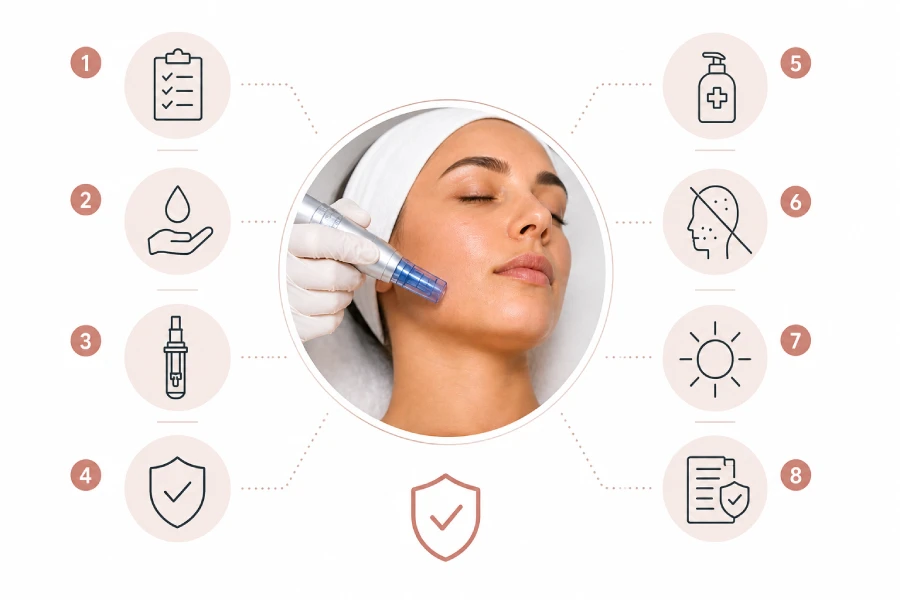
Professional safety guidelines for microneedling cover five core areas: client screening and contraindication assessment, informed consent, sanitation and infection control, needle depth limits within scope of practice, and post-treatment recovery management. Estheticians who operate within these guidelines consistently minimise adverse events and build the long-term client trust that sustains a professional microneedling practice.
- Contraindication screening must occur before every session—not only at the initial consultation—because client health status can change between appointments.
- Single-use cartridges must be disposed of in a sharps container after each client; reuse is never acceptable under any disinfection protocol.
- Estheticians are generally limited to needle depths of 0.25–0.5 mm; deeper depths require medical licensure in most jurisdictions and must never be exceeded without verifying local scope of practice.
- A signed informed consent form is mandatory before every treatment session and must describe risks, expected skin responses, and post-treatment care requirements in clear language.
- Only fragrance-free, alcohol-free, and active-exfoliant-free products should be applied immediately after needling while the barrier is compromised and micro-channels remain open.
- Clients must receive written aftercare instructions covering sun avoidance, product restrictions, and the expected timeline of redness and sensitivity resolution.
- Estheticians should document all treatments, reactions, and aftercare instructions in a retained client record to support both continuity of care and professional liability protection.
Microneedling is one of the most results-driven treatments available in the esthetician’s scope of practice—and one of the most consequential when safety protocols are treated as optional. Unlike many facial treatments that can tolerate a degree of variation in technique, microneedling physically breaches the skin barrier and initiates a controlled wound-healing response. That controlled response is only safe and effective when the practitioner has verified that the client’s health, skin condition, and treatment history create a suitable environment for the procedure. When these checks are skipped or abbreviated, outcomes can range from poor results to serious adverse events including infection, prolonged inflammation, and post-inflammatory hyperpigmentation that takes months to resolve.
Safety in professional microneedling is not simply a matter of using the right device settings. It encompasses the entire arc of the client encounter—from the intake form collected before the first appointment to the aftercare instructions given at checkout. Each component of the safety framework serves a specific protective function, and understanding the rationale behind each requirement helps practitioners apply them consistently rather than mechanically. This article provides a complete reference to those requirements, organised by stage of treatment and clinical priority.
Whether you are establishing a microneedling protocol for the first time or auditing an existing one, the principles covered here reflect the consensus approach across professional esthetics associations, infection-control guidelines, and scope-of-practice frameworks that govern the treatment in most North American and international jurisdictions.
What Every Esthetician Needs to Know About Microneedling Safety
- Contraindication screening is a clinical responsibility that must be repeated at every session, not delegated to a one-time intake form.
- Scope-of-practice regulations for needle depth vary by jurisdiction and must be verified independently—not assumed from training materials alone.
- Single-use device cartridges are non-negotiable; no disinfection protocol renders a used needle head safe for a second client.
- Informed consent is both an ethical requirement and a legal protection—the form must be specific to microneedling, not a generic treatment waiver.
- Post-needling skin is acutely vulnerable to infection and hyperpigmentation triggers; product selection in the recovery window is a direct safety decision.
- Fitzpatrick skin type assessment is essential before selecting settings; higher skin types require conservative needle depths and mandatory sun-avoidance counselling.
- All adverse reactions must be documented in the client record immediately, including photographs where appropriate, to support both clinical follow-up and professional accountability.
Client Screening and Contraindication Assessment
The contraindication assessment is the most clinically significant step in any microneedling protocol. It determines whether the treatment should proceed, be modified, or be deferred entirely. Unlike facials that work with an intact skin barrier, microneedling creates deliberate micro-injuries that can amplify pre-existing conditions rather than improve them if performed on a contraindicated client. Practitioners who conduct thorough screenings consistently report fewer adverse events and stronger long-term client outcomes than those who treat contraindication review as a formality.
Absolute contraindications—those that must halt treatment entirely—include active acne lesions, open wounds, or pustular rosacea in the treatment area; a documented history of keloid or hypertrophic scarring; current isotretinoin use or use within the past six months; active herpes simplex infection; uncontrolled bleeding disorders or anticoagulant medication; active skin cancer or previous radiation to the treatment area; and compromised immune function from any cause. Pregnancy is also considered an absolute contraindication in most professional guidelines.
Relative Contraindications and Modified Treatment Approaches
Relative contraindications are conditions that may allow treatment to proceed with modifications to settings, timing, or adjunct product choices. These include well-controlled rosacea (in a non-flare state), mild eczema outside the treatment zone, a history of post-inflammatory hyperpigmentation, and antiplatelet medications such as aspirin used at low therapeutic doses. In each of these cases, the decision to proceed requires a more conservative needle depth, a lengthened interval between sessions, and enhanced post-treatment recovery support. The esthetician should document the rationale for proceeding and ensure the client has been counselled on the specific additional risks relevant to their condition.
Fitzpatrick skin type is a distinct assessment from contraindication screening but is equally important. Clients presenting at Fitzpatrick types IV through VI have a significantly elevated risk of post-inflammatory hyperpigmentation following microneedling, particularly at aggressive depth settings or with inadequate sun protection in the recovery period. Conservative needle depths, thorough sun-avoidance counselling, and an appropriate recovery-support protocol are mandatory for these clients regardless of whether any other contraindication is present.
Sanitation Standards, Infection Control, and Scope of Practice
Infection control in professional microneedling operates at a higher standard than in most other esthetic treatments because the procedure creates a direct pathway through the skin into subepidermal tissue. The protocols required are not more rigorous than necessary—they reflect the actual biological risk created by the treatment. Practitioners who treat these requirements as procedural overhead rather than clinical necessity are operating outside the accepted standard of care for the modality.
The most fundamental infection-control requirement is single-use cartridges. Every microneedling needle cartridge or tip must be used on one client and disposed of immediately in an approved sharps container at the end of that treatment. There is no disinfection or sterilisation process that makes a used cartridge safe for a second client—the physical structure of the needle tips after use cannot be reliably decontaminated, and any attempt to reuse cartridges constitutes a bloodborne pathogen exposure risk. Regulatory bodies that audit esthetic facilities treat cartridge reuse as a major violation, and it should be treated as one.
Environmental Sanitation and Practitioner Hygiene
The treatment room surface that contacts the client or the device must be sanitised between every client using an EPA-registered disinfectant appropriate for non-porous surfaces. The device handpiece itself must be wiped with the manufacturer-recommended disinfectant after each use. Disposable draping should cover the treatment chair or bed. Practitioners must wear gloves throughout the procedure and change them immediately if contact with a non-sterile surface occurs. Masks are recommended as standard during microneedling given the proximity to open micro-channels, particularly in environments where respiratory pathogen transmission is a concern.
What Microneedling Does to Barrier Function—and Why It Matters for Safety
Microneedling at depths as shallow as 0.25 mm creates transient micro-channels through the stratum corneum and into the upper epidermis. At 0.5 mm, those channels extend into the viable epidermis and begin approaching the papillary dermis in thinner facial skin zones. These openings do not close instantaneously—the epidermis requires between 24 and 72 hours to re-epithelialise the micro-injury sites, during which transepidermal water loss rates rise significantly and the skin’s physical barrier against pathogen entry is substantially reduced.
Research on post-needling barrier function confirms that TEWL (transepidermal water loss) increases measurably for 48–72 hours after treatment at standard esthetic depths. This is not a clinical problem in a well-managed protocol—it is expected physiology. It becomes a safety problem only when product choices during this window include ingredients that cannot be safely absorbed at depth, or when environmental sanitation fails and pathogenic microorganisms gain access to the compromised barrier.
The 6-month isotretinoin contraindication exists because retinoids at therapeutic concentrations impair normal wound healing by affecting keratinocyte differentiation and sebaceous gland recovery. Needling skin that has been treated with isotretinoin within this window creates atypical healing patterns that are unpredictable even at shallow depths.
Informed Consent, Documentation, and Client Communication
Informed consent for microneedling is a clinical and legal requirement that serves the client’s right to make an autonomous decision about a procedure that carries real, if manageable, risks. A generic treatment waiver that does not name microneedling specifically, does not describe the expected skin response, and does not outline the aftercare requirements does not meet the standard of informed consent for this procedure. The consent form must be treatment-specific, written in plain language the client can understand, and signed willingly before the treatment begins—not retroactively after the fact.
The informed consent form should cover: a description of what microneedling is and what it does to the skin; the expected sensations during treatment; the anticipated post-treatment response including redness, sensitivity, and mild swelling; the potential risks including infection, hyperpigmentation, and scarring in contraindicated clients; the mandatory aftercare requirements; and a statement that the client has had the opportunity to ask questions and understands they may decline or stop the treatment at any time. Clients should receive a copy of the signed form, and the original must be retained in the client record.
Documentation as a Safety Practice
Client records for microneedling should contain significantly more detail than records for routine facials. Every session should be documented with: the needle depth and device settings used; the specific products applied before, during, and after the treatment; the observed skin response including degree of erythema, presence and distribution of petechiae, and any unexpected reactions; the aftercare instructions provided; and the date and planned interval for the next session. This level of documentation is not bureaucratic overhead—it is the clinical record that allows a practitioner to adjust settings progressively based on the client’s demonstrated response pattern, and to defend their standard of care in the event of a complaint.
In high-volume treatment environments where microneedling is offered across multiple appointments per day, the post-treatment recovery phase is the most consistently under-resourced stage of the protocol. The tendency is to abbreviate the post-needling mask step to save time between clients—but this is precisely the stage where skin is most vulnerable and where the outcome of the treatment is shaped. Estheticians who work with Poly-Luronic™ Jelly Mask in the post-needling position consistently observe a more controlled inflammatory response compared to finishing with a standard cream mask or a gauze-soaked serum compress: the jelly matrix maintains full occlusive contact with the skin surface for the entire dwell time without drying down at the edges, which is a common failure point with cream-based alternatives that lose occlusive capacity as they absorb.
The practical application detail that matters most: the mask should be applied after the treatment serum has had 60 to 90 seconds to partially absorb—not immediately on freshly needled dry skin, and not after the serum has fully dried. Applied in this window, the occlusive layer captures the serum ingredients before they can evaporate and creates the sealed environment that supports optimal hydration retention during the critical first hour of recovery. Standard non-occlusive finishing masks applied at the same stage allow measurable surface evaporation during the dwell time, which is a particularly significant outcome difference in low-humidity treatment environments.
Six Critical Safety Checkpoints Every Esthetician Must Know
The safety requirements for professional microneedling can be distilled into six discrete checkpoints, each of which addresses a specific failure mode that recurs in adverse event reports across the industry. Practitioners who review these checkpoints as part of their pre-treatment routine will rarely encounter serious complications.
Contraindication Screening at Every Visit
Client health status changes. A client who was suitable for microneedling three months ago may have started a new medication, developed a skin infection, or begun isotretinoin since their last appointment. The screening question is never “has anything changed?”—it is a structured review of every relevant contraindication at every session.
Single-Use Cartridge Disposal
Every used cartridge must go directly into a sharps container at the end of the treatment. Never place a used cartridge on the treatment tray where it could be confused with an unopened one. The cartridge packaging should be dated and logged as a disposal record where facility regulations require it.
Depth Verification for Scope of Practice
Scope-of-practice regulations for needle depth are not uniform across jurisdictions and are updated periodically. Estheticians must verify their specific state or provincial limit independently, not rely on training materials that may reflect different regulatory environments. When in doubt, work at the conservative end of the permitted range.
Treatment-Specific Informed Consent
A general treatment waiver does not satisfy informed consent for microneedling. The consent document must describe the specific risks and expected responses associated with this procedure. A client who has not received adequate information to make an autonomous decision has not given truly informed consent, regardless of whether they have signed a form.
Post-Treatment Product Safety
The product choices applied to skin in the 24–72 hours following microneedling are clinical decisions, not cosmetic ones. Active exfoliants, synthetic fragrance, retinoids, and acidic vitamin C delivered to open micro-channels can trigger inflammatory responses that overwhelm the controlled healing cascade the treatment is designed to produce. Product selection in this window directly determines outcome quality.
Sun Avoidance Counselling for Higher Fitzpatrick Types
Post-inflammatory hyperpigmentation is the most common adverse outcome in clients with Fitzpatrick skin types III–VI. UV exposure on freshly needled skin dramatically increases this risk. Written sun-avoidance instructions, specific SPF recommendations, and a clear timeline for when normal sun exposure can resume must be communicated and documented before the client leaves the treatment room.
Managing Adverse Reactions and Building a Culture of Safe Practice
Even within a rigorous safety framework, mild adverse reactions occur in a small percentage of professional microneedling treatments. The practitioner’s ability to recognise the difference between an expected skin response and a genuine adverse event, respond appropriately when one occurs, and document it accurately determines whether that event becomes a manageable clinical situation or escalates into a client-relations and liability problem.
Expected Versus Unexpected Skin Responses
Expected responses following microneedling at standard esthetic depths include moderate erythema across the treated area, warmth and mild tightness, petechiae (pinpoint bleeding) in isolated zones on thinner skin areas such as the forehead and around the nose, and mild swelling that typically resolves within 24 hours. These are signs of an appropriate inflammatory response, not of injury. Clients should be prepared for all of these before the treatment begins—not informed after the fact when they see their reflection in the mirror at checkout.
Unexpected responses that require the treatment to stop and the practitioner to assess include: profuse bleeding beyond pinpoint petechiae that does not resolve with light pressure; hives, urticaria, or diffuse swelling developing rapidly during the treatment; visible blistering or skin lifting; and client reports of severe burning or stinging that is disproportionate to the depth and pass pattern being used. Each of these can indicate an allergic reaction to an applied product, a previously undetected contraindication, or a device issue. The treatment must be halted, the skin assessed, and the event documented. If there is any concern about systemic allergic response, the client should be referred for medical assessment immediately.
Building Safety Into Practice Systems, Not Just Individual Treatments
The highest-performing microneedling practices are those where safety is embedded into the system rather than dependent on the memory and vigilance of individual practitioners. This means standardised intake forms reviewed at every appointment, printed post-treatment instruction sheets given to every client, a documented disposal log for sharps waste, and regular staff refreshers on scope-of-practice updates in the relevant jurisdiction. It also means creating a treatment environment where a practitioner feels supported in declining or deferring a treatment when contraindications are present—rather than feeling pressure to proceed in order to fill a booking slot. The long-term professional reputation of a microneedling practice is built on the consistent quality and safety of its outcomes, not on the number of appointments completed in any given week.
Professional and Scientific References
The safety guidelines in this article draw from professional esthetics association standards, infection-control research, wound-healing physiology literature, and scope-of-practice regulatory frameworks governing microneedling in North American and international esthetic practice contexts.
- Hou A, Cohen B, Haimovic A, Elbuluk N. “Microneedling: A Comprehensive Review.” Dermatologic Surgery, 2017. Establishes clinical evidence base and safety parameters for professional microneedling including contraindication frameworks.
- Singh A, Yadav S. “Microneedling: Advances and Widening Horizons.” Indian Dermatology Online Journal, 2016. Covers wound-healing physiology post-needling including TEWL dynamics and re-epithelialisation timelines.
- Occupational Safety and Health Administration (OSHA). Bloodborne Pathogens Standard (29 CFR 1910.1030). Defines sharps disposal requirements and infection-control obligations relevant to microneedling practice in US-regulated facilities.
- Alster TS, Graham PM. “Microneedling: A Review and Practical Guide.” Dermatologic Surgery, 2018. Provides clinical guidance on post-treatment product selection, adverse event management, and Fitzpatrick-stratified protocol recommendations.
- National Coalition of Estheticians, Manufacturers/Distributors & Associations (NCEA). Professional Scope of Practice Guidelines for Esthetic Devices. Addresses needle depth scope-of-practice boundaries and the distinction between esthetic and medical microneedling applications.
When building a complete microneedling protocol, the post-treatment recovery phase is where the quality of product selection most directly affects client outcomes. The barrier is compromised, the inflammatory cascade is active, and the skin needs occlusive support that does not introduce fragrance, alcohol, or active exfoliant ingredients into the equation. Poly-Luronic™ Jelly Mask satisfies all three requirements: its formulation is free of synthetic fragrance and alcohol, it contains no AHAs, BHAs, or retinoids, and its jelly matrix creates and maintains occlusive contact with the skin surface throughout the full dwell time without drying at the edges. For estheticians who perform microneedling as part of a results-driven facial protocol, incorporating the Poly-Luronic™ Jelly Mask in the post-needling recovery position addresses the most clinically significant gap that standard finishing masks leave unmet.
Explore the Poly-Luronic™ Jelly Mask LineFrequently Asked Questions: Professional Safety Guidelines for Microneedling
What are the most important contraindications to screen for before a microneedling treatment?
The most critical contraindications to screen for before microneedling include active acne lesions or open wounds in the treatment area, a history of keloid or hypertrophic scarring, use of isotretinoin within the past six months, blood-thinning medications, compromised immune function, and active infections including cold sores or rosacea flares. Estheticians should also screen for uncontrolled diabetes, pregnancy, and recent radiation therapy, as each of these conditions significantly increases the risk of adverse outcomes. A thorough written intake form reviewed at every appointment is the most reliable method for catching new or changed contraindications.
How should needles and microneedling cartridges be handled to prevent cross-contamination?
Microneedling cartridges and needle heads are single-use only and must be disposed of in a sharps container immediately after each treatment. Reusing needles between clients is never acceptable and constitutes a serious infection-control violation regardless of disinfection attempts. Before the treatment begins, cartridges should be inspected for packaging integrity and expiration dates. The device handpiece must be wiped down with an EPA-registered disinfectant between clients, and gloves must be worn throughout the procedure and changed if contamination occurs.
What needle depth is safe for estheticians to use in a professional microneedling treatment?
In most states and provinces, estheticians are restricted to needle depths of 0.25 mm to 0.5 mm for superficial microneedling treatments, which stimulate mild epidermal cell turnover and improve product absorption without penetrating the dermis. Depths exceeding 0.5 mm begin to enter the papillary dermis and in many jurisdictions require a medical license or physician supervision. Estheticians should always verify the scope-of-practice regulations in their specific state or province before selecting needle depth settings, as these rules vary and are regularly updated.
Does a client need to sign a consent form before microneedling?
Yes, a signed informed consent form is mandatory before every microneedling session. The consent form should clearly describe the nature of the treatment, the expected sensations, the anticipated skin response including redness and sensitivity, potential risks such as hyperpigmentation or infection, and the post-treatment care requirements. The client must have time to read the form, ask questions, and sign willingly without pressure. Retaining signed consent forms in client records protects both the client and the practitioner if a dispute arises.
Why does skin become more vulnerable to infection right after microneedling?
Microneedling creates thousands of microscopic channels through the epidermis, temporarily breaching the skin barrier and removing the first line of defence against pathogens. For a period of 24 to 72 hours after treatment, these micro-injuries leave the skin significantly more permeable than normal, allowing bacteria, viruses, and environmental irritants to penetrate more deeply than they could on intact skin. This is why strict post-treatment hygiene instructions are essential, why clients must avoid applying non-sterile products immediately after treatment, and why active infections are an absolute contraindication.
How should estheticians handle a client reaction during a microneedling treatment?
If a client experiences unexpected pain, excessive bleeding beyond petechiae, or signs of an allergic reaction such as hives or swelling during microneedling, the treatment must be stopped immediately. The device should be removed from the skin and the area treated with a sterile saline rinse or a gentle barrier-supportive serum. The esthetician should document the reaction in the client record, photograph the skin response if appropriate, and advise the client on when to seek medical attention. Moderate redness and mild pinpoint bleeding are expected; anything beyond this threshold requires immediate assessment.
What products are safe to apply to skin immediately after a microneedling treatment?
Immediately after microneedling, only products formulated specifically for post-needling use should be applied to the skin. These include sterile hyaluronic acid serums, peptide-based recovery serums, and barrier-supportive formulations free of alcohol, synthetic fragrance, retinoids, and active exfoliants. Anything containing vitamin C in an acidic form, AHAs, BHAs, or benzoyl peroxide must be avoided for at least 72 hours. Occlusive hydration treatments applied at the right time in the protocol help seal the micro-channels and dramatically reduce transepidermal water loss during the recovery window.
How long after microneedling should clients avoid sun exposure?
Clients should avoid direct sun exposure for a minimum of 72 hours after microneedling, and ideally for 7 to 10 days if the treatment included deeper needle depths. UV exposure on freshly needled skin dramatically increases the risk of post-inflammatory hyperpigmentation, particularly in Fitzpatrick skin types III through VI. Clients should also be advised to avoid sunbeds, tanning sprays, and high-heat environments during the recovery period, and to apply a broad-spectrum mineral SPF 30 or higher as soon as the initial recovery phase allows.
Why is the Poly-Luronic™ Jelly Mask a clinically appropriate choice for post-microneedling recovery?
The Poly-Luronic™ Jelly Mask is well-suited to post-microneedling recovery because its occlusive jelly matrix creates a physical barrier over the freshly treated skin, reducing transepidermal water loss while the micro-channels are still open. The formulation is free of synthetic fragrance, alcohol, and active exfoliants, which makes it compatible with the compromised barrier state that follows microneedling. In professional practice, applying the Poly-Luronic™ Jelly Mask immediately after the treatment serum has absorbed allows the occlusive layer to lock in hydration-active ingredients and support the inflammatory cascade in a controlled, recovery-focused environment rather than allowing surface dehydration to develop during the treatment session.
Safety Is the Foundation That Makes Microneedling Results Possible
The clinical outcomes that make microneedling one of the most sought-after treatments in professional esthetics—improved skin texture, enhanced product absorption, progressive collagen remodelling—are only achievable when the treatment is performed within a rigorous safety framework. Contraindication screening, infection control, scope-of-practice compliance, and post-treatment recovery management are not regulatory obstacles to the treatment. They are the conditions that make those results reproducible, and the foundation on which a sustainable professional microneedling practice is built.
Practitioners who internalise these guidelines as clinical reasoning rather than checklist compliance will find that safety and results are not in tension—they reinforce each other. A client who is properly screened, properly consented, and properly supported through recovery will respond better to the treatment, experience fewer complications, and return for the series of sessions that generate the most significant long-term skin improvements. The safety framework is how good outcomes are protected, not how they are constrained.
As you continue building your professional microneedling knowledge, the companion articles in this guide covering treatment protocols, session timing, device selection, and post-treatment recovery strategies provide the operational depth needed to move from understanding these principles to applying them with confidence in the treatment room.