How Often Should Clients Receive Microneedling Treatments?
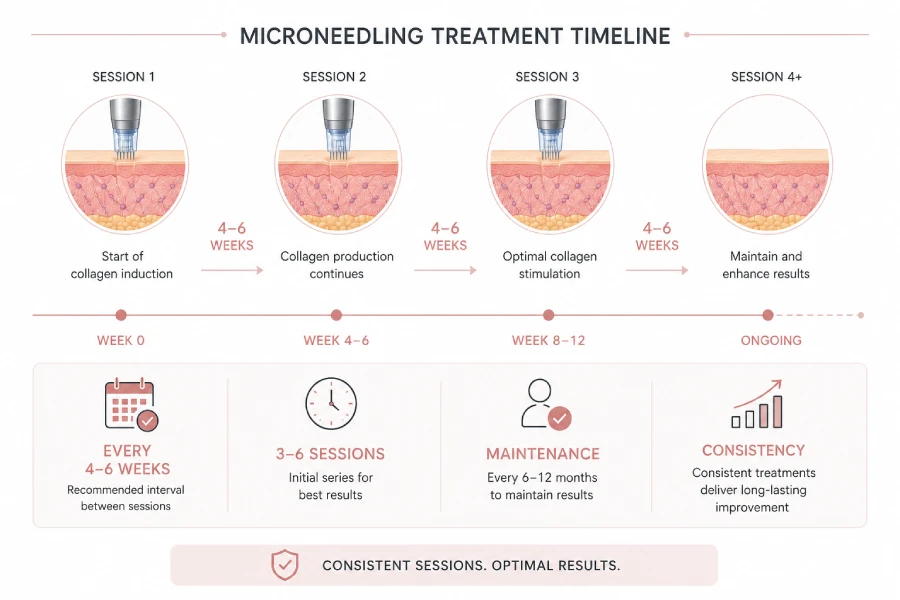
Microneedling treatments should be spaced a minimum of 4 weeks apart, with most clinical protocols recommending 4 to 6 weeks between sessions during an active treatment series. This interval is determined by the biology of collagen induction—the skin needs to complete its wound-healing cycle and enter the remodelling phase before the next treatment stimulus is applied.
- The standard active-series interval is every 4 to 6 weeks—shorter intervals do not accelerate collagen production and may disrupt barrier recovery.
- Most skin rejuvenation goals are addressed in a series of 3 sessions; acne scarring and deeper textural concerns typically require 4 to 6 sessions.
- After completing an initial series, maintenance sessions are scheduled every 6 to 12 weeks depending on the client’s skin response and goals.
- Interval length should be adjusted based on needle depth used, skin sensitivity, and how quickly the client’s barrier recovers after each session.
- Clients showing prolonged redness, sensitivity, or slow barrier recovery after a session should have their next appointment pushed out to a full 6 weeks or longer.
- Estheticians should document series progress with photos and reassess treatment goals at the midpoint of any multi-session protocol.
One of the most common questions estheticians field from both clients and colleagues is how frequently microneedling treatments should be scheduled. The answer is grounded in wound-healing biology—not in client demand, appointment availability, or the desire to accelerate results. Getting the interval right is fundamental to whether a microneedling series delivers meaningful skin improvement or produces diminishing returns due to chronic low-grade inflammation.
Unlike surface-level hydration treatments that can be repeated weekly, microneedling initiates a multi-phase healing response in the dermis. The inflammatory phase, the proliferative phase, and the remodelling phase each unfold on a specific biological timeline. Scheduling a second treatment before the first has resolved means the esthetician is working on tissue that is still mid-repair—a situation that undermines collagen synthesis rather than supporting it.
This article covers the clinical rationale behind treatment spacing, how to adjust intervals by skin concern and needle depth, how to design a complete multi-session series, and how to manage the maintenance phase once initial treatment goals have been achieved.
What Every Esthetician Should Know About Microneedling Treatment Frequency
- Four weeks is the minimum clinically appropriate interval between microneedling sessions—this is determined by the collagen synthesis timeline, not by scheduling convenience.
- Spacing of 4 to 6 weeks is standard for an active treatment series; maintenance clients typically require 6 to 12-week intervals after their initial series is complete.
- Deeper needle depths and more aggressive settings generally require longer recovery intervals—0.5 mm treatments may recover faster than 1.5 mm treatments in the same client.
- Acne scar and textural remodelling protocols typically require more sessions (4–6) than general anti-aging or skin-tone protocols (3 sessions).
- Always reassess the skin visually before each session—defer treatment if there are signs of incomplete recovery, active inflammation, or barrier compromise.
- Client education is essential: explain that microneedling results compound over 3 to 6 months, not immediately after a single session.
- Documenting progress photographs at each appointment is a clinical best practice that helps both the esthetician assess results and the client stay motivated through a full series.
Why Microneedling Frequency Cannot Be Rushed
The impulse to schedule microneedling more frequently is understandable—clients see early results and want to accelerate them, while practitioners want to maximise the impact of each treatment series. But microneedling operates on a biological clock that does not respond to scheduling pressure. The controlled micro-injuries created during a session trigger a cascade of events that require weeks to unfold completely, and repeating treatment before that cascade concludes does not speed up the process—it interferes with it.
In the immediate 24 to 72 hours after microneedling, the skin is in the inflammatory phase: blood vessels dilate, immune cells migrate to the treated area, and growth factors are released to signal repair. This is followed by the proliferative phase, which runs from approximately day 3 through day 14, during which fibroblasts produce new collagen and elastin fibres. The third phase—remodelling—begins around week 3 and can continue for three to six months as immature collagen matures into organised structural tissue. Booking a second microneedling session during weeks one or two means the esthetician is stimulating a fresh inflammatory response in tissue that is still actively repairing, which can create a chronic low-grade inflammatory state rather than ordered collagen production.
The Clinical Consequence of Under-Spacing Sessions
Estheticians who have inadvertently treated too soon typically observe a pattern of clients with plateaued results, persistent flushing, and heightened skin sensitivity between appointments. In some cases, chronic micro-trauma to the dermis without adequate recovery time has been associated with delayed barrier disruption and paradoxical textural worsening. Understanding this risk is what makes proper interval design a safety protocol, not merely a scheduling preference.
The Collagen Remodelling Timeline That Drives Interval Decisions
Understanding why 4 to 6 weeks is the correct interval requires a working knowledge of the wound-healing and collagen synthesis process triggered by microneedling. Each phase has a distinct function, and the timing of each phase is what informs the minimum treatment frequency that is both safe and productive.
Phase-by-Phase Breakdown of Post-Microneedling Skin Biology
The inflammatory phase begins within minutes of treatment and peaks at 24 to 48 hours. Platelets release transforming growth factor-beta (TGF-β) and platelet-derived growth factor (PDGF), which recruit fibroblasts to the injury sites. If a second treatment is performed during this phase, the inflammatory signals overlap, and the fibroblast recruitment pattern is disrupted rather than amplified. The proliferative phase, spanning days 3 to 14, is when new collagen type III is deposited as a scaffold. By weeks 3 to 4, type III collagen begins converting to the stronger type I collagen. This conversion, and the structural maturation of new dermal tissue, is precisely what produces the visible skin improvement clients attribute to microneedling—and it requires the full interval to complete.
Post-Microneedling Healing Phases and Clinical Timing
Microneedling triggers a three-phase wound-healing response in the dermis. Each phase has a specific biological function and a defined temporal window that governs safe and effective treatment scheduling.
The inflammatory phase (hours 0–72) initiates the repair cascade via platelet degranulation and growth factor release. The proliferative phase (days 3–14) produces new collagen type III and new blood vessels. The remodelling phase (weeks 3–6+) converts immature collagen into organised type I collagen and continues tissue maturation. Treating before week 3–4 interrupts the remodelling phase, which is the source of lasting textural improvement.
Estheticians who respect this timeline allow each session to contribute its full collagen stimulus to the cumulative result, rather than producing competing inflammatory cycles that cancel each other out.
Recommended Treatment Frequency by Skin Concern
Not all microneedling protocols use the same frequency or session count. The appropriate interval and total number of sessions depends on the presenting skin concern, the needle depth used, and the client’s demonstrated skin resilience. The framework below reflects standard professional practice for the most common microneedling indications.
Adjusting Intervals Based on Needle Depth and Skin Response
The framework above represents standard professional benchmarks, but individual client response must always inform the final scheduling decision. A client receiving 0.5 mm treatments for fine texture refinement may recover fully within 3 weeks, making a 4-week interval comfortably appropriate. A client receiving 1.5 mm treatments targeting deeper acne scars will likely need the full 5 to 6 weeks to complete barrier recovery and move through the early remodelling phase before the next stimulus is applied. Estheticians should conduct a brief skin assessment at the beginning of every appointment and have a frank conversation about whether the skin is ready to receive treatment that day, regardless of what the calendar says.
In practice, the most revealing indicator of whether a client is ready for their next microneedling session is not the date on the calendar—it’s the tactile and visual assessment at the start of the appointment. Estheticians working with a consistent post-treatment recovery protocol tend to see clients arriving in genuinely better condition from session to session. Specifically, clients who receive the Poly-Luronic™ Jelly Mask as the final step of each session—applied for 20 minutes over a hyaluronic acid serum before the occlusive mask is set—consistently present with less residual redness at their follow-up assessment than those managed with standard post-treatment moisturisers alone. The difference is most visible in clients receiving 1.0 mm to 1.5 mm needle depths, where the barrier disruption is more significant. By contrast, clients who skip the post-treatment mask step and rely on home moisturisers frequently show subtle signs of incomplete barrier recovery at their 4-week check—a tightness in the mid-cheek zone, occasional micro-flaking, or heightened stinging response to toner application—that prompts a deferral to 5 or 6 weeks before proceeding. Building a standardised post-treatment hydration protocol into every session is one of the simplest ways to keep clients on track with their intended series schedule.
Six Common Frequency Errors Estheticians Should Avoid
Misunderstanding microneedling frequency leads to predictable problems—both in client outcomes and in professional reputation. The six errors below are among the most commonly observed patterns in esthetic practice and are entirely preventable with sound clinical education.
Treating Every 2 Weeks
A 2-week interval does not allow the skin to exit the inflammatory phase and enter proliferation. Repeated early-stage inflammation produces chronic barrier disruption rather than structured collagen synthesis. No clinical protocol supports a 2-week microneedling interval at standard treatment depths.
Spacing Sessions Too Far Apart in an Active Series
While waiting too long between sessions is less harmful than treating too soon, sessions spaced 10 to 12 weeks apart during an active series allow the newly formed collagen to mature without the amplifying benefit of a second stimulus. For active series goals, the 4 to 6-week window is both safe and optimally productive.
Applying a Fixed Interval to All Clients Regardless of Skin Type
Fitzpatrick I–II skin and Fitzpatrick IV–VI skin do not always recover at the same rate, and sensitive or barrier-compromised clients may consistently need 6 weeks between sessions even for standard depths. Using a fixed 4-week calendar interval for every client risks under-serving those who need more recovery time.
Failing to Reassess Before Each Session
Booking appointments in advance is good practice, but proceeding with a scheduled treatment without a pre-session skin assessment is a clinical error. Clients may experience unexpected stress, illness, or medication changes between appointments that alter their skin’s readiness for treatment. A brief visual and tactile check at every appointment takes 90 seconds and prevents unnecessary adverse events.
Over-Promising Results in a Single Session
Clients who expect dramatic results after one microneedling session often push for more frequent treatments when they don’t see an immediate transformation. Setting accurate expectations at the initial consultation—explaining that collagen remodelling takes 3 to 6 months and that results compound across sessions—prevents this pressure and improves client trust through the series.
Not Transitioning to a Maintenance Schedule After the Initial Series
Some estheticians complete a 3-session series and then stop booking the client for maintenance, losing a recurring relationship. Others continue booking at active-series intervals (4–6 weeks) indefinitely, which is unnecessary and more intensive than maintenance skin requires. Transitioning to a 6 to 12-week maintenance schedule after series completion is the clinically appropriate and professionally sustainable approach.
Designing a Complete Microneedling Series and Maintenance Protocol
A microneedling protocol that produces consistent client results is built around three distinct phases: the initial assessment and series design, the active treatment series, and the maintenance phase. Each phase has different interval logic and different clinical objectives, and estheticians who manage all three phases systematically produce more predictable outcomes than those who treat on a session-by-session basis without a documented plan.
Phase 1: Initial Assessment and Series Design
At the first consultation, the esthetician should identify the client’s primary skin concern, assess skin type and barrier resilience, document the client’s current skincare routine, and identify any contraindications or factors that might affect healing speed—including isotretinoin use history, recent chemical peel history, immunosuppressant medications, and pregnancy. Based on this assessment, the esthetician should propose a specific series: number of sessions, planned interval, expected needle depth range, and target outcomes. Handing the client a written treatment plan at the first consultation sets professional expectations, reduces mid-series pressure, and improves series completion rates significantly.
Phase 2: Active Treatment Series
During the active series, the esthetician should document skin condition, redness levels, and client feedback at the start of each session. Progress photographs taken under consistent lighting conditions at every second session give both parties a visual reference point for results. Needle depth may be adjusted session to session based on the skin’s demonstrated tolerance—many practitioners start conservatively at 0.5 mm and progress to 1.0 or 1.5 mm by session 2 or 3 once the client’s healing pattern is established. At the series midpoint, the esthetician and client should review progress together and confirm whether the original session count remains appropriate or whether additional sessions are warranted based on response so far.
Phase 3: Maintenance Scheduling
Once the initial series is complete, the objective shifts from active remodelling to structural preservation and ongoing skin quality support. Most clients in a maintenance phase do well with sessions every 8 to 12 weeks—often described as once per season—at moderate needle depths. This schedule maintains the collagen density built during the active series without subjecting the skin to excessive cumulative trauma. Estheticians should book the first maintenance appointment at the final active-series session to maintain the client relationship and prevent the lapse that often occurs when clients are left to re-initiate booking independently.
Professional and Scientific References
The treatment frequency and series design recommendations in this article are informed by published research on collagen induction therapy, wound-healing biology, and clinical microneedling protocols in dermatology and esthetic medicine.
- Aust, M.C. et al. “Percutaneous collagen induction therapy: an alternative treatment for scars, wrinkles, and skin laxity.” Plastic and Reconstructive Surgery, 2008. Established foundational evidence for 4–6 week intervals in multi-session CIT protocols.
- Doddaballapur, S. “Microneedling with dermaroller.” Journal of Cutaneous and Aesthetic Surgery, 2009. Documented session count recommendations for acne scarring vs. general rejuvenation protocols.
- Schwartz, R.A. et al. Research on wound-healing phases and dermal collagen remodelling timelines in International Journal of Dermatology, multiple years. Basis for understanding proliferative and remodelling phase timing in interval design.
- Fabbrocini, G. et al. “Acne scarring treatment using skin needling.” Clinical, Cosmetic and Investigational Dermatology, 2009. Documented 4–6 session series requirements for moderate-to-severe acne scarring protocols.
- El-Domyati, M. et al. “Microneedling therapy for atrophic acne scars: an objective evaluation.” Journal of Clinical and Aesthetic Dermatology, 2015. Provided histological evidence for cumulative collagen production across multi-session microneedling series.
Post-treatment hydration management is one of the most consequential variables in a microneedling series protocol, and yet it is often treated as an afterthought. Estheticians who standardise the recovery step at every session—using a clinically formulated mask immediately post-treatment—consistently report shorter redness duration and better client readiness at follow-up assessments. Poly-Luronic™ Jelly Mask is the post-treatment recovery mask our education team recommends for microneedling series protocols because its polyglutamic acid and hyaluronic acid combination delivers immediate humectant support to barrier-disrupted skin, while the occlusive jelly structure seals that hydration in place during the critical first 20 minutes of post-treatment recovery. For estheticians designing multi-session protocols where session-to-session skin readiness directly affects whether the series stays on schedule, building this mask into the standard protocol is a practical clinical decision, not an upsell.
Explore the Poly-Luronic™ Jelly MaskFrequently Asked Questions: Microneedling Treatment Frequency
How often should clients get microneedling treatments?
Most clients should receive microneedling treatments every 4 to 6 weeks during an active treatment series. This interval allows the skin to complete its wound-healing response and enter the remodelling phase before the next session. Clients targeting significant concerns like acne scarring or deeper texture issues may benefit from a 6-session series spaced 4 to 6 weeks apart, while maintenance clients doing general skin health work typically schedule treatments every 6 to 8 weeks once their initial series is complete.
Is it safe to do microneedling every 2 weeks?
No, microneedling every 2 weeks is generally not recommended and can compromise results. The skin requires a minimum of 4 weeks to complete the initial wound-healing cascade and begin collagen synthesis. Repeating treatments before this process finishes does not accelerate results; it interrupts the healing cycle, increases the risk of chronic inflammation, and can lead to barrier disruption. In most professional protocols, 4 weeks is the shortest clinically appropriate interval, and this applies only to clients with resilient skin types and shallow needle depths.
How many microneedling sessions does a client typically need?
The number of sessions depends on the presenting concern. For general skin rejuvenation and mild texture improvement, 3 sessions spaced 4 to 6 weeks apart typically deliver visible results. For acne scarring, post-inflammatory hyperpigmentation, or deeper textural concerns, a series of 4 to 6 sessions is standard, with some clients requiring 6 to 8 sessions for significant scar remodelling. Estheticians should conduct a thorough consultation to set realistic expectations and document progress with photos between sessions.
Why does skin need time between microneedling sessions?
Skin needs time between microneedling sessions because collagen synthesis unfolds over weeks, not days. Immediately after treatment, the skin enters a haemostasis and inflammatory phase lasting 24 to 72 hours. Proliferation follows for up to 2 weeks, during which new collagen fibres are laid down. The remodelling phase, where collagen matures and realigns, begins around week 3 and continues for months. Treating too soon interrupts this process and prevents the full collagen response from developing, reducing the effectiveness of each session.
Does microneedling frequency change for acne scars versus anti-aging?
Yes, treatment frequency and total session count differ meaningfully between these two goals. For anti-aging and general skin rejuvenation, a series of 3 sessions every 4 to 6 weeks is often sufficient, followed by quarterly maintenance. For acne scarring, the inflammatory nature of the scarring and the deeper dermal involvement typically calls for a 6-session series at 4 to 6-week intervals, with progress re-evaluated at session 3. Clients with active acne should be stabilised before beginning a microneedling scar series to avoid spreading bacteria and worsening inflammation.
When should microneedling intervals be extended beyond 6 weeks?
Intervals should be extended beyond 6 weeks when a client shows signs of prolonged redness, persistent sensitivity, or slow barrier recovery after a session. Clients on isotretinoin or who have recently completed a chemical peel series may also require longer intervals of 8 to 12 weeks. Additionally, maintenance phase clients who have completed their initial series and are microneedling for ongoing skin health typically do well on an 8 to 12-week schedule, or once per season, as their skin no longer requires the stimulus of closely spaced sessions.
How do I know when a client is ready for their next microneedling session?
A client is ready for their next microneedling session when the skin has fully recovered from the previous treatment: redness has resolved, sensitivity has normalised, and the skin feels calm and its barrier feels intact. Visually, the skin should not show signs of ongoing flaking, inflammation, or hypersensitivity. Estheticians should perform a brief skin assessment at the start of every appointment and defer treatment if the skin is still in active recovery, even if the scheduled interval has passed. Booking clients 4 to 6 weeks out gives a useful buffer.
Can clients do microneedling as a standalone maintenance treatment once a year?
A single annual microneedling session provides minimal benefit on its own. While even one treatment stimulates some collagen synthesis, the results of microneedling are cumulative and depend on repeated collagen remodelling cycles to produce lasting changes in skin texture and firmness. Clients who have completed an active treatment series and are in a maintenance phase often benefit from 1 to 2 sessions per year to sustain their results, but without a properly spaced initial series, a single isolated treatment will not deliver the structural improvements clients expect.
How does the Poly-Luronic™ Jelly Mask support post-microneedling recovery between sessions?
The Poly-Luronic™ Jelly Mask is formulated specifically for the recovery demands of post-microneedling skin. Applied immediately after a session, the mask delivers polyglutamic acid and hyaluronic acid under an occlusive seal, which helps flood the micro-channels with humectant molecules while the barrier begins to close. In a multi-session protocol, using the mask at each appointment establishes a consistent post-treatment hydration standard that supports faster barrier recovery between sessions. Estheticians working with closely spaced series protocols report that clients receiving the mask after each session show reduced redness duration and return to baseline skin comfort more reliably than those managed with standard post-treatment moisturisers alone.
Treatment Frequency Is a Clinical Decision, Not a Calendar Decision
The single most important principle in microneedling series design is that frequency must be determined by skin biology, not by client enthusiasm or scheduling convenience. The 4 to 6-week interval standard exists because collagen induction therapy works by triggering a specific wound-healing cascade, and that cascade requires time to unfold completely before it can be productively stimulated again. Estheticians who understand this principle—and communicate it clearly to their clients—produce better outcomes, fewer adverse events, and more satisfying client experiences.
Building a documented series protocol for each client, performing a pre-session skin assessment at every appointment, and managing post-treatment recovery with the same clinical rigour applied to the treatment itself are the three habits that distinguish estheticians who achieve consistent microneedling results from those who see variable outcomes. Frequency is just one variable in this system, but it is the variable that is most often mismanaged and whose mismanagement has the most direct consequences for client safety and treatment efficacy.
Continue exploring the full Microneedling Collagen Induction Therapy guide for in-depth coverage of professional safety guidelines, step-by-step treatment protocols, and evidence-based approaches to every aspect of clinical microneedling practice.