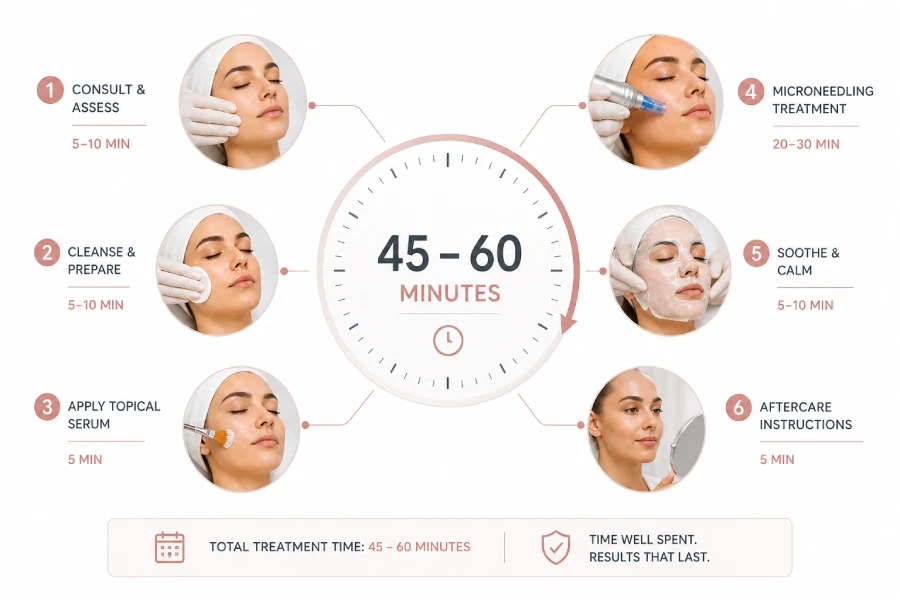
How Long Should a Professional Microneedling Treatment Take?
A complete professional microneedling treatment takes between 60 and 90 minutes from client arrival to departure, with 75 to 90 minutes being the recommended standard for full-face sessions. This range accounts for all protocol phases including intake, numbing, active needling, post-treatment recovery, and client discharge—each of which has a defined minimum duration that cannot be shortened without affecting outcomes.
- Topical numbing requires 20 to 45 minutes of contact time and is one of the most commonly under-scheduled phases.
- The active needling pass for a full face takes 20 to 30 minutes when performed at appropriate speed and technique.
- Post-treatment recovery inside the treatment room should not be less than 15 to 20 minutes.
- First-time clients require a longer appointment—90 to 105 minutes—due to extended intake and conservative treatment pacing.
- Extending microneedling to the neck and décolleté adds 15 to 20 minutes to the needling phase alone.
- Scheduling 60-minute blocks for microneedling consistently forces shortcuts in numbing or recovery, compromising clinical results.
One of the most frequent scheduling errors in professional microneedling practice is under-estimating how long each phase of the protocol actually requires. Estheticians who are transitioning into microneedling from shorter facial services often default to booking 60-minute appointments, only to find that proper numbing, thorough needling, and adequate post-treatment care cannot all be completed within that window without something being cut short.
The consequences of compressed session timing are clinically meaningful. Insufficient numbing time increases client discomfort, which disrupts treatment flow and limits the esthetician’s ability to work at appropriate depth. A rushed needling pass produces uneven stimulation across the face. A skipped or abbreviated recovery phase leaves the skin in a compromised state at the time of departure, increasing the likelihood of prolonged redness, irritation, and poor hydration outcomes in the hours following treatment.
This article provides a complete timing framework for professional microneedling sessions, broken down by protocol phase, client type, and treatment area scope. The goal is to give estheticians the information needed to build accurate scheduling templates that protect every stage of the treatment without unnecessary padding or inefficiency.
What Every Esthetician Should Know About Microneedling Session Length
- 75 to 90 minutes is the professional standard for a complete full-face microneedling appointment.
- The numbing phase is the most commonly under-scheduled step—most formulas require 20 to 45 minutes to work effectively.
- Active needling for a full face takes 20 to 30 minutes; rushing this phase produces uneven collagen stimulation.
- Post-treatment recovery inside the room should be a minimum of 15 to 20 minutes and should never be optional.
- First-time clients should be booked for 90 to 105 minutes to allow for extended intake, conservative pacing, and client education.
- Neck and décolleté treatments require additional time and must be accounted for during pre-treatment numbing application as well.
- Accurate scheduling is a professional responsibility—it directly determines whether the esthetician can deliver a safe and effective outcome every time.
Breaking Down the Microneedling Session: Phase by Phase
Understanding microneedling session length requires looking at each phase individually rather than treating the appointment as a single block of time. Every phase has a clinical function, and the minimum time for each is determined by biology rather than scheduling preference. Compressing any phase does not save time in the meaningful sense—it shifts the cost onto the client in the form of reduced comfort or poorer outcomes.
Phase One: Client Arrival and Pre-Treatment Intake
The first phase of a microneedling appointment covers client arrival, skin assessment review, treatment confirmation, and pre-cleanse preparation. For returning clients who have been pre-screened, this phase typically takes five to eight minutes. For new clients, a thorough intake including contraindication review, consent documentation, and skin assessment may require ten to fifteen minutes before numbing is even applied. Estheticians who schedule new client microneedling appointments at the same block length as returning client appointments will consistently run over time.
Phase Two: Cleanse and Topical Numbing
The cleanse and numbing phase is the longest single phase in the microneedling protocol. The skin must be thoroughly cleansed and prepped before numbing cream is applied, and the numbing cream must be left on for sufficient time to achieve meaningful analgesia. Most professional topical anesthetics require a minimum of 20 minutes of contact time, and many perform better at 30 to 45 minutes, particularly on clients with thicker or more intact skin barriers. This phase should be scheduled for a minimum of 30 minutes in most practice environments, with 40 to 45 minutes allocated for clients with higher pain sensitivity or thicker skin.
Why Each Timing Window Exists: The Clinical Rationale
Estheticians who understand why each timing requirement exists are far more likely to protect those windows under scheduling pressure. When a session runs long for unexpected reasons—a difficult intake, a client who arrives late, a device that requires recalibration—understanding which phases can absorb minor compression and which cannot is essential for making informed decisions in real time.
The Biology Behind Numbing Time
Topical anesthetics work by penetrating the stratum corneum and upper epidermis to block sodium channels in peripheral nerve endings. The time required for this penetration depends on the thickness and integrity of the barrier, the concentration of the anesthetic compound, the use of occlusion during the waiting period, and the ambient temperature of the treatment room. Compromising this wait time does not mean clients will experience only slightly less numbing—the relationship between contact time and analgesia is nonlinear, meaning the last ten minutes of the recommended wait time often accounts for a disproportionate portion of the numbing effect.
The Four Phases of a Professional Microneedling Appointment
A complete microneedling session consists of four sequential phases, each with a defined clinical function and minimum time requirement. Phase one covers intake, consent, and skin assessment: 5 to 15 minutes depending on client history. Phase two covers cleanse and topical numbing: 30 to 45 minutes is the professional standard, with 20 minutes being an absolute minimum only under ideal conditions. Phase three is the active needling pass: 20 to 30 minutes for a full face at appropriate technique speed. Phase four is post-treatment recovery: a minimum of 15 to 20 minutes including serum application, hydration mask, and final barrier product.
The total of these minimum values produces a 70-minute session in best-case scenarios. Because best-case conditions do not apply to every client on every visit, professional scheduling standards default to 75 to 90 minutes as the appropriate booking block for full-face microneedling.
Microneedling Session Timing by Appointment Type
Different appointment types require different total session lengths. A first-time client receiving a conservative introductory microneedling treatment has different timing requirements than a returning client receiving a deeper anti-aging protocol. Estheticians who use a single flat appointment duration for all microneedling bookings will either over-schedule experienced clients or under-schedule new ones. The framework below provides differentiated timing guidance by appointment category.
How Treatment Area Scope Changes the Calculus
The most significant variable affecting total session length after client type is treatment area scope. A targeted zone treatment on a localised scar or single concern area can reasonably be completed in 60 minutes. A full-face treatment requires 75 to 90 minutes. Once the neck and décolleté are added, the total extends to 105 to 120 minutes because both the numbing and needling phases must cover a significantly larger surface area, and recovery care must be applied across that full zone as well. Estheticians offering extended-area microneedling should create a separate booking category in their scheduling system rather than using the same standard block as full-face appointments.
The recovery phase of a microneedling appointment used to be where scheduling inefficiency showed up most visibly. When using a sheet mask, the product needs to be opened, positioned across the face, and adjusted multiple times to conform to the contours around the nose and mouth—a process that consistently took three to four minutes per mask, on top of the mask’s dwell time. After switching to the Poly-Luronic™ Jelly Mask, the mix-and-apply step takes under 90 seconds even when working at pace, and the mask sets conformally without adjustment, which means the esthetician can step away to complete charting during the 10 to 12 minute dwell time rather than monitoring the mask. Across a four-client microneedling day, that difference in recovery-phase efficiency adds up to meaningful time recovered—time that previously had to be absorbed into the appointment block or handed over as client overtime. Removal is also cleaner than sheet mask alternatives, which tend to leave seepage around the edges that needs to be wiped before the final barrier product is applied.
Six Scheduling Mistakes That Compromise Microneedling Outcomes
The most common timing errors in professional microneedling practice follow predictable patterns. Recognising these mistakes in advance allows estheticians to build scheduling systems that prevent them before they affect client outcomes.
Booking 60-Minute Blocks for Full-Face Treatments
A 60-minute appointment does not provide enough time for adequate numbing, a complete needling pass, and a meaningful recovery phase. Something is always shortened. Most often it is numbing or recovery—the two phases most directly linked to client experience and outcome quality.
Not Scheduling Longer Blocks for First-Time Clients
New microneedling clients require extended intake time, conservative pacing during the needling phase, and more thorough client education at discharge. Using the same appointment length as returning clients guarantees that at least one phase will be rushed, usually the intake or the post-treatment recovery conversation.
Removing the Numbing Cream Before Full Contact Time
Topical anesthetic removed too early provides less analgesia than the product is capable of delivering. This appears most often when an esthetician is running behind schedule and attempts to recover time by shortening the numbing wait. The result is increased client discomfort during needling, which disrupts technique and may necessitate pausing the treatment.
Treating the Recovery Phase as Optional
Post-treatment recovery is a clinical phase, not a courtesy. The 15 to 20 minutes spent applying calming serum, a hydration mask, and a barrier product actively supports the skin’s early healing environment. Skipping or shortening this phase sends a compromised skin barrier out of the treatment room without adequate support.
Using One Appointment Block for All Microneedling Scenarios
Full-face, neck extension, targeted zone, and first-time client appointments have meaningfully different time requirements. A single flat booking block either over-schedules simpler sessions or under-schedules complex ones. Differentiated appointment types in the scheduling system resolve this efficiently.
Rushing the Active Needling Pass to Recover Lost Time
When earlier phases have run long, the temptation is to move through the needling pass more quickly to restore the schedule. This produces uneven stimulation, inconsistent depth across facial zones, and a poorer clinical result. The needling pass pace should be set by technique requirements, not by schedule pressure.
Building a Microneedling Schedule That Works in Practice
Translating timing knowledge into a functional scheduling system requires a few deliberate decisions. The first is establishing differentiated appointment types in whatever practice management software the business uses. At minimum, most microneedling practices benefit from three appointment categories: first-time client (105 minutes), returning client standard full-face (90 minutes), and targeted zone (60 minutes). Extended-area sessions should be booked as 120-minute appointments and treated as a separate service line from full-face treatments.
Buffer Time and Back-to-Back Scheduling
Scheduling microneedling appointments back-to-back without a buffer between sessions is a common source of schedule compression. Even experienced estheticians encounter occasional delays during client intake, device setup, or post-treatment conversation. A 10 to 15 minute buffer between microneedling appointments allows these variables to be absorbed without cascading through the rest of the treatment day. Estheticians who run high-volume microneedling practices should build this buffer into the appointment block rather than relying on clients being punctual and treatments proceeding without variation.
Communicating Session Length to Clients at Booking
Client punctuality is a meaningful factor in whether a microneedling appointment can be completed within its scheduled window. Clients who arrive five to ten minutes late to a 75-minute appointment may make it impossible to complete the numbing phase fully before the rest of the schedule requires the treatment to begin. Setting clear expectations at the time of booking—including an explicit statement that the appointment includes 30 to 45 minutes of numbing time and should not be rushed—reduces the frequency of late arrivals on microneedling days and protects every phase of the protocol.
Adjusting Session Length as Client History Develops
Over a series of microneedling treatments with the same client, estheticians develop an accurate picture of that individual’s response pattern, pain tolerance, numbing sensitivity, and skin behaviour. Some clients consistently numb effectively in 25 minutes. Others reliably require 40. Building these individual notes into the client record allows appointment blocks to be calibrated over time, rather than defaulting to the same maximum length for every returning visit. This level of personalisation improves scheduling efficiency without compromising the clinical quality of any individual phase.
Professional and Scientific References
The timing recommendations in this article are grounded in published clinical research on microneedling protocols, topical anesthetic pharmacodynamics, and post-procedural skin recovery, as well as professional standards from esthetics and dermatology practice guidelines.
- Doddaballapur, S. (2009). Microneedling with dermaroller. Journal of Cutaneous and Aesthetic Surgery, 2(2), 110–111. Establishes foundational understanding of needle-induced collagen stimulation and technique pacing considerations.
- Aust, M.C., et al. (2008). Percutaneous collagen induction therapy: An alternative treatment for scars, wrinkles, and skin laxity. Plastic and Reconstructive Surgery, 121(4), 1421–1429. Provides clinical context for treatment depth, pass duration, and post-treatment recovery requirements.
- El-Domyati, M., et al. (2015). Microneedling therapy for atrophic acne scars: an objective evaluation. Journal of Clinical and Aesthetic Dermatology, 8(7), 36–42. References protocol standardisation for session length and multi-pass timing in clinical practice.
- Friedman, P.M., et al. (2001). Safety data of lidocaine and tetracaine mixing for topical anesthesia. Dermatologic Surgery, 27(11), 950–954. Establishes pharmacokinetic basis for topical anesthetic contact time requirements in procedural dermatology.
- Singh, A., & Yadav, S. (2016). Microneedling: Advances and widening horizons. Indian Dermatology Online Journal, 7(4), 244–254. Reviews protocol evolution including timing standards and post-treatment care integration.
The post-treatment recovery phase of a microneedling session is where timing efficiency and clinical quality intersect most directly. Estheticians need a recovery mask that can be mixed, applied, and removed cleanly within the 15 to 20 minute recovery window—without adding handling steps that extend the appointment or reduce the time available for the mask to dwell. The Poly-Luronic™ Jelly Mask was formulated for exactly this context: it mixes in under 90 seconds, sets conformally within two to three minutes, delivers sustained occlusive hydration throughout its dwell period, and peels away cleanly without residue, allowing the esthetician to apply a final barrier product and complete client discharge without additional wiping or cleansing steps. For practices running multiple microneedling appointments per day, the cumulative time efficiency of this format is a meaningful operational advantage over sheet mask or cream mask alternatives that require more hands-on time per application.
Explore the Poly-Luronic™ Jelly Mask LineFrequently Asked Questions: Microneedling Treatment Timing
How long does a microneedling treatment take from start to finish?
A complete professional microneedling session typically takes between 60 and 90 minutes from the moment the client arrives to the moment they leave the treatment room. This includes approximately 20 to 30 minutes for topical numbing, 20 to 30 minutes for the active needling pass, and 15 to 20 minutes for post-treatment recovery steps including calming serums and a hydration mask. Consultation and setup add another 5 to 10 minutes on either end. Scheduling 90-minute appointment blocks protects both client outcomes and your professional workflow.
How long should the actual needling pass take during a microneedling session?
The active needling pass itself typically takes 20 to 30 minutes for a full facial treatment. The exact duration depends on the size of the treatment area, the depth setting being used, and the device being operated. Denser or deeper passes over scar tissue or textured areas may slow technique slightly, while lighter collagen-stimulation passes over larger flat zones can move more quickly. Rushing the needling pass compromises coverage consistency and increases the risk of uneven stimulation across the face.
Why does topical numbing take so long before microneedling?
Topical anesthetic cream requires 20 to 45 minutes of contact time to adequately numb the skin, depending on the formulation and the client’s skin barrier integrity. Most professional numbing formulas need at minimum 20 minutes under occlusion to reach effective dermal penetration. Rushing this phase results in inadequate comfort during the needling pass, which causes involuntary client movement, interrupts the treatment, and reduces the ability to work at appropriate depth. Consistent numbing time is one of the most important scheduling disciplines in a microneedling protocol.
Does needle depth affect how long a microneedling treatment takes?
Needle depth affects treatment pace indirectly rather than directly. Deeper depth settings require slower, more deliberate device movements to ensure safe, controlled penetration and to allow the esthetician to monitor the skin’s response in real time. Shallower settings used for skin-texture refinement or product infusion can be applied with slightly more speed across larger zones. Estheticians working at greater depths also typically spend more time evaluating skin response between passes, which adds to total session time.
How long should the post-treatment recovery phase take inside the treatment room?
The in-room post-treatment recovery phase should take a minimum of 15 to 20 minutes. This phase includes the immediate application of calming serum, followed by a hydration mask worn for 10 to 15 minutes, and then a final barrier-support product before the client leaves the room. This recovery window is not optional. Skin that has been needled is temporarily compromised, and the recovery phase actively supports the early healing environment, reduces visible redness at the time of departure, and sets the stage for optimal collagen outcomes.
Is 60 minutes enough time to do a proper microneedling treatment?
A 60-minute appointment block is generally not sufficient for a complete professional microneedling treatment unless the numbing phase has been pre-scheduled as a separate arrival step. With a 60-minute hard limit, something in the protocol must be shortened, and it is almost always the numbing or recovery phase that gets cut. Both cuts compromise outcomes. Most experienced estheticians build 75 to 90 minute blocks as their standard microneedling appointment to protect every protocol stage without rushing.
Does treating a larger body area make microneedling take longer?
Yes, treatment area size directly affects session duration. A full facial treatment takes longer than a targeted zone treatment such as the forehead or a scar area. When microneedling is extended to the neck and décolleté, estheticians should add 15 to 20 minutes to the needling phase and ensure the numbing application covered those areas as well. Body microneedling for stretch marks or large scar surfaces requires significantly longer sessions, often 90 to 120 minutes of active needling time alone, and should be scheduled as dedicated extended appointments.
How long should a microneedling treatment take for a first-time client versus a returning client?
First-time microneedling clients typically require a longer appointment than returning clients. The initial session includes an extended intake and skin assessment, a conservative depth setting to evaluate the client’s response, and more time spent on client education throughout the session. A first appointment should be scheduled for a full 90 minutes minimum, and many estheticians block 105 minutes. Returning clients who have established their response pattern and comfort tolerance can often be completed in 75 minutes, provided their skin type and treatment goals have not changed.
How does the Poly-Luronic™ Jelly Mask fit into the timing of a microneedling treatment?
The Poly-Luronic™ Jelly Mask is applied during the post-treatment recovery phase, immediately after calming serum has been pressed into the skin. The mask is mixed and applied within approximately 60 to 90 seconds of preparation and sets within two to three minutes of application. It is left on for 10 to 15 minutes during the recovery window, providing an occlusive hydration layer that supports the compromised skin barrier without requiring the esthetician to be present at the table the entire time. Removal is clean and complete, allowing the final barrier-support product to be applied efficiently before client departure.
Accurate Scheduling Is a Clinical Decision, Not Just a Business One
Microneedling treatment duration is not simply a matter of fitting appointments into a calendar—it is a clinical variable that directly determines whether the esthetician has enough time to execute each protocol phase at the standard the treatment requires. Numbing that is cut short, a needling pass that is rushed, and a recovery phase that is omitted are not minor scheduling inconveniences. They are departures from standard of care that affect client comfort, skin response, and long-term outcomes.
Estheticians who invest the time to build accurate, differentiated scheduling templates for their microneedling practice will find that session quality becomes more consistent, client satisfaction improves, and the post-treatment experience feels less chaotic. The clinical result is better. The professional experience is better. And the likelihood of the client returning for a series of treatments—which is how microneedling collagen induction therapy produces its most significant outcomes—improves meaningfully when every appointment is managed with timing precision.
Continue your professional education in the Microneedling Collagen Induction Therapy guide below to build out your full protocol knowledge, from needle depth selection and device choice to aftercare communication and business development strategy.