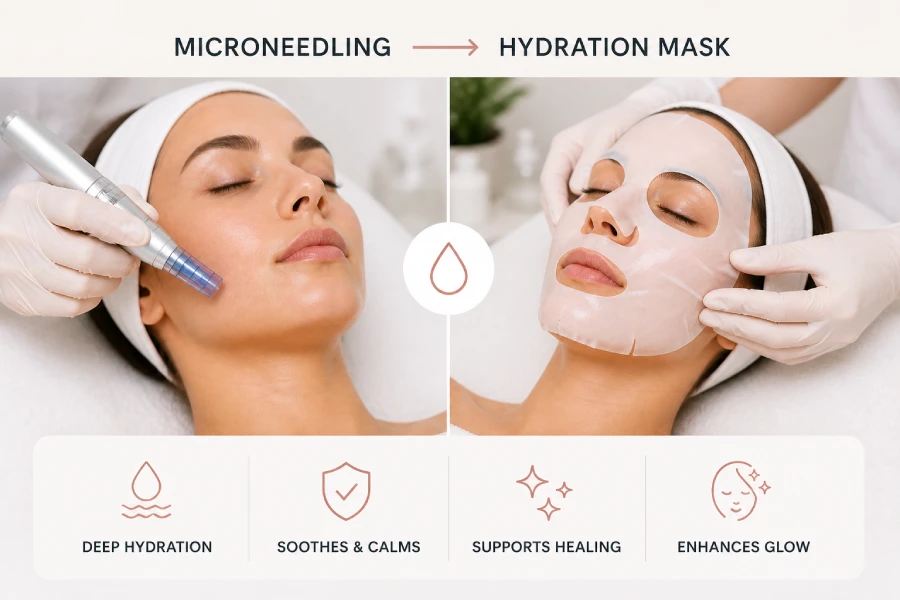
Why Do Estheticians Use Hydration Masks After Microneedling?
Estheticians apply hydration masks immediately after microneedling because the thousands of microchannels created during the treatment temporarily increase skin permeability by up to 80 percent, creating an optimal window for driving active hydration ingredients deep into the epidermis and upper dermis. At the same time, the disrupted stratum corneum loses its ability to restrict transepidermal water loss, making rapid occlusion essential to prevent dehydration and support the early stages of collagen remodelling.
- Microneedling disrupts the stratum corneum, the skin’s primary water-retention barrier, causing accelerated transepidermal water loss that must be addressed immediately after treatment.
- Open microchannels increase ingredient absorption by up to 80 percent compared to intact skin, making the post-needling window the most effective time to deliver hydration actives.
- The best post-microneedling masks combine humectants (hyaluronic acid, polyglutamic acid) with calming ingredients (centella asiatica, panthenol) and an occlusive seal to lock moisture in.
- Masks should be applied within two to three minutes of completing the microneedling pass and left on for 15 to 20 minutes for optimal recovery benefit.
- Clay masks, exfoliating masks, retinol-containing masks, and any fragrance-containing formulas must be avoided in the immediate post-microneedling window due to sensitisation risk through open channels.
- Occlusive hydration masks reduce visible post-treatment redness duration by moderating the inflammatory response and lowering surface temperature through evaporative cooling control.
- The post-microneedling mask step is a protocol non-negotiable — skipping it measurably increases client discomfort, extends visible recovery time, and reduces the hydration benefit of the overall treatment.
Of all the steps in a professional microneedling protocol, the immediate post-treatment phase is the one most frequently underestimated. The needling itself creates the stimulus for collagen remodelling — but how the skin is treated in the ten to twenty minutes immediately following the last pass has a direct bearing on how comfortable the client feels, how quickly visible redness resolves, and how effectively the skin recovers its barrier function ahead of the next session.
Hydration masks occupy a specific and irreplaceable position in this recovery window. Unlike serums, which absorb quickly and leave the surface exposed, or sheet masks, which begin drying at the edges within minutes, a well-formulated hydration mask maintains continuous contact with the skin surface throughout the recovery period. This sustained contact is what makes the difference between a post-treatment step that merely soothes and one that genuinely accelerates recovery.
This article covers the physiological reasons why hydration masks are essential after microneedling, which ingredient profiles are most effective, how to time and apply them correctly, and what mask types to avoid in the immediate post-needling window. The guidance is intended for licensed estheticians performing microneedling within their scope of practice and is not applicable to at-home dermaroller use.
What Every Esthetician Should Know About Hydration Masks After Microneedling
- Microneedling creates a temporary high-permeability window of 15–30 minutes during which active hydration ingredients penetrate far more effectively than they would on intact skin.
- The stratum corneum’s barrier function is significantly impaired immediately after needling, making transepidermal water loss the primary recovery challenge that a hydration mask addresses.
- Mask formulation matters as much as timing — humectants alone are insufficient without an occlusive seal to prevent the water they attract from evaporating off the skin surface.
- Anti-inflammatory ingredients in the mask formulation (centella asiatica, panthenol, aloe vera) provide measurable benefit by moderating the cytokine cascade triggered by needle trauma.
- Needle depth influences mask selection — deeper treatments at 1.0–1.5 mm require extra caution around active ingredient concentration in the mask to avoid irritation through deep channels.
- Peel-off or jelly-style masks are mechanically preferred over sheet masks after microneedling because removal involves no dragging or friction on sensitised, flushed skin.
- Client education about the hydration mask step increases treatment satisfaction and compliance with home-care hydration protocols in the 48 hours following treatment.
Why the Post-Microneedling Skin State Demands Immediate Hydration
To understand why a hydration mask is a clinical necessity rather than a cosmetic indulgence after microneedling, it is important to consider what the treatment has done to the skin’s structural integrity. A standard professional microneedling session creates between 250 and 1,900 microchannels per square centimetre depending on device type and needle density. Each channel is a temporary wound that penetrates through the stratum corneum and into the viable epidermis, and at greater depths, into the papillary dermis.
These microchannels achieve their therapeutic purpose — triggering growth factors, initiating collagen synthesis, and stimulating dermal remodelling — precisely because they represent a controlled wound response. But the same disruption that initiates healing also removes the skin’s primary defence against moisture loss. The stratum corneum under normal conditions acts as a selectively permeable membrane, restricting the passive diffusion of water vapour from the tissue below. When it is perforated at the density a professional microneedling device creates, that restriction is substantially reduced.
The Evaporative Loss Problem
In the immediate post-needling period, measurements of transepidermal water loss consistently show values two to four times higher than baseline on treated areas. This accelerated evaporative loss creates a desiccating environment at the epidermal surface precisely when tissue hydration is most important for supporting the wound-healing cascade. The fibroblasts responsible for collagen production operate most efficiently in a moist wound environment — dehydration at this stage impairs their function and can delay the remodelling response that is the entire therapeutic rationale for the treatment.
The solution is twofold: deliver humectant ingredients into the open channels to increase the water content of the epidermis and upper dermis, then seal the surface with an occlusive layer to stop evaporative loss from continuing to draw that moisture out. A properly formulated hydration mask accomplishes both goals simultaneously, which is why it is the preferred recovery intervention over serums alone.
The Science of Enhanced Absorption Through Microchannels
The permeability increase created by microneedling is not simply an incidental side effect of the treatment — it is one of the primary mechanisms through which microneedling delivers clinical benefit when combined with active topical ingredients. Understanding the biology of this enhanced absorption window helps estheticians make better decisions about which ingredients to apply, at what concentrations, and for how long after the needling pass.
How Microchannels Change the Absorption Equation
Under normal skin conditions, the stratum corneum presents a formidable barrier to topical ingredient absorption. Most molecules larger than 500 Daltons cannot penetrate intact skin in clinically meaningful concentrations through passive diffusion alone. Hyaluronic acid, for example, has a molecular weight typically between 1,500 and 1,800 kilodaltons in standard formulations, meaning it primarily forms a hydrating film on the surface rather than penetrating into the epidermis. Microneedling physically bypasses this barrier by creating direct aqueous pathways through the stratum corneum into the viable epidermis and, at deeper settings, the papillary dermis.
This is why the ingredient profile of any mask applied in the post-needling window must be selected with greater care than a mask applied to intact skin. Ingredients that are benign on the surface can produce pronounced irritation or sensitisation when delivered systemically through microchannels. This consideration particularly applies to fragrance compounds, retinoids, high-concentration vitamin C, and any exfoliating acids, all of which should be completely absent from post-microneedling masks.
Why Microneedling Transforms Topical Ingredient Delivery
Microneedling creates temporary aqueous pathways through the stratum corneum that remain patent for approximately 30 to 60 minutes post-treatment at standard needle depths. During this window, transdermal delivery rates for water-soluble ingredients increase by 60 to 80 percent compared to intact skin, fundamentally changing the clinical relevance of any topical product applied during or after needling.
Polyglutamic acid (PGA) is particularly well-suited to delivery through microchannels because it functions at the stratum corneum surface rather than requiring deep penetration. PGA forms a moisture-retaining microgel film at the channel openings that simultaneously holds water in the channel and inhibits hyaluronidase, protecting both applied and endogenous hyaluronic acid from enzymatic breakdown during the recovery period.
Calming actives including centella asiatica extract and panthenol show measurably greater anti-inflammatory activity when applied through microchannels compared to intact skin application, due to their closer proximity to the dermal fibroblasts and keratinocytes initiating the wound-healing response. This is why mask formulation — not just mask type — directly influences the rate of visible redness resolution after treatment.
Comparing Hydration Mask Types for Post-Microneedling Use
Not all hydration masks are equal in their suitability for the post-microneedling environment. The choice of mask type influences occlusion quality, contact duration, removal trauma, and the practical challenge of application over flushed, sensitised skin. The following comparison covers the four mask formats estheticians most commonly consider for this protocol step.
What the Comparison Reveals for Protocol Design
The comparison above makes clear that the common practice of reaching for a pre-packaged sheet mask as a convenient post-microneedling recovery step is suboptimal from a clinical standpoint. Sheet masks lose their effective contact within 8 to 10 minutes, which falls short of the 15 to 20 minute recovery window estheticians should be targeting. Their fabric edges also require careful removal to avoid dragging on sensitised skin — a practical concern that increases the risk of mechanical irritation when barrier function is already compromised.
Hydrogel masks are the strongest alternative to jelly masks and are appropriate when mixing time is a constraint or when the esthetician is not yet proficient with jelly mask application timing. Their limitation is the slipping tendency on facial contours, which can be managed with careful placement and minimal client movement during the contact period.
The most consistent feedback from estheticians transitioning to the Poly-Luronic™ Jelly Mask for post-microneedling recovery is that the timing discipline it requires actually improves the overall treatment workflow. Because the mask needs to be mixed and ready to apply within two to three minutes of completing the final needling pass, practitioners report they begin preparing the mixture during the last third of the needling sequence — which also serves as a natural cue to ensure they are not rushing or extending the needling phase beyond what the protocol calls for. In practice, a 2:1 powder-to-water ratio mixed at room temperature creates the optimal viscosity for full-face coverage before the mask begins to set. Estheticians who previously used sheet masks after microneedling consistently observe that clients treated with the jelly mask report significantly less tightness and surface sensitivity during the 24 hours following treatment, and visible redness is typically resolved or substantially reduced by the time the mask is removed after 20 minutes. The peel-off removal is a particularly meaningful practical advantage — being able to remove the mask in a single upward motion without any wiping or pressing on the treated skin eliminates one of the more uncomfortable moments in the post-microneedling experience for clients with heightened sensitivity.
Six Criteria for Evaluating Any Post-Microneedling Hydration Mask
When selecting a hydration mask for use in a post-microneedling protocol, estheticians should evaluate candidates against the following six criteria. Each addresses a specific clinical or practical requirement created by the post-needling skin state. A mask that fails two or more of these criteria is not appropriate for this protocol context, regardless of its performance in other facial steps.
Fragrance-Free Formulation
Fragrance compounds are among the most common sensitisers in skincare and present minimal risk on intact skin. Through open microchannels, however, they can penetrate to the viable epidermis and trigger contact sensitisation responses that would not occur under normal conditions. Any mask containing fragrance, essential oils, or parfum must be categorically excluded from post-microneedling use.
Occlusive Delivery Mechanism
A mask that simply deposits humectant ingredients on the skin surface without forming an occlusive layer addresses only half the recovery challenge. The occlusive mechanism is what prevents accelerated transepidermal water loss from continuing to dehydrate the treated tissue during the contact period. Masks that dry down to a film, remain fluid, or are wiped off cannot provide this function reliably.
Absence of Active Exfoliants
Alpha-hydroxy acids, beta-hydroxy acids, enzymatic exfoliants, and retinoids must all be absent from any mask applied immediately after microneedling. These ingredients can penetrate deeply through open channels and cause significant irritation, barrier disruption, or in the case of retinoids, an adverse inflammatory response in the already-activated dermis. This applies even to low-concentration formulations that would be considered gentle on intact skin.
Anti-Inflammatory Active Ingredients
A recovery mask should do more than hydrate — it should actively moderate the inflammatory response triggered by needle trauma. Centella asiatica, panthenol, allantoin, and aloe vera are the most clinically supported calming actives for this application. Their presence in the mask formulation is a meaningful differentiator between a mask that soothes by default and one that actively accelerates recovery.
Friction-Free Removal
Post-microneedling skin is at its most mechanically sensitive immediately after treatment, when the disrupted barrier and inflammatory response combine to heighten tactile sensitivity. Mask removal that requires wiping, pressing, or scrubbing introduces unnecessary mechanical trauma. Peel-off formats are mechanically superior for this reason — they lift cleanly from the skin surface without any dragging action.
Neutral to Slightly Acidic pH
The skin’s natural pH is approximately 4.5 to 5.5, and maintaining this acid mantle is critical to barrier recovery after treatment. Masks with an alkaline pH can interfere with the enzymatic processes responsible for rebuilding the stratum corneum and can disrupt the lipid organisation of the barrier. Post-microneedling masks should be formulated at a pH of 4.5 to 6.0 to support rather than impede the natural recovery process.
Timing, Application Sequence, and Post-Mask Protocol
The clinical benefit of a post-microneedling hydration mask is significantly influenced by how quickly it is applied after the treatment, how it is layered relative to any serums, and what follows it before the client leaves the treatment room. Getting these details right is what separates a protocol that produces strong, consistent results from one that is variable in its outcomes.
The Two-to-Three Minute Application Window
The most important timing principle in post-microneedling mask application is the two-to-three minute rule: the mask should be on the skin within three minutes of completing the final needling pass. This corresponds closely to the peak permeability window when microchannels are most patent and transepidermal water loss is at its highest rate. Estheticians who delay mask application while completing documentation, changing gloves, or preparing other products allow the channels to begin closing and the surface to begin desiccating — both of which reduce the clinical benefit of the mask step.
In practice, this means the mask should be pre-mixed (for jelly formats) or pre-positioned (for sheet and hydrogel formats) before the needling pass begins, so application can proceed immediately after the final needle pass without any delay. Building this preparation into the protocol sequence is a simple workflow adjustment with a measurable impact on outcomes.
Serum Layering Before the Mask
Many estheticians apply a targeted hydration serum directly to the treated skin before placing the mask, using the open microchannels to drive deeper penetration of the serum’s active ingredients. This is a valid technique, provided the serum formulation contains only post-needling safe ingredients and the application is completed quickly — the serum should be on the skin and the mask applied on top of it within the two-to-three minute window. Common safe serum choices for this step include hyaluronic acid serums, peptide serums, and growth factor serums. The mask then acts as an occlusive cover over the serum layer, preventing evaporation and extending the absorption window.
Post-Mask Recovery Steps
Once the hydration mask is removed, the skin should not be wiped or rinsed — any residual serum or mask actives remaining on the surface should be gently pressed into the skin with clean fingertips or left to absorb naturally. The next steps in the immediate post-treatment protocol should follow in this order: a light, fragrance-free moisturiser or barrier recovery cream to extend occlusion; a broad-spectrum mineral sunscreen if the client is leaving during daylight hours; and verbal aftercare instructions covering what to avoid for the next 24 to 48 hours. Products containing retinoids, vitamin C, AHAs, or fragrance should not be reintroduced until the skin barrier has had at least 48 to 72 hours to re-establish, and clients should be advised not to apply any active skincare at home on the day of treatment.
Professional and Scientific References
The protocols and ingredient science in this article are grounded in peer-reviewed research on microneedling-induced transdermal drug delivery, wound healing biology, and post-procedural barrier recovery in clinical dermatology and esthetic practice literature.
- Doddaballapur S. Journal of Cutaneous and Aesthetic Surgery, 2009–2021 — Establishes the clinical basis for microneedling-induced transdermal permeability enhancement and the rationale for immediate post-needling topical application.
- Kalluri H, Banga AK. AAPS PharmSciTech, 2011 — Quantifies permeability changes through microneedle-created channels and the time-dependent recovery of barrier function post-needling.
- Cao Y et al. International Journal of Molecular Sciences, 2017–2022 — Examines the wound-healing cascade following microneedling, including the role of tissue hydration in supporting fibroblast activity and collagen remodelling.
- Jeong SH et al. Skin Research and Technology, 2014–2020 — Evaluates occlusive dressing and mask application effects on transepidermal water loss following dermal injury and identifies optimal contact duration for maximum benefit.
- Briden ME, Jacobsen E. Cosmetic Dermatology, 2008–2019 — Addresses post-procedure skincare formulation requirements, including pH considerations, ingredient safety in compromised barrier states, and anti-inflammatory actives in recovery protocols.
For estheticians looking to standardise the post-microneedling recovery step across their treatment protocols, the Poly-Luronic™ Jelly Mask meets every clinical criterion established in this article. Its fragrance-free formulation eliminates the sensitisation risk associated with applying mask products through open microchannels, while the polyglutamic acid and hyaluronic acid combination delivers dual-depth humectancy through the enhanced absorption window. The rubber-mask matrix provides the continuous occlusive seal required to prevent transepidermal water loss throughout the full 15 to 20 minute recovery period, and the peel-off removal method removes the mechanical trauma risk that makes sheet mask removal problematic on flushed, sensitised post-needling skin. For practices that perform microneedling regularly, it represents a post-treatment recovery tool whose clinical performance is matched by its practical workflow advantages.
Explore the Poly-Luronic™ Jelly Mask LineFrequently Asked Questions: Hydration Masks After Microneedling
Why should estheticians use a hydration mask immediately after microneedling?
Estheticians should apply a hydration mask immediately after microneedling because the microchannels created during treatment allow active hydration ingredients to penetrate far deeper than they would on intact skin. At the same time, the skin’s barrier is temporarily compromised, causing accelerated transepidermal water loss that leaves tissue vulnerable to dehydration unless an occlusive layer is applied quickly. A well-formulated hydration mask delivers humectants into the open channels while the occlusive matrix seals the surface, reducing inflammation signals and supporting the early stages of collagen remodelling. Estheticians who delay mask application by even ten minutes consistently observe more pronounced post-treatment redness and slower visible recovery in subsequent sessions.
How long should a hydration mask stay on after microneedling?
Most estheticians leave a hydration mask on for 15 to 20 minutes following microneedling, though the optimal duration depends on mask type and the depth of needling used. Occlusive jelly-style masks can remain on for the full 20 minutes because their sealed surface continues reducing transepidermal water loss throughout the contact period. Sheet masks and cream masks tend to dry or lose effectiveness faster, making them less reliable for the full window. For deeper treatments at 1.5 mm or above, some practitioners extend contact time to 25 minutes when the mask formulation supports it and the client shows no adverse reaction.
What ingredients should a hydration mask contain to support microneedling recovery?
The most effective hydration masks for post-microneedling recovery contain a combination of humectants, calming actives, and barrier-supportive ingredients. Hyaluronic acid and polyglutamic acid are the primary humectants, drawing water into the newly penetrated epidermis and holding it there. Centella asiatica and panthenol address the inflammatory response triggered by needle trauma. Aloe vera provides immediate soothing relief while contributing to surface hydration. Barrier-support ingredients such as ceramides and fatty acids help reinitiate the skin’s natural protective function. Ingredients to avoid in the immediate post-microneedling window include retinol, vitamin C, glycolic acid, and any fragrance or essential oils, all of which can cause significant irritation through open microchannels.
Does using a hydration mask after microneedling actually improve results?
Yes, applying a hydration mask after microneedling measurably improves clinical outcomes compared to leaving the skin unmasked during recovery. The open microchannels created by needling temporarily increase skin permeability by up to 80 percent compared to intact skin, which means active hydration ingredients are delivered at concentrations not achievable under normal conditions. This enhanced absorption accelerates the replenishment of water content in the treated dermis and epidermis. Additionally, the occlusive seal of a mask reduces the inflammatory cascade that follows needle trauma, which shortens visible redness duration and supports a more organised collagen remodelling response. Clients who receive a post-microneedling hydration mask consistently report greater comfort and faster resolution of tightness compared to those who do not.
Is it safe to use any mask after microneedling, or are some masks harmful?
Not all masks are safe for use immediately after microneedling, and applying the wrong formulation can cause significant adverse reactions. Clay and charcoal masks must be avoided entirely because their drawing and absorbing action will strip moisture and further destabilise the compromised barrier. Masks containing active exfoliants such as alpha-hydroxy acids, beta-hydroxy acids, or enzymes should also be avoided, as they will penetrate deeply through open microchannels and cause chemical irritation. Fragrance-containing masks present a sensitisation risk when applied to a disrupted barrier. The safest post-microneedling masks are fragrance-free, formulated with calming humectants and barrier-support ingredients, and have a neutral to slightly acidic pH that supports natural barrier recovery.
Can you use a hydration mask during microneedling as a glide medium?
Yes, many estheticians apply a hydration serum or thinned hydration medium during the microneedling pass itself to facilitate device glide, and some incorporate a compatible mask product as the infusion medium. This technique allows active ingredients to be driven into the microchannels in real time as they are being formed, maximising the delivery window. However, the medium used during needling must be free of any ingredients that could cause adverse reactions when introduced below the epidermal surface, including retinoids, strong antioxidants, and all fragrance compounds. After needling is complete, a separate occlusive hydration mask is still applied on top to seal the surface and extend the recovery environment.
Why does skin dehydrate so fast after microneedling if you skip the mask?
Skin dehydrates rapidly after microneedling without a mask because needling physically disrupts the stratum corneum, which is the primary barrier controlling transepidermal water loss. Under normal conditions, an intact stratum corneum restricts passive water evaporation from the dermis. When thousands of microchannels puncture this layer simultaneously, the evaporative surface area increases dramatically and water vapour escapes at an accelerated rate. This process is compounded by the inflammatory vasodilation that follows needle trauma, which increases local tissue temperature and drives additional evaporative loss. Without an occlusive barrier applied quickly, the treated skin can lose a clinically significant amount of its moisture within the first 20 to 30 minutes of recovery, which impairs the early stages of collagen remodelling.
How does an occlusive hydration mask reduce redness after microneedling?
An occlusive hydration mask reduces post-microneedling redness primarily by lowering the inflammatory stimulus that drives cutaneous vasodilation. When the skin surface is sealed with an occlusive layer, evaporative water loss slows, tissue temperature stabilises, and the concentration of inflammatory cytokines at the surface is moderated. The physical cooling effect of a cold or room-temperature mask applied to the skin also causes mild vasoconstriction, visually reducing redness within the first few minutes of application. Calming ingredients within the mask, particularly centella asiatica and panthenol, provide an additional anti-inflammatory action at the receptor level. Together, these mechanisms can reduce visible redness duration by 30 to 50 percent compared to leaving treated skin unmasked.
How does the Poly-Luronic™ Jelly Mask perform as a post-microneedling hydration mask?
The Poly-Luronic™ Jelly Mask is specifically well-suited to post-microneedling recovery because its rubber-mask structure creates a continuous occlusive seal over the treated surface without requiring the practitioner to press or manipulate the skin during application. Estheticians working with it after microneedling typically apply the mixed jelly within two to three minutes of completing the needling pass, allowing it to set over the still-flushed surface. The combination of polyglutamic acid and hyaluronic acid in the formulation delivers dual-depth humectancy through the open microchannels, while the alginate matrix locks moisture against the epidermis throughout the full contact period. Compared to sheet masks, which begin drying at the edges within eight to ten minutes, the jelly mask maintains its seal for the full 15 to 20 minute recovery window without repositioning. The peel-off removal also avoids any dragging or friction on sensitised skin, which is a meaningful practical advantage in the immediate post-needling period.
Hydration Masks Are a Clinical Necessity, Not an Optional Add-On
The post-microneedling recovery window is one of the most consequential phases of the entire treatment. The microchannels that make microneedling therapeutically powerful also make the skin acutely vulnerable to dehydration, irritation, and inadequate barrier recovery if that window is not managed correctly. A well-selected, correctly timed hydration mask is the single most impactful step an esthetician can take in this period — addressing transepidermal water loss, moderating inflammation, and driving recovery-supporting ingredients into the skin at a depth and concentration not otherwise achievable.
The selection criteria outlined in this article — fragrance-free formulation, occlusive delivery, absence of active exfoliants, anti-inflammatory actives, friction-free removal, and appropriate pH — provide a practical framework for evaluating any mask against the specific demands of the post-needling environment. Applying these criteria consistently will produce more predictable recovery outcomes and a client experience that reinforces the professional value of the treatment.
Estheticians who standardise this step across their microneedling protocols will find that it also supports client education conversations about home hydration care in the 48 to 72 hours following treatment — a continuation of the occlusion and barrier-support principles that the in-treatment mask step introduces.