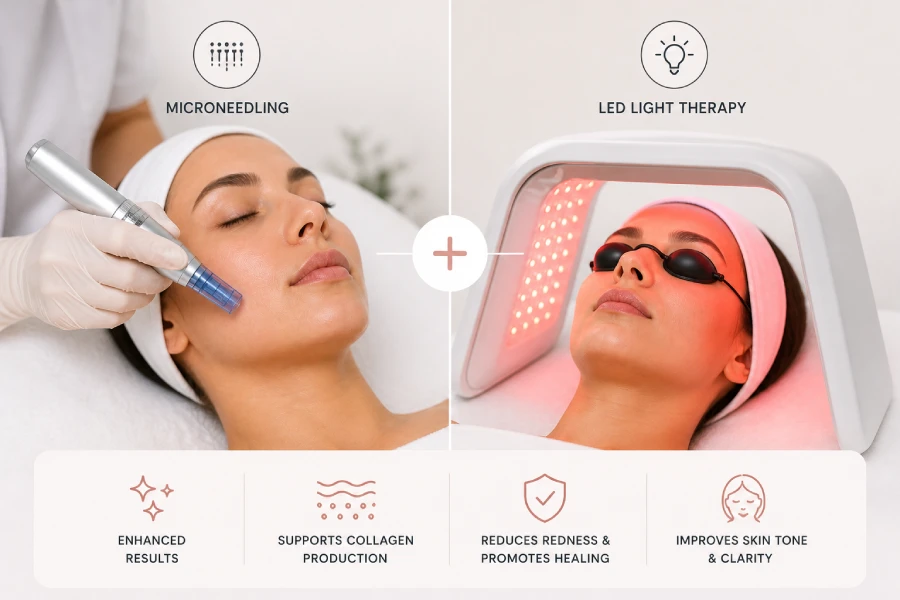
How Do Estheticians Combine Microneedling With LED Light Therapy?
Combining microneedling with LED light therapy is a well-established dual-modality approach in professional esthetic practice. LED is applied immediately after the microneedling pass is complete, before any occlusive recovery mask, to deliver anti-inflammatory and cellular repair support during the skin’s most responsive post-treatment window.
- LED therapy is positioned as a post-needling recovery step, applied after serum infusion and before the final hydration mask
- Red light at 630 to 660 nm is the primary wavelength used for its anti-inflammatory and fibroblast-stimulating properties
- Near-infrared at 810 to 850 nm can be combined for deeper tissue penetration and enhanced mitochondrial energy support
- Standard LED exposure time in a post-microneedling context is 10 to 20 minutes depending on device irradiance output
- Blue light should not be used in the immediate post-needling phase due to potential photosensitivity concerns with compromised skin
- LED therapy calms inflammation, supports the transition from the inflammatory to the proliferative healing phase, and energises collagen-producing fibroblasts
- A hydration or recovery mask applied after LED completes the protocol by sealing in moisture during the critical early repair window
Microneedling is one of the most mechanically active treatments in the professional esthetician’s toolkit. By creating controlled micro-injury across the dermis, it intentionally triggers the wound-healing cascade—stimulating collagen synthesis, increasing growth factor activity, and improving the skin’s overall structural density over time. But the same mechanism that produces these results also creates a period of acute inflammation, heightened sensitivity, and temporary barrier disruption that requires careful management if clients are to achieve the best possible recovery and outcome.
LED light therapy has emerged as one of the most clinically logical partners for microneedling precisely because its mechanism of action addresses the specific physiological demands of the post-needling skin state. Where microneedling creates intentional controlled injury, LED supports the repair cascade that follows. The combination is not about treating two separate concerns simultaneously—it is about using one modality to set the wound-healing process in motion and the other to optimise the cellular environment in which that healing occurs.
This article covers the science behind the combination, the correct sequencing protocol within a standard microneedling appointment, wavelength selection, timing, contraindication awareness, and how to position this combination for clients who want to reduce downtime and maximise their collagen induction results.
What Every Esthetician Should Know About Combining Microneedling and LED
- LED therapy does not compete with microneedling—it supports the repair phase that microneedling initiates, making the two modalities synergistic rather than redundant
- Correct sequencing is essential: LED must be applied to exposed skin before any occlusive mask layer to preserve full light energy delivery
- Red light at 630 to 660 nm is the evidence-backed choice for post-microneedling use; near-infrared at 810 to 850 nm adds depth of tissue support
- The post-microneedling skin is in an enhanced absorption state—serums applied before LED and the mask applied after both benefit from improved transdermal uptake
- Blue light is contraindicated in the immediate post-needling phase; estheticians should not use multi-mode devices in blue-light mode at this stage
- LED exposure of 10 to 20 minutes fits within a standard 60-minute microneedling appointment without compressing client consultation or aftercare time
- Estheticians should verify device irradiance specifications before determining duration—higher-irradiance panels deliver therapeutic doses in less time
Why These Two Modalities Work Together
The pairing of microneedling and LED light therapy is grounded in how each modality interacts with the skin’s wound-healing response. Microneedling creates a precise, repeatable stimulus for collagen production by delivering micro-channels into the dermis. The depth, density, and pattern of these channels determine the intensity of the healing response. Once needling is complete, the skin enters an acute inflammatory phase characterised by increased blood flow, cytokine activity, and the arrival of repair-signalling growth factors at the injury site.
LED photobiomodulation acts on this inflammatory environment in two important ways. First, red light wavelengths at 630 to 660 nm are documented to modulate pro-inflammatory cytokine expression, helping to calm the acute inflammatory response without suppressing the underlying repair signals that drive collagen synthesis. Second, both red and near-infrared wavelengths stimulate mitochondrial cytochrome c oxidase, increasing ATP production in the fibroblasts and keratinocytes that are tasked with executing the repair work. More cellular energy means faster, more efficient collagen deposition and epithelial recovery.
The Concept of Synergistic Modality Pairing
The key to understanding why this combination is clinically effective is recognising that the two modalities operate at different phases of the same process. Microneedling sets the wound-healing cascade in motion. LED does not repeat or compete with that initial signal—it enters the sequence at the cellular energy and inflammatory regulation phase, optimising the environment in which the repair work is carried out. Estheticians who understand this distinction are better positioned to explain the combined protocol to clients and to justify the added step within their appointment structure.
The Photobiomodulation Mechanism in Post-Needling Skin
Photobiomodulation is the process by which specific wavelengths of light interact with chromophores in skin tissue to produce measurable biological effects. In the context of post-microneedling skin, the most clinically relevant chromophore is cytochrome c oxidase, a key enzyme in the mitochondrial electron transport chain. When red or near-infrared photons are absorbed by cytochrome c oxidase, they stimulate increased ATP synthesis, which in turn accelerates cellular repair processes including fibroblast proliferation, collagen synthesis, and keratinocyte migration across the healing surface.
Wavelength-Specific Effects Relevant to Microneedling Recovery
Not all wavelengths produce the same effects in post-needling skin. Red light at 630 to 660 nm is the most evidence-supported range for surface anti-inflammatory action and fibroblast stimulation. Its penetration depth of approximately 2 to 3 mm places it directly in the upper dermal zone where microneedling channels are concentrated in standard esthetic treatments using 0.5 to 1.5 mm needle depths. Near-infrared at 810 to 850 nm penetrates more deeply, reaching the mid-dermis and subcutaneous tissue, making it valuable for treatments targeting deeper structural collagen remodelling.
How Red and Near-Infrared Light Support the Post-Needling Repair Cascade
When red light at 630 to 660 nm is absorbed by cytochrome c oxidase in dermal fibroblasts following microneedling, it increases mitochondrial membrane potential and ATP output. This cellular energy boost is delivered precisely when fibroblasts are being signalled to begin collagen synthesis by the growth factors released during the micro-injury response.
Anti-inflammatory modulation occurs via reduced pro-inflammatory cytokine expression (particularly IL-1β and TNF-α) and enhanced transition of macrophages from the M1 inflammatory phenotype to the M2 repair phenotype. This means the inflammatory phase resolves faster and with less clinical redness, while the proliferative repair phase begins sooner.
Near-infrared at 810 to 850 nm adds depth of penetration to this effect, reaching the papillary and reticular dermis where deeper microneedling channels require cellular energy support for collagen matrix reconstruction.
Protocol Sequencing: Where LED Fits in a Microneedling Appointment
Correct sequencing of LED therapy within a microneedling appointment is one of the most practically important decisions an esthetician makes when combining these modalities. The placement must account for the transdermal absorption window created by microneedling, the need for LED to reach the skin surface without an obstructing mask layer, and the logical flow of a timed professional treatment appointment.
Why the Order of Steps Matters Clinically
The specific placement of LED at Step 5—after serum infusion but before the hydration mask—is not arbitrary. Microneedling creates transient micro-channels in the stratum corneum, which temporarily increases transdermal penetration for both topical actives and light energy. By delivering serums immediately after needling, estheticians take advantage of peak absorption before the channels begin to close. LED is then applied to this serum-treated but still-exposed skin, ensuring the light energy reaches the epidermis and upper dermis without interference from an overlying occlusive layer. The hydration mask, applied after LED, then performs its barrier-support function during the remainder of the recovery period while the client rests.
In practice, the transition from the LED step to the recovery mask step is one of the places where timing discipline matters most in this combined protocol. Estheticians working with higher-irradiance professional LED panels find that 10 minutes delivers an adequate dose and leaves a comfortable window for mask preparation without the client waiting on the treatment bed. The Poly-Luronic™ Jelly Mask works particularly well in this sequence because it can be mixed during the LED exposure time—meaning the mask is ready to apply the moment the LED panel is removed. In contrast to sheet masks, which require the esthetician to stop the LED session to retrieve and apply the product, the jelly mask’s mixing-bowl preparation allows the LED time to run completely before the next step begins. Estheticians who have tested this transition consistently note that clients experience a marked cooling sensation when the freshly mixed jelly is applied to the warm, post-LED skin—a sensory contrast that clients frequently describe as one of the most memorable moments of the treatment.
Six Clinical Considerations When Adding LED to a Microneedling Protocol
Estheticians integrating LED therapy into their microneedling appointments should evaluate the following six factors before finalising their protocol approach. Each consideration affects the safety, efficacy, and client experience outcomes of the combined treatment.
Device Irradiance and Dose Calculation
The therapeutic dose of LED is determined by irradiance (mW/cm²) multiplied by time. Estheticians must know their device’s output specification to calculate how long the LED session must run to deliver a clinically relevant energy dose. Higher-irradiance panels achieve this in 10 minutes; lower-output devices may require 20 minutes or longer.
Wavelength Selection for Post-Needling Skin
Red at 630 to 660 nm is the primary wavelength for post-microneedling use. Near-infrared at 810 to 850 nm can be added for deeper tissue support. Blue light at 415 to 470 nm should not be used immediately post-needling due to photosensitivity risk in compromised skin. Confirm your device’s active wavelength mode before applying.
Eye Protection for Client and Practitioner
Professional LED panels emit high-intensity light that requires appropriate eye protection. Clients must wear the opaque or filtered goggles provided with the device. Estheticians should not look directly at the panel during operation. This applies regardless of whether the device is classified as a low-power or high-power system.
Photosensitising Medication Check
Clients taking photosensitising medications including certain antibiotics, diuretics, and retinoid formulations may be contraindicated for LED post-microneedling. Estheticians should screen for photosensitising medications during the pre-treatment consultation and adjust the protocol accordingly, potentially omitting the LED step for affected clients.
Panel Distance and Coverage
Professional LED panels are typically positioned 5 to 10 cm from the skin surface, following manufacturer-specific guidelines for optimal energy delivery. Coverage should encompass the full treatment area. Panels positioned too far from the skin lose irradiance proportionally with distance. Estheticians should document the distance setting used for treatment reproducibility.
Appointment Timing and Client Communication
Adding LED to a standard microneedling appointment extends total chair time by 10 to 20 minutes. Clients should be informed of the extended duration at booking and understand why the LED step is included in their protocol. Framing it as a recovery-optimisation step—rather than simply an add-on—improves client understanding and perceived treatment value.
Managing Contraindications and Client Selection
While the combination of microneedling and LED light therapy is safe and well-tolerated for the majority of professional skincare clients, estheticians should maintain a clear contraindication framework for both modalities and apply it at every consultation. Contraindications for the two treatments are largely independent, meaning a client who is appropriate for microneedling may still require LED modifications, and vice versa.
Microneedling Contraindications That Affect the Combined Protocol
Active acne lesions in the treatment area, keloid scarring history, active rosacea flares, use of blood-thinning medications, recent isotretinoin use within six months, and any active skin infection or wound are standard contraindications for microneedling that apply equally to the combined protocol. If microneedling is contraindicated, the LED-only option may still be available for the client depending on their specific condition.
LED-Specific Contraindications to Screen For
LED-specific contraindications include photosensitive skin conditions such as systemic lupus erythematosus, xeroderma pigmentosum, and porphyria. Clients taking photosensitising medications—including certain antibiotics such as doxycycline, antifungals, diuretics, and prescription retinoids—should have the LED component reviewed or omitted. Epilepsy with photosensitive triggers is a contraindication for high-frequency flickering LED systems, though most professional LED panels used in esthetic practice use continuous-wave or very-low-frequency output that does not typically trigger this concern. Always consult the device manufacturer’s contraindication list alongside clinical intake screening.
Client Communication and Setting Expectations
Clients choosing a combined microneedling and LED protocol should be counselled that they will experience the standard post-microneedling redness and sensitivity, but that the LED step is intended to moderate the duration and intensity of these effects. Estheticians who consistently set this expectation during the consultation typically report higher client satisfaction scores, as clients are better prepared for what a normal recovery looks like and attribute less intense redness—in part the result of the LED anti-inflammatory effect—as evidence the treatment is working. Post-treatment written care instructions should reference both the microneedling recovery protocols and any specific guidance related to sun avoidance in the context of recent LED exposure.
Professional and Scientific References
The clinical rationale for combining microneedling with LED light therapy is supported by research in photobiomodulation, wound healing, and collagen induction therapy published across dermatology, biomedical photonics, and esthetic science literature.
- Avci P, Gupta A, Sadasivam M et al. “Low-level laser (light) therapy (LLLT) in skin: stimulating, healing, restoring.” Seminars in Cutaneous Medicine and Surgery, 2013. Foundational review of photobiomodulation mechanisms including fibroblast stimulation and anti-inflammatory cytokine modulation.
- Hamblin MR. “Mechanisms and applications of the anti-inflammatory effects of photobiomodulation.” AIMS Biophysics, 2017. Details the macrophage phenotype-switching mechanism by which red and near-infrared light reduce post-treatment inflammation.
- Dogra S, Yadav S. “Microneedling in clinical practice.” CRC Press, 2021. Comprehensive professional reference covering collagen induction science, needle depth protocols, and combination treatment approaches.
- Wunsch A, Matuschka K. “A controlled trial to determine the efficacy of red and near-infrared light treatment in patient satisfaction, reduction of fine lines, wrinkles, skin roughness, and intradermal collagen density increase.” Photomedicine and Laser Surgery, 2014. Clinical trial data relevant to collagen density outcomes from red and near-infrared photobiomodulation.
- Yadav A, Gupta A. “Noninvasive red and near-infrared wavelength-induced photobiomodulation: promoting impaired cutaneous wound healing.” Photodermatology, Photoimmunology & Photomedicine, 2017. Reviews light-induced wound-healing acceleration mechanisms applicable to post-microneedling recovery context.
For estheticians looking to complete a combined microneedling and LED protocol with an effective post-treatment recovery mask, the selection criteria should centre on three clinical properties: an occlusive matrix that seals transepidermal water loss without requiring active pressure on sensitised post-needling skin, a humectant system that operates at multiple skin depths to address both surface and upper-dermal hydration, and a formulation free of fragrance and high-risk actives that are contraindicated on compromised barrier tissue. Poly-Luronic™ Jelly Mask meets all three of these criteria: its alginate base creates the occlusive seal through the physical jelly matrix rather than active ingredient penetration, its polyglutamic acid and hyaluronic acid combination delivers dual-depth humectant support, and its clean formulation profile makes it appropriate for the sensitised post-needling skin state. The mix-during-LED preparation window means there is no appointment time penalty for incorporating it into the protocol.
Explore the Poly-Luronic™ Jelly Mask LineFrequently Asked Questions: Combining Microneedling With LED Light Therapy
Is it safe to use LED light therapy right after microneedling?
Yes, LED light therapy is considered one of the safest modalities to apply immediately after microneedling. Because LED devices emit non-thermal, non-ablative light energy, they do not aggravate the micro-channels created during needling. Red light wavelengths at 630 to 660 nm are the most commonly used post-microneedling because of their well-documented anti-inflammatory and cellular energising effects. Near-infrared wavelengths at 810 to 850 nm can be layered in for deeper tissue support. Most professional protocols call for 10 to 20 minutes of LED exposure at the conclusion of the microneedling session, before any occlusive recovery mask is applied.
Why does LED light therapy help after microneedling?
LED light therapy helps after microneedling by addressing the two primary physiological responses that define the post-needling window: inflammation and cellular repair demand. Red light at 630 to 660 nm modulates the inflammatory cascade by reducing pro-inflammatory cytokine expression and supporting macrophage transition from the inflammatory to the proliferative phase. This means the skin moves through the acute inflammatory phase faster and with less visible redness. Simultaneously, photobiomodulation stimulates mitochondrial ATP production in fibroblasts, giving skin cells the cellular energy they need to initiate and sustain collagen synthesis. The combination of calmer inflammation and more energised repair cells means the collagen remodelling phase that microneedling triggers is better supported when LED follows the treatment.
What wavelength of LED should estheticians use after microneedling?
Red light at 630 to 660 nm is the primary wavelength used after microneedling for anti-inflammatory support and collagen stimulation. Near-infrared light at 810 to 850 nm is frequently combined with red in dual-wavelength professional devices, providing deeper tissue penetration for enhanced cellular energy support. Blue light at 415 to 470 nm is generally not used in the immediate post-microneedling phase because of its potential to increase surface photosensitivity in compromised skin. Yellow light at approximately 590 nm may be incorporated in multi-wavelength devices for additional redness reduction. The choice of wavelength should be guided by the device manufacturer’s post-needling protocol recommendations and the client’s specific skin condition and treatment goals.
How long should LED therapy last when combined with microneedling?
Most professional LED devices used in a post-microneedling context are applied for 10 to 20 minutes. The optimal duration depends on the device’s irradiance output, measured in milliwatts per square centimetre, and the target energy dose for the session. Higher-irradiance professional panels can deliver a therapeutically relevant dose in 10 minutes, while lower-output devices may require closer to 20 minutes. For estheticians working within a standard 60-minute microneedling appointment, 10 to 15 minutes of LED exposure is a practical window that does not compress the time needed for serum application, hydration masking, and post-treatment client education.
Does using LED after microneedling actually improve results?
The evidence supporting LED as a complement to microneedling is grounded in photobiomodulation research, which consistently demonstrates that red and near-infrared light wavelengths accelerate wound healing, reduce inflammation, and stimulate fibroblast activity. In the context of microneedling, where controlled micro-injury intentionally triggers the wound-healing cascade, adding LED is designed to amplify the repair-phase outcomes by improving cellular energy availability and moderating excessive inflammation. Clinically, estheticians using LED post-microneedling commonly report reduced visible redness in the days following treatment, faster resolution of post-treatment sensitivity, and clients who feel more comfortable immediately after the session. While individual outcomes vary based on skin type, needle depth, and device quality, the mechanistic rationale for combining these two modalities is well-supported.
Where does LED therapy fit within a microneedling appointment?
LED therapy is positioned as a post-needling recovery step, applied after the microneedling pass is complete and any serums have been pressed into the skin, but before the final occlusive hydration mask. This placement takes advantage of the enhanced transdermal penetration window created by microneedling while the LED simultaneously begins calming the inflammatory response. The sequence recommended by most professional protocols is: cleanse, prep, numbing topical if used, microneedling pass, serum infusion, LED therapy 10 to 20 minutes, hydration mask 15 to 20 minutes, SPF and aftercare. Placing LED before the mask allows the occlusive layer to lock in the skin’s hydration immediately after the photobiomodulation step.
Can clients with sensitive skin receive LED after microneedling?
Clients with sensitive or reactive skin are generally excellent candidates for LED therapy following microneedling, provided the correct wavelength and a low-to-moderate irradiance setting are used. Red light specifically is documented for its calming and anti-inflammatory properties, which can be beneficial for sensitive skin types who may experience prolonged post-needling redness. The key contraindication considerations for LED post-microneedling are photosensitive skin conditions, use of photosensitising medications such as certain antibiotics and retinoids, and active skin infections. Estheticians should complete a thorough intake consultation and confirm that the client has no known photosensitivity conditions before proceeding.
Should a hydration mask be applied before or after LED therapy in a microneedling protocol?
A hydration mask should be applied after LED therapy in a standard post-microneedling protocol. Applying LED through an occlusive or dense mask layer would significantly reduce the effective light energy reaching the skin tissue, particularly with lower-output devices. The recommended sequence is to complete the LED session on exposed skin, then immediately follow with the hydration or recovery mask. This order preserves the full therapeutic dose of LED while still delivering occlusive hydration at the ideal time in the recovery window, when the micro-channels are still open and transdermal absorption is at its peak.
How does the Poly-Luronic™ Jelly Mask fit into a combined microneedling and LED protocol?
The Poly-Luronic™ Jelly Mask is designed to serve as the final occlusive recovery step following both the microneedling treatment and the LED therapy session. After LED therapy is complete and the skin has received its photobiomodulation dose, applying the Poly-Luronic™ Jelly Mask provides an occlusive seal that prevents transepidermal water loss during the critical early recovery window. Its polyglutamic acid and hyaluronic acid combination delivers dual-depth humectant support while the alginate matrix creates the physical occlusion that traps moisture at the skin surface. In practice, the cooling sensation of the freshly mixed jelly mask provides immediate sensory relief following microneedling, and the 15 to 20 minute wear time aligns precisely with the post-LED recovery phase, making it a practical and clinically logical final step in the combined protocol.
A Protocol Built on Complementary Mechanisms
The case for combining microneedling with LED light therapy is not simply about offering more steps within a treatment—it is about understanding how two distinct physiological mechanisms can be sequenced to support each other. Microneedling initiates the wound-healing cascade that drives collagen induction. LED photobiomodulation enters at the cellular energy and inflammatory regulation phase to optimise the environment in which that healing occurs. When the protocol is structured correctly—serum infusion, then LED on exposed skin, then occlusive hydration mask—each step reinforces the last, and the client leaves with skin that is already in a calmer, better-supported recovery state than microneedling alone would produce.
For estheticians building or refining their microneedling service offering, the decision to add LED is one of the highest-value protocol choices available. It extends the appointment by 10 to 15 minutes, requires only correct wavelength selection and device positioning knowledge to execute well, and provides clients with a tangible, noticeable difference in their immediate post-treatment comfort. The client experience of visible redness calming in real time during the LED session is a powerful trust-building moment that reinforces the esthetician’s expertise and the scientific credibility of the protocol.
As your practice develops, continue exploring the other treatment combination articles in this guide for detailed guidance on serums, hydration strategies, and specific recovery approaches that complement your microneedling protocols across different skin types and treatment goals.