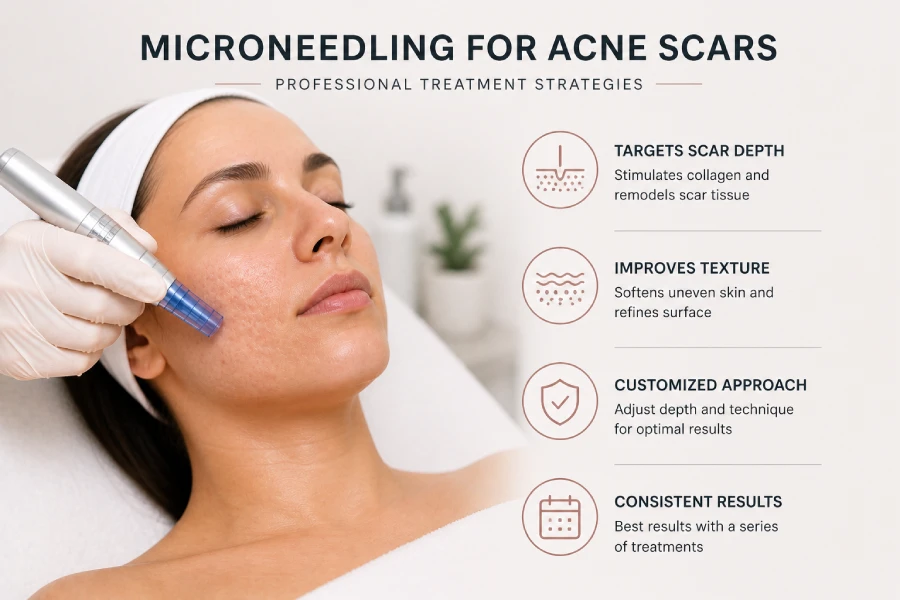
Does Microneedling Work for Acne Scars, and How Should Estheticians Approach Treatment?
Microneedling is one of the most clinically validated approaches for improving atrophic acne scars in professional esthetic practice. By delivering controlled micro-injuries to the dermis, microneedling activates the skin’s natural collagen induction cascade, which gradually remodels the depressed or distorted tissue that characterises post-acne scarring. Results develop progressively over a series of sessions, with improvements continuing for several months after each treatment as new collagen matures.
- Rolling scars and shallow boxcar scars respond most consistently to microneedling; ice pick scars require deeper or adjunctive intervention.
- Needle depth selection for acne scar treatment typically ranges from 0.5 mm to 1.0 mm within esthetician scope, guided by scar depth and skin sensitivity.
- Active acne lesions are a contraindication; treatment should only proceed once the skin is stable and non-inflamed.
- A minimum series of three to six sessions spaced four to six weeks apart is standard for moderate atrophic scarring.
- Serum selection during treatment should prioritise barrier-safe actives such as hyaluronic acid, growth factors, or peptides rather than exfoliating acids.
- Immediate post-treatment occlusive hydration is critical to supporting the wound-healing environment and reducing transepidermal water loss.
- Realistic client expectation-setting is a professional obligation—microneedling improves scar appearance, not elimination, and results accumulate over time.
Acne scarring is among the most emotionally significant skin concerns estheticians encounter in professional practice. For many clients, the scars left behind after years of breakouts can be more distressing than the acne itself, and navigating treatment options requires a practitioner who understands both the science of scar formation and the practical realities of what can be achieved in an esthetic setting. Microneedling has established itself as one of the most reliable tools for addressing atrophic acne scars precisely because it works with the skin’s intrinsic repair mechanisms rather than against them.
The clinical rationale is straightforward: atrophic acne scars represent an area of deficient collagen architecture, where the normal dermis was replaced with fibrotic or absent matrix during the inflammatory healing process. Microneedling’s controlled puncture stimulus triggers a fresh wound-healing cascade in and around that tissue, directing the body to lay down new collagen and elastin in a more organised pattern. Over a series of sessions, this remodelling process gradually raises depressed scar floors and softens sharp scar margins.
This article covers the classification of acne scar types relevant to esthetic practice, evidence-based needle depth selection, serum pairing strategies, post-treatment recovery protocols, and the client communication framework that turns a single treatment series into a long-term professional relationship.
What Every Esthetician Should Know About Treating Acne Scars With Microneedling
- Scar classification determines treatment approach—not all acne scars respond equally to microneedling, and identifying scar type before booking a series is non-negotiable.
- Rolling and boxcar scars are the best candidates for professional microneedling within esthetic scope; ice pick scars are slower to respond and may require adjunctive referral.
- Needle depth directly influences clinical outcome—too shallow produces minimal collagen stimulus; too deep exceeds esthetician scope and risks client harm.
- Active acne is a firm contraindication; attempting to treat scarring over actively inflamed skin worsens outcomes and introduces infection risk.
- Serum choice during treatment matters—hyaluronic acid, growth factors, and peptides are appropriate; exfoliating acids and retinoids are not.
- Post-treatment hydration and barrier protection are as important as the needling itself for supporting the collagen induction environment.
- Clients must be counselled that improvement is gradual and cumulative—three to six sessions is a standard treatment series, and collagen remodelling continues for months after each session.
Understanding Acne Scar Types Before Treatment
Effective microneedling for acne scars begins with accurate scar classification. Treating all acne scars as interchangeable is one of the most common errors in esthetic practice, and it leads to mismatched expectations, inappropriate needle depth selection, and underwhelming results. The three atrophic scar types most relevant to esthetic practice—rolling, boxcar, and ice pick—differ not just in appearance but in their depth, structure, and responsiveness to collagen induction therapy.
Rolling Scars
Rolling scars are characterised by a wave-like, undulating surface appearance caused by fibrous tethering bands that pull the epidermis downward at irregular intervals. They tend to be broad in base relative to their depth and often appear more pronounced when the skin is stretched. Rolling scars are the most consistently responsive scar type for microneedling because the tethering bands can be disrupted by the needling stimulus and the broad scar base provides sufficient target area for collagen induction to occur across multiple sessions.
Boxcar Scars
Boxcar scars have sharply defined, vertical walls with a flat or slightly undulating floor. They range from shallow to moderately deep and can have a punched-out appearance, particularly on the cheeks and temples. Shallow boxcar scars respond well to a consistent microneedling series. Deep boxcar scars with pronounced vertical walls are more challenging and may show only partial improvement within esthetic scope; practitioners should communicate this clearly before beginning treatment.
Ice Pick Scars
Ice pick scars are narrow, deep, and sharply defined channels that extend into the mid or deep dermis. They are the most difficult atrophic scar type to treat with microneedling alone because the channel geometry limits the collagen stimulus that can be delivered to the scar walls at depths within esthetician scope. Clients with predominantly ice pick scarring should be counselled that microneedling may improve overall skin texture and surface quality but is unlikely to resolve the ice pick channels themselves without adjunctive treatments such as TCA cross or physician-administered procedures.
The Science of Collagen Induction in Scar Tissue
Understanding why microneedling works on acne scars requires a working knowledge of what scar tissue actually is at a cellular level, and how the wound-healing cascade can be deliberately re-engaged to improve it. Acne scars form when the inflammatory process during an active breakout damages dermal collagen and disrupts normal fibroblast activity. The resulting scar represents either a collagen deficit (atrophic) or collagen excess (hypertrophic), with the atrophic variants being the target of microneedling in professional esthetic practice.
How Microneedling Re-Initiates the Healing Cascade in Scar Tissue
When microneedling creates controlled micro-injuries in the dermis around and within scar tissue, it triggers a three-phase wound-healing response: the inflammatory phase, the proliferative phase, and the remodelling phase. During the proliferative phase, fibroblasts migrate into the injured area and begin synthesising new collagen and elastin. In the remodelling phase, which can continue for three to six months post-treatment, disorganised collagen fibres are progressively replaced with a more organised matrix pattern that reduces the visual depth and definition of the scar.
How the Remodelling Cascade Improves Atrophic Acne Scars Over Time
Microneedling initiates all three phases of wound healing without removing the epidermis. The inflammatory phase peaks within 24–72 hours post-treatment. The proliferative phase, during which fibroblasts actively synthesise new collagen, runs from approximately day 3 to day 21. The remodelling phase, during which new collagen is organised and refined, continues for three to six months post-session.
In scar tissue specifically, the fibroblasts activated by microneedling’s stimulus must not only produce new collagen but also work within and alongside pre-existing scar matrix, which is why scar improvement is slower and more incremental than general skin rejuvenation. Research supports that repeated sessions produce cumulative collagen reorganisation that exceeds what a single treatment can achieve, making consistent series adherence critical to the outcome.
Post-treatment hydration directly supports the collagen induction environment by maintaining moisture levels in the epidermis during the critical early healing window, reducing transepidermal water loss that would otherwise divert cellular energy from repair activity.
Needle Depth Selection for Acne Scar Types
Needle depth is the single most consequential technical decision in a microneedling session for acne scars. Too shallow and the treatment delivers insufficient stimulus to reach the dermal layer where scar remodelling occurs. Too deep and the esthetician exceeds their professional scope, risks bruising or post-inflammatory hyperpigmentation, and may cause unintended tissue trauma. The chart below provides a practical reference framework for depth selection across scar types and client presentations.
Adjusting Depth Based on Skin Tone and Hyperpigmentation Risk
Clients with Fitzpatrick skin types IV through VI require particular care when selecting needle depth for acne scar treatment because deeper dermal trauma in higher melanin skin carries a greater risk of post-inflammatory hyperpigmentation (PIH). In these clients, estheticians should begin at the conservative end of the depth range for the scar type and build depth incrementally only after confirming that the skin’s response to the initial sessions is stable and without PIH development. Brightening serums and post-treatment sun protection protocols become critical components of the treatment plan rather than optional additions.
One of the most consistent observations in acne scar protocols is that the immediate post-needling application step is where many estheticians underinvest—rushing to close out the session rather than supporting the skin through the first critical hour of recovery. With Poly-Luronic™ Jelly Mask, the standard approach is to apply the treatment serum at the end of the needling pass, allow it two to three minutes to absorb, then mix and apply the jelly mask as the final in-treatment step before the client sits upright. The set mask provides approximately 15 to 20 minutes of occlusive contact time, during which the skin visibly calms—redness intensity typically reduces noticeably by the time the mask is removed. This cooling-and-seal sequence is markedly different from simply misting the skin with a calming spray and applying SPF, which leaves the compromised barrier much more exposed during the early inflammatory phase. Clients who have experienced both approaches almost universally comment on the difference in how their skin feels when they leave the room, and the reduced next-day redness they report supports what practitioners observe during the session itself.
Six Critical Protocol Decisions in Microneedling Acne Scar Treatment
Beyond needle depth, a professional microneedling protocol for acne scars involves a series of interconnected decisions that together determine the clinical outcome. Each of the following considerations represents a point in the protocol where a clear, evidence-informed choice will consistently produce better results than an uninformed or habitual one.
Pre-Treatment Skin Stability Assessment
Before every session in an acne scar series, perform a thorough skin assessment to confirm the absence of active lesions, current inflammation, and recent use of sensitising actives. A client who was clear at consultation may present with a breakout cycle at session two. Treatment over active acne is a contraindication regardless of where in the series the client is.
Numbing Application Timing
If topical numbing cream is used, application and removal timing must be precise. Over-numbed skin loses the subtle feedback cues that guide pressure modulation. Remove numbing agent completely and allow at least five minutes for the vasoconstrictive effect to pass before beginning needling—vasoconstriction reduces the inflammatory response that drives collagen induction.
Pass Direction and Overlap for Scar Coverage
Atrophic scars require deliberate multi-directional passes to ensure even needle coverage across the scar base and walls. A single-direction protocol delivers inconsistent stimulus across irregular scar topography. Standard practice for scar treatment is four-pass coverage: vertical, horizontal, and both diagonals, with consistent overlap between passes.
Serum Application Sequence
Apply treatment serums in small amounts throughout the needling pass rather than saturating the skin once at the beginning. This ensures the serum is present in an active film as channels are created, maximising infusion without over-loading the skin surface. Hyaluronic acid is the standard base serum; growth factors or peptides can be added as secondary infusion if the client’s protocol calls for it.
Immediate Post-Treatment Recovery Protocol
The first 20 minutes after the needling pass are the highest-value recovery window. Apply an occlusive hydration mask immediately after the final serum application. This seals the treatment actives against the skin, reduces transepidermal water loss through the temporarily compromised barrier, and provides the anti-inflammatory cooling effect that measurably reduces post-treatment erythema intensity.
Session Interval and Series Architecture
Schedule sessions four to six weeks apart to allow sufficient collagen remodelling time between treatments. Compressing the interval to two to three weeks does not accelerate results—it layers new stimulus onto skin that has not completed its repair cycle, which can produce cumulative irritation without proportional collagen gain. Build the series architecture with the client at the consultation and confirm it in writing as part of the treatment agreement.
Client Communication and Expectation Setting for Acne Scar Protocols
The clinical outcome of a microneedling acne scar series is only as good as the client compliance and expectation management that surrounds it. Estheticians who invest in thorough pre-series communication consistently report higher client satisfaction scores and better rebooking rates than those who rely on the treatment results alone to carry the relationship. This is because acne scar improvement is inherently incremental, and clients who are not prepared for that reality often interpret slow progress as treatment failure rather than normal physiological timing.
Setting Realistic Timelines at Consultation
At the initial consultation, estheticians should clearly establish that microneedling works over a series of sessions, not a single treatment. A starting framework of three sessions with a reassessment at session three is appropriate for most moderate scar presentations. Clients should understand that collagen remodelling from each session continues for three to six months, which means the final result of session one is not visible at session two—it will continue improving in the background throughout the series. Before-and-after photography taken at each session provides objective documentation that is invaluable for client motivation and professional record-keeping.
At-Home Care as Part of the Protocol
The at-home care instructions provided after each session are not supplementary information—they are part of the treatment protocol. Clients who use sensitising actives within the 48 to 72 hour post-treatment window, skip sun protection, or fail to hydrate adequately during recovery will experience slower healing and potentially compromise the collagen-induction environment. Providing a written aftercare instruction card at every session, rather than relying on verbal instruction alone, significantly improves client adherence and reduces the incidence of preventable adverse responses.
When to Refer
Estheticians should maintain a clear referral pathway for clients whose scar presentation exceeds the scope of what can be achieved in an esthetic setting. Severe ice pick scarring, deep boxcar scars with pronounced vertical walls, and scars in clients with active hormonal acne cycles that cannot be stabilised are all situations where a dermatologist or plastic surgeon should be part of the care team. Providing this referral is a professional service, not a clinical failure—and clients who receive honest guidance about their options are more likely to return as long-term treatment partners for the improvements that are within esthetic scope.
Professional and Scientific References
This article is grounded in peer-reviewed clinical research on collagen induction therapy, atrophic acne scar treatment, and wound-healing physiology, alongside established esthetic industry protocols for microneedling practice.
- Fabbrocini, G. et al. “Acne Scarring Treatment Using Skin Needling.” Clinical, Cosmetic and Investigational Dermatology, 2010. Foundational study documenting histological collagen changes following microneedling in atrophic acne scar tissue.
- Dogra, S. et al. “Microneedling for Atrophic Acne Scars.” Journal of Cutaneous and Aesthetic Surgery, 2014. Provides clinical assessment of rolling and boxcar scar response across a multi-session treatment series.
- Aust, M.C. et al. “Percutaneous Collagen Induction Therapy: An Alternative Treatment for Scars, Wrinkles, and Skin Laxity.” Plastic and Reconstructive Surgery, 2008. Establishes the wound-healing cascade mechanism underlying microneedling’s collagen induction effects.
- El-Domyati, M. et al. “Multiple Microneedling Sessions for Minimally Invasive Facial Rejuvenation.” International Journal of Dermatology, 2015. Documents the cumulative and progressive nature of collagen production across repeated microneedling sessions.
- Garg, S. & Baveja, S. “Combination Therapy in the Management of Atrophic Acne Scars.” Journal of Cutaneous and Aesthetic Surgery, 2014. Reviews scar classification and treatment response stratification relevant to esthetic practice protocol design.
For estheticians building a professional microneedling protocol for acne scar clients, the immediate post-treatment hydration step is where outcome quality is often won or lost. The skin’s barrier is temporarily disrupted after each session, and the occlusive mask applied in those first 15 to 20 minutes directly supports the collagen-induction environment by sealing treatment actives in contact with the skin and reducing the transepidermal water loss that would otherwise compete with repair signalling. Poly-Luronic™ Jelly Mask’s combination of polyglutamic acid and hyaluronic acid delivers the dual-depth hydration that compromised post-needling skin requires, while the physical jelly structure provides the occlusion that a mist or lightweight moisturiser cannot replicate. For practitioners who treat acne scar clients regularly, incorporating it as a non-negotiable close to every microneedling session is a straightforward upgrade to protocol quality that clients notice immediately.
Explore the Poly-Luronic™ Jelly Mask LineFrequently Asked Questions: Microneedling for Acne Scars
Does microneedling actually work for acne scars?
Yes, microneedling is one of the most clinically supported treatments for atrophic acne scars. By creating controlled micro-injuries that trigger the skin’s wound-healing cascade, microneedling stimulates new collagen and elastin formation within the scar tissue, physically remodelling depressed areas over a series of treatments. Clinical research consistently shows measurable improvements in rolling scars and boxcar scars after three to six sessions, with results continuing to develop for several months post-treatment as collagen matures.
What types of acne scars respond best to microneedling?
Rolling scars and shallow boxcar scars respond most consistently to microneedling. Both scar types involve dermal volume loss and distorted collagen architecture that collagen induction therapy can address by stimulating new matrix formation from below. Ice pick scars, which are narrow and extend deep into the dermis, respond more slowly and typically require more sessions or adjunct treatments. Hypertrophic and keloid scars are contraindications, not candidates for microneedling, because additional wound stimulus can worsen raised scar tissue.
What needle depth should estheticians use for acne scars?
For atrophic acne scars, most estheticians working within their scope of practice use needle depths in the 0.5 mm to 1.0 mm range. Depths of 0.5 mm are appropriate for superficial texture improvement and mild scarring in clients with thinner or more reactive skin. Depths of 0.75 mm to 1.0 mm are used for moderate atrophic scarring where deeper dermal stimulation is required. Deeper depths above 1.0 mm typically fall within medical scope. Estheticians should always confirm their state licensing scope before selecting treatment depth.
How many microneedling sessions are needed for acne scars?
Most clients with moderate atrophic acne scarring require a minimum series of three to six treatments to see meaningful improvement. Sessions are typically spaced four to six weeks apart to allow sufficient collagen remodelling time between treatments. Clients with deeper or more established scarring may benefit from six or more sessions. Realistic expectation-setting is essential: microneedling improves scar appearance progressively, and full results from a single session may take three to six months to become visible as new collagen matures.
Why is post-treatment hydration so important after microneedling for acne scars?
After microneedling, the skin’s barrier is temporarily compromised and transepidermal water loss increases significantly. For acne scar clients specifically, the skin surrounding scar tissue is often already structurally different from normal tissue, which can make it more vulnerable to dehydration stress. Applying a deeply occlusive hydration treatment immediately after the session helps seal moisture into the skin, reduce post-treatment redness and tightness, and support the early wound-healing environment that drives collagen production. Skipping immediate post-treatment hydration risks slowing recovery and reducing the overall treatment outcome.
What serums should estheticians use during microneedling for acne scars?
Hyaluronic acid serums are the most universally used infusion serums during microneedling for acne scars because they are non-irritating, deeply hydrating, and compatible with the compromised barrier state of post-needling skin. Growth factor serums are also widely used in professional settings for their ability to support wound healing signalling. Vitamin C serums, peptide complexes, and brightening serums targeting post-inflammatory hyperpigmentation may be introduced as the skin heals in subsequent sessions. Estheticians should avoid active exfoliants, retinoids, and fragrance-containing serums during the treatment itself.
Can estheticians treat active acne breakouts during a microneedling session?
No. Active acne lesions, inflamed pustules, and open comedones are contraindications for microneedling. Needling over active breakouts risks spreading bacteria across the skin surface, introducing infection into micro-channels, and worsening inflammatory acne. Estheticians should delay treatment until active breakouts have fully resolved and the skin is in a stable, non-inflamed state. Clients with chronic acne should have their breakouts managed with appropriate cleansing, extraction, and topical protocols before beginning a microneedling series for scar treatment.
What should clients avoid after microneedling for acne scars?
After microneedling for acne scars, clients should avoid active skincare ingredients including retinoids, exfoliating acids, and vitamin C for a minimum of 48 to 72 hours. Sun exposure should be avoided or strictly protected with mineral SPF once the skin has stabilised. Sweating from intense exercise, saunas, and steam rooms should be avoided for at least 24 to 48 hours to prevent irritation of open micro-channels. Clients should also avoid touching their face unnecessarily and should use only the gentle, barrier-supportive products recommended by their esthetician during the healing window.
How does the Poly-Luronic™ Jelly Mask support recovery after microneedling for acne scars?
The Poly-Luronic™ Jelly Mask is well suited to post-microneedling recovery for acne scar clients because its occlusive jelly structure seals moisture against the skin surface while the barrier remains temporarily disrupted after treatment. The combination of polyglutamic acid and hyaluronic acid in the formula delivers dual-depth hydration, while the cooling effect of the set mask helps calm the post-needling redness and heat response that acne scar clients commonly experience. In professional practice, applying the jelly mask immediately after the treatment serum allows estheticians to lock in the infused actives and provide a visibly calming finish that clients respond strongly to before leaving the treatment room.
Building a Professional Acne Scar Protocol That Delivers Results Over Time
Microneedling for acne scars is one of the most rewarding services an esthetician can offer, not because it delivers dramatic overnight results, but because it delivers genuine, progressive improvement in a concern that profoundly affects how clients feel about their skin. The key to consistent outcomes lies in the combination of accurate scar classification, evidence-based depth selection, appropriate serum pairing, and a recovery protocol that takes the post-treatment phase as seriously as the treatment itself.
Estheticians who build their acne scar protocols around a complete series framework—with clear client communication, structured session intervals, and a non-negotiable post-treatment recovery step—consistently achieve better outcomes than those who approach each session in isolation. The collagen remodelling that drives scar improvement is a slow biological process, and every decision in the protocol either supports or undermines that process.
Continue building your professional knowledge by exploring the full Microneedling Collagen Induction Therapy guide, which covers everything from the science of needle depth to post-treatment aftercare communication and the business strategy for building a profitable microneedling service in your practice.