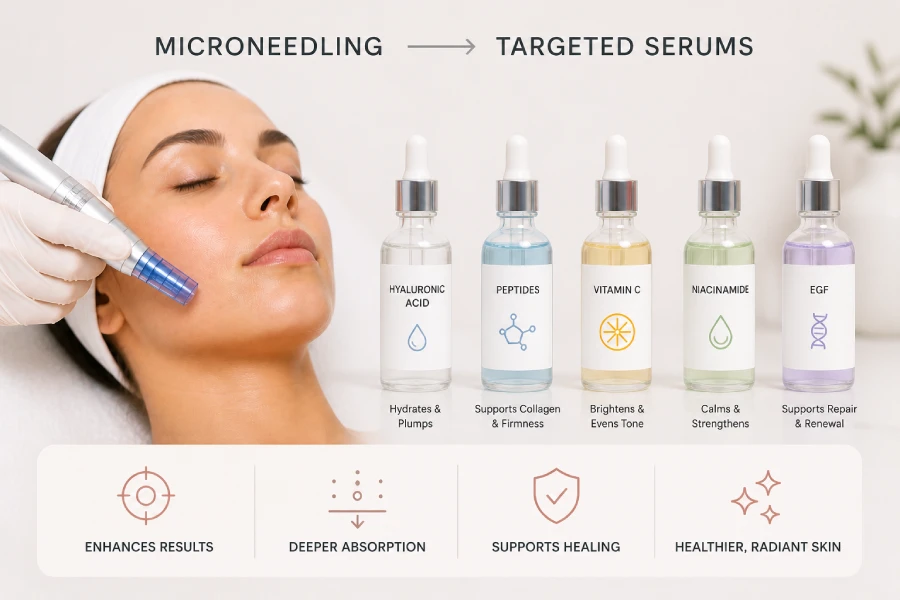
What Are the Best Serums to Use During Microneedling Treatments?
The best serums for use during microneedling are those formulated with ingredients the skin can safely absorb at elevated concentrations through compromised tissue. Hyaluronic acid, polyglutamic acid, peptides, and growth factors are the primary clinical options. Ingredients that are safe at normal topical doses—retinoids, vitamin C, AHAs, BHAs—become contraindicated during microneedling because the open microchannels dramatically increase dermal absorption.
- Hyaluronic acid (all molecular weights) is the standard glide medium and is safe across all Fitzpatrick skin types during active needling.
- Polyglutamic acid provides superior surface hydration retention and is well tolerated on compromised skin.
- Peptide serums support collagen induction signalling and are appropriate when formulated without sensitising additives.
- Growth factor serums are highly effective during needling because open microchannels maximise their dermal bioavailability.
- Retinoids, vitamin C, AHAs, BHAs, niacinamide above 2–5%, fragrance, and alcohol are all contraindicated during active needling.
- The serum applied during needling should keep the skin surface visibly moist throughout each device pass to prevent friction trauma.
- Serum choice is a clinical decision—the wrong ingredient applied through open microchannels can cause sensitisation, hyperpigmentation, or systemic irritation.
Every esthetician who performs microneedling faces the same fundamental clinical question before each treatment begins: what goes on the skin during the procedure itself? Unlike most facial treatments where product selection affects surface-level outcomes, serum choice during microneedling carries real physiological consequence. The microchannels created by needling temporarily bypass the stratum corneum—the skin’s primary permeability barrier—which means that whatever is applied to the skin surface during the procedure is absorbed transdermally at concentrations far exceeding what standard topical application achieves.
This dramatically increases both the therapeutic potential and the risk profile of any ingredient used mid-treatment. A well-chosen serum becomes a precision delivery vehicle. An inappropriate active becomes a source of deep-tissue irritation, sensitisation, or post-inflammatory hyperpigmentation. Practitioners who understand the science of transdermal delivery and barrier compromise can make serum selections that meaningfully improve treatment outcomes. Those who default to using whatever is on the shelf risk compounding procedural stress with chemical stress at exactly the moment the skin is most vulnerable.
This article provides a complete clinical framework for serum selection during microneedling—covering the science of transdermal delivery through microchannels, the ingredients that are therapeutically appropriate, the contraindicated actives that must be avoided, and the practical protocol decisions that affect how serum is applied throughout a treatment session.
What Every Esthetician Should Know About Serums During Microneedling
- Microneedling transiently bypasses the stratum corneum, making serum ingredient selection a clinical safety decision, not just a product preference.
- Hyaluronic acid is the universal safe choice for glide and hydration during needling—low-molecular-weight HA enters microchannels while high-MW HA provides surface lubrication.
- Peptide and growth factor serums are appropriate mid-treatment choices that actively support the wound-healing and collagen induction cascade.
- Retinoids, vitamin C, AHAs, BHAs, and high-concentration niacinamide are strictly contraindicated during active needling due to enhanced absorption risk.
- The serum must continuously lubricate the skin surface throughout each pass—dry skin under the device causes friction drag and uneven needle depth.
- Fragrance-free, preservative-minimal formulations are essential when the barrier is compromised to avoid sensitisation reactions.
- Serum is typically reapplied every one to two minutes per treatment zone, using approximately 2 to 4 ml total across a full-face session.
Why Serum Choice During Microneedling Is a Clinical Safety Decision
The relationship between microneedling and transdermal drug delivery has been studied for over two decades, primarily in the context of pharmaceutical research. What that body of literature consistently demonstrates is that needling—even at shallow esthetic depths of 0.25 to 0.5 mm—creates transient permeation pathways that dramatically increase the skin’s uptake of topically applied substances. For estheticians, this is not a theoretical consideration. It is the reason that what goes on the skin during a microneedling treatment requires the same level of scrutiny as what goes into a chemical peel formula.
At normal skin depths used in esthetic practice (0.25 to 1.0 mm), the needle tips penetrate through the stratum corneum and into the viable epidermis or papillary dermis, depending on device setting and skin anatomy. This disrupts the lipid lamellar structure of the stratum corneum in thousands of discrete points across the treatment zone. Each of those points becomes a temporary low-resistance pathway through which dissolved substances can bypass the barrier they would ordinarily need to penetrate through passive diffusion. Studies measuring skin permeability after microneedling consistently show increases in transdermal flux of 10-fold to 100-fold or greater depending on needle density, depth, and the molecular weight of the substance being measured.
The Barrier Disruption Window and Why It Matters for Serums
The permeability enhancement created by microneedling is temporary. Microchannels begin closing within 15 to 60 minutes of treatment, with measurable barrier recovery occurring over 24 to 72 hours depending on needle depth and individual skin health. The window during which dramatically elevated transdermal absorption occurs is concentrated in the treatment session itself and the first several hours post-treatment. This means that any ingredient applied during active needling has the highest possible bioavailability at the most sensitive moment in the treatment sequence—making safe ingredient selection most critical during this phase.
The Approved Serum Ingredients: What Works and Why
Within the category of ingredients that are safe and therapeutically beneficial to apply during active microneedling, there are four primary groups that represent the current clinical standard for professional use. Each group has a different mechanism of action and a different contribution to the treatment outcome. Understanding these distinctions allows estheticians to make serum selections that are matched to specific client goals rather than defaulting to a single generic protocol.
Hyaluronic Acid: The Universal Glide Medium
Hyaluronic acid occupies a unique position in microneedling protocols because it serves two simultaneous functions: it provides the lubrication needed for smooth device movement across the skin, and it delivers a biologically compatible hydration ingredient through open microchannels. HA is a glycosaminoglycan naturally synthesised by dermal fibroblasts and present in significant concentrations in the extracellular matrix. This means the skin has a high physiological tolerance for HA even when the barrier is compromised—it is not recognised as a foreign or potentially reactive substance by skin immune cells.
Molecular weight determines where HA works. High-molecular-weight HA (above 1,000 kDa) remains at the skin surface, forming a hydrating film that maintains procedural glide and reduces friction drag under the device. Low-molecular-weight HA (below 300 kDa) and oligomeric HA fragments penetrate through the microchannels into the upper dermis, where they interact with native HA receptors and support extracellular matrix hydration. For microneedling, a serum containing a blend of molecular weights provides the most clinically complete outcome.
Peptides and Growth Factors: Synergistic Support for Collagen Induction
Peptides are short-chain amino acid sequences that function as signalling molecules in skin biology. Several classes are relevant during microneedling: copper peptides, which support wound healing and angiogenesis; signal peptides such as palmitoyl tripeptide-1, which stimulate fibroblast collagen synthesis; and carrier peptides that transport trace minerals to the dermal matrix. Applied during needling, peptides are driven into the dermis through open microchannels where they interact with fibroblasts at exactly the moment those cells are being stimulated by the mechanical injury signal of needling itself.
Growth factors are signalling proteins—including epidermal growth factor (EGF), transforming growth factor beta (TGF-β), and basic fibroblast growth factor (bFGF)—that directly regulate the wound-healing cascade triggered by controlled needle injury. Their large molecular weight (typically 6,000 to 53,000 Daltons) means they cannot penetrate intact skin in any meaningful quantity. Microneedling fundamentally changes this. When growth factors are applied to skin during needling, the open microchannels allow these large proteins to reach the dermis, where they bind to their receptor targets and amplify the collagen induction signal.
How Microneedling Amplifies Serum Bioavailability
The stratum corneum’s primary function is to resist passive diffusion of substances into the skin. Its lipid bilayer architecture creates a selective permeability barrier that blocks or severely limits the uptake of most molecular compounds applied topically. Microneedling physically disrupts this barrier at thousands of discrete points, creating transient aqueous channels through which dissolved substances can move by convection and diffusion directly into the viable epidermis and papillary dermis.
Research measuring the impact of microneedling on transdermal penetration consistently shows significant flux increases for molecules that would otherwise have negligible skin uptake. This effect is concentration-independent: the same ingredient that is safe at normal topical doses may become problematic at the dramatically elevated dermal concentrations achieved through microchannel delivery. This is why the contraindicated ingredient list is not arbitrary—it reflects a systematic assessment of which actives produce adverse effects when absorbed at 10-fold to 100-fold their normal topical penetration levels.
For approved ingredients such as hyaluronic acid and peptides, the same amplification effect works in the treatment’s favour. These molecules are biologically compatible and therapeutically beneficial at elevated dermal concentrations, making microneedling one of the most effective delivery mechanisms available in esthetic practice.
Serum Ingredient Safety Reference: Approved vs. Contraindicated During Needling
Making accurate serum safety decisions requires a clear working reference for which ingredients fall into which category. The following framework organises the most common serum ingredients by their safety status during active microneedling, with clinical rationale for each classification. This is not a complete ingredient encyclopedia—it is a practical tool for the most common decisions practitioners face in a treatment room context.
Reading the Safety Framework in Practice
The approved column does not imply that all serums within those categories are automatically appropriate. Formula quality matters as much as active ingredient choice. An HA serum preserved with methylisothiazolinone or formulated with fragrance becomes a sensitisation risk on compromised skin, regardless of the safety profile of HA itself. Practitioners should evaluate serums not only on their active ingredient but on their full formulation, prioritising fragrance-free, preservative-minimal, and pH-neutral options for use during active needling.
The contraindicated column represents a hard boundary, not a spectrum of risk levels. There is no concentration of retinol or vitamin C that is safe to apply during active microneedling. These are not ingredients to use cautiously—they are ingredients to remove from the treatment surface entirely before the device makes contact with the skin.
The most consistent observation in post-microneedling treatment sequencing is how much the skin’s response during the recovery phase depends on what was applied during the active needling phase. When a well-chosen HA and peptide serum is used throughout the treatment, the skin arrives at the recovery mask step already hydrated at the dermal level, and the Poly-Luronic™ Jelly Mask functions exactly as intended—providing an occlusive seal that preserves the hydration that has already been delivered rather than needing to compensate for a dehydrated surface. In contrast, when practitioners have used a multi-active serum containing vitamin C or a brightening complex during the needling pass—often because the client requested a “results-focused” treatment—the skin at the recovery mask stage is visibly more reactive, displaying prolonged erythema and transient sensitivity that standard cream masks cannot adequately address. The jelly mask’s cooling set and complete surface occlusion does reduce the discomfort in those cases, but the more important clinical lesson is prevention: keeping the treatment surface clean of inappropriate actives during needling means the recovery step is a refinement rather than a rescue. Practitioners who establish a strict two-serum protocol—HA for glide and peptides for induction—followed immediately by the Poly-Luronic™ Jelly Mask for recovery, consistently report more predictable outcomes and significantly fewer reports of extended post-treatment sensitivity than those using more complex multi-active serum blends.
Six Common Serum Selection Errors Estheticians Make During Microneedling
Even experienced practitioners can fall into predictable patterns that compromise serum safety or reduce treatment effectiveness. These six errors represent the most common decision points where clinical knowledge gaps lead to suboptimal outcomes—ranging from minor treatment inefficiency to potentially significant adverse reactions.
Using a Multi-Active Serum as the Glide Medium
Products marketed as “microneedling serums” often contain a blend of actives—vitamin C, niacinamide, brightening agents—alongside HA. During active needling, all of those actives are being driven transdermally, not just the HA. Practitioners should evaluate the full ingredient list of any multi-active product before using it as a glide medium and avoid those containing contraindicated actives regardless of marketing claims.
Not Refreshing Serum Frequently Enough
Applying a full coating of serum at the start of the treatment and then needling an entire face without reapplying is one of the most common technique errors observed in training settings. Serum evaporates quickly under treatment room lighting and device heat. The skin must stay visibly moist throughout every pass. Practitioners should reapply serum to each treatment zone every one to two minutes to maintain consistent glide and prevent friction drag causing uneven needle depth.
Selecting a Serum With Fragrance or Undisclosed Preservatives
Many professional serums that are perfectly appropriate for standard facial use contain fragrance compounds, essential oil derivatives, or preservation systems that become sensitisation risks when applied to skin with compromised barrier function. During microneedling, these compounds reach the dermis at concentrations they never would under normal topical use. Checking the full INCI list for fragrance, parfum, essential oils, and high-concentration preservatives is a required step before any serum is approved for microneedling use.
Using the Same Post-Treatment Serum as the Treatment-Phase Serum
Some serums appropriate for use in the 24 hours after microneedling—moderate vitamin C esters, low-concentration niacinamide, mild exfoliating enzymes—are not appropriate during the active needling phase itself. The distinction between treatment-phase serums (applied before and during needling) and recovery-phase serums (applied after needling is complete) is clinically significant and should be built into every treatment protocol as a clearly documented checkpoint.
Applying Growth Factor Serum Before Needling Begins
Growth factor serums are most valuable when applied to the skin during or immediately after needling, not applied as a pre-treatment serum on intact skin. On uncompromised skin, the large molecular weight of growth factors prevents meaningful dermal penetration. Applying growth factors as a pre-treatment product and then wiping the surface before needling wastes a high-value ingredient. The correct protocol is to apply growth factors directly as the active serum during the needling pass or immediately upon completion of each treatment zone.
Ignoring Client Skin Sensitivity History When Selecting Serums
A client with a history of contact dermatitis, known ingredient sensitivities, or reactive skin requires a more conservative serum protocol than a client with resilient, stable skin. The standard clinical baseline for serum selection is HA plus sterile water for highly reactive clients, HA plus peptides for moderate complexity clients, and HA plus growth factors or copper peptides for resilient clients with anti-aging or repair goals. Applying a growth factor serum to a client with a compromised barrier history without prior patch consideration is a clinical risk that should always be assessed in the intake consultation.
Building a Serum Protocol That Matches Client Goals and Skin Tolerance
The most effective microneedling serum protocols are not single-product solutions—they are sequenced decisions that change based on the client’s primary treatment goal, their skin sensitivity profile, and the needle depth being used in that specific session. Practitioners who develop a library of three to four serums covering the key clinical categories can adapt their protocols meaningfully to different client presentations without needing to stock an excessive product inventory.
The Minimal Protocol: Safety-First for Reactive Skin
For clients with a history of barrier disruption, reactive skin conditions, or first-time microneedling exposure, the minimal protocol uses a single preservative-free HA serum throughout the treatment, applied generously and refreshed every one to two minutes across each treatment zone. This protocol maximises procedural safety and ensures that no unexpected sensitisation variables are introduced through the microchannels. It is also appropriate for clients who have not been patch-tested with more complex serums and for situations where the practitioner is uncertain about a client’s ingredient tolerance history. The therapeutic benefit is primarily delivered through the collagen induction mechanism of the needling itself rather than through active ingredient infusion.
The Enhanced Protocol: Peptides and Growth Factors for Targeted Outcomes
For established clients with known ingredient tolerance, the enhanced protocol introduces a peptide serum or growth factor serum as the primary active ingredient alongside HA for glide. In practice, many practitioners use HA as the base glide medium throughout the treatment and apply a concentrated peptide or growth factor serum directly to each treatment zone immediately after completing that zone’s needling pass, while the microchannels are still open. This technique delivers the high-bioavailability benefit of microchannel infusion while maintaining the consistent lubrication advantage of HA throughout the full treatment sequence. The selection between signal peptides and growth factors depends on the primary client goal: signal peptides are appropriate for general collagen induction and anti-aging, while growth factors are particularly appropriate for post-procedure skin restoration, more advanced aging concerns, or clients undergoing treatment for acne scarring or significant texture irregularity.
Communicating Serum Selection to Clients
Clients frequently ask why only specific products are used during microneedling, particularly when they are used to seeing their favourite vitamin C serum in their home care routine. A clear, brief explanation that microneedling temporarily changes how the skin absorbs ingredients—and that the same serum that is beneficial on normal skin can cause irritation when the barrier is open—is both accurate and sufficient for most client education conversations. Practitioners who take the time to explain serum selection rationale during the treatment or consultation build client confidence in the clinical depth of the service and establish themselves as credible sources of professional skincare guidance, which supports both treatment rebooking and retail recommendation outcomes.
Professional and Scientific References
The clinical guidance in this article is grounded in peer-reviewed research on transdermal drug delivery, microneedling mechanisms, and ingredient safety on barrier-compromised skin, as well as established professional esthetics education standards.
- Prausnitz, M.R. & Langer, R. (2008). “Transdermal drug delivery.” Nature Biotechnology, 26(11), 1261–1268. Foundational research on transdermal permeation enhancement mechanisms relevant to microneedling delivery.
- Alster, T.S. & Graham, P.M. (2018). “Microneedling: A review and practical guide.” Dermatologic Surgery, 44(3), 397–404. Clinical review covering procedural standards and topical agent use during microneedling.
- Ita, K. (2017). “Transdermal delivery of drugs with microneedles—potential and challenges.” Pharmaceutics, 7(3), 90. Establishes quantitative data on microneedling-induced increases in skin permeability across molecular weight ranges.
- Farris, P.K. (2014). “Combination approach to treating hyperpigmentation.” Journal of Drugs in Dermatology, 13(9). Contextual reference for post-inflammatory hyperpigmentation risk from inappropriate ingredient use on compromised skin.
- Gorouhi, F. & Maibach, H.I. (2009). “Role of topical peptides in preventing or treating aged skin.” International Journal of Cosmetic Science, 31(5), 327–345. Evidence base for peptide bioavailability and collagen induction signalling relevant to microneedling serum selection.
After the active needling phase is complete and the treatment serum has been infused through open microchannels, the clinical priority shifts to sealing and protecting the skin surface during the initial recovery window. The Poly-Luronic™ Jelly Mask addresses this transition point directly: its occlusive gel structure locks the treatment serums against the skin surface, preventing transepidermal water loss at exactly the moment the barrier is most compromised. Its polyglutamic acid and hyaluronic acid formulation is designed to complement the hydrating serums used during needling without introducing any sensitising actives that would undermine the careful ingredient selection made throughout the procedure. For estheticians building a complete microneedling protocol—from treatment serum selection through post-procedure recovery—the Poly-Luronic™ Jelly Mask functions as the evidence-based conclusion to a serum protocol that begins with the first needle pass.
Explore the Poly-Luronic™ Jelly Mask Line →Frequently Asked Questions: Serums During Microneedling Treatments
What serum should I use during a microneedling treatment?
The safest and most effective serums to use during microneedling are single-ingredient or minimal-formula hydrating serums based on hyaluronic acid, polyglutamic acid, or sterile saline. These ingredients support the treatment glide, maintain tissue hydration during the procedure, and do not introduce irritating actives into compromised skin. Peptide serums are also appropriate for use during or immediately after needling, provided they contain no sensitising preservatives or fragrance. Estheticians should avoid any serum containing retinol, vitamin C, alpha hydroxy acids, or niacinamide at concentrations above 2% during the active needling phase, as the compromised barrier dramatically increases systemic absorption and irritation risk.
Is hyaluronic acid serum safe to use during microneedling?
Yes, hyaluronic acid serum is widely considered the standard glide medium for microneedling treatments and is safe for use across all Fitzpatrick skin types during active needling. Hyaluronic acid is a naturally occurring glycosaminoglycan found in the dermis, which means the skin has a high tolerance for it even when the barrier is compromised. Low-molecular-weight HA formulations penetrate through microchannels to reach the upper dermis, while high-molecular-weight HA remains at the surface to maintain procedural glide and reduce friction. Estheticians should choose a preservative-free or minimal-preservative HA serum whenever possible to minimise irritation risk on compromised skin during the procedure.
Can I use a vitamin C serum during microneedling?
No, vitamin C serums should not be applied to the skin during active microneedling. Ascorbic acid and most vitamin C derivatives are pH-dependent actives that can cause significant irritation, stinging, and inflammatory response when applied to skin with a compromised barrier. During microneedling, the permeability of the skin increases dramatically, which means active ingredients penetrate far deeper and at far higher concentrations than under normal conditions. This dramatically raises the risk of a sensitisation response, post-inflammatory hyperpigmentation, and prolonged redness. Vitamin C can be reintroduced 72 to 96 hours after microneedling, once the skin barrier has begun to recover.
Why do estheticians apply serum during microneedling instead of after?
Serums applied during microneedling serve two clinical purposes: they provide the lubrication needed to move the device smoothly across the skin without drag, and they allow beneficial ingredients to be mechanically driven into the microchannels created by the needles in real time. This dual delivery mechanism—sometimes called passive infusion—means that hydration and recovery ingredients reach deeper dermal layers than they would with topical-only application post-treatment. Applying serum before and during the procedure continuously replenishes the medium on the skin surface, preventing friction trauma and ensuring consistent ingredient delivery throughout the treatment.
Are growth factor serums appropriate for use during microneedling?
Growth factor serums are among the most clinically supported choices for use during and immediately after microneedling. Growth factors are signalling proteins that directly interact with the wound-healing cascade triggered by controlled needling injury, supporting collagen synthesis, fibroblast activation, and tissue repair. When applied during microneedling, growth factors are driven into the dermis through open microchannels, significantly improving their bioavailability compared to standard topical application. The key selection criterion is that the growth factor serum must be fragrance-free, preservative-minimal, and formulated at a physiologically compatible pH to avoid sensitisation on compromised skin.
What ingredients should never be used during a microneedling treatment?
Several ingredient categories are contraindicated for use during active microneedling due to the skin’s dramatically increased permeability. Retinoids and retinol should never be applied during needling, as the enhanced absorption can cause deep tissue irritation, prolonged peeling, and potential toxicity at higher concentrations. Alpha hydroxy acids (glycolic, lactic, mandelic) and beta hydroxy acids (salicylic acid) are also contraindicated because their exfoliating and acid pH effects become unpredictable and potentially damaging when the barrier is open. Niacinamide at concentrations above 2% to 5% should be avoided during active needling. Fragrance, essential oils, alcohol-based toners, and any ingredient flagged as a known sensitiser should be strictly excluded from the treatment surface during the procedure.
Does the serum used during microneedling affect results?
Yes, serum selection during microneedling significantly influences both the safety and the clinical outcome of the treatment. The microchannels created by needling act as transient delivery pathways that bypass the stratum corneum, meaning that whatever is on the skin surface at the time of needling will be absorbed at a far higher concentration and to a far greater depth than standard topical application allows. This makes serum selection a critical clinical decision rather than an optional add-on. Using a well-chosen peptide or hyaluronic acid serum during needling can meaningfully enhance collagen induction outcomes, while using an inappropriate active can produce inflammatory responses, sensitisation, or unintended systemic effects.
How much serum should be applied during a microneedling treatment?
Estheticians should apply enough serum to keep the skin surface visibly moist throughout the entire needling pass, typically refreshing the serum application every one to two minutes per treatment zone. A thin but continuous layer is the target—the skin should never feel dry or tacky under the device, as friction drag can cause unnecessary trauma and uneven needle penetration depth. For a full-face treatment, this generally means applying serum in small amounts across the forehead, cheeks, nose, and chin in rotation rather than applying a single large quantity at the start. Most practitioners find that approximately 2 to 4 ml of serum is used across a standard 45-minute facial microneedling session when refreshed correctly.
Can the Poly-Luronic™ Jelly Mask be used after a microneedling serum treatment to support recovery?
Yes, the Poly-Luronic™ Jelly Mask is well-suited for use immediately following microneedling as a post-procedure recovery step once the active needling phase is complete. The mask’s occlusive seal traps the serums already infused during treatment against the skin surface, preventing transepidermal water loss during the critical first hour of barrier recovery. Its polyglutamic acid and hyaluronic acid formulation complements the hydrating serums typically used during needling without introducing any sensitising actives. Estheticians working with post-microneedling protocols consistently find that the cooling set of the jelly mask also helps calm visible redness and reduces client discomfort more effectively than a standard cream mask applied at the same stage.
Serum Selection Is the Clinical Decision That Defines Microneedling Safety and Outcomes
The difference between a microneedling treatment that delivers consistent, predictable results and one that produces unexpected adverse reactions often comes down to a single clinical decision made before the device makes contact with the skin: what serum is on the surface when the needles pass. Practitioners who understand the transdermal delivery mechanism of microneedling, who can clearly distinguish approved ingredients from contraindicated ones, and who maintain consistent serum application throughout the treatment session are equipped to deliver the full therapeutic potential of collagen induction therapy safely across a diverse client base.
The approved ingredient framework is not restrictive—it is precise. Hyaluronic acid, polyglutamic acid, peptides, and growth factors represent a clinically complete toolkit that covers hydration, collagen signalling, wound healing support, and anti-aging outcomes at the level that microneedling’s unique delivery mechanism makes possible. These are not compromises for safety’s sake. They are the ingredients that work best when applied through open microchannels, precisely because the skin can utilise them effectively at the elevated dermal concentrations that microneedling achieves.
Building a clear, documented serum protocol that specifies exactly which products are used at each phase of the microneedling treatment—pre-treatment, active needling, post-needling, recovery mask—is one of the most practical quality improvements an esthetician can make to their microneedling service. That documentation protects clients, supports consistent outcomes, and provides the clinical framework that distinguishes a professional-grade service from a generic one.