How Do You Choose the Right Microneedling Device for a Professional Esthetic Practice?
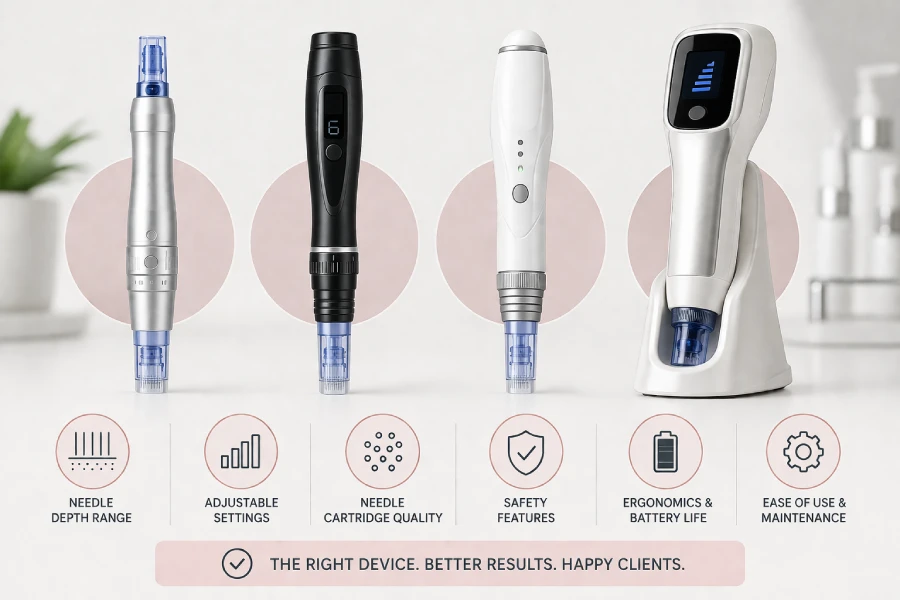
Choosing a professional microneedling device requires evaluating six core criteria: motor type, needle cartridge quality, adjustable depth range, speed consistency, safety features, and long-term consumable costs. The device that performs best on paper is not always the most appropriate choice for a given practice—scope of practice, client volume, and service positioning all shape which device delivers the best clinical and business outcomes.
- Linear motors produce cleaner vertical needle punctures than rotary motors, reducing lateral drag and epidermal trauma at higher treatment speeds.
- Cartridge lock integrity is the single strongest indicator of overall device build quality—any lateral cartridge movement introduces inconsistent channel depth.
- Depth precision matters even at shallow esthetic settings; devices engineered for clinical depth ranges hold shallower settings more accurately than devices purpose-limited to shallow use.
- Anti-backflow cartridge mechanisms are a non-negotiable safety requirement—they prevent blood and serum from contaminating the reusable pen body between cartridge changes.
- Consumable cartridge cost per treatment should be calculated before purchase—in high-volume practices, cartridge spend often exceeds the device cost within 12 to 18 months.
- Scope of practice varies significantly by state—confirm that the device’s operating depth range is compatible with your board’s regulations before purchasing.
The microneedling device market has expanded rapidly, and the range of options available to estheticians now spans from entry-level pens under $200 to clinical-grade systems exceeding $3,000. Price alone is a poor guide. Devices at every price point vary dramatically in motor quality, cartridge engineering, depth accuracy, and the safety features that protect both the client and the practitioner. An esthetician who selects a device based on price or brand recognition alone—without evaluating these functional criteria—is making a decision that will shape treatment outcomes for every client served on that device, for years.
The challenge is that most device marketing does not explain the engineering differences that actually matter clinically. Specifications like “adjustable depth from 0.25 to 2.5 mm” or “up to 18,000 RPM” describe capacity, not precision. What matters in practice is whether the device holds its set depth accurately under skin resistance, whether the cartridge locks without wobble, and whether the motor maintains consistent speed across different tissue densities. These are the questions this guide is designed to help estheticians ask—and answer—before committing to a device.
This article covers the six primary evaluation criteria for professional microneedling device selection, the engineering factors behind each, what distinguishes performance across device tiers, and how to match device characteristics to the specific demands of your practice and client base.
What Every Esthetician Should Know Before Buying a Microneedling Device
- Motor type is the primary driver of channel quality—linear motors outperform rotary motors at higher speeds because they eliminate lateral needle drag during puncture.
- Cartridge lock mechanism integrity is the single most reliable indicator of overall device manufacturing quality—test it before you buy.
- Depth precision at shallow settings (0.25–0.5 mm) is more important for esthetic-scope practitioners than maximum depth capacity.
- Anti-backflow cartridge protection is a clinical safety requirement, not an optional feature—never use a device without a confirmed anti-backflow mechanism.
- Speed consistency across different tissue densities determines whether collagen stimulation is uniform or patchy across a full facial treatment.
- Total cost of ownership includes cartridge cost per treatment, not just device purchase price—always calculate both before choosing a device.
- State scope regulations must be verified before purchase—the same device that is legal for an esthetician in one state may require medical supervision in another.
Motor Type: The Foundation of Channel Quality
The motor is the mechanical heart of any microneedling device, and its design determines the fundamental character of the channels it creates. There are two motor architectures used in professional microneedling pens: rotary and linear. Understanding the difference is essential because it affects not just channel quality but also client comfort, post-treatment recovery, and the precision of any serum infusion performed during treatment.
Rotary Motors vs. Linear Motors
A rotary motor generates needle movement by converting circular shaft rotation into up-and-down oscillation through a cam mechanism. This design is mechanically simple and cost-effective to manufacture, which is why it appears in most entry-level and mid-range devices. The limitation is that the cam conversion introduces a slight rotational component to the needle motion at the moment of skin entry. At lower speeds this effect is minimal, but at higher oscillation rates—above approximately 14,000 cycles per minute—the lateral micro-drag becomes measurable and can increase epidermal trauma per channel, particularly on thinner periorbital or upper-lip skin.
A linear motor drives needle movement directly along a vertical axis with no rotational component at any point in the cycle. The needle enters and exits perpendicular to the skin surface regardless of speed. This produces cleaner puncture channels, lower tissue resistance during treatment, and more consistent channel geometry across zones of varying skin thickness and density. Linear motor devices are more expensive to manufacture and therefore appear predominantly in professional and clinical-tier equipment, but the difference in channel quality is demonstrable and clinically meaningful, particularly for estheticians treating sensitive skin types or performing high-pass-count anti-aging protocols.
Speed Consistency Under Resistance
A frequently overlooked motor specification is speed consistency under load—how well the motor maintains its set oscillation rate when pressing against areas of higher skin resistance like the forehead, jaw, and nasal bridge. Devices with underpowered motors will slow under resistance, creating inconsistent channel depth and spacing across a single treatment pass. High-quality devices maintain their set speed within a narrow tolerance across all tissue types, ensuring uniform collagen stimulation from the center of the face to its densest zones.
Needle Cartridge Systems and Safety Engineering
The cartridge is the consumable component of a microneedling device—replaced between every client—and its engineering quality has a greater direct impact on treatment outcomes than almost any other device variable. Estheticians evaluating devices should spend as much time assessing cartridge quality as they spend assessing the pen body itself.
What Makes a High-Quality Needle Cartridge
Professional-grade cartridges are manufactured with surgical-grade stainless steel needles that maintain consistent sharpness across their intended use life (a single treatment) and are arranged with precise inter-needle spacing that does not vary across the cartridge face. In lower-quality cartridges, needle tip geometry can vary within the same cartridge, producing channels of inconsistent diameter and depth even when the device is set correctly. When evaluating cartridges, estheticians should request manufacturer quality control documentation and examine whether the needles protrude evenly and symmetrically under magnification before accepting a new supply.
The anti-backflow mechanism is the most critical safety feature in any cartridge system. During microneedling treatment, capillary disruption produces micro-quantities of blood and interstitial fluid at the treatment surface. Without a physical barrier, this fluid can travel back through the cartridge stem into the pen body, contaminating the reusable device housing. A properly engineered anti-backflow cartridge uses a one-way valve or sealed reservoir to stop this reverse flow. This is not an optional feature—it is a cross-contamination control requirement. Any device whose cartridges lack a documented anti-backflow mechanism should not be used in a professional practice setting.
Needle Count Options and Clinical Application
Most professional-tier devices offer multiple cartridge configurations with different needle counts. The most clinically useful configurations for facial esthetic practice are 12-pin, 16-pin, and 36-pin. A 12-pin nano cartridge operates at very shallow depths and is suited to delicate periorbital and perioral zones as well as serum infusion protocols. A 16-pin cartridge is the standard workhorse configuration for full-face collagen induction at moderate depths. A 36-pin cartridge covers more surface area per pass, reducing treatment time for full-face protocols, but the increased needle density requires the practitioner to slow pass speed to maintain consistent depth across the full cartridge face.
Why Cartridge Engineering Determines Treatment Precision
The quality of microchannels created during professional microneedling is determined as much by cartridge manufacturing precision as by device motor quality. Needles that are not perfectly parallel to each other create channels at slightly varying angles, which produces inconsistent depth across a single pass even when device depth settings are correctly calibrated. This “angular variance” effect is more pronounced in lower-cost cartridges manufactured to wider tolerance specifications.
Anti-backflow efficacy is measured by the volume of reverse fluid flow permitted under simulated treatment conditions. Clinical-grade cartridges are engineered to produce zero measurable backflow at all clinically relevant treatment speeds and pressures. This engineering standard is what separates professional cartridges from consumer-grade needle tips.
Needle sharpness retention also varies significantly by cartridge tier. Professional-grade needles maintain their tip geometry across a full 60-minute facial treatment. Entry-level cartridge needles may show measurable tip deformation within 20 to 30 minutes of use, increasing skin trauma and reducing channel definition in the second half of the treatment.
Depth Range, Precision, and Scope Compatibility
Adjustable depth range is one of the most prominently advertised device specifications, and one of the most commonly misunderstood. The stated depth range describes the span of settings available, but it says nothing about the accuracy with which those settings are delivered under actual treatment conditions. A device that claims a range of 0.25 to 2.5 mm may drift significantly from its set depth when used on areas of high skin resistance, such as the forehead or chin, where subcutaneous tissue density is greater. Practitioners should always distinguish between a device’s depth capacity and its depth precision.
Scope of Practice and Depth Settings
For estheticians operating within standard esthetic scope, the clinically relevant depth range is 0.25 to 0.5 mm for most facial protocols. Some states permit depths up to 1.0 mm under esthetic license; others restrict estheticians to 0.3 mm without medical supervision. Estheticians should always verify their specific state board regulations before purchasing a device and before adjusting depth settings on any device already in use. The consequence of operating outside scope is not merely regulatory—it creates liability exposure that can affect both the practice and the practitioner’s license.
One of the most consistent observations among estheticians who have switched from rotary to linear motor devices is the difference in post-treatment skin state at the point when the recovery product is applied. With a rotary device, there is a noticeable increase in surface redness and what practitioners describe as “rough texture” immediately post-treatment—a sign of more epidermal disruption from the lateral needle drag. With a linear motor device at the same depth setting and pass count, the skin surface is noticeably smoother and more uniformly pink rather than variably red, indicating cleaner channel creation. Poly-Luronic™ Jelly Mask applied at this point behaves differently depending on which device was used: on the cleaner channels from a linear motor device, the mask sets with a perceptibly better surface contact and clients consistently report a cooler, more soothing sensation—which estheticians attribute to the mask being able to make full contact with the channel openings rather than sitting on disrupted surface tissue. By contrast, applying the same mask after a rotary device treatment at the same depth produces adequate but less pronounced cooling and hydration delivery—a practical, treatment-room-observable difference that speaks directly to why device quality matters at every step of the protocol, not just during the needling phase itself.
Six Criteria for Evaluating Any Professional Microneedling Device
When assessing a specific device for purchase, applying a structured six-criterion evaluation framework helps eliminate the marketing noise and focus assessment on variables that directly affect clinical outcomes, client safety, and practice profitability. Each criterion below represents a discrete, testable aspect of device performance that can be verified before purchase through manufacturer documentation, hands-on demonstration, or peer practitioner review.
Motor Type and Speed Consistency
Confirm whether the device uses a rotary or linear motor. Ask the manufacturer for speed consistency data under resistance. If demonstration units are available, test the device on varying tissue-density surfaces and observe whether the needle sound changes pitch—pitch drop indicates motor slowdown under load, which translates to inconsistent depth in dense tissue zones.
Cartridge Lock Integrity
Install a cartridge and attempt to move it laterally with moderate thumb pressure while the device is off. There should be zero detectable movement in any direction. A cartridge that shifts even slightly under this test will produce inconsistent needle protrusion angles during treatment. This single test is the fastest way to assess overall device manufacturing quality.
Anti-Backflow Mechanism Documentation
Request written confirmation from the manufacturer that the cartridge system includes a tested anti-backflow mechanism and that independent testing has been conducted. Any hesitation or inability to provide this documentation is a disqualifying factor. This is a non-negotiable safety requirement for any device used in a professional practice where blood exposure risk exists.
Depth Calibration Accuracy Under Resistance
Ask whether the manufacturer has published or can provide depth accuracy data at multiple resistance levels. Clinical-grade devices are calibrated to hold depth within ±0.05 mm across varying tissue resistance. If calibration data is unavailable, test the device on a silicone skin analog at two resistance levels and observe channel uniformity under magnification to assess real-world depth consistency.
Cartridge Configuration Range and Availability
Verify which cartridge configurations are available for the device and that they are consistently in stock from the manufacturer or distributor. A device that offers only one cartridge configuration will limit protocol flexibility. Confirm whether cartridges from other manufacturers can be used with the pen body, or whether the device uses a proprietary lock system that restricts you to a single cartridge supplier.
Total Cost of Ownership
Calculate the cost per cartridge multiplied by your projected monthly treatment volume to determine annual cartridge spend. Add device purchase price, warranty cost, and any required servicing fees. Compare this total cost of ownership across devices rather than comparing purchase price alone. In a practice performing 20 microneedling treatments per month, cartridge costs over three years typically exceed the device purchase price by a factor of two to four.
Building a Device Strategy That Fits Your Practice
Device selection should not be a one-size-fits-all decision. An esthetician building a high-volume acne-treatment practice has different device requirements than one focused on anti-aging protocols for mature skin, or one who performs microneedling as an occasional add-on to a primarily waxing and facial menu. Matching device capabilities to actual practice demands produces better clinical outcomes and better financial returns on the device investment.
Matching Device Tier to Service Volume and Client Base
Entry-level devices—typically rotary motor pens in the $150 to $400 range—are appropriate for estheticians who are beginning to offer microneedling as an occasional service and want to develop technique before committing to a higher investment. These devices have real limitations in motor precision and cartridge quality, and practitioners should be aware that their results will be less consistent than with professional-tier equipment. As client volume increases and microneedling becomes a core service, upgrading to a professional-tier linear motor device with full cartridge documentation becomes both clinically justified and financially reasonable.
Professional-tier devices in the $800 to $2,500 range represent the standard of care for estheticians who perform microneedling as a primary service. These devices offer linear motor performance, clinical-grade cartridge systems with documented anti-backflow protection, and the depth calibration accuracy that produces consistent results across high-volume treatment schedules. The higher upfront investment is typically recovered within 12 to 18 months for practitioners performing 15 or more treatments per month.
Planning for Protocol Integration
Device selection is inseparable from protocol planning. The device determines the character of the channels created, which in turn determines what recovery products can be used and how effectively they will work. Estheticians who plan to pair microneedling with immediate post-treatment mask application should select a device whose channel quality is consistent enough to support reliable ingredient penetration. Inconsistent channels from a poorly calibrated device produce unpredictable recovery product absorption, which undermines the post-treatment protocol regardless of the quality of the products used.
Estheticians who intend to offer both microneedling and nano infusion treatments should evaluate whether a single device with interchangeable cartridges can serve both modalities at acceptable performance levels, or whether maintaining two separate devices—one optimized for each treatment—produces better outcomes for the investment. In most practice settings, a dual-function device with appropriate cartridge options offers sufficient performance for both services, but practitioners who make nano infusion a significant revenue driver often find that a purpose-built nano device outperforms a dual-use pen for that specific modality.
Verifying Scope Compliance Before Purchase
Before purchasing any microneedling device, estheticians should obtain a written confirmation of their state board’s specific regulations governing needle depth, single-use cartridge requirements, required training documentation, and whether any depth settings require medical supervision or a medical director agreement. Regulations change, and in some states the rules governing esthetician microneedling scope have been revised multiple times in the past five years. Checking the current published regulations—not relying on secondhand information from distributors or colleagues—is the only safe approach to confirming compliance before purchasing and operating a device.
Professional and Scientific References
The device evaluation criteria and engineering specifications presented in this article draw on peer-reviewed clinical research on percutaneous collagen induction, published device performance standards, and professional esthetic practice guidelines.
- Aust, M.C., et al. “Percutaneous Collagen Induction—Regeneration in Place of Cicatrisation?” Journal of Plastic, Reconstructive & Aesthetic Surgery, 2011. Establishes the foundational channel-depth and tissue-response relationships central to device depth selection.
- Doddaballapur, S. “Microneedling With Dermaroller.” Journal of Cutaneous and Aesthetic Surgery, 2009. Early documentation of needle geometry effects on channel quality and collagen induction uniformity.
- Alster, T.S., and Graham, P.M. “Microneedling: A Review and Practical Guide.” Dermatologic Surgery, 2018. Reviews motorized device performance variables including motor type and speed consistency effects on outcomes.
- Bhardwaj, D. “Microneedling in Clinical Practice.” Indian Journal of Dermatology, Venereology and Leprology, 2016. Covers safety requirements including cartridge anti-backflow standards for professional practice settings.
- National-Interstate Council of State Boards of Cosmetology (NIC). Scope of Practice Reference Guide for Esthetic Modalities, current edition. State-by-state reference for needle depth and microneedling scope regulations applicable to licensed estheticians.
For estheticians who have invested in a high-quality microneedling device, the recovery phase immediately following treatment represents the highest-absorption window in the entire facial protocol. The precision channels created by a professional-grade device remain patent for 30 to 45 minutes post-needling, during which topically applied humectants penetrate to depths not achievable on intact skin. Poly-Luronic™ Jelly Mask is formulated specifically to work within this window: its polyglutamic acid and hyaluronic acid humectant system delivers deep hydration while the occlusive jelly matrix seals the skin surface to prevent transepidermal water loss during the initial recovery phase. For estheticians building a complete microneedling protocol, applying the jelly mask immediately post-needling—before any facial massage or serum layering—is the clinical step that maximizes the value of the device investment and consistently improves client-reported recovery outcomes.
Explore the Poly-Luronic™ Jelly Mask LineFrequently Asked Questions: Choosing a Professional Microneedling Device
What is the most important thing to look for when choosing a microneedling device?
The most important factor is needle cartridge quality and the device’s ability to maintain consistent depth under varying skin resistance. A device that drifts from its set depth when pressing against denser tissue areas like the forehead or jaw will produce uneven collagen stimulation and unpredictable client outcomes. After cartridge precision, motor type and speed consistency are the next most clinically significant factors.
What is the difference between a rotary and a linear motor in a microneedling pen?
A rotary motor converts circular rotation into up-and-down needle movement, which can introduce slight lateral drag at higher speeds. A linear motor drives needles in a purely vertical oscillation with no rotational component, producing cleaner puncture channels at all speed settings. Most estheticians working at higher needle counts and faster treatment speeds prefer linear motor devices because they produce less epidermal trauma per channel.
How many needle counts do I actually need for facial microneedling?
For standard facial collagen induction, 12-needle and 16-needle cartridges cover the majority of treatment scenarios. A 12-pin nano cartridge is ideal for sensitive zones and shallow infusion work. A 36-pin cartridge increases treatment speed for body or full-face coverage at shallower depths. Estheticians rarely need more than three cartridge configurations to handle their full treatment menu effectively.
Does needle depth range matter if I’m only working within scope as an esthetician?
Yes, depth range matters even if your scope limits you to shallower settings. Devices designed only for shallow work often lack the motor torque and precision engineering needed to maintain consistent depth even at 0.25 to 0.5 mm. A device built for a wider clinical range will hold depth accuracy more reliably across all its settings, including the shallower depths used in scope-limited esthetic practice.
Why does cartridge lock-in mechanism matter so much when buying a device?
A loose or inconsistent cartridge lock creates micro-wobble during treatment, which causes needles to drag laterally rather than penetrate cleanly. This increases skin trauma, creates irregular channel patterns, and reduces the precision of any serum or product infused during the treatment. A cartridge that locks with a firm, audible click and zero lateral movement is a strong indicator of overall device build quality.
Can I use a device for both microneedling and nano infusion treatments?
Some devices accept both standard needle cartridges and nano-tip cartridges, making them functional for both treatments from one pen body. However, devices purpose-built for one modality often outperform dual-use devices at their primary function. If nano infusion is a significant part of your service menu, many estheticians maintain a dedicated nano device alongside their primary microneedling pen rather than relying on one device for both.
How do I know if a microneedling device is safe to use in my state’s esthetic scope?
Device safety within scope depends on your state board’s specific regulations governing needle depth, single-use cartridge requirements, and which procedures require medical supervision. Most state boards permit estheticians to perform microneedling at 0.3 mm or shallower, though this varies significantly. Always verify current regulations directly with your state cosmetology or esthetics board before purchasing or operating any microneedling device.
What should I look for in the disposable cartridge system when evaluating devices?
The key cartridge criteria are: sterile single-use packaging with tamper-evident seals, consistent needle protrusion across the full cartridge face, a reliable anti-backflow mechanism that prevents blood or serum from contaminating the pen body, and a needle material that does not flex under resistance. Estheticians working in high-volume practices should also evaluate cartridge cost per treatment, since consumable costs directly affect service margin over time.
Why do estheticians use the Poly-Luronic™ Jelly Mask immediately after microneedling treatments?
The Poly-Luronic™ Jelly Mask is applied immediately post-microneedling because the open microchannels created during treatment allow humectant ingredients to penetrate significantly deeper than they could on intact skin. The mask’s occlusive jelly matrix locks that hydration in place while the skin begins its repair response, reducing transepidermal water loss at the most vulnerable point in the recovery window. Estheticians consistently report that clients who receive the jelly mask immediately post-needling show measurably less post-treatment redness at the 24-hour mark compared to those who receive only a standard serum finish.
Device Selection Is a Clinical Decision, Not Just a Purchasing Decision
The microneedling device an esthetician selects becomes the foundation of every collagen induction treatment they deliver. Motor type determines channel quality. Cartridge engineering determines safety and precision. Depth calibration accuracy determines whether collagen stimulation is uniform or inconsistent across a client’s face. These are clinical variables, and they deserve to be evaluated with the same rigor an esthetician brings to product formulation decisions or treatment protocol design.
Applying the six-criterion framework—motor type, cartridge lock integrity, anti-backflow documentation, depth calibration accuracy, cartridge configuration range, and total cost of ownership—to any device under consideration eliminates the noise of marketing claims and focuses the decision on what actually determines treatment outcomes. The practitioner who makes this decision well will see more consistent results, fewer client concerns about recovery variability, and a stronger return on their equipment investment over the device’s service life.
The device is only one part of a complete microneedling protocol. For guidance on the full treatment sequence—including preparation, serum selection, recovery mask application, and client aftercare instructions—explore the companion articles in the Microneedling Collagen Induction Therapy guide below.