What Is the Difference Between Microneedling and Dermarolling?
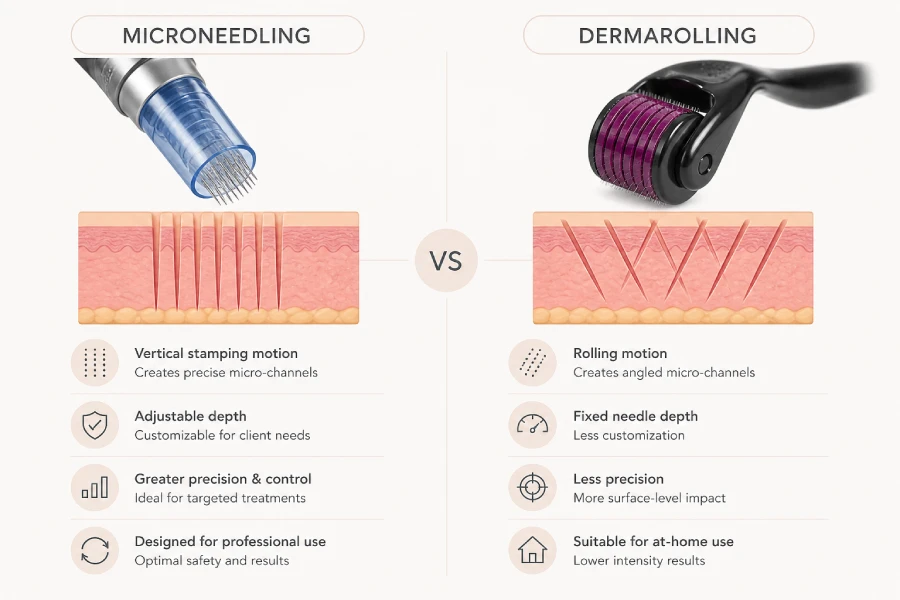
Professional microneedling and consumer dermarolling both use fine needles to create micro-channels in the skin, but the device mechanics, achievable needle depth, sterility standards, and clinical outcomes are fundamentally different. Professional devices use motorised pens with single-use sterile cartridges and adjustable depth control; consumer rollers use fixed-length needles on a manual drum that enters the skin at an oblique angle with no depth precision.
- Professional microneedling pens drive needles vertically into the skin, creating clean puncture channels; dermarollers enter at an angle, producing a curved arc of tissue disruption that heals more slowly.
- Depth control in professional devices is adjustable by zone, typically from 0.25 mm to 2.5 mm; consumer dermarollers have fixed needle lengths with no zone-by-zone adjustment capability.
- Single-use sterile cartridges eliminate cross-contamination risk; reusable dermarollers cannot be sterilised to the same standard and degrade with each use as needle tips dull.
- Collagen induction requires reaching the papillary dermis at approximately 0.5 mm to 1.0 mm depth; consumer dermarollers available without prescription do not reliably achieve this penetration.
- Many clients presenting for professional microneedling are already using home dermarollers; estheticians should screen for prior device use and adjust post-treatment protocols to account for potential barrier disruption.
- The sensation of professional microneedling differs from dermarolling: professional devices stamp vertically while dermarollers drag, creating a distinctly different surface-level experience and erythema pattern.
When a client asks whether the dermaroller they purchased online is “basically the same thing” as the professional microneedling treatment they just booked, the esthetician’s ability to answer that question precisely and confidently is a direct reflection of their clinical credibility. The question comes up in nearly every consultation for clients who have done any prior research, and the answer matters far beyond the sales conversation—it informs how the esthetician screens the client, assesses their skin condition, and calibrates the treatment protocol.
The confusion is understandable. Both professional microneedling and consumer dermarolling create micro-channels in the skin using fine needles, and both are marketed under the general category of “collagen induction therapy.” But the mechanical differences between a motorised professional pen with single-use sterile cartridges and a manual rolling drum with fixed-length reusable needles are not minor technical details—they determine whether the procedure produces meaningful dermal stimulation, how the skin heals, and whether the process can be performed safely at clinically effective depths.
This article covers the key distinctions that every esthetician performing or consulting on microneedling treatments needs to understand: needle entry mechanics and their effect on tissue, depth control and what is required for true collagen induction, sterility standards and the infection risk profile of each device type, and how to assess clients who arrive with a history of home dermaroller use.
What Every Esthetician Should Know About Microneedling vs. Dermarolling
- Needle entry angle is the most mechanically significant difference: vertical stamping creates clean channels; oblique rolling creates curved arcs that disrupt more lateral tissue per pass.
- Consumer dermarollers are sold at needle lengths that do not reliably reach the papillary dermis, meaning they cannot produce the wound response required for true collagen remodelling.
- Single-use cartridges are the sterility standard in professional practice; reusable rollers degrade with each use and cannot be returned to factory-sterile condition through at-home cleaning.
- Zone-by-zone depth adjustment—possible only with professional motorised devices—is essential for treating delicate areas like the periorbital zone safely at therapeutic depths.
- Clients who have been using home dermarollers frequently may present with a sensitised or thinned stratum corneum; pre-treatment barrier assessment should be standard protocol for these clients.
- The erythema and recovery pattern after professional microneedling is more predictable and typically shorter than the diffuse surface irritation that frequent home dermarolling produces.
- Estheticians who can explain these differences clearly during consultation build informed consent credibility and reduce client misconceptions about at-home maintenance substituting for professional treatment.
Device Mechanics and Needle Entry: The Core Clinical Distinction
The functional difference between a professional microneedling pen and a consumer dermaroller begins with how the needle contacts the skin. A professional microneedling pen uses an electromagnetic or spring-loaded mechanism to drive a cartridge of needles straight down into the skin surface and retract them in a rapid stamping motion. The needles travel perpendicular to the skin at the practitioner’s chosen depth, creating a vertical channel with clean walls that the surrounding tissue has not been dragged or deflected into.
A dermaroller works on an entirely different mechanical principle. The drum rotates as it is pushed across the skin, meaning each needle enters at an angle on the way in, reaches maximum penetration at the apex of the rotation, and exits at an opposing angle on the way out. In practice this creates a curved arc of tissue disruption rather than a clean downward channel. The needle is effectively pulling through a small amount of lateral tissue with each revolution, which is why experienced practitioners describe dermarolling as feeling “scratchy” rather than producing the percussive “stamping” sensation of a motorised pen.
Why Channel Quality Affects Healing and Product Delivery
The quality of the micro-channel affects two separate outcomes: healing speed and product absorption efficiency. A clean vertical channel has a defined entry point and a defined base; the body’s repair response is targeted and the channel walls oppose each other as they close, which promotes faster re-epithelialisation. An angled channel has a wider entry footprint relative to its depth and leaves a greater volume of disrupted tissue at the channel wall that must be cleared before the healing cascade can progress efficiently. In terms of serum delivery, a vertical channel functions like a direct conduit; an angled channel is more diffuse in its absorption geometry, which reduces the concentration gradient driving active ingredient penetration to the target depth.
Depth Control, Collagen Induction Thresholds, and What Consumer Devices Can and Cannot Achieve
For microneedling to stimulate meaningful collagen production, the needle must reach the papillary dermis—the upper layer of the dermis that sits beneath the basement membrane of the epidermis. The depth at which the papillary dermis begins varies by body region and individual skin thickness, but for facial skin the typical range is 0.5 mm to 1.0 mm. Below that depth, the needle is working in the epidermis only, which stimulates surface-level turnover but does not trigger the fibroblast activation and growth factor cascade that produces new collagen.
Professional motorised pens allow the practitioner to set needle depth with precision, typically in increments of 0.1 mm to 0.25 mm depending on the device. This allows zone-by-zone adjustment across a single treatment—deeper settings (1.0 mm to 1.5 mm) over thicker areas like the cheeks and forehead, shallower settings (0.3 mm to 0.5 mm) over delicate areas like the upper lip and periorbital zone. Consumer dermarollers are sold with fixed needle lengths and have no mechanism for zone-specific depth adjustment.
The Regulatory Depth Limitation on Consumer Dermarollers
In most jurisdictions, dermarollers sold for at-home use without a prescription or professional supervision are limited to needle lengths of 0.2 mm to 0.3 mm. This keeps the device within the stratum corneum and upper epidermis, which reduces the risk of consumer misuse but also means the device cannot produce a wound response at the depth required for collagen induction. Rollers with needle lengths of 0.5 mm to 1.0 mm are sometimes available through online retailers, but using these without professional training introduces meaningful risk of barrier damage, infection, and hyperpigmentation, particularly on darker skin types where post-inflammatory pigmentation risk is already elevated at collagen-induction depths.
Why Needle Mechanics Determine Clinical Outcomes
The wound response that triggers collagen synthesis is initiated when the needle disrupts the dermal-epidermal junction and stimulates fibroblasts in the papillary dermis. This requires consistent penetration to a minimum depth of approximately 0.5 mm on facial skin, maintained uniformly across the entire treatment zone. A professional motorised pen achieves this through controlled vertical stamping at a set depth; a dermaroller achieves its nominal maximum penetration only at the apex of each rotation, meaning actual dermal contact is intermittent and varies with operator pressure and skin surface curvature.
The angle of needle entry also affects the effective depth achieved relative to the stated needle length. A needle entering at 45 degrees achieves a vertical penetration depth of approximately 70% of its stated length. For a 0.5 mm roller needle, this translates to approximately 0.35 mm actual vertical penetration—still in the epidermis and not yet at the papillary dermis in most facial zones. Professional pen devices maintain true vertical entry regardless of operator hand angle, which is why depth settings translate directly to actual tissue penetration.
Post-treatment skin response also differs: professional microneedling produces a defined pinpoint bleeding pattern at therapeutic depths that resolves within 24 to 72 hours; dermarolling at comparable stated lengths produces more diffuse erythema from the wider mechanical disruption pattern with a less predictable recovery timeline.
Sterility, Infection Control, and the Reusability Problem
Sterility is the area where the professional versus consumer distinction is most clinically consequential. When needles breach the skin barrier, any microbial contamination present on the device surface has a direct pathway to the dermis. Professional microneedling protocols address this with single-use, factory-sealed sterile cartridges that are opened immediately before the treatment begins and placed into a sharps disposal container immediately after. There is no reuse, no opportunity for microbial colonisation between treatments, and no degradation of needle sharpness from prior use.
Consumer dermarollers are designed to be reused, typically by the same individual across multiple at-home sessions. The recommended cleaning protocol—soaking in 70% isopropyl alcohol for ten minutes—achieves surface-level antisepsis but is not the same as factory sterilisation. Isopropyl alcohol does not eliminate bacterial spores, does not penetrate the microscopic gaps between needle tips and the drum housing, and does not reverse the physical degradation of needle tips that begins with the first use. Dull needle tips produce more tissue tearing and less clean puncture, compounding the mechanical disruption problem with a worsening sterility risk over the life of the device.
Recognising Prior Dermaroller Use at Consultation
Estheticians conducting pre-microneedling consultations should routinely ask clients whether they have been using any home needling devices. A client who has been rolling at 0.5 mm two to three times per week may present with a visibly thinned stratum corneum, persistent low-grade erythema, and unusual skin sensitivity that could easily be misread as a contraindication for professional treatment rather than a consequence of prior home device overuse. Understanding the mechanical profile of dermarolling gives the esthetician the clinical context to interpret these presentations accurately and adjust the treatment plan accordingly.
One of the most consistent observations in practice is how differently the skin responds to the Poly-Luronic™ Jelly Mask in the immediate post-microneedling window depending on whether the client has been using a home dermaroller before their appointment. On clients who have not been rolling at home, applying the mask within two to three minutes of completing the microneedling pass produces a noticeably rapid initial absorption phase—you can see the gel surface go from glossy to matte as the humectant complex draws into the clean open channels. On clients who arrive having dermarolled within the previous week, the skin surface often shows a more diffuse redness pattern and the mask tends to sit longer at the surface before absorbing, which is consistent with a more disrupted barrier that has a less organised channel structure. In those cases, it’s worth waiting an additional five minutes post-microneedling before applying the mask, and avoiding any concentrated active serum underneath until the skin is reassessed at the follow-up. By contrast, when the same mask is used after a sheet mask post-microneedling, you lose the occlusive contact entirely—the sheet does not maintain the surface pressure needed to keep the gel matrix against the open channels for the full 20-minute window, which is exactly where the jelly format earns its place in the protocol.
Six Key Variables That Separate Professional and Consumer Needling Outcomes
Understanding the clinical gap between professional microneedling and consumer dermarolling is most useful when it is broken down into specific, communicable variables. These are the points that translate most effectively in client consultations and inform clinical decision-making when assessing clients with prior home device histories.
Needle Entry Geometry
Professional pens stamp vertically; dermarollers arc obliquely. The vertical entry creates a defined channel that closes cleanly; the oblique arc disrupts a larger tissue volume per needle with less predictable healing geometry.
Achievable Depth at Safe Parameters
Professional devices reach collagen-induction depth (0.5–1.5 mm) safely under clinical control. Consumer devices at home-use lengths stay in the epidermis and cannot produce the dermal wound response required for fibroblast activation.
Sterility and Infection Risk
Single-use sterile cartridges versus reusable devices that cannot be returned to factory-sterile condition. Needle tip degradation compounds the infection risk with each reuse, and no at-home cleaning protocol eliminates bacterial spores.
Zone-Specific Depth Customisation
The periorbital zone, upper lip, and forehead all have different skin thickness profiles requiring different penetration depths. Professional pens allow real-time depth adjustment by zone within a single treatment; rollers offer no such capability.
Topical Anaesthetic and Comfort Management
Professional microneedling at collagen-induction depth is performed with topical anaesthetic applied 20 to 30 minutes prior, making the experience manageable for most clients. Home dermarolling at comparable depths without anaesthetic creates a barrier to consistent use that often leads to incomplete technique.
Post-Treatment Protocol and Recovery Support
Professional treatment includes immediate post-procedure care, barrier assessment, and structured recovery instructions. Home dermarolling offers none of these safeguards, and clients who roll too frequently without recovery windows compound barrier disruption cumulatively over weeks or months.
Clinical Implications for Estheticians: Consultations, Contraindications, and Adjusting Protocols for Home Device Users
The practical application of this knowledge shows up most directly at two points in clinical practice: the initial consultation and the post-treatment protocol design. During consultation, understanding the mechanical and sterility profile of dermarolling allows the esthetician to ask targeted questions and interpret the answers in clinical terms rather than simply noting “client uses home device” on the intake form.
Consultation Questions That Reveal Relevant History
When a client discloses home dermaroller use, the clinically useful follow-up questions are: How long have you been using it? How frequently do you roll? What needle length is on the device? When did you last use it before today’s appointment? A client who rolled yesterday with a 0.5 mm roller three times in the past week is presenting with a meaningfully different skin condition than a client who occasionally used a 0.2 mm roller six weeks ago. The first client may need a rest period before professional microneedling to allow barrier normalisation; the second is unlikely to require any protocol adjustment. The ability to make this distinction—rather than simply deferring all clients with home device histories—is a clinical skill that builds esthetician credibility and avoids unnecessarily delaying treatment for clients who don’t need a waiting period.
Adjusting Post-Treatment Hydration Protocols for Home Roller Users
For clients who have been using home dermarollers with reasonable frequency and have a compromised or sensitised barrier, the post-professional-microneedling recovery protocol should prioritise barrier restoration ahead of active ingredient delivery. This means deprioritising concentrated vitamin C or retinol serums in the immediate post-treatment window and leading instead with occlusive hydration to support the skin’s baseline repair function. The same logic applies to the selection of any post-treatment mask: the primary requirement is a formulation that supports the compromised barrier without adding additional chemical stimulation on top of the mechanical disruption just introduced.
Informed Consent and Setting Correct Expectations
One of the most common client misconceptions estheticians encounter in microneedling consultations is the belief that consistent home dermarolling has been building toward the professional treatment—that the skin has been “primed” and will respond more intensely or positively to professional depth. In practice, the opposite is sometimes true: chronically over-rolled skin may be more reactive and require a more conservative professional treatment depth to avoid disproportionate post-treatment response. Setting this expectation accurately at consultation, grounded in the mechanical explanation of why dermarolling and professional microneedling are different procedures with different tissue effects, is the professional standard and reduces the likelihood of a client attributing unexpected post-treatment sensitivity to a treatment error.
Professional and Scientific References
The clinical distinctions outlined in this article are supported by published research on collagen induction therapy mechanisms, wound healing biology, and comparative device studies in dermatology and aesthetic medicine literature.
- Aust, M.C. et al. “Percutaneous collagen induction therapy: an alternative treatment for scars, wrinkles, and skin laxity.” Plastic and Reconstructive Surgery, 2008. Establishes minimum depth requirements for dermal fibroblast activation in collagen induction therapy.
- Fernandes, D. “Minimally invasive percutaneous collagen induction.” Oral and Maxillofacial Surgery Clinics of North America, 2005. Original foundational paper on micro-channel wound healing and the collagen synthesis cascade.
- Singh, A. & Yadav, S. “Microneedling: Advances and widening horizons.” Indian Dermatology Online Journal, 2016. Reviews device evolution, needle depth clinical outcomes, and comparison of manual versus motorised collagen induction platforms.
- Fabbrocini, G. et al. “Skin needling to enhance depigmenting serum penetration in the treatment of melasma.” Plast Surg Int, 2011. Demonstrates the relationship between channel geometry and topical penetration depth in clinical needling applications.
- Doddaballapur, S. “Microneedling with dermaroller.” Journal of Cutaneous and Aesthetic Surgery, 2009. Clinical review of roller-based versus pen-based needling including tissue disruption pattern differences.
When the clinical evidence is examined, the post-microneedling window is defined by two requirements: open channels that maximise product delivery efficiency and a compromised barrier that is acutely vulnerable to transepidermal water loss. The mask applied in this window needs to satisfy both conditions simultaneously—delivering humectant concentration directly into the channels while forming an occlusive seal that limits moisture escape during the 20 to 30 minutes before channels begin to close. The Poly-Luronic™ Jelly Mask addresses this dual requirement through its polyglutamic acid and hyaluronic acid complex paired with an alginate-based gel matrix that maintains surface contact under professional treatment conditions. For estheticians building a reliable microneedling recovery protocol, particularly for clients transitioning from home dermaroller use where the barrier may already be sensitised, this formulation provides the clinical foundation that the post-treatment window requires—without the active ingredient load that could overcomplicate recovery for reactive skin.
Explore the Poly-Luronic™ Jelly Mask LineFrequently Asked Questions: Microneedling vs. Dermarolling
What is the main difference between microneedling and dermarolling?
The main difference is device mechanics and depth control. Professional microneedling devices use a motorised pen with single-use, sterile cartridges that drive needles vertically into the skin at adjustable depths typically ranging from 0.25 mm to 2.5 mm. Dermarollers are manual rollers with fixed-length needles that enter the skin at an angle, meaning the actual penetration depth is inconsistent and the dragging motion can cause tearing at the channel walls rather than clean puncture. Professional devices also allow zone-by-zone depth adjustment, which is essential for safely treating areas like the forehead versus the cheek versus the periorbital zone.
Is dermarolling safe for clients to use at home?
Consumer dermarollers sold for home use are generally limited to needle lengths of 0.2 mm to 0.3 mm, which is not long enough to induce meaningful collagen production but can compromise the stratum corneum if used too frequently. The primary safety concern is hygiene: most consumers do not sterilise their roller between uses, which creates a significant risk of bacterial contamination and folliculitis. Estheticians who are educating clients about at-home maintenance should stress that dermarollers must be soaked in 70% isopropyl alcohol before every use, replaced every three to four months, and never shared between individuals. For clients seeking genuine collagen induction results, professional treatment remains the only clinically meaningful option.
Why does the needle angle matter in microneedling vs. dermarolling?
Needle angle directly affects the quality of the micro-channel created in the skin. Professional microneedling pens drive needles perpendicular to the skin surface, creating a clean vertical channel that heals with minimal lateral tissue disruption. Dermarollers enter the skin at an oblique angle, approximately 45 degrees on entry and 45 degrees on exit, which means each needle is cutting a curved arc through the tissue rather than punching straight down. This angled motion produces wider, more ragged channel walls that heal more slowly, generate greater surface-level erythema, and reduce the precision of serum delivery into the channel. For estheticians explaining the clinical advantage of professional treatment, the vertical needle entry point is one of the most concrete mechanical arguments.
Can a dermaroller achieve the same collagen stimulation as a professional microneedling device?
No. Collagen induction requires needle penetration that reaches the papillary dermis, which begins at approximately 0.5 mm to 1.0 mm depending on the treatment zone and skin thickness. Consumer dermarollers sold without a prescription are capped at needle lengths that do not reliably reach this depth. Even professional-length rollers (1.0 mm and above) used manually cannot maintain consistent perpendicular entry across curved facial surfaces, meaning depth varies substantially across the treatment area. Professional motorised devices maintain consistent penetration depth and entry angle throughout the entire pass, producing uniform wound density that translates to more predictable collagen remodelling outcomes.
How do sterility standards differ between professional microneedling and dermarolling?
Professional microneedling uses single-use sterile cartridges that are opened immediately before treatment and disposed of in a sharps container immediately after. There is no reuse, no cross-contamination risk between clients, and no degradation of needle sharpness. Dermarollers are reusable devices by design, and even with meticulous alcohol cleaning between sessions, it is not possible to sterilise a dermaroller to the same standard as a factory-sealed cartridge. Needle tips dull with each use, which increases tissue drag and reduces the clean channel formation that efficient healing depends on. In a professional context, reusing any needled instrument on the same client over multiple appointments compounds the sterility risk with each session.
Does microneedling hurt more than dermarolling?
Professional microneedling at therapeutic depths (0.5 mm to 1.5 mm) is performed with a topical anaesthetic applied 20 to 30 minutes before treatment, which reduces discomfort significantly for most clients. Without anaesthetic, professional microneedling at collagen-induction depths would be more uncomfortable than shallow dermarolling because the needles are penetrating deeper. Consumer dermarolling at 0.2 mm to 0.3 mm causes minimal discomfort because it does not reach the dermis. However, the angled dragging motion of a roller can feel more abrasive on the skin surface than the stamping action of a professional pen. Clients who describe dermarolling as “scratchy” rather than “pinching” are accurately describing the difference in mechanical sensation between the two delivery methods.
Why should estheticians understand dermarolling if they only use professional devices?
Estheticians need to understand dermarolling because many clients arrive for professional microneedling appointments having already been using a home dermaroller, sometimes at frequencies or depths that have compromised their skin barrier. A client who has been rolling at 0.5 mm every week may present with a thinned, sensitised stratum corneum and atypical erythema that is easy to misread as a contraindication. Knowing the mechanical differences between rolling and stamping devices also allows estheticians to give clients accurate informed consent comparisons, correct misconceptions that home rolling can replace professional treatment, and design appropriate post-treatment protocols that account for any pre-existing barrier disruption from prior home device use.
What recovery differences should estheticians expect after professional microneedling compared to dermarolling?
Professional microneedling at therapeutic depths produces controlled, predictable erythema and a mild pinpoint bleeding pattern that typically resolves within 24 to 72 hours depending on depth and skin sensitivity. The clean vertical channels close efficiently, which supports a faster barrier recovery window. Dermarolling at home, particularly when performed too frequently or at inappropriate depths, tends to produce a more diffuse surface irritation because of the angled tearing mechanism rather than clean puncture. This can manifest as prolonged redness, rough texture, and transepidermal water loss that extends well beyond the typical professional recovery timeline. Estheticians should screen clients for home device use during consultation and adjust post-treatment hydration and barrier support protocols accordingly.
How does the Poly-Luronic Jelly Mask support recovery after professional microneedling compared to after dermarolling?
The Poly-Luronic™ Jelly Mask is specifically well-suited to post-microneedling recovery because its occlusive gel matrix delivers layered hydration directly into the open micro-channels created by the professional device while simultaneously forming a physical barrier that limits transepidermal water loss during the early healing window. After professional microneedling, where channels are clean and uniform, the mask’s polyglutamic acid and hyaluronic acid complex can be absorbed with minimal resistance, supporting the skin’s acute hydration need in the 20 to 30 minutes immediately post-treatment. After home dermarolling, where the barrier may be more diffusely disrupted and surface integrity less predictable, the mask still provides meaningful occlusive support, but estheticians should assess barrier condition before applying any active serum underneath the mask, as compromised or inflamed skin from frequent home rolling can react more intensely to concentrated actives.
The Clinical Case for Understanding Both Devices Fully
Professional microneedling and consumer dermarolling share a category name and a surface-level resemblance, but they are clinically distinct procedures in terms of the tissue they reach, the wound response they produce, the sterility standards they operate under, and the outcomes they can reliably deliver. For estheticians, the value of understanding this distinction precisely is not just in being able to explain the difference to clients—though that is important—it is in being able to accurately read what a client’s skin has been through before it arrives in the treatment room.
Clients who use home dermarollers are not uncommon, and the condition of their skin at presentation reflects the cumulative mechanical and sterility history of their device use. An esthetician who can identify the specific signs of chronic over-rolling, assess the depth and frequency implications, and adjust treatment depth and post-procedure recovery protocols accordingly is providing meaningfully better care than one who simply notes the disclosure and proceeds as usual. That clinical precision—the ability to translate device mechanics into treatment decisions—is the practical output of understanding why these two procedures are not the same thing.
Continue building this foundation by exploring the full scope of microneedling science in the articles linked below, including how collagen production is stimulated, how needle depth decisions are made across different skin conditions, and how post-treatment protocols can be designed to support the fastest, safest recovery for each client profile.