What Is Microneedling and How Does It Work in Professional Skincare?
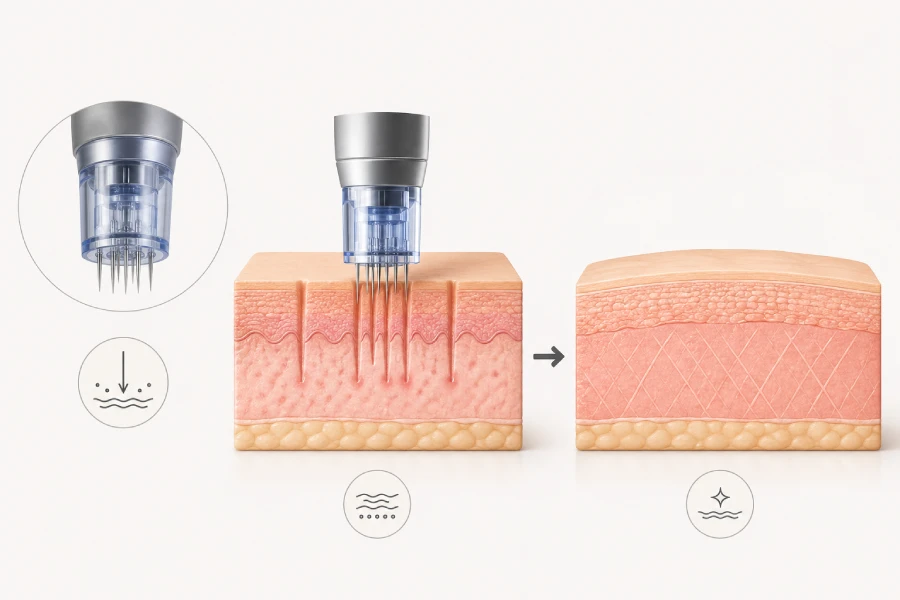
Microneedling, also called collagen induction therapy (CIT), is a professional skin treatment that uses a device fitted with fine, sterile needles to create thousands of controlled micro-injuries across the skin’s surface. These micro-channels trigger the body’s natural wound-healing response, stimulating fibroblasts to produce new collagen and elastin while also enhancing the transdermal absorption of serums applied during treatment.
- Microneedling works by mechanically triggering the skin’s wound-healing cascade, not through heat or chemical action, making it safe for a wider range of skin tones than laser-based alternatives.
- The primary biological outcome is increased collagen and elastin synthesis, with measurable improvements in skin density, firmness, and texture appearing over four to eight weeks post-treatment.
- Treatable concerns include fine lines and wrinkles, acne scars, hyperpigmentation, enlarged pores, uneven texture, and general skin laxity.
- Needle depth is a critical protocol variable: shallower depths (0.25–0.5 mm) maximise product absorption, while deeper settings (0.5–1.5 mm) target dermal remodelling for scars and laxity.
- Post-treatment care—particularly immediate hydration and barrier support—directly affects recovery speed and the quality of the collagen induction outcome.
- A standard treatment series is three to six sessions spaced four to six weeks apart, with visible results typically building progressively across the series rather than appearing after a single session.
For estheticians expanding their service menu into advanced treatments, microneedling represents one of the most evidence-supported and versatile procedures available within the esthetic scope of practice. Unlike treatments that rely on a single mechanism—a chemical exfoliant that resurfaces the epidermis, or an LED device that delivers photobiomodulation—microneedling simultaneously initiates a multi-phase healing response and creates physical channels that dramatically amplify the penetration of active serums applied during the procedure. This dual-action quality is precisely why it has become a cornerstone treatment in professional esthetic practice over the past decade.
The challenge for many practitioners entering this area is separating the genuine clinical science from the marketing language that surrounds high-demand treatments. Phrases like “collagen induction therapy” appear on marketing materials everywhere, but understanding what that actually means biologically—which cells are activated, which growth factors are released, and what the realistic timeline of results looks like—is what separates estheticians who achieve consistent outcomes from those who do not. This guide establishes that clinical foundation.
This article covers what microneedling is at the structural and biological level, how the collagen induction mechanism works, which skin concerns it addresses and why, the key protocol variables every esthetician must understand, and the critical role post-treatment care plays in determining the quality of every session’s outcome.
What Every Esthetician Should Know About Microneedling
- Microneedling is a mechanical collagen induction treatment, not a chemical or thermal one—this distinction determines its safety profile, suitable skin types, and combination treatment logic.
- The wound-healing cascade triggered by micro-injuries follows a predictable three-phase sequence: inflammation, proliferation, and remodelling—each phase matters for treatment spacing and aftercare decisions.
- Needle depth must be matched to the treatment goal: product infusion, texture refinement, and scar remodelling each require different depth settings and informed client consultation.
- Transdermal absorption of serums applied during treatment increases by a clinically significant margin through open micro-channels—serum ingredient selection is therefore as important as the needling protocol itself.
- Post-treatment barrier support and hydration are not optional extras—they directly affect the speed of recovery, the degree of client discomfort, and the quality of the collagen induction outcome.
- Microneedling is contraindicated in several common client scenarios, including active acne, isotretinoin use, blood-thinning medications, and keloid history—intake screening is non-negotiable.
- Results are cumulative and build across a series—setting accurate client expectations from the first consultation is essential to treatment satisfaction and rebooking rates.
The Structure of Microneedling: Devices, Needles, and Depth
Professional microneedling devices fall into two main categories: motorised pen devices and manual dermarollers. In professional esthetic practice, motorised pen devices have largely supplanted dermarollers as the standard of care. Pen-style devices use a cartridge containing between 12 and 36 needles that oscillate vertically at high speed, creating near-perpendicular channels in the skin. This vertical entry angle causes less epidermal drag and tearing compared to the angled entry of dermarolling, resulting in more consistent channel depth and a reduced risk of mechanical skin trauma.
Needle count in cartridges affects both treatment speed and the density of micro-channels created per pass. Higher-count cartridges (24–36 needles) are typically used for full-face coverage and general rejuvenation protocols, while lower-count nano-tip cartridges may be preferred for periorbital areas and more targeted work. Cartridges are single-use, sterile, and should be disposed of after each client session without exception—this is a non-negotiable safety standard, not a preference.
Understanding Needle Depth and Its Clinical Impact
Needle depth is the single most consequential variable in a microneedling protocol, and it is where the clinical logic of the treatment lives. At depths of 0.25 to 0.5 mm, the needles remain primarily in the epidermis and the papillary dermis, creating channels that dramatically enhance transdermal serum absorption without triggering significant bleeding. This range is appropriate for product infusion sessions and maintenance treatments on thinner or more sensitive skin. At depths of 0.5 to 1.0 mm, channels penetrate into the reticular dermis where fibroblast density is higher, initiating a more robust collagen induction response suitable for addressing fine lines, general texture irregularities, and mild laxity. Depths above 1.0 mm target deeper dermal remodelling for atrophic scarring and are typically reserved for practitioners with advanced training and appropriate device credentials.
The key principle is that depth decisions should always be driven by client skin concern, skin condition on the day of treatment, and the esthetician’s scope of practice in their jurisdiction—never by the assumption that deeper is always better. Excessive depth on unprepared or contraindicated skin is one of the most common causes of adverse outcomes in microneedling practice.
The Collagen Induction Cascade: What Actually Happens in the Skin
To explain microneedling to clients convincingly and to make intelligent protocol decisions, estheticians need to understand the three-phase wound-healing response that the treatment intentionally triggers. This is not merely academic—each phase has direct implications for how treatment sessions should be spaced, what aftercare supports each phase, and why results appear on the timeline they do.
Phase One: Inflammation (Days 1–3)
Immediately after needling, platelets aggregate at the micro-injury sites and release alpha-granules containing growth factors including platelet-derived growth factor (PDGF), vascular endothelial growth factor (VEGF), and transforming growth factor beta (TGF-β1). This triggers the classical inflammatory response: vasodilation, increased vascular permeability, and the recruitment of neutrophils followed by macrophages to the treatment zone. The visible redness and warmth clients experience post-treatment are surface expressions of this inflammatory phase. Critically, this phase should not be suppressed with anti-inflammatory drugs or ice immediately post-treatment, as the inflammatory signals are the initiating triggers for everything that follows.
Phase Two: Proliferation (Days 4–21)
Once the inflammatory signals have set the stage, fibroblasts migrate to the treatment zone and begin synthesising new extracellular matrix components—most importantly, Type III collagen, which is later converted to the stronger Type I collagen during the remodelling phase. Keratinocytes proliferate to re-establish the epidermal barrier, and angiogenesis creates new capillary networks to supply the rebuilding tissue. This is the phase during which the skin begins to look and feel progressively better, often described by clients as their skin feeling “plumper” or “tighter.” Supporting this phase with optimal hydration and barrier-protective ingredients maximises the cellular environment for fibroblast activity.
Phase Three: Remodelling (Weeks 3–12+)
The remodelling phase is the longest and the most clinically significant for results. Type III collagen matures and is replaced by denser, more organised Type I collagen fibres. The collagen network reorganises along lines of mechanical tension, improving skin firmness and elasticity. This is why the most noticeable improvements in skin texture, pore appearance, and fine line reduction typically occur six to twelve weeks after a treatment session—not in the days immediately following. Treatment series spacing of four to six weeks is designed to initiate the next inflammatory cycle while the current remodelling phase is still active, compounding collagen density with each successive session.
Measured Outcomes from Professional Microneedling Research
Peer-reviewed clinical studies on microneedling have documented consistent, measurable changes in dermal collagen architecture following a series of professional treatments. These figures represent the evidence base estheticians should be familiar with when discussing outcomes with clients.
Collagen density increase measured by histology in clinical studies typically ranges from 400% to 1000% above baseline after a series of four to six treatments, reflecting the compounding effect of repeated collagen induction cycles on dermal matrix density.
Transdermal absorption of topically applied molecules through micro-channels created by professional needling has been shown to increase by up to 10,000-fold for certain molecular weights, which is why serum selection during treatment is clinically consequential rather than cosmetic.
Skin Concerns Microneedling Addresses and Why
One of the distinguishing features of microneedling as a professional modality is the breadth of skin concerns it addresses through a single core mechanism. Unlike treatments that are highly specific to one concern, the collagen induction cascade and enhanced product absorption that microneedling generates are relevant across a wide range of the skin concerns estheticians most frequently encounter. The table below maps the primary treatable concerns to the specific biological mechanism that drives improvement in each case.
Why the Same Treatment Produces Different Results Across Clients
A question estheticians frequently encounter is why two clients on the same protocol appear to respond at different rates. The variability comes from several sources that are predictable and manageable when understood. Intrinsic factors include the client’s age (fibroblast activity decreases with age, extending the remodelling timeline), skin thickness (thinner skin on the periorbital area requires shallower depths and shorter intervals), and baseline skin health (a compromised barrier going into treatment leads to greater inflammatory overshoot and slower recovery). Lifestyle factors—sun exposure, smoking, nutritional status, and sleep quality—all affect the healing cascade speed and collagen synthesis efficiency.
The most controllable variable is post-treatment care. Estheticians who build a structured post-needling protocol that immediately addresses the barrier disruption and TEWL spike are consistently reporting faster recovery windows and better client satisfaction scores than those who leave post-treatment care to chance or generic retail recommendations. This is where the practitioner’s choice of recovery products becomes a direct extension of the clinical treatment itself.
In practice, the two-to-three minute window immediately after completing a microneedling pass is when post-treatment outcomes are most directly influenced by what the esthetician does next. Estheticians who apply a hyaluronic acid serum and then leave the skin unmasked while moving to LED setup consistently observe more pronounced redness and client discomfort at the fifteen-minute mark compared to those who apply the serum and immediately place an occlusive mask. The Poly-Luronic™ Jelly Mask has become a preferred choice for this post-needling window specifically because it sets firm enough to stay in place while the LED panel runs—a practical advantage that a sheet mask, which slides when a client tilts their head, does not provide. Mixing it at a slightly thicker ratio than standard facials—closer to the 3:1 powder-to-water ratio rather than the standard 2.5:1—creates a more robust occlusive layer for the compromised post-needling barrier compared to thinner hydrogel formats. The client-reported sensation difference is significant: the cooling, setting gel effect noticeably reduces the post-needling heat and tightness that clients otherwise describe as their primary discomfort point.
Six Critical Protocol Variables Every Esthetician Must Master
A microneedling treatment is not a single decision—it is a sequence of calibrated choices that together determine clinical outcomes, client safety, and the quality of the recovery experience. Each of the following variables operates independently but interacts with the others. Estheticians who develop a systematic decision framework for each variable produce more consistent results than those who work from general habit.
Needle Depth Selection
Depth drives both the treatment goal and the safety profile. Match depth to the target concern using the mechanism framework: shallower for product infusion and surface texture, deeper for dermal scar remodelling and laxity. Assess skin thickness and sensitivity on the day before confirming the session depth setting.
Treatment Speed and Pass Count
Motorised pen speed affects the density and uniformity of micro-channels. Slower speed with more deliberate pressure creates deeper, more consistent channels; higher speed with lighter pressure is preferred for product infusion passes. Standard full-face protocols typically involve two to four passes, with pass direction varied to avoid creating linear channel patterns.
Serum Selection During Treatment
Because micro-channels increase transdermal penetration by orders of magnitude, ingredient selection becomes critical for safety as well as efficacy. Hyaluronic acid, growth factors, peptides, and vitamin C derivatives are widely used during needling. Retinoids, aggressive acids, and vitamin A derivatives should not be applied through open channels due to the risk of deeper-than-intended penetration and irritation.
Treatment Spacing in a Series
Four to six weeks between sessions is the evidence-based standard for most skin concerns because it allows the proliferative phase to complete while the remodelling phase is still active. Spacing treatments too closely—under three weeks—risks treating skin that has not completed the previous healing cycle, which can compromise barrier integrity and diminish the compounding collagen benefit.
Contraindication Screening
Every session must be preceded by an updated health intake review. Active acne in the treatment zone, isotretinoin use within six months, blood-thinning medication, keloid history, open skin lesions, and active cold sores are absolute contraindications. Rosacea in a reactive phase, recent sun exposure, and compromised barrier conditions require clinical judgement about whether to postpone or modify the treatment.
Immediate Post-Treatment Recovery Protocol
The first five minutes after needling are when TEWL is highest and the compromised barrier is most vulnerable to dehydration. Applying a humectant serum followed immediately by an occlusive mask is the minimum standard of care. The quality of the occlusive mask used in this window has a measurable impact on the client’s recovery experience, comfort level, and the speed at which barrier function is re-established.
Setting Client Expectations and Building a Treatment Series
One of the most clinically important things an esthetician can do before the first microneedling session is establish an accurate timeline of expected results. Microneedling is a compounding treatment—each session adds to the collagen density and organisational quality built by the previous one. Clients who expect dramatic visible change after a single session, and who are not prepared for the redness and sensitivity of the first 24 hours, are the clients most likely to drop out of a series before the compounding benefit accumulates. The consultation conversation is therefore as important as the technical execution of the treatment itself.
How to Frame the First Consultation
The most effective framing estheticians working in high-volume practices use is the “investment model”—each session is building structural capital in the dermis that previous treatments could not reach. For anti-aging and texture goals, the conversation typically sets expectations at weeks six to eight for initial perceptible improvement and weeks twelve or beyond for the full benefit of the first series. For acne scar clients, who are often dealing with the most emotionally significant skin concerns, it is important to be specific about the mechanism—that microneedling remodels existing scar tissue by filling depressed areas with new collagen, a biological process that cannot be accelerated beyond the skin’s healing timeline, regardless of treatment frequency.
Post-Series Maintenance Protocols
After completing an initial series of three to six sessions, most clients benefit from quarterly maintenance treatments to sustain the collagen density gains achieved. The maintenance phase is also when at-home skincare becomes proportionally more important—retinoids, peptides, and consistent SPF use between sessions support the dermal remodelling work initiated in the treatment room. Estheticians who provide structured at-home recommendations aligned with the treatment phase see significantly better long-term client outcomes and higher rebooking rates than those who leave between-session skincare to the client’s discretion.
Documentation and Progress Tracking
Consistent photography under standardised lighting conditions before the first session and at the start of each subsequent session is the most effective tool for demonstrating the cumulative progress of microneedling to clients. Because improvement occurs gradually through the remodelling phase rather than immediately post-treatment, clients who can compare current-day skin to their baseline photograph are far more likely to appreciate and complete their series than those relying on subjective memory of how their skin looked months earlier. Documenting needle depth, pass count, serums used, and client response at each session also allows estheticians to make informed protocol adjustments as the series progresses.
Professional and Scientific References
The clinical claims in this article are grounded in peer-reviewed research on microneedling mechanisms, collagen induction therapy outcomes, and transdermal drug delivery. The following sources form the primary evidence base for the treatment science discussed above.
- Aust, M.C., et al. “Percutaneous collagen induction therapy: an alternative treatment for scars, wrinkles, and skin laxity.” Plastic and Reconstructive Surgery, 2008. Established foundational evidence for collagen density increases following microneedling in histological analysis.
- Doddaballapur, S. “Microneedling with Dermaroller.” Journal of Cutaneous and Aesthetic Surgery, 2009. Documented clinical outcomes for acne scarring and skin texture improvement across a treatment series.
- Fabbrocini, G., et al. “Acne Scarring Treatment Using Skin Needling.” Clinical and Experimental Dermatology, 2009. Peer-reviewed evidence for atrophic scar remodelling through controlled micro-injury and collagen induction.
- Singh, A., & Yadav, S. “Microneedling: Advances and widening horizons.” Indian Dermatology Online Journal, 2016. Comprehensive review of device types, depth parameters, clinical indications, and safety profile.
- Alster, T.S., & Graham, P.M. “Microneedling: A Review and Practical Guide.” Dermatologic Surgery, 2018. Evidence summary covering transdermal absorption enhancement, combination protocols, and contraindication management for professional practice.
For estheticians building a complete microneedling protocol, the post-needling recovery mask is not a finishing step—it is a clinical variable that directly affects barrier recovery speed, client comfort, and the quality of the environment in which the collagen induction cascade begins. The criteria that matter most in this window are occlusive structure to seal the temporarily compromised barrier, dual-depth humectancy to maintain the moist healing environment fibroblasts require, and a formulation free of active ingredients that could over-penetrate through open micro-channels. Poly-Luronic™ Jelly Mask addresses all three criteria: its alginate-based gel sets firm to provide consistent occlusion, the combination of polyglutamic acid and hyaluronic acid delivers surface-level and epidermal-depth hydration simultaneously, and the clean formulation is appropriate for the post-needling barrier state. For estheticians who are serious about producing measurable outcomes with their microneedling services, choosing the right mask for the immediate post-treatment window is as important as choosing the right needle depth for the session.
Explore the Poly-Luronic™ Jelly Mask LineFrequently Asked Questions: Microneedling in Professional Esthetic Practice
What exactly is microneedling and how is it different from other skin treatments?
Microneedling is a collagen induction therapy that uses a device tipped with fine needles to create thousands of controlled micro-injuries in the skin’s surface. Unlike chemical exfoliation or laser treatments, microneedling works mechanically rather than chemically or thermally, triggering the skin’s wound-healing cascade to produce new collagen and elastin. This makes it a uniquely versatile treatment that can be combined with serums, LED therapy, and hydration masks to amplify outcomes across multiple skin concerns.
Does microneedling actually stimulate collagen or is that just marketing language?
Microneedling does genuinely stimulate collagen production through a well-documented biological mechanism. When the needles create micro-channels in the dermis, platelets aggregate and release growth factors including platelet-derived growth factor (PDGF) and transforming growth factor beta (TGF-β). These signals activate fibroblasts—the cells responsible for synthesising collagen—leading to measurable increases in Type I and Type III collagen density over weeks to months following treatment. Multiple peer-reviewed studies have confirmed significant dermal collagen remodelling following a series of professional microneedling sessions.
What skin concerns can microneedling treat in a professional setting?
In professional esthetic practice, microneedling is used to address fine lines and wrinkles, acne scars, hyperpigmentation, enlarged pores, uneven skin texture, and general skin laxity. It is also used to enhance transdermal absorption of active serums applied during treatment. The range of treatable concerns is broad because the mechanism—controlled collagen induction and improved product penetration—benefits virtually all skin remodelling goals when depth and frequency are calibrated correctly to the client’s condition.
Is microneedling safe for estheticians to perform, and are there contraindications I need to know?
Microneedling is within the esthetician scope of practice in most jurisdictions at shallower needle depths, though state-by-state regulations vary and practitioners must verify local licensing requirements. Key contraindications include active acne breakouts in the treatment zone, rosacea flares, open wounds, cold sore outbreaks, blood-thinning medications, isotretinoin use within six months, keloid scarring history, and immunocompromised conditions. A thorough intake consultation and health history review should precede every treatment session.
How long does microneedling recovery actually take for most clients?
Most clients experience redness and mild sensitivity for 24 to 72 hours following a professional microneedling treatment, with the majority returning to normal activity within 24 hours for standard protocol depths. Deeper treatments targeting scar tissue or significant laxity may extend the reactive phase to four to five days. Recovery duration is influenced by needle depth, number of passes, client skin sensitivity, and the quality of post-treatment hydration and barrier support provided immediately after the session.
How often should clients come in for microneedling treatments to see real results?
For most skin concerns, a series of three to six treatments spaced four to six weeks apart is the standard professional recommendation. This spacing allows the skin to complete the initial inflammatory and proliferative healing phases before the next treatment is applied. Anti-aging and texture goals typically require a minimum of three to four sessions before collagen remodelling becomes visually apparent, while acne scarring often benefits from five to six sessions in an initial series followed by maintenance treatments every three to four months.
Why is hydration so important immediately after a microneedling treatment?
Immediately after microneedling, the skin’s barrier function is temporarily compromised by the micro-channels created during treatment. Transepidermal water loss (TEWL) increases dramatically in this window, making the skin highly vulnerable to dehydration that can slow the healing cascade and increase sensitivity. Applying a humectant-rich serum followed by an occlusive mask within the first minutes post-treatment locks in moisture, supports barrier recovery, and creates the hydrated environment fibroblasts need to begin the proliferative phase of collagen synthesis.
Can microneedling be combined with LED light therapy in the same session?
Yes, and this combination is one of the most clinically logical treatment pairings in professional esthetics. Red LED light therapy applied immediately after microneedling delivers photobiomodulation to fibroblasts at a time when the collagen induction cascade is already activated, potentially amplifying the cellular energy available for collagen synthesis. The LED session also helps calm post-needling redness by reducing inflammatory cytokine activity in the treated tissue. The sequence should always place LED after needling, never before, to avoid sensitising skin that will be mechanically disrupted.
How does the Poly-Luronic Jelly Mask fit into a post-microneedling protocol?
The Poly-Luronic™ Jelly Mask is particularly well-suited for post-microneedling use because its alginate-based occlusive structure seals the compromised barrier immediately after treatment, halting the spike in transepidermal water loss that occurs when micro-channels are open. The combination of polyglutamic acid and hyaluronic acid delivers dual-depth humectancy—PGA forms a film at the stratum corneum while HA draws moisture into the epidermis—supporting the hydrated environment the healing cascade requires. Estheticians applying it within two to three minutes of completing needling consistently observe a rapid reduction in client discomfort and erythema compared to leaving the skin unmasked or using a basic hydrogel sheet mask.
Building Clinical Confidence in Microneedling: The Foundation That Makes Every Session Better
Microneedling is not a complicated treatment to learn technically—the device does much of the mechanical work. What separates estheticians who consistently produce excellent outcomes from those who get inconsistent results is the depth of their understanding of the underlying biology. When you know that the collagen induction cascade follows a predictable three-phase sequence, you can make intelligent decisions about session spacing, serum selection, and the critical importance of the post-treatment recovery window. When you understand that needle depth directly determines which tissue layer is being targeted, you can calibrate each session to the specific concern and skin condition in front of you rather than using a one-size-fits-all approach.
The most important professional insight from this foundational article is that every element of a microneedling protocol is connected. The pre-treatment screening determines safety. The depth and pass count determine the collagen induction signal strength. The serums applied during treatment determine the secondary biochemical inputs reaching the dermis. And the post-treatment recovery protocol determines how efficiently the skin processes those signals into genuine structural change. None of these elements operates in isolation, and treating any one of them casually undermines the investment the others represent.
The articles in this guide that follow—covering collagen stimulation science, clinical research evidence, step-by-step protocols, treatment combinations, and recovery strategies—each build on the foundational understanding established here. Working through them in sequence will give you the complete clinical picture needed to offer microneedling with confidence, consistency, and the kind of measurable client outcomes that build a professional reputation.