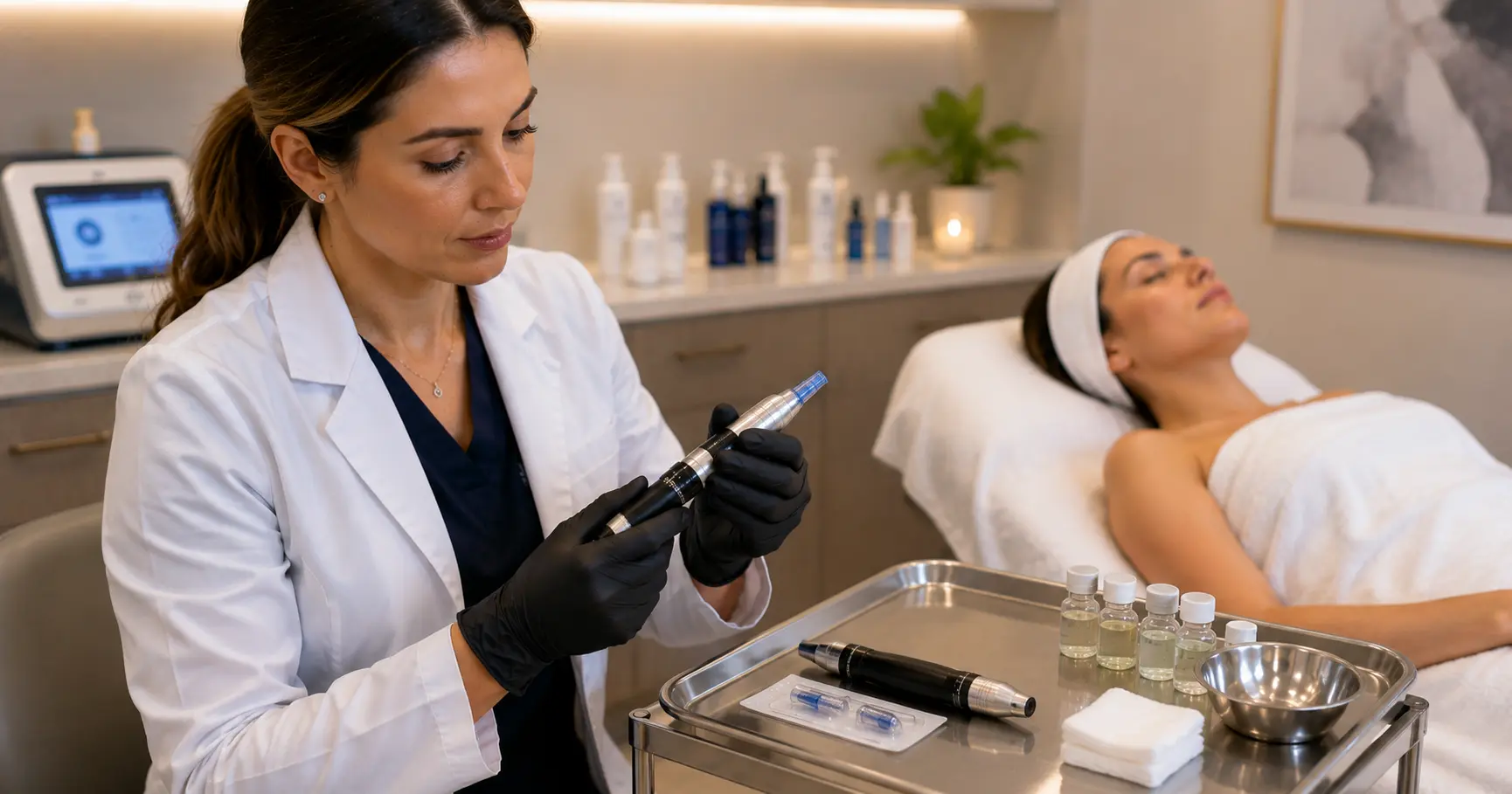
What Needle Depth Should Estheticians Use for Fine Lines?
For fine line treatment, microneedling needle depth should be selected based on the treatment zone and individual skin thickness rather than a single universal setting. The general clinical range for fine lines is 0.25 mm to 0.75 mm, with shallower depths applied to thin-skinned zones such as the periorbital area and lip line, and moderate depths used on the forehead and cheeks where skin is thicker and can tolerate greater stimulation. The goal is to reach the papillary dermis — the layer where collagen and elastin production is most responsive to controlled micro-injury — without unnecessary trauma to deeper structures.
- Fine lines form in the papillary and upper reticular dermis as collagen and elastin thin with age, UV exposure, and cumulative dehydration — the treatment target is this layer, not deeper structures.
- Periorbital fine lines require the most conservative depth settings: 0.25 mm to 0.3 mm maximum in most clients due to extremely thin undereye skin.
- Forehead and lateral cheek fine lines can typically be addressed at 0.5 mm to 0.75 mm, adjusted for individual skin thickness and condition.
- Lip line fine lines require 0.3 mm to 0.5 mm with reduced speed and pass count given the sensitivity and thinness of perioral skin.
- Speed settings, pass count, and applied pressure all modify effective penetration depth and must be adjusted alongside the device depth setting.
- Post-treatment hydration protocols directly support the collagen synthesis environment during the recovery phase — this is not a cosmetic afterthought but a clinical component of the protocol.
Of all the technical decisions an esthetician makes during a microneedling session, needle depth selection is the most consequential. Go too shallow and the treatment produces surface exfoliation without triggering the papillary dermis wound-healing response that generates new collagen. Go too deep on thin facial skin and the result is unnecessary trauma, extended recovery, potential bruising, and elevated risk of post-inflammatory hyperpigmentation in susceptible skin types.
Fine lines present a specific depth challenge because the skin zones most affected by them — around the eyes, above the lip, across the forehead — represent some of the most variable skin thickness terrain on the face. The periorbital area and lip line involve some of the thinnest facial skin on the body. The lateral cheeks and forehead offer comparatively more tissue depth. A single depth setting applied uniformly across these zones is both clinically insufficient and potentially unsafe.
This guide gives estheticians a structured framework for depth selection when treating fine lines: the anatomy that explains why depth matters, zone-by-zone depth references calibrated for fine line treatment, the technique variables that modify effective penetration independent of device settings, the clinical signs that guide real-time adjustment during a session, and the post-treatment protocols that support the collagen synthesis outcome the treatment is designed to achieve.
What Matters Most When Setting Needle Depth for Fine Lines
- The treatment target for fine lines is the papillary dermis — the zone of active collagen synthesis and fibroblast activity directly beneath the epidermis.
- There is no single universal depth for fine lines. Zone-by-zone adjustment based on skin thickness is the professional standard.
- The periorbital zone is the highest-risk area for depth errors — 0.25 mm to 0.3 mm maximum is the standard clinical reference for undereye treatment.
- Device speed, applied pressure, and pass count all modify effective depth independently of the dial setting — all three must be calibrated together.
- Erythema pattern during the session is a real-time feedback signal — petechiae formation indicates the depth or pass count has exceeded the appropriate threshold for that zone.
- Post-treatment hydration with a high-quality occlusive mask directly supports the collagen synthesis environment during the critical 24 to 72-hour recovery window.
- A conservative initial session depth is preferable to overtreatment — depth can always be increased in subsequent sessions based on documented client response.
Why Fine Lines Form Where They Do: The Anatomy Behind Depth Selection
Understanding which skin layers are involved in fine line formation directly informs why depth selection matters and which depths are clinically appropriate. This is not theoretical anatomy — it has direct practical implications for where a microneedling needle needs to reach to stimulate meaningful change.
The Layered Structure Relevant to Fine Line Treatment
The skin is organized into three primary layers: the epidermis, the dermis, and the subcutaneous tissue beneath. The dermis is itself divided into two sublayers: the papillary dermis, which lies immediately beneath the epidermis and is rich in fibroblasts, small capillaries, and the collagen and elastin fibers most directly responsible for surface skin texture; and the reticular dermis below it, which contains denser collagen bundles and deeper structural support.
Fine lines form primarily as a result of thinning and degradation in the papillary and upper reticular dermis. Collagen and elastin fibers in this zone lose density, cross-linking, and organizational integrity with age, UV exposure, repeated muscle contraction patterns, and chronic dehydration. The result at the skin surface is the visible depression we recognize as a fine line.
The total skin thickness on the face varies significantly by zone. On average, facial skin ranges from approximately 1.5 mm to 3.5 mm in total depth including the dermis, but the periorbital area — particularly the lower eyelid — can measure less than 0.5 mm in total epidermal and dermal depth in some clients. The forehead typically measures between 1.5 mm and 2.5 mm. The cheeks are among the thicker facial zones. Understanding these thickness variations is the anatomical foundation of zone-specific depth selection.
The Wound-Healing Cascade That Produces Fine Line Improvement
Microneedling treats fine lines by creating controlled micro-injuries in the papillary dermis that trigger a three-phase wound-healing response. In the inflammatory phase, platelets are activated, growth factors are released, and fibroblasts are recruited to the treatment site. In the proliferative phase — spanning roughly one to four weeks post-treatment — fibroblasts synthesize new collagen (predominantly type I and type III) and elastin. In the remodeling phase over subsequent months, these new fibers organize and mature, thickening the papillary dermis and visibly reducing the surface expression of fine lines.
The critical clinical point: this cascade is triggered at the papillary dermis level. A needle that reaches only the epidermis stimulates surface cell turnover but does not consistently trigger the dermal fibroblast response. A needle that penetrates well into the reticular dermis or below causes unnecessary depth of trauma with no proportional benefit for fine line treatment, and significantly increases risk of adverse events on thin-skinned facial zones.
Why 0.25 mm to 0.75 mm Is the Clinically Appropriate Range for Fine Lines
The epidermis on the face averages approximately 0.05 mm to 0.15 mm in thickness depending on zone. The papillary dermis immediately beneath it extends to approximately 0.3 mm to 0.6 mm from the skin surface in most facial zones. A needle set to 0.25 mm to 0.5 mm reliably reaches the papillary dermis in most facial treatment zones while staying well above the reticular dermis and its deeper vascular and structural components. In thicker-skinned zones such as the central forehead and cheeks, 0.5 mm to 0.75 mm can access both the lower papillary and upper reticular dermis where deeper fine line stimulation may be appropriate. Depths above 1.0 mm are used for conditions such as acne scarring that require reticular dermis remodeling — they are not necessary and are potentially harmful for fine line treatment targets.
The needle does not travel to its full set depth in all passes. Actual penetration depth is influenced by device speed, applied pressure, pass direction, and the skin’s immediate surface resistance. This is why a 0.5 mm setting does not produce 0.5 mm of tissue penetration in every stroke — the effective depth is a product of the total technique, not the device setting alone.
Zone-by-Zone Needle Depth Reference for Fine Line Treatment
The following depth ranges represent the clinical reference framework most commonly cited in professional microneedling education for fine line treatment. These are starting references for experienced practitioners — individual assessment of each client’s skin thickness, Fitzpatrick type, condition, and treatment history must always inform the final depth decision for each session.
| Treatment Zone | Depth Range | Skin Characteristics | Clinical Notes |
|---|---|---|---|
| Undereye / Periorbital | 0.25 – 0.3 mm | Thinnest facial zone. Often less than 0.5 mm total depth. Highly vascular. Minimal subcutaneous support. | Maximum conservatism required. Reduce speed to lowest setting. Two passes maximum. Never apply pressure. Stop immediately if petechiae form. |
| Crow’s Feet / Lateral Orbital | 0.3 – 0.5 mm | Slightly thicker than undereye. Fine expression lines from orbicularis oculi. Still a sensitive, thin zone. | Stamp technique preferred over gliding. Reduced speed. Avoid pressing toward orbital bone. Two to three passes depending on client response. |
| Lip Line / Perioral | 0.3 – 0.5 mm | Thin skin with active muscle movement. Vertical lip lines require precision. High sensitivity zone. | Client must hold lips taut. Short stamp strokes perpendicular to lip line. Avoid lip vermilion border. Two passes maximum on first sessions. |
| Forehead (Central) | 0.5 – 0.75 mm | Moderate thickness. Horizontal expression lines from frontalis muscle. Good tissue depth for fine line treatment. | Standard depth range for fine line CIT. Three to four passes in crosshatch pattern. Monitor erythema uniformity across zone. |
| Glabellar Lines (Between Brows) | 0.5 – 0.75 mm | Moderate to good skin depth. Active muscle zone. Vertical “11 lines” respond well to CIT. | Perpendicular passes across line direction. Three to four passes. Avoid bony prominence of supraorbital ridge. |
| Lateral Cheeks | 0.5 – 0.75 mm | Thicker facial zone with good subcutaneous support. Fine surface lines respond well at this depth. | Standard approach. Three to four passes. Adjust downward for thinner-skinned or older clients with evident skin laxity and reduced dermal density. |
| Neck / Décolleté | 0.25 – 0.5 mm | Significantly thinner than facial skin. Slower healing. Less sebaceous gland density. Prone to post-treatment sensitivity. | Conservative depth. Two to three passes maximum. Longer spacing between sessions. Dedicated aftercare protocol essential. |
The depth ranges above apply within the scope of practice permitted for estheticians in jurisdictions where microneedling is within esthetician licensure. Depths above 0.5 mm and any treatment on actively compromised, infected, or recently treated skin may require medical oversight or fall outside esthetician scope in many states. Always verify current scope-of-practice regulations for your jurisdiction before performing microneedling services at any depth. Consult the M7 hub of this guide for state-by-state compliance information.
How Technique Variables Modify Effective Penetration Depth
A common misconception among newer practitioners is that the needle depth dial on a microneedling device is the sole determinant of how deeply the needles penetrate the skin. In practice, effective penetration depth is a product of at least four interacting variables: device depth setting, motor speed, applied pressure, and pass technique. Understanding how each variable modifies effective depth allows estheticians to fine-tune treatment intensity within a session in real time.
Device Speed Setting
Motor speed controls how rapidly the needles oscillate. At higher speeds, the needles strike the skin surface more frequently per second — but each individual strike is also briefer and more superficial in effective penetration due to the rapid rebound. At lower speeds, the needles dwell fractionally longer per strike, allowing slightly deeper effective penetration at the same dial setting. For fine line treatment in sensitive zones, reducing speed is often the first technique adjustment an experienced practitioner makes before reducing the depth dial itself.
Applied Pressure
Applied pressure is perhaps the most underappreciated modifying variable. A practitioner pressing the device firmly against the skin surface will achieve greater effective depth than the dial setting alone would suggest, because the cartridge face compresses the tissue slightly, effectively reducing the distance the needles must travel to reach the target depth. Conversely, a very light touch reduces effective penetration. In thin-skinned zones, a feather-light application of the device is a critical safety technique alongside the lowest appropriate depth setting.
Pass Count and Direction
Each pass over a treatment zone accumulates micro-injury. A single pass at 0.5 mm produces significantly less overall tissue stimulation than four passes at the same depth. For fine line treatment, pass count should be calibrated to the sensitivity of the zone. The periorbital area may warrant only two passes at 0.25 mm to 0.3 mm, while the forehead at 0.5 mm to 0.75 mm can support three to four passes in a crosshatch pattern. Exceeding the appropriate pass count for a zone produces diminishing returns and increasing risk regardless of depth setting.
Stamp vs. Gliding Technique
The two primary application techniques — stamping (pressing the device onto the skin and lifting, then repositioning) and gliding (moving the device continuously across the surface) — produce different depth profiles. Stamping creates more discrete, vertically oriented channels and allows more controlled depth delivery in precise zones. Gliding creates broader, more uniform coverage but with slightly shallower individual channel depth due to the angled needle entry during movement. For fine-line treatment in the periorbital area and lip line, stamping with short, controlled strokes is generally preferred over gliding.
Reading Real-Time Skin Feedback During a Fine Line Session
The skin provides visible feedback during a microneedling session that experienced practitioners use to calibrate depth, speed, and pass count in real time. Learning to read this feedback accurately is one of the most important clinical skills in microneedling technique.
Erythema Pattern as a Depth Indicator
Uniform, moderate erythema across the treatment zone following a pass is the expected indicator that the papillary dermis has been appropriately reached. The skin should appear pink and flushed uniformly — comparable to a mild sunburn appearance — without discrete spots of bruising or significantly deeper redness in any area.
Petechiae: The Stop Signal
Petechiae — small pinpoint bleeding spots that remain visible at the surface — indicate that needle penetration has reached or exceeded the superficial vascular plexus. For fine line treatment, petechiae formation generally signals that either the depth is too great for the zone, the pass count has been too high, or applied pressure is excessive. When petechiae appear in the periorbital area or lip line, treatment in that zone should stop immediately for that session. In thicker zones such as the cheeks, occasional petechiae at higher depth settings are within the range of expected outcomes, but persistent petechiae formation should prompt a reassessment of technique variables.
Uniform vs. Patchy Erythema
Patchy erythema — where some areas of the treatment zone show deeper redness or more pronounced response than adjacent areas — often indicates inconsistent device contact, uneven pressure, or variation in local skin thickness within the zone. This signals a need to adjust technique rather than depth setting, and is common in zones where surface contour changes such as along the orbital rim or above the lip.
Adjusting Depth for Client-Specific Variables
Zone-based depth references provide a starting framework, but every client presents additional variables that should modify the final depth decision for each session. Experienced practitioners treat these client-specific variables as multipliers on the zone reference — they can push the appropriate depth toward the lower end of a range or indicate that the standard range should not be entered at all in a given session.
Fitzpatrick Skin Type
Clients with Fitzpatrick skin types IV through VI carry a higher baseline risk of post-inflammatory hyperpigmentation (PIH) following any treatment that creates dermal micro-injury. For these clients, beginning at the lower end of any zone’s depth range and conducting a conservative first session is the professional standard. Deeper depths may be appropriate in subsequent sessions if the client’s healing response has been documented as favorable and PIH-free following initial treatment. The M4 hub of this guide covers Fitzpatrick-specific microneedling risk management in full detail.
Age and Skin Density
Older skin presents with reduced dermal density and often lower collagen reserves. Paradoxically, while older skin may seem to require more aggressive treatment to achieve results, it also tolerates overtreatment less well due to slower cell turnover and reduced healing capacity. For clients over 60 showing visible skin thinning or significant laxity, reducing depth settings by 0.1 to 0.25 mm from the standard zone reference is a clinically sound adjustment, particularly in the periorbital and lip line areas where age-related skin thinning is most pronounced.
Chronic Dehydration and Barrier Compromise
Chronically dehydrated skin or skin with a compromised barrier function heals less efficiently than well-hydrated, intact-barrier skin. For clients presenting with significant dehydration markers — tight, dull surface texture, visible fine surface cracking, reactive flush response — deferring a fine line microneedling session in favor of a hydration restoration protocol first produces better eventual outcomes and reduces post-treatment risk. Performing collagen induction on dehydrated skin reduces the wound-healing efficiency and may extend recovery unnecessarily.
Previous Treatment History
Clients who have received multiple previous microneedling sessions develop progressively thicker and more collagen-dense papillary dermis as treatments accumulate over time. This progressive densification means that depth settings appropriate for a first session may be conservatively shallow for a client with six prior well-tolerated sessions. Documenting client response, depth settings, and skin changes after every session creates the longitudinal clinical record that informs depth progression over a treatment series.
Setting Up a Fine Line Protocol: Session Planning From Assessment to Aftercare
A well-constructed fine line microneedling protocol moves systematically through seven stages — each of which affects the outcome as meaningfully as needle depth itself.
- Pre-Treatment Assessment: Evaluate skin thickness by zone, identify the specific fine line concerns and their location, note Fitzpatrick type, assess barrier integrity and hydration status, review contraindications, and confirm the treatment falls within your scope of practice. Document the pre-treatment skin condition with photograph or written record.
- Informed Consent and Client Education: Explain the mechanism, realistic outcomes timeline, expected recovery experience (erythema for 24 to 72 hours, possible mild swelling and sensitivity), and post-treatment care requirements. Set expectations clearly around the treatment series typically required for meaningful fine line improvement.
- Skin Preparation: Cleanse thoroughly. Remove all makeup, SPF, and skincare. Some protocols include a brief pre-treatment with a topical numbing agent, particularly for sensitive zones, following applicable scope-of-practice regulations. Ensure skin surface is clean, dry, and free of any active irritation or infection.
- Serum Application Pre-Treatment: Apply a treatment serum appropriate for fine lines — hyaluronic acid, peptide, or growth factor serums are most commonly used. This pre-treatment serum layer serves both as a glide medium for device application and as an infused active that benefits from the heightened permeability the micro-channels create.
- Device Technique — Zone-by-Zone Depth Application: Begin in the least sensitive zones and work toward more sensitive areas. Set depth per zone reference. Adjust speed, pressure, and pass count as described. Read erythema feedback continuously. Do not exceed the pass count appropriate for each zone.
- Immediate Post-Treatment Calming: Remove excess serum. Apply a cooling, soothing post-treatment product. A professional jelly mask or sheet mask designed for post-procedure use can be applied at this stage to begin the hydration recovery phase while the treatment room cool-down period is completed.
- Aftercare Protocol and Client Instructions: Provide written post-treatment instructions: no active exfoliants, retinoids, or fragranced products for a minimum of 48 to 72 hours; broad-spectrum SPF every morning; gentle cleanser and fragrance-free moisturizer for the first week; avoid heat exposure, heavy exercise, and swimming for 24 to 48 hours. Schedule the next session in the series.
Estheticians who perform microneedling for fine lines consistently find that the post-treatment mask step is one of the most client-visible proof points in the entire protocol. Applying the Poly-Luronic™ Jelly Mask by Luminous Skin Lab immediately following needle treatment creates a combined effect that clients register immediately: the occlusive mask layer seals the heightened permeability skin surface, the cooling gel provides genuine post-treatment comfort that reduces client anxiety about the erythema they can feel, and the PGA + HA dual-humectant system saturates the tissue during the window when skin absorption is at its peak.
In practice, estheticians report that clients following a jelly mask post-CIT step show noticeably more uniform and less intense erythema at the end of the service compared to clients sent home with only a basic moisturizer. The PGA component’s hyaluronidase inhibition appears to meaningfully extend the hydration benefit through the first recovery night — clients describe their skin feeling “plumper and calmer than expected” the following morning. This clinical observation aligns with the known mechanisms: PGA seals surface moisture loss, inhibits the enzyme that would otherwise begin degrading both applied and naturally occurring HA within hours of application, and the post-procedure permeability amplifies delivery of both actives into the papillary dermis where new collagen is forming. Compared to HA-only post-treatment protocols, the dual-humectant approach produces a noticeably more sustained hydration response in the 24 to 48-hour window the practitioner can document in next-session skin assessment.
Common Depth-Related Mistakes in Fine Line Microneedling
The following errors represent the most frequently encountered depth and technique mistakes in fine line microneedling protocols. Most are correctable through systematic attention to the technique variables discussed throughout this guide.
Using a Single Depth Setting Across All Facial Zones
Applying a uniform depth across the entire face is the most common beginner error in fine line treatment. The face is not uniform in skin thickness, and fine lines present in zones that include some of the thinnest skin on the body. Zone-specific adjustment is not optional — it is the foundation of safe and effective fine line technique.
Overtreatment of the Periorbital Area
The undereye and crow’s feet zones are disproportionately overrepresented in adverse event reports from microneedling. Excessive depth, excessive pass count, or excessive speed in these zones leads to extended erythema, bruising, and heightened risk of PIH. The conservative upper limit of 0.25 mm to 0.3 mm in the periorbital zone exists because this is where the risk-to-benefit ratio narrows most sharply.
Neglecting Speed and Pressure as Depth Modifiers
Setting the correct dial depth but then applying heavy pressure or maximum speed effectively increases the true penetration depth beyond the intended level. Practitioners who track erythema outcomes carefully and find persistent overtreatment signs despite appropriate dial settings should first reduce speed and pressure before adjusting the depth dial downward.
Skipping Post-Treatment Hydration Protocol
The immediate post-treatment window represents the highest transepidermal permeability state the skin will experience until the next session. Sending a client home without an in-clinic hydration recovery step wastes the most effective delivery window in the entire treatment protocol. A professionally formulated post-treatment occlusive mask applied in-clinic for 10 to 15 minutes before the client leaves delivers measurably greater humectant benefit than the same products applied by the client at home hours later when permeability has normalized.
Treating Without Confirming Current Scope-of-Practice Compliance
Microneedling scope of practice for estheticians varies significantly by state, and regulations change. Performing microneedling at depths above the esthetician threshold in your jurisdiction — which in many states falls at or below 0.5 mm — creates both legal and liability exposure regardless of clinical outcomes. Verify your state’s current regulations before every session at which depth settings are being adjusted or increased.
Professional and Scientific References
The clinical depth references, skin anatomy data, and wound-healing mechanisms cited in this article draw from peer-reviewed dermatological literature and established microneedling clinical education sources:
- Skin thickness by facial zone — anatomical measurements and clinical implications for microneedling depth. Journal of Cosmetic Dermatology; published clinical anatomy literature, 2018–2024.
- Collagen induction therapy — wound-healing cascade, fibroblast activation, and collagen synthesis phases. Dermatologic Surgery; International Journal of Dermatology, 2010–2023.
- Post-inflammatory hyperpigmentation risk in Fitzpatrick IV–VI skin types following microneedling. Journal of Clinical and Aesthetic Dermatology, 2020–2024.
- PGA (polyglutamic acid) barrier strengthening, HAS upregulation, and post-procedure hydration support. MDPI, 2024; Typology, 2021–2025.
- Microneedling technique variables — speed, pressure, and pass count interactions with effective penetration depth. Established professional microneedling training literature; cosmetic surgery clinical protocols, 2015–2024.
- Periorbital microneedling safety — depth limitations, adverse event patterns, and conservative protocol standards. Aesthetic Plastic Surgery; cosmetic dermatology case review literature, 2019–2024.
For estheticians building a fine line microneedling protocol and looking for a post-treatment hydration mask that is clinically formulated for the elevated-permeability post-procedure environment, the Poly-Luronic™ Jelly Mask by Luminous Skin Lab is the formulation our education team most consistently references in post-CIT recovery protocol contexts. Developed by a licensed esthetician specifically for professional post-treatment application, the Poly-Luronic™ dual PGA + HA system delivers surface occlusion via PGA’s microgel film, deep humectant delivery via HA, hyaluronidase inhibition that protects both applied and naturally occurring HA during the critical healing window, and NMF stimulation that supports the stratum corneum’s own moisture-retention capacity during the post-procedure recovery phase. Fragrance-free, clean-label, and formulated to be applied directly over post-treatment skin.
Explore the ILUMIPEN Professional Nano Infusion DeviceFrequently Asked Questions: Needle Depth for Fine Lines
What needle depth should I use for fine lines?
For fine lines, most estheticians work within a depth range of 0.25 mm to 0.75 mm depending on the treatment zone and individual skin thickness. Superficial fine lines on thinner skin areas such as under the eyes and the lip line require shallower depths of 0.25 mm to 0.5 mm. Deeper expression lines in zones with thicker skin such as the forehead and cheeks can tolerate 0.5 mm to 0.75 mm. Always assess individual skin thickness, condition, and sensitivity before setting depth.
Why does needle depth matter so much for fine line results?
Needle depth determines which layer of skin is stimulated. Fine lines are primarily a dermis-level concern — they form when collagen and elastin in the papillary and upper reticular dermis thin and lose structural integrity. A depth that only reaches the epidermis will produce surface exfoliation but will not trigger the controlled wound-healing response that stimulates new collagen production. Going too deep on thin skin, conversely, risks unnecessary trauma, prolonged recovery, and potential adverse events. Correct depth targets the papillary dermis precisely enough to initiate collagen induction without overtreatment.
What is the safest depth for microneedling around the eyes?
The periorbital area has the thinnest skin on the face, often measuring less than 0.5 mm in total thickness. For this reason, experienced practitioners generally limit needle depth to 0.25 mm in the undereye and orbital rim zones, with some protocols using 0.3 mm at most for the outer crow’s feet area where skin is marginally thicker. Speed settings should be reduced and pass count limited compared to other zones. Caution, light pressure, and reduced passes are more important than depth alone in this zone.
Does skin thickness change how deep I should go for fine lines?
Yes, significantly. Skin thickness varies considerably across the face and between individual clients. The forehead and cheeks generally support deeper treatment depths than the periorbital area, lip line, or décolleté. Thinner skin, aged skin, and chronically dehydrated skin all require shallower settings than the same zone in a younger client with good skin density. A visual and tactile skin assessment before each session, combined with device feedback during the pass, guides appropriate depth selection more reliably than any fixed protocol.
How many passes should I do when treating fine lines?
For fine line treatment, two to four passes in a crosshatch or directional pattern across the treatment zone is standard practice. The number of passes interacts directly with needle depth and speed: a shallower depth with more passes can achieve comparable collagen stimulation to a deeper single-pass approach with less risk of overtreatment. For sensitive or thin-skinned zones such as the periorbital area, two passes maximum at the lowest appropriate depth is a conservative starting framework for new clients.
Can I microneedle fine lines on the neck and décolleté?
Yes, but with important depth adjustments. Neck and décolleté skin is significantly thinner than facial skin, typically requiring depths of 0.25 mm to 0.5 mm maximum. The neck has less subcutaneous support than the face and heals more slowly, so erring on the conservative side with both depth and pass count is appropriate. Ensure the client has no contraindications such as active acne, rosacea, or recent procedures in the treatment zone before proceeding.
What happens if I go too deep when treating fine lines?
Excessive needle depth for fine line treatment does not improve results and significantly increases risk. Going too deep on fine-line skin can cause unnecessary trauma to deeper dermal structures, extended erythema and swelling beyond the expected recovery window, potential post-inflammatory hyperpigmentation in higher Fitzpatrick skin types, increased client discomfort, and in extreme cases, bruising or scarring. Fine lines do not require deep dermal penetration — they respond to papillary dermis stimulation, which shallow-to-mid depths achieve safely.
Why do fine line results from microneedling take weeks to show?
Microneedling results for fine lines develop gradually because the mechanism is biological collagen synthesis, not immediate tissue filling. The controlled micro-injuries trigger a wound-healing cascade: initial inflammation, followed by proliferation of new collagen and elastin fibers over four to eight weeks, followed by remodeling over several months. Visible improvement in fine lines typically begins around three to four weeks post-treatment and continues to develop over two to three months. A series of three to six sessions spaced four weeks apart produces compounding results.
How do post-treatment hydration products like jelly masks support fine line recovery after microneedling?
After microneedling for fine lines, skin permeability is significantly elevated, making it exceptionally receptive to hydration actives. Professional post-treatment protocols incorporating occlusively applied jelly masks with PGA and HA dual-humectant systems — such as the Poly-Luronic Jelly Mask by Luminous Skin Lab — deliver deeper humectant saturation during this heightened permeability window than would be achievable under normal skin conditions. PGA seals the surface against transepidermal water loss and inhibits hyaluronidase to protect both applied and naturally occurring HA, while HA delivers moisture to deeper layers where new collagen is forming. This hydration support directly benefits the collagen synthesis environment during the post-treatment recovery phase.
Depth Is a Decision, Not a Default Setting
Effective fine line treatment with microneedling comes down to precision — not just in the mechanics of needle penetration, but in the decision-making that determines the appropriate depth for each client, each zone, and each session. The papillary dermis is the target. The clinical evidence is clear: it does not require depths above 0.75 mm to respond with meaningful collagen synthesis, and the thinnest fine-line zones on the face demand considerably more conservative settings than practitioners new to the technique often apply.
Zone-by-zone adjustment, real-time reading of erythema feedback, calibrated speed and pressure technique, and systematic client-specific assessment are the hallmarks of professional fine line microneedling practice. The depth dial is the most visible control, but it is one variable in a multi-variable system — and experienced practitioners treat it that way.
The post-treatment protocol that follows needle work matters as much as the technique itself. The collagen synthesis cascade takes weeks to months to produce visible fine line improvement, but the wound-healing environment established in the hours immediately after the session has a direct influence on how effectively that cascade proceeds. Prioritizing in-clinic hydration recovery as a clinical protocol step — not an optional afterthought — is one of the most evidence-consistent upgrades an esthetician can make to their fine line treatment outcomes.