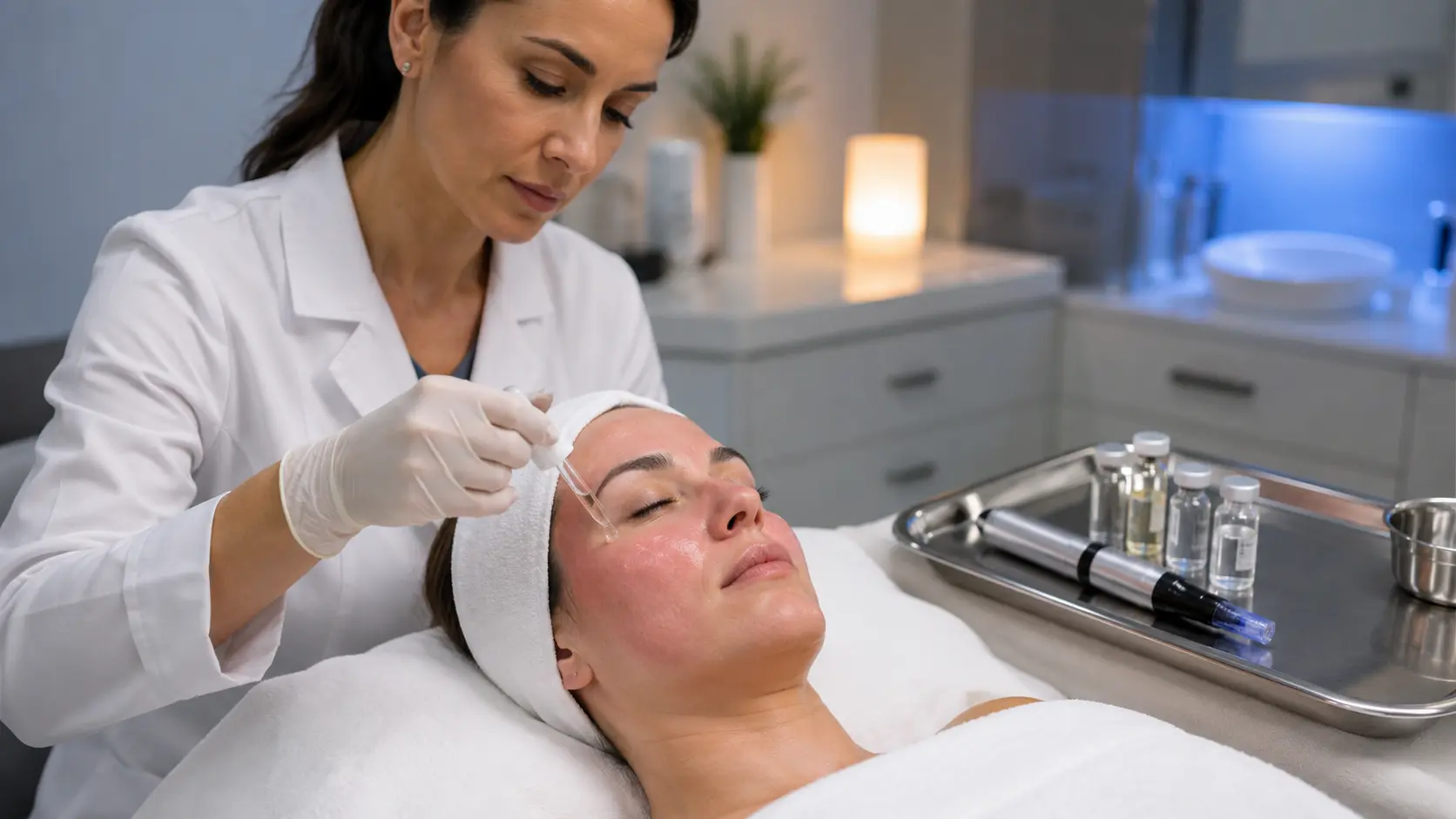
What Are the Best Hydration Protocols to Use After Microneedling?
Effective hydration protocols after microneedling begin immediately following the procedure and follow a layered, sequenced approach designed to exploit the skin’s heightened post-procedure permeability while protecting its compromised barrier. The protocol applies humectants first to draw moisture into disrupted skin channels, then uses an occlusive layer to seal applied actives and dramatically reduce transepidermal water loss during the critical 24 to 72 hour recovery window.
- Apply hydration immediately post-procedure — within the first 5 to 10 minutes — while the skin’s micro-channels are open and permeability is at its highest.
- Layer in sequence: growth factor or peptide recovery serum first, hyaluronic acid or polyglutamic acid humectant second, fragrance-free occlusive mask or barrier recovery cream third.
- Polyglutamic acid is clinically advantageous in post-microneedling hydration because it inhibits hyaluronidase — protecting both applied and naturally occurring HA — while also stimulating the skin’s natural moisturizing factor production.
- Fragrance-free, dye-free, and sensitizer-free formulations are not optional for post-microneedling application — they are a professional safety requirement on compromised skin.
- The post-microneedling hydration protocol does not end in the treatment room — the client home care routine for days 1 through 7 is equally critical to final results.
- Needle depth determines the intensity and duration of the required hydration protocol — deeper passes require more aggressive immediate and home care hydration support.
Microneedling is one of the most results-driven treatments in the professional esthetician’s service menu — and one of the most demanding in terms of post-procedure skin management. The controlled micro-injury that initiates the collagen remodeling cascade also creates the conditions for significant transepidermal water loss, acute barrier disruption, and a skin surface that is simultaneously more permeable and more vulnerable than at any other point in the treatment cycle.
What happens in the treatment room in the minutes immediately following a microneedling pass is not a finishing step. It is a critical clinical intervention. The hydration decisions made during that window — which ingredients are applied, in what sequence, with what occlusive layer, and at what timing — directly influence the quality of barrier recovery, the speed of visible redness resolution, and the client’s perception of their overall results. Estheticians who treat the post-procedure phase as an afterthought are leaving measurable clinical outcome on the table.
This guide gives estheticians a complete, science-grounded framework for post-microneedling hydration protocols. It covers the physiological basis of why the post-microneedling window is so clinically significant, the correct layering sequence and timing for in-treatment hydration application, the specific ingredient considerations that apply to compromised post-procedure skin, how to structure client home care for the recovery period, and how to adjust protocols for different needle depths and skin types.
What Every Esthetician Needs to Know About Post-Microneedling Hydration
- The post-microneedling permeability window is a clinical opportunity — the micro-channels that compromise the barrier also allow significantly enhanced delivery of humectants into the skin.
- Immediate hydration application within the first 5 to 10 minutes post-procedure is the single most impactful step in a post-microneedling protocol.
- The layering sequence matters: recovery serum first, humectant second, occlusive layer third — applied in this order to maximize delivery and retention.
- Polyglutamic acid adds hyaluronidase inhibition and NMF stimulation to the post-microneedling recovery stack — benefits that HA alone does not provide.
- The occlusive layer is not optional — without it, topically applied humectants can draw moisture upward and increase net TEWL rather than reduce it.
- Every ingredient applied to post-microneedling skin must pass a fragrance-free, sensitizer-free standard — compromised skin has dramatically reduced tolerance for irritants.
- Client home care on days 1 through 7 is an extension of the clinical protocol — simplicity, fragrance-free products, and sustained hydration are the priorities.
- Deeper needle passes require more intensive hydration support and longer recovery-focused home care periods.
Why the Post-Microneedling Window Is Clinically Different From Any Other Hydration Scenario
To understand why post-microneedling hydration protocols require specific, sequenced attention — rather than simply applying whatever hydrating products are in the back bar — it helps to understand exactly what microneedling does to the skin’s physical structure and its relationship to water retention.
The Stratum Corneum as a Water Barrier
The stratum corneum — the outermost layer of the epidermis — is the skin’s primary mechanical barrier against transepidermal water loss. Its tightly organized structure of corneocytes and intercellular lipids creates a largely impermeable membrane that regulates moisture exchange between the skin and the external environment. Under normal conditions, TEWL is maintained within a narrow physiological range that keeps deeper skin layers adequately hydrated without excessive surface moisture loss.
Microneedling creates thousands of micro-channels that penetrate through the stratum corneum and into the epidermis — and, at deeper settings, into the upper dermis. Each of these channels is a temporary disruption of the barrier’s continuity. The immediate and measurable consequence is a dramatic increase in transepidermal water loss. Research on controlled barrier disruption models shows TEWL can increase by multiples of baseline within minutes of skin perforation, and this elevated loss rate persists for 24 to 72 hours depending on the depth and density of the treatment.
The Permeability Opportunity
The same micro-channels that increase TEWL also create a transient delivery advantage for topically applied active ingredients. Under intact barrier conditions, most high molecular weight humectants — including many forms of hyaluronic acid — have limited ability to penetrate past the stratum corneum and reach the target layers where their hydrating effects are most clinically meaningful. Immediately post-microneedling, this limitation is substantially reduced. Both humectants and growth factors, peptides, and barrier-recovery ingredients applied in the minutes following the procedure have measurably greater access to deeper skin layers than they would have under normal conditions.
This is the clinical opportunity that a well-designed post-microneedling hydration protocol is built to exploit. The window is real, it is finite, and it cannot be recovered once the skin begins to re-seal its surface channels — a process that begins within hours of the procedure.
The Three Phases of Post-Microneedling Barrier Recovery
Phase 1 — Acute Disruption (0 to 4 hours): TEWL is at its highest. Permeability is maximized. This is the window for humectant and growth factor delivery. Immediate, sequenced hydration application is the clinical priority. The skin cannot be over-hydrated during this phase — the challenge is preventing excessive moisture loss, not avoiding moisture input.
Phase 2 — Active Recovery (4 to 72 hours): TEWL remains elevated but begins to normalize. The inflammatory cascade driving collagen remodeling is active during this phase. Skin sensitivity is high. The priority shifts to sustained occlusive hydration, simplified product application, and avoidance of all potential irritants. Client home care enters the protocol during this phase.
Phase 3 — Barrier Rebuilding (72 hours to 7–14 days): The stratum corneum progressively rebuilds its lipid barrier architecture. TEWL returns toward baseline. Redness and visible sensitivity resolve. Continued hydration support accelerates the quality of barrier reconstruction. Introduction of additional actives can begin cautiously toward the end of this phase — after a minimum of 5 to 7 days for standard needle depths.
Why Hydration Quality Directly Affects Collagen Remodeling Outcomes
The connection between post-microneedling hydration and final treatment results is not merely about client comfort during recovery. The quality of barrier hydration during the post-procedure inflammatory and proliferative phases has direct implications for collagen synthesis quality. Fibroblasts — the cells responsible for producing new collagen and elastin during the remodeling cascade — operate within an extracellular matrix that requires adequate hydration to function optimally. Dehydrated, barrier-compromised skin that is not adequately supported with topical hydration may experience a less organized, less efficient remodeling response than well-hydrated skin that receives targeted post-procedure support.
In other words: the investment a client makes in a professional microneedling treatment is partially recovered or lost in the quality of the recovery protocol that follows it.
Which Ingredients Belong in a Post-Microneedling Hydration Protocol and Why
Ingredient selection for post-microneedling hydration is not simply about applying whatever is on the back bar. The heightened permeability of post-procedure skin means every ingredient applied has greater access to deeper layers than normal — which amplifies both beneficial effects and sensitization risks. The post-microneedling ingredient standard is considerably more restrictive than for standard facial protocols.
Tier 1: Actively Beneficial Post-Microneedling Ingredients
These are the ingredients with established benefit and safety profiles for immediate post-procedure application:
- Hyaluronic acid (HA): A naturally occurring polysaccharide and the foundational post-microneedling humectant. Applied immediately post-procedure, fragrance-free HA serum can be delivered into the epidermis and upper dermis through the open micro-channels. Holds approximately 1,000 times its weight in water. Use on slightly damp skin to maximize draw-in rather than draw-away moisture dynamics.
- Polyglutamic acid (PGA): A fermentation-derived biopolymer that holds up to 5,000 times its weight in water at the skin surface. PGA’s additional mechanisms — hyaluronidase inhibition, NMF stimulation, and HAS-1/2/3 upregulation — make it particularly valuable in the post-microneedling context where preserving delivered HA and stimulating the skin’s own hydration capacity accelerates recovery quality.
- Growth factors and peptides: The heightened permeability of post-microneedling skin is the primary reason many practitioners apply growth factor or peptide serums immediately post-procedure. These larger molecule actives have significantly greater access to the dermis through open micro-channels than under intact barrier conditions. Apply before humectants in the layering sequence.
- Centella asiatica (Cica) and related barrier-recovery botanicals: Well-established fragrance-free calming and barrier-recovery compounds with broad tolerability profiles. Support the recovery of barrier lipid architecture during phases 2 and 3.
- Ceramides and cholesterol: Key components of the stratum corneum’s lipid matrix. Post-procedure application of ceramide-containing, fragrance-free formulations supports the structural rebuilding of the intercellular lipid seal during the barrier rebuilding phase.
Tier 2: Use With Caution Post-Microneedling
- Low-concentration niacinamide (below 5%): Some practitioners incorporate niacinamide at concentrations of 2 to 4% in the recovery phase for its barrier-supportive and anti-inflammatory properties. Higher concentrations carry flush risk on sensitized skin. Evaluate on a client-by-client basis and introduce only after 24 to 48 hours post-procedure.
- Aloe vera: Fragrance-free, preservative-minimal aloe can provide calming benefit during the acute phase. However, quality varies significantly across products — verify the formulation does not contain masking fragrances or alcohol before post-procedure application.
Ingredients to Completely Avoid Post-Microneedling
Retinoids and retinol: Contraindicated for a minimum of 7 to 10 days post-procedure. The combination of heightened permeability and retinoid-induced cellular turnover on a barrier-disrupted skin surface carries significant irritation and post-inflammatory hyperpigmentation risk. | AHA and BHA exfoliating acids: Any acid applied to post-microneedling skin penetrates deeper than intended and can cause chemical burn-level irritation even at concentrations that would be safe on intact skin. Minimum 7-day hold. | High-concentration vitamin C (L-ascorbic acid): L-ascorbic acid at standard treatment concentrations (10 to 20%) is significantly irritating on compromised skin. Avoid for 48 to 72 hours minimum; reassess before reintroduction. | Synthetic fragrance and parfum: An absolute contraindication. Any fragrance compound on compromised, highly permeable skin carries heightened sensitization risk and should never appear in any product applied post-procedure. | Artificial dyes, alcohol-based toners, or astringents: No clinical benefit and meaningful sensitization risk on post-procedure skin.
The Step-by-Step Post-Microneedling Hydration Protocol for Estheticians
The following protocol covers the in-treatment hydration sequence applied immediately following the microneedling pass. It is structured for the standard professional treatment room context and should be adapted based on needle depth, client skin type, and the specific products available in your back bar. Every product used in this sequence must meet the fragrance-free, sensitizer-free standard.
If the procedure produced pinpoint bleeding, gently blot — do not wipe or rub — with sterile gauze until active bleeding has stopped. Do not apply any active product while bleeding is actively occurring. In standard practice at 0.25 to 0.5mm depths, this step is rarely required. At 0.75mm and above, allow 2 to 5 minutes for the skin surface to stabilize before applying active hydration products.
This is the first active layer and should be applied while the micro-channels are at maximum openness. Apply generously to the entire treatment area, allowing the serum to fully absorb without rubbing. If growth factors or exosomes are not in the protocol, a fragrance-free peptide serum or pure centella extract serves as an effective foundation layer. Do not skip this step — the permeability window for these larger-molecule actives is finite.
Apply a fragrance-free HA serum, PGA serum, or combined PGA + HA humectant product over the recovery serum while the skin surface is still slightly moist from the first layer. Applying humectants to damp skin maximizes their water-attracting function — a humectant applied to completely dry skin in a low-humidity environment can draw moisture upward from deeper skin layers rather than inward, which counterproductively increases net TEWL. Work gently across the face without pulling or manipulating the skin.
This is the most critical step in the immediate post-microneedling hydration sequence. The occlusive layer serves two functions simultaneously: it seals the applied growth factors and humectants against the skin surface during the treatment window, preventing evaporative loss of these just-delivered actives; and it dramatically reduces the ongoing TEWL from the barrier-disrupted skin beneath. A professional jelly mask is an ideal occlusive choice for this step: the cooling effect during set reduces immediate post-procedure redness and client discomfort, the set mask maintains a sealed microenvironment over the skin during its dwell time, and the professional removal experience can be incorporated into the service. Allow the mask to remain on for 15 to 20 minutes during the post-procedure phase — longer than a standard hydration facial application.
Following mask removal, apply a fragrance-free, ceramide-containing barrier recovery moisturizer to support the skin’s barrier rebuilding process. If the client is leaving the treatment room and will be exposed to UV, a mineral SPF 30 or above is required before they exit. Do not apply chemical sunscreens on compromised post-procedure skin — chemical UV filters can penetrate through disrupted barrier and cause sensitization. Mineral (zinc oxide) formulations only.
Before the client leaves the treatment room, confirm their home care protocol for days 1 through 7 and explain what is normal during the recovery phase: redness and heat during the first 24 hours, mild peeling or tightness during days 2 through 4, and the appearance of visible skin improvement typically beginning at day 5 to 7 as collagen remodeling initiates. Clients who are prepared for the recovery process experience significantly lower post-treatment anxiety and are more likely to rebook.
Estheticians incorporating the Poly-Luronic™ Jelly Mask by Luminous Skin Lab into their post-microneedling protocol consistently observe a notable difference in how clients respond during the immediate recovery phase compared to practices using cream-based occlusives or sheet masks at this step. The cooling effect of the jelly mask upon application visibly reduces active redness within the first 2 to 3 minutes of contact — which measurably changes the client’s emotional response to their immediate post-procedure appearance. Practitioners who have used the Poly-Luronic™ formulation specifically note that clients frequently comment on how “calmed down” their skin feels before the mask has even fully set.
From a clinical workflow standpoint, the 15-minute set window aligns precisely with the post-procedure client consultation conversation — going through home care instructions, answering questions, and reviewing before photos — so the mask step does not add time to the service. The PGA-forward dual-humectant formulation in the mask is applied on top of the growth factor serum and HA humectant layer, and the occlusive set mask environment seals all three layers against the skin simultaneously during the treatment window. Practitioners report consistently better visible immediate hydration outcomes at mask removal compared to cream-based alternatives applied alone — an outcome that clients notice and comment on before leaving the treatment room.
How Needle Depth Changes the Hydration Protocol Requirements
Not all microneedling treatments are equivalent in terms of barrier disruption severity or recovery timeline. The depth and density of the pass directly determines how aggressive the immediate hydration response needs to be and how long the intensive home care phase should continue. Estheticians working across the full range of needle depths available within their scope of practice need distinct protocol adjustments for each depth tier.
Building the Client Home Care Protocol for Post-Microneedling Recovery
The clinical outcome of a microneedling treatment is not determined solely by what happens in the treatment room. The quality of client home care during the 7 to 14 days following the procedure has a measurable impact on barrier recovery speed, the resolution of transient side effects like redness and dryness, and the final visible skin improvement that the client experiences. An esthetician who delivers a technically excellent in-treatment protocol and then sends the client home with vague or incomplete instructions is leaving significant outcome quality on the table.
Days 1 Through 3: Maximum Simplicity
The first 72 hours are the period of highest TEWL and greatest sensitization risk. The home care protocol for this window should be stripped to the minimum effective routine. Prescribe the following and nothing else: a gentle, fragrance-free pH-balanced cleanser applied with fingertips only — no exfoliating tools or devices; a fragrance-free HA or PGA+HA serum applied to slightly damp skin morning and evening; a fragrance-free barrier recovery moisturizer applied over the serum; and mineral SPF 30 or above applied before any UV exposure during daylight hours. Instruct clients not to introduce any products that are not on this prescribed list, regardless of what they normally use. No retinoids, no acids, no vitamin C, no fragrance.
Days 4 Through 7: Gradual Barrier Rebuilding
From day 4 onward, the skin’s barrier integrity is progressively rebuilding. The simplified protocol continues, but clients may begin to notice skin peeling or flaking as the affected stratum corneum cells shed. This is a normal part of the recovery process and should not be addressed with exfoliation — neither physical nor chemical. Instruct clients to continue applying their barrier moisturizer generously and to avoid any temptation to pick, peel, or exfoliate. A ceramide-containing night moisturizer can be added at this stage if clients find their skin feels tight or uncomfortable overnight.
Days 7 Through 14: Cautious Active Reintroduction
For standard needle depths of 0.5 to 1.0mm, most clients can begin cautiously reintroducing their regular active ingredients after day 7, starting with lower-risk options first. Vitamin C in the form of L-ascorbic acid can typically be reintroduced after day 7 to 10. Retinoids should wait until day 10 to 14 and be reintroduced at reduced frequency. Exfoliating acids should be among the last actives reintroduced, typically at the 10 to 14 day mark and with concentration reduction. The reintroduction timeline extends proportionally with needle depth.
Client Home Care Product Checklist
Gentle Fragrance-Free Cleanser
pH-balanced, gel or cream formulation. Applied with fingertips only — no tools, brushes, or cloths that could create friction on recovering skin.
Humectant Serum (HA or PGA+HA)
Applied to slightly damp skin morning and evening throughout the recovery period. Continue for at least 14 days to support ongoing barrier hydration even as the skin normalizes.
Fragrance-Free Barrier Recovery Moisturizer
Ceramide-containing, fragrance-free formulation applied over humectant serum. The occlusive component prevents overnight moisture loss during sleep when the skin cannot access humidity from the environment.
Mineral SPF 30+ (Daytime Only)
Zinc oxide mineral formulation only. No chemical UV filters on post-procedure skin. Post-microneedling skin is significantly more susceptible to UV-induced pigmentation during recovery — sun protection is non-negotiable.
Retinoids and Retinol
Minimum 7-day hold for shallow depths. 10 to 14-day hold for deeper passes. Reintroduce at reduced frequency before returning to regular application schedule.
AHA, BHA, and PHA Acids
All exfoliating acids are contraindicated during the acute recovery phase. Reintroduce cautiously at 10 to 14 days minimum, starting with lower concentrations.
How to Adjust Post-Microneedling Hydration Protocols for Different Skin Types
While the core post-microneedling hydration protocol applies across all skin types, certain client presentations require protocol modifications that an esthetician should anticipate and build into their treatment planning.
Dehydrated or Chronically Dry Skin
Clients with pre-existing dehydration or dry skin have a lower baseline barrier integrity before microneedling begins. This means their TEWL elevation post-procedure may be more pronounced and take longer to resolve. These clients benefit from a higher concentration of humectant in both the immediate post-procedure application and the home care routine. Consider adding a second humectant serum application mid-day during the first 48 to 72 hours. At night, a thicker ceramide-based occlusive moisturizer — applied generously in what is sometimes called a “slugging” technique using a petrolatum-based product as the outermost layer — can dramatically improve overnight hydration retention.
Oily or Acne-Prone Skin
Oily skin does not mean well-hydrated skin. Oily post-microneedling skin still requires the same immediate humectant and occlusive protocol, but practitioners should select lighter-weight, non-comedogenic formulations for both the in-treatment hydration and the home care moisturizer. A PGA-forward humectant — which provides a surface seal without the heavier occlusive weight of traditional cream formulations — is particularly well-suited to this skin type in the post-microneedling context. Instruct acne-prone clients that the recovery protocol overrides their regular skin type routine for the duration of the recovery period.
Sensitive or Reactive Skin
Sensitive and reactive skin types require the strictest application of the fragrance-free, sensitizer-free standard. Every product applied in the post-microneedling sequence — both in-treatment and home care — should be patch-tested well in advance of the procedure if the client has a documented history of sensitization reactions. For reactive clients, consider extending the simplified home care phase by an additional 2 to 3 days before beginning cautious active reintroduction.
Fitzpatrick IV Through VI Skin Types
Clients with deeper Fitzpatrick skin types have a higher baseline risk of post-inflammatory hyperpigmentation following microneedling. In this context, the post-microneedling hydration protocol takes on additional clinical significance: adequate barrier recovery hydration reduces the duration and severity of the inflammatory phase, which in turn reduces the hyperpigmentation risk associated with prolonged post-procedure inflammation. Consistent mineral SPF application is an absolute requirement for these clients during and beyond the standard recovery period.
Professional and Scientific References
The science of post-microneedling hydration referenced in this article draws from the following peer-reviewed and professional literature:
- Barrier disruption and TEWL elevation following controlled percutaneous injury: established dermatological literature on stratum corneum recovery timelines and transepidermal water loss dynamics post-procedure.
- Gamma-PGA barrier strengthening, HAS-1/2/3 upregulation, aquaporin-3 enhancement, and NMF stimulation. MDPI, 2024. Reconstructed human skin model demonstrating mechanisms of topical gamma-PGA application on barrier recovery and endogenous HA production.
- PGA moisture-binding capacity (up to 5,000× weight in water) and hyaluronidase inhibition mechanisms. Typology, 2021–2025; cosmetic chemistry peer-reviewed literature.
- Hyaluronic acid molecular weight and skin penetration: relationship between HA molecular weight and depth of penetration into epidermis and dermis under intact and disrupted barrier conditions. Established dermatological and cosmetic science literature.
- Post-microneedling ingredient safety and contraindication frameworks: clinical practice standards from professional esthetic and dermatological continuing education literature.
- Collagen induction therapy recovery timelines and fibroblast response: established CIT mechanism-of-action literature.
For estheticians seeking a professional occlusive hydration mask specifically suited for the immediate post-microneedling recovery step, the Poly-Luronic™ Jelly Mask by Luminous Skin Lab is the formulation our education team references most consistently in post-CIT protocol contexts. The proprietary Poly-Luronic™ dual-humectant system delivers PGA surface occlusion and hyaluronidase inhibition alongside HA deep-layer delivery within a fragrance-free, dye-free, sensitizer-free formulation that meets the professional safety standard required for post-procedure application on compromised skin. The cooling set mask reduces immediate post-procedure redness and client discomfort, and its 15 to 20 minute dwell time aligns precisely with the in-treatment post-CIT service window.
Explore the Poly-Luronic™ Jelly Mask LineFrequently Asked Questions: Hydration Protocols After Microneedling
What should I put on a client’s skin immediately after microneedling?
Immediately after microneedling, apply a fragrance-free, barrier-safe hydrating serum containing humectants such as hyaluronic acid or polyglutamic acid before the skin surface begins to dry. Follow with a fragrance-free occlusive layer — a professional jelly mask or barrier recovery cream — to seal in the applied actives and dramatically reduce transepidermal water loss during the critical early recovery window. Avoid all actives that could cause irritation on compromised skin, including retinoids, exfoliating acids, vitamin C, and niacinamide at high concentrations.
How long should you wait before applying hydration products after microneedling?
Do not wait — apply hydration immediately after the microneedling pass is complete and any pinpoint bleeding has resolved. The first 5 to 10 minutes post-procedure represent a critical hydration window where heightened skin permeability allows superior delivery of humectants into the skin. Delaying application allows transepidermal water loss to accelerate on already-compromised skin, extending recovery time and reducing client comfort.
Why does skin get so dehydrated after microneedling?
Microneedling creates thousands of micro-channels through the stratum corneum — the skin’s primary water-retention barrier. This disruption dramatically increases transepidermal water loss (TEWL) because the physical channels allow moisture to evaporate from deeper skin layers at a rate the intact barrier would prevent. The inflammatory response that initiates collagen remodeling also temporarily increases metabolic activity in the dermis, further increasing moisture demand. Without immediate and sustained hydration support, the skin can experience significant dehydration throughout the 24 to 72 hour post-procedure recovery window.
Can I use hyaluronic acid right after microneedling?
Yes, hyaluronic acid is one of the safest and most effective ingredients to apply immediately after microneedling. Its moisture-attracting properties make it ideal for the heightened-permeability post-procedure window, where HA can be delivered more effectively into the skin than under intact barrier conditions. Use a fragrance-free, low molecular weight HA serum and follow with an occlusive layer to prevent the HA from drawing moisture upward out of the skin rather than inward — which can occur when a humectant is applied to very dry or low-humidity environments without an occlusive seal.
What is the best layering order for post-microneedling hydration products?
The correct post-microneedling hydration layering sequence is: first, a fragrance-free growth factor, peptide, or barrier-recovery serum applied to damp skin; second, a hyaluronic acid or polyglutamic acid humectant serum layered over while the skin is still slightly moist; third, a fragrance-free occlusive layer such as a professional jelly mask or barrier recovery cream to seal the applied actives and reduce transepidermal water loss. This sequence maximizes humectant delivery during the permeability window while the occlusive layer prevents moisture from escaping the skin surface.
How many days after microneedling should I keep doing intensive hydration?
Intensive in-treatment hydration begins immediately after the procedure and continues through the first 72 hours, when the barrier disruption is most significant. Client home care should maintain a simplified, hydration-focused routine for a minimum of 5 to 7 days post-treatment. The first three days are the most critical — during this window, barrier function is most compromised and TEWL is highest. From day 4 onward, the skin progressively rebuilds barrier integrity, though hydration-supportive products should continue until full barrier recovery is confirmed, typically 7 to 14 days depending on needle depth.
Is a jelly mask safe to use right after microneedling?
Yes — a professional-grade, fragrance-free jelly mask is one of the most effective immediate post-microneedling hydration tools available in the treatment room. The occlusive set mask dramatically reduces transepidermal water loss during the treatment window, the cooling effect reduces immediate post-procedure redness and discomfort, and the humectant system within a quality formulation actively delivers moisture while the skin’s permeability is heightened. The critical requirement is that the formulation must be 100% fragrance-free, dye-free, and free from any active ingredients that could cause sensitization on compromised skin.
What ingredients should I completely avoid on skin right after microneedling?
Avoid all actives that are contraindicated on compromised skin immediately after microneedling: retinoids and retinol, AHA and BHA exfoliating acids, high-concentration vitamin C (especially L-ascorbic acid), high-concentration niacinamide above 5%, synthetic fragrance and parfum, artificial dyes, alcohol-based products, and any ingredient with a known sensitization profile. The heightened permeability of post-microneedling skin means these ingredients can penetrate more deeply than under normal conditions, significantly increasing the risk of irritation, inflammation, or post-inflammatory hyperpigmentation.
How does the Poly-Luronic Jelly Mask support post-microneedling hydration recovery?
The Poly-Luronic Jelly Mask by Luminous Skin Lab is formulated with a dual-humectant PGA and HA system specifically suited to post-microneedling application. Polyglutamic acid seals moisture at the skin surface and inhibits hyaluronidase — the enzyme that degrades both applied and naturally occurring hyaluronic acid — extending the hydration benefit throughout the treatment window. Hyaluronic acid delivers moisture to deeper skin layers where the micro-channels have increased permeability. The formulation is 100% fragrance-free and free from sensitizing additives, meeting the professional safety standard required for post-treatment use on compromised skin. The occlusive set mask also provides a cooling effect that reduces immediate post-procedure redness and client discomfort.
The Post-Microneedling Hydration Protocol Is Where Results Are Made or Lost
Microneedling creates the biological conditions for meaningful skin improvement — but those conditions require skilled clinical management to translate into the results clients book the treatment to achieve. The 10 minutes immediately following a microneedling pass are not a wind-down step. They are one of the highest-leverage moments in the entire service.
An esthetician who understands why barrier disruption creates a hydration delivery opportunity — and who has a sequenced, ingredient-specific protocol for exploiting that window safely and effectively — delivers measurably better client outcomes than one who treats post-procedure care as a routine finishing step. The same understanding, extended into a well-structured 7-day home care protocol, continues to compound those outcomes long after the client has left the treatment room.
The science here is clear: immediate humectant application, fragrance-free formulation throughout, sequenced layering with an occlusive seal, and sustained home care support. Apply this framework systematically across every microneedling client at every needle depth, and the quality of your recovery outcomes — and your clients’ experience of their results — will reflect it.