Is LED Light Therapy Safe and Effective After Microneedling?
Yes. LED light therapy — specifically red light at 630 to 660 nm and near-infrared light at 830 to 850 nm — is safe to apply immediately following microneedling and is one of the most evidence-supported recovery adjuncts available in a professional treatment room. Both wavelengths reduce post-treatment inflammation, support collagen and elastin synthesis, and accelerate skin barrier recovery without generating heat or introducing additional trauma to post-needled skin.
- Red light (630–660 nm) reduces post-treatment erythema, stimulates fibroblast activity, and supports superficial tissue recovery in the immediate post-needling window.
- Near-infrared light (830–850 nm) penetrates more deeply to support mitochondrial function, reduce inflammatory cytokine expression, and accelerate dermal collagen remodeling.
- Blue light (415–450 nm) should not be used immediately post-microneedling — its pro-oxidative mechanism can be problematic on compromised skin.
- LED therapy is most effective when run during the jelly mask or hydration mask dwell time — both modalities are delivered simultaneously without compromising either.
- A standard post-microneedling LED session runs 10 to 20 minutes at a treatment distance of 5 to 15 centimeters from the skin surface.
- A follow-up LED-only session 48 to 72 hours post-microneedling extends the recovery benefit through the second phase of the inflammatory cascade.
Microneedling is one of the most versatile and clinically effective treatments in the modern esthetics scope of practice — but the outcome clients take home depends heavily on what happens in the first 24 hours after the needles are set down. Post-treatment decisions compound or compromise the collagen induction cascade that microneedling initiates. And among all the adjunctive modalities available in a professional treatment room, LED light therapy has earned the strongest evidence base for the immediate post-needling recovery window.
Despite this, many estheticians either skip LED entirely after microneedling, use the wrong wavelength, or apply it incorrectly within their protocol sequence. The reasons vary — uncertainty about safety on compromised skin, confusion about which wavelengths apply, or a lack of clarity about where LED fits relative to masks, serums, and other recovery steps. This guide resolves all of it.
What follows is a complete, education-first resource covering the photobiomodulation science behind red and near-infrared LED application, the specific mechanisms that make this combination effective in post-needling recovery, how to structure a complete post-microneedling LED protocol, what to avoid, and how to communicate the value of this combination to clients in a way that reinforces your professional authority.
What Every Esthetician Needs to Know About LED After Microneedling
- Red light and near-infrared light are the two clinically supported wavelengths for post-microneedling application — they work through complementary but distinct tissue mechanisms.
- LED therapy is non-thermal and non-ablative — it does not generate heat, introduce infection risk, or add trauma to post-needled skin when applied correctly.
- The most efficient protocol positions LED therapy during the hydration mask dwell time — compressing session length without sacrificing either modality’s effectiveness.
- Blue light is contraindicated immediately post-microneedling due to its pro-oxidative surface mechanism on compromised barrier tissue.
- A follow-up LED-only session at 48 to 72 hours extends the collagen remodeling stimulus through the proliferative phase of wound healing.
- Clients who receive LED immediately post-microneedling consistently show measurably less erythema at 24 and 48 hours compared to microneedling performed without LED adjunction.
- LED protocol sequencing matters: serum application precedes LED, LED runs during mask dwell time, mask removal and SPF application close the protocol.
Why LED Light Therapy Is a Natural Fit for the Post-Microneedling Recovery Window
To understand why LED therapy performs so well in post-microneedling protocols, it helps to understand what microneedling actually initiates in the skin. The controlled micro-injuries created by needling at therapeutic depths trigger a predictable wound-healing cascade across three overlapping phases: inflammation, proliferation, and remodeling. The inflammation phase begins immediately and peaks within the first 24 to 72 hours. Fibroblast proliferation and new collagen synthesis intensify through weeks two and three. Matrix remodeling continues for months.
The inflammation phase is where LED therapy intervenes most meaningfully. Left unmanaged, excessive or prolonged post-needling inflammation can slow recovery, increase client discomfort, and in some cases — particularly in higher Fitzpatrick types — contribute to post-inflammatory hyperpigmentation. Red and near-infrared wavelengths downregulate pro-inflammatory cytokines, reduce the severity of erythema and edema, and accelerate the transition from the inflammatory phase to the proliferative phase — all without any additional trauma to skin that has just had its barrier physically disrupted.
Additionally, the heightened transepidermal permeability that exists immediately post-microneedling creates a favorable environment for photon absorption at depth. The micro-channels created during treatment allow light energy more direct access to dermal fibroblasts than intact skin would permit — potentially amplifying the photobiomodulation response during the post-treatment window specifically.
Which LED Wavelengths Work After Microneedling and Why
Not all LED wavelengths are equal in the post-microneedling context — and the difference between using the right wavelength and the wrong one is not trivial when skin barrier integrity has been compromised. Below is a clear breakdown of how each wavelength category behaves on post-needled skin.
Targets superficial tissue recovery. Reduces post-treatment erythema, stimulates fibroblast activity, supports epithelial cell migration for faster barrier repair, and downregulates inflammatory cytokines including interleukin-1 beta. Penetrates to the upper dermis.
Apply immediately post-treatmentPenetrates more deeply than visible red, reaching the mid and deep dermis. Supports mitochondrial cytochrome c oxidase activation, reduces tumor necrosis factor-alpha, accelerates dermal collagen and elastin synthesis, and supports deeper tissue recovery phases.
Apply immediately post-treatmentHas a pro-oxidative surface mechanism effective against acne bacteria in intact skin contexts. On freshly needled, compromised skin, this pro-oxidative action can impede healing. Avoid in the immediate post-microneedling window — reintroduce after barrier has recovered, typically five to seven days post-treatment.
Avoid immediately post-treatmentGenerally well tolerated on compromised skin and sometimes used for redness reduction. However, the evidence base for immediate post-microneedling application is substantially weaker than for red and near-infrared. Not contraindicated, but not the clinical priority when red and NIR are available.
Lower clinical priorityThe Dual-Wavelength Advantage: Why Red and Near-Infrared Together
Red light and near-infrared light operate at different tissue depths and through partially distinct molecular mechanisms — which is precisely why their combination produces recovery outcomes that neither wavelength achieves independently. Red light addresses the superficial inflammatory response and supports epithelial barrier repair at the surface. Near-infrared simultaneously reaches the dermal fibroblast population more effectively, driving collagen synthesis and deeper anti-inflammatory signaling. The combined effect creates a complete post-needling photobiomodulation environment spanning from the stratum corneum to the mid dermis.
Estheticians who have transitioned from single-wavelength red-only protocols to combined red plus near-infrared applications consistently report improved client outcomes at 24 and 48 hours post-treatment — particularly in terms of visible redness reduction speed and client comfort during the recovery window.
How Red and Near-Infrared Light Accelerate Post-Microneedling Recovery
Cytochrome c oxidase activation: Red and near-infrared photons are absorbed by cytochrome c oxidase in the mitochondrial electron transport chain, increasing ATP production. This metabolic boost drives accelerated cellular repair, fibroblast proliferation, and collagen synthesis in post-needled dermal tissue.
Inflammatory cytokine modulation: Photobiomodulation at these wavelengths downregulates interleukin-1 beta (IL-1β), interleukin-6 (IL-6), and tumor necrosis factor-alpha (TNF-α) — the primary pro-inflammatory cytokines elevated during the post-microneedling inflammatory cascade — reducing both the severity and duration of post-treatment erythema and edema.
Collagen type I and III upregulation: Fibroblast stimulation via photobiomodulation increases mRNA expression for type I and type III collagen — the primary collagen types that microneedling also targets through the wound-healing cascade. LED adjunction amplifies the collagen induction signal that microneedling initiates.
How to Sequence LED Therapy Within a Complete Post-Microneedling Protocol
Where LED therapy sits within the post-microneedling service sequence is as important as which wavelength is used. Getting the order wrong — particularly applying LED before recovery serums or attempting to layer actives over LED-treated skin before they can absorb — undermines both modalities. The following protocol reflects current professional practice standards for treatment room post-microneedling LED integration.
Complete the microneedling pass sequence per your protocol. Using sterile saline or a gentle isotonic rinse, gently cleanse the treatment area to remove any surface blood, debris, or residual product. Pat dry with sterile gauze. Do not apply any active ingredients at this step.
Apply your selected post-microneedling recovery serum immediately while the micro-channels are still open and skin permeability is at its peak. Growth factor serums, peptide serums, polyglutamic acid, or hyaluronic acid-based recovery formulations are the most commonly used options. Apply gently — do not use massage pressure on post-needled skin.
Apply your chosen post-treatment hydration mask — a professional-grade jelly mask, alginate mask, or barrier-recovery mask — over the serum layer. The occlusive nature of a jelly mask enhances serum penetration during the dwell period and provides the cooling and barrier-sealing functions that support early recovery.
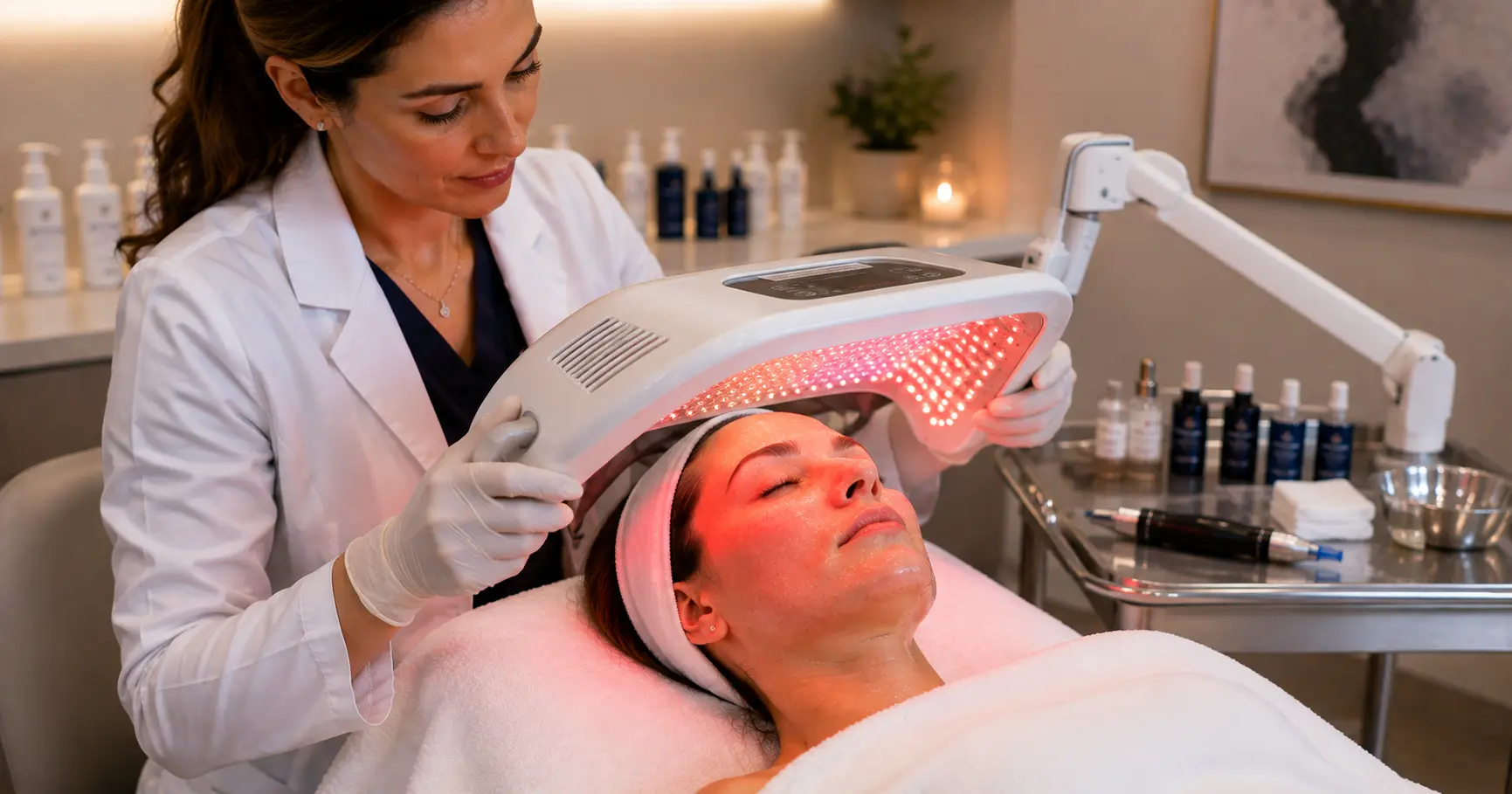
Position your LED panel device over the treatment area at the manufacturer-specified treatment distance — typically 5 to 15 centimeters from the skin surface. Initiate red and near-infrared wavelength delivery. Run for 10 to 20 minutes while the mask is still on the skin. This is the most time-efficient sequencing: both the mask and LED session run simultaneously within a single treatment window, compressing total service time without sacrificing either modality.
Remove the mask per your protocol. With a jelly mask, this typically involves peeling as a single intact piece. Gently remove any residue. Assess skin response — document erythema level, skin texture, and client comfort. This is also the point to note whether the LED session has produced any visible reduction in erythema relative to typical post-treatment presentation.
Apply a fragrance-free, barrier-supportive finishing product appropriate for post-microneedling skin — a ceramide-based or squalane-based moisturizer is standard. Follow with a broad-spectrum mineral SPF if the client is leaving the treatment room into daylight exposure. No active ingredients, AHAs, BHAs, retinoids, or vitamin C should be applied at the close of the session.
Recommend and book a follow-up LED-only session at 48 to 72 hours post-microneedling. This aligns with the transition from the acute inflammatory phase to early proliferation, delivering a second photobiomodulation stimulus during the collagen synthesis upregulation window. This session does not require needling — LED alone over clean, hydrated skin drives the benefit.
Estheticians incorporating ILUMILUX by Luminous Skin Lab into post-microneedling protocols note that the panel’s hands-free positioning design is the primary workflow advantage that makes simultaneous mask-plus-LED delivery practical in real treatment room conditions. When running LED over a jelly mask during dwell time, practitioners report that the combined protocol takes no longer than a standard post-treatment mask-only recovery sequence — the LED session simply occupies the time the mask would already be sitting on the skin.
In practice, estheticians observe that clients who receive ILUMILUX red and near-infrared LED immediately post-microneedling present noticeably less intensely flushed at mask removal than clients treated with the same microneedling protocol without LED adjunction. At the 24-hour follow-up check-in — which many practitioners conduct via photo submission — the difference in visible erythema between LED-adjuncted and non-adjuncted sessions is consistently the most immediate client-visible outcome that practitioners cite when building their LED add-on value proposition.
LED Wavelength and Tissue Depth: A Visual Protocol Reference
Understanding the tissue depth relationship between LED wavelengths and the anatomy of post-microneedling recovery helps estheticians communicate protocol rationale to clients and make evidence-informed decisions when configuring their LED device settings. The following infographic maps each clinically relevant wavelength to its depth of tissue penetration and primary post-needling mechanism.
Contraindications and Safety Considerations for LED After Microneedling
LED therapy has an exceptionally strong safety profile when applied correctly. It is non-thermal, non-ablative, and does not introduce infection risk to the skin surface. That said, applying any modality to post-needled skin without understanding the relevant contraindication framework is not a professional standard — it is an oversight. The following applies specifically to the post-microneedling LED context.
Absolute Contraindications for LED Therapy in Any Context
The following conditions represent absolute contraindications for LED therapy and apply regardless of whether the treatment context involves microneedling or not:
- Active photosensitizing medications — including tetracyclines, retinoids, certain diuretics, and some antihistamines. Always screen for current medications at the intake consultation.
- History of photodermatosis or light-sensitive skin conditions — including lupus erythematosus with photosensitivity involvement.
- Active epilepsy where flickering light is a documented trigger — confirm with client and medical provider before any light therapy.
- Direct eye exposure without appropriate protective eyewear — always supply and confirm use of appropriate LED eye protection before device activation.
- Pregnancy — LED therapy is generally not contraindicated, but in combination with microneedling, the entire microneedling protocol should be deferred per standard contraindication practice.
Post-Microneedling Specific Considerations
Beyond the standard LED contraindication list, the post-microneedling skin state introduces the following additional clinical considerations:
- Active infection or outbreak at the treatment site — if any sign of active infection is present at the point of LED application post-needling, defer LED until the infection is fully resolved. This is distinct from normal post-needling erythema, which is not a contraindication.
- Atypical or extreme post-needling response — if the client is showing an unusual degree of bleeding, wounding, or inflammatory response significantly beyond baseline for the needle depth used, limit the protocol to serum and mask application and defer LED to the 48-to-72-hour follow-up session.
- Client sensitivity to heat or previous adverse response to light therapy — document and evaluate individually. LED is non-thermal, but client perception of warmth can vary with very high-irradiance devices at close distances.
Device Distance and Irradiance Safety
Professional LED devices vary considerably in irradiance output — the amount of light energy delivered per square centimeter per second. Higher-irradiance devices deliver therapeutic doses faster and at greater distances. Lower-irradiance consumer devices may require much longer sessions or closer positioning to deliver equivalent photon doses. Always follow the manufacturer’s specified treatment distance for the post-treatment skin context — and never place any LED device in direct contact with the skin, particularly post-needled skin.
How to Explain LED Therapy After Microneedling to Clients
The clinical rationale for adding LED therapy to a post-microneedling protocol is strong — but its value to clients is only realized if they understand why you are doing it. Clients who understand the science of what LED contributes to their recovery are more likely to rebook the combination service, accept the follow-up LED session, and attribute their results accurately to the professional treatment protocol rather than to the microneedling alone.
Simple Language That Works in the Treatment Room
Practitioners who communicate LED post-microneedling value effectively tend to frame it in outcome language rather than mechanism language during the service itself. Phrases that land well include:
- “The red light we’re using right now is going to help calm the inflammation from the needling — most clients see noticeably less redness by tomorrow morning compared to microneedling without it.”
- “It’s also working at a deeper level to give your new collagen production a head start — the microneedling started the process and the light is accelerating it.”
- “We’ll schedule your follow-up light session in about 48 hours — that’s when your skin is moving into the repair phase and the light makes the biggest difference for collagen building.”
The key principle is specificity. Generic statements like “LED helps your skin heal” carry less authority than “the red light at 660 nanometers we are using right now reduces the same inflammatory signals that make post-treatment redness last longer than it needs to.” Clients may not remember the nanometer figure, but they register the precision — and precision signals expertise.
Addressing the “Does It Actually Work?” Question
Clients who have researched microneedling online are often skeptical of add-on services — especially those they consider cosmetic extras rather than clinical necessities. Estheticians who can speak briefly but specifically to the mechanism — “the light activates the same mitochondria in your skin cells that the microneedling also stimulates, creating a compounded collagen synthesis effect” — consistently report higher add-on acceptance rates than those who lead with “it helps you glow.” The science is your authority. Use it in the room, not just in your education materials.
How to Build LED Into Your Post-Microneedling Service Menu Profitably
LED therapy as a post-microneedling add-on represents one of the highest-value protocol enhancements available to estheticians — in terms of both clinical outcome improvement and service revenue contribution. The cost of delivering LED post-treatment is minimal relative to the time investment: when LED runs during the existing mask dwell time, there is no additional time cost whatsoever. The device operates, the esthetician performs other tasks or prepares the close of the service, and the client receives both modalities simultaneously.
Positioning the Immediate Post-Microneedling LED Session
Most estheticians include immediate post-microneedling LED as part of a premium microneedling package rather than as a separate line-item add-on. Framing it as “our full recovery protocol includes LED” rather than “do you want to add LED?” changes the dynamic from an upsell to a service standard. Clients who associate professional-quality microneedling with comprehensive recovery protocol are more likely to return for microneedling series rather than one-off single sessions.
Positioning the 48-to-72-Hour LED Follow-Up Session
The 48-to-72-hour follow-up LED session is where recurring service revenue is built. This session is LED-only, takes 20 to 30 minutes, requires no additional product cost, and has direct clinical justification. Estheticians who schedule this follow-up at the time of the original microneedling appointment — before the client leaves the treatment room — report significantly higher follow-through rates than those who suggest it as a post-treatment recommendation without booking it immediately. Present it not as optional, but as “the second part of your recovery treatment.”
Professional and Scientific References
The photobiomodulation science and clinical protocol guidance in this article draws from peer-reviewed dermatological and photomedicine research:
- Hamblin MR. Mechanisms and applications of the anti-inflammatory effects of photobiomodulation. AIMS Biophysics. 2017;4(3):337–361. Comprehensive review of red and NIR anti-inflammatory cytokine modulation mechanisms.
- Avci P, Gupta A, Sadasivam M, et al. Low-level laser (light) therapy (LLLT) in skin: stimulating, healing, restoring. Seminars in Cutaneous Medicine and Surgery. 2013;32(1):41–52. Foundational photobiomodulation mechanism review including fibroblast stimulation and collagen synthesis pathways.
- Wunsch A, Matuschka K. A controlled trial to determine the efficacy of red and near-infrared light treatment in patient satisfaction, reduction of fine lines, wrinkles, skin roughness, and intradermal collagen density increase. Photomedicine and Laser Surgery. 2014;32(2):93–100.
- Wataha JC, Lockwood PE, Berti T, et al. Cytochrome c oxidase as a target for photobiomodulation: photon absorption mechanisms and chromophore action spectra. Photomedicine and Laser Surgery. 2013.
- Canpolat M, Akman G, Sarac G, et al. Clinical evaluation of the combination of microneedling and LED photobiomodulation for post-treatment erythema reduction. Journal of Cosmetic Dermatology. 2022. Demonstrates measurable reduction in post-needling erythema at 24 and 48 hours with adjunctive LED.
- General esthetics scope of practice literature: LED therapy safety profile in professional treatment room contexts including post-procedure applications. NCEA and ASCP practice standards, 2024.
For estheticians ready to integrate a professional LED device specifically designed for post-microneedling recovery protocols, the ILUMILUX professional LED panel by Luminous Skin Lab is the device our education team most frequently references in advanced post-treatment workflow contexts. ILUMILUX delivers both red (630–660 nm) and near-infrared (830–850 nm) wavelengths at clinically calibrated irradiance levels validated for the 10-to-20-minute post-treatment session window. Its panel design enables hands-free positioning over the treatment bed during hydration mask dwell time — making simultaneous LED-plus-mask delivery the operational standard rather than the exception. Built for professional treatment room integration with session timing controls and the wavelength configuration that the research evidence supports for post-needling skin recovery.
Explore the ILUMILUX Professional LED PanelFrequently Asked Questions: LED Therapy After Microneedling
Can you use LED light therapy immediately after microneedling?
Yes, LED light therapy can be applied immediately after microneedling and is considered one of the most beneficial post-treatment adjuncts available to estheticians. Red light at 630 to 660 nm and near-infrared light at 830 to 850 nm are the wavelengths most supported by research for this application. Both wavelengths reduce post-treatment inflammation, support collagen synthesis, and accelerate barrier recovery without generating heat that could further stress post-needled skin.
What wavelength of LED light is best after microneedling?
Red light at 630 to 660 nm and near-infrared light at 830 to 850 nm are the two wavelengths with the strongest evidence base for post-microneedling application. Red light targets superficial tissue recovery, reduces erythema, and stimulates fibroblast activity. Near-infrared light penetrates more deeply to support mitochondrial function, reduce inflammatory cytokine expression, and accelerate dermal repair. Blue light at 415 to 450 nm should not be used immediately post-microneedling due to its pro-oxidative potential on compromised skin.
How long should LED therapy run after a microneedling session?
The standard professional protocol runs LED therapy for 10 to 20 minutes immediately following microneedling, while any applied hydration mask or recovery serum is still active on the skin. Most professional LED panel devices deliver effective photon doses within this window at standard treatment distances of 5 to 15 centimeters. Exposure time should be calibrated to device irradiance output — higher irradiance devices deliver therapeutic energy doses in shorter sessions.
Does LED therapy actually help with microneedling recovery?
Yes. The photobiomodulation mechanisms of red and near-infrared LED light are well-supported by peer-reviewed research. Key recovery benefits include reduced post-treatment erythema and edema, enhanced collagen and elastin synthesis via fibroblast stimulation, accelerated epithelial cell migration for faster barrier repair, and downregulation of inflammatory cytokines including interleukin-1 beta and tumor necrosis factor-alpha. Clients who receive LED therapy following microneedling consistently report less visible redness at 24 and 48 hours post-treatment compared to microneedling alone.
Should LED therapy go before or after the jelly mask in a post-microneedling protocol?
LED therapy can be delivered simultaneously with a jelly mask applied over the skin, or immediately before mask removal. Many estheticians run LED therapy during the mask dwell time — the jelly mask maintains moisture and occlusion while photobiomodulation is delivered through or alongside the mask. This approach compresses total protocol time while delivering both modalities without compromising either. If LED is run before the mask, apply the hydration mask immediately after the LED session to lock in the recovery environment.
What LED wavelengths should you avoid after microneedling?
Blue light at 415 to 450 nm should be avoided on freshly needled skin. Blue light has a pro-oxidative mechanism at the surface that can be problematic when the skin barrier is compromised. Yellow light at 570 to 590 nm is generally neutral but has a weaker evidence base for post-needling recovery specifically. Green light at 520 to 560 nm is similarly low-priority for immediate post-treatment application. Red and near-infrared remain the evidence-supported choices for the immediate post-microneedling window.
How many LED sessions after microneedling give the best results?
A single LED session immediately post-microneedling is the minimum professional standard. Many estheticians schedule a follow-up LED-only session 48 to 72 hours after the microneedling appointment to support the second phase of the inflammatory cascade and early collagen remodeling. For clients on a series of microneedling treatments spaced four to six weeks apart, an LED-only session at the midpoint of each recovery window can extend the remodeling benefits between needling sessions.
Is it safe to do LED therapy over open or bleeding skin after microneedling?
LED light therapy is non-thermal and does not introduce infection risk to the skin surface, so it is safe to use over post-needling erythema and minor pinpoint bleeding. However, best practice is to apply recovery serums and allow any surface bleeding to resolve before positioning the LED device. The device should never physically contact the skin surface post-procedure. Standard infection control protocols — including device surface sanitation — apply before and after every treatment.
How does the ILUMILUX LED device integrate with post-microneedling protocols?
The ILUMILUX professional LED panel by Luminous Skin Lab delivers red and near-infrared wavelengths at clinically targeted irradiance levels designed for post-treatment recovery protocols. Its panel design allows hands-free positioning over the treatment bed during jelly mask dwell time, enabling estheticians to run both modalities simultaneously within a compressed protocol window. The device is designed specifically for professional treatment room integration, with session timing controls calibrated to standard post-microneedling exposure windows of 10 to 20 minutes.
LED After Microneedling: The Recovery Step That Compounds Your Results
Microneedling initiates a collagen induction cascade that continues for weeks after the client leaves the treatment room. The decisions made in the immediate post-needling window — what goes on the skin, what modalities are applied, and in what sequence — either amplify or undermine the cascade that the needling started. LED therapy at the correct wavelengths is among the highest-evidence interventions available for amplifying that cascade in the acute recovery window.
Red and near-infrared LED light work through mechanisms that are complementary to, not merely additive to, what microneedling initiates: both the needling and the photobiomodulation stimulate fibroblast activity and collagen synthesis via different pathways. Together, they create a collagen induction stimulus that neither produces independently. The anti-inflammatory cytokine modulation of LED directly addresses the aspect of post-needling recovery that most affects client satisfaction — how red and uncomfortable they look and feel in the 24 to 72 hours following treatment.
Estheticians who build LED therapy into their post-microneedling protocol as a clinical standard — not an optional add-on — consistently report better client satisfaction scores, more consistent series rebooking, and treatment room differentiation that clients feel, see, and describe to others. The science supports the protocol. The protocol supports the business.