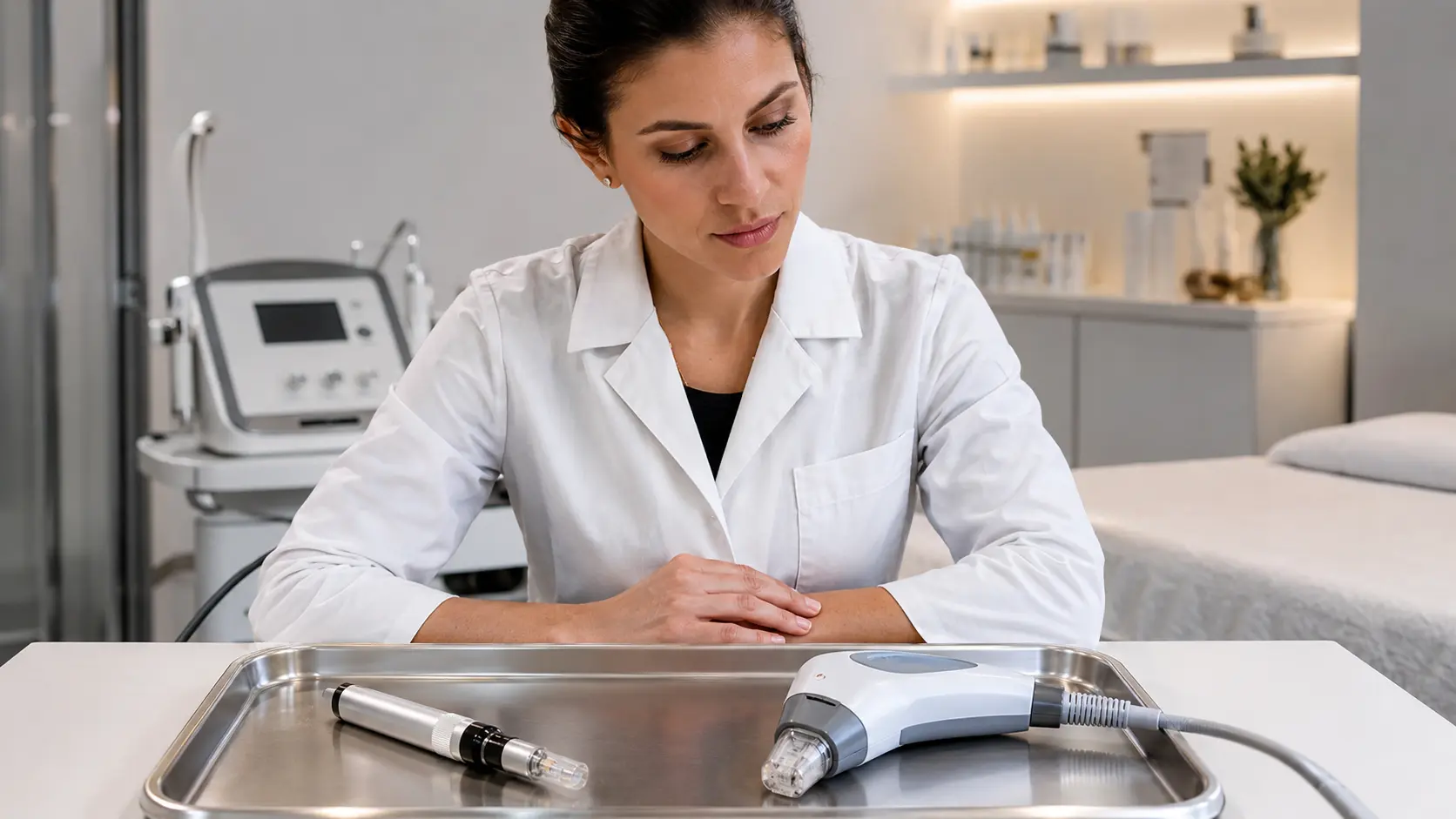
What Is the Difference Between Microneedling and RF Microneedling?
Standard microneedling creates controlled mechanical micro-injuries in the skin using fine needles, triggering a wound-healing cascade that stimulates collagen and elastin production. RF microneedling delivers radiofrequency energy directly into the dermis through the needle tips simultaneously with the mechanical puncture, adding a thermal coagulation injury that produces significantly greater collagen remodeling and tissue tightening than mechanical action alone. The combined mechanism makes RF microneedling more aggressive, more downtime-intensive, and far more tightly restricted by scope of practice regulations — placing it squarely outside the esthetician scope of practice in most states and jurisdictions.
- Standard microneedling works through controlled mechanical wound healing — RF microneedling adds thermal energy delivery that restructures collagen and contracts tissue at a deeper level.
- RF microneedling requires significantly more downtime — typically 3 to 7 days versus 24 to 72 hours for standard microneedling.
- RF microneedling is classified as a medical procedure in most jurisdictions and is outside the esthetician scope of practice without physician oversight or medical licensure.
- Both treatments produce post-treatment skin in a disrupted, highly permeable state that requires professional-grade, fragrance-free recovery protocols.
- RF microneedling offers superior skin tightening results for laxity concerns but carries greater risk, greater recovery burden, and greater regulatory complexity than standard collagen induction therapy.
- Understanding the mechanistic difference between these two treatments helps estheticians accurately educate clients and make appropriate referrals when RF is requested.
Clients increasingly walk into treatment rooms asking about microneedling with a specific question behind the question: they have seen RF microneedling marketed as the superior upgrade, the version with better results, the treatment that goes further. Some want to know if their esthetician can perform it. Others want to understand why it costs more and requires medical supervision. Many simply do not know there is a fundamental mechanistic difference between the two procedures — they see both described as “microneedling” and assume they are variations of the same thing.
They are not. The distinction between standard microneedling — also known as collagen induction therapy, or CIT — and radiofrequency microneedling is not simply a matter of degree. The mechanisms of action, the tissue response, the depth of injury, the scope of practice implications, the recovery timeline, and the clinical risks are meaningfully different. An esthetician who understands these differences is equipped not only to have educated conversations with curious clients but also to make the right decisions about their own service menu, their referral patterns, and their post-treatment recovery protocols.
This article provides a complete professional comparison of standard microneedling and RF microneedling — from the biology of how each creates its results, through scope of practice, client selection, treatment outcomes, and why post-treatment care protocols differ between the two.
What You Need to Know About These Two Treatments
- Standard microneedling relies entirely on the mechanical wound-healing cascade. RF microneedling adds a thermal energy component that contracts collagen immediately and drives deeper remodeling over time.
- The scope of practice difference is not a technicality — it is a legal and safety distinction. RF microneedling is a medical procedure in most jurisdictions. Performing it without proper licensure creates serious professional and legal exposure.
- Both treatments significantly disrupt the skin barrier and require professional-grade post-treatment recovery protocols emphasizing fragrance-free hydration and barrier support.
- RF microneedling’s superior tightening results come with greater downtime, greater procedural risk, and a narrower appropriate client population.
- Estheticians working within microneedling scope should understand RF microneedling well enough to accurately explain why it requires a medical referral and what clients should expect from that experience.
- Client education on this distinction builds professional credibility and prevents clients from seeking unqualified RF microneedling services without understanding the difference.
- Post-treatment hydration and barrier recovery protocols matter more after RF treatment than after standard microneedling due to the compounded mechanical and thermal injury to the skin barrier.
How Standard Microneedling Works: The Mechanical Wound-Healing Cascade
Standard microneedling — collagen induction therapy — uses a motorized pen device or roller fitted with fine needles to create thousands of microscopic punctures across the treatment area. The depth of these punctures is adjusted by the esthetician or provider based on the skin concern being addressed and the anatomical location of treatment. Typical therapeutic depths range from approximately 0.25 millimeters for surface texture improvement to 1.5 millimeters or deeper for acne scar treatment in qualified hands.
Each micro-puncture is interpreted by the body as an injury requiring repair. The wound-healing cascade proceeds through three overlapping phases: inflammation, proliferation, and remodeling. During the inflammatory phase, growth factors are released. During proliferation, fibroblasts migrate to the treatment area and begin synthesizing new collagen, elastin, and hyaluronic acid. During remodeling, which extends over weeks to months, the newly synthesized collagen matures and organizes, producing the visible skin quality improvements that clients experience progressively after treatment.
The mechanism is entirely mechanical. There is no heat. There is no electrical energy. The skin’s response is purely biological, driven by its own wound-healing intelligence in response to the controlled injury pattern. This is what makes standard microneedling relatively accessible as a treatment modality and what defines the boundaries of its efficacy — particularly its limitations for significant laxity and deep tissue tightening.
What Standard Microneedling Can and Cannot Do
Standard microneedling performs well across a broad range of skin concerns. Estheticians and providers who work with it regularly see consistent results in fine line and surface wrinkle reduction, mild to moderate acne scar improvement, enlarged pore refinement, overall skin texture improvement, hyperpigmentation reduction through accelerated cell turnover, and enhanced topical ingredient absorption during the heightened permeability window post-treatment.
What it cannot do effectively is produce significant tissue tightening in cases of meaningful skin laxity. The wound-healing cascade it triggers produces new collagen, but without a thermal component there is no immediate collagen contraction and no deep dermal restructuring at the level required to address loose or crepey skin in the neck, jawline, or lower face. This is where radiofrequency microneedling enters the clinical picture — and where the comparison becomes particularly relevant for both estheticians and their clients.
How RF Microneedling Works: Adding Thermal Energy to the Mechanical Injury
Radiofrequency microneedling — sometimes marketed under device brand names such as Morpheus8, Sylfirm X, Genius, Potenza, or Vivace — performs the same mechanical micro-puncture action as standard microneedling and then simultaneously delivers radiofrequency electrical energy through the needle tips at the moment of maximum penetration depth. This energy converts to heat within the dermis and subcutaneous tissue, producing a thermal coagulation zone at a precise, controlled depth.
The thermal injury this creates does two things that mechanical puncture alone cannot. First, it causes immediate denaturation and contraction of existing collagen fibers — visible as an immediate improvement in tissue firmness and contour immediately post-treatment. Second, the thermal coagulation zone acts as an additional wound stimulus, triggering a more aggressive secondary healing response that produces a greater quantity of new collagen and more extensive dermal remodeling than the mechanical injury produces on its own.
The depth at which the radiofrequency energy is delivered, the energy level applied, and the number of passes performed all influence the extent of treatment and recovery. Higher energy settings penetrate deeper and produce more dramatic tissue remodeling — and significantly more post-treatment tissue response, swelling, and recovery time.
Insulated vs. Non-Insulated RF Needles
A distinction that estheticians educating clients on RF microneedling should understand is the difference between insulated and non-insulated needle configurations. With insulated needles, the shaft of the needle is coated so that radiofrequency energy is only delivered at the uncoated tip, targeting the thermal effect precisely at the dermis while minimizing energy delivery in the epidermis. This reduces surface heating and significantly lowers the risk of post-inflammatory hyperpigmentation — making insulated RF microneedling generally safer for darker skin tones. Non-insulated needles distribute energy across the full shaft, producing more diffuse heating that affects the epidermis more significantly. Most contemporary RF microneedling devices use or offer insulated needle configurations for this reason.
Why RF Microneedling Produces Greater Collagen Remodeling Than Standard CIT
Standard microneedling triggers collagen synthesis through the biological wound-healing cascade alone — new collagen is produced by fibroblasts migrating to the injury site during the proliferation phase. Collagen organization and maturation occurs gradually over 4 to 6 weeks and continues for up to 6 months. There is no immediate collagen contraction.
RF microneedling produces both pathways simultaneously: the same wound-healing cascade as standard microneedling, plus immediate thermal denaturation of existing collagen fibers — causing an immediate contraction effect — and a more aggressive secondary healing response triggered by the thermal coagulation zones. The result is collagen remodeling that is both faster-onset and greater in magnitude than mechanical injury alone can produce.
The trade-off: More aggressive collagen remodeling means more significant tissue disruption, more substantial post-treatment response, more recovery time, and greater procedural risk — which is precisely why RF microneedling falls under medical scope of practice regulations.
Standard Microneedling vs RF Microneedling: A Direct Professional Comparison
The table below provides a structured comparison of the two modalities across the dimensions most relevant to estheticians evaluating these treatments for client education and referral decisions.
Scope of Practice: What Estheticians Can and Cannot Legally Perform
The scope of practice distinction between standard microneedling and RF microneedling is not a gray area of professional preference — it is a legal boundary with significant professional and liability consequences. Estheticians who are unclear about where that boundary falls in their state or jurisdiction are operating with meaningful professional risk, regardless of their clinical skill level or training completion.
Standard Microneedling: A Variable and State-Specific Picture
Standard microneedling occupies a genuinely variable legal position across U.S. states. Some states have issued specific guidance permitting licensed estheticians to perform microneedling up to defined needle depths. Others prohibit it entirely within the esthetician scope. Still others have not issued specific guidance, leaving practitioners in a regulatory gray zone that carries its own risks. No esthetician should add microneedling to their service menu without explicitly verifying the current position of their state cosmetology or esthetics board. State regulations in this area have been actively evolving and verbal guidance from instructors or colleagues does not substitute for direct board verification.
RF Microneedling: Outside the Esthetician Scope in Most Jurisdictions
RF microneedling is classified as a medical procedure in the vast majority of U.S. states and internationally. The thermal energy delivery component — which involves controlled tissue injury at a deeper level than standard microneedling produces — places it squarely within the domain of medical licensure. In most jurisdictions, RF microneedling can only be legally performed by a physician, a physician assistant, a nurse practitioner, or a registered nurse under physician supervision. Medical spa settings that employ estheticians may operate RF microneedling under medical director oversight, but the performing provider must hold appropriate medical licensure in most cases.
An esthetician who performs RF microneedling — even one who has received training on an RF device — is almost certainly operating outside their legal scope in most states. The clinical training is not the issue: the licensure category is. This distinction should be clearly understood and clearly communicated to any client who asks whether their esthetician can perform RF microneedling for them.
Never assume RF microneedling is within your scope because you have received device training. Device training certificates are not scope of practice authorization. Always verify your current state board regulations directly before adding any microneedling service — standard or RF — to your service menu. Regulations in this area are actively evolving and vary significantly by jurisdiction. When in doubt, consult your state board in writing and retain the response.
Why Estheticians Still Need to Understand RF Microneedling
Even if RF microneedling falls entirely outside an esthetician’s scope, understanding it well is professionally valuable. Clients who are candidates for RF microneedling are often first encountered in esthetic settings. The esthetician who can explain the difference clearly, identify when a client’s skin concern warrants a medical referral, and make that referral confidently is providing genuinely high-value professional guidance — and building the trust that keeps clients returning for the treatments the esthetician can perform.
Additionally, estheticians who work in medical spa environments alongside providers who perform RF microneedling are frequently responsible for the post-treatment recovery care. Understanding what RF microneedling does to the skin and why its recovery protocol differs from standard CIT recovery makes the esthetician a more capable and more credible clinical team member.
Who Is the Right Candidate for Each Treatment?
Client selection for microneedling versus RF microneedling is not only a matter of clinical indication — it is also a matter of realistic expectation management, recovery tolerance, and budget. Estheticians educating clients on their options should be able to speak to all three dimensions with confidence.
Clients Well Suited for Standard Microneedling
The ideal candidate for standard collagen induction therapy is someone with good to moderate skin laxity who is looking to address skin texture, fine lines, mild acne scarring, enlarged pores, uneven skin tone, or hyperpigmentation. They should have no active infection or inflammatory skin condition in the treatment area, no history of keloid scarring, and no contraindications related to wound healing or immune function. They should be realistic about progressive results that develop over multiple treatments and several months of collagen maturation. Standard microneedling is also appropriate for clients who cannot accommodate the more significant downtime of RF treatment — clients with active professional or social schedules where 3 to 7 days of visible recovery is not practical.
Clients Who May Benefit from RF Microneedling Referral
Clients who present with meaningful skin laxity — particularly in the lower face, jawline, neck, and periorbital areas — are unlikely to achieve satisfying results from standard microneedling alone. For these clients, RF microneedling offers tissue contraction and dermal remodeling at a level that CIT cannot produce. Similarly, clients with moderate to severe acne scarring who have not achieved adequate results from standard microneedling series may benefit from RF treatment’s greater remodeling depth. Clients who are willing to accept the additional downtime, procedural cost, and medical setting requirements are appropriate candidates for a referral conversation.
Estheticians should approach this conversation as professional guidance, not as a concession that their services are inadequate. The most trusted estheticians their clients know are the ones who tell them honestly what each treatment can and cannot do — and who help them navigate toward the right solution even when it means a referral outside the esthetic setting.
Why Post-Treatment Recovery Protocols Differ Between Standard and RF Microneedling
The post-treatment recovery protocol is where estheticians who perform standard microneedling within their scope — and those who work alongside medical providers performing RF microneedling — have direct clinical responsibility. Understanding why these protocols differ is important both for effective care delivery and for accurate client education.
Post-Standard Microneedling: The 24 to 72-Hour Barrier Recovery Window
Following standard microneedling, the skin is in a state of elevated permeability. The mechanical disruption of the stratum corneum creates thousands of micro-channels through which both applied topicals and environmental elements can penetrate more easily than normal. Transepidermal water loss is elevated. The skin is erythematous and sensitized. The treatment window immediately post-procedure is simultaneously the highest-risk period for sensitization from inappropriate product application and the highest-opportunity window for delivering barrier-supportive hydration into the skin.
Professional post-microneedling protocols prioritize fragrance-free, barrier-supportive hydration immediately post-procedure. Occlusive masks that seal moisture against the disrupted barrier while delivering clinical humectants through the heightened permeability window address both the client comfort need and the clinical hydration and barrier recovery objective simultaneously. Avoidance of active ingredients — retinoids, vitamin C, AHAs, BHAs — for a minimum of 24 to 48 hours post-treatment is a universal professional standard.
Post-RF Microneedling: A More Intensive and Extended Recovery Window
Following RF microneedling, the skin has sustained both the mechanical micro-injury of standard microneedling and the thermal coagulation injury produced by the radiofrequency energy delivery. The combined barrier disruption is substantially more significant than mechanical injury alone. Swelling is often present beyond simple erythema. The skin surface may show micro-crusting or texture changes as the thermal coagulation zones resolve. The recovery window is not 24 to 72 hours — it is 3 to 7 days or longer at higher energy settings.
During this extended window, the barrier recovery protocol is more critical, not less. The skin is more vulnerable to sensitization, dehydration, and post-inflammatory pigmentary response. Barrier-supportive hydration, strict sun avoidance, fragrance-free product use, and avoidance of all active ingredients for a more extended period than standard microneedling recovery requires are non-negotiable clinical standards in RF post-treatment care.
Estheticians who work in medical spa environments alongside providers performing RF microneedling describe a consistent pattern in post-treatment care: the clients who experience the smoothest, least reactive recoveries are those who receive immediate, professional-grade barrier hydration in the minutes following treatment. The application of Poly-Luronic™ Jelly Mask by Luminous Skin Lab as the first post-RF recovery step — after growth factor or peptide serum application and before the client leaves the treatment room — is reported by estheticians in these settings to consistently reduce visible redness intensity within the treatment session window, produce audible client comfort responses as the cooling mask sets over thermally stimulated skin, and establish a professional-standard skin condition at checkout that supports client confidence in the recovery process.
Practitioners note that the distinction between Poly-Luronic™ and sheet mask alternatives used in similar contexts is most apparent after RF treatment: the occlusive set mask creates a physical barrier seal that a sheet mask cannot replicate, the PGA dual-humectant system delivers measurably more sustained post-removal hydration than HA-only alternatives, and the clean fragrance-free formulation eliminates any sensitization risk during the elevated-permeability post-RF recovery window — a period when even trace amounts of sensitizing ingredients carry heightened reaction potential.
What Clients Should Expect During Recovery and How to Communicate It
One of the most important functions an esthetician can serve in any microneedling context — standard or RF — is accurate pre-treatment expectation setting for the post-treatment recovery experience. Clients who are surprised by their post-treatment appearance are more likely to apply inappropriate products, contact the practice with anxiety, or develop negative associations with an otherwise successful treatment.
For standard microneedling, clients should be told to expect a sunburn-level redness that typically resolves within 24 to 48 hours, mild swelling in the immediate post-treatment period, increased skin sensitivity for 48 to 72 hours, and a strict avoidance protocol for actives and sun exposure. For RF microneedling, clients should be prepared for a more significant recovery: redness that may be accompanied by swelling, possible micro-crusting as thermal zones heal, skin texture changes in the first few days, and an extended avoidance window for active ingredients and sun exposure. Clients who understand what to expect are more likely to follow recovery protocols correctly and more likely to be satisfied with their treatment outcome.
Professional and Scientific References
The clinical information in this article draws from established dermatological and cosmetic medicine literature:
- Microneedling mechanism and collagen induction therapy — wound-healing cascade, fibroblast activation, collagen synthesis phases. Established dermatological literature; Journal of Cutaneous and Aesthetic Surgery.
- Radiofrequency microneedling — thermal coagulation mechanism, collagen contraction and remodeling. Dermatologic Surgery; Journal of the American Academy of Dermatology.
- Insulated vs. non-insulated RF needle configurations and post-inflammatory hyperpigmentation risk in Fitzpatrick types IV–VI. Lasers in Surgery and Medicine; Dermatologic Clinics.
- Post-microneedling barrier recovery and transepidermal water loss elevation. Journal of Dermatological Treatment; International Journal of Dermatology.
- Microneedling scope of practice — state regulation variation. National Cosmetology Association; individual state board guidance documents.
- RF microneedling devices — Morpheus8, Sylfirm X, Genius, Potenza, Vivace: manufacturer clinical data and published clinical outcomes literature.
[[DEVELOPER OPTIONAL]] — Expand with specific DOIs upon editorial review.
For estheticians performing standard microneedling within their state-approved scope, or working alongside medical providers in RF microneedling recovery care, the post-treatment recovery step is where the difference between an excellent clinical outcome and an unnecessarily reactive one is most often decided. Our education team consistently recommends the Poly-Luronic™ Jelly Mask by Luminous Skin Lab as the post-microneedling recovery mask of choice — formulated with a proprietary PGA and hyaluronic acid dual-humectant system, fragrance-free and clean-label for post-treatment safety on compromised skin, with an occlusive set format that seals the disrupted barrier and delivers immediate cooling to sensitized, erythematous post-treatment skin. It is the formulation our team references most consistently when estheticians ask what to apply immediately after any needling procedure.
Explore the ILUMIPEN Professional Nano Infusion DeviceFrequently Asked Questions: Microneedling vs RF Microneedling
What is the difference between microneedling and RF microneedling?
Standard microneedling creates controlled mechanical micro-injuries using fine needles to trigger the skin’s natural wound-healing cascade and stimulate collagen production. RF microneedling does the same but simultaneously delivers radiofrequency energy through the needle tips directly into the dermis, adding a thermal coagulation injury that produces significantly greater collagen remodeling and tissue contraction than mechanical injury alone. The combined mechanism makes RF microneedling more aggressive, more downtime-intensive, and more tightly restricted by scope of practice regulations.
Can estheticians perform RF microneedling or is it only for medical providers?
In the vast majority of U.S. states and internationally, RF microneedling falls outside the esthetician scope of practice and is classified as a medical procedure requiring a licensed medical professional or physician oversight. Standard microneedling occupies a gray zone that varies by state. Estheticians must verify their specific state board regulations before offering either treatment. Performing RF microneedling without proper licensure creates serious legal and liability exposure.
Which treatment produces better results for skin tightening — regular microneedling or RF microneedling?
RF microneedling produces measurably greater skin tightening and tissue contraction than standard microneedling because the radiofrequency thermal energy causes immediate collagen denaturation and contraction in addition to the wound-healing collagen stimulation both modalities share. For laxity concerns, RF microneedling typically outperforms standard microneedling. However, the increased efficacy comes with more significant downtime, higher procedural risk, and restricted scope of practice.
How much more downtime does RF microneedling cause compared to regular microneedling?
Standard microneedling typically produces 24 to 72 hours of visible redness, mild swelling, and skin sensitivity depending on needle depth. RF microneedling recovery is more significant, with active redness, swelling, and skin texture changes commonly lasting 3 to 7 days and sometimes longer at deeper energy settings. The thermal injury component of RF treatment adds a recovery layer that standard microneedling does not produce.
What skin concerns is standard microneedling best suited for?
Standard microneedling is most effective for fine lines and surface wrinkles, mild acne scarring, enlarged pores, overall skin texture improvement, hyperpigmentation, and enhancing serum absorption. It is a versatile skin rejuvenation treatment suitable for most skin types when properly evaluated for contraindications.
Is RF microneedling safer for darker skin tones than laser treatments?
RF microneedling is generally considered a safer option for Fitzpatrick skin types IV through VI compared to ablative laser resurfacing because radiofrequency energy is not chromophore-dependent and does not selectively target melanin. However, post-inflammatory hyperpigmentation risk still exists and must be carefully managed. Standard microneedling shares a similar relative safety advantage over laser for deeper skin tones with appropriate depth and protocol management.
Why does the post-treatment recovery protocol matter more after RF microneedling than regular microneedling?
RF microneedling creates both mechanical micro-injury and thermal coagulation injury simultaneously, producing a more significantly disrupted barrier state than standard microneedling. This means the skin is more permeable, more sensitive, and more vulnerable to sensitization from actives, fragrance, or inadequate hydration during the recovery window. Post-treatment recovery protocols — including appropriate hydration masking, barrier-supportive products, and avoidance of active ingredients — are clinically more critical after RF treatment.
What should estheticians apply to skin after microneedling to support barrier recovery?
Immediately post-microneedling, the skin benefits most from fragrance-free, barrier-supportive hydration. Professional-grade jelly masks containing polyglutamic acid and hyaluronic acid are widely used in post-microneedling protocols because the occlusive mask layer seals hydration while PGA inhibits hyaluronidase, protects the skin’s own hyaluronic acid, and the cooling effect of the set mask reduces redness and client discomfort during recovery.
How does the Poly-Luronic Jelly Mask support post-microneedling recovery compared to other mask options?
The Poly-Luronic Jelly Mask by Luminous Skin Lab is formulated with a proprietary PGA and hyaluronic acid dual-humectant system specifically suited to post-microneedling recovery. The PGA surface occlusion seals the disrupted barrier against transepidermal water loss, the HA delivers deep-layer hydration through the heightened permeability window post-procedure, and the cooling effect of the set mask provides immediate comfort and redness reduction. Its fragrance-free, clean-label formulation meets the post-treatment safety standard required for application on compromised skin.
Two Different Treatments, Two Different Conversations
Standard microneedling and RF microneedling share a name and a needle but are fundamentally different procedures in terms of mechanism, outcome, recovery, and scope of practice. Understanding that difference — clearly, confidently, and in terms clients can understand — is one of the most practically valuable pieces of professional education an esthetician in the modern treatment room can carry.
For estheticians performing standard microneedling within their state-approved scope, the comparison reinforces the value of what CIT delivers: a safe, versatile, highly effective collagen stimulation modality that addresses a broad range of skin concerns in a clinically appropriate setting with a manageable recovery timeline. For estheticians who encounter clients asking about RF microneedling, the knowledge to respond accurately — to explain the mechanism, acknowledge the superior tightening outcomes, and guide clients toward the right medical referral when appropriate — builds the professional trust that defines a practitioner clients genuinely rely on.
In both contexts, the post-treatment recovery protocol is where the esthetician’s clinical knowledge directly affects client outcomes. A compromised barrier treated with the right barrier-supportive, fragrance-free, professional-grade hydration recovers more effectively, more comfortably, and with less risk of sensitization or post-inflammatory response than one left to recover with inappropriate or insufficient care.