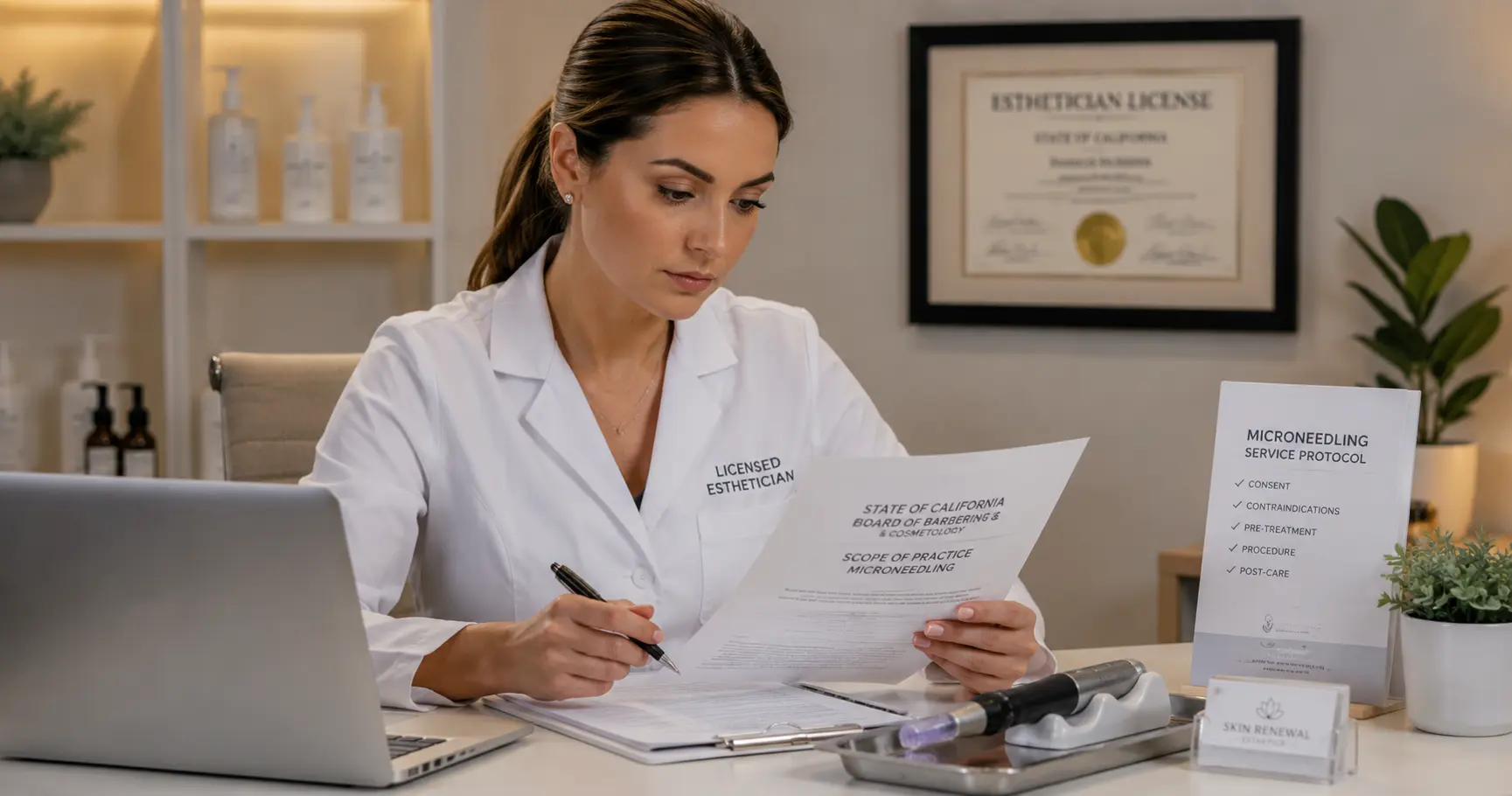
Can Estheticians Legally Perform Microneedling in the United States?
The answer is: it depends entirely on the state. In the United States, there is no federal standard governing whether licensed estheticians may perform microneedling. Each state sets its own scope of practice rules through cosmetology or esthetics licensing boards, medical board regulations, and in some cases formal attorney general opinions or legislative statute. The legal landscape varies dramatically across states — from states that explicitly permit estheticians to perform microneedling within defined conditions, to states that restrict the service entirely to licensed medical professionals.
- Microneedling is regulated at the state level only. No federal law governs who may perform it — every esthetician must verify their specific state’s current rules.
- Most states that allow estheticians to perform microneedling impose conditions: needle depth limits, medical director requirements, prohibited use of prescription topicals, and mandatory documentation.
- Needle depth thresholds — commonly 0.5mm or 1.0mm — are the most frequently used legal dividing line between cosmetic and medical procedure classifications.
- Performing microneedling outside your legal scope of practice risks license revocation, civil liability, criminal charges, and voided insurance coverage.
- State regulations change. An esthetician who verified compliance two years ago cannot assume the same rules apply today without re-verification.
- The safest compliance path is to contact your state cosmetology or esthetics licensing board directly and obtain written confirmation of current rules before offering any microneedling service.
Microneedling has become one of the most requested services across esthetic practices in the United States. Clients who once sought it only in medical spa environments are now asking for it at independent esthetic studios, day spas, and solo practitioner suites. The demand is real. The business case can be compelling. But the legal question — can estheticians actually perform this service — remains one of the most misunderstood compliance issues in the profession.
The short answer is: sometimes, in some states, under specific conditions. The longer answer requires understanding how state regulatory systems work, why microneedling sits in a uniquely complicated position between cosmetic and medical procedure classification, what the most common legal thresholds look like, and what the real-world consequences of practicing outside your scope actually are.
This guide gives estheticians a complete, education-first framework for understanding microneedling legal compliance. It covers how scope of practice law works, what the major state-level regulatory approaches look like, what conditions typically apply when estheticians are permitted to offer the service, and what every practitioner must do before making any service menu decision. It does not constitute legal advice — and every esthetician reading this should treat it as professional education that directs them toward the authoritative sources they need to consult directly.
This article is professional educational content, not legal advice. Scope of practice law is state-specific, subject to change, and must be verified directly with your state licensing board and, where appropriate, a licensed attorney familiar with your state’s esthetics law. Never rely on peer advice, social media, or general educational content alone to make microneedling compliance decisions.
What Every Esthetician Needs to Know About Microneedling Legal Compliance
- There is no federal rule — microneedling is regulated entirely at the state level and rules vary dramatically across all 50 states.
- Three broad regulatory categories exist: states that permit estheticians to perform microneedling under conditions, states that restrict it to medical professionals only, and states with no specific guidance yet.
- Needle depth restrictions — most commonly 0.5mm or 1.0mm thresholds — are the most frequently used legal dividing line in states that have issued formal guidance.
- Medical director requirements are common in states that allow spa-based microneedling. The scope of required oversight varies significantly.
- Practicing outside your legal scope exposes you to license revocation, civil suit, criminal liability in some states, and voided professional insurance coverage.
- State law changes. Always verify current rules through your state board directly and obtain written confirmation before offering any new service.
- Informed consent documentation, contraindication screening, and proper post-treatment protocols are professional obligations regardless of state law permitting the service.
How Esthetics Scope of Practice Law Actually Works in the United States
To understand why the microneedling legal question is complicated, it helps to understand how professional scope of practice law is structured in the United States. There is no national esthetics licensing board, no federal law governing what estheticians may or may not do, and no universal standard. Each state independently determines what services fall within the scope of a licensed esthetician, typically through its cosmetology or esthetics licensing board, sometimes through its medical board, and occasionally through the state legislature itself.
The Three Regulatory Layers
In most states, microneedling compliance involves navigating at least two and sometimes three distinct regulatory systems simultaneously. The cosmetology or esthetics licensing board defines what is within an esthetician’s license scope. The state medical board defines what constitutes the practice of medicine and therefore what requires a medical license. The state legislature may pass specific statutes that override or complement both board positions. When these three systems produce conflicting or ambiguous guidance — which is common with newer aesthetic technologies like microneedling — estheticians are left in genuine legal uncertainty.
Why Microneedling Sits in a Particularly Complex Position
Unlike dermaplaning or extractions — which are clearly established within esthetic scope in virtually all states — microneedling creates a category problem for regulators. At very shallow depths with cosmetic intent, it can reasonably be classified as a cosmetic procedure. At deeper depths with prescription topicals applied to the channels created, it begins to look more like a medical procedure. This ambiguity means that many states either have not yet issued specific guidance, have issued guidance that is inconsistently interpreted, or have rules that were written before modern automated microneedling pen technology existed and therefore do not clearly apply.
The Danger of Secondhand Regulatory Information
One of the most common and dangerous patterns in the esthetics profession is estheticians making compliance decisions based on what they heard from colleagues, read in trade publications, or encountered in training courses — rather than verifying directly with their state board. State regulations change. A colleague in the same state may have different information because they checked two years ago and the rules have since been updated. A training course certificate does not constitute state authorization to perform a service. The only reliable source of current compliance information is the state licensing board itself.
The Three Major Regulatory Categories for Microneedling and Estheticians
While every state is unique and must be verified individually, three broad regulatory patterns emerge when surveying the national landscape as of 2026. Understanding which category your state falls into is the starting point for compliance research — not the end point.
Permitted Under Conditions
Some states explicitly permit licensed estheticians to perform microneedling within defined conditions. These conditions typically include needle depth restrictions, prohibition on prescription topicals, medical director oversight requirements, specific training or certification requirements, and mandatory informed consent documentation. Operating within this category requires full compliance with every specified condition — not just the ones that are convenient.
Medical Supervision Required
Some states permit microneedling in spa or esthetics settings only with active medical supervision or a formal medical director relationship. The structure of required oversight varies: some states require a physician on-site; others require only protocol review and availability for consultation. The medical director must typically hold a valid state medical license and accept medical responsibility for the services performed.
Restricted or No Clear Guidance
Some states explicitly classify microneedling as a medical procedure that may only be performed by licensed physicians, nurse practitioners, physician assistants, or registered nurses. Other states have simply not issued specific guidance, leaving estheticians in a legal gray zone where performing the service carries meaningful liability risk regardless of intent. No guidance does not mean permitted.
Why Your State’s Category Can Change
State regulatory positions on aesthetic technologies regularly evolve as the technology becomes more widespread, as professional associations advocate for expanded or restricted scope, and as adverse events generate regulatory attention. A state that permitted estheticians to perform microneedling two years ago may have tightened requirements. A state that previously had no guidance may have issued a formal opinion. Re-verification is not paranoia — it is professional responsibility.
Why Needle Depth Is the Most Common Legal Threshold for Microneedling Scope
In states that have issued formal microneedling scope of practice guidance, needle depth is the most frequently used regulatory dividing line. Understanding why regulators use depth as a threshold — and what the most common depth limits are — is essential for any esthetician evaluating compliance in a depth-restricted state.
The Logic Behind Depth-Based Regulation
Needle depth determines how deeply the mechanical trauma of microneedling penetrates the skin structure. At very shallow depths — typically 0.25mm to 0.5mm — the needles interact primarily with the stratum corneum and upper epidermis. At these depths, the skin’s inflammatory and wound-healing response is relatively limited, and the treatment functions primarily as a controlled exfoliation and product delivery enhancement mechanism. At deeper depths — 1.0mm to 2.5mm — needles reach the dermis, triggering the robust wound-healing cascade that produces collagen induction. This deeper dermal engagement is what regulators in many states classify as crossing from cosmetic into medical procedure territory, because it involves intentional penetration of the dermis and carries meaningfully higher risks including infection, scarring, hyperpigmentation, and post-inflammatory responses.
The Most Common Depth Thresholds in State Regulations
While specific thresholds must always be verified with each state’s board, two depth limits appear most frequently in states that have issued specific guidance. The 0.5mm threshold is used in some states as the maximum depth permissible for estheticians, placing anything deeper into medical scope. The 1.0mm threshold is used in other states, allowing estheticians to access the upper dermis under permitted conditions but restricting deeper penetration. Some states do not use a depth threshold at all — either permitting microneedling without depth specification or prohibiting it entirely regardless of depth.
What Depth Restrictions Mean in Practice
If your state permits microneedling up to 0.5mm, that means the maximum cartridge setting used during any service must not exceed 0.5mm — regardless of what the client requests, what the treatment goal is, or what the device is capable of. Exceeding a state-mandated depth restriction constitutes practicing outside your scope even if the service is otherwise permitted.
Practical implications for depth-restricted estheticians include:
- Device selection must include models with adjustable depth settings and clear calibration indicators.
- Treatment area mapping must account for tissue thickness variation — the periorbital area and lips require lower depth settings than cheeks and forehead.
- Client goals must be managed within the clinical reality of what shallow-depth microneedling can achieve. Deep acne scarring, for example, responds more meaningfully to depths beyond what esthetician-scope restrictions commonly permit.
- Documentation of settings used should be part of every treatment record.
What Do Medical Director Requirements Actually Mean for Estheticians?
In states that require medical director oversight for esthetician-performed microneedling, the medical director requirement is one of the most frequently misunderstood compliance elements. Many estheticians assume that having a physician sign a document is sufficient. In practice, the requirements are typically more substantive than a signature relationship.
What a Medical Director Relationship Must Include
A functional medical director relationship for esthetic services generally includes a licensed physician who has reviewed and approved the treatment protocols used, accepts medical responsibility for the services performed under their oversight, is available to respond to adverse events or complications, has a written agreement with the esthetics practice documenting the oversight structure, and in some states must conduct periodic on-site reviews or be physically present during treatments. A physician who simply signs a document in exchange for a fee, with no genuine protocol review or oversight involvement, may not meet the legal standard — and may expose both the physician and the esthetician to significant liability.
How to Identify a Compliant Medical Director Relationship
Estheticians seeking a medical director relationship should look for a physician with genuine interest in and knowledge of esthetic procedures, willingness to review treatment protocols in detail, a clearly documented agreement specifying the scope and structure of oversight, appropriate malpractice insurance that covers their medical director role, and clear communication protocols for adverse event response. The medical director should be a genuine clinical partner, not a name on a wall. Any arrangement that does not meet this standard creates unacceptable professional and legal risk for both parties.
What Happens If a Medical Director Relationship Is Inadequate
If a state inspection, board complaint, or legal claim reveals that a purported medical director relationship did not meet state-required standards, the esthetician may be found to have been performing services outside their permitted scope — even if they believed they had appropriate oversight in place. Due diligence in establishing and documenting the medical director relationship is not optional for estheticians operating in states that require it.
What Are the Real Consequences of Performing Microneedling Outside Your Legal Scope?
The consequences of practicing microneedling outside your legal scope of practice are severe, lasting, and in some cases irreversible. Understanding them concretely is important because many estheticians who operate outside their scope do so without fully appreciating what they are risking.
License Suspension or Revocation
State licensing boards have the authority to suspend or permanently revoke an esthetician’s license for practicing outside their scope. A revoked license ends a professional career. Even a temporary suspension during investigation creates practice interruption, reputational damage, and financial impact that can take years to recover from. Board complaints can come from clients, competing practitioners, medical boards, or from insurance investigations following an adverse event claim.
Civil Liability for Client Injury
When a client suffers an adverse outcome — infection, scarring, hyperpigmentation, nerve damage, or allergic reaction — following a service performed outside the esthetician’s legal scope, the esthetician’s liability exposure is substantially greater than if the service had been performed within scope. Practicing outside your scope is typically cited as evidence of negligence in civil proceedings. The fact that the client consented to the service does not protect the esthetician if the service was not legally within their scope to offer.
Professional Liability Insurance Invalidation
This is perhaps the most commonly overlooked consequence. Most professional liability insurance policies specifically exclude coverage for services performed outside the insured’s legal scope of practice. An esthetician who performs microneedling outside their permitted scope and then faces a client injury claim may find their insurance company declines coverage entirely — leaving them personally financially liable for all legal defense costs and any damages awarded.
Criminal Charges in Some States
Some states classify the unlicensed practice of medicine as a criminal offense. Depending on the state and the specific circumstances, an esthetician performing microneedling that is legally classified as a medical procedure in their state could face criminal charges. While criminal prosecution of estheticians for scope violations is not common, it has occurred and the possibility is not theoretical.
Performing microneedling outside your legal scope of practice is not a technicality. It is a career-ending risk that can result in permanent license loss, uninsured civil liability, and in some states criminal charges. The business opportunity is never worth these consequences. Verify your state law, work within your scope, and grow your microneedling business legally.
Post-Treatment Protocol: The Part of Microneedling Every Esthetician Is Responsible For
Regardless of which regulatory category your state falls into, every esthetician who performs or assists with microneedling is professionally responsible for the post-treatment protocol. This is not a secondary clinical consideration — it is a primary component of client safety and treatment outcome quality that directly affects your professional reputation and your liability exposure if something goes wrong after the client leaves your treatment room.
Why Post-Microneedling Recovery Is a Clinical Priority
Following microneedling at any permitted depth, skin is in a state of heightened permeability, compromised barrier function, and active inflammatory response. The microchannels created by the needling process significantly increase the rate at which topically applied ingredients penetrate the skin. This heightened absorption window is clinically valuable — it is the mechanism through which serums applied post-needling achieve deeper delivery than they would on intact skin. It is also a vulnerability: anything applied to the skin post-procedure that contains sensitizing ingredients, synthetic fragrance, or reactive actives can cause dramatically more severe reactions than the same product would cause on intact skin.
The Core Elements of a Sound Post-Microneedling Protocol
Professional post-microneedling recovery protocols consistently include several essential elements. Immediate calming through cooling — either through cooling tools, cool water, or an occlusive cooling mask — addresses the acute inflammatory response and client comfort. Barrier-safe hydration delivery through carefully selected humectants supports skin recovery without sensitization risk. An occlusive layer over a hydration serum locks in moisture during the critical first recovery window. Fragrance-free formulations are non-negotiable; any fragrance-containing product applied to post-needled skin creates a serious sensitization risk.
Practitioners working with advanced post-treatment recovery protocols understand that the occlusive layer is the most clinically significant element of immediate post-microneedling care. The skin’s heightened permeability state creates a window during which transepidermal water loss occurs rapidly without occlusive management. An occlusive professional mask applied immediately post-procedure locks in the serum layer, maintains moisture, supports barrier recovery, and provides the cooling thermal effect that reduces post-procedure redness and discomfort.
Estheticians who have systematically evaluated post-microneedling mask options consistently report the same practical conclusions: the formulation requirements for post-procedure skin are far more demanding than for standard facial applications, and the majority of jelly mask options on the market do not meet them without compromise.
Practitioners incorporating Poly-Luronic™ Jelly Masks by Luminous Skin Lab into their post-microneedling recovery workflows describe several operationally specific observations that go beyond general hydration outcomes. The PGA surface seal effect is noticeably more pronounced on post-procedure skin in the 10-to-15-minute application window — the elevated transepidermal water loss rate that characterizes fresh post-needling skin appears to be addressed more effectively by the dual PGA + HA system than by single-humectant alternatives previously used. Practitioners specifically note that the consistent set behavior and clean removal in a single intact piece are clinically relevant in post-procedure context: disrupted removal mechanics that require pulling or extended manipulation on sensitized post-needling skin create unnecessary discomfort and risk. The fragrance-free formulation is a professional requirement these practitioners do not negotiate — any fragrance-containing product applied to the microchannels created by needling produces predictable sensitization risk that is simply not acceptable in a clinical recovery context.
Client Education as a Post-Treatment Protocol Element
The esthetician’s responsibility does not end when the client leaves the treatment room. Post-microneedling client education is a professional obligation: what to avoid for the first 24 to 72 hours, which home-care products are safe during the recovery window, what signs of normal versus abnormal post-treatment response look like, and when to contact the esthetician or seek medical attention. Clear, written aftercare instructions provided to every microneedling client are both a clinical best practice and a meaningful liability management tool.
The Compliance Action Steps Every Esthetician Must Take Before Offering Microneedling
The compliance process for microneedling is not a one-time research exercise. It is an ongoing professional responsibility that requires initial verification, documentation, and periodic re-verification as state regulations evolve. Here is the complete compliance action framework that every esthetician considering microneedling services should follow.
Microneedling Compliance Checklist for Estheticians
- Contact your state cosmetology or esthetics licensing board directly and ask for written confirmation of current microneedling scope of practice rules — in writing, by email or letter.
- Contact your state medical board to verify whether microneedling at any depth is classified as the practice of medicine in your state.
- Consult a licensed attorney with specific experience in state esthetics law before offering any microneedling service, particularly if regulations are ambiguous.
- Obtain professional training and certification from a reputable, recognized microneedling education provider — and understand that this is required but not sufficient for legal authorization.
- Review your professional liability insurance policy specifically for microneedling coverage — confirm in writing that the service is covered, at which needle depths, and under which conditions.
- If your state requires a medical director, establish a documented, substantive oversight relationship with a qualified physician before performing any services.
- Develop written treatment protocols including contraindication screening criteria, informed consent documentation, treatment record forms, and post-treatment care instructions.
- Establish infection control protocols that meet or exceed your state’s requirements for microneedling procedures, including single-use cartridge policies and surface disinfection standards.
- Set a calendar reminder to re-verify state regulations at least annually and any time you hear of regulatory changes in your state.
What to Do If Your State Prohibits or Is Unclear on Microneedling
If your state either prohibits esthetician-performed microneedling or has not issued clear guidance, you have several professional options that do not require practicing outside your scope. Nano infusion — a needle-free microchanneling technology — is permitted within esthetician scope in most states and delivers similar benefits to shallow-depth microneedling for many skin concerns. Advocating through professional associations for clearer or expanded scope guidance is a legitimate and valuable long-term strategy. Building a referral relationship with a licensed medical provider who performs microneedling allows you to serve clients who need deeper treatment within a compliant professional network.
Professional and Regulatory References
The regulatory framework content in this article draws from publicly available state board guidance documents, professional association position statements, and legal commentary on esthetics scope of practice:
- State cosmetology and esthetics licensing board guidance documents — individual state sources including Colorado Department of Regulatory Agencies, Virginia Board for Barbers and Cosmetology, and multiple additional state boards. Verify directly with your state board for current rules.
- National Coalition of Estheticians, Manufacturers/Distributors & Associations (NCEA) — scope of practice resources and position statements on emerging esthetic technologies.
- Associated Skin Care Professionals (ASCP) — state-by-state scope of practice guidance and member compliance resources. ascp.com
- American Med Spa Association (AmSpa) — medical spa compliance resources and state law updates covering microneedling and medical director requirements. americanmedspa.org
- State attorney general opinions on medical practice act scope — applicable where formal opinions have been issued regarding aesthetic technology classification.
- Professional liability insurance policy analysis — scope of coverage conditions for microneedling services in esthetic practice settings.
For estheticians operating within their legal microneedling scope, the post-treatment recovery protocol is the clinical component entirely within your professional control — regardless of state category. Our education team’s most consistent recommendation for post-microneedling recovery masking is the Poly-Luronic™ Jelly Mask by Luminous Skin Lab. Formulated by a licensed esthetician specifically for post-treatment use, it delivers the PGA + HA dual-humectant system that addresses the unique recovery needs of post-procedure skin: PGA surface sealing against heightened transepidermal water loss, HA deep hydration delivery through the post-needling permeability window, hyaluronidase inhibition to protect applied and natural HA, and the occlusive mask format that compresses recovery time while optimizing hydration delivery. Fully fragrance-free. Clean-label. Formulated for the clinical post-treatment standards that post-microneedling skin demands.
Explore the Poly-Luronic™ Jelly Mask Line →Frequently Asked Questions: Can Estheticians Legally Perform Microneedling?
Can estheticians legally perform microneedling in the United States?
It depends entirely on the state. Some states explicitly permit licensed estheticians to perform microneedling under defined conditions, some require medical supervision or a medical director, some restrict it to licensed medical professionals only, and some have not issued specific guidance at all. There is no federal standard. Every esthetician must verify the current law in their specific state before offering microneedling services.
Which states allow estheticians to do microneedling without a doctor?
A limited number of states permit licensed estheticians to perform microneedling independently within defined scope conditions, typically with needle depth restrictions of 0.5mm or less and no use of prescription topicals. States in this category have historically included Colorado, Virginia, and several others, though regulations change frequently. Always verify directly with your state cosmetology or esthetics licensing board before offering services.
What happens if an esthetician performs microneedling illegally?
Practicing outside your legal scope of practice can result in license suspension or revocation, civil liability for client injury, criminal charges in some states, voided professional liability insurance, and permanent damage to your professional reputation. The consequences are severe and the risk is not worth taking. Verify your state law before performing any microneedling service.
Does needle depth matter for whether microneedling is legal for estheticians?
Yes, needle depth is one of the most commonly used legal thresholds in states that have issued microneedling scope of practice guidance. Many states draw the line between cosmetic and medical procedures at 0.5mm needle depth or 1.0mm. Below that threshold, some states allow estheticians to perform the service; above it, medical licensure or supervision is typically required. The specific depth thresholds vary by state and must be verified with your licensing board.
Do estheticians need a medical director to offer microneedling?
In many states, yes. States that permit microneedling in spa or esthetics settings often require a licensed physician or medical professional to serve as a medical director who provides oversight, reviews protocols, and accepts medical responsibility for the services performed. The specific requirements for what a medical director must do vary by state. Some states require active on-site supervision; others require only protocol approval and oversight.
Is microneedling considered a medical procedure or a cosmetic treatment?
This classification varies by state and is one of the central legal questions in microneedling regulation. States that classify microneedling as a medical procedure restrict it to licensed physicians, nurse practitioners, physician assistants, or registered nurses. States that classify it as a cosmetic procedure may permit licensed estheticians to perform it under defined conditions. The distinction often hinges on needle depth, intent, and the use of prescription topicals applied alongside the treatment.
Can I get sued if a client has a bad reaction to microneedling I performed legally?
Yes. Performing a service legally does not eliminate civil liability. If a client experiences injury, adverse reaction, infection, or scarring, they may pursue a civil claim regardless of whether the service was within your legal scope. This is why professional liability insurance specifically covering microneedling is essential, informed consent documentation must be thorough, contraindications must be screened and documented, and post-treatment protocols must follow professional standards.
What should estheticians do before offering microneedling in their state?
Before offering microneedling, estheticians should contact their state cosmetology or esthetics licensing board directly for current written guidance, consult with a licensed attorney familiar with state esthetics law, obtain appropriate training and certification from a reputable provider, secure professional liability insurance that explicitly covers microneedling, establish informed consent and medical history intake documentation, and develop post-treatment protocols including contraindication screening.
What is the best post-microneedling recovery protocol for estheticians to use after a session?
After a microneedling session, skin is in a heightened permeability state that requires immediate calming, hydration, and barrier support. A professional post-microneedling protocol typically includes application of a barrier-safe, fragrance-free serum layer followed by an occlusive hydration mask to seal moisture and support recovery. Poly-Luronic Jelly Masks by Luminous Skin Lab are formulated specifically for post-treatment use, with a PGA and HA dual-humectant system that delivers deep hydration while the occlusive mask layer supports barrier recovery in the critical window immediately after the procedure.
The Non-Negotiable Standard: Know Your State Law Before You Touch a Device
The microneedling legal landscape in the United States in 2026 is not simple, and it is not static. Estheticians who approach the compliance question seriously — who contact their state board directly, consult an attorney where warranted, document their compliance steps, obtain appropriate insurance, and build sound post-treatment protocols — are building a sustainable, legally protected microneedling practice that can grow as the regulatory environment evolves.
Estheticians who rely on secondhand information, peer assurance, or the assumption that a training certificate equals authorization are accepting professional and financial risks that can end careers. The demand for microneedling services is real. The business opportunity is genuine. But no service revenue justifies the consequences of operating outside your legal scope.
Know your state law. Document your compliance. Verify it regularly. Build your practice on a foundation that will withstand scrutiny — because in the event of an adverse client outcome, your compliance documentation will be the first thing examined. Every compliance decision you make today is an investment in the long-term viability and integrity of your professional practice.