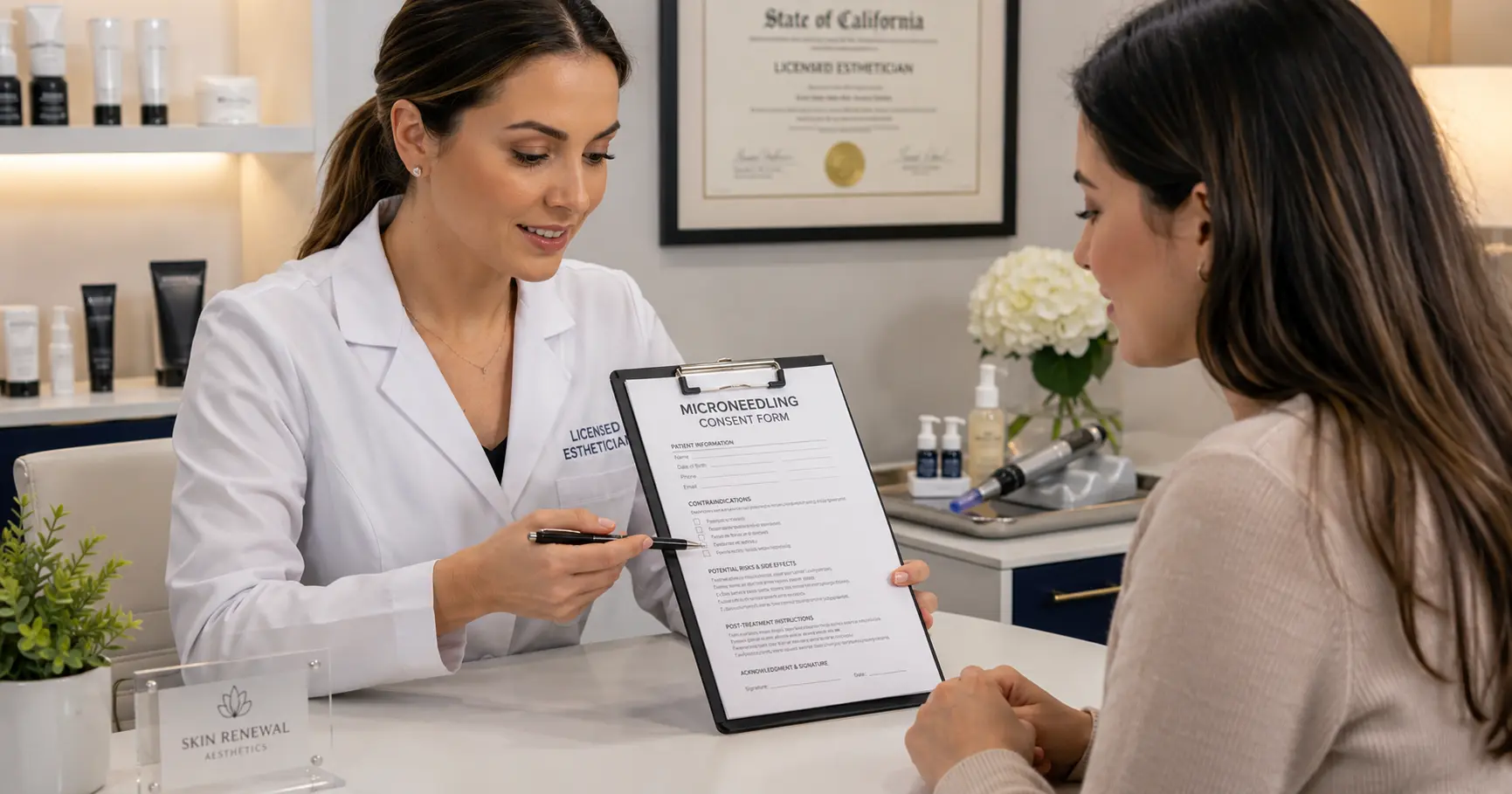
What Should a Microneedling Consent Form for Estheticians Include?
A professional microneedling consent form must document informed consent by clearly explaining the treatment, disclosing all known risks and expected side effects, confirming the absence of contraindications, providing post-treatment care instructions, and establishing the practitioner’s scope of practice. Every client must sign before treatment begins — and that signature should be obtained again at every subsequent visit, not just at the initial appointment.
- The form must include a complete contraindication checklist covering active skin conditions, medication use (particularly retinoids, blood thinners, and isotretinoin), pregnancy, autoimmune conditions, and Fitzpatrick skin type considerations.
- A description of expected side effects — redness, swelling, sensitivity, peeling, and rare risks such as infection or post-inflammatory hyperpigmentation — must be written in plain language the client can understand and confirm they have read.
- Post-treatment instructions must be documented as part of the consent, not delivered verbally alone. Clients must confirm in writing that they understand and agree to follow aftercare requirements.
- Scope of practice language should confirm the service is being performed by a licensed esthetician operating within applicable state regulations.
- Signed consent forms should be retained in a HIPAA-compliant system for a minimum of seven years.
- A consent form does not override state licensing law — it functions as documented due diligence within a framework of legal compliance, proper training, and appropriate protocol.
Of all the professional and legal responsibilities that accompany microneedling services, the consent form is simultaneously the most visible and the most frequently underestimated. Many estheticians treat it as an administrative formality — something to hand a client before a treatment, collect a signature, and file. The reality is significantly more consequential than that framing suggests.
A properly constructed microneedling consent form is a legal document, a clinical screening tool, a post-treatment instruction delivery mechanism, and a practitioner protection record all in one. When something goes wrong — even when the esthetician has performed everything correctly — the consent form is often the first document a licensing board, insurance provider, or attorney will request. Its completeness and accuracy can be the difference between a resolved complaint and a serious professional liability event.
This guide walks estheticians through every dimension of microneedling consent documentation: what the form must contain from a clinical standpoint, how to structure informed consent language that stands up legally, which contraindications must be explicitly documented, how post-treatment instructions should be incorporated, how to handle the form’s lifecycle from signature to storage, and what common consent form failures actually look like in practice. Understanding this material thoroughly is not optional for estheticians who offer microneedling — it is a foundational professional requirement.
What Every Esthetician Offering Microneedling Needs to Know About Consent Forms
- A consent form is a legal document first — approach its design with that priority, not administrative convenience.
- Informed consent requires that the client understands the treatment, risks, contraindications, and aftercare obligations before signing — not just that they signed.
- Re-consent is required at every microneedling visit. Health status, medications, and skin conditions change between sessions.
- Contraindication disclosure must be explicit and itemized — a general health question does not meet the professional standard for an invasive service.
- Post-treatment instructions embedded in the consent form create a documented record that aftercare guidance was provided.
- Generic online templates require significant customization before use — they should never be used unchanged.
- Seven-year minimum record retention is the professional standard; digital HIPAA-compliant storage is strongly recommended.
- A consent form does not authorize services outside your scope of practice — it documents due diligence within your lawful scope.
Why Microneedling Specifically Requires a More Rigorous Consent Process Than Standard Facial Services
Estheticians who offer both standard facial services and microneedling often underestimate how different the legal and clinical risk profile of microneedling is from a hydration facial or dermaplaning service. The distinction matters because it shapes how the consent form is structured and how seriously it should be treated.
Microneedling creates controlled micro-injuries in the skin. Needle penetration — even at shallow depths within the esthetic scope of practice — introduces potential for infection, post-inflammatory hyperpigmentation, scarring in keloid-prone individuals, aggravation of active inflammatory conditions, and significant adverse outcomes when performed on clients with certain medication profiles. These are not hypothetical risks. They are documented in professional esthetics literature and in licensing board complaint records across multiple states.
This risk profile is fundamentally different from a facial mask, a chemical exfoliant application, or even a dermaplaning service. The consent documentation must reflect that difference. A generic facial intake form with a checkbox for medical conditions is not adequate for microneedling. The form needs to be treatment-specific, exhaustive in its contraindication review, explicit about realistic outcomes, and structured to demonstrate that the practitioner took genuine informed consent — not just a signature.
This Guide Is Educational, Not Legal Advice
The information in this guide is educational content for licensed estheticians. It is not legal advice and does not constitute an attorney-client relationship. Before using any consent form in your practice, have it reviewed by a licensed esthetics attorney or your professional liability insurance provider. State regulations vary significantly, and what constitutes adequate informed consent documentation may differ based on your state, your specific services, and your business structure.
The Professional Standard vs. the Minimum Requirement
There is a meaningful distinction between what is legally required in any given state and what constitutes a genuine professional standard of care. Some states have minimal explicit requirements for esthetic consent documentation beyond general professional standards. Others are more prescriptive. But regardless of what any specific state requires at minimum, estheticians who offer microneedling should be working at the level of the professional standard — the documentation practices that the broader licensed esthetics community and professional liability insurers consider appropriate for the service.
Estheticians who have navigated licensing board inquiries or professional liability situations consistently describe the same experience: the adequacy of their documentation was the primary factor determining how the situation resolved. Thorough consent documentation that demonstrates genuine informed consent — even in cases where an adverse outcome was not the practitioner’s fault — creates a defensible record that protects the practitioner’s license and livelihood.
The Eight Required Sections of a Professional Microneedling Consent Form
A professional microneedling consent form is not a single-purpose document. It performs multiple clinical and legal functions simultaneously. Each section below addresses one of those functions specifically.
Section 1: Treatment Description in Plain Language
The form must include a clear, accurate description of what microneedling is, how it works, and what the client should expect during the session. This description should cover the creation of micro-channels in the skin using a professional microneedling device, the collagen induction mechanism, the typical needle depth range to be used for the session, the expected treatment experience including sensation, and the general post-treatment recovery timeline. Writing this in plain language accessible to a non-professional is essential — a consent form written in clinical jargon that clients cannot understand does not constitute genuine informed consent.
Section 2: Anticipated Benefits and Realistic Outcomes
The form should include a realistic statement of the benefits clients may experience, with appropriate language that avoids overpromising specific outcomes. Typical language acknowledges that microneedling may improve the appearance of fine lines, texture, acne scarring, and skin firmness; that results vary by individual; that multiple sessions are typically required; and that visible improvement develops over weeks as collagen production responds. This section protects the practitioner from complaints rooted in unrealistic client expectations — expectations that a well-written consent form explicitly addresses before treatment begins.
Section 3: Risks and Potential Side Effects
This is the clinical heart of the informed consent. It must be exhaustive and written in plain language. Expected and common side effects to disclose include redness, swelling, and sensitivity lasting 24 to 72 hours; skin flaking or peeling during the healing phase; temporary tightness or dryness; and pinpoint bleeding during the procedure. Less common but possible risks that must be disclosed include post-inflammatory hyperpigmentation (particularly relevant for deeper Fitzpatrick skin types); infection if aftercare instructions are not followed; herpes simplex reactivation in clients with a history of cold sores; rare cases of scarring in keloid-prone individuals; and prolonged redness or sensitivity in clients with certain underlying skin conditions.
The client’s signature on this section documents that they were informed of these risks before treatment — not after. Practitioners who omit specific risk disclosures and later face a complaint involving that undisclosed risk have significantly weaker documentation positions than those who disclosed comprehensively.
Section 4: Contraindication Checklist
This section should be structured as an explicit checklist where clients confirm the presence or absence of each contraindication. A general “do you have any medical conditions” question does not meet the professional standard for microneedling. Each contraindication should be listed individually.
Required Contraindication Items for Microneedling Consent Forms
- Active acne breakouts, open lesions, or inflammatory skin conditions in the treatment area
- Active rosacea in the treatment area
- History of keloid or hypertrophic scarring
- Current use of isotretinoin (Accutane) or use within the past 6–12 months (state and protocol dependent)
- Current use of retinoids (tretinoin, retinol, adapalene) within the past 5–7 days
- Use of blood-thinning medications including aspirin, warfarin, clopidogrel, or NSAIDs
- Autoimmune conditions including lupus, psoriasis, eczema, or vitiligo in the treatment area
- Immunosuppressant medication use or immune-compromised health status
- Active cold sores, oral herpes outbreak, or history of recurrent herpes simplex in the treatment area
- Pregnancy or breastfeeding
- Open wounds, active infections, sunburn, or recent radiation in the treatment area
- Diabetes or any condition that significantly impairs wound healing
- Blood clotting disorders or anticoagulant use
- Fitzpatrick skin type IV–VI without prior provider discussion of depth modification and hyperpigmentation risk
- Botox, filler, or laser treatment in the treatment area within the past two weeks (timeline varies by treatment)
Section 5: Post-Treatment Care Instructions and Client Acknowledgment
Post-treatment instructions embedded in the consent form serve a dual purpose. Clinically, they give clients a documented reference for what to do and avoid after their service. Legally, they create a record that the practitioner provided this guidance in writing before or during the appointment — not just verbally at the end of a session that the client may not fully retain.
The post-care section should specify that clients must avoid retinoids, AHAs, BHAs, and vitamin C for a minimum of 48 to 72 hours; avoid direct sun exposure and use SPF 30 or higher as soon as sun exposure is necessary; avoid heat, steam, saunas, vigorous exercise, and anything that significantly elevates skin temperature for 24 to 48 hours; use only gentle, non-active, fragrance-free moisturizers and barrier-supportive products during the first 48 hours; avoid makeup for at least 24 hours unless using mineral-only products as directed; and contact the practitioner immediately if signs of infection, unusual or prolonged redness, or unexpected adverse reactions develop.
Section 6: Scope of Practice Statement
The consent form should include a brief statement confirming that this service is being performed by a licensed esthetician operating within the scope of practice defined by the applicable state licensing authority. This statement should not make representations about medical oversight that do not accurately reflect your state’s requirements and your actual business arrangement. If your state requires physician oversight for the needle depths you use, that oversight arrangement should be documented separately and referenced appropriately in your consent language. Misrepresenting your scope or oversight status in a consent form is more legally damaging than omitting the statement entirely.
Section 7: Photography and Marketing Authorization
If you photograph client results for your portfolio, social media, or educational materials, a separate authorization must be included in your consent documentation. This must be clearly identified as optional — the client’s agreement to receive treatment cannot be conditioned on their agreement to be photographed. Many estheticians include this as a clearly marked separate section or separate form within the same documentation packet.
Section 8: Signature, Date, and Practitioner Acknowledgment
The form must include a client signature line, date, printed name, and a statement confirming that the client has read the form, had an opportunity to ask questions, and consents to proceed. A practitioner signature line and date acknowledging that the form was reviewed with the client before treatment creates a complete documentation record. Some practitioners also include a note field where the reviewing practitioner can document any specific concerns raised or contraindications that were borderline and were evaluated before proceeding.
The Anatomy of a Professional Microneedling Consent Form: A Visual Reference
The following framework illustrates how the eight required sections fit together within a complete professional consent document, and what each section is legally and clinically protecting against.
The Re-Consent Requirement: Why Clients Must Sign Before Every Session
One of the most common consent form failures estheticians make is treating the initial consent as a permanent authorization for all future microneedling sessions. The professional standard — and the practice that professional liability insurers and licensing boards expect — is re-consent before every session.
Why Health Status Changes Between Visits
A client who was a safe and appropriate microneedling candidate three months ago may not be today. Between visits, clients may have started a new prescription medication including retinoids, blood thinners, or immunosuppressants. They may have developed a new skin condition. They may have recently had a laser treatment, injectable filler, or other professional service that creates a contraindication window. They may be pregnant. They may have had a herpes simplex outbreak since their last visit.
None of these changes will appear in an initial consent form signed months earlier. An esthetician who relies on that original document has no documented record that these changes were reviewed before the subsequent treatment. If an adverse outcome occurs in connection with a contraindication that developed after the original consent, the practitioner’s documentation position is severely weakened.
The Returning Client Update Form
Many estheticians use a shorter returning client update form for established microneedling clients in lieu of requiring the full original consent form at every visit. This update form typically confirms that the client has reviewed the original consent form on file, that there have been no significant changes to their health status, medications, or skin conditions since their last visit, that they are not currently experiencing any contraindications from the original list, and that they consent to proceed with today’s treatment. This approach maintains re-consent documentation without requiring the same administrative burden as the full original form at every session.
Estheticians performing regular microneedling services across a busy treatment schedule describe the returning client update form as one of the most practically important workflow tools in their consent documentation system. Rather than asking established clients to re-read an entire multi-page document at each visit, the update form — typically one page — takes under three minutes to complete and review, confirms no contraindication changes have occurred, and creates a dated re-consent record for every session. Practitioners who have incorporated this system report that it also creates a natural opening for brief consultation at the start of each appointment: asking “has anything changed since your last visit” before reviewing the update form consistently surfaces relevant information that clients might not have volunteered unprompted.
Several estheticians also note that they document their immediate post-needling protocol within the session notes attached to each signed update form — including the application of a cooling, barrier-supportive recovery mask like the Poly-Luronic™ Jelly Mask by Luminous Skin Lab as the first post-procedure product applied. This creates a complete session-by-session treatment record that connects consent documentation, contraindication review, and post-procedure product application in a single organized client file.
Common Consent Form Failures and How They Create Professional Risk
Understanding where consent forms typically fall short is as important as understanding what they should contain. The following failures represent the most common issues identified in professional esthetics liability situations involving microneedling services.
Using a Generic Template Unchanged
Generic templates frequently omit state-specific scope language, miss contraindications relevant to professional microneedling, and fail to address post-treatment product contraindications. Use templates as a starting structure only — never unchanged.
Treating Initial Consent as Permanent
One-time consent signed at the first visit does not cover subsequent sessions. Health status, medications, and contraindications change. Re-consent documentation is required before every treatment session.
Vague Contraindication Language
“Do you have any medical conditions?” is not a contraindication checklist. Item-by-item explicit screening for each specific contraindication is the professional standard for a service with this risk profile.
Verbal-Only Post-Care Instructions
Verbally delivering post-treatment instructions at the end of an appointment — without written documentation — creates zero documented record that aftercare guidance was provided. Instructions must be embedded in the consent form or provided as a signed written document.
Omitting Risk Disclosures for Unlikely Outcomes
Practitioners sometimes omit low-probability risks like post-inflammatory hyperpigmentation or herpes reactivation to avoid alarming clients. Any risk that has documented occurrence in professional literature must be disclosed regardless of probability.
Poor Record Storage and Retention
Signed consent forms stored in paper only, without backup, or disposed of before seven years creates documentation gaps that cannot be recovered if a complaint arises. HIPAA-compliant digital storage with backup is the professional standard.
Not Having the Form Reviewed by a Professional
Self-drafted or minimally modified template consent forms that have never been reviewed by a licensed esthetics attorney or professional liability insurance provider may have structural or content gaps that only become apparent during a complaint resolution process.
Inaccurate Scope of Practice Statements
Including scope or medical oversight language that does not accurately reflect your state regulations or your actual business arrangement is more damaging than omitting a scope statement. Every word in the consent form must be accurate and verifiable.
Record Retention: How Long to Keep Signed Consent Forms and How to Store Them
Signed microneedling consent forms are professional records with a legally relevant lifecycle that extends far beyond the appointment date. The professional and insurance standard for retention is a minimum of seven years. Many practitioners retain records indefinitely in digital format, particularly as the cost and complexity of permanent digital storage has become negligible.
Why Seven Years Is the Minimum, Not the Target
Professional liability claims can arise years after a service was performed. Licensing board complaints are often filed months or years after an alleged incident. Some states allow longer civil claim windows for certain types of professional liability. A consent form destroyed after three years provides no protection against a claim filed in year four. Retaining all consent documentation indefinitely in a secure digital system eliminates the retention calculation entirely and removes a potential documentation gap at no practical cost.
HIPAA Compliance in Record Storage
Consent forms contain protected health information under HIPAA. Paper forms stored in unlocked filing systems in a multi-practitioner environment, digital records on an unencrypted personal computer, or consent forms emailed in plain text all represent HIPAA compliance failures. Secure, encrypted, password-protected storage — whether a professional electronic health record system, a HIPAA-compliant practice management platform, or encrypted cloud storage with appropriate access controls — is the required standard for managing client consent documentation.
Organizing Consent Records by Session
Estheticians who perform multiple microneedling sessions on returning clients should organize consent records by session, not just by client. A client file with a single consent form from two years ago and no subsequent documentation provides significantly weaker protection than a file with a dated consent or update form for each session performed. The session-by-session organization model creates a defensible timeline of informed consent that matches the treatment history exactly.
Getting Your Consent Form Reviewed: Working With an Esthetics Attorney and Your Insurance Provider
The most important step many estheticians skip is having their consent form reviewed by a professional before using it in practice. This is not a bureaucratic formality — it is the most cost-effective professional risk management step available to any esthetician offering microneedling services.
What an Esthetics Attorney Reviews
A licensed esthetics attorney or healthcare attorney familiar with your state’s regulations can review your consent form for compliance with state-specific informed consent requirements, accuracy of scope of practice language relative to your state’s esthetics licensing regulations, adequacy of risk disclosure for the specific services you offer, HIPAA compliance in your documentation and storage practices, and any structural issues that would weaken your documentation position in a complaint or claim scenario. Initial consultation fees for this type of review are modest relative to the professional risk being mitigated.
What Your Professional Liability Insurer Can Tell You
Professional liability insurers who specialize in esthetics and spa services are a frequently underutilized resource for consent form guidance. Many professional esthetics insurance providers offer consent form review services or maintain consent form templates as part of their policyholder resources. Because your insurer has direct financial exposure to the adequacy of your documentation practices, they have a genuine interest in ensuring your consent forms meet the professional standard. Consulting with your insurer about your consent documentation before a service-related issue arises — rather than after — is consistently cited by esthetics legal professionals as the most accessible professional risk management resource available.
Professional Associations and Continuing Education
Professional esthetics associations including the Associated Skin Care Professionals (ASCP) and the American Association of Cosmetology Schools (AACS) publish consent form guidance, provide member resources, and offer legal consultation referrals. Advanced microneedling certification programs also typically address consent documentation standards as part of their curriculum. Treating consent form education as ongoing continuing education — revisiting and updating your forms periodically as regulations and professional standards evolve — is the practice characteristic of the most professionally protected estheticians in the field.
Professional and Educational References
The professional standards referenced in this article draw from esthetics licensing law, professional liability insurance guidance, and esthetics continuing education resources:
- Associated Skin Care Professionals (ASCP) — Professional liability insurance, consent form guidance, and scope of practice resources for licensed estheticians. ascp.com
- State esthetics licensing boards — Individual state regulations governing scope of practice for licensed estheticians performing skin penetration services. Regulatory requirements vary significantly by state and should be verified directly with the relevant licensing authority.
- Professional liability insurance guidance for esthetics practices — General standards for consent documentation, record retention, and HIPAA compliance in professional skincare settings. Consult your specific insurance provider for policy-relevant guidance.
- Microneedling contraindications — Established dermatological literature on collagen induction therapy safety, contraindication profiles, and post-procedure adverse event documentation. Specific contraindication protocols should be confirmed with advanced microneedling certification training.
- HIPAA compliance in professional health-adjacent practices — U.S. Department of Health and Human Services guidance on protected health information in service provider settings. hhs.gov/hipaa
A professional consent form documents what happens before and during a microneedling service — but a complete clinical record also includes what is applied to the skin immediately following the procedure. Estheticians building a documented post-microneedling protocol frequently reference the immediate post-procedure product application within their treatment notes and consent documentation. The Poly-Luronic™ Jelly Mask by Luminous Skin Lab is the post-microneedling recovery product our education team most frequently references in advanced protocol contexts — a fragrance-free, clean-label occlusive mask formulated with a PGA + HA dual-humectant system specifically designed for application on post-procedure skin where barrier recovery, cooling, and hydration delivery are the primary clinical objectives. When your consent documentation, your treatment protocol, and your post-procedure product selection are all working together at the same professional standard, the complete clinical picture is one that protects both your clients and your practice.
Explore the ILUMIPEN Professional Nano Infusion DeviceFrequently Asked Questions: Microneedling Consent Forms for Estheticians
What should be included in a microneedling consent form for estheticians?
A microneedling consent form for estheticians should include a clear description of the treatment and how it works, a complete list of contraindications the client must confirm they do not have, a disclosure of expected side effects and realistic outcome statements, a detailed post-treatment care section with instructions the client agrees to follow, a statement of scope of practice confirming the service is being performed by a licensed esthetician, signature and date lines for both client and practitioner, and a HIPAA-compliant record retention statement. The form should also include the needle depth range to be used and confirm the client is not on blood thinners or retinoids.
Does a consent form actually protect estheticians legally if something goes wrong?
A properly structured consent form significantly strengthens an esthetician's legal position in the event of a complaint or claim. It documents that the client was informed of risks before treatment, that contraindications were reviewed and confirmed absent, and that post-treatment instructions were provided. Courts and licensing boards consistently treat documented informed consent as evidence of professional due diligence. However, a consent form does not override state scope of practice law or excuse negligence — it functions as a legal foundation alongside proper training, licensing, and protocol compliance.
How often should clients sign a new microneedling consent form?
Clients should sign a new consent form before every microneedling session, not just at the initial appointment. Health status, medications, and contraindications can change between visits. A client who was a safe candidate six months ago may now be on a retinoid, blood thinner, or immunosuppressant that changes their candidacy. Re-consenting at each visit is both the professional standard and the legally protective practice. Many estheticians use a shorter update form for returning clients that reviews changes since the last visit.
What contraindications should a microneedling consent form specifically ask about?
A microneedling consent form should specifically ask clients to confirm the absence of active acne, rosacea, or inflammatory skin conditions in the treatment area; history of keloid or hypertrophic scarring; use of isotretinoin (Accutane) within the past six to twelve months; use of retinoids within the past five to seven days; blood thinning medications including aspirin, warfarin, and NSAIDs; autoimmune conditions or immunosuppressant medication use; active cold sores or history of herpes simplex in the treatment area; pregnancy or breastfeeding; open wounds, active infections, or recent radiation in the treatment area; and Fitzpatrick skin types IV through VI requiring depth modification review.
Can I use a generic consent form template I found online for microneedling?
Generic online templates provide a starting structure but should never be used without significant customization for your specific state regulations, your specific treatment protocols, the needle depths you use, your device type, and your specific post-treatment product protocols. A consent form must reflect your actual practice. Generic templates also frequently omit state-specific scope of practice language, fail to address post-treatment product contraindications, and miss critical contraindications relevant to professional microneedling. Have any template reviewed by a licensed esthetics attorney or professional liability insurance provider before use.
How long should estheticians keep signed microneedling consent forms?
Most esthetics licensing boards and professional liability insurers recommend retaining signed consent forms for a minimum of seven years, and many practitioners retain them indefinitely in digital format. State regulations vary — some states specify minimum retention periods for professional records, while others defer to general business record requirements. Retaining all consent forms in a HIPAA-compliant, secure system protects practitioners against delayed complaints, insurance claims, and licensing board inquiries that may arise years after a service was performed.
Should the consent form explain what happens after microneedling and what products to avoid?
Yes — post-treatment instructions are one of the most legally and clinically important sections of a microneedling consent form. The form should specify that clients must avoid retinoids, AHAs, BHAs, and vitamin C for at least 48 to 72 hours post-treatment; avoid direct sun exposure and use SPF 30 or higher; avoid heat, steam, saunas, and vigorous exercise for 24 to 48 hours; use only gentle, non-active moisturizers and barrier-supportive products in the first 48 hours; avoid makeup for at least 24 hours; and contact the practitioner immediately if they experience signs of infection. Clients who ignore post-treatment instructions and experience adverse outcomes are more likely to file complaints — documented post-care consent significantly reduces this risk.
What's the difference between a microneedling intake form and a consent form, and do I need both?
An intake form collects health history, medication use, skin concerns, and contact information — it is an information-gathering document. A consent form documents that the client was informed of treatment risks, contraindications, expected outcomes, and post-care requirements, and that they explicitly agree to proceed. Both documents serve distinct professional and legal functions. Many estheticians combine them into a single comprehensive pre-treatment document that includes both the intake questionnaire and the informed consent section with signature. Using both, whether combined or separate, is the professional standard for microneedling services.
How does the post-microneedling recovery protocol connect to what the consent form covers?
The consent form and the post-treatment recovery protocol work as a connected system. The consent form documents that the client was informed of what to expect and what to avoid — the recovery protocol delivers the clinical follow-through. Estheticians who use professional-grade post-microneedling recovery products, such as the Poly-Luronic™ Jelly Mask by Luminous Skin Lab applied immediately post-procedure, often reference their specific post-treatment protocol in the consent form itself, noting the products used during and immediately after the service and confirming that fragrance-free, barrier-supportive formulations are used on post-procedure skin. This creates a complete documented record of the treatment environment, product application, and client instruction.
Your Consent Form Is Your Professional Foundation — Build It That Way
Microneedling consent documentation is not a formality to complete before moving on to the treatment. It is a professional legal document, a clinical screening tool, a client education vehicle, and a practitioner protection record — all built into a single structured form that should be treated with exactly that level of seriousness in its design, its use, and its storage.
Estheticians who invest the time to build a thorough, legally reviewed, treatment-specific consent form — and who use it rigorously at every client visit, not just the first — are operating at the professional standard that protects both their clients and their licenses. The small administrative investment of re-consenting at every session, retaining all records in a secure system, and having the form periodically reviewed by a professional is negligible compared to the professional risk it eliminates.
The client experience of microneedling begins before the device ever touches the skin. A professional consultation, a thorough consent review, and a clear explanation of what to expect — before and after the treatment — builds the trust and informed understanding that separates exceptional esthetic practitioners from those who are simply technically proficient. Make your consent documentation reflect the quality of the service that follows it.