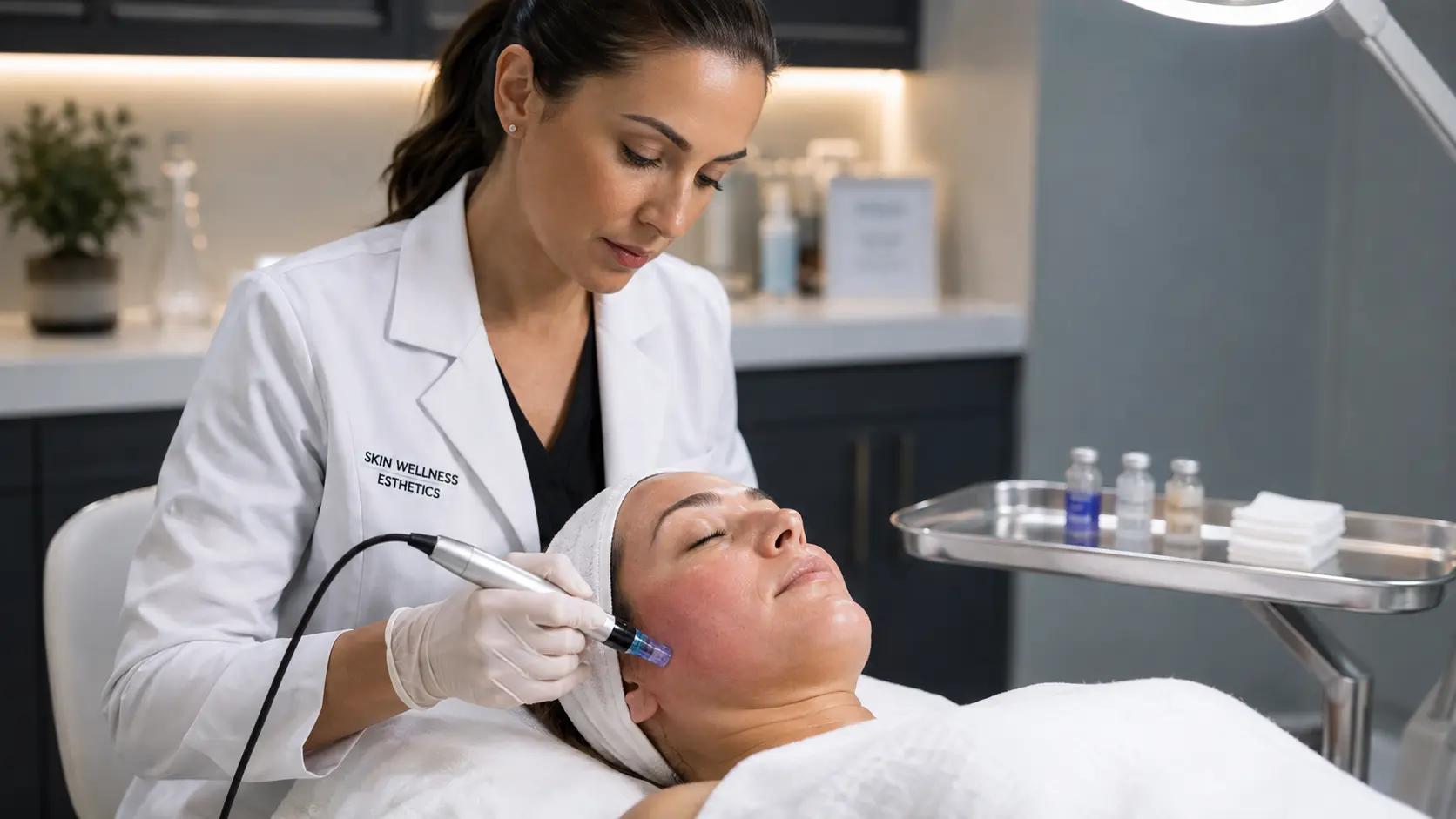
What Is Collagen Induction Therapy and How Does It Work?
Collagen induction therapy (CIT) is the clinical mechanism that describes what microneedling achieves inside the skin. Fine needles create thousands of controlled micro-injuries in the dermis, triggering the body’s natural wound healing cascade. This cascade produces new collagen, elastin, and growth factors as part of the repair response — progressively improving skin firmness, texture, and the appearance of scars, fine lines, and enlarged pores over a remodeling period that can last up to 12 months after each session.
- CIT proceeds in three distinct phases: the inflammatory phase (hours to 72 hours), the proliferative phase (days 3 to 21), and the remodeling phase (week 3 to 12 months).
- During inflammation, platelets release growth factors — including PDGF and TGF-beta — that recruit fibroblasts and initiate collagen synthesis at the injury site.
- New collagen deposited during proliferation is initially Type III (soft, disorganized); it is progressively converted to stronger, more organized Type I collagen during remodeling.
- The sustained collagen remodeling phase is the primary reason CIT results continue improving for months after each treatment session.
- Post-treatment skin barrier compromise increases transepidermal water loss significantly — immediate occlusive hydration following CIT is a clinical priority, not optional aftercare.
- Results are cumulative: most clients require a series of 3 to 6 sessions spaced 4 to 6 weeks apart for lasting structural improvement.
Of all the professional treatments available to licensed estheticians, collagen induction therapy stands out for a reason that has nothing to do with marketing: it works by recruiting the skin’s own biology to do the heavy lifting. Unlike treatments that apply external agents to create surface changes, CIT triggers an internal wound healing response that produces genuinely new structural proteins — collagen and elastin — from within the dermis itself.
Understanding this mechanism at a clinical level is not a luxury for estheticians who perform microneedling — it is the foundation of informed practice. Knowing why the inflammatory phase is necessary, what fibroblasts do during the proliferative window, how long the remodeling phase continues, and why post-treatment barrier support is a genuine clinical requirement rather than an afterthought determines whether an esthetician can manage client expectations accurately, time their protocols correctly, and explain outcomes in a way that builds lasting professional authority.
This guide gives estheticians that foundational understanding — from the cellular biology of the wound healing cascade through the practical implications for treatment room protocols and post-procedure care decisions.
What Every Esthetician Needs to Know About Collagen Induction Therapy
- CIT and microneedling are not different treatments — CIT is the physiological mechanism; microneedling is the tool and technique used to activate it.
- The inflammatory phase is not a side effect to minimize — it is the necessary initiating event of the entire collagen synthesis cascade.
- Fibroblasts produce new collagen and elastin during the proliferative phase — the quality and organization of that collagen continues improving for up to 12 months through the remodeling phase.
- Post-CIT skin barrier disruption is significant and immediate — transepidermal water loss increases substantially within minutes of treatment completion.
- Needle depth selection is the primary variable controlling treatment depth, inflammatory intensity, and collagen response magnitude.
- Series of sessions are required for cumulative structural improvement — a single treatment initiates the cascade but cannot achieve lasting remodeling on its own.
- Post-inflammatory hyperpigmentation risk is meaningfully elevated in Fitzpatrick types IV through VI — conservative depth and extended intervals are required for these clients.
CIT vs. Microneedling: Understanding the Terminology Before You Treat
The terms “collagen induction therapy” and “microneedling” are frequently used interchangeably in both clinical and consumer contexts — but they describe different things. Microneedling is the technique: the use of fine needles to create controlled micro-punctures in the skin. Collagen induction therapy is the mechanism: the physiological process that those micro-punctures trigger inside the skin. Every microneedling treatment is a collagen induction therapy procedure. CIT is the why; microneedling is the how.
This distinction matters in practice because it reorients how estheticians think about what they are actually doing when they perform a microneedling service. The goal is not puncturing the skin — the micro-injuries are simply the stimulus. The goal is triggering a controlled, calibrated wound healing response that produces predictable structural changes in the dermis. Everything about protocol design — needle depth, pass count, serum selection, session spacing, post-treatment care — should be understood in the context of managing that wound healing response effectively.
Why “Induction” Is the Key Word
The word “induction” is precise and important. CIT does not supply collagen to the skin from an external source. It induces — stimulates and initiates — the skin’s own collagen synthesis process. This distinction separates CIT from filler-based or topically applied collagen treatments, and it explains why results develop gradually over weeks and months rather than immediately: the skin must first complete its biological repair sequence before the collagen remodeling outcome becomes visible.
For estheticians, this foundational understanding enables accurate client communication. Clients who understand that the treatment is triggering their own biology — not simply applying an external substance — are far better prepared to understand why results develop progressively, why a series of sessions is required, and why post-treatment care in the days following each session is a meaningful clinical variable rather than optional.
The Three-Phase Wound Healing Cascade That Makes CIT Work
When microneedles penetrate the dermis, the body responds immediately with its standard wound healing protocol. This cascade proceeds in three overlapping but distinct phases, each contributing differently to the final collagen induction outcome. Estheticians who understand each phase can manage client expectations with precision, recognize normal versus abnormal post-treatment presentations, and time their session intervals to support rather than interrupt the healing sequence.
-
1
Phase One — Hemostasis and Inflammation (Hours to 72 Hours)
Immediately following needle injury, platelets aggregate at the micro-injury sites and release alpha granules containing platelet-derived growth factor (PDGF), transforming growth factor beta (TGF-β), vascular endothelial growth factor (VEGF), and epidermal growth factor (EGF). These growth factors are the primary chemical signals that initiate the entire subsequent healing cascade. Neutrophils and macrophages enter the site within hours, clearing debris and releasing additional cytokines that further stimulate fibroblast recruitment. The visible skin redness, warmth, and tightness that clients experience immediately after CIT treatment are the surface manifestations of this inflammatory phase — normal, expected, and clinically necessary. This phase typically resolves within 24 to 72 hours at standard treatment depths.
-
2
Phase Two — Proliferation (Days 3 to 21)
Once the inflammatory signals have recruited fibroblasts to the treatment site, the proliferative phase begins. Fibroblasts are the primary collagen-producing cells of the dermis, and under the stimulus of the growth factors released during phase one, they ramp up synthesis of new structural proteins. The first collagen produced is Type III collagen — a relatively soft, loosely organized form sometimes described as “provisional matrix.” Simultaneously, new blood vessels form (angiogenesis), supporting the increased metabolic activity of the healing tissue. The skin during this phase is completing the cellular architecture of repair; the surface may still appear pink or feel slightly sensitive, particularly in the first week. Clients commonly notice early textural improvements beginning in weeks two and three as the new matrix takes shape.
-
3
Phase Three — Remodeling (Week 3 to 12 Months)
The remodeling phase is the longest and clinically most significant phase of the CIT healing cascade. During this phase, the provisional Type III collagen is progressively degraded and replaced by Type I collagen — the dominant structural collagen of healthy adult dermis. Type I collagen is stronger, more organized along lines of mechanical stress, and more closely resembles the collagen architecture of youthful skin. Elastin fibres also reorganize during this phase. The progressive shift from Type III to Type I collagen is the mechanism behind the gradual firming, pore refinement, and scar improvement that clients observe for months after each CIT session. This phase can continue actively for 6 to 12 months per treatment, which is why results from a series of sessions continue compounding long after the final appointment.
Key Growth Factors Released During CIT Phase One
Platelet-Derived Growth Factor (PDGF): Released by platelets within minutes of needle injury. Recruits fibroblasts and smooth muscle cells to the treatment site; promotes fibroblast proliferation and collagen synthesis initiation.
Transforming Growth Factor Beta (TGF-β): A primary driver of fibroblast differentiation and collagen deposition. TGF-β1 and TGF-β3 specifically modulate the ratio of Type I to Type III collagen produced — TGF-β3 is associated with more organized, scar-free collagen deposition.
Vascular Endothelial Growth Factor (VEGF): Promotes angiogenesis — the formation of new blood vessels supporting the healing tissue. Adequate vascularization is essential to sustain fibroblast metabolic activity during the proliferative phase.
Epidermal Growth Factor (EGF): Stimulates keratinocyte proliferation, accelerating surface re-epithelialization and contributing to the skin texture improvements observable in the first two to three weeks post-treatment.
How Needle Depth Controls the Collagen Response
The mechanical principle behind collagen induction therapy is elegantly calibrated: the depth of needle penetration controls the intensity and anatomical location of the wound healing response, which in turn determines the clinical outcome of the treatment. This is why needle depth selection is not a minor technical detail — it is the primary variable through which an esthetician modulates what CIT actually achieves for each individual client and concern.
Shallow Depths: Epidermis and Superficial Papillary Dermis (0.25–0.5 mm)
At depths of 0.25 to 0.5 mm, needles reach the epidermis and superficial papillary dermis. The wound healing response at this depth is relatively mild and primarily improves superficial skin texture, product absorption, and mild dehydration patterns. This depth range is frequently used for general skin health maintenance, serum infusion enhancement, and introductory client treatments. The inflammatory response and post-treatment recovery are minimal — most clients experience redness for 12 to 24 hours.
Mid Depths: Papillary and Reticular Dermis (0.5–1.5 mm)
At 0.5 to 1.5 mm, the needle reaches the papillary and upper reticular dermis where the majority of dermal fibroblasts reside. This is the primary therapeutic range for fine lines, mild laxity, enlarged pores, and surface scarring. The inflammatory response is more pronounced, and the proliferative and remodeling phases produce meaningful new collagen deposition at this depth. Redness and sensitivity typically resolve within 48 to 72 hours.
Deeper Depths: Reticular Dermis (1.5–2.5 mm and Beyond)
Deeper needle depths reaching the mid and deep reticular dermis are used for moderate to severe acne scarring, deeper wrinkles, and significant skin laxity. The wound healing response at these depths is more intense, recovery takes longer (3 to 5 days or more of visible erythema), and the risks — including post-inflammatory hyperpigmentation in susceptible Fitzpatrick types — increase proportionally. Depths beyond 1.5 mm are typically reserved for medical settings or estheticians operating under appropriate scope of practice and training authorization.
What Skin Concerns Does Collagen Induction Therapy Actually Improve?
The clinical evidence base for collagen induction therapy is well established across multiple skin concerns. Understanding which concerns CIT addresses, and at what depth and session frequency, allows estheticians to design realistic treatment plans and communicate expected outcomes with accuracy.
Fine Lines and Superficial Wrinkles
Fine lines — particularly periorbital, perioral, and forehead lines — respond well to CIT at mid-depth ranges (0.5 to 1.5 mm). The new collagen and elastin deposited during the proliferative and remodeling phases fill and support the dermal tissue beneath the line, reducing its visible depth progressively over three to six months following each session. Most clients require three to four sessions spaced four to six weeks apart to achieve meaningful, durable line softening. Setting realistic expectations around the progressive timeline is critical to client satisfaction.
Acne Scarring
Acne scarring — particularly rolling and boxcar scar subtypes — responds to CIT through a mechanism that involves both collagen induction and the release of fibrous tethering bands beneath the scar surface. As the wound healing cascade deposits new collagen and the remodeling phase organizes it, the tethered scar tissue is lifted and the surface depression gradually fills. This process requires greater session frequency (four to six sessions) and often deeper needle penetration (1.0 to 2.0 mm depending on scar depth) than general skin maintenance treatments.
Enlarged Pores and Skin Texture
The improvement in pore appearance and overall skin texture that many clients notice within weeks of their first CIT session is primarily driven by the proliferative phase collagen and the reorganization of the superficial dermis. As new collagen tightens and thickens the dermal structure surrounding follicle openings, pore walls are supported more firmly and the visible pore diameter appears reduced. Surface texture improvements — smoother feel, more uniform light reflection — develop rapidly and are among the earliest visible outcomes clients notice.
Skin Laxity and Firmness
For clients experiencing mild to moderate skin laxity, CIT at therapeutic depths triggers elastin reorganization and Type I collagen deposition that progressively improves dermal structural integrity. The results in this category develop more slowly — typically over four to six months of remodeling — and require a series of sessions to accumulate meaningful structural change. For moderate to severe laxity, CIT outcomes may be supplemented with other modalities in a collaborative protocol.
Hyperpigmentation and Skin Tone
The controlled removal and replacement of damaged dermal matrix during CIT can improve the appearance of certain hyperpigmentation subtypes — particularly post-inflammatory hyperpigmentation from acne or injury — by promoting turnover of melanin-containing keratinocytes and stimulating more even epidermal renewal. However, estheticians must exercise significant caution with hyperpigmentation treatment in Fitzpatrick types IV through VI, where the inflammatory phase of CIT itself carries a risk of triggering new post-inflammatory hyperpigmentation. Conservative depth, extended session intervals, consistent mineral SPF, and avoidance of heat-generating adjunct devices are required protocol modifications for these clients.
Why Post-CIT Recovery Is a Clinical Requirement, Not Optional Aftercare
The immediate post-treatment phase following collagen induction therapy presents a set of skin conditions that require a genuinely clinical recovery response. Estheticians who understand the biology of the immediate post-CIT window can design post-treatment steps that actively support the healing cascade — not simply soothe client discomfort.
Barrier Compromise and Transepidermal Water Loss
When microneedles penetrate the stratum corneum and epidermis, the skin barrier is temporarily disrupted. The normal barrier function — the tightly organized network of corneocytes and intercellular lipids that prevents water from evaporating from the skin surface — is physically interrupted at each micro-channel site. The result is a meaningful and immediate increase in transepidermal water loss (TEWL). Without an occlusive step immediately post-treatment, this elevated TEWL dehydrates the skin rapidly, potentially causing tightness, flaking, and discomfort that impairs the early healing environment the skin needs.
Heightened Permeability and Active Ingredient Delivery
The temporary barrier disruption created by CIT is also a clinical opportunity. In the immediate post-treatment window, the micro-channels created by the needles allow topically applied active ingredients to penetrate the skin at significantly greater depth and concentration than under normal intact-barrier conditions. This is why serum selection for post-CIT application matters: the same humectants, growth factors, and peptides that would have limited penetration on intact skin can enter the dermal environment much more effectively during the first hour post-treatment. Applying an occlusive mask layer over a quality post-treatment serum maximizes this penetration opportunity while simultaneously sealing against TEWL.
Inflammation Management Without Suppression
A critical nuance in post-CIT care is the distinction between managing the client’s inflammatory experience and suppressing the inflammation that drives collagen production. The wound healing cascade’s Phase One is the necessary initiator of the entire collagen synthesis sequence — therapeutic anti-inflammatory agents applied immediately post-treatment, particularly NSAIDs or corticosteroids, could theoretically blunt the inflammatory signal that recruits fibroblasts. The appropriate post-CIT approach is to support and protect the healing skin while allowing the inflammatory phase to proceed, rather than chemically suppressing it. Occlusive hydration and cooling support this balance: they improve client comfort and reduce visible redness without blocking the cytokine and growth factor signals the skin needs.
Estheticians who have standardized their post-microneedling protocol to include the Poly-Luronic™ Jelly Mask by Luminous Skin Lab as an immediate post-treatment step consistently note two things their clients report: first, significantly reduced immediate discomfort and visible redness within the first 10 minutes of mask application; and second, noticeably more hydrated, less tight-feeling skin at the post-treatment debrief compared to sessions where only a serum was applied without an occlusive mask step.
In practice, the protocol runs as follows: once the microneedling pass sequence is complete, a full application of quality post-procedure serum (hyaluronic acid or growth factor based) is applied to the treatment surface, followed immediately by the Poly-Luronic™ Jelly Mask mixed to a standard 1:1 ratio using cooled water — the cooler mixing temperature extending both the application window and the mask’s cooling comfort effect on post-treated skin. The mask sets in approximately 12 minutes, during which scalp massage or client consultation can be conducted. Removal in a single intact piece is a consistent outcome at the standard ratio, and the skin surface post-removal presents visibly more hydrated and calmer than the immediate post-needling presentation. The PGA surface seal within the formulation continues functioning as an occlusive after removal, maintaining the barrier support effect as the client transitions to the homecare product close-out.
How Many Sessions Does Collagen Induction Therapy Require and Why?
One of the most important expectation-management conversations an esthetician has with a prospective CIT client is the one about session frequency and series requirements. Because CIT results develop through a biological remodeling process that takes months rather than days, clients who expect immediate or after-one-session outcomes will be disappointed — not because the treatment has failed, but because they did not understand how it works.
Why Single Sessions Produce Limited Lasting Results
A single CIT session triggers a wound healing cascade that produces new collagen and initiates a remodeling phase lasting up to 12 months. For mild skin concerns — very superficial texture, light dehydration patterns — one session may produce visible improvement. But for meaningful structural collagen remodeling, acne scar improvement, or lasting laxity correction, the collagen deposition from a single session is insufficient to achieve durable change. Each additional session in a series adds another layer of new collagen deposition that compounds the structural improvement of previous sessions.
Recommended Series by Concern
General professional guidance suggests the following session series by skin concern:
- General skin maintenance and superficial texture: 3 sessions, 4 weeks apart
- Fine lines and mild laxity: 3 to 4 sessions, 4 to 6 weeks apart
- Enlarged pores and uneven skin tone: 3 to 4 sessions, 4 to 6 weeks apart
- Mild to moderate acne scarring: 4 to 6 sessions, 4 to 6 weeks apart
- Moderate to severe acne scarring or significant laxity: 6 or more sessions, with extended intervals between cycles
The Four-to-Six Week Interval Requirement
The 4 to 6 week minimum interval between CIT sessions is not arbitrary. It reflects the time required for the proliferative phase to complete its primary collagen deposition cycle before the next wound healing cascade is initiated. Performing CIT sessions more frequently than this interval risks compounding an inflammatory response before the previous one has fully resolved, which can result in prolonged erythema, increased PIH risk, and paradoxically reduced net collagen yield. The remodeling phase of each session continues for months — results accumulate progressively between and after sessions when spacing is appropriate.
Professional and Scientific References
The wound healing science, collagen biology, and clinical protocols referenced in this article draw from established dermatological and cosmetic sciences literature:
- Wound healing cascade phases — hemostasis, inflammation, proliferation, and remodeling: established human wound biology literature. Gurtner GC et al.; Singer AJ, Clark RAF. New England Journal of Medicine, 1999. Foundational tissue repair model remains current in dermatological sciences.
- Platelet-derived growth factor (PDGF) and TGF-β roles in dermal fibroblast recruitment and collagen synthesis: Ross R. et al.; Roberts AB. Annals of the New York Academy of Sciences, 1990. Confirmed in multiple subsequent CIT-specific literature reviews.
- Collagen induction therapy mechanism and clinical outcomes for acne scarring: Majid I. Journal of Cutaneous and Aesthetic Surgery, 2009. Peer-reviewed demonstration of new Type I and III collagen deposition following CIT across 4-session series.
- Type III to Type I collagen conversion during wound remodeling: Witte MB, Barbul A. American Journal of Surgery, 1997. Established timeline of provisional to mature collagen transition in wound healing.
- Post-inflammatory hyperpigmentation risk in Fitzpatrick types IV–VI following CIT: Fabbrocini G et al. Journal of Dermatological Treatment, 2009. PIH incidence analysis with depth and session interval recommendations.
- TEWL increase following microneedling and barrier disruption: Dermatologic Surgery literature; established transepidermal water loss measurement studies post-needling procedure.
[[DEVELOPER OPTIONAL]] — Expand with specific DOIs upon editorial review.
For estheticians designing post-collagen induction therapy protocols, the immediate barrier support and occlusive hydration step is a clinical priority that directly affects the quality of the healing environment for the wound healing cascade initiated during treatment. The Poly-Luronic™ Jelly Mask by Luminous Skin Lab is the formulation our education team most frequently references in post-microneedling protocol contexts — a PGA and hyaluronic acid dual-humectant, fragrance-free, clean-label professional jelly mask formulated specifically for post-procedure application. The PGA surface seal reduces TEWL on the compromised barrier immediately, the HA delivers deep hydration support, and the occlusive mask format enhances serum penetration through the micro-channels created during CIT treatment. Developed by a licensed esthetician for treatment room use in exactly these protocol contexts.
Explore the ILUMIPEN Professional Nano Infusion DeviceFrequently Asked Questions: Collagen Induction Therapy Explained
What exactly is collagen induction therapy and how is it different from regular microneedling?
Collagen induction therapy (CIT) is the clinical term that describes the mechanism behind microneedling. While microneedling refers to the physical tool and technique, CIT refers to what the treatment actually does inside the skin: it creates controlled micro-injuries that trigger the body’s wound healing response, which produces new collagen and elastin as part of that repair process. Every microneedling treatment is a collagen induction therapy procedure — CIT is the physiological outcome, microneedling is the method used to achieve it.
How does collagen induction therapy actually work inside the skin?
When microneedles create controlled micro-channels in the skin, the body initiates a three-phase wound healing cascade. Phase one — hemostasis and inflammation — occurs within the first 24 to 72 hours, as platelets release growth factors including PDGF and TGF-beta that signal fibroblasts to begin collagen production. Phase two — proliferation — runs from roughly day 3 to day 21, during which fibroblasts lay down new Type III collagen and elastin. Phase three — remodeling — begins around week 3 and continues for up to 12 months, as the softer Type III collagen is converted to stronger, more organized Type I collagen, progressively improving skin texture, firmness, and scar appearance.
What skin concerns does collagen induction therapy actually help with?
Collagen induction therapy has clinical evidence supporting its use for fine lines and wrinkles, acne scarring (particularly rolling and boxcar scars), surgical and traumatic scars, skin laxity and firmness loss, enlarged pores, uneven skin texture, and hyperpigmentation in appropriate Fitzpatrick skin types. Results develop progressively over the remodeling phase — typically most visible between 4 and 8 weeks after each session — with full tissue remodeling outcomes taking up to 12 months per treatment cycle.
How many collagen induction therapy sessions does someone actually need to see results?
Most clients require a series of 3 to 6 sessions spaced 4 to 6 weeks apart to achieve meaningful, lasting collagen remodeling outcomes. The number varies by skin concern: superficial texture and fine lines may respond well in 3 sessions, while moderate acne scarring typically requires 4 to 6 sessions at therapeutic depths. Skin laxity and deeper scarring may require 6 or more sessions. Because the remodeling phase continues for up to 12 months, results continue improving between and after sessions.
Why does the skin look red and feel tight after collagen induction therapy?
Redness and tightness after collagen induction therapy are normal signs that the wound healing cascade has been successfully triggered. The redness is caused by the inflammatory phase of healing — increased blood flow, vasodilation, and the release of cytokines and growth factors at the treatment site. Tightness reflects temporary edema and early fibroblast activity. Both typically resolve within 24 to 72 hours for standard needle depths. More aggressive treatments at greater depths may extend this response to 4 to 5 days.
What is the difference between Type I and Type III collagen in microneedling results?
Type III collagen is the first collagen produced during the wound healing response — it forms quickly but is relatively soft and disorganized, resembling scar tissue at the microscopic level. Over the remodeling phase, which begins around week 3 and continues for up to 12 months, the body replaces Type III collagen with Type I collagen — a stronger, more organized, and more mature form that is the primary structural collagen of healthy adult skin. The progressive shift from Type III to Type I collagen is what drives the gradual firming and texture improvement clients observe for months after each collagen induction therapy session.
Can collagen induction therapy be done on darker skin tones safely?
Collagen induction therapy can be performed safely on darker Fitzpatrick skin types (IV through VI) with appropriate protocol modifications. The primary risk is post-inflammatory hyperpigmentation (PIH), which is more prevalent in higher Fitzpatrick types. To minimize PIH risk, estheticians should use conservative needle depths, avoid treatment during active inflammation, extend session intervals to 6 to 8 weeks, apply mineral SPF consistently post-treatment, and avoid any heat-generating adjunct devices at the same visit. Proper client selection, conservative technique, and thorough post-treatment education significantly reduce PIH incidence.
Why does hydration matter so much right after a collagen induction therapy treatment?
Immediately following collagen induction therapy, the skin barrier is temporarily compromised by the micro-channels created during treatment. This dramatically increases transepidermal water loss (TEWL), dehydrating the skin rapidly if no occlusive recovery step is applied. Restoring hydration at this stage is both a client comfort measure and a clinical priority — the proliferative phase of collagen synthesis requires a well-hydrated tissue environment to support fibroblast function and new collagen deposition. Applying an occlusive hydration mask immediately post-treatment supports barrier recovery, reduces TEWL, and provides the moisture-rich environment the healing skin requires.
What makes a jelly mask a good choice for post-collagen induction therapy recovery?
Professional jelly masks formulated with polyglutamic acid (PGA) and hyaluronic acid (HA) are particularly well-suited to post-collagen induction therapy recovery for several reasons. The occlusive gel layer immediately reduces TEWL on compromised post-treatment skin. The cooling effect of the setting mask provides comfort and helps reduce visible redness. PGA inhibits hyaluronidase — the enzyme that breaks down the skin’s own hyaluronic acid — extending the moisture-retention benefit during the vulnerable early healing phase. The Poly-Luronic™ Jelly Mask by Luminous Skin Lab combines these PGA and HA mechanisms in a fragrance-free, clean-label formulation specifically suited for post-treatment application.
Collagen Induction Therapy: A Treatment Built on Biology Every Esthetician Must Understand
Collagen induction therapy is not a complex concept — but understanding it at the cellular level transforms how an esthetician approaches every aspect of the treatment, from device selection and needle depth to post-procedure care decisions and client communication. The wound healing cascade that CIT triggers is among the most studied regenerative biological processes in dermatological science. When an esthetician understands that the inflammatory phase is the engine of collagen production rather than an inconvenient side effect, that Type III collagen transitions to Type I over a remodeling window that continues for nearly a year, and that post-treatment barrier compromise is a clinical vulnerability requiring an active occlusive response — every protocol decision becomes more deliberate and every client conversation becomes more credible.
The treatments that consistently deliver exceptional client outcomes are not the ones performed with the most expensive device or the most aggressive technique. They are the ones performed by estheticians who understand what they are asking the skin to do — and who design every protocol step, including and especially the post-treatment recovery phase, to support that biological process rather than simply conclude the service.