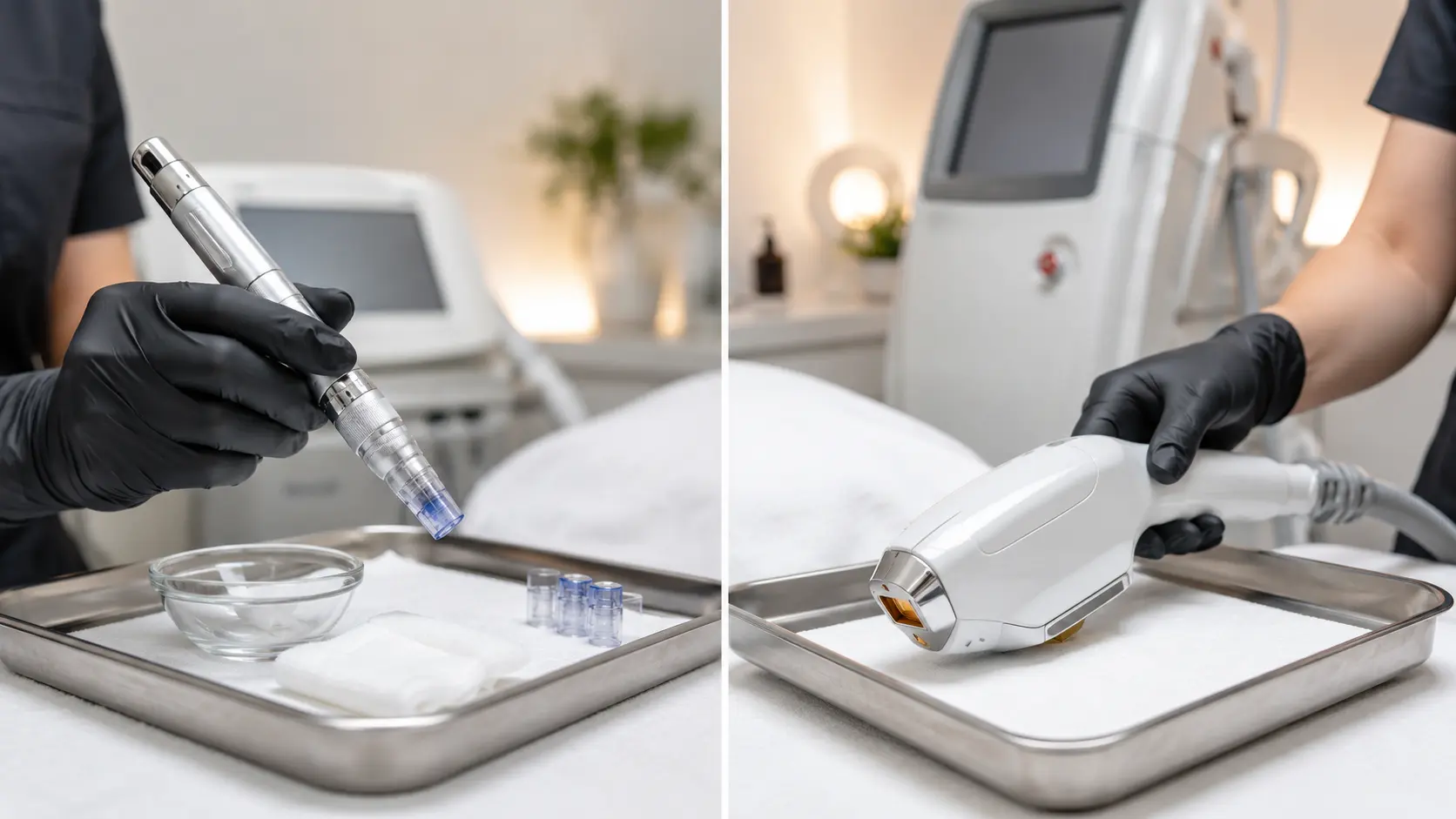
How Do Microneedling and Laser Resurfacing Compare for Estheticians?
Microneedling and laser resurfacing are both collagen-stimulating professional skin treatments, but they work through fundamentally different mechanisms, carry different safety profiles across Fitzpatrick skin types, involve very different recovery timelines, and sit in different positions relative to esthetician scope of practice. Microneedling uses mechanical micro-injury to trigger the skin’s natural healing cascade. Laser resurfacing uses focused light energy to vaporize or thermally remodel skin tissue. Both require trained, skilled practitioners — but only microneedling is consistently available within esthetician scope of practice in many states.
- Microneedling triggers collagen production through controlled micro-injury and the wound-healing cascade. Laser resurfacing uses thermal or ablative light energy to remove or remodel tissue directly.
- Microneedling is generally safer across Fitzpatrick types IV through VI. Laser resurfacing — particularly ablative types — carries significant post-inflammatory hyperpigmentation risk in darker skin tones.
- Microneedling downtime: one to three days. Ablative laser downtime: five to fourteen days. Non-ablative laser: two to five days.
- Microneedling is within esthetician scope of practice in many states where permitted. Laser resurfacing is almost universally a medical or medically supervised procedure.
- Both treatments address fine lines, acne scarring, texture, and tone. Laser can produce more dramatic single-session results for certain concerns; microneedling typically requires a series of treatments.
- Post-treatment recovery protocols differ significantly between the two modalities and must be tailored accordingly.
For most licensed estheticians, microneedling represents the most advanced collagen-stimulating service within or near the boundary of their scope of practice. Laser resurfacing sits beyond that boundary in virtually all jurisdictions — typically requiring a physician, nurse practitioner, or specifically licensed laser operator working under medical supervision. Yet clients routinely arrive in treatment rooms having researched both modalities and expecting their esthetician to help them understand the difference, evaluate which approach is right for them, and determine where to go for services beyond the esthetician’s scope.
This creates a genuinely important educational gap. Estheticians who cannot clearly, confidently, and accurately explain the difference between microneedling and laser resurfacing are less useful to their clients, less credible as professionals, and more likely to either overstate or undersell the capabilities of the services they offer. Closing that gap is exactly what this guide is designed to do.
We cover the mechanism of action for each modality, the clinical outcomes both can produce, the critical differences in safety across Fitzpatrick skin types, the realistic comparison of downtime and recovery, the scope of practice landscape for estheticians, and the practical knowledge that enables you to have informed conversations with clients about which treatment pathway is most appropriate for their concerns.
What Matters Most When Comparing Microneedling and Laser Resurfacing
- The mechanism difference is fundamental: microneedling is mechanical, laser is photothermal or photoablative. Both stimulate collagen but through entirely different biological pathways.
- Skin tone safety is one of the most clinically important variables. Microneedling is generally color-safe across all Fitzpatrick types; ablative laser carries significant hyperpigmentation risk in types IV through VI.
- Microneedling involves substantially less downtime and a lower adverse event profile when performed correctly. Laser resurfacing is more aggressive and more operator-dependent.
- Estheticians can perform microneedling in many states where permitted; laser resurfacing is almost always outside esthetician scope of practice without medical oversight.
- Post-treatment hydration and barrier recovery protocols are critical after both modalities and represent a direct service opportunity for estheticians managing client aftercare.
- Knowing when to refer a client to a laser provider is a professional skill — not a limitation. Clients trust estheticians who demonstrate clear knowledge of what different modalities can and cannot do.
How Each Modality Works: Mechanism of Action Explained
Microneedling: The Mechanical Wound-Healing Pathway
Microneedling — also known as collagen induction therapy (CIT) — uses a device fitted with fine, sterile needles to create thousands of controlled micro-channels in the skin at a precise depth. These micro-injuries trigger the skin’s natural wound-healing response: growth factors are released, fibroblasts are activated, and the skin begins producing new collagen and elastin to repair the micro-damage. The cascade includes three overlapping phases — inflammation, proliferation, and remodeling — with visible collagen remodeling typically developing over four to six weeks following each treatment session.
Critically, microneedling does not remove skin tissue. The needle channels close within hours. The skin’s surface integrity is preserved in a way that ablative laser procedures do not preserve it. This is a key reason microneedling is tolerated across a wider range of skin types and conditions, involves minimal downtime, and can be safely combined with other treatment room modalities including LED therapy and hydration mask protocols applied immediately post-treatment.
Estheticians performing microneedling typically work at needle depths ranging from 0.25 mm for superficial texture and product infusion to 1.5 mm or deeper for collagen stimulation and scar remodeling, depending on state scope of practice regulations, client tolerance, and the target concern. Topical numbing agents are standard for deeper needle depths.
Laser Resurfacing: The Photothermal and Photoablative Pathway
Laser resurfacing uses concentrated, coherent light energy delivered at specific wavelengths to target chromophores in the skin — water, melanin, or hemoglobin — producing either ablative or non-ablative tissue effects. The distinction between ablative and non-ablative laser is clinically significant and directly affects downtime, risk profile, and result magnitude.
Ablative laser resurfacing (CO2 and Er:YAG are the most common) vaporizes the outer layers of the epidermis and upper dermis. The skin surface is effectively removed and must regenerate. This produces the most dramatic results but also the most significant downtime, highest operator skill requirement, and greatest risk of adverse events including scarring, infection, and post-inflammatory hyperpigmentation, particularly in darker skin tones.
Non-ablative laser resurfacing delivers thermal energy below the skin surface without removing the epidermis. The surface remains intact while dermal collagen remodeling is stimulated. Downtime is reduced significantly compared to ablative treatments, but results are also more gradual and typically require multiple sessions. Fractional laser technology — available in both ablative and non-ablative configurations — treats a fraction of the skin surface at a time, leaving surrounding tissue intact to support faster healing.
Why the Mechanism Difference Matters Clinically
Both microneedling and laser resurfacing ultimately arrive at collagen remodeling — but through pathways that have meaningfully different clinical implications. Microneedling relies entirely on the skin’s own wound-healing intelligence, preserving tissue architecture while triggering repair signaling. Laser resurfacing introduces thermal or ablative energy that directly alters or removes tissue, producing a more forceful stimulus but also a greater physiological disruption that requires more recovery time and carries higher risk in darker skin tones due to melanocyte sensitivity to heat.
The clinical result of this difference: microneedling tends to produce improvements that develop gradually over a series of treatments, with predictable safety across skin types. Laser tends to produce more dramatic single-session changes but with narrower safety parameters and more demanding recovery requirements. Neither approach is universally superior — the right choice is always determined by the client’s specific concern, skin type, downtime tolerance, and the practitioner’s training and scope.
Side-by-Side Comparison: What Estheticians Need to Know at a Glance
The table below summarizes the most clinically relevant variables for estheticians when comparing microneedling and laser resurfacing. Use this framework when clients ask you to explain the difference or help them decide between modalities.
| Variable | Microneedling (CIT) | Ablative Laser | Non-Ablative Laser |
|---|---|---|---|
| Primary mechanism | Mechanical micro-injury → wound healing cascade | Tissue vaporization → forced regeneration | Subsurface thermal energy → collagen remodeling |
| Surface removal | No — tissue preserved | Yes — epidermis removed | No — epidermis preserved |
| Downtime | 1–3 days redness, mild swelling | 5–14 days, significant peeling/weeping | 2–5 days, moderate redness |
| Fitzpatrick IV–VI safety | Generally safe; low PIH risk | High PIH risk; requires extreme caution | Moderate risk; wavelength and parameter dependent |
| Pain level | Mild to moderate with topical numbing | Moderate to significant; often requires sedation | Mild to moderate; topical numbing standard |
| Results timeline | 4–6 weeks per session; series recommended | Dramatic results in 1–2 sessions | Gradual; 3–6 sessions typical |
| Cost per session | $200–$700 typical range | $1,000–$5,000+ per session | $400–$1,500 per session |
| Esthetician scope | Within scope in many states where permitted | Medical procedure; outside esthetician scope | Usually requires medical oversight |
| Best for | Fine lines, acne scars, texture, all skin tones | Deep lines, significant scarring, photoaging; lighter types | Mild to moderate aging, tone; lighter to medium types |
| Combination treatments | Compatible with LED, jelly masks, serums same day | No same-day combinations; extensive recovery required | Limited combinations; recovery protocol required |
Why Fitzpatrick Skin Type Is One of the Most Important Variables in This Comparison
For estheticians working with a diverse client base, understanding how microneedling and laser resurfacing differ in their safety profiles across Fitzpatrick skin types is not optional background knowledge — it is clinically essential. Getting this wrong, or failing to communicate it clearly to clients, can contribute to outcomes including post-inflammatory hyperpigmentation, dyschromia, and permanent scarring.
Why Laser Resurfacing Carries Higher Risk in Darker Skin Tones
Melanocytes — the cells responsible for skin pigmentation — are sensitive to both thermal energy and inflammatory stimuli. Ablative laser treatments destroy surface tissue indiscriminately, creating inflammation that can trigger melanocyte overactivation and post-inflammatory hyperpigmentation. Non-ablative laser treatments deliver subsurface thermal energy that still poses a significant risk of melanocyte stimulation through heat, particularly at higher fluence settings or with wavelengths that have greater melanin affinity.
Fitzpatrick types IV through VI have higher baseline melanocyte activity and a greater tendency to produce PIH in response to any trauma or thermal insult. This is not a contraindication to all laser treatments — but it significantly narrows the safe parameter window and increases the demand on operator skill and device selection. Ablative CO2 laser in particular is very rarely recommended for Fitzpatrick types V and VI by experienced laser practitioners.
Why Microneedling Is Generally Safer Across All Skin Tones
Because microneedling creates micro-injury through mechanical rather than thermal or photothermal means, it does not generate the same melanocyte-activating heat response. The controlled inflammation produced by needle micro-channels is more contained and predictable than the broader thermal disruption of laser treatments. Post-inflammatory hyperpigmentation following microneedling does occur — particularly when incorrect needle depth, excessive treatment passes, or inadequate pre- and post-treatment care are involved — but the risk profile is substantially lower than that of laser resurfacing across Fitzpatrick types IV through VI.
For this reason, microneedling has become the collagen-stimulating modality of choice for practitioners working with diverse client populations, and for clients in higher Fitzpatrick ranges seeking meaningful skin improvement without the elevated risk associated with laser procedures.
Even where microneedling is within esthetician scope of practice, assessing Fitzpatrick skin type and advising on its treatment implications remains a critical professional responsibility. Always complete a thorough consultation, document Fitzpatrick type, review contraindications including active isotretinoin use, recent sun exposure, and active inflammatory conditions, and refer to a medical provider when the client’s history or presentation raises concerns beyond your training or scope. State regulations governing esthetician microneedling depth limits vary significantly — verify your specific state board requirements before performing any microneedling service.
Visualizing the Clinical Differences: A Framework for Treatment Room Decisions
The comparison below organizes the most decision-relevant variables across five clinical dimensions that practitioners and clients most commonly use when evaluating these two modalities.
Scope of Practice: Where the Line Is and How to Navigate It Professionally
The scope of practice question around microneedling and laser resurfacing is one of the most practically important areas of professional knowledge for an esthetician to understand clearly. Getting it wrong in either direction — performing a service outside your scope, or unnecessarily refusing a service within it — has professional and legal consequences.
Microneedling and Esthetician Scope
The legal status of microneedling performed by licensed estheticians varies state by state. In some states, estheticians may perform microneedling to defined depth limits — often 0.5 mm to 1.0 mm — without medical oversight. In others, any microneedling is restricted to medical settings. In still others, the state board has issued no specific guidance, leaving the question in a legally ambiguous space.
Because this landscape changes and is genuinely inconsistent across jurisdictions, the most important professional responsibility is to know your specific state’s current regulations before performing any microneedling service. Verified, current state board guidance is the only reliable source — not what a training program says, not what other practitioners in your state report, and not general online information. State boards update their positions, and practitioners are responsible for remaining compliant.
Laser Resurfacing and the Medical Boundary
Laser resurfacing — both ablative and non-ablative — is performed in a medical setting in virtually all jurisdictions. Some states allow separately licensed laser operators to perform laser treatments under physician supervision; this is a different credential from an esthetics license and requires separate training and certification. Estheticians who encounter clients asking about laser resurfacing should be comfortable with two professional responses: an accurate, confident explanation of what laser resurfacing is and how it differs from microneedling, and a clear, professional referral to a qualified medical provider for those seeking laser services.
Knowing your scope boundary and communicating it clearly is a sign of professional competence, not a limitation. Clients who understand that you are knowledgeable enough to distinguish between treatment modalities and honest enough to refer appropriately develop stronger trust in your professional judgment than they would if you provided services outside your training or scope.
The Esthetician’s Role in Post-Laser Care
While estheticians do not perform laser resurfacing, they may have a meaningful role in supporting clients through laser recovery — particularly following non-ablative treatments where the skin surface is intact. Providing guidance on post-treatment home care products, booking follow-up hydration facials once the skin has recovered sufficiently, and supporting the client’s long-term treatment plan in partnership with the laser provider are all legitimate esthetic services. Understanding laser resurfacing outcomes allows estheticians to provide this support intelligently and in proper sequence with the client’s medical treatment plan.
Post-Treatment Recovery: What the Skin Needs After Each Modality
Post-treatment care after microneedling is one of the areas where estheticians have the most direct, active role. The recovery protocol immediately following microneedling determines a significant portion of the client’s final outcome — and it represents a service opportunity that distinguishes experienced practitioners from those who treat microneedling as a standalone procedure with no active aftercare component.
Immediate Post-Microneedling Protocol
The skin immediately following microneedling is in a heightened permeability state. The micro-channels created during treatment remain open for a window of time, and the skin’s own repair signaling is actively underway. This creates a specific set of requirements and opportunities:
- Sterile saline or clean water rinse — Clear any topical agents used during the treatment. The skin surface should be clean before any post-treatment product is applied.
- Fragrance-free hyaluronic acid or PGA serum application — Apply a hydrating serum immediately while micro-channels are open. The heightened permeability window significantly amplifies humectant delivery compared to intact skin application.
- Occlusive recovery mask — Apply a professional jelly mask or equivalent occlusive recovery mask to seal in the serum layer, reduce heat and redness, support barrier recovery, and provide the cooling comfort that clients associate with the end of a treatment session. Occlusion at this stage prevents transepidermal water loss and significantly supports the skin’s barrier repair signaling.
- LED therapy (if included in protocol) — Red LED therapy can be applied in combination with or following jelly mask removal to support the anti-inflammatory and collagen-stimulating benefits of photobiomodulation alongside the mechanical CIT stimulus.
- Fragrance-free moisturizer and SPF — Complete the immediate in-clinic protocol with a barrier-supportive moisturizer and, if the client is departing during daylight hours, a mineral SPF. Sun protection is non-negotiable post-microneedling due to heightened photosensitivity.
Estheticians who have incorporated occlusive jelly mask protocols into their post-microneedling workflow consistently report that it is one of the additions that clients notice and respond to most positively — both in the immediate treatment experience and in the skin condition they observe in the days following. The Poly-Luronic™ Jelly Mask by Luminous Skin Lab has become a go-to post-microneedling recovery tool for practitioners who have tested it in this context: the PGA and HA dual-humectant formulation is applied over the freshly applied serum layer, and the combination of physical occlusion from the set mask plus the PGA surface microgel creates a layered moisture-locking effect that is measurably different from applying serum alone.
Practitioners note that the cooling sensation during set time provides immediate relief from post-treatment heat and redness — which clients find reassuring and which distinguishes the treatment experience from microneedling protocols that end without an active recovery step. The consistent 12-to-15-minute set window fits naturally into the end of a microneedling session without disrupting appointment timing. The fragrance-free, clean-label formulation satisfies the post-treatment safety requirement for application on compromised skin. And the one-piece removal at the end of the mask phase provides a signature treatment moment that clients frequently reference when describing the service to others. Compared to sheet mask or cream mask alternatives tested in the same post-microneedling position, the occlusive jelly format consistently produced a more hydrated, calmer-looking immediate post-removal result.
Post-Laser Recovery: A Different Protocol Entirely
Post-ablative laser recovery is a medical wound care process, not an esthetic one. The first several days following ablative laser resurfacing require sterile wound management, prescribed topical antibiotics or antivirals in many protocols, and strict avoidance of any non-prescribed topical products until the surface epithelium has regenerated. Estheticians should never attempt to provide post-treatment services for clients in the immediate days following ablative laser, and should understand clearly that their role in laser aftercare begins only after the tissue has sufficiently regenerated — a timeline determined by the treating physician, not the esthetician.
Non-ablative laser recovery is less demanding. Gentle hydration and SPF are typically indicated from the first post-treatment day, and esthetic support in the form of soothing hydration facials may be appropriate within a week to ten days, depending on the specific device used and the treating provider’s protocol. Always communicate with the client’s laser provider before performing any esthetic service during the recovery period following any laser treatment.
How to Have This Conversation With Your Clients Confidently and Accurately
The client conversation about microneedling versus laser resurfacing comes up in three common scenarios: a client comparing their options before deciding which modality to pursue, a client who has already had laser resurfacing and is now considering microneedling maintenance, and a client who asks whether you offer laser treatments or why you do not. Each scenario requires a slightly different approach, but all three are grounded in the same foundational knowledge.
When a Client Is Comparing Options
The most effective approach is to anchor the conversation in the client’s specific concern and skin type rather than presenting an abstract modality comparison. Ask what they are hoping to improve, how much downtime they can accommodate, and whether they have any significant history of hyperpigmentation or keloid scarring. From those answers, you can provide genuinely useful guidance. A client with darker skin, limited downtime, and concern about fine lines and dehydration is an excellent microneedling candidate. A client with lighter skin, significant photoaging, and willingness to manage extended downtime may benefit from a physician consultation about laser options. Both conversations are useful to the client and reflect well on your professional knowledge.
Explaining What You Offer Without Underselling It
A common mistake estheticians make when the topic of laser comes up is to apologize for not offering it or to position microneedling as “the less intense alternative.” This framing undermines the genuine clinical value of microneedling. Microneedling is not a lesser version of laser resurfacing — it is a distinct modality with its own mechanism, its own strengths, its own ideal client profile, and in many cases a preferable safety and recovery profile. Frame it that way. Estheticians who communicate clearly that microneedling is the right choice for certain concerns and clients — not the compromise choice — present a more credible professional profile and generate stronger client confidence.
When to Refer
Refer to a laser provider when a client has concerns — deep scarring, significant photoaging, vascular concerns requiring specific wavelength targeting — that microneedling alone is unlikely to adequately address, when they have the skin type and downtime tolerance to make laser appropriate, and when their goals align more closely with what laser can deliver in one or two treatments versus what microneedling can deliver in a series. A confident, well-reasoned referral demonstrates professional depth and builds client trust. Clients who are well-served by a referral you provide often return to you for the ongoing esthetic maintenance work that surrounds and follows their medical treatment.
Professional and Scientific References
The clinical comparisons and treatment information in this article draw from established dermatological and cosmetic medicine literature:
- Microneedling / Collagen Induction Therapy mechanisms and clinical outcomes — wound healing cascade, collagen remodeling timeline, and Fitzpatrick safety profile. Journal of Cutaneous and Aesthetic Surgery; Dermatologic Surgery, multiple publications 2018–2025.
- Ablative laser resurfacing: CO2 and Er:YAG mechanisms, post-inflammatory hyperpigmentation risk in Fitzpatrick types IV–VI, and downtime parameters. Journal of the American Academy of Dermatology; Lasers in Surgery and Medicine, 2019–2025.
- Non-ablative and fractional laser resurfacing: mechanism of subsurface thermal remodeling, recovery profiles, and safety across skin types. Dermatologic Surgery; Journal of Cosmetic and Laser Therapy, 2020–2025.
- Post-microneedling skin permeability and topical delivery enhancement: heightened permeability window and humectant delivery amplification through micro-channels. Journal of Controlled Release; Skin Pharmacology and Physiology, 2019–2024.
- Esthetician scope of practice for microneedling — state board regulatory overview. National Coalition of Estheticians Associations (NCEA); individual state cosmetology and esthetics board publications, current.
- Polyglutamic acid mechanisms: hyaluronidase inhibition, NMF stimulation, and HAS-1/2/3 upregulation. MDPI, 2024; Typology, 2021–2025; Reviva Labs clinical review, 2025.
[[DEVELOPER OPTIONAL]] — Expand with specific DOIs upon editorial review.
For estheticians building out their post-microneedling recovery protocol, the immediate post-treatment step is one of the highest-impact moments in the entire service. The Poly-Luronic™ Jelly Mask by Luminous Skin Lab was formulated specifically for this context: a fragrance-free, clean-label PGA and HA dual-humectant jelly mask designed to be applied over a hydrating serum immediately following microneedling, delivering layered humectant action through the heightened permeability window, sealing the skin surface against transepidermal water loss, providing therapeutic cooling relief during set time, and completing with the signature one-piece removal experience that clients consistently cite as a highlight of the treatment. If you are looking for a professional recovery mask designed to perform within a microneedling workflow rather than alongside it, this is the formulation our education team recommends exploring first.
Explore the ILUMIPEN Professional Nano Infusion DeviceFrequently Asked Questions: Microneedling vs Laser Resurfacing
What is the main difference between microneedling and laser resurfacing?
Microneedling uses fine needles to create controlled micro-injuries in the skin, triggering the body’s natural wound-healing and collagen production cascade without removing tissue. Laser resurfacing uses concentrated light energy to vaporize or heat skin tissue, removing damaged surface layers and stimulating collagen remodeling. Microneedling is generally considered safer across a wider range of Fitzpatrick skin types, involves less downtime, and in most states falls within esthetician scope of practice where permitted. Laser resurfacing requires medical oversight and produces more aggressive results with longer recovery.
Which one is safer for darker skin tones?
Microneedling is generally the safer option for clients with Fitzpatrick types IV through VI. Because it does not use heat or light energy, it does not carry the same risk of post-inflammatory hyperpigmentation (PIH) that ablative and even some non-ablative laser treatments present for darker skin tones. Laser resurfacing, particularly ablative CO2 and Er:YAG lasers, carries a meaningful risk of PIH and dyschromia in higher Fitzpatrick types and requires careful parameter selection and medical oversight. Estheticians should always flag this distinction clearly when discussing treatment options with clients.
How much downtime does microneedling require compared to laser resurfacing?
Microneedling typically involves one to three days of redness, mild swelling, and skin sensitivity, with most clients resuming normal activities within 24 to 72 hours. Ablative laser resurfacing can involve five to fourteen days of significant downtime, including weeping, peeling, crusting, and extended redness. Non-ablative laser treatments fall between the two, with two to five days of moderate recovery. The gap in downtime tolerance is one of the most practical reasons clients with active social or professional lives often prefer microneedling over ablative laser options.
Can estheticians legally perform microneedling but not laser resurfacing?
In many states, licensed estheticians can legally perform microneedling within defined depth and scope parameters, though the legal status varies significantly by state. Laser resurfacing, particularly ablative procedures, is generally classified as a medical procedure requiring physician or nurse practitioner oversight across most jurisdictions. Some states permit licensed laser technicians operating under medical supervision to perform non-ablative laser treatments, but estheticians should verify their specific state board regulations before offering any laser service. When in doubt, always consult your state board directly.
What skin concerns does microneedling treat that laser resurfacing also targets?
Both microneedling and laser resurfacing address fine lines and wrinkles, acne scarring, skin texture and tone irregularities, pore appearance, and early signs of photoaging. Laser resurfacing tends to produce more dramatic results for deeper lines, significant pigmentation irregularities, and extensive sun damage in a single treatment. Microneedling often requires a series of treatments to achieve comparable results for more severe concerns but offers a lower-risk profile, particularly across diverse skin tones. Each modality also has unique advantages: microneedling excels at improving skin hydration infrastructure, while laser resurfacing is more effective for vascular concerns like rosacea redness.
How do I explain the difference between microneedling and laser to a client?
The simplest accurate explanation is that microneedling signals the skin to repair and rebuild using its own healing process, while laser resurfacing uses controlled energy to remove or remodel skin tissue directly. Tell clients that microneedling works by creating tiny channels the skin responds to, producing new collagen over several weeks, while laser works by removing or heating the skin’s surface to trigger replacement growth. Emphasize the difference in downtime, the safety profile across skin tones, and the number of treatments typically required, as these are usually the most decision-relevant factors for clients.
Which gives better results for acne scars, microneedling or laser?
Both modalities are effective for acne scarring, but the best choice depends on scar type, skin tone, and acceptable downtime. Ablative fractional laser resurfacing tends to produce more significant results for deeper boxcar and icepick scars in lighter Fitzpatrick types in fewer sessions. Microneedling is effective across all scar types and is the preferred option for Fitzpatrick types IV through VI due to its lower PIH risk. Many practices use microneedling as a first-line treatment, reserving laser options for clients who have not achieved adequate improvement or who have lighter skin types with extensive scarring.
What should I put on skin after microneedling?
Immediately after microneedling, the skin needs hydration, barrier support, and soothing without irritating actives. The ideal post-microneedling application sequence includes a hydrating serum containing hyaluronic acid or polyglutamic acid, followed by an occlusive recovery mask to seal moisture and support barrier repair, and then a fragrance-free moisturizer. Avoid retinoids, exfoliating acids, vitamin C in unstabilized forms, and any fragrance-containing products for a minimum of 72 hours post-treatment. SPF application is essential as soon as the skin is ready, which for most clients is the following morning.
Does a jelly mask actually help skin recover faster after microneedling?
Yes. A professional-grade jelly mask applied immediately after microneedling provides immediate benefits on multiple levels: the occlusive gel layer seals moisture against transepidermal water loss during the early recovery window, the cooling effect reduces post-treatment redness and heat, and formulations containing polyglutamic acid and hyaluronic acid deliver humectants directly into the heightened permeability environment created by the micro-channels. The Poly-Luronic Jelly Mask by Luminous Skin Lab, which contains a proprietary PGA plus HA dual-humectant blend, is specifically formulated for this post-treatment application context and is used by estheticians as a core step in post-microneedling recovery protocols.
What This Comparison Means for Your Practice
The difference between microneedling and laser resurfacing is not simply a matter of which technology is more advanced or produces more dramatic results. It is a comparison of fundamentally different mechanisms, safety profiles, recovery demands, scope of practice positions, and ideal client profiles. Understanding this comparison at a clinical level — rather than at the surface level of marketing language — is what allows estheticians to provide genuinely useful guidance to clients navigating their options.
Microneedling is, for most licensed estheticians, the most advanced collagen-stimulating service available within or near their scope of practice. When it is performed correctly, supported by a thoughtful post-treatment recovery protocol, and explained to clients with clinical clarity, it is a meaningful and highly effective treatment. It does not need to apologize for not being laser resurfacing — it is its own modality with its own distinct strengths, its own safety profile advantages, and its own ideal client population.
Equally important is the knowledge to recognize when a client’s goals are better served by a referral. An esthetician who can accurately characterize what laser resurfacing is, how it differs from microneedling, and when it may be the more appropriate choice for a specific client is a more credible and more useful professional than one who positions every concern as addressable by whatever service they happen to offer. That combination of capability and professional honesty is what builds the kind of client trust that drives long-term practice growth.