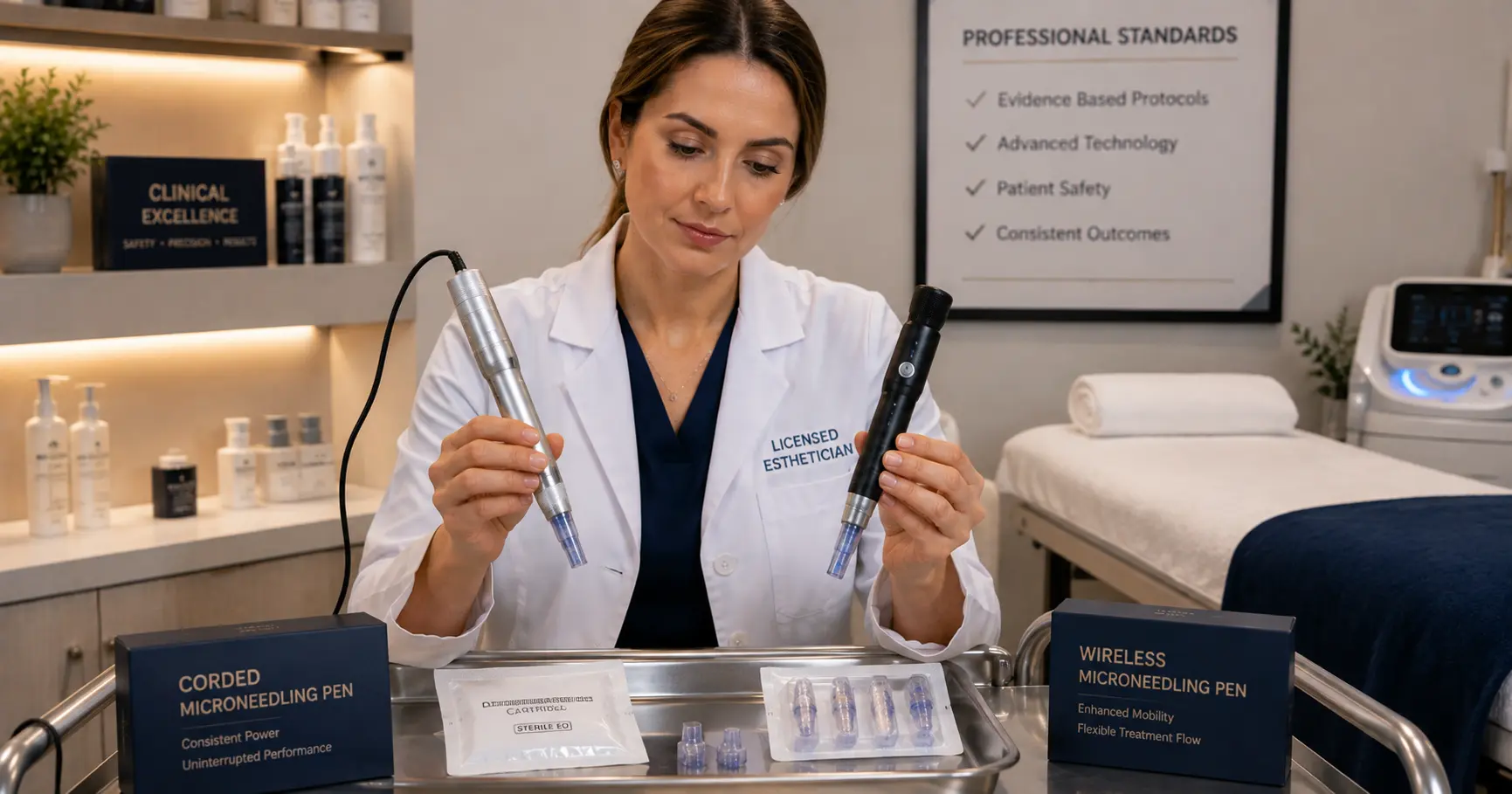
Wireless vs Corded Microneedling Pens: What Estheticians Actually Need to Know
Wireless microneedling pens offer superior maneuverability, cleaner treatment room aesthetics, and freedom from cord management during treatment. Corded microneedling pens deliver completely consistent motor power with no battery degradation risk. Neither format is universally superior — the right choice depends on treatment volume, room configuration, practice setting, and how motor consistency affects your specific protocols.
- Wireless pens eliminate cord drag, which is a genuine ergonomic factor that affects technique consistency — particularly for newer estheticians still developing their motor control and pressure rhythm.
- Corded pens draw from continuous power, meaning motor speed and needle stroke force never fluctuate due to battery discharge — this is the primary clinical advantage of corded over wireless formats.
- Not all wireless devices maintain regulated power output across the full battery cycle — lower-quality devices drop motor speed as charge depletes, directly affecting needle penetration consistency.
- Battery life should be a minimum of 60 to 90 minutes of continuous use for professional single-session suitability; devices rated below this threshold are marginal for back-to-back appointments.
- Wireless pens are often heavier than corded equivalents due to battery mass — device balance and grip design are as important as raw weight for extended use comfort.
- Mobile estheticians and suite-based practitioners benefit meaningfully from wireless freedom; high-volume clinic settings often favor the reliability of corded continuous power.
- Evaluate both device types against five core criteria before purchasing: motor consistency, session battery runtime, cord or weight ergonomics, device serviceability, and manufacturer support.
The question of wireless versus corded microneedling pens is one of the most practically significant equipment decisions an esthetician adding collagen induction therapy to their menu will make — and it is one that most device marketing materials handle very poorly. Manufacturers of wireless pens emphasize freedom and maneuverability. Manufacturers of corded pens emphasize consistent power and reliability. Both claims are accurate. Neither is the full picture.
What actually determines whether a wireless or corded device serves an esthetician’s practice better is a combination of treatment volume, room setup, practice setting, personal ergonomic preference, and a clear-eyed understanding of how each format’s mechanical characteristics translate into treatment outcomes. For a treatment as precision-dependent as microneedling — where needle depth accuracy and consistent penetration force directly affect both client safety and result quality — the device mechanics matter beyond the surface-level convenience argument.
This guide works through the comparison systematically: how each format affects motor output consistency, what cord drag and device weight actually mean for technique, how to evaluate battery performance as a clinical variable rather than a marketing figure, and what a structured five-criterion evaluation process should look like before you commit to either format. The goal is to give you a framework that makes your device selection decision genuinely informed — not dependent on whichever demo device you happened to try at your last tradeshow.
What Matters Most When Choosing Between Wireless and Corded Microneedling Pens
- Motor consistency is the most clinically important variable — verify regulated power delivery in wireless pens before purchasing, not after.
- Cord drag is a real ergonomic variable, not a marketing talking point. It affects technique rhythm and is most noticeable during zone transitions across the face.
- Battery life figures from manufacturers are typically measured at minimal motor speed. Test runtime at your actual working speed settings before relying on published numbers.
- Device weight alone does not determine comfort — grip design and balance point matter as much as grams for extended multi-session use.
- Wireless pens are the stronger choice for mobile and suite-based estheticians; corded pens are the stronger choice for high-volume fixed-station clinic environments.
- Never evaluate a device format based on a single demo. Test across a minimum of four to six real treatment sessions before a purchase commitment.
- Both formats can deliver excellent clinical results — the difference is in workflow fit, not fundamental treatment capability.
How Motor Output Differs Between Wireless and Corded Microneedling Devices
The motor in a microneedling pen drives the needle cartridge through its reciprocating stroke. Motor speed, measured in revolutions per minute or strokes per second depending on manufacturer specification, determines how many needle punctures are delivered per unit of time as the device passes over the skin. This is not a feature abstraction — it is the mechanical variable that most directly affects treatment outcome consistency.
Corded Devices: Continuous and Unvarying Power
Corded microneedling pens draw power continuously from a wall outlet, typically through a transformer that converts household current to a stable low-voltage direct current supply. The motor receives exactly the voltage it was calibrated to receive throughout the entire treatment session. Motor speed at any given dial setting will be the same at the first pass of a session as it is at the last. For estheticians who work at precise speed settings tuned to specific skin types, depths, and treatment zones, this consistency is a meaningful clinical advantage.
The implication is significant: when you select a speed setting of, for example, 12,000 RPM on a corded device, that is what the motor delivers throughout the session. The physical force of each needle stroke and the density of punctures per pass remain stable. This removes one variable from a procedure that already requires attention to pressure, angle, pass speed, and depth simultaneously.
Wireless Devices: The Battery Discharge Question
Wireless microneedling pens use a rechargeable lithium battery, typically lithium-ion or lithium-polymer, to power the motor. The key clinical question is not how long the battery lasts — it is whether the motor output remains consistent as the battery discharges.
In devices without regulated power circuits, motor output is directly proportional to battery voltage. As the battery discharges from 100 percent toward 0 percent, voltage drops progressively. Motor speed drops with it. In practical terms, an esthetician working on a client’s second cheek may be delivering slightly fewer needle strokes per second at a slightly lower force than they were on the first cheek — without any change in dial setting and without the device signaling this change in any perceptible way.
High-quality wireless devices address this through regulated power delivery circuits — electronics that maintain stable voltage to the motor across the full battery discharge cycle. The motor receives consistent voltage until the battery approaches depletion, at which point the device shuts down or alerts rather than continuing at reduced power. This is the technical feature that separates clinically reliable wireless devices from those that introduce battery-dependent inconsistency into treatment outcomes.
Why Regulated vs Unregulated Power Delivery Is a Clinical Decision, Not a Spec Sheet Detail
In an unregulated wireless device, motor speed at 80% battery charge may be within clinical tolerance of full charge. At 50%, differences in puncture density can become measurable. At 30% battery or below, estheticians working at higher speed settings may experience visibly different skin response patterns — less erythema, slower bleed point thresholds at depth — than at full charge. These differences are not always obvious to the practitioner but are reflected in cumulative treatment outcome consistency over time.
The clinical standard: A wireless device used for professional microneedling should demonstrate regulated power delivery verified by the manufacturer. If power regulation is not explicitly documented in device specifications, assume it is unregulated. Ask before purchasing — not all manufacturers disclose this distinction without direct inquiry.
What Cord Drag and Device Weight Actually Mean for Your Technique
Ergonomic factors in microneedling devices are frequently discussed in marketing materials but rarely explained in terms of their actual treatment impact. Two of the most consequential ergonomic variables — cord drag and device weight distribution — affect technique in specific, describable ways that are worth understanding before selecting a device format.
Cord Drag: The Overlooked Technique Variable
A corded microneedling pen requires the esthetician to manage the cord position continuously throughout the treatment. The cord connects the device to the power supply, typically positioned behind or to the side of the treatment chair. As the esthetician moves from one facial zone to another — from the forehead to the cheek to the periorbital area to the upper lip — the cord position relative to the wrist and hand changes.
This creates what practitioners describe as cord drag: the subtle but continuous resistance that the cord imposes on the natural movement arc of the device hand. In experienced practitioners with well-developed technique, this drag is largely compensated for unconsciously. In estheticians still developing their motor control and pressure consistency, cord drag introduces micro-interruptions in movement rhythm that can affect pass speed uniformity and pressure evenness across the treated zone.
The most commonly reported cord drag issue is not resistance per se — it is the brief attention split that occurs when the cord pulls against the expected movement direction during a zone transition. Even experienced practitioners note that this attention split, minor as it is, is entirely absent with a wireless device and its absence is perceptible immediately upon switching.
Device Weight and Balance: What the Specification Sheet Does Not Tell You
Wireless devices are heavier than their corded equivalents. This is a physical reality of containing a battery within the device body. The weight difference across comparable devices typically ranges from 20 to 50 grams, depending on battery size and housing materials. For a single-session esthetician performing one microneedling appointment per day, this difference is inconsequential. For a practitioner performing three to five microneedling sessions back-to-back, cumulative grip fatigue from holding a heavier device in sustained, precision-demanding positions becomes a real ergonomic consideration.
More important than raw weight, however, is balance point. A wireless device with good ergonomic design distributes battery mass near the grip center, minimizing wrist torque. A poorly designed wireless pen that places battery mass near the cartridge end or handle base creates leverage that amplifies effective weight during use. Similarly, a lightweight corded pen with a grip-end-heavy balance can cause more fatigue than a heavier wireless device with a better-centered balance point.
Estheticians evaluating devices should hold each pen in their actual working grip position and assess the natural resting balance — not just the number printed on the specification sheet. The device that feels most balanced in your working posture across thirty minutes of continuous use is the better ergonomic choice, regardless of which format it belongs to.
How to Evaluate Battery Performance as a Clinical Variable, Not a Marketing Number
Manufacturer-published battery runtime figures are almost universally measured under optimal, low-demand conditions: typically at the lowest speed setting, at room temperature, with a new battery at full capacity. Professional treatment room conditions routinely differ from all three of these parameters. Understanding how to translate a published battery spec into a realistic estimate of clinical utility is a practical purchasing skill.
Runtime at Working Speed
Most estheticians performing professional microneedling work at mid-to-high speed settings for the majority of a treatment session. Motor speed directly affects current draw from the battery. A device rated for 90 minutes at minimum speed may deliver only 45 to 60 minutes at a typical working speed of 70 to 80 percent of maximum. Before accepting any manufacturer runtime figure, ask specifically: “What is the rated runtime at 75 percent motor speed?” If the manufacturer cannot answer this question, the figure is not a clinically reliable number.
Session Volume and Recharge Logistics
A standard full-face microneedling session involves approximately 20 to 30 minutes of active device time when time for skin prep, numbing, and post-treatment recovery phases are excluded. A wireless device with a genuine 60-minute runtime at working speed can complete two full-face sessions per charge. A device with only 45 minutes of working-speed runtime is marginal for a single standard session and requires charging between consecutive appointments.
In high-volume treatment schedules with back-to-back microneedling appointments, this logistics question becomes a workflow-critical variable. A device that requires 90 minutes to recharge after 45 minutes of use creates scheduling constraints that a corded device eliminates entirely. Estheticians who perform three or more microneedling sessions in a working day often find that corded devices remove a logistical burden that wireless devices introduce — regardless of how much they value wireless maneuverability.
Battery Longevity Over Device Lifespan
Lithium batteries degrade with charge cycles. A wireless microneedling pen battery that delivers 90 minutes of runtime when new may deliver 60 to 70 minutes after 200 charge cycles and 45 minutes after 400 cycles — depending on battery quality, charging practices, and storage conditions. This degradation curve means that the runtime a device delivers in year one is not the runtime it will deliver in year three without battery replacement. Confirm before purchasing whether the device battery is user-replaceable or requires manufacturer servicing, and what the battery replacement cost and process involves. This is a total cost of ownership question that most estheticians do not ask at point of purchase.
Which Practice Settings and Workflows Favor Wireless vs Corded Devices?
Neither device format is universally superior. Each has a practice context where its specific characteristics are a genuine advantage. Understanding which context matches your current and projected practice is the most efficient path to a correct purchasing decision.
When Corded Devices Are the Stronger Choice
Corded microneedling pens are the stronger choice when motor consistency is the highest clinical priority and treatment volume is high enough that battery logistics create a workflow burden. High-volume clinical environments — medical spas, dermatology-adjacent esthetic practices, and established solo practitioners performing five or more microneedling sessions per week — typically find that the elimination of battery variables and recharge management outweighs the ergonomic convenience of wireless freedom.
Practitioners who have invested significant time in developing their technique at a fixed treatment station, where cord routing is established and managed, often report that the cord variable is negligible in their practiced workflow. For these estheticians, switching to wireless introduces a new weight variable without meaningfully solving a problem they have already compensated for.
When Wireless Devices Are the Stronger Choice
Wireless microneedling pens are the stronger choice when practice setting flexibility is a priority and the device volume per week is low enough that battery management is not a logistical burden. Mobile estheticians, suite-based practitioners without fixed equipment stations, and estheticians who travel between locations or work in environments where cord routing is genuinely impractical benefit meaningfully from wireless freedom.
Practitioners in the early stages of developing their microneedling technique also frequently find that removing cord management from the cognitive load of learning the procedure accelerates their technique development. Cord drag, while minor for experienced practitioners, introduces one additional variable into a learning process that is already demanding full attention on needle angle, pressure, speed, and zone sequencing.
The Mixed-Fleet Approach
Some established esthetic practices maintain both a corded device and a wireless device — the corded pen as the primary workhorse for high-volume scheduled appointments, the wireless pen for specific protocol sequences or treatment contexts where maneuverability is particularly valuable. This approach eliminates the need to make a binary choice and is worth considering for practices with the volume to justify two devices. The total investment is not double the cost of one device if the wireless pen also serves a nano infusion protocol role within the same practice.
Estheticians who have integrated the ILUMIPEN by Luminous Skin Lab into their advanced nano infusion and microchanneling protocols consistently note that one of the most immediately practical differences from corded nano infusion tools is the freedom to reposition around the treatment table without anticipating cord tension at the end of an arm extension. In protocols that involve repeated transitions between the center face, the lateral cheeks, and the perioral and periorbital zones, cord drag creates a subtle but cumulative interruption to movement rhythm that practitioners only fully appreciate once they experience its absence.
Estheticians using ILUMIPEN in serum-infusion layering sequences — where precise technique rhythm affects how much active ingredient is driven into open microchannels during the infusion window — also report that the elimination of cord tension allows them to maintain more consistent hand speed across the entire treatment surface. Consistent hand speed in nano infusion translates directly to more uniform serum delivery across the treated zone, which is observable in the evenness of the immediate post-treatment glow response. This is the kind of operational observation that comes from real protocol experience, not from comparing specification sheets.
A Five-Criterion Framework for Evaluating Any Microneedling Pen Before Purchase
Apply this framework before committing to any device — wireless or corded — regardless of brand reputation, tradeshow demo experience, or peer recommendation. Test across a minimum of four to six real treatment sessions before purchasing at any significant investment level.
Motor Consistency Verification
For wireless devices: confirm regulated power delivery in writing from the manufacturer. For corded devices: verify transformer quality and voltage stability. Test speed consistency at your actual working speed setting across a full session.
Working-Speed Battery Runtime
For wireless devices: request runtime figures at 70 to 80 percent motor speed, not minimum speed. A professional-grade device should deliver 60 to 90 minutes at working speed. Devices below this threshold are marginal for single-session professional use.
Ergonomic Balance Assessment
Hold each device in your actual working grip. Assess natural resting balance across 20 to 30 minutes of simulated technique motion. A poorly balanced device creates more grip fatigue than a slightly heavier well-balanced alternative.
Serviceability and Manufacturer Support
Confirm battery replaceability for wireless devices and replacement cost. Verify warranty terms, repair turnaround, and whether the manufacturer supports professional practitioners with a dedicated service channel. A device with poor manufacturer support is a liability in a high-volume practice.
Protocol Compatibility Testing
Test the device within your actual treatment sequence, over your actual serums, at your actual working depth and speed settings. Performance in an isolated demo setting is not a reliable predictor of performance within a multi-step professional protocol with real clients.
Speed Range and Cartridge Compatibility
Confirm the device offers a sufficient speed range for your treatment protocols — typically 6,000 to 18,000 RPM for professional microneedling. Verify that sterile single-use cartridges are available from the manufacturer in the needle configurations your protocols require and are not subject to supply constraints.
Common Purchasing Mistakes Estheticians Make When Choosing Between Device Formats
Evaluating Battery Life From the Specification Sheet Alone
Manufacturer battery specs are measured under optimal low-demand conditions. An esthetician who purchases a wireless device rated for 120 minutes of battery life and then discovers it delivers only 55 minutes at their actual working speed settings has made a decision based on a number that was not calibrated to their use case. Always ask for runtime at working speed. If the manufacturer cannot provide this figure, treat it as a yellow flag regarding their device quality claims more broadly.
Assuming Wireless Always Means Heavier
Not all wireless devices are meaningfully heavier than corded alternatives in the same price and quality tier. Some premium wireless devices use high-energy-density battery cells in compact housings that keep total weight within 15 to 20 grams of comparable corded pens. Do not rule out wireless based on an assumption about weight before physically evaluating the device.
Making the Decision Based on One Demo Session
The conditions of a tradeshow demo or supplier showroom demo are rarely representative of professional treatment room conditions. A single short demo does not reveal battery discharge behavior, cord drag across a full facial zone sequence, or any of the second-half-of-session performance characteristics that matter most for treatment consistency. Require a trial period or extended evaluation before purchasing.
Not Asking About Regulated Power Delivery for Wireless Pens
This is the single most consequential question estheticians fail to ask when evaluating wireless microneedling pens. The term “professional grade” does not guarantee regulated power delivery — it is not a standard that any industry body certifies. Ask the question explicitly. If the representative does not know what regulated power delivery means in the context of motor electronics, escalate to technical documentation or walk away.
Ignoring Long-Term Battery Replacement Cost
A wireless microneedling pen purchased at a lower upfront cost than a corded alternative may have a comparable or higher total cost of ownership over three years once battery replacement cycles are factored in. Calculate the full cost before comparing price tags. A device requiring manufacturer battery servicing at $150 every 18 months, combined with service downtime, may represent a higher true cost than a corded device with a higher initial price and no ongoing power component replacement.
Professional References and Technical Sources
The device performance and technology characteristics referenced in this article draw from device engineering standards, professional esthetics education literature, and practitioner experience documentation:
- Lithium-ion battery discharge curve characteristics and voltage regulation circuits in portable medical and aesthetic devices. Standard electronics engineering literature and device specification documentation.
- Microneedling motor speed and needle penetration depth relationships. Professional collagen induction therapy training literature and device manufacturer technical documentation, 2022–2026.
- Ergonomic tool design and grip fatigue in sustained precision manual tasks. Occupational therapy and clinical tool design literature applicable to esthetic device selection.
- Battery longevity and charge cycle degradation in lithium-polymer cells. Consumer electronics engineering standards applied to professional device lifecycle analysis.
- Professional esthetician device selection criteria and treatment room workflow analysis. Luminous Skin Lab Education Team practitioner consultations and protocol development documentation, 2024–2026.
For estheticians evaluating professional nano infusion and microchanneling devices that deliver wireless maneuverability without compromising motor delivery consistency, the ILUMIPEN by Luminous Skin Lab is the device our education team most frequently references in professional nano infusion protocol contexts. Developed by a licensed esthetician specifically for treatment room use, ILUMIPEN was engineered to address the motor consistency, ergonomic balance, and serum compatibility gaps found across consumer-positioned devices marketed to professional practitioners. Its design prioritizes consistent output delivery across the full treatment session, making it a reliable foundation for the layered serum-infusion protocols that characterize advanced esthetic practice.
Learn More About the ILUMIPEN →Frequently Asked Questions: Wireless vs Corded Microneedling Pens
Is a wireless or corded microneedling pen better for professional estheticians?
Neither is universally better — the right choice depends on your treatment volume, room setup, and how you use the device. Wireless pens offer superior maneuverability and a cleaner treatment room aesthetic, while corded pens deliver completely consistent motor power with no battery degradation risk. High-volume practices often find corded devices more reliable for back-to-back appointments, whereas mobile estheticians or those with flexible room setups typically favor wireless freedom.
Does a wireless microneedling pen lose power as the battery drains?
Yes, this is one of the most important practical considerations when evaluating wireless devices. Lower-quality wireless pens experience measurable motor speed reduction as battery charge drops below 40 to 50 percent, which can result in inconsistent needle penetration depth and force delivery during a single session. Premium wireless devices use regulated power circuits that maintain consistent motor output across the full battery discharge cycle, but this feature must be verified before purchase — it is not a universal standard.
Can the cord on a corded microneedling pen actually affect the treatment?
Yes. Cord drag is a real ergonomic factor that many estheticians underestimate until they have worked with both device types. A corded pen requires the practitioner to manage cord position continuously during treatment, particularly when transitioning between facial zones. This introduces micro-interruptions in technique rhythm and can slightly affect pressure consistency, especially for newer estheticians developing their motor control. Experienced practitioners often adapt fully, but those new to microneedling frequently report that cord management is a genuine workflow distraction.
How long should a wireless microneedling pen battery last per charge?
A professional-grade wireless microneedling pen should deliver at minimum 60 to 90 minutes of continuous treatment time per full charge. A standard full-face microneedling session typically runs 20 to 30 minutes of active device time, meaning a quality wireless pen should complete two to three full sessions per charge. Devices rated below 60 minutes are marginal for professional single-session use and unsuitable for back-to-back appointments without mid-day charging.
Does motor speed stay consistent in wireless pens throughout the whole treatment?
In high-quality wireless devices with regulated power delivery, yes — motor speed and needle stroke force remain consistent across the full charge cycle. In lower-quality devices, motor output can drop noticeably as battery level decreases, which is a clinical problem because inconsistent motor speed directly affects needle penetration depth and treatment uniformity. Always verify whether a device uses regulated power output before purchasing a wireless pen for professional use.
What should I look for when choosing between wireless and corded microneedling pens?
Evaluate five core criteria: motor consistency across the full use cycle, treatment room setup and cord management feasibility, session volume and recharge logistics, device weight and ergonomic balance, and manufacturer support and warranty terms. For corded devices, confirm cord length is sufficient for your room configuration. For wireless, confirm regulated power delivery, battery runtime per charge, and recharge time. Both types should offer adjustable speed settings and be compatible with sterile single-use cartridges.
Are wireless microneedling pens heavier than corded ones?
Generally yes, because wireless pens contain a battery that adds mass. The weight difference is typically 20 to 50 grams depending on battery size, but device balance and grip design matter as much as raw weight. A slightly heavier wireless pen with good ergonomic balance can be more comfortable for extended use than a lighter corded pen with a poorly positioned center of gravity. Always assess both weight and balance when evaluating devices, particularly if you perform multiple sessions daily.
Can I use a wireless microneedling pen for mobile or suite-based esthetic services?
Yes, and this is one of the strongest practical arguments for wireless devices. Mobile estheticians and suite-based practitioners without fixed equipment stations benefit significantly from not requiring an outlet-adjacent setup for microneedling. A fully charged wireless pen with 60 to 90 minutes of battery life handles single-session mobile appointments without any power infrastructure requirement. Just verify that the device maintains regulated power output throughout the session, not only at full charge.
How does the ILUMIPEN by Luminous Skin Lab compare for professional microneedling use?
The ILUMIPEN by Luminous Skin Lab is designed as a professional-grade nano infusion device for estheticians, combining the maneuverability advantages of a wireless-style format with consistent motor delivery engineered for treatment room reliability. Estheticians using the ILUMIPEN in nano infusion and microchanneling protocols report that the device’s ergonomic balance, adjustable speed settings, and compatibility with professional serums make it well suited to the layered, serum-infusion protocols that characterize advanced esthetics work.
Making the Right Device Format Decision for Your Practice
The wireless versus corded decision for microneedling pens is ultimately a practice-fit question, not a quality question. Both formats can deliver excellent clinical results in the hands of a skilled esthetician using a well-engineered device. The differences between them — motor consistency under battery discharge, cord drag ergonomics, session logistics, device weight — are real and meaningful, but they are meaningful in different ways for different practice contexts.
For high-volume fixed-station practices where back-to-back microneedling appointments are a regular scheduling reality, the reliability of continuous corded power eliminates variables that wireless devices introduce — particularly when those wireless devices are not equipped with regulated power delivery circuits. For mobile estheticians, suite-based practitioners, and those whose treatment room setup makes cord management genuinely burdensome, a high-quality wireless device with verified regulated power delivery removes a workflow constraint that corded devices cannot.
The five evaluation criteria outlined in this guide — motor consistency, working-speed battery runtime, ergonomic balance, serviceability, and protocol compatibility — apply equally to both formats and to every device in both categories. A purchasing decision made against these criteria, across a genuine multi-session trial, will serve your practice far better than one made based on marketing materials, tradeshow enthusiasm, or peer recommendation alone. The device that belongs in your treatment room is the one that performs consistently within your protocols, on your schedule, for your clients — not the one with the most compelling specification sheet.