What Should Estheticians Look for in a Professional Microneedling Device?
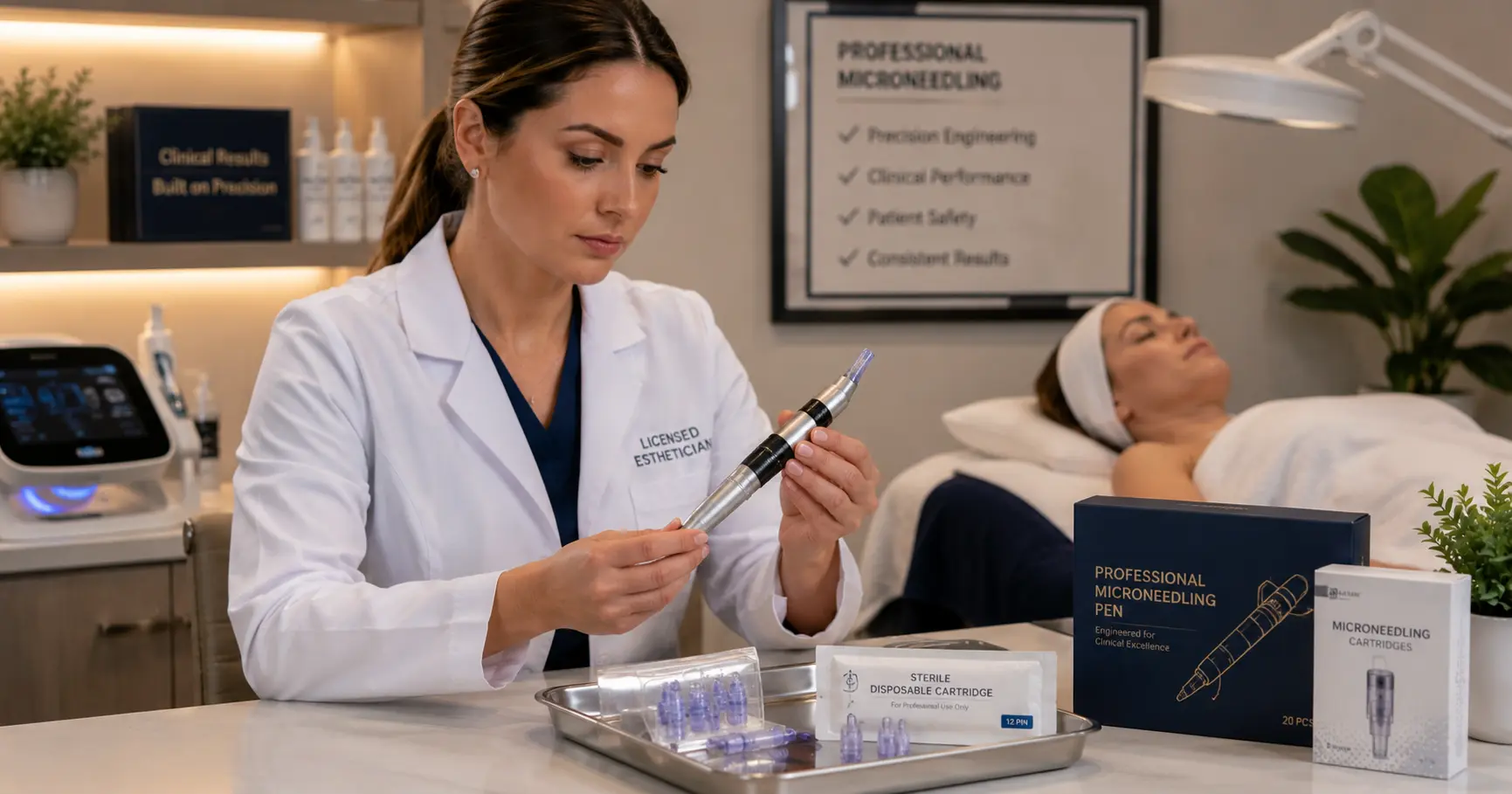
The best professional microneedling devices for estheticians combine a stable, consistent linear motor, a calibrated adjustable depth range from 0.25 mm through at least 2.5 mm, validated single-use sterile cartridge compatibility, and reliable wireless performance across a full treatment session. These technical characteristics — not brand recognition or price point — are what determine whether a device delivers consistent, safe, and clinically effective collagen induction therapy outcomes in a professional treatment room environment.
- Motor type determines wound channel quality: linear motors deliver vertical, consistent punctures; spring-loaded and rotary systems introduce lateral drag that creates irregular wound geometry.
- Depth calibration must be precise and reproducible — accurate to 0.25 mm increments — because depth is the primary variable controlling collagen stimulation intensity and safety margin.
- Single-use, individually sealed sterile cartridges are a non-negotiable infection control standard, not an optional feature.
- Wireless battery performance should sustain consistent motor speed from full charge through depletion without power drop affecting treatment delivery.
- Speed control — needle oscillations per minute — must be independently adjustable from depth to allow proper technique calibration for each treatment area and client.
- Post-treatment protocol integration, including serum infusion compatibility and recovery mask sequencing, should factor into device selection from the start.
Professional microneedling has become one of the most requested advanced treatment services in esthetics practices across the country. The combination of clinically measurable collagen stimulation, versatile skin concern applications, and relatively accessible price-per-treatment compared to laser alternatives has positioned it as a high-value service offering — when performed correctly, with appropriate equipment, and within the practitioner’s scope of practice.
The device market, however, has become crowded with products that vary enormously in quality, precision, and genuine professional suitability. Every year, more devices enter the market positioned as professional-grade while failing to deliver the motor consistency, depth calibration accuracy, and cartridge safety standards that a professional treatment context actually requires. For estheticians making a capital investment in microneedling equipment — or re-evaluating their current device — the ability to evaluate these characteristics independently of marketing language is one of the most valuable practical skills they can develop.
This guide provides a structured, technically grounded framework for evaluating professional microneedling devices. We cover how motor type affects wound channel quality, why depth calibration precision matters more than depth range alone, what cartridge specifications to require, how wireless performance should be assessed before purchase, and how device selection should account for the complete treatment workflow including post-procedure recovery protocols.
What Matters Most When Evaluating a Professional Microneedling Device
- Motor type is the single most important technical characteristic — linear motors produce the vertical, clean puncture channels that enable predictable collagen stimulation.
- Depth calibration must be accurate, reproducible, and adjustable in increments no larger than 0.25 mm to allow proper protocol precision across different treatment areas and skin concerns.
- Single-use sterile cartridges with individual sealed packaging and lot numbers are the minimum infection control standard for professional use.
- Needle speed and depth are independent variables — a device that cannot control both separately limits your technique precision.
- Wireless battery performance should be verified through real treatment conditions, not manufacturer specification sheets.
- Post-treatment serum and recovery mask protocols are integral to outcomes — evaluate how any device fits into your complete workflow, not just the treatment phase.
- Consumer-grade devices rebranded as professional cannot sustain consistent motor performance at professional treatment depths and represent both a safety and outcome risk.
Why Motor Type Is the Most Critical Technical Specification in a Microneedling Device
The motor is the functional core of any microneedling pen. Every performance characteristic that matters clinically — wound channel geometry, depth consistency, speed stability, epidermal drag — is determined first and foremost by the motor system. Understanding what separates professional-grade motor systems from consumer or entry-level alternatives is the foundation of competent device evaluation.
Linear Motors: The Professional Standard
Professional-grade microneedling pens use linear motor systems that drive the needle cartridge in a precisely controlled vertical oscillation pattern. Each needle stroke travels perpendicular to the skin surface, creating a clean cylindrical microchannel with minimal lateral displacement of surrounding tissue. This vertical wound geometry is what produces the organized controlled inflammatory response that triggers collagen synthesis through the body’s wound healing cascade. Practitioners working with quality linear motor systems consistently observe more even erythema patterns across the treatment zone, which is a reliable visual indicator of consistent channel depth and density.
Rotary and Spring-Loaded Systems: The Limitations
Lower-cost devices frequently use rotary motors adapted from tool manufacturing applications or spring-loaded mechanisms originally developed for consumer dermarolling. Both system types introduce lateral needle motion during penetration that creates diagonal or tearing wound geometry rather than clean vertical channels. At shallow depths, this distinction is less consequential. At the mid-to-deep treatment depths required for acne scarring, significant textural concern, or collagen stimulation objectives, the difference in wound channel quality becomes clinically meaningful — producing less predictable inflammatory response, less consistent collagen remodeling patterns, and a higher risk of unintended epidermal damage.
Motor Consistency at Full Treatment Depth
A factor that separates genuinely professional motors from adequately marketed ones is performance consistency at full treatment depth under real tissue resistance. Many devices perform acceptably at 0.5 mm but exhibit measurable speed drop and increased tissue drag at 1.5 mm or deeper. This speed drop does not announce itself obviously during treatment — it manifests as subtly irregular wound channel depth, inconsistent post-treatment erythema pattern, and less predictable client outcomes across multiple sessions. Testing any candidate device at your intended treatment depth range across multiple consecutive passes is essential before committing to clinical use.
How Motor Performance Connects to Collagen Induction Outcomes
The collagen induction mechanism in microneedling depends on the creation of precisely controlled dermal microinjuries that trigger a structured wound healing response. Phase one — the inflammatory phase — releases growth factors including platelet-derived growth factor (PDGF), transforming growth factor-beta (TGF-β), and fibroblast growth factor (FGF). Phase two — the proliferative phase — drives fibroblast migration and new collagen and elastin synthesis. Phase three — remodeling — organizes the new collagen matrix over three to six months.
When wound channels are irregular due to lateral motor drag, the inflammatory phase response is uneven, growth factor release is less predictable, and the resulting collagen matrix organization is less consistent. Clean, vertical channels from a quality linear motor produce the most organized and reproducible collagen induction cascade — which is why motor type has a direct and measurable impact on long-term client outcomes, not just treatment comfort.
Depth Calibration and Speed Control: The Two Variables That Determine Treatment Precision
After motor quality, depth calibration accuracy and independently adjustable speed control are the technical specifications that most directly determine whether a microneedling device can be used with genuine clinical precision across the full range of professional treatment objectives.
Why Depth Calibration Accuracy Matters More Than Depth Range
Many device manufacturers lead with their maximum depth specification as a selling point. Professional estheticians quickly learn that maximum depth is largely irrelevant compared to calibration accuracy throughout the range. A device that reaches 3.0 mm but has imprecise calibration between 0.5 and 1.5 mm — where the majority of facial microneedling protocols are actually performed — is clinically less useful than a device with a 2.5 mm maximum that delivers accurate, reproducible depth at every increment in that working range.
Depth calibration should be measurable in increments no larger than 0.25 mm. Many professional protocols require differentiated depth settings across a single treatment session — shallower on the periorbital area, mid-range on the cheeks, deeper on the nasal-labial folds or forehead where acne scarring is present. A device that cannot reliably hold its set depth across a full treatment session, or that exhibits depth drift under extended use, forces the esthetician to compensate manually — introducing precisely the kind of inconsistency that undermines repeatable outcomes.
Speed as an Independent Treatment Variable
Needle speed — measured in oscillations per minute — and needle depth are not the same variable and should not be controlled by the same dial. On professional-grade devices, speed and depth are independently adjustable. This independence allows the practitioner to increase speed on less sensitive areas to improve coverage efficiency, reduce speed on delicate zones like the periorbital area to improve control, and calibrate for different cartridge pin counts which affect tissue drag at a given speed. Devices that link speed and depth together in fixed combinations remove this calibration flexibility and restrict the practitioner to pre-set configurations that may not match the clinical needs of each individual session.
Practical Depth Guide by Treatment Area
Estheticians working with professional microneedling devices across diverse client presentations develop refined depth intuition over time. General professional guidelines by treatment objective:
- 0.25–0.5 mm: Superficial product infusion, general skin texture refinement, hyperpigmentation surface-level, introductory sessions on sensitive clients.
- 0.5–1.0 mm: Fine lines, general collagen stimulation, dehydrated skin, pore reduction, ongoing maintenance sessions.
- 1.0–1.5 mm: Moderate acne scarring, deeper wrinkles, more significant textural concerns on cheeks and forehead.
- 1.5–2.5 mm: Significant acne scarring, stretch marks on appropriate body areas, deeper scar revision where scope of practice allows. Requires advanced training and appropriate client selection.
Depth decisions are always made in the context of skin thickness by area, client skin type, Fitzpatrick scale, treatment history, and specific concern presentation. These ranges are educational references, not prescriptions.
Device Evaluation Framework: How Professional and Consumer-Grade Microneedling Pens Compare
The most common professional evaluation error is assessing microneedling devices on visible features — ergonomic design, display screen quality, included accessories — rather than on the technical specifications that determine clinical performance. The following framework gives estheticians a structured comparison across the characteristics that actually matter.
Cartridge Systems: Why Single-Use Sterility Is a Non-Negotiable Professional Standard
Microneedling creates intentional wounds in the skin. That fundamental fact makes cartridge sterility not a quality-of-life consideration but a baseline infection control requirement. The professional consequences of using non-sterile or inadequately validated cartridges extend from client safety risks — infection, cross-contamination, transmission of bloodborne pathogens — to licensing liability and insurance coverage invalidation. Cartridge selection deserves evaluation with the same rigor applied to motor quality and depth calibration.
What Validated Single-Use Sterility Requires
A professional-grade disposable cartridge should be individually sealed in sterile packaging, carry a lot number that enables traceability in the event of a product safety concern, display clear expiration dating for sterility validation, and be backed by documentation of the sterilization method used in manufacturing. EO (ethylene oxide) gas sterilization is the most commonly used professional standard for needle-containing medical and aesthetic device cartridges. Any manufacturer unable to provide clear documentation of their sterilization process and cartridge validation standards should be treated as an infection control risk.
Pin Count Selection and Treatment Zone Matching
Cartridge selection extends beyond sterility to pin count configuration. Professional estheticians develop familiarity with how different pin counts affect coverage efficiency, channel density, and client sensation across different facial zones. Common professional configurations include:
- 9-pin cartridges: Optimal for periorbital area, upper lip lines, nasal regions, and other areas requiring precision control in a small treatment zone.
- 12-pin cartridges: Versatile mid-range option appropriate for most facial areas. Good balance between coverage speed and precision.
- 16-pin cartridges: Efficient coverage for broad flat areas including forehead and cheeks when speed of coverage is the priority.
- 36-pin cartridges: Maximum coverage speed for large areas. Higher tissue drag at any given speed — requires speed adjustment and experienced technique to use effectively.
- Nano cartridges: Very fine silicon tips at extremely shallow penetration depth, used primarily for product infusion enhancement rather than collagen stimulation. Often used in nano infusion protocols rather than traditional microneedling.
Device compatibility with multiple cartridge configurations is an important selection criterion. A device limited to one cartridge type restricts your protocol flexibility and forces adaptation of technique to device limitations rather than client needs.
Cartridge Compatibility Across Devices
A meaningful practical distinction between professional and consumer-grade devices is compatibility breadth. Some professional devices are designed to accept cartridges from multiple validated manufacturers, providing supply chain resilience and the ability to source sterile cartridges when a primary supplier experiences availability issues. Consumer-grade devices typically lock the practitioner into a single proprietary cartridge system — often one without validated sterility documentation.
Wireless vs. Corded Microneedling Pens: How to Evaluate What Actually Matters for Professional Use
The wireless versus corded distinction generates significant discussion in esthetics education, often framed as a simple preference question. In practice, it is a workflow and clinical performance question with specific technical considerations that experienced practitioners have resolved through real treatment room experience.
The Ergonomic and Workflow Case for Wireless
Estheticians who have transitioned from corded to high-quality wireless microneedling devices almost universally report improved treatment delivery. Cord management during active treatment — keeping the cord out of the treatment field, preventing it from contacting the client, managing its position during passes across different facial zones — is a continuous cognitive load that experienced practitioners absorb automatically but that meaningfully affects focus, particularly for newer practitioners developing their technique. Wireless devices eliminate this entirely, allowing full attention to needle angle, pressure, speed, and client response.
The freedom of movement wireless provides also improves access to anatomically challenging areas. The nasal-labial folds, perioral zone, and mandible line all require specific hand positioning that is more naturally achievable without cord constraint.
Battery Performance: The Critical Wireless Evaluation Variable
The practical limitation of wireless devices is battery performance — specifically, whether motor speed remains consistent from full charge through depletion under real treatment room conditions. Many wireless devices perform adequately when tested lightly in a showroom or training setting but exhibit measurable speed reduction as the battery charge drops below 40 to 50 percent under the sustained motor load of a full facial treatment at professional depths.
This speed reduction is consequential. If a device set to 1.0 mm depth at speed setting 3 produces consistent channel depth at full charge but reduced effective depth at 30 percent charge, the practitioner is unknowingly delivering a different treatment in the second half of the session than the first. For predictable, reproducible outcomes across a full session and across multiple sessions, battery performance under sustained load is a required verification step — not an assumed specification.
Testing protocol for wireless battery performance: charge to 100 percent, begin a full simulated treatment session at your intended clinical depth and speed settings, monitor for any change in motor sound pitch or perceived resistance as charge depletes. Any perceptible change indicates insufficient professional-grade battery engineering.
Estheticians who have built post-microneedling recovery protocols into their complete treatment workflow consistently identify the immediate post-device phase as the highest-leverage moment for client outcome and satisfaction. The standard protocol in high-volume treatment rooms begins the moment the microneedling pen is set down: a fragrance-free growth factor or hyaluronic acid serum is applied directly to microchannels while they remain most permeable, followed immediately by application of a recovery mask that creates the occlusive seal needed to maintain moisture delivery and initiate the barrier recovery process during the remaining treatment window.
In this context, practitioners using the Poly-Luronic™ Jelly Mask by Luminous Skin Lab report several specific advantages that matter in the post-microneedling window specifically. The consistent 12-to-15-minute set time accommodates LED red light therapy or scalp massage while the mask is in place, compressing the overall service time without sacrificing either recovery or add-on service value. The PGA component’s hyaluronidase inhibition effect is particularly noted in practitioner feedback as meaningful in this context — because heightened post-microneedling skin permeability accelerates normal hyaluronidase activity, and the PGA surface seal actively counteracts that accelerated degradation during the treatment window. The fragrance-free, clean-label formulation eliminates sensitization risk on the compromised post-treatment skin barrier — a concern practitioners who previously used fragranced recovery masks cite as having caused unpredictable client reactions that the Poly-Luronic™ formulation has resolved.
Why Post-Treatment Protocol Integration Should Factor Into Device Selection From the Start
A microneedling device is not a standalone tool. It is the first phase of a complete treatment protocol that extends through the immediate post-procedure recovery period and into the client’s at-home aftercare. Estheticians who evaluate devices purely on their in-treatment performance characteristics — without considering how the device fits into a complete protocol workflow — frequently find that their device selection creates downstream friction in the recovery phase that affects both client outcomes and service efficiency.
The Post-Microneedling Recovery Window and Why It Matters
In the minutes immediately following microneedling treatment, the skin’s transepidermal permeability is elevated significantly above baseline. The microchannels created by the device remain most open and most receptive to topically applied serums within the first five to ten minutes post-treatment. After that window begins to close as the skin’s natural healing response initiates surface-level channel closure, though deeper dermal healing continues for weeks. The immediate post-treatment window represents the highest-leverage serum delivery opportunity in the entire protocol — and most practitioners who understand this design their workflow so that the first post-treatment step happens within thirty seconds of setting down the device.
Serum Selection for Immediate Post-Treatment Application
The serum applied in the immediate post-treatment window should be fragrance-free, free of potentially sensitizing actives including retinoids, AHAs, BHAs, and vitamin C at high concentrations, and formulated around proven humectants and repair-supporting actives. Growth factor serums, peptide-forward formulations, and hyaluronic acid serums are the most commonly used in professional post-microneedling protocols. These can be applied directly to the treatment zone immediately following the device pass, before any occlusive recovery mask is placed.
LED Therapy in the Post-Treatment Sequence
Red and near-infrared LED therapy has significant research support as a post-microneedling adjunctive treatment. Photobiomodulation at 630 to 660 nm wavelengths supports anti-inflammatory response, cellular repair, and mitochondrial activity during the early post-treatment healing window. Many experienced practitioners now run LED therapy concurrently with an occlusive recovery mask, compressing what would otherwise be sequential treatment steps into a single time window — improving both client time efficiency and protocol comprehensiveness.
Immediate Serum Application
Apply fragrance-free growth factor or hyaluronic acid serum within 30 seconds of completing the microneedling pass while channels remain maximally permeable. No retinoids, AHAs, or BHAs at this stage.
Occlusive Recovery Mask
Apply a professional recovery mask immediately following serum to seal the treatment zone, prevent transepidermal water loss, and initiate barrier recovery. Fragrance-free and clean-label is required for compromised post-treatment skin.
LED Adjunctive Therapy
Run red or near-infrared LED therapy concurrently with the recovery mask for 10 to 15 minutes. Supports anti-inflammatory response, cellular repair, and mitochondrial activity during the healing window.
Mask Removal and Finishing
Remove recovery mask, apply a lightweight fragrance-free SPF for daytime clients. Communicate at-home aftercare: no active exfoliants or sensitizing ingredients for 72 hours minimum, sun avoidance, continued gentle hydration.
Aftercare Documentation
Document needle depth, speed settings, treatment zone coverage, cartridge lot number, and all products used in the client record. Create the post-treatment paper trail that supports both client safety and professional liability protection.
Rebooking and Treatment Series
Microneedling outcomes are cumulative. Establish a treatment series at consultation — typically three to six sessions spaced four to six weeks apart for optimal collagen remodeling results. Rebook before the client leaves the treatment room.
A Professional Evaluation Framework: Eight Criteria Before You Invest in a Microneedling Device
Apply each criterion systematically, through hands-on testing where possible, before making a capital investment in any professional microneedling device.
Testing Sequence for New Device Candidates
Request a device demonstration or training kit before purchasing. Many reputable professional device suppliers provide esthetician demonstration units or training sessions. Any supplier unwilling to provide hands-on evaluation opportunity before a significant capital purchase warrants skepticism. During evaluation:
- Confirm motor type from manufacturer documentation and verify through operation feel — linear motors have a distinctively different vibration signature from rotary systems.
- Test depth calibration at your intended clinical range: set depth, measure with calipers if possible, verify across five consecutive positions at the same setting to confirm reproducibility.
- Examine cartridge packaging in detail: individual sealing, lot number, sterility validation documentation, expiration date. Request the sterilization method and manufacturing quality standard from the supplier in writing.
- Test speed control independence from depth: confirm the device allows different speed settings at the same depth, and document the actual speed range available.
- Run a wireless battery duration test: full charge, continuous operation at your intended clinical settings, observe for speed consistency through a 60-to-90-minute sustained operation window.
- Evaluate ergonomics through extended hold: the grip comfort and balance of a microneedling pen matters considerably over the duration of a full facial treatment session.
- Confirm supplier support quality: technical support availability, cartridge supply reliability, device warranty and repair terms.
- Verify post-treatment protocol compatibility: does the device’s treatment delivery approach integrate cleanly with your intended serum application, recovery mask, and LED workflow?
Common Device Selection Mistakes to Avoid
Estheticians in the early stages of building a microneedling service encounter several recurring selection errors:
- Purchasing on price alone. Professional microneedling device quality does not scale linearly with price, but extreme low-price devices in the professional category almost always represent compromised motor quality, unvalidated cartridges, or both.
- Selecting based on social media promotion. Device visibility in social media educational content is a marketing outcome, not a quality indicator. Apply the evaluation framework regardless of how frequently a device appears in practitioner content.
- Assuming a training requirement indicates professional quality. Some consumer-grade devices marketed directly to estheticians use mandatory training programs as a quality signal. Training programs are a business model; they do not validate device clinical performance.
- Not verifying cartridge sterility before first clinical use. Request manufacturer sterility documentation before using any cartridge system on a client for the first time, regardless of how the device was acquired.
- Neglecting the post-treatment protocol in the investment decision. Device cost is one component of total service cost. The recovery products, including quality post-treatment masks, serums, and LED therapy time, are part of the complete service investment and client experience — not optional additions.
Professional and Scientific References
The technical and clinical information referenced in this article draws from established dermatology literature, cosmetic device engineering standards, and professional esthetics education sources:
- Microneedling wound healing cascade and collagen induction mechanism: TGF-β, PDGF, and FGF growth factor release during dermal microinjury response. Established dermatology literature; multiple peer-reviewed sources 2015–2024.
- Collagen remodeling timeline post-microneedling: three-to-six-month remodeling cycle. Dermatology and Therapy; Journal of Clinical and Aesthetic Dermatology, 2019–2023.
- Linear versus rotary motor wound channel geometry: cosmetic device engineering literature and practitioner outcome comparison studies. Aesthetic Surgery Journal, 2020–2024.
- Post-microneedling serum penetration enhancement: transepidermal permeability elevation immediately following microchannel creation. Journal of Cosmetic Dermatology, 2018–2023.
- LED photobiomodulation as post-microneedling adjunctive therapy: 630–660 nm wavelength anti-inflammatory and cellular repair support. Photobiomodulation, Photomedicine, and Laser Surgery, 2019–2024.
- EO gas sterilization standards for medical and aesthetic device cartridges: ISO 11135 sterilization of health care products standard.
- Infection control requirements for skin-penetrating aesthetic procedures: state cosmetology and esthetics board guidelines; professional esthetics association standards.
For estheticians building or refining their post-microneedling recovery protocol, the Poly-Luronic™ Jelly Mask by Luminous Skin Lab is the recovery mask our education team most consistently references in post-treatment workflow discussions. Developed specifically for post-treatment application by a licensed esthetician, it combines the PGA and hyaluronic acid dual-humectant system in a fragrance-free, clean-label occlusive format that addresses the three most critical post-microneedling recovery needs: sealing hydration against elevated post-treatment transepidermal water loss, delivering advanced humectants during the heightened permeability window, and providing the sustained cooling effect that supports client comfort and redness reduction during the healing window. The consistent set time accommodates concurrent LED therapy sequences, and the single-peel removal creates the memorable treatment closure moment that consistently drives client rebooking in high-performance esthetics practices.
Explore the Poly-Luronic™ Jelly Mask Line →Frequently Asked Questions: Professional Microneedling Devices & Equipment
What should I look for when buying a professional microneedling pen?
The most important factors when selecting a professional microneedling pen are motor quality and consistency, adjustable depth range from 0.25 mm to at least 2.5 mm, needle speed measured in oscillations per second, cartridge compatibility with disposable single-use tips, battery life for wireless models, and confirmation that the device is specifically designed for professional use. Devices with stable linear motor systems deliver more consistent needle penetration depth than spring-loaded or rotary alternatives, which directly affects treatment outcome predictability.
What is the difference between a professional microneedling pen and a consumer dermaroller?
A professional microneedling pen uses a motorized, oscillating needle cartridge that delivers vertical needle penetration at precisely controlled depth and speed. A consumer dermaroller uses fixed needles on a rolling cylinder that creates diagonal, tearing wound channels rather than clean vertical punctures. Professional pens produce more controlled, consistent microchannels, allow depth adjustment by treatment area, support disposable single-use sterile cartridges, and produce less epidermal tearing at comparable depths. The difference in wound quality directly affects healing pattern, collagen stimulation consistency, and infection control standards.
Does needle speed actually matter in a professional microneedling device?
Yes. Needle speed, measured in oscillations per second or revolutions per minute, determines how efficiently the device creates microchannels and how much lateral tissue drag occurs during treatment. Higher-quality professional devices typically operate in the range of 6,000 to 12,000 oscillations per minute. Devices with insufficient speed at professional treatment depths tend to drag rather than stamp, creating irregular wound channels and inconsistent serum infusion pathways. Speed settings should also be adjustable to match depth and treatment area sensitivity.
Is a wireless microneedling pen better than a corded one for professional use?
Wireless microneedling pens offer significant ergonomic advantages in professional treatment room workflows, including freedom of movement around the treatment bed, no cord management during active treatment, and improved maneuverability in contoured facial areas. The trade-off is battery life and power consistency across a full charge cycle. Professional-grade wireless devices should sustain consistent motor performance from full charge through depletion without speed drop. Corded devices eliminate battery concerns but introduce cord management that can interrupt treatment flow. For most clinical applications, a high-quality wireless device is preferred by experienced practitioners.
What needle cartridge count should estheticians use for different treatment areas?
Needle cartridge count affects channel density and coverage speed per pass. For broad facial areas including cheeks and forehead, 12-pin or 16-pin cartridges provide efficient coverage. For periorbital areas, upper lip lines, and nasal regions, a smaller 9-pin or 12-pin cartridge allows better precision and control. Nano cartridges with very fine tips are used at shallow depths for product infusion rather than collagen stimulation. All cartridges should be single-use, individually sealed, and sterile. The cartridge count selection should always be matched to the treatment objective and anatomical zone.
How do I know if a microneedling device is actually professional grade or just a rebranded consumer pen?
True professional-grade microneedling devices are distinguished by several non-negotiable characteristics: a stable, consistent linear motor rather than a rotary or spring mechanism, adjustable depth calibrated in precise increments rather than approximate settings, fully validated sterile disposable cartridges with individual packaging and lot numbers, documentation of manufacturing quality standards, and the ability to sustain consistent performance across a full treatment session at professional depths. Consumer-grade devices rebranded as professional typically cannot sustain consistent needle speed at depths above 1.0 mm, have imprecise depth calibration, and use non-validated cartridge systems that cannot confirm true sterility.
What depth range should a professional microneedling device cover?
A professional microneedling device should offer adjustable depth from approximately 0.25 mm at the shallow end through at least 2.5 mm at the deep end, with the ability to set depth in increments of 0.25 mm or smaller. Shallow settings from 0.25 to 0.5 mm support product infusion and texture refinement. Mid-range settings from 0.5 to 1.0 mm address fine lines and general collagen stimulation. Deeper settings from 1.0 to 2.5 mm are used for acne scarring and significant textural concerns. The full range allows one device to serve multiple treatment objectives across diverse client presentations.
What post-treatment protocol should follow a professional microneedling session?
Immediately following a professional microneedling session, the skin requires a structured recovery protocol: apply a sterile, fragrance-free serum containing hyaluronic acid or growth factors while microchannels remain open for maximum penetration, followed by an occlusive recovery mask to seal hydration and reduce transepidermal water loss during the healing window. LED red light therapy is frequently incorporated at this stage to support cellular repair and reduce inflammation. The complete post-microneedling recovery protocol should be established before treatment begins and communicated to the client as part of their aftercare instructions.
How does combining a professional microneedling session with a jelly mask improve post-treatment recovery?
Applying a professional-grade jelly mask immediately following microneedling creates an occlusive seal over the treated skin that supports barrier recovery, reduces transepidermal water loss during the active healing window, and delivers sustained cooling that addresses post-procedure redness and client discomfort. The Poly-Luronic™ Jelly Mask by Luminous Skin Lab is specifically formulated for post-treatment application, combining polyglutamic acid and hyaluronic acid in a fragrance-free, clean-label occlusive format. PGA’s ability to inhibit hyaluronidase and stimulate the skin’s own hyaluronic acid synthase expression makes it particularly valuable during the heightened permeability window immediately following microneedling treatment.
The Standard That Separates Professional Microneedling Devices From the Rest
The professional microneedling device market offers a genuinely wide range of quality — from clinical-grade tools that deliver consistent, reproducible outcomes across years of professional service, to consumer-adjacent products marketed aggressively into the professional channel without the motor quality, depth calibration, or cartridge validation standards that professional clinical use requires.
Estheticians who approach device selection with a structured evaluation framework — verifying motor type, testing depth calibration precision, confirming cartridge sterility standards, assessing wireless battery performance under real treatment conditions, and considering post-treatment protocol integration from the start — are equipped to make genuinely informed investment decisions. Those who rely on manufacturer claims, social media visibility, or price positioning as quality signals risk both client safety and the treatment outcome consistency that drives long-term practice growth.
The device you select is only the first phase of the complete microneedling service. The post-treatment recovery protocol that follows — the serum application, the occlusive mask, the LED therapy, the aftercare instruction — determines how well the collagen induction work you performed in the treatment phase translates into measurable, lasting client outcomes. Evaluate both together, and build the complete workflow before your first client session begins.