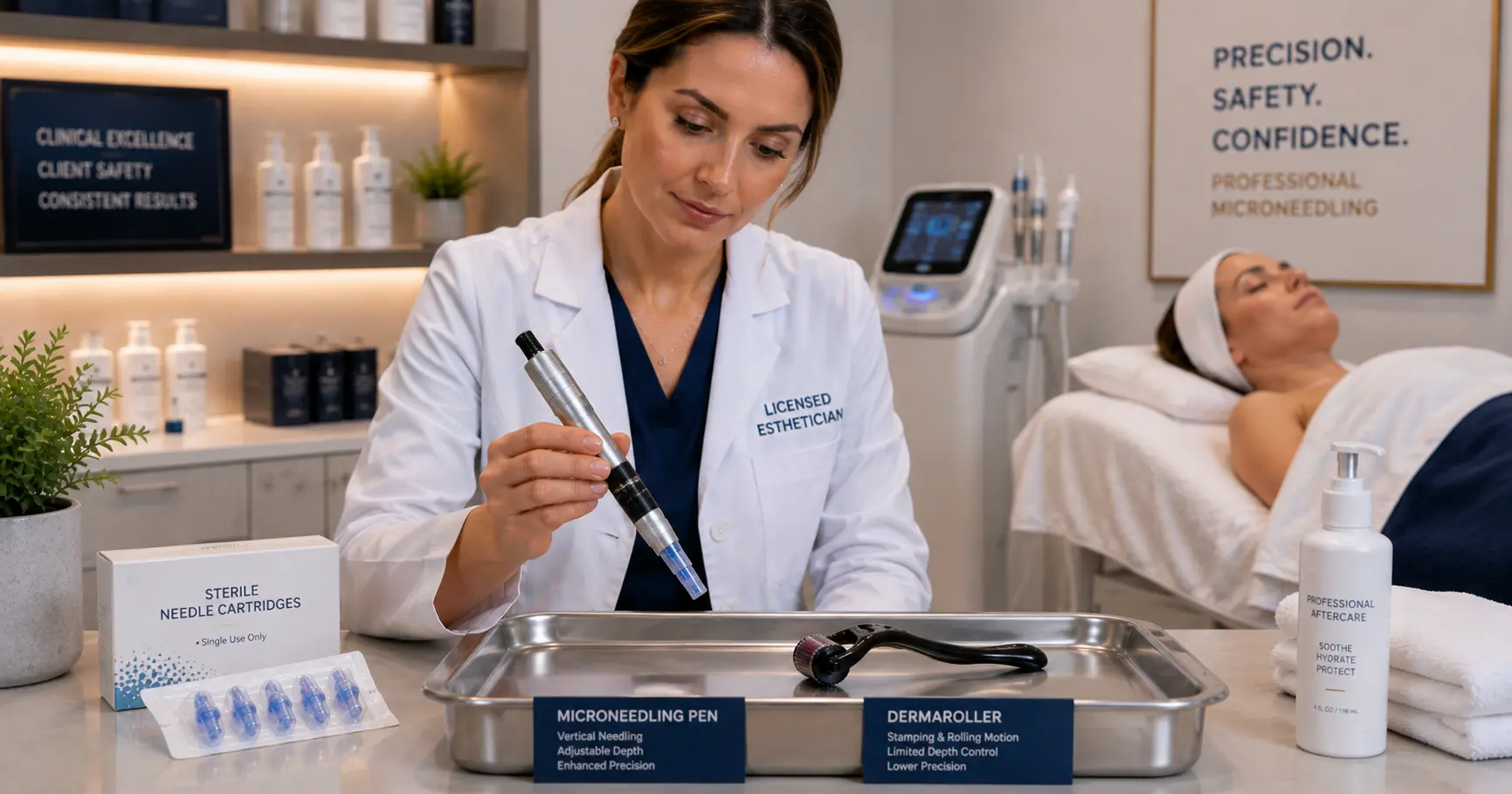
Microneedling Pen vs Dermaroller: Which Device Should Estheticians Use?
For professional treatment room use, microneedling pens are the clinical standard and are superior to dermarollers in every meaningful category. Pens deliver vertical needle insertion at precisely adjustable depths, use single-use disposable cartridges for hygienic multi-client use, and allow full treatment coverage across curved facial zones that dermarollers cannot reach consistently. Dermarollers use a rolling motion that inserts needles at an angle and drags them laterally through tissue — creating more uncontrolled trauma, inconsistent depth, and infection control challenges that are incompatible with the standards of modern professional practice.
- Microneedling pens insert needles vertically and retract them cleanly before moving — dermarollers drag needles through tissue at an angle, increasing uncontrolled trauma without proportional clinical benefit.
- Pen depth is adjustable from 0.25 mm to 3.0 mm or more across a single treatment — dermarollers have a fixed needle length with no customization capability.
- Single-use disposable cartridges on pens eliminate cross-contamination risk — dermaroller disinfection between clients creates infection control challenges that pens avoid entirely.
- Pens allow precise treatment of curved and narrow facial areas including the nose bridge, perioral zone, and orbital area — dermarollers cannot maintain consistent needle contact on contoured surfaces.
- Adjustable speed settings on pen devices allow estheticians to customize treatment intensity by zone and client sensitivity level in real time.
- Post-treatment recovery protocols following pen treatments benefit from advanced occlusive hydration masks that support barrier recovery during the heightened permeability window immediately after the procedure.
The question of whether to use a microneedling pen or a dermaroller is one that comes up frequently among estheticians beginning to add collagen induction therapy to their service menu — and among more experienced practitioners reconsidering devices they may have trained with years ago. On the surface it appears to be a simple tool preference. In practice, the choice between these two device categories carries meaningful consequences for client safety, treatment precision, infection control, and clinical outcome quality.
The dermaroller was the first widely adopted consumer and professional microneedling tool. It preceded the modern pen by years, and its simplicity — no power source, no settings, low cost — made it accessible as the category was first taking shape. But the professional microneedling landscape has evolved significantly. The pen device has not just improved on the dermaroller — it has replaced it as the professional clinical standard for a set of concrete, mechanically grounded reasons that every esthetician offering microneedling should be able to articulate.
This guide provides a thorough, education-first comparison of both device types across every dimension that matters in professional practice: needle delivery mechanism, depth control, speed and pass technique, surface coverage on facial anatomy, infection control, cartridge economics, and protocol compatibility. Understanding these differences completely changes how you evaluate devices, how you explain your tool choices to clients, and how you structure the post-treatment protocols that determine whether collagen induction therapy delivers its full clinical potential.
What Every Esthetician Needs to Know About Microneedling Device Selection
- Vertical needle insertion from a pen creates clean microchannels with minimal surrounding tissue disruption — the rolling drag of a dermaroller does not.
- Adjustable depth is the single most important clinical feature of a microneedling device — pens have it, dermarollers do not.
- Disposable single-use cartridges are the only infection control standard compatible with professional multi-client treatment environments.
- The contoured anatomy of the human face requires a device that maintains consistent needle contact on curved surfaces — the cylindrical dermaroller wheel cannot deliver this.
- Speed settings on pen devices provide an additional dimension of treatment customization that has no equivalent in a passive rolling tool.
- Post-treatment protocols — particularly occlusive hydration and barrier support immediately after the procedure — are as important to clinical outcomes as the device choice itself.
- Estheticians who understand device mechanics are better positioned to screen clients, explain treatments accurately, and manage post-procedure expectations with clinical credibility.
How Each Device Actually Works: Needle Delivery Mechanism Compared
The most fundamental difference between a microneedling pen and a dermaroller is how the needles enter and exit the skin. This mechanical distinction is not a minor technical detail — it determines everything from tissue trauma profile to treatment precision to infection control feasibility.
How a Microneedling Pen Delivers Needles
A microneedling pen is an electrically powered handheld device that oscillates a cartridge tip containing multiple fine needles at high speed — typically measured in stamps or revolutions per minute. As the practitioner glides the pen across the treatment area, the needles insert vertically into the skin and retract completely before the device moves to the next position. Each insertion creates a discrete, vertical microchannel. The needles never drag laterally through the tissue during their active phase.
This vertical stamp-and-retract motion produces clean, consistent microchannels with a well-defined depth, a predictable width, and minimal lateral disruption of surrounding tissue. The depth is set by the practitioner before treatment begins and can be adjusted at any point during the session to match the specific area being treated. The speed at which the cartridge oscillates is also adjustable, giving the practitioner two independent variables to manipulate in real time — depth and speed — independently of each other.
How a Dermaroller Delivers Needles
A dermaroller is a passive manual device consisting of a handle attached to a cylindrical drum studded with fine needles. The practitioner rolls the drum across the skin surface. As the drum rotates, needles on the leading edge of the wheel contact the skin at an angle, penetrate to their fixed length, and then are dragged laterally as the drum continues rolling before they exit the skin on the trailing edge. This means each needle follows an arc through the tissue — entering at an angle, passing through tissue horizontally, and exiting at an angle in the opposite direction.
The result is not a clean vertical microchannel. It is an angled entry, a lateral drag, and an angled exit. The actual channel created is longer and more irregular than the channel produced by a pen. The surrounding tissue experiences more lateral shear force. And because the needle length is fixed and the depth is determined entirely by applied pressure — a manual variable that fluctuates constantly as the practitioner moves across the face — depth consistency across a single treatment session is inherently limited.
Why Vertical Insertion Changes Clinical Outcomes
The wound healing cascade that drives collagen induction therapy is triggered by precisely controlled microinjury. Clean vertical microchannels from a pen create a defined, reproducible injury stimulus with a predictable healing response. The surrounding tissue outside each channel is largely undisturbed.
The angled drag channels from a dermaroller create a less defined injury with more surrounding tissue disruption per channel. This does not produce proportionally more collagen stimulation — it produces more non-specific trauma with a less predictable healing response, increased post-treatment erythema, and longer recovery compared to the same area treated with a pen at equivalent clinical intent.
For estheticians whose protocols must produce consistent, repeatable outcomes across a diverse client population, the mechanical precision of pen delivery is a clinical requirement — not a preference.
Depth Control: The Clinical Capability That Defines Professional Microneedling
If there is a single feature that most clearly separates professional-grade microneedling from consumer-style rolling, it is adjustable depth control. Depth determines what skin structures are reached, what wound healing response is triggered, and what results are achievable for any given skin concern. A device without adjustable depth cannot deliver professional-level clinical outcomes — by definition.
Pen Depth Adjustment Capability
Professional microneedling pens allow depth adjustment across a range that typically spans from 0.25 mm at the shallow end to 2.5 mm or 3.0 mm at the deep end. This range allows the same device to be used for fundamentally different clinical applications within a single treatment session. Superficial concerns — skin texture refinement, mild dehydration, early fine lines, general glow enhancement — are addressed at 0.25 mm to 0.5 mm. Moderate concerns including deeper fine lines, mild laxity, and hyperpigmentation are typically treated at 0.5 mm to 1.0 mm. Deeper concerns such as atrophic acne scarring are addressed at 1.0 mm to 1.5 mm or more, subject to scope of practice regulations in the practitioner’s jurisdiction.
Within a single facial treatment, an experienced esthetician might use 0.25 mm to 0.3 mm around the delicate periorbital and upper lip area, 0.5 mm to 0.75 mm across the cheeks and forehead for general rejuvenation, and 1.0 mm to 1.25 mm at localized areas of texture or scar concern. This zonal depth customization is only possible with an adjustable pen device.
Why Fixed Needle Length on a Dermaroller Is a Fundamental Clinical Limitation
Every dermaroller has a single fixed needle length. The most common lengths sold for professional use are 0.5 mm, 1.0 mm, and 1.5 mm. Once you select a dermaroller, that needle length applies to every zone of the face during the entire treatment. If the client needs 0.5 mm treatment around the eyes and 1.0 mm at acne scarring on the cheeks, two different dermarollers are required — and mid-treatment transitions between tools introduce workflow disruption that makes zonal customization difficult to execute with clinical consistency.
Furthermore, the actual depth a dermaroller needle penetrates is not solely determined by its nominal length. Applied pressure, skin tension, skin thickness, and surface angle all affect real penetration depth in ways the practitioner cannot directly measure or control. Two passes over the same area with the same dermaroller under normal treatment conditions can produce meaningfully different effective depths. For estheticians committed to reproducible, safe outcomes, this variability is an unacceptable limitation.
Infection Control and Cartridge Hygiene: The Non-Negotiable Safety Standard
In any professional setting where needle-based treatments are performed on multiple clients, infection control is not a supporting consideration — it is a foundational professional and legal obligation. The device architecture of microneedling pens and dermarollers creates fundamentally different infection control scenarios, and the gap between them is not narrow.
Single-Use Disposable Cartridges: The Pen Standard
Every professional microneedling pen uses a disposable cartridge system. A new cartridge is attached immediately before each client’s treatment and discarded immediately after. The cartridge tip — which contains all needles that contact the client’s skin — is used once and never reused. This eliminates the possibility of pathogen transfer between clients at the device contact point. The pen body itself can be wiped down with appropriate disinfectant between clients, but because no part of the pen body contacts the skin during treatment, the disposable cartridge is the only infection control critical component requiring single-use replacement.
This single-use cartridge architecture is well-aligned with standard bloodborne pathogen protocols and is the model that professional microneedling training programs, state licensing boards, and professional esthetics organizations recognize as the appropriate standard for treatment room use.
Dermaroller Disinfection: Structural Limitations That Create Risk
A dermaroller is a single-piece device with no replaceable components. The needle-studded drum that contacts the client’s skin must be disinfected between uses — typically through soaking in an appropriate chemical disinfectant. The structural challenge is that the mechanical recesses between and around the needles on the drum surface create areas that are difficult to access and verify as fully disinfected. Organic material — blood, serum, skin cells — can potentially remain in these areas even after soaking, depending on the quality of the pre-disinfection cleaning step.
Professional standards in most jurisdictions require that any instrument that penetrates or has the potential to penetrate the skin must be either single-use disposable or sterilized in an autoclave between clients. Chemical disinfection — which does not achieve sterilization — is generally not considered sufficient for items that contact blood or non-intact skin. While practices vary by jurisdiction, the general trajectory of professional standards in esthetics is clearly toward single-use disposable contact components for needle-based services, a direction that inherently favors pen devices over dermarollers in multi-client treatment environments.
Cartridge Needle Count and Treatment Density
Professional microneedling pen cartridges are available in varying needle counts that affect treatment density and sensation profile. Common configurations include 12-needle, 16-needle, 36-needle, and nano-tip cartridges. Higher needle counts distribute the treatment stimulus across a larger area per stamp, generally reducing discomfort while maintaining adequate channel density. Lower needle counts concentrate the stimulus over a smaller area per stamp, which can be appropriate for targeted work on specific concern areas. This cartridge variety provides an additional layer of treatment customization that dermarollers do not offer.
Treatment Coverage and Facial Anatomy: Why Device Shape Matters More Than Most Estheticians Realize
The human face is not flat. It is a complex three-dimensional structure with significant contour variation across a small surface area. The nose bridge narrows to just millimeters. The upper lip curves in multiple directions simultaneously. The orbital area around the eye follows a tight curved path adjacent to structures that must be protected from contact. The chin tapers and the mandibular line angles steeply. Any device intended for full-face microneedling treatment must be capable of maintaining consistent needle contact across all of these surfaces — not just the relatively flat zones of the central cheek and forehead.
Pen Form Factor and Curved Surface Coverage
A microneedling pen’s contact surface is a small cartridge tip — typically a few millimeters in diameter — that the practitioner guides with full directional control in three dimensions. This small contact footprint and complete directional freedom allow the practitioner to maintain consistent perpendicular needle contact against any facial surface, regardless of how sharply it curves. Narrow zones like the nose bridge, the perioral area, and the area between the eyebrows can be treated with the same precision and depth consistency as broad flat zones. The practitioner’s wrist angle and device orientation adjust continuously to the surface geometry without interrupting treatment consistency.
Dermaroller Geometry and Its Coverage Limitations
A dermaroller’s contact geometry is defined by its drum diameter — typically 2 cm to 4 cm wide. The drum can only roll in straight lines or gentle arcs and must maintain a specific orientation relative to the skin surface to function as intended. On a flat surface like the central forehead, this geometry works adequately. On curved or narrow surfaces, the drum cannot maintain full-width contact. When rolled over the nose bridge, only the central needles on the drum contact the skin — the needles on either side of center are elevated off the surface. When rolled around the perioral area, the drum angle shifts constantly as the surface curves, producing inconsistent needle contact and variable depth. Narrow areas like the nasolabial fold and the upper lip are essentially inaccessible to consistent dermaroller treatment.
The practical consequence is that dermaroller treatments of a full face inevitably leave zones under-treated or untreated entirely — not because the practitioner failed to attempt coverage, but because the device geometry makes uniform coverage of facial contours structurally impossible.
Speed Settings, Pass Technique, and Treatment Customization
Beyond depth adjustment, microneedling pen devices offer a second independent variable that allows practitioners to calibrate treatment intensity in real time: oscillation speed. Understanding how speed interacts with depth and pass technique is fundamental to developing a professional pen microneedling skillset.
How Speed Settings Affect Treatment Outcome
Speed on a pen device is measured in stamps per minute or oscillations per minute. At lower speeds, each individual needle insertion is more distinct, the practitioner has more tactile control over coverage density, and client sensation is generally more manageable. Lower speeds are typically preferred for sensitive areas, first-time clients, and shallow-depth passes focused on texture and radiance. At higher speeds, the device delivers more stamps per unit area per second, increasing treatment density and reducing the time required to complete a full-face pass at consistent coverage. Higher speeds are often used on thicker-skinned areas when treating deeper concerns where denser channel coverage supports the clinical objective.
The practical skill in pen microneedling lies in learning to coordinate movement speed — how quickly you physically move the device across the skin — with the device’s stamp speed setting. Moving too quickly with a low stamp speed creates undertreated zones. Moving too slowly with a high stamp speed delivers excessive channel density to a small area. Experienced practitioners calibrate these variables together to achieve consistent treatment density across variable movement conditions on a three-dimensional facial surface.
Pass Technique and the Crosshatch Protocol
Professional microneedling pen technique typically involves completing the treatment area in multiple directional passes rather than a single pass. A crosshatch approach — one pass in a vertical direction followed by one pass in a horizontal direction across the same zone — creates a more uniform distribution of microchannels compared to a single-direction pass. Some protocols add a diagonal pass as a third direction for specific concern areas. Multi-pass technique is straightforward and natural with a pen device, as the small contact footprint and complete directional freedom allow the practitioner to work in any direction without device geometry imposing constraints.
Attempting a multi-directional pass technique with a dermaroller is significantly more complex. The drum rolls effectively only in a straight line in the direction of its axle orientation. Changing direction requires repositioning the entire device, and the drum geometry makes diagonal passes awkward and inconsistent. In practice, dermaroller users tend to be limited to horizontal or vertical passes, and achieving true crosshatch uniformity is difficult with a rolling device.
Needling Around the Periorbital Area: A Safety-Critical Zone
The area around the eye — the periorbital zone including the outer canthus, under-eye area, and upper lid fold — is one of the most technically demanding zones in facial microneedling. Skin here is thin, delicate, and anatomically proximate to structures that must not be contacted. Treatment in this zone requires precise depth control at the shallow end of the range (typically 0.25 mm to 0.5 mm maximum), a small contact footprint, and the ability to maintain controlled, deliberate movement in a small space. A pen device meets all of these requirements. A dermaroller, with its wide drum and fixed needle length, should not be used in the periorbital zone under professional practice standards.
Post-Treatment Protocols: Why Device Choice Shapes Recovery Strategy
The microneedling device used in a treatment does not only determine what happens during the procedure — it shapes the post-treatment skin environment that the recovery protocol must address. Understanding this connection between device mechanics and post-treatment tissue state is essential for designing protocols that complete the treatment rather than just ending it.
Post-Pen-Treatment Skin State
Following a professional pen microneedling treatment, the skin presents with a predictable post-procedure profile. Active pinpoint bleeding or serum oozing may be present at the surface depending on depth used. Transepidermal water loss is elevated as the barrier has been disrupted at multiple discrete microchannel points. The skin surface is temporarily more permeable, creating an enhanced delivery window for topically applied active ingredients. Erythema — redness — is present across the treated area and typically resolves over 24 to 72 hours depending on treatment intensity. The clean, vertical channel profile from a pen device creates a relatively predictable wound response with a well-defined healing timeline.
Immediate Post-Treatment Application: What the Skin Needs First
In the immediate post-treatment window, the skin requires three things simultaneously: hydration to address the elevated transepidermal water loss, barrier support to begin the barrier repair process, and a formulation profile that is completely safe for application on compromised, permeable skin. This rules out fragrance, synthetic dyes, known sensitizers, and any active ingredient that is contraindicated on post-procedure skin. It strongly favors humectants with documented barrier-supportive mechanisms, applied under an occlusive layer that prevents the hydration from evaporating before the skin can absorb it.
Estheticians working in practices where microneedling pen treatments are a core service consistently describe the post-treatment masking step as one of the most clinically impactful moments in the entire protocol — not a cooling afterthought but an active treatment phase that directly affects how the skin completes its immediate recovery.
Estheticians who have built structured post-microneedling pen protocols consistently report that the masking step following needling is where client perception of the treatment’s quality is often formed. A client who experiences skin that is visibly calmed, hydrated, and radiantly recovered within minutes of needle removal is a client who books the series. The formulation used in this window matters.
Practitioners incorporating Poly-Luronic™ Jelly Masks by Luminous Skin Lab into their post-pen-microneedling protocols note several operationally specific advantages: the PGA component’s hyaluronidase-inhibiting action is particularly well-timed in the post-procedure window, where elevated skin permeability would otherwise accelerate HA breakdown from both the applied serum and the skin’s own reserves. The occlusive set of the jelly mask layer adds a physical barrier while the formulation works, and the cooling effect during the 12-to-15-minute set window consistently reduces the subjective sensation of heat and tightness that many clients report following pen treatments at moderate depth. The fragrance-free, clean-label formulation meets the absolute safety requirement for post-needle application — practitioners who previously used scented masks in this protocol phase and transitioned to Poly-Luronic™ uniformly report the change as clinically necessary rather than optional. Post-removal skin response — reduced erythema visibility, immediate surface hydration, and a measurable improvement in skin feel — is consistently noted by practitioners as a differentiating outcome compared to non-occlusive post-treatment hydration alternatives.
Dermaroller Post-Treatment Skin State: Additional Considerations
Following a dermaroller treatment, the tissue trauma profile is less predictable than post-pen treatment due to the angled insertion and lateral drag mechanism. Erythema tends to be more pronounced and more diffuse. The irregular channel shape means the wound response is less uniform. In practice, this does not necessarily require a fundamentally different post-treatment approach — the same priorities of hydration, barrier support, and clean-label formulation apply — but the recovery window may be longer and less predictable, which has implications for client expectations and appointment spacing in a series protocol.
Device Economics: Cartridge Cost vs Dermaroller Replacement Cycle
Professional device selection is not purely a clinical decision — it also involves understanding the ongoing per-service cost structure and how device economics affect service profitability. Microneedling pens and dermarollers have meaningfully different cost profiles when evaluated across a realistic treatment volume.
Pen Cartridge Economics
Professional microneedling pen cartridges are consumable single-use items. Wholesale cartridge pricing for professional-grade cartridges from reputable manufacturers typically ranges from approximately $2 to $8 per cartridge depending on needle count configuration and supplier. At this cost, even ten cartridges per week represents a relatively modest per-service consumable cost when weighed against typical microneedling service pricing, which ranges from $200 to $600 or more per session depending on market and service level. The cartridge cost is a straightforward, predictable per-service variable cost that is easy to account for in service pricing calculations.
The pen device itself represents an upfront capital cost, but professional pens from established manufacturers are durable items that typically last years with appropriate maintenance. The long-term per-service cost of a pen setup is well-defined and manageable within standard service pricing for microneedling.
Dermaroller Replacement Considerations
Dermarollers require periodic replacement regardless of disinfection protocol, as needle tips dull and bend with repeated use, reducing their ability to create clean microchannels and increasing mechanical trauma per pass. Professional standards generally suggest replacing dermarollers after a defined number of sessions or treatment passes — recommendations vary but frequent replacement is the standard of care for needle integrity. The cost of a single dermaroller is lower than a pen device, but repeated replacement across treatment volume adds up. More significantly, the infection control limitations of a reusable dermaroller in a multi-client professional environment represent a risk exposure that has its own professional and liability cost implications beyond the device price itself.
Initial Investment
Professional pens range from $100 to $600+ depending on features. Dermarollers cost $10 to $80. However, device longevity and cartridge economics make pen total cost competitive at professional service volumes.
Per-Service Consumable Cost
Pen cartridges: $2 to $8 per service, predictable and easy to price into service cost. Dermarollers: periodic full replacement required as needles dull, with no clear per-service cost accounting.
Infection Control Cost
Pen cartridges eliminate cross-contamination risk at the contact point. Dermaroller disinfection protocols involve chemical costs and time, and do not achieve the same hygiene standard. Risk exposure has its own implicit professional cost.
Service Pricing Justification
Clients expect professional microneedling to be performed with professional equipment. A pen device is a visible, credible signal of professional-grade service. A dermaroller may undermine premium pricing in client-visible service contexts.
When Estheticians Should Avoid Offering Microneedling Entirely
The comparison between pens and dermarollers should not overshadow a more fundamental assessment that every esthetician must make before offering any needle-based treatment: whether microneedling falls within their licensed scope of practice in their specific jurisdiction, and whether they have received sufficient training to perform it safely.
Scope of Practice Is Jurisdiction-Specific
Microneedling regulations for estheticians vary significantly by state and country. Some jurisdictions permit licensed estheticians to perform microneedling at certain depth limitations. Others restrict microneedling to medical professionals regardless of device or depth. Before investing in any microneedling device — pen or dermaroller — every esthetician must verify their jurisdiction’s specific rules with their state board or licensing authority. This is not optional due diligence — practicing outside scope of practice creates legal and insurance exposure that no device advantage can offset.
Training Adequacy Is Non-Negotiable
Professional microneedling training must cover skin anatomy at the level of skin layers and vascular structures, contraindications and client screening, depth-by-zone protocols, infection control specific to needle-based services, adverse event recognition and management, and post-treatment protocol design. Estheticians who have received manufacturer training on a device but have not completed comprehensive professional microneedling education are not adequately prepared to offer the service regardless of which device type they hold. The pen does not make the practitioner — education does.
Professional and Scientific References
The device mechanics, infection control standards, and clinical outcome principles referenced in this article draw from established professional microneedling literature and professional standards frameworks:
- Collagen induction therapy wound healing mechanisms and microchannel formation — established dermatological literature on percutaneous collagen induction. Journal of Cutaneous and Aesthetic Surgery; multiple peer-reviewed sources.
- Microneedling pen vs dermaroller trauma profile — clinical comparison of vertical insertion versus angled rolling insertion on channel morphology and surrounding tissue disruption. Cosmetic dermatology and plastic surgery literature.
- Infection control standards for needle-based esthetic services — bloodborne pathogen frameworks and single-use device standards. OSHA Bloodborne Pathogen Standard; state cosmetology board sanitation guidelines.
- Post-microneedling barrier recovery and transepidermal water loss dynamics. Dermatology research literature; wound healing science.
- PGA and hyaluronic acid dual-humectant post-treatment hydration mechanisms — including hyaluronidase inhibition and HAS-1/2/3 upregulation by gamma-PGA. MDPI 2024; Typology 2021–2025.
- Professional microneedling scope of practice frameworks. State cosmetology and esthetics licensing boards; National Coalition of Estheticians Associations (NCEA).
For estheticians building or refining their post-microneedling pen recovery protocol, the masking step immediately following needle-based treatment is one of the highest-impact moments in the entire service. The formulation used in this window must meet an exacting standard: fragrance-free, clean-label, safe for compromised and permeable skin, and formulated with humectants that actively support barrier recovery rather than simply sitting on the surface.
The Poly-Luronic™ Jelly Mask by Luminous Skin Lab is the formulation our education team most consistently references for this protocol context. Its proprietary Poly-Luronic™ dual-humectant system — pairing polyglutamic acid’s surface occlusion, 5,000× moisture binding, and hyaluronidase inhibition with hyaluronic acid’s deep-layer delivery — is specifically well-suited to the post-needle skin state, where elevated permeability creates an enhanced ingredient delivery window and enzymatic protection of the skin’s own HA reserves becomes clinically meaningful. Fragrance-free, clean-label, and developed by a licensed esthetician specifically for professional post-treatment protocols.
Explore the ILUMIPEN Professional Nano Infusion DeviceFrequently Asked Questions: Microneedling Pen vs Dermaroller
Is a microneedling pen better than a dermaroller for professional use?
Yes, for professional treatment room use, a microneedling pen is significantly superior to a dermaroller in nearly every clinical category. Pens deliver vertical needle insertion at adjustable depths ranging from 0.25 mm to 3.0 mm or more, allowing precise customization by treatment area and concern. Dermarollers use a rolling motion that inserts needles at an angle, creating inconsistent depth and dragging that increases tissue trauma without proportional benefit. For licensed estheticians performing professional collagen induction therapy, a pen device is the clinical standard.
Why do dermarollers cause more skin trauma than microneedling pens?
Dermarollers create tissue trauma through a combination of angled needle insertion and a rolling drag effect as the device moves across the skin. As the roller wheel turns, needles enter the skin at an angle, then are dragged laterally before exiting — creating a tearing motion rather than clean vertical puncture. Microneedling pens insert needles vertically and retract them before the device moves to the next position, eliminating the drag component and producing cleaner, more consistent microchannels with less surrounding tissue disruption.
Can estheticians use a dermaroller professionally or should they only use pens?
While dermarollers are not illegal for professional use in most jurisdictions, the professional standard of care in modern esthetics strongly favors microneedling pens. Pens offer adjustable depth, vertical insertion, disposable cartridges for single-client hygiene, and consistent microchannel quality that dermarollers cannot match. Most professional microneedling training programs and advanced esthetics educators now teach pen technique exclusively for treatment room applications.
What needle depths can a microneedling pen reach that a dermaroller cannot?
Professional microneedling pens can be adjusted across a depth range typically spanning 0.25 mm to 3.0 mm or beyond, depending on the device. This allows estheticians to treat superficial concerns like fine lines and texture at shallower depths — 0.25 mm to 0.5 mm — and deeper concerns like acne scars at 1.0 mm to 1.5 mm or more where scope of practice permits. Dermarollers have a fixed needle length with no adjustment capability. The practitioner cannot change depth mid-treatment or customize depth by facial zone, which is a fundamental clinical limitation.
How does cartridge hygiene differ between a pen and a dermaroller?
Microneedling pens use disposable single-use cartridges that are attached for each individual client session and discarded immediately after. This eliminates any risk of cross-contamination between clients. Dermarollers are a single-piece device with fixed needles that must be disinfected between uses. Even with rigorous chemical disinfection protocols, the physical recesses of a dermaroller wheel create disinfection challenges. In professional settings, single-use disposable cartridges represent the clear infection control standard, making pens the hygienic choice for multi-client treatment rooms.
Do microneedling pens work better on curved facial areas than dermarollers?
Yes, significantly. The pen form factor allows precise control and full contact on curved, contoured, and narrow facial areas including the nose bridge, upper lip, around the eye orbital area, chin, and jawline. A dermaroller’s cylindrical wheel cannot maintain consistent needle contact on these curved surfaces — some needles on the wheel may not penetrate at all while others apply excessive pressure, creating uneven treatment. Estheticians consistently report that pen devices allow complete, uniform treatment of the entire face including areas that dermarollers simply cannot reach effectively.
How fast should a microneedling pen be set for most facial treatments?
Most professional microneedling pens offer adjustable speed settings, typically ranging from 6,000 to 18,000 revolutions or stamps per minute. For standard facial treatments, mid-range speeds between 10,000 and 14,000 stamps per minute provide a balance of efficacy and client comfort. Slower speeds allow more control in sensitive or delicate zones like the upper lip and orbital area. Higher speeds are sometimes used on thicker skin areas like the cheeks and forehead when treating deeper concerns. Always adjust speed to match both the treatment area and the client’s skin response.
What should estheticians apply immediately after microneedling to support skin recovery?
Immediately post-microneedling, the skin barrier is compromised and transepidermal water loss increases substantially. Professional post-treatment protocols typically involve application of a fragrance-free, clean-label hydration serum — often containing hyaluronic acid, growth factors, or peptides — followed by an occlusive recovery mask to seal moisture and support barrier recovery. Jelly masks containing a polyglutamic acid and hyaluronic acid dual-humectant system are increasingly used in post-microneedling protocols because the PGA surface seal enhances moisture retention while the occlusive mask layer supports barrier recovery during the treatment window.
How does the Poly-Luronic Jelly Mask support recovery after microneedling pen treatments?
The Poly-Luronic Jelly Mask by Luminous Skin Lab is formulated with a PGA and hyaluronic acid dual-humectant system specifically suited to post-microneedling recovery protocols. PGA holds up to 5,000 times its weight in water at the skin surface, forms a protective occlusive microgel film, and inhibits hyaluronidase — the enzyme that degrades the skin’s own hyaluronic acid — which is particularly valuable on post-procedure skin where barrier compromise accelerates moisture loss. HA delivers deep-layer hydration. The mask’s fragrance-free, clean-label formulation meets the safety standard required for application on skin immediately following needle-based treatments.
Choosing the Right Device Is a Clinical Decision, Not a Tool Preference
The comparison between a microneedling pen and a dermaroller is not a matter of personal style or workflow preference. It is a clinical decision with direct consequences for needle delivery precision, depth control, infection control compliance, anatomical coverage quality, and post-treatment outcome consistency. On every one of these dimensions, the evidence and the professional standard point clearly toward the pen device as the appropriate tool for licensed estheticians performing collagen induction therapy in a professional multi-client treatment environment.
Understanding why the pen outperforms the dermaroller — not just that it does — is what separates an esthetician who can make a credible clinical argument for their equipment choices from one who simply follows recommendations without comprehension. Clients notice when their esthetician speaks with genuine clinical authority. That authority starts with knowing exactly what your device does, how it does it, and why that matters for the skin on the table in front of you.
The post-treatment protocol is where that device decision is completed. The microneedling pen creates the microchannels — the recovery protocol determines what the skin does with them. Design both halves of the treatment with the same clinical rigor, and the outcomes your clients experience will reflect it.