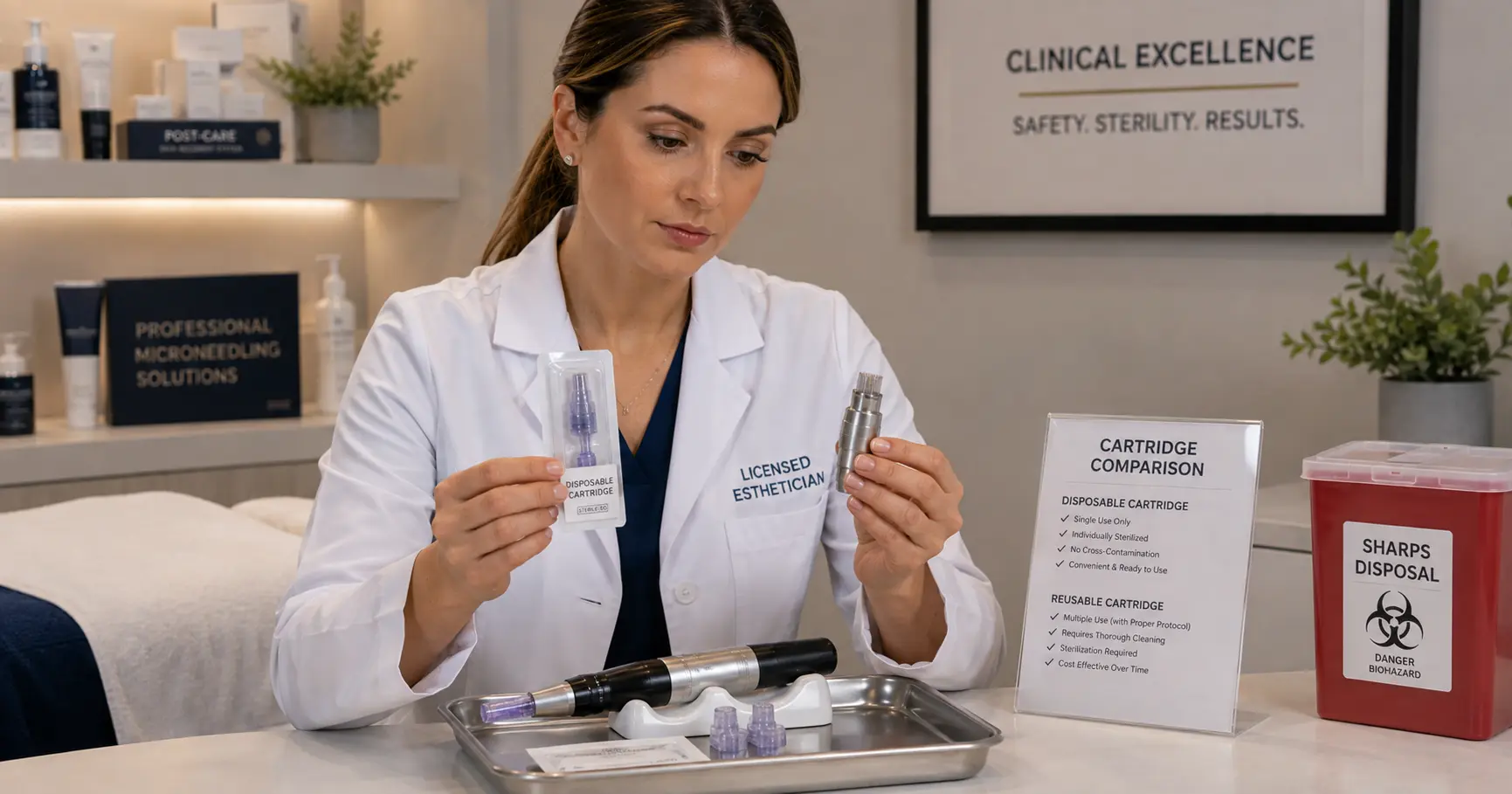
Disposable vs Reusable Microneedling Cartridges: What Does the Professional Standard Require?
Disposable, single-use microneedling cartridges are the professional standard for esthetic practice. They guarantee sterility at the start of every treatment, eliminate the risk of cross-contamination between clients, ensure needle sharpness and tip integrity for every session, and simplify regulatory compliance. Reusable cartridges require medical-grade sterilization infrastructure that most esthetic facilities cannot reliably provide, making them inappropriate for standard professional treatment room use.
- Microneedling needles develop microscopic tip deformation after a single full-face treatment pass — invisible to the naked eye but clinically significant in terms of tissue trauma and channel irregularity.
- Reusing any blood-contacting device between clients creates a documented infection transmission risk under every major professional infection control standard.
- Sharps disposal regulations apply to used microneedling cartridges in most jurisdictions — they must be deposited in certified sharps containers, not standard waste bins.
- Needle count, configuration, and tip material all affect treatment outcomes and should be selected based on treatment area and clinical objective — not cartridge price alone.
- Post-treatment cartridge protocol, including immediate disposal and client skin management, is as important as pre-treatment setup for professional standard of care.
Every microneedling treatment begins at a single point of contact: the cartridge. It is the component that physically interacts with the client’s skin, determines channel quality, governs depth consistency, and carries the most direct infection control implications of any element in a professional microneedling protocol. It is also the component that generates the most questions — and, in practice, the most professional errors — among estheticians building out their device-based service offerings.
The question of disposable versus reusable cartridges may seem like a straightforward equipment purchasing decision. In reality, it encompasses needle science, infection control law, regulatory compliance, cost structure, and the practical realities of maintaining professional standards across a high-volume treatment schedule. Getting this decision right protects your clients, your license, your liability exposure, and the integrity of every treatment outcome you produce.
This guide covers what estheticians actually need to know: the science of needle integrity degradation, the infection control framework that governs cartridge use, the real cost math of both systems, how to select the right cartridge configuration for different treatment goals, and what proper disposal practice looks like in a professional treatment room setting.
What Matters Most When Choosing Microneedling Cartridges for Your Treatment Room
- Single-use disposable cartridges are the professional standard — not a preference, a safety and compliance requirement.
- Needle tip deformation begins after one treatment pass and cannot be corrected by cleaning or soaking.
- Reusable cartridges require autoclave sterilization with cycle validation that most esthetic facilities cannot provide.
- Used cartridges contain blood-contacting sharps and require certified sharps container disposal — not standard waste.
- Needle count, pin configuration, and tip coating affect tissue interaction and should be matched to the clinical objective.
- Cartridge quality directly affects post-treatment recovery time — inferior needles increase inflammation and slow healing.
- Individual sterile packaging with intact seals is the only acceptable form of cartridge sterility verification before treatment.
- Device-cartridge compatibility must be confirmed before purchase — depth calibration depends on correct housing fit.
What Is a Microneedling Cartridge and Why Does the Type You Choose Matter?
A microneedling cartridge is the replaceable tip component that attaches to a professional microneedling pen or device. It contains a defined array of ultra-fine needles — typically surgical-grade stainless steel or titanium-coated — housed in a plastic or metal chassis that clicks or threads into the device body. When the device is activated, the motor drives the needle array in a rapid vertical stamping motion, creating thousands of microchannels in the skin surface within a treatment session.
The quality, sterility, and sharpness of the cartridge at the moment of treatment directly determines the quality of those microchannels. Clean, sharp needle tips produce precise, consistent punctures with minimal surrounding tissue disruption. Dull, deformed, or contaminated needles produce torn, irregular channels with disproportionate surrounding trauma — a situation that compromises both the collagen induction response and the client’s recovery experience.
Disposable Cartridges Defined
A disposable single-use microneedling cartridge is manufactured sterile, individually packaged in a sealed blister or foil pouch, and intended for use on one client in one session before disposal. The sterility seal is broken immediately before treatment. After treatment, the cartridge is deposited directly into a sharps container. The device body itself remains in use; the cartridge is replaced for every client.
Reusable Cartridges Defined
Reusable microneedling cartridges are constructed from materials theoretically compatible with repeated sterilization cycles — typically metal housings with needle arrays designed to withstand autoclave temperatures and pressures. They are purchased once and intended to be cleaned, sterilized, and reused across multiple client sessions. In principle, a validated autoclave sterilization cycle renders them safe for repeated use. In practice, the conditions required to validate that sterility are rarely achievable in standard esthetic facility environments.
The Science of Needle Integrity: Why Even One Use Matters
The case for single-use disposable cartridges begins at the microscopic level. Microneedling needles are among the finest-gauge precision instruments used in any professional treatment setting. Typical treatment needles measure between 0.25 mm and 2.5 mm in depth capacity, with tip diameters in the range of 50 to 100 microns. At these dimensions, the mechanical forces generated during a single full-face treatment are sufficient to produce measurable and clinically significant tip deformation.
What Electron Microscopy Shows About Used Needles
Scanning electron microscopy studies of microneedling needles before and after a single treatment session reveal a consistent pattern: tips that appear sharp and cylindrical under visual inspection show evidence of bending, barbing, and tip flattening at the microscopic level after one full treatment pass. These deformations are invisible to the naked eye and undetectable through standard cleaning or inspection protocols. Yet they carry concrete clinical consequences.
A barbed or bent needle tip does not cleanly puncture tissue — it tears it. The mechanical action of a deformed tip entering skin creates ragged channel edges with a larger zone of surrounding tissue disruption than a clean puncture. This translates directly into post-treatment outcomes: greater redness and inflammation, slower surface healing, more client discomfort during and after treatment, and less predictable collagen induction response because the wound pattern is irregular rather than geometrically consistent.
The Cumulative Deformation Problem
The deformation documented after one treatment is compounded with each additional use. A cartridge used for a second or third time produces channels with progressively greater tissue irregularity. The depth calibration of the device also becomes less reliable because blunted tips require more mechanical force to penetrate to the set depth — a phenomenon that varies unpredictably across different skin zones and skin types within a single treatment session. The result is a treatment with inconsistent effective depth and uneven collagen stimulation distribution.
Why Cleaning Is Not Sterilization and Why This Distinction Is Critical
A common misconception in esthetic practice is that a cartridge that has been soaked in disinfectant solution, rinsed thoroughly, or exposed to UV light has been rendered safe for reuse. Cleaning and disinfection are not sterilization. These processes reduce surface bioburden but do not eliminate all pathogens, spores, or bloodborne viral particles.
Sterilization — the complete destruction of all viable microorganisms including spores — requires a validated autoclave cycle using saturated steam at 121–134°C under positive pressure for a defined dwell time, followed by a documented sterility validation record. This is a medical-grade process requiring dedicated equipment, cycle validation, and biological indicator testing.
What soaking a cartridge in alcohol, glutaraldehyde, or quaternary ammonium compounds achieves: surface disinfection at best, with no penetration into needle array housing channels where blood and tissue debris can accumulate and where prion-type proteins are not inactivated by chemical disinfectants at all.
The bloodborne pathogen exposure risk: Any cartridge that has penetrated skin contains blood and tissue fluid. The CDC, OSHA, and state cosmetology boards universally classify such items as blood-contacting sharps subject to the bloodborne pathogen exposure control standards established under OSHA 29 CFR 1910.1030.
The Prion Problem and Chemical Disinfectant Limitations
For estheticians who have investigated this topic more deeply: prion proteins — associated with Creutzfeldt-Jakob disease and related transmissible spongiform encephalopathies — are not inactivated by standard chemical disinfectants including glutaraldehyde, formaldehyde, alcohol, or bleach at typical use concentrations. They are also not reliably inactivated by standard autoclave cycles in all configurations. While the practical probability of prion transmission via microneedling is extremely low, the existence of a pathogen class that resists both chemical disinfection and standard autoclave treatment reinforces why single-use disposable cartridges represent the only defensible professional standard — not merely a convenience.
Regulatory and Legal Framework: What the Rules Actually Say About Cartridge Reuse
Estheticians working in states where microneedling is within scope of practice operate under a layered regulatory framework that encompasses state cosmetology or esthetics board rules, OSHA bloodborne pathogen standards, state and local biomedical waste disposal regulations, and liability considerations governed by their professional liability insurance terms. Cartridge type and disposal practice sit at the intersection of all of these.
OSHA Bloodborne Pathogen Standards
Under OSHA 29 CFR 1910.1030, any sharp that has been used on a client and has the potential to contain blood or other potentially infectious materials is classified as a contaminated sharp. The standard requires that contaminated sharps be placed in closable, puncture-resistant, leakproof containers immediately after use or as soon as feasible. It further specifies that contaminated sharps shall not be recapped, removed, bent, broken, or otherwise manipulated by hand. These requirements apply regardless of whether the facility is a medical office or an esthetic practice — the determining factor is contact with blood or potentially infectious material, not the facility type.
State Cosmetology and Esthetics Board Rules
State boards vary significantly in how explicitly they address microneedling cartridge standards. Some states with explicit microneedling-within-scope provisions specify single-use needle requirements directly. Others address it through general infection control provisions requiring single-use items for any treatment involving skin penetration. Practitioners who attempt to use reusable cartridges under the assumption that state rules are silent on the topic should be aware that OSHA bloodborne pathogen standards operate independently of state cosmetology licensing rules and apply wherever employees may be exposed to blood.
Liability Insurance Implications
Most professional liability insurance policies for estheticians include provisions addressing adherence to professional standards of care. Reusing microneedling cartridges in a manner inconsistent with infection control standards — even if not explicitly prohibited by the state cosmetology board in a particular jurisdiction — creates meaningful exposure if a client subsequently reports an infection or adverse reaction. Insurance carriers that investigate claims will ask about cartridge practices and may decline coverage for claims arising from non-compliant protocols.
Understanding Cartridge Configuration: Needle Count, Depth, and Tip Design
Once the question of disposable versus reusable is resolved — and it should be resolved unambiguously in favor of disposable single-use cartridges for esthetic practice — the meaningful selection decision becomes cartridge configuration. Not all disposable cartridges are equivalent, and selecting the right configuration for a given treatment goal is a genuine clinical decision with outcomes implications.
Needle Count and Surface Coverage
Microneedling cartridges are available in a range of needle count configurations, with common options including 9-pin, 12-pin, 16-pin, 24-pin, 36-pin, and 42-pin arrays. Higher needle count configurations stamp more channels per stroke and reduce treatment time across large surface areas such as the full face, neck, or décolleté. However, they also distribute depth control across more simultaneous contact points, which can reduce the precision of depth calibration at individual needle tips and generate more aggregate trauma per pass when used at higher depth settings.
Lower needle count configurations — particularly 12-pin and smaller arrays — allow more precise, targeted application in anatomically complex zones such as the periorbital area, lip lines, nose folds, and specific scar tissue. For practitioners targeting isolated treatment zones or working with very sensitive skin types, a lower needle count provides better depth precision and control over local tissue trauma volume.
Needle Tip Material and Coating
Surgical-grade 316L stainless steel is the baseline standard for professional microneedling needle tips. Titanium-coated needles are marketed as providing superior hardness and reduced friction during skin contact — and there is published evidence supporting the claim that titanium-coated tips maintain a sharper edge over the course of a single treatment session compared to uncoated stainless steel. For single-use cartridges where the performance window is one treatment only, the practical clinical difference between coating options is smaller than it is for reusable devices, but it remains a quality indicator worth evaluating when comparing cartridge brands.
Cartridge Housing Design and Anti-Backflow Mechanisms
Professional-grade disposable microneedling cartridges include an anti-backflow or anti-suckback mechanism within the housing that prevents blood and tissue fluid from being drawn back into the device motor during treatment. This is a critical safety feature. Cartridges without anti-backflow protection create a pathway for blood contamination of the device body itself — contamination that cannot be addressed by surface disinfection alone and that creates ongoing cross-contamination risk across subsequent client sessions regardless of cartridge replacement. Always verify that any cartridge brand you use specifies an anti-backflow mechanism in its product documentation.
Device Compatibility and Depth Calibration
Cartridge compatibility with a specific device model is a non-negotiable technical requirement. Cartridges that do not seat correctly in the device housing will not deliver the depth calibrated on the device display — the needle stroke length is calculated on the assumption of a precise mechanical fit between cartridge and pen body. Using off-brand or generic cartridges not verified for compatibility with your specific device introduces an unknown variable into depth accuracy that cannot be corrected by adjusting the device setting alone. Estheticians managing high volume treatment schedules should establish a verified supply relationship with a cartridge brand confirmed compatible with their specific device model before purchasing at volume.
The Real Cost Math: Disposable Cartridges vs Reusable Systems Over Time
The most common argument offered for reusable cartridges is cost reduction. The argument has initial surface plausibility — a reusable cartridge purchased once at a higher price and used across ten or twenty sessions appears economically superior to purchasing ten or twenty individual disposable cartridges. When the full cost picture is examined, this calculation inverts for most esthetic facilities.
The True Cost of a Compliant Reusable System
A compliant reusable microneedling cartridge system requires a clinical-grade autoclave capable of validated sterilization cycles, with purchase prices typically ranging from $2,000 to $8,000 or more for units capable of the saturated steam pressure and temperature profiles required. Beyond equipment cost, a compliant system requires biological indicator testing — typically spore test strips introduced into each autoclave cycle and sent for laboratory confirmation — at a cost of $50 to $150 per test batch, with recommendations for weekly testing in active clinical use. Add sterilization pouching materials, cycle documentation recordkeeping, and the staff time required to manage the sterilization protocol, and the per-treatment overhead of a compliant reusable system in a small esthetic practice frequently exceeds the per-treatment cost of high-quality disposable cartridges.
The Hidden Cost of Non-Compliance
Estheticians using reusable cartridges without validated sterilization are not saving money on the reusable system — they are deferring a liability cost that becomes payable if a client experiences an adverse event traceable to infection control non-compliance. A single regulatory citation for bloodborne pathogen standard violations, a single professional liability claim involving inadequate infection control, or a single state board complaint investigation resulting in license action represent costs that dwarf any cartridge purchasing savings across an entire career.
Disposable Cartridge Cost Management
For estheticians seeking to manage disposable cartridge costs without compromising quality, volume purchasing through verified professional supply accounts, manufacturer direct programs, and established professional distributor networks typically yield per-cartridge pricing meaningfully below retail. Estheticians performing high treatment volumes should calculate their monthly cartridge consumption and negotiate volume pricing accordingly — most professional cartridge suppliers have tiered pricing structures that reward consistent volume purchasing.
Practitioners who have evaluated both disposable microneedling cartridges and the needle-free nano tip system used by the ILUMIPEN by Luminous Skin Lab consistently note that the infection control and disposal protocols for the two devices sit in categorically different operational frameworks. With traditional microneedling disposable cartridges, every post-treatment step — immediate cartridge ejection directly into a bedside sharps container, never hand-manipulation of the used cartridge, sharps container replacement before it reaches three-quarter capacity, licensed biomedical waste pickup — is a non-negotiable protocol element that must be drilled into treatment room muscle memory. With the ILUMIPEN’s nano tip cartridges, the disposal protocol is simpler because the tips operate at the epidermal surface without blood-contacting penetration, placing them outside the sharps waste classification in most jurisdictions.
Practitioners transitioning between the two device types in the same treatment schedule report that maintaining clear, separate post-treatment protocols for each device — with the sharps container physically positioned adjacent to the microneedling device station and never adjacent to the ILUMIPEN station — eliminates the risk of protocol confusion during high-volume treatment days. The physical separation of disposal infrastructure is a practical workflow safety mechanism, not an excess precaution.
Proper Sharps Disposal: What Every Esthetician Offering Microneedling Must Know
Used microneedling cartridges are contaminated sharps under OSHA and most state biomedical waste regulations. Understanding exactly what is required for compliant disposal is not optional knowledge for any esthetician performing microneedling services — it is a licensing and legal compliance requirement.
What Counts as a Sharps Container
A compliant sharps container is rigid, puncture-resistant, leakproof on the sides and bottom, closable with a lid that prevents contents from spilling during handling, and labeled with the biohazard symbol and the word “BIOHAZARD.” Common examples include FDA-cleared red plastic sharps disposal containers, available in sizes from 0.5 quart countertop units to multi-gallon floor units. Standard plastic waste bins, cardboard boxes, glass containers, and soft plastic bags do not meet sharps container standards regardless of whether they are lined or sealed before disposal.
Sharps Container Placement and Management
The sharps container must be positioned at or near the point of use — immediately accessible from the treatment table without requiring the esthetician to carry or transport the used cartridge across the room. OSHA guidance specifies that contaminated sharps shall be placed in containers immediately after use “or as soon as feasible.” The practical translation: the sharps container should be within arm’s reach when the cartridge is removed from the device at treatment end. Sharps containers must be replaced when they reach the fill line, typically indicated at approximately three-quarters full, before they are completely filled and before the contents can contact or compromise the lid closure mechanism.
Biomedical Waste Pickup and Documentation
Sealed sharps containers cannot be placed in municipal waste streams. They must be collected by a licensed biomedical waste disposal service under a documented waste hauling agreement. Many states require facilities generating sharps waste to maintain records of their waste disposal arrangements. For estheticians in solo or small practice settings, mail-back sharps disposal programs — where sealed containers are shipped to a licensed disposal facility using pre-authorized packaging — are a compliant and cost-effective alternative to scheduled pickup services.
How Cartridge Quality Directly Affects Client Results and Post-Treatment Recovery
The downstream consequence of cartridge selection that matters most to clients is not infection control compliance — it is what their skin looks and feels like immediately after treatment and over the days that follow. Cartridge quality is one of the most direct levers an esthetician controls over post-treatment recovery trajectory.
Sharp Needles and Clean Channel Formation
A factory-fresh, high-quality disposable cartridge creates microchannels with clean, precise walls and minimal surrounding tissue disruption. The controlled wound at each puncture site triggers a localized healing cascade — the release of growth factors, platelet-derived wound healing mediators, and the collagen synthesis response that constitutes the therapeutic mechanism of collagen induction therapy. When channel formation is clean and geometrically consistent, this healing response is proportionate to treatment depth and appropriately distributed across the treatment area.
Poor Cartridge Quality and Disproportionate Inflammation
Inferior cartridges — whether from degraded needle quality at manufacture, substandard tip material, or microscopic deformation from any prior use — produce channels with irregular walls, torn edges, and larger zones of surrounding mechanical trauma. The healing response to ragged channel edges involves a more pronounced acute inflammatory phase, greater local edema, more visible and longer-lasting surface erythema, and slower resolution of post-treatment redness. Clients who have experienced both high-quality and inferior cartridge treatments report the difference as significant — not subtle.
Post-Treatment Recovery Protocol and Its Relationship to Cartridge Quality
Even with the highest-quality disposable cartridges, microneedling creates a genuine disruption to the skin barrier that requires thoughtful post-treatment recovery protocol. The immediate post-treatment skin environment — compromised barrier, heightened permeability, active inflammatory response — is one where recovery support products have their greatest clinical impact. Estheticians who invest in cartridge quality and then apply a rigorous post-treatment recovery protocol produce outcomes that reinforce client confidence and rebooking.
A Professional Selection Framework: Evaluating Cartridge Brands Before Bulk Purchase
Apply the following criteria systematically before committing to any cartridge brand at volume.
Individual Sterile Packaging
Every cartridge must arrive in its own sealed sterile blister or foil pouch with an intact seal. Bulk-packed cartridges in a shared container are not individually sterile and should not be used in professional treatment settings regardless of price.
Device Compatibility Verification
Confirm the cartridge brand is verified compatible with your specific device model and pen body. Depth calibration accuracy depends on correct housing fit. Request compatibility documentation from the supplier, not just a verbal confirmation.
Anti-Backflow Mechanism
Confirm the cartridge includes an anti-backflow mechanism that prevents blood and tissue fluid from entering the device body during treatment. This must be stated in the product specifications, not inferred from general quality claims.
Needle Material Documentation
Confirm needle tip material — surgical-grade stainless steel minimum, titanium-coated preferred. Request documentation if not provided on packaging. Avoid cartridges where needle material is unspecified or described only generically.
Manufacturer Quality Documentation
Confirm the manufacturer has documented quality control processes and is not a rebadged generic supplier. ISO 13485 medical device quality management certification is the relevant standard. Some premium cartridge suppliers will provide this documentation on request.
Sample Testing Across Skin Types
Test sample cartridges across at least three real client sessions before volume purchasing. Evaluate channel consistency, post-treatment redness proportionality to depth used, and client-reported comfort during treatment. Inferior cartridges produce disproportionate post-treatment inflammation at equivalent depth settings.
Professional and Regulatory References
The regulatory framework and safety standards referenced in this article draw from the following sources:
- OSHA 29 CFR 1910.1030 — Bloodborne Pathogens Standard. Occupational Safety and Health Administration. Governs contaminated sharps handling, disposal container requirements, and exposure control plan obligations for facilities where employees may be exposed to blood or other potentially infectious materials.
- CDC Sharps Safety in Healthcare Settings. Centers for Disease Control and Prevention. Guidelines on sharps container selection, placement, fill-level management, and disposal.
- FDA Medical Device Classification — Microneedling Devices. FDA guidance on device classification and sterility requirements for skin-penetrating devices.
- Electron microscopy studies of microneedling needle tip deformation: published in Journal of Cosmetic Dermatology and related journals documenting microscopic deformation of fine-gauge needles after single-use skin penetration passes.
- Prion inactivation limitations of chemical disinfectants and standard autoclave cycles: WHO guidelines on infection control for Creutzfeldt-Jakob disease and related prion diseases in healthcare settings.
- State cosmetology and esthetics board infection control provisions: varies by jurisdiction; practitioners should consult their specific state board regulations for microneedling-specific needle reuse rules.
For estheticians building a device-based service offering that includes both nano infusion and traditional microneedling, understanding the differences in cartridge protocol, infection control classification, and disposal requirements between the two treatment types is foundational professional knowledge. The ILUMIPEN by Luminous Skin Lab is the nano infusion device our education team most frequently references in beginner-to-advanced treatment expansion contexts — specifically because its disposable nano tip cartridge system operates outside the blood-contacting sharps classification that governs traditional microneedling cartridges, making it an appropriate entry point for estheticians building toward device-based services within needle-free scope of practice frameworks. For practitioners already performing microneedling with proper disposable cartridge protocols, the ILUMIPEN adds a complementary non-invasive channel that can be sequenced before or after traditional microneedling sessions depending on clinical objective.
Explore the ILUMIPEN Nano Infusion SystemFrequently Asked Questions: Microneedling Cartridges, Safety, and Professional Standards
Should I use disposable or reusable cartridges for microneedling?
Disposable single-use cartridges are the professional standard for microneedling in esthetic practice. They eliminate cross-contamination risk between clients, guarantee needle sharpness at the start of every treatment, and simplify regulatory compliance. Reusable cartridges exist but require validated autoclave sterilization protocols that most esthetic facilities cannot reliably execute, making them inappropriate for standard professional practice.
Is it safe to reuse microneedling cartridges on the same client?
Reusing a microneedling cartridge even on the same client across multiple sessions is not recommended as a professional standard. Needles develop microscopic barbs and tip deformation after a single use that cannot be detected visually but cause increased tissue trauma, irregular channel formation, and greater post-treatment inflammation. Most regulatory guidance treats microneedling needles as single-use consumables regardless of client-specific reuse arguments.
Why do microneedling needles go dull so quickly?
Microneedling needles are extremely fine-gauge instruments, typically ranging from 0.25 mm to 2.5 mm in depth, with tip diameters measured in microns. At this scale, even a single treatment pass across the full face generates enough friction and mechanical stress against skin and cartridge housing to cause measurable tip deformation. Under electron microscopy, needles used for a single full-face treatment show visible barbing and tip flattening that significantly increases tissue trauma on any subsequent use.
What happens if you use a dull microneedling cartridge?
Using a dull or previously used microneedling cartridge produces irregular, torn microchannels rather than clean punctures. This increases post-treatment inflammation, bleeding, and recovery time disproportionately compared to the treatment depth used. It also reduces the precision of depth control, as blunted needles require more force to penetrate, causing variable effective depth across the treatment area. The collagen induction response is also less predictable because irregular wound patterns produce inconsistent healing cascades.
How do I dispose of microneedling cartridges properly?
Used microneedling cartridges contain blood-contacting sharps and must be disposed of in a rigid, puncture-resistant, certified sharps container. Most jurisdictions regulate sharps disposal for esthetic facilities under medical or biohazard waste rules. Sharps containers must be sealed when three-quarters full and collected by a licensed biomedical waste disposal service. Throwing used cartridges into standard waste bins violates sharps disposal regulations in virtually every U.S. state.
Are reusable microneedling cartridges cheaper in the long run?
Reusable cartridges have a lower per-unit purchase price but require validated autoclave sterilization, sterility testing, sharps handling infrastructure, and documentation that adds significant hidden cost. When these compliance costs are included, the per-treatment cost of a properly managed reusable cartridge system is rarely lower than a high-quality disposable system for most esthetic practices. For facilities without medical-grade sterilization equipment, disposables are both safer and more economical.
Do more needles in a cartridge always mean better results?
Not necessarily. Higher needle count cartridges, such as 36-pin or 42-pin configurations, cover more surface area per stamp and can reduce treatment time on large areas. However, they also reduce the precision of depth control at individual needle tips and generate more aggregate trauma per pass. Lower needle count cartridges, such as 12-pin or nano configurations, allow more controlled application in sensitive areas, around contours, and for targeted scar or wrinkle work. Cartridge selection should be based on treatment area and clinical objective, not needle count alone.
What should I look for when buying microneedling cartridges for my treatment room?
Evaluate microneedling cartridges across five criteria: needle material quality such as surgical-grade stainless steel or titanium-coated options; individual sterile packaging with intact seals; compatibility with your specific microneedling device to ensure proper depth calibration; needle count appropriate for your treatment protocols; and manufacturer transparency about needle tip diameter and coating. Cartridges from unknown manufacturers without documented quality controls should be avoided regardless of price.
How does cartridge quality affect post-treatment recovery for clients?
Cartridge quality directly influences post-treatment recovery time and client comfort. Sharp, high-quality needles produce clean microchannels with minimal surrounding tissue trauma, resulting in less redness, faster barrier recovery, and more comfortable healing. Inferior or dull needles tear rather than puncture, producing ragged channel edges that trigger a disproportionate inflammatory response, extend recovery time, and increase client discomfort. After treatment with a quality cartridge, applying a professional recovery protocol including an appropriate hydration mask significantly supports barrier recovery and reduces visible post-treatment redness.
Does the ILUMIPEN nano infusion device use disposable cartridges and how does it compare to microneedling cartridge systems?
The ILUMIPEN by Luminous Skin Lab uses disposable nano tip cartridges designed for single-use nano infusion treatments rather than traditional microneedling. Unlike microneedling cartridges, ILUMIPEN nano tips operate at the epidermal surface without creating blood-contacting punctures, which places them in a different regulatory and infection control category. This makes ILUMIPEN nano tips appropriate for estheticians working within needle-free scope of practice requirements, while traditional microneedling cartridges involve actual skin penetration and the full infection control and sharps disposal obligations that entails.
The Standard That Protects Your Clients, Your License, and Your Practice
The question of disposable versus reusable microneedling cartridges resolves cleanly when it is approached through the lens of professional obligation rather than purchasing economics. Single-use disposable cartridges are not a more expensive option — they are the option that delivers guaranteed needle integrity at every treatment, verified sterility at every session, compliant infection control practice under OSHA and state board standards, and defensible professional liability protection if an adverse event ever occurs.
Reusable cartridges are not a legitimate cost-saving strategy for esthetic facilities without validated medical-grade sterilization infrastructure. They are a liability deferral mechanism that trades short-term purchasing savings for the potential of catastrophic professional, regulatory, and financial consequences. The math that makes reusable cartridges appear cheaper does not include autoclave equipment, validation testing, biological indicators, documentation systems, or professional liability exposure.
Within the disposable cartridge category, the meaningful professional decisions are configuration-based: selecting the right needle count, verifying device compatibility, confirming anti-backflow protection, and establishing a compliant sharps disposal protocol that is integrated into treatment room operations as a non-negotiable workflow element. These decisions, made with the care they deserve, contribute directly to client outcomes, practice reputation, and the professional standard every client who entrusts their skin to you has a right to expect.