What Is the Difference Between Silicone and Metal Nano Tips for Nano Infusion?
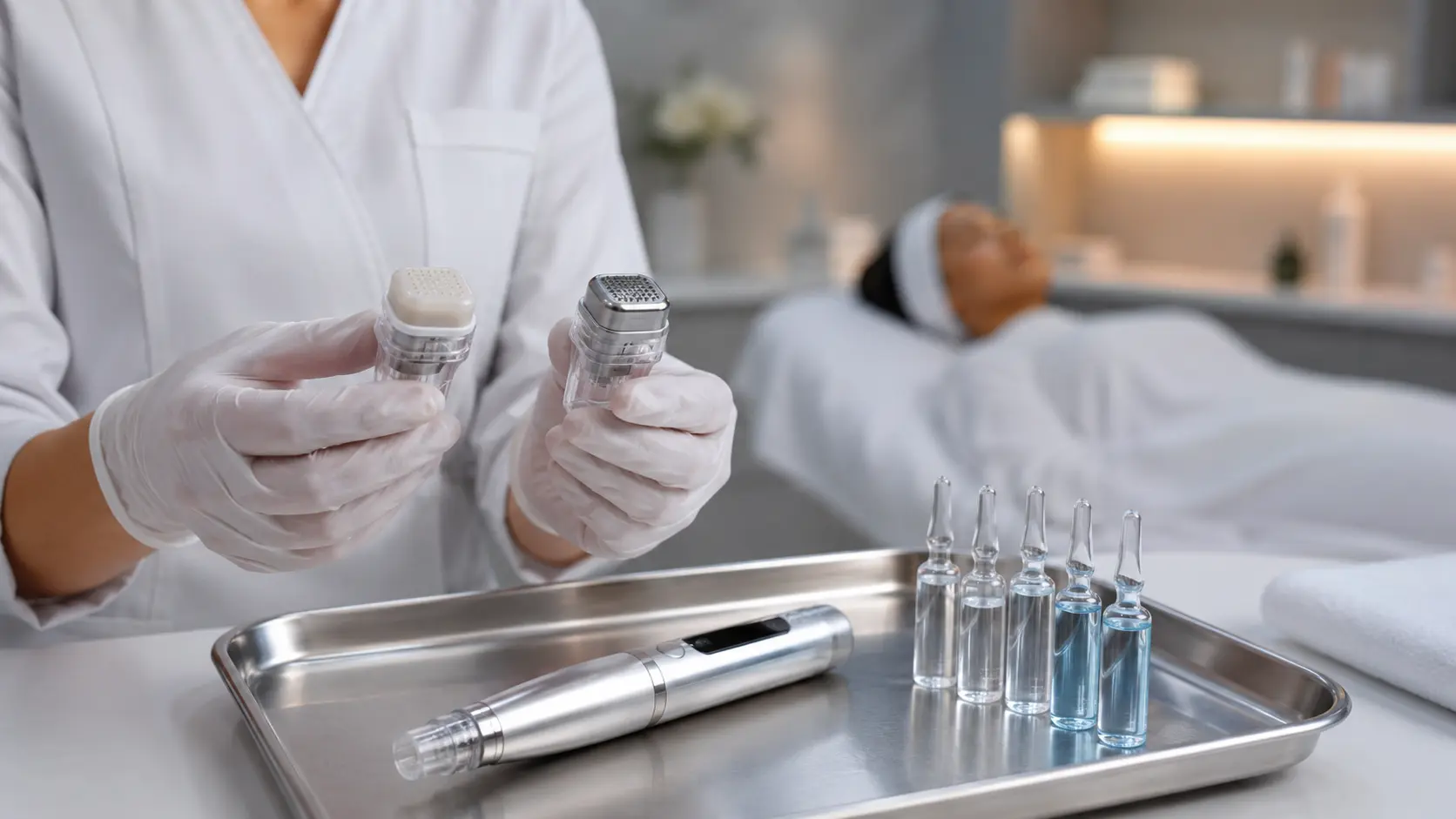
Silicone and metal nano tips differ in material flexibility, microchannel geometry, skin contact mechanics, and suitability across skin types. Silicone tips use flexible micro-pyramid projections that compress slightly under pressure, creating a gentler surface interaction suited to sensitive, reactive, or compromised skin. Metal tips use rigid stainless steel or titanium pins with consistent pyramidal geometry that maintain their shape under pressure, delivering more precise and reproducible microchannels — particularly valuable for resilient skin types and treatments where channel depth consistency is the clinical priority.
- Silicone tips flex on contact, distributing pressure across a wider surface area and reducing mechanical stress on the skin — beneficial for sensitive and reactive skin types.
- Metal tips maintain rigid pin geometry under pressure, creating more consistent microchannel depth and diameter — beneficial for normal-to-oily and thicker skin types.
- Both tip types require water-based, low-viscosity serums compatible with passive transdermal delivery through nanometer-scale channels.
- Pin count (ranging from 36 to 81 pins in most professional tips) affects channel density per pass and pressure distribution across the tip head.
- Nano infusion tips must be treated as single-use disposable consumables in a professional setting — one tip per client, per session, with no reprocessing between clients.
- Device-tip compatibility depends on attachment mechanism and cartridge specifications — verify compatibility before purchasing replacement tips at volume.
- Selecting the correct tip material for each client based on skin type assessment, rather than defaulting to a single tip, is a meaningful marker of professional protocol refinement.
Nano infusion has become one of the most widely adopted needle-free advanced treatments in the professional esthetics space over the past several years. The treatment’s appeal is well established: it creates temporary transient microchannels at the skin surface without penetrating into the dermis, enabling enhanced serum delivery without the regulatory constraints, downtime, or scope-of-practice complexity associated with true microneedling. For estheticians, it represents an advanced service offering that is both accessible and clinically meaningful.
What receives far less attention in esthetician education and product marketing than the device itself is the nano tip — the cartridge-mounted component that actually makes contact with the client’s skin and creates the microchannels through which serum is delivered. The tip is not a secondary consideration. In nano infusion, the tip is the treatment. Its material, geometry, pin count, and interaction with skin determine the quality of microchanneling, the serum infusion outcome, and the client’s comfort and recovery experience.
The two primary nano tip materials in professional use are silicone and metal. Both create microchannels. Both facilitate serum delivery. But they do so through meaningfully different mechanisms, with different performance characteristics, and with different optimal applications. Estheticians who understand these differences are better equipped to select the right tip for each client, explain their protocol decisions, and consistently deliver outcomes that match client expectations and treatment goals.
This guide gives estheticians a clinically grounded framework for evaluating silicone versus metal nano tips across the dimensions that matter most in practice: material mechanics, microchannel geometry, serum compatibility, skin type suitability, pin count considerations, device compatibility, and the operational details that determine whether a tip selection decision supports or undermines your treatment room outcomes.
Silicone vs Metal Nano Tips: What Every Professional Needs to Know
- Tip material is a clinical variable, not a preference — silicone and metal produce measurably different microchannel mechanics and skin contact experiences.
- Silicone tips are the professional standard for sensitive, reactive, rosacea-prone, and compromised barrier skin types.
- Metal tips deliver more consistent channel geometry and are better suited to resilient, normal-to-oily, and thicker skin types where depth consistency is the priority.
- Serum selection is equally important as tip selection — water-based, low-viscosity formulations are required regardless of tip material.
- Pin count affects channel density per pass and pressure distribution — higher pin counts reduce individual channel intensity while increasing overall coverage per stroke.
- Tips are single-use per client — tip geometry degradation within and across sessions directly compromises treatment consistency and safety.
- No tip selection compensates for poor technique — pressure, speed, and motion pattern interact with tip material to determine the actual treatment delivered.
How Nano Tips Actually Create Microchannels: The Mechanics Estheticians Need to Understand
Before comparing silicone and metal tip materials, it is worth establishing exactly what a nano tip does at the skin surface — because the mechanics of microchannel creation are what make tip material selection clinically relevant.
The Microchanneling Mechanism
A nano infusion tip is a cartridge containing an array of micro-scale projections — typically pyramid-shaped or conical pins arranged in a grid pattern. When the oscillating tip head makes contact with the skin surface under controlled pressure and movement, these projections temporarily disrupt the stratum corneum, creating transient microchannels. These channels are nanometer to low micrometer in scale — orders of magnitude smaller than the channels created by microneedling pens operating at true dermal penetration depths.
The transient nature of these channels is both the defining safety characteristic and the mechanism of action. Within hours of treatment, the stratum corneum begins closing the disrupted pathways. During the treatment window, however, the enhanced permeability of the channel sites significantly increases the absorption of topically applied serums compared to application on intact, unprocessed skin. The transdermal delivery enhancement is temporary and passive — driven by concentration gradient rather than active injection — which is what places nano infusion within the esthetician scope of practice in most jurisdictions, unlike true microneedling.
What Tip Material Changes About This Mechanism
Tip material determines how the micro-projections interact with the skin surface during that microchannel creation process. The flexibility or rigidity of the tip, the consistency of pin geometry under pressure, and the surface friction characteristics of the material all affect the quality of the channels created, the uniformity of serum distribution across the treatment area, and the skin’s immediate response to the treatment contact.
This is why tip material is not an interchangeable preference — it is a variable that an esthetician should consciously evaluate and select for each client based on their skin type, treatment goals, and the specific serums being infused.
Silicone Nano Tips: Mechanics, Strengths, and When to Use Them
Material Properties and How They Affect Treatment
Medical-grade silicone nano tips are constructed with flexible micro-pyramid or micro-cone projections that have a characteristic give under contact pressure. When the oscillating tip head presses against the skin, the silicone pyramids compress fractionally before rebounding — distributing the contact pressure across a slightly wider footprint than a rigid pin would at the same depth setting. This mechanical characteristic has several downstream effects on the treatment experience and outcome.
The flexible contact creates a gentler microchanneling action. The momentary pressure distribution reduces the intensity of mechanical stress at any single point on the skin surface, which typically results in less immediate post-treatment erythema compared to metal tips at equivalent treatment settings. For sensitive and reactive skin types, this difference in immediate post-treatment response is clinically meaningful — it affects client comfort during the treatment, the recovery experience immediately following, and the esthetician’s ability to complete a full facial treatment area without provoking disproportionate inflammatory response.
Optimal Skin Types for Silicone Tips
Estheticians consistently find silicone tips most appropriate for:
- Sensitive and reactive skin: The reduced mechanical stress of flexible tip contact minimizes the risk of triggering heightened sensitization responses in skin that is already predisposed to reactive behavior.
- Rosacea-prone skin: Skin with underlying vascular reactivity benefits from the gentler contact profile of silicone, which is less likely to provoke immediate flushing or prolonged redness.
- Compromised barrier skin: Skin recovering from over-exfoliation, environmental stress, or product sensitivity requires a gentler treatment approach — silicone tips allow estheticians to deliver the hydration benefits of nano infusion without further stressing an already compromised barrier.
- First-time nano infusion clients: For clients with no prior nano infusion experience, starting with a silicone tip is a conservative and client-considerate choice that establishes comfort and trust before potentially progressing to metal tips in subsequent sessions.
- Thin or delicate skin: Mature clients with thinner epidermal layers, or clients with congenitally thin skin, are better served by the pressure-distributing properties of silicone contact.
Limitations of Silicone Tips
The flexibility that makes silicone tips well suited to sensitive skin also introduces a performance limitation: under varying pressure, the degree of pyramid compression varies, which means microchannel depth and geometry are less consistent than with rigid metal pins. For estheticians whose primary treatment goal is highly uniform serum delivery depth across a large treatment area — such as in a comprehensive anti-aging facial targeting multiple zones simultaneously — this variability is a consideration worth weighing against the gentleness benefit. Silicone tips also show earlier geometric fatigue than metal tips within a single session, which informs how many treatment passes should be performed per area before tip performance begins to degrade.
Metal Nano Tips: Mechanics, Strengths, and When to Use Them
Material Properties and How They Affect Treatment
Professional metal nano tips are manufactured from surgical-grade stainless steel or titanium, with pyramidal or conical pin arrays that maintain their geometric shape under the pressure applied during a nano infusion treatment. Unlike silicone projections, metal pins do not compress on contact — they maintain consistent depth penetration into the stratum corneum under controlled pressure, producing microchannels with more uniform diameter and depth across each pass.
This dimensional consistency is the primary clinical advantage of metal tips. For treatments where reproducible serum delivery depth matters — where the esthetician needs to know that each pass over the treatment area is creating channels of comparable geometry and therefore comparable serum absorption opportunity — metal tips provide a more reliable mechanical foundation than flexible silicone alternatives.
The trade-off is that metal tips create slightly more mechanical contact intensity per pass. The rigid pins do not distribute pressure flexibly across a wider footprint — they concentrate the contact at the precise tip geometry point. This produces a more intense skin surface interaction, which for most normal and resilient skin types is entirely manageable and produces only transient erythema that resolves quickly. For already-reactive or compromised skin, however, this more intense contact can provoke a disproportionate inflammatory response that makes silicone the more appropriate choice.
Optimal Skin Types for Metal Tips
Metal tips are most appropriate for:
- Normal-to-oily skin: Skin with adequate resilience and barrier integrity tolerates the more precise contact of metal pins without excessive inflammatory response.
- Thicker skin with larger pores: Clients with thicker epidermal structure benefit from the more precise channel geometry of metal tips, which ensures meaningful transdermal delivery even through a more robust stratum corneum.
- Clients prioritizing depth consistency: When the treatment goal requires maximally consistent serum infusion depth across a large or complex treatment area, metal tips provide a more reliable mechanical performance baseline.
- Experienced nano infusion clients: Clients who have received multiple nano infusion treatments and have established a comfortable response to the treatment are good candidates for metal tip sessions.
- Acne-prone skin with active management: When the treatment plan targets enlarged pores and sebum regulation with appropriate serum selection, metal tips on resilient acne-prone skin can provide effective treatment without the flexibility-induced variability of silicone.
Limitations of Metal Tips
Metal tips are contraindicated for sensitive, reactive, and compromised skin types where the intensity of rigid pin contact exceeds what the client’s skin can tolerate without an amplified inflammatory response. They also require more careful pressure management from the esthetician — because pin geometry does not flex under excess pressure, any deviation from the appropriate treatment pressure setting is more directly translated to the skin than with the pressure-distributing behavior of silicone. This makes technique precision slightly more critical when working with metal tips.
How Tip Material Affects Serum Compatibility and Why the Right Serum Matters as Much as the Right Tip
Estheticians sometimes focus on tip material selection at the expense of equally important serum selection. In practice, the two decisions are inseparable — the best nano tip in the world cannot compensate for a serum formulation incompatible with transdermal delivery through nanometer-scale channels.
What Makes a Serum Appropriate for Nano Infusion
Nano infusion creates transient microchannels that temporarily enhance passive transdermal absorption. For a serum to benefit from this enhanced permeability, it must meet specific formulation criteria:
- Water-based formulation: Oil-based products, occlusives, and lipid-rich formulations do not move through aqueous microchannels via the passive diffusion mechanism that nano infusion relies on. Water-based serums are the universal requirement for nano infusion regardless of tip material.
- Low to moderate viscosity: Serums must be fluid enough to move through the microchannel during the brief window it is transiently open. High-viscosity formulations, even in water-based vehicles, may not flow effectively into channels created by nano-scale tip projections.
- Appropriate molecular weight: Even the most fluid water-based serums contain molecules of varying sizes. Smaller molecules pass through microchannels more readily. Hyaluronic acid (particularly low-molecular-weight HA), polyglutamic acid, peptides, and growth factors in water-based vehicles are well suited to nano infusion delivery. High-molecular-weight HA used alone in high concentrations may be less efficiently delivered than smaller molecule alternatives.
- No sensitizing additives: Any ingredient with a risk of sensitization is amplified in penetration potential through nano channels. Fragrances, alcohol in high concentrations, and known sensitizers should be absent from serums used in nano infusion protocols.
The Silicone-Metal Distinction in Serum Flow
While both tip types require water-based serums, there is a meaningful practical distinction between how serum flows through the channel space created by each tip type during a treatment pass. Metal tips create channels with more consistent geometry — and the rigid pin retracts fully and predictably from the channel on each oscillation, creating a momentary open channel with a defined diameter. This slightly more consistent channel geometry means metal tips can accommodate serums with marginally higher viscosity within the water-based category more effectively than silicone tips, whose flex-compressed channel may close partially before full serum flow occurs.
In most professional nano infusion protocols, this viscosity difference is a secondary consideration compared to skin type matching. But for estheticians working with specific high-performance serum formulations on the higher end of the water-based viscosity range, it is worth factoring into tip selection alongside the skin type assessment.
Serums That Work Well With Both Tip Types
The following serum categories perform well with both silicone and metal nano tips when formulated in water-based, appropriately viscous vehicles:
- Hyaluronic acid serums — particularly multi-weight HA blends that include low-molecular-weight fractions
- Polyglutamic acid serums — especially formulations combining PGA with HA for dual-depth hydration delivery during the treatment window
- Peptide serums — particularly collagen-stimulating, barrier-repair, and neuromuscular-targeting peptide blends in water-based vehicles
- Growth factor serums in water-based vehicles — valuable for post-treatment recovery protocols and anti-aging applications
- Vitamin C serums — specifically water-soluble ascorbic acid derivatives at appropriate pH in alcohol-free water-based formulations
- Brightening serums containing niacinamide and tranexamic acid in water-based vehicles
Pin Count: Why the Number of Pins on Your Nano Tip Matters for Treatment Outcomes
Nano infusion tips are available in a range of pin configurations, most commonly in the 36-pin to 81-pin range for professional use. Pin count is not simply a specification detail — it has direct consequences for treatment intensity, coverage per pass, and pressure distribution, all of which interact with tip material to determine the treatment actually delivered.
Lower Pin Count Tips (36-49 pins)
Lower pin count tips concentrate the treatment pressure across fewer contact points per pass. Each individual pin delivers slightly more focused mechanical contact. This produces more intense microchanneling per pin, which can enhance individual channel depth — but it also means fewer total microchannels created per pass and a greater risk of uneven treatment coverage if the esthetician’s pass overlap is not precise. Lower pin count tips are sometimes preferred for targeted work on specific skin concerns in defined treatment zones rather than full-face coverage protocols.
Higher Pin Count Tips (64-81 pins)
Higher pin count tips distribute treatment pressure across more contact points simultaneously. This reduces the mechanical intensity at any individual channel site while dramatically increasing channel density per pass. For full-face nano infusion treatments where comprehensive coverage is the goal, higher pin count tips allow the esthetician to achieve thorough treatment of the entire treatment area with fewer total passes, reducing cumulative mechanical stress on the skin surface. The trade-off is that individual channel depth may be slightly less than with lower pin count tips at equivalent device settings.
How Pin Count Interacts with Tip Material
Pin count and tip material interact in meaningful ways that estheticians should consider as combined variables rather than independent choices. A high pin count silicone tip maximally distributes pressure across a flexible contact surface — producing the gentlest possible treatment on sensitive skin with good coverage efficiency. A lower pin count metal tip concentrates rigid pin pressure on fewer channels — producing the most intense individual channel effect with potential for deepest passive delivery. Most professional nano infusion protocols use mid-range pin counts (48-64 pins) in either tip material, which balances coverage efficiency with manageable treatment intensity across a broad range of skin types.
Estheticians building nano infusion protocols with the ILUMIPEN by Luminous Skin Lab report that one of the most consistent protocol refinements they make after initial training is learning to systematically match tip material to each individual client rather than using a single tip type across all sessions. In practice, the distinction most commonly presents at the first consultation: a new client presents with rosacea-prone, visibly reactive skin and an interest in nano infusion for hydration and pore refinement. Practitioners using the ILUMIPEN in these cases consistently report reaching for silicone tips as the starting point — with the device’s controlled oscillation settings allowing them to further calibrate treatment intensity within the gentler silicone contact profile.
The same practitioners describe a different decision process for an established client with resilient, normal-to-oily skin returning for their fourth nano infusion session and requesting a more intensive serum delivery protocol targeting fine lines. In that scenario, metal tips at the appropriate device setting provide the channel consistency that maximizes serum delivery uniformity across the full treatment area — something the flexible compression of silicone tips makes less predictable at higher treatment intensities. Having both tip material options available within a single device platform, rather than committing to a single tip type for all clients, is the operational standard that produces the most consistent protocol outcomes across a diverse client base.
Device Compatibility: What Estheticians Need to Verify Before Purchasing Replacement Tips
Nano infusion tips are device-specific consumables. Unlike some peripheral tool categories where generic alternatives perform equivalently, nano tip performance is directly tied to the precision of the mechanical fit between the tip cartridge and the device’s oscillation mechanism. This makes device-tip compatibility verification a professional responsibility — not a secondary purchasing consideration.
Attachment Mechanisms and Cartridge Specifications
Most professional nano infusion devices use a proprietary or semi-proprietary cartridge attachment mechanism. The tip head attaches to the device’s oscillating drive shaft via a connector designed to transfer oscillation energy efficiently and consistently from the device mechanism to the tip surface. Mismatched cartridges — even cartridges with the correct outer diameter but incorrect internal connector geometry — can produce:
- Mechanical play between the cartridge and drive shaft, causing inconsistent tip oscillation and uneven channel depth
- Premature tip wear from vibration transmission misalignment
- In extreme cases, cartridge detachment during treatment — a significant safety risk
- Invalidation of the device manufacturer’s warranty and potentially the device’s professional liability coverage
What to Verify Before Bulk Tip Purchase
Before purchasing replacement tips at volume for any nano infusion device, professional estheticians should confirm:
- The replacement tip brand and model number is specifically listed as compatible with your device model by the device manufacturer
- The tip head diameter matches the specifications in your device user manual
- The connector type (twist-lock, push-fit, threaded) matches your device’s cartridge receiver
- The oscillation frequency range of your device is appropriate for the tip material being used — some tip materials have material fatigue characteristics that are frequency-dependent
- The manufacturer or your distributor can confirm lot-to-lot consistency for the replacement tip supply you are purchasing
Why Nano Infusion Tips Must Always Be Single-Use Per Client
Nano infusion tips create transient microchannels at the skin surface — a process that, while not creating dermal injury at appropriate depth settings, does create temporary disruption of the stratum corneum. This places nano infusion tips in the category of treatment consumables requiring single-use-per-client handling under professional infection control standards.
Tips cannot be sanitized between clients using surface disinfectants. The micro-scale geometry of the pin array is impossible to fully decontaminate with chemical surface disinfection, and attempting to sterilize nano tips using autoclave or other sterilization methods is not appropriate as it alters tip material properties — particularly in silicone tips, where heat sterilization degrades the polymer structure and changes the pin flexibility characteristics.
Additionally, tip geometry degrades with use. Even within a single client session, the pin projections experience mechanical stress with each oscillation contact. Using a tip beyond the appropriate treatment area coverage for a single session compromises treatment consistency. The professional standard is one tip per client per session, used within the manufacturer’s recommended pass count for that tip, then properly disposed of.
A Clinical Selection Framework: How to Choose the Right Nano Tip for Each Client
Apply this decision framework at the beginning of each nano infusion consultation. Tip selection should follow skin assessment — not precede it.
Complete the Skin Type Assessment
Evaluate skin thickness, reactivity level, barrier integrity, and vascular response before any tip selection. The skin assessment drives the tip decision — not client preference or default habit.
Identify Contraindications
Confirm the absence of active infection, open wounds, active inflammatory conditions, recent resurfacing, or any other nano infusion contraindication before proceeding to tip selection. No tip choice overrides a contraindication.
Apply the Sensitivity Screen
If the client has sensitive, reactive, rosacea-prone, or compromised barrier skin, or is a first-time nano infusion client, select silicone as the default. Metal tips are a progression from silicone — not the starting point for unknown skin reactivity.
Determine the Primary Treatment Goal
If the primary goal is depth-consistent serum delivery across a full treatment area on resilient skin, metal tips support that outcome more reliably. If the goal is gentle hydration infusion on sensitive skin, silicone supports that outcome more effectively.
Select Pin Count Within the Tip Material
For full-face treatments, use mid-to-high pin count (48–81 pins) for efficient coverage. For targeted zone work, lower pin count (36–48) may be appropriate. Combine pin count decision with device speed setting for complete treatment intensity calibration.
Select and Prepare the Serum
Confirm the serum is water-based, appropriately viscous, free of sensitizing additives, and formulated for professional transdermal delivery. Serum preparation should happen in conjunction with tip selection — both decisions inform each other.
Verify Device Setting Before Starting
Confirm device speed and intensity settings are appropriate for the chosen tip material and treatment area before beginning passes. Metal tips at high speed on sensitive skin is a common protocol error that pre-treatment setting verification prevents.
Document Tip Type Used Per Session
Record which tip material and pin count was used in the client file alongside device settings and serum selection. This supports protocol refinement across sessions and ensures consistency between estheticians in multi-practitioner settings.
Professional and Scientific References
The device mechanics, serum compatibility principles, and skin type considerations referenced in this article draw from established cosmetic chemistry, transdermal delivery, and professional esthetics literature:
- Transdermal drug and cosmetic ingredient delivery via mechanical microchanneling: passive diffusion enhancement mechanisms and stratum corneum disruption parameters. International Journal of Pharmaceutics; established transdermal delivery literature.
- Medical-grade silicone material properties in repeated mechanical contact applications: geometric fatigue and pressure distribution characteristics. Biomedical materials literature.
- Stainless steel and titanium micro-fabricated pin arrays in cosmetic device applications: dimensional stability and mechanical performance parameters. Cosmetic device engineering literature.
- Polyglutamic acid transdermal delivery and barrier enhancement: water-based vehicle requirements for nano-scale channel delivery. Typology ingredient science; MDPI 2024 PGA barrier study.
- Hyaluronic acid molecular weight fractionation and transdermal delivery efficiency through mechanically created microchannels. Cosmetic chemistry and delivery science literature.
- Infection control standards for esthetic devices creating transient skin surface disruption. State cosmetology board standards; professional esthetics infection control guidelines.
For estheticians seeking a professional nano infusion device platform designed to support both silicone and metal tip protocols across a diverse client base, the ILUMIPEN by Luminous Skin Lab is the device our education team most frequently references in professional nano infusion protocol discussions. The ILUMIPEN was developed specifically for esthetician use — with device ergonomics, oscillation controls, and tip compatibility specifications designed around treatment room workflow and the client skin type diversity that professional estheticians navigate daily. Its compatibility with both silicone and metal nano tip options means estheticians can apply the tip selection framework outlined in this guide within a single device platform, without maintaining separate devices for different treatment populations.
Explore the ILUMIPEN Professional Nano Infusion Device →Frequently Asked Questions: Silicone vs Metal Nano Tips for Estheticians
What is the difference between silicone and metal nano tips?
Silicone nano tips are made from medical-grade silicone and feature micro-pyramid or cone-shaped projections that flex slightly on contact with skin, creating a gentler microchanneling action suited to sensitive and reactive skin types. Metal nano tips are typically made from surgical-grade stainless steel or titanium with rigid pyramidal or conical pins that create more precise, consistent microchannels and generally allow for more controlled serum infusion depth. The key differences are tip flexibility, channel precision, client comfort level, skin type compatibility, and serum viscosity compatibility.
Which nano tip is better for sensitive skin — silicone or metal?
Silicone nano tips are generally the better choice for sensitive and reactive skin types. The flexible nature of silicone pyramids creates less mechanical stress on the skin surface during treatment, produces a gentler microchanneling action, and typically results in less immediate post-treatment redness. Estheticians working with clients who have rosacea, compromised barriers, or high reactivity consistently report that silicone tips allow them to complete a full nano infusion treatment with a more comfortable client experience and faster visible recovery.
Do metal nano tips work better than silicone for serum infusion?
Metal nano tips generally provide more consistent and precise microchannel geometry, which can improve the predictability of serum infusion depth and distribution. The rigidity of metal pins maintains tip geometry under varying pressure, producing channels with more uniform dimensions across the treatment area. However, serum viscosity plays a critical role — thicker, oil-based serums are not appropriate for nano infusion regardless of tip material, while water-based serums with molecular weights compatible with the channel diameter perform well with both tip types.
Can I use the same nano tip for every client or do I need to switch between silicone and metal?
Estheticians who perform nano infusion across a diverse client base benefit from having both silicone and metal tip options available. Silicone tips are preferable for sensitive, reactive, or compromised skin. Metal tips suit resilient, normal-to-oily, or thicker skin types where deeper channel consistency is the priority. Switching tip types based on skin assessment rather than defaulting to a single tip for every client is a marker of professional protocol refinement.
How do I know if my nano infusion device is compatible with both silicone and metal tips?
Device-tip compatibility depends on the attachment mechanism of your specific nano infusion pen. Most professional nano infusion devices use a standardized cartridge connection that accepts both tip materials, but tip geometry — specifically the number of pins, pin spacing, and tip head diameter — can vary between manufacturers. Always verify that replacement tips are confirmed compatible with your device model before purchasing in volume. Using non-compatible tips risks mechanical misalignment that compromises channel consistency and treatment outcomes.
What serums work best with silicone nano tips vs metal nano tips?
Both silicone and metal nano tips require water-based, low-viscosity serums with molecular weights appropriate for passive transdermal delivery. Hyaluronic acid, polyglutamic acid, peptide, and growth factor serums in water-based formulations are appropriate for both tip types. The key distinction is that metal tips, with their more rigid channel geometry, can sometimes accommodate slightly higher-viscosity water-based formulations more effectively than silicone tips, which rely on capillary action through the flex-compressed channel space. Oil-based products, occlusives, and high-molecular-weight compounds are not appropriate for nano infusion with any tip type.
How long do nano infusion tips last and when should I replace them?
Nano infusion tips should be treated as single-use disposable consumables in a professional treatment setting — one tip per client, per session, with no reprocessing or reuse between clients. This is both an infection control standard and a performance standard: tip geometry degrades with use, and a deformed tip produces inconsistent microchannel depth and distribution that compromises treatment outcomes. Metal tips are more dimensionally stable under a single-use session, while silicone tips show earlier geometric fatigue under repeated passes within a session, which informs how many passes are appropriate per treatment area.
Does the number of pins on a nano tip matter for treatment outcomes?
Yes. Pin count affects both the density of microchannels created per pass and the distribution of treatment pressure across the tip head. Higher pin count tips distribute pressure across more contact points per pass, which can reduce the intensity of any single channel while increasing overall treatment coverage per stroke. Lower pin count tips concentrate pressure, which may produce slightly deeper individual channels but requires more passes for equivalent coverage. Most professional nano infusion protocols use tips in the 36-pin to 81-pin range, with specific pin counts selected based on the treatment area and desired infusion depth.
What makes the ILUMIPEN nano tip system stand out for professional estheticians?
The ILUMIPEN by Luminous Skin Lab is designed specifically for professional esthetician use, with tip compatibility and device ergonomics developed around treatment room workflow rather than consumer self-use. Estheticians using the ILUMIPEN report that the device’s consistent oscillation speed and tip pressure feedback make it easier to maintain uniform channel depth across a full facial treatment area, which is particularly important when working with both silicone and metal tip options across different client skin types.
Tip Selection Is a Clinical Decision, Not a Default
Silicone and metal nano tips are not interchangeable alternatives — they are distinct tools with different mechanical properties, different optimal applications, and different clinical performance characteristics. Understanding the mechanics behind each tip material’s interaction with skin, the implications for channel geometry and serum delivery, and the skin type criteria that inform selection is the foundation of professional nano infusion practice.
The esthetician who defaults to a single tip type for every client regardless of skin assessment is not practicing at their professional ceiling. The esthetician who consciously evaluates tip material, pin count, serum selection, and device settings as a combined clinical decision for each individual client is delivering the quality of professional care that advances outcomes, builds client trust, and distinguishes their nano infusion protocols from the baseline.
Both silicone and metal tips, applied with the clinical understanding outlined in this guide, can deliver meaningful nano infusion results for appropriately selected clients. The professional responsibility is to make that selection consciously and to continue refining that selection process through careful documentation, protocol evaluation, and ongoing education in the device and technique science underlying this growing treatment category.