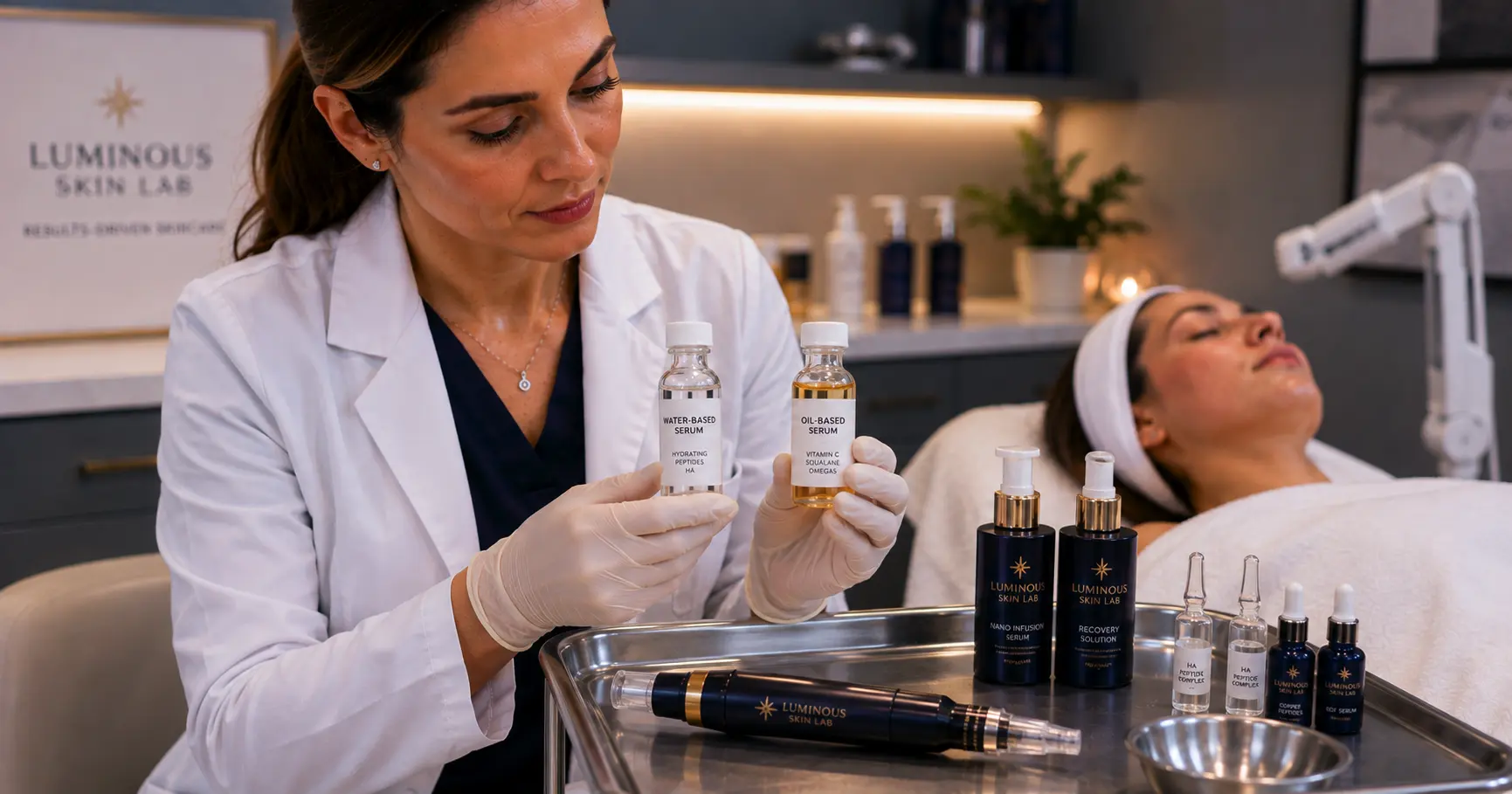
Water-Based or Oil-Based Serums for Nano Infusion — Which Should Estheticians Use?
Water-based serums are the professional standard for nano infusion treatments. The microchannels created by nano-tip devices are engineered for aqueous ingredient delivery, and oil molecules are too large and molecularly incompatible to be meaningfully infused through nano-scale channels. Oil-based serums also compromise tip glide, can clog the spaces between nano-tips, and leave a surface film that prevents water-soluble actives from reaching the microchannels effectively.
- Water-based serums provide the aqueous carrier that allows active ingredients to travel through transient nano-channels during treatment — oil-based formulations cannot replicate this delivery mechanism.
- Tip glide is directly affected by serum chemistry: water-based serums allow smooth, even glide; oil residue creates drag, uneven pressure, and inconsistent channel contact.
- The most effective nano infusion serums contain water-soluble actives including hyaluronic acid, peptides, growth factors, stable vitamin C forms, niacinamide, and amino acids.
- Serum viscosity matters: too thick creates tip resistance; too thin may evaporate before full coverage is complete. Light to medium viscosity is optimal.
- Oils and oil-based products have a defined role in nano infusion protocols — as post-treatment finishing steps to seal hydration — but never during the active device pass.
- Highly acidic exfoliating serums should be avoided during the nano infusion pass because heightened transdermal penetration amplifies their effect beyond safe topical levels.
Of all the technique variables that affect nano infusion outcomes, serum selection is among the most consequential — and among the most frequently misunderstood. The decision between water-based and oil-based formulations is not simply a matter of texture preference or ingredient availability. It is a question of delivery science, device compatibility, and clinical safety that directly determines whether the treatment achieves its therapeutic objectives or produces an expensive and incomplete result.
Estheticians new to nano infusion sometimes assume that any high-quality serum used in their standard facial protocols will perform equally well under a nano infusion device. This assumption is incorrect, and understanding why requires a basic grasp of how nano infusion creates transient microchannels and what those channels can — and cannot — transport.
This guide explains the science behind serum-to-channel compatibility, establishes clear criteria for evaluating water-based vs oil-based formulations, identifies which active ingredients perform best in nano infusion protocols, and provides a practical framework for sequencing serums and finishing products across different skin type goals. Estheticians who internalize this information will build more consistent treatment outcomes, fewer client complaints about tip drag or uneven results, and a stronger clinical foundation for serum recommendations across their practice.
What Every Esthetician Should Know About Serum Selection for Nano Infusion
- Water-based serums are not just preferred for nano infusion — they are the only formulation type that works with the device mechanism. Oil-based formulations are incompatible with the delivery physics of nano channels.
- Serum viscosity directly controls tip glide quality, channel contact consistency, and ingredient distribution across the treatment area.
- The most clinically effective nano infusion serums contain multiple molecular weights of hyaluronic acid, peptides, and growth factors in an aqueous carrier.
- Exfoliating acids at standard topical concentrations become potentially irritating at nano infusion delivery depths — they require careful evaluation before inclusion in any protocol.
- Oils belong after the device pass, not before or during it — sequencing this correctly protects both tip performance and ingredient delivery.
- Always verify pH and molecular weight compatibility before introducing any new serum into a nano infusion protocol.
- Skin type and treatment goal determine which active ingredient category should anchor the serum selection for each client.
How Nano Infusion Creates Transient Channels and Why Serum Chemistry Matters
Nano infusion devices use a tip array of extremely fine silicone or metal nano-pyramids or cones — typically between 150 and 400 nanometers in scale — that oscillate or stamp against the skin surface at high speed. Unlike microneedling, which penetrates into the dermis, nano infusion interacts only with the outermost layers of the epidermis: primarily the stratum corneum and superficial stratum granulosum. This distinction is clinically significant for several reasons, but for the purposes of serum selection, the most important consequence is what happens at the skin surface during the device pass.
As the nano-tips contact the skin, they create transient microchannels: temporary disruptions in the tightly organized stratum corneum barrier through which applied substances can pass more readily than through intact, undisturbed skin. These microchannels are not permanent. They remain open for a clinically meaningful window of minutes — the precise duration varies by device, tip design, treatment speed, and individual skin condition — before the barrier begins to reseal. Whatever is on the skin surface during this window has a significantly enhanced opportunity to penetrate.
This is the core delivery mechanism of nano infusion — and it is also why serum chemistry is so critical. The question is not simply “what ingredient do I want to deliver?” but “what carrier and molecular profile will allow that ingredient to travel through a nano-scale channel during a finite open window?” Water-based formulations, with their aqueous carrier and smaller dissolved molecule profiles, are designed for exactly this type of delivery. Oil-based formulations are not.
Why Oil Molecules Cannot Pass Through Nano Channels
Lipid molecules — the building blocks of oils and oil-based serums — are significantly larger than the transient channels created by nano-tip devices. Triglycerides, fatty acids, and plant oil compounds range in molecular weight from several hundred to several thousand daltons, and their hydrophobic nature means they do not disperse or travel through the aqueous environment of the stratum corneum interior. They remain at the skin surface as a film. This is not a failure — it is simply the correct physicochemical behavior of lipid molecules. It means they are performing as expected in a standard topical context. The problem arises only when an esthetician attempts to use them as infusion vehicles during a nano infusion treatment, where their behavior is fundamentally incompatible with the delivery mechanism.
Beyond the molecular delivery failure, oil residue on the skin surface during nano infusion creates a secondary problem: it coats the nano-tips and fills the spaces between the tip array, impeding the consistent contact between tip and skin that effective nano channel creation depends on. Practitioners who have inadvertently applied an oil-rich product before a device pass consistently describe the tip as dragging or sticking, the glide as uneven, and the sound and feel of the device as noticeably different from a clean skin-to-water-base pass.
What Makes a Water-Based Serum Well-Suited for Nano Infusion?
Not every water-based serum is equally suited for nano infusion. Within the broad category of aqueous formulations, significant variation exists in viscosity, molecular weight profile, pH, active ingredient concentration, and ingredient interaction potential at heightened penetration depths. Understanding what separates a well-suited nano infusion serum from a general-purpose hydrating serum is one of the more practically important distinctions an esthetician can develop.
Viscosity: The Tip Glide Variable
Viscosity is the most immediately obvious serum characteristic that affects treatment feel and device performance. A serum that is too thin — essentially water-like — will not provide adequate slip across the skin surface, can evaporate or be absorbed before the tip has completed a full pass of the treatment area, and may leave areas of the face with insufficient surface product for consistent channel delivery. A serum that is too thick — gel-like or dense — creates resistance against the tip, making smooth, even glide difficult and requiring additional pressure that can compromise technique consistency and skin comfort.
The optimal viscosity range for nano infusion is light to medium: a serum that flows smoothly off a fingertip with some resistance, spreads evenly across the skin with minimal drag, does not separate or run when applied to a slightly angled face, and maintains a consistent surface film throughout the 5 to 10 minutes of device coverage for a full face treatment. In practice, this means avoiding both very watery toners and very dense gel serums as primary infusion vehicles.
Molecular Weight Compatibility
Active ingredients in water-based serums exist at a range of molecular weights, and not all of them are equally deliverable through nano channels. As a general framework, smaller molecular weight actives penetrate more readily through both intact and nano-disrupted stratum corneum. This is why low molecular weight hyaluronic acid fragments penetrate more deeply than high molecular weight HA, and why certain peptides with small chain lengths show better transdermal delivery than larger protein complexes.
For nano infusion specifically, the most clinically productive active ingredient selections are those with molecular profiles that benefit meaningfully from the enhanced permeability window created by the device — ingredients that are well-established at topical delivery but gain additional clinical impact from the transient channel. High molecular weight HA used at the surface for humectancy is effective in any hydration protocol. Low molecular weight HA fragments used for deeper structural hydration are particularly well-suited to nano infusion delivery.
pH Compatibility
The pH of a serum affects both its stability on the skin surface and its behavior at the deeper delivery levels that nano infusion enables. The stratum corneum maintains a slightly acidic pH of approximately 4.5 to 5.5 — often referred to as the acid mantle — which is critical for barrier enzyme function and microbiome balance. Serums with pH values significantly outside this range, particularly highly acidic exfoliating serums, require particular caution in nano infusion protocols because the enhanced permeability of the treatment amplifies their effect at deeper layers in ways that can cause irritation, inflammation, or barrier disruption beyond the intended therapeutic effect.
Why Water-Based Serums Are the Only Effective Nano Infusion Vehicle
Aqueous carrier compatibility: The stratum corneum interior is a partially hydrophilic environment during the transient channel open window. Water-based serum molecules travel through this environment by passive diffusion and concentration gradient. Oil molecules, being hydrophobic, cannot enter or travel through this aqueous pathway regardless of tip pressure or device speed.
Molecular size alignment: Nano channels created by silicone or metal nano-tips are in the range of 150 to 400 nanometers. Water-soluble actives including peptides, vitamin C forms, small HA fragments, and niacinamide exist at molecular scales compatible with this channel size. Triglycerides and fatty acid chains in oils range from several hundred to several thousand daltons and are structurally incompatible with these channel dimensions.
Surface film integrity: Water-based serums maintain a thin, even film across the skin surface during the device pass, ensuring consistent product availability at every nano channel site. Oil films bead, create uneven coverage, and coat the tip array — producing inconsistent delivery across the treatment area.
Post-treatment role of oils: Facial oils and oil-based finishing products have genuine value in the nano infusion protocol sequence — applied after the device pass is complete, they seal the hydration delivered through the channels and support barrier recovery. This is the correct clinical application of lipid-based products in a nano infusion workflow.
Comparing Water-Based and Oil-Based Serums Across Every Key Performance Variable
The following comparison framework evaluates water-based and oil-based serum formulations across six performance variables directly relevant to nano infusion treatment outcomes. Use this framework when evaluating any serum for protocol inclusion.
Which Active Ingredients Perform Best in Nano Infusion Serums?
Within the category of water-based professional serums, estheticians have a broad range of active ingredient options. The optimal selection for each client depends on their primary skin concern, treatment history, sensitivity profile, and the specific results the protocol is designed to achieve. The following ingredient categories represent the most clinically validated options for nano infusion delivery.
Hyaluronic Acid — Multiple Molecular Weights
Hyaluronic acid is the most universally applicable ingredient for nano infusion serums and is present in most professional-grade formulations for good reason. As a water-soluble humectant with inherent affinity for skin tissue, HA benefits significantly from the enhanced permeability window created by nano infusion. Serums that incorporate multiple molecular weights of HA — high molecular weight for surface hydration and film formation, low molecular weight for deeper delivery — provide a more complete hydration effect than single-weight HA formulations. The nano infusion device pass particularly enhances delivery of the low molecular weight HA fractions that contribute to deeper tissue hydration.
Peptides and Growth Factors
Peptides — short chains of amino acids that signal skin cells to produce collagen, elastin, or other functional proteins — are among the most protocol-appropriate ingredients for nano infusion delivery. Many peptides exist at molecular weights compatible with nano channel delivery, and the enhanced penetration created by the device meaningfully improves on their standard topical delivery profile. Growth factors, whether derived from plant stem cells, human growth factor analogues, or EGF (epidermal growth factor) complexes, follow a similar rationale: their primary therapeutic mechanism depends on reaching receptor sites at or below the stratum corneum surface, and nano infusion enhances that delivery.
Stable Vitamin C Forms
Vitamin C in its various stable, water-soluble forms — sodium ascorbyl phosphate, ascorbyl glucoside, and magnesium ascorbyl phosphate — is a well-established brightening and antioxidant ingredient that performs well in nano infusion protocols. L-ascorbic acid (the purest form) is effective but requires careful pH management: at the 10 to 20% concentrations used in professional vitamin C serums, the enhanced penetration of nano infusion can create localized irritation on sensitive skin. Estheticians working with vitamin C in nano infusion protocols should evaluate their client’s sensitivity profile carefully and consider starting with stable derivative forms before progressing to pure L-ascorbic acid concentrations.
Niacinamide
Niacinamide (vitamin B3) is a versatile, well-tolerated water-soluble ingredient with documented benefits for pore appearance, sebum regulation, barrier support, hyperpigmentation reduction, and anti-inflammatory modulation. Its compatibility with nano infusion is excellent: good molecular size for channel delivery, stable pH range compatible with most professional serums, and broad skin type applicability. Niacinamide is a particularly strong choice for oily, acne-prone, or hyperpigmentation-focused nano infusion protocols.
What to Avoid During the Nano Infusion Pass
Several ingredient categories require caution or exclusion from the active nano infusion serum pass:
- High-percentage exfoliating acids (AHAs at 10%+, BHAs, PHAs at high concentrations) — the amplified penetration of nano infusion can cause irritation, erythema, or barrier disruption at concentrations that are well-tolerated topically.
- Retinol and retinoids — enhanced penetration depth combined with post-treatment barrier disruption creates an elevated sensitization risk. Retinol serums are more appropriately used in the client’s home care protocol following nano infusion, not during the treatment itself.
- Highly fragranced serums — fragrance compounds become sensitizing risks at nano infusion delivery depths, particularly for reactive or post-treatment skin.
- Serums with unknown or undisclosed ingredient profiles — never use a serum in a nano infusion protocol without full INCI knowledge. The enhanced delivery mechanism amplifies every ingredient in the formulation, not just the featured actives.
Matching Serum Selection to Skin Type and Treatment Goal
Once the fundamental compatibility requirement of a water-based formulation is confirmed, serum selection becomes a clinical matching exercise: which active ingredients best address this client’s primary concern, at what concentration range, and within what pH parameters? The following framework provides practical guidance across the most common skin type and treatment goal combinations.
| Skin Type / Concern | Recommended Serum Actives | Actives to Approach with Caution |
|---|---|---|
| Dehydrated / Dry | Multi-weight HA, amino acids, panthenol, aloe vera water base | High-concentration glycolic acid, retinol |
| Oily / Acne-Prone | Niacinamide, low-weight HA, salicylic acid at low concentration (1–2%), zinc peptides | High-fat humectant blends, fragrance-containing formulas |
| Sensitive / Reactive | Fragrance-free HA, panthenol, centella asiatica extract, low niacinamide (3–5%) | L-ascorbic acid, high-percentage actives, any synthetic fragrance |
| Mature / Anti-Aging | Growth factors, collagen-stimulating peptides, multi-weight HA, EGF analogues | Retinol (apply post-treatment at home, not during pass), high-acid serums |
| Hyperpigmentation | Stable vitamin C forms, niacinamide, tranexamic acid, kojic acid at low concentration | Very high L-ascorbic acid concentrations on sensitive Fitzpatrick types |
| Post-Treatment Recovery | Fragrance-free HA, centella asiatica, panthenol, growth factors — clean, minimal formulas | All exfoliating acids, retinol, vitamin C at high concentrations |
Estheticians working with the ILUMIPEN nano infusion device by Luminous Skin Lab consistently report that serum selection is the variable that most dramatically differentiates treatment outcomes between sessions — more than device speed, more than technique pattern, and more than treatment frequency. Practitioners describe a measurable difference in immediate post-treatment hydration response when they transition from single-active water-based serums to multi-molecular-weight HA serums specifically formulated for device delivery: clients notice the skin feels “plumper” and “more cushioned” in the minutes after treatment, and the skin holds that hydration response more visibly through the remainder of the day.
A specific observation relevant to viscosity management: estheticians using the ILUMIPEN report that adding a small amount of plain saline or distilled water to a serum that has thickened slightly — from temperature or air exposure during the treatment — to restore optimal viscosity mid-pass produces noticeably improved tip glide and more even delivery across the full face. This adjustment is a simple real-time quality control step that preserves the consistency of ingredient delivery across the entire treatment area, and it reflects the kind of attentive technique management that separates high-performing nano infusion results from average ones.
How to Correctly Sequence Oils and Oil-Based Products in a Nano Infusion Protocol
Establishing that oils should not be used during the active nano infusion pass does not mean they have no place in a nano infusion protocol. Facial oils and oil-based products serve a genuine and valuable clinical function when used correctly in the post-device phase of treatment, and understanding this sequencing distinction is important for designing complete protocols that address both the infusion delivery goal and the post-treatment skin recovery objective.
The Post-Treatment Finishing Role of Facial Oils
Following the active nano infusion device pass, the skin is in a state of heightened permeability with transient microchannels that are actively beginning to reseal. The treatment has delivered water-soluble actives, and the skin now benefits from a sealing layer that reduces transepidermal water loss and supports barrier recovery. This is the clinically appropriate moment to introduce an oil-based finishing product.
A lightweight facial oil applied as the final product step after nano infusion — following any post-treatment serum or mist, if used — serves as a lipid barrier support: creating an occlusive seal that keeps the humectants delivered during the treatment in contact with the skin, reduces TEWL during the immediate post-treatment period, and supports the barrier recovery process as the microchannels reseal. For clients with dry or barrier-compromised skin, this finishing oil step can meaningfully extend the visible hydration outcome of the treatment into the hours following their session.
A Professional Nano Infusion Product Sequencing Protocol
- Cleanse: Double cleanse to ensure completely oil-free, residue-free skin before any device contact. Any oil residue from cleansing oils or balms must be fully removed.
- Tone or prep: Apply a light alcohol-free toner or prep mist to hydrate and slightly plump the stratum corneum. This creates a receptive surface for serum delivery.
- Apply water-based serum: Apply the selected water-based treatment serum generously across the face. Work in sections if needed to prevent the serum from absorbing or evaporating before the device reaches that area.
- Nano infusion device pass: Complete the device pass systematically across all treatment zones. Re-apply serum to any area that has absorbed before the device reaches it. Maintain consistent tip contact and pressure throughout.
- Post-device serum or mist (optional): Apply a second application of the water-based serum or a hydrating mist immediately after the device pass to capitalize on the open-channel window before resealing begins.
- Oil-based finishing product (if appropriate): Apply a lightweight facial oil or barrier-supportive balm as the final product step to seal hydration and support barrier recovery. This step is skin-type dependent — appropriate for dry and barrier-compromised clients; less necessary for oily or acne-prone skin types.
- SPF: Complete the protocol with broad-spectrum SPF for all daytime treatments. Post-nano infusion skin is temporarily more photosensitive and requires UV protection.
Common Serum Selection Mistakes Estheticians Make in Nano Infusion Treatments
Using Oil-Based or Dual-Phase Serums Without Checking the Base
Some professional serums marketed as “treatment serums” or “intensive formulas” contain significant oil or ester components despite appearing serum-like in packaging or marketing description. Always check the INCI list. If a plant oil, synthetic ester, or silicone appears in the top five ingredients, the product is not suitable for use during the active nano infusion pass. Dual-phase serums that require shaking to combine a water phase and an oil phase are also not appropriate for device use — the phases separate immediately after shaking, and the oil component will compromise tip performance.
Applying Too Much Serum Too Fast
Applying the full session volume of serum across the entire face before beginning the device pass is a common beginner mistake. By the time the device reaches areas applied first, the serum has partially absorbed or dried, leaving insufficient surface product for effective channel delivery. Work in sections, re-applying serum to each zone immediately before the device pass reaches it. This ensures optimal surface product at every treatment point.
Selecting Serums Based on Label Claims Rather Than INCI Analysis
Marketing claims — “professional strength,” “advanced delivery formula,” “clinical grade” — carry no standardized regulatory definition and do not guarantee nano infusion compatibility. Evaluate every serum by its INCI ingredient list, molecular weight profile of key actives, pH, and viscosity characteristics. A serum that performs excellently in standard facial protocols may be entirely inappropriate for nano infusion use.
Ignoring Client Skin Sensitivity History When Choosing Actives
The enhanced penetration of nano infusion amplifies every ingredient in the serum, including potential sensitizers. A client who has tolerated a 15% vitamin C serum topically in standard protocols may experience redness, stinging, or inflammation if that same serum is used during a nano infusion pass without first assessing their tolerance at amplified delivery levels. Build in a patch test step when introducing any new high-active serum into a client’s nano infusion protocol.
Professional and Scientific References
The serum chemistry and delivery science referenced in this article draws from peer-reviewed dermatological literature, cosmetic chemistry research, and professional device documentation:
- Transdermal drug delivery through stratum corneum disruption: mechanism and clinical implications. Journal of Controlled Release; established transdermal pharmacology literature. Passive diffusion and concentration gradient mechanisms in transient channel delivery.
- Molecular weight dependency of hyaluronic acid penetration through disrupted stratum corneum. Cosmetic chemistry and dermatological literature, 2020–2025. Low molecular weight HA fractions demonstrate enhanced delivery through skin barrier disruption models.
- Peptide transdermal delivery: molecular weight thresholds and aqueous carrier requirements. International Journal of Pharmaceutics; cosmetic peptide science literature. Water-soluble peptide delivery through transient barrier disruption.
- pH of the skin surface and its impact on the barrier function. Skin Pharmacology and Physiology, established literature. Acid mantle pH 4.5–5.5 and implications for serum compatibility in enhanced delivery protocols.
- Niacinamide (vitamin B3): mechanism of action in sebum regulation, barrier function, and hyperpigmentation. Dermatologic Therapy; cosmetic chemistry literature.
- L-ascorbic acid stability and penetration considerations in professional delivery protocols. Cosmetic formulation literature, 2018–2025.
For estheticians building or refining their nano infusion protocols around the serum compatibility science discussed in this guide, the ILUMIPEN nano infusion device by Luminous Skin Lab was designed with serum-to-tip performance as a core engineering consideration. Its silicone nano-tip array is optimized for water-based serum glide, delivering consistent channel contact and even ingredient distribution across the full treatment area. The ILUMIPEN protocol documentation provides specific serum viscosity guidelines, water-based active ingredient recommendations, and post-treatment sequencing protocols that reflect the delivery science outlined here — giving estheticians a complete technical framework from device to serum to finishing step.
Explore the ILUMIPEN Nano Infusion DeviceFrequently Asked Questions: Serums for Nano Infusion Treatments
Can I use oil-based serums with a nano infusion device?
Oil-based serums are generally not recommended for use with nano infusion devices. The silicone or metal nano tips are engineered to move freely across the skin surface using water-based slip, and oil residue can cause tips to drag, stick, or clog the microchannels between the nano-tips. More importantly, oil molecules are significantly larger than the microchannels created by nano infusion, meaning they cannot be meaningfully infused and simply sit on the skin surface. Water-based serums are the professional standard for nano infusion treatment.
Why do water-based serums work better for nano infusion than oil-based ones?
Water-based serums work better for nano infusion because their aqueous base allows active ingredients to travel through the transient microchannels created by the nano-tip. The low viscosity of water-based formulations enables smooth tip glide across the skin, consistent ingredient distribution, and effective delivery of small to medium molecular weight actives including hyaluronic acid, peptides, growth factors, and vitamin C. Oil-based formulations lack the molecular size profile and aqueous carrier necessary for meaningful transdermal delivery through nano channels.
What ingredients should I look for in a nano infusion serum?
The most effective nano infusion serums contain water-soluble active ingredients with molecular weights compatible with nano-channel delivery. Top performing ingredient categories include hyaluronic acid (multiple molecular weights for depth variation), peptides, growth factors, vitamin C in stable water-soluble forms such as ascorbic acid or sodium ascorbyl phosphate, niacinamide, and amino acids. The serum should have a light to medium viscosity, a transparent or lightly milky appearance, and a pH appropriate for the skin concern being addressed.
Does serum viscosity affect how well nano infusion works?
Yes, viscosity directly affects nano infusion performance. Serums that are too thick create resistance against the tip, making it difficult to glide smoothly and reducing consistent channel contact. Serums that are too thin may not provide adequate slip and can evaporate before full device coverage is complete. A light to medium viscosity water-based serum provides the optimal balance of tip glide, sustained surface presence, and ingredient delivery through the transient nano-channels.
Can I use a hydrating serum and an oil together in a nano infusion treatment?
Yes, but the sequencing matters critically. The water-based serum should always be applied and infused first, during the active nano infusion device pass. Once the nano infusion treatment step is complete, a facial oil or oil-based finishing product can be applied as part of the post-treatment care protocol to seal hydration and support barrier recovery. Never apply oil to the skin before or during the active nano infusion pass, as it will compromise tip glide, clog the nano channels, and prevent water-soluble actives from penetrating effectively.
What serums should I avoid using with a nano infusion device?
Several serum types should be avoided during the active nano infusion pass. Oil-based and lipid-heavy serums cannot be infused and will compromise tip performance. Highly acidic exfoliating serums such as high-percentage AHAs, BHAs, or retinol should not be used during nano infusion because the transient channels amplify penetration to a degree that can cause irritation. Thick gel serums with large humectant molecules that exceed nano-channel capacity offer limited delivery benefit. Always confirm ingredient molecular weight and pH compatibility before incorporating any new serum into your nano infusion protocol.
How do I know if a serum is water-based or oil-based?
Check the INCI ingredient list. A water-based serum will list water (aqua) as its first ingredient, indicating the highest concentration ingredient is an aqueous base. The texture will be lightweight, transparent or lightly milky, and will absorb quickly without a greasy residue. An oil-based serum will list one or more plant oils, esters, or silicones near the top of the ingredient list and will feel noticeably richer, more emollient, and leave a skin-surface sheen. When in doubt, apply a small amount to the back of your hand and observe absorption speed and finish.
Should the serum I use for nano infusion be different from what I use for regular facials?
Often yes. Nano infusion increases the transdermal penetration of whatever is on the skin surface during treatment, so serums selected for nano infusion should be carefully chosen for both ingredient compatibility and skin safety at enhanced delivery depths. Actives that are beneficial and well-tolerated in standard topical application may require caution at the amplified delivery levels nano infusion provides. Work with professional-grade, treatment-specific serums formulated for use with transdermal delivery devices rather than repurposing general retail or back-bar serums without considering their ingredient concentration and pH.
What serums does the ILUMIPEN nano infusion device work best with?
The ILUMIPEN by Luminous Skin Lab is engineered for use with professional water-based serums formulated for nano infusion delivery. It performs optimally with light to medium viscosity aqueous serums containing hyaluronic acid, peptides, growth factors, or vitamin C. Luminous Skin Lab recommends pairing the ILUMIPEN with serums that have been specifically formulated or verified for transdermal device use, ensuring molecular weight compatibility, appropriate pH, and tip glide performance. Always confirm serum compatibility with your specific protocol goals before treatment.
Serum Selection Is a Clinical Decision, Not a Preference
The distinction between water-based and oil-based serums in nano infusion is not a matter of personal protocol preference or skin type philosophy — it is a delivery science requirement. The device mechanism creates transient aqueous channels through which water-soluble actives can travel. Oil molecules cannot enter those channels, will not be meaningfully delivered, and will actively impair the device performance that makes channel creation possible. This is not a nuanced debate: it is a clear, physics-based incompatibility that every esthetician performing nano infusion needs to understand at a foundational level.
Within the confirmed category of water-based serums, the clinical decisions become meaningfully complex: which actives, at what concentrations, at what molecular weights, and with what pH profile match this client’s concern, sensitivity history, and treatment goal? Building fluency in these decisions is what separates estheticians who deliver consistently outstanding nano infusion results from those who produce variable outcomes despite using the same device.
The protocol sequencing framework in this guide — water-based serum during the device pass, oil-based finishing products after — provides a clear, evidence-based structure for integrating both formulation types into a complete nano infusion service. Apply it consistently, evaluate your serum selections with the same rigor you apply to device technique, and your treatment outcomes will reflect the clinical depth that distinguishes expert nano infusion practice.