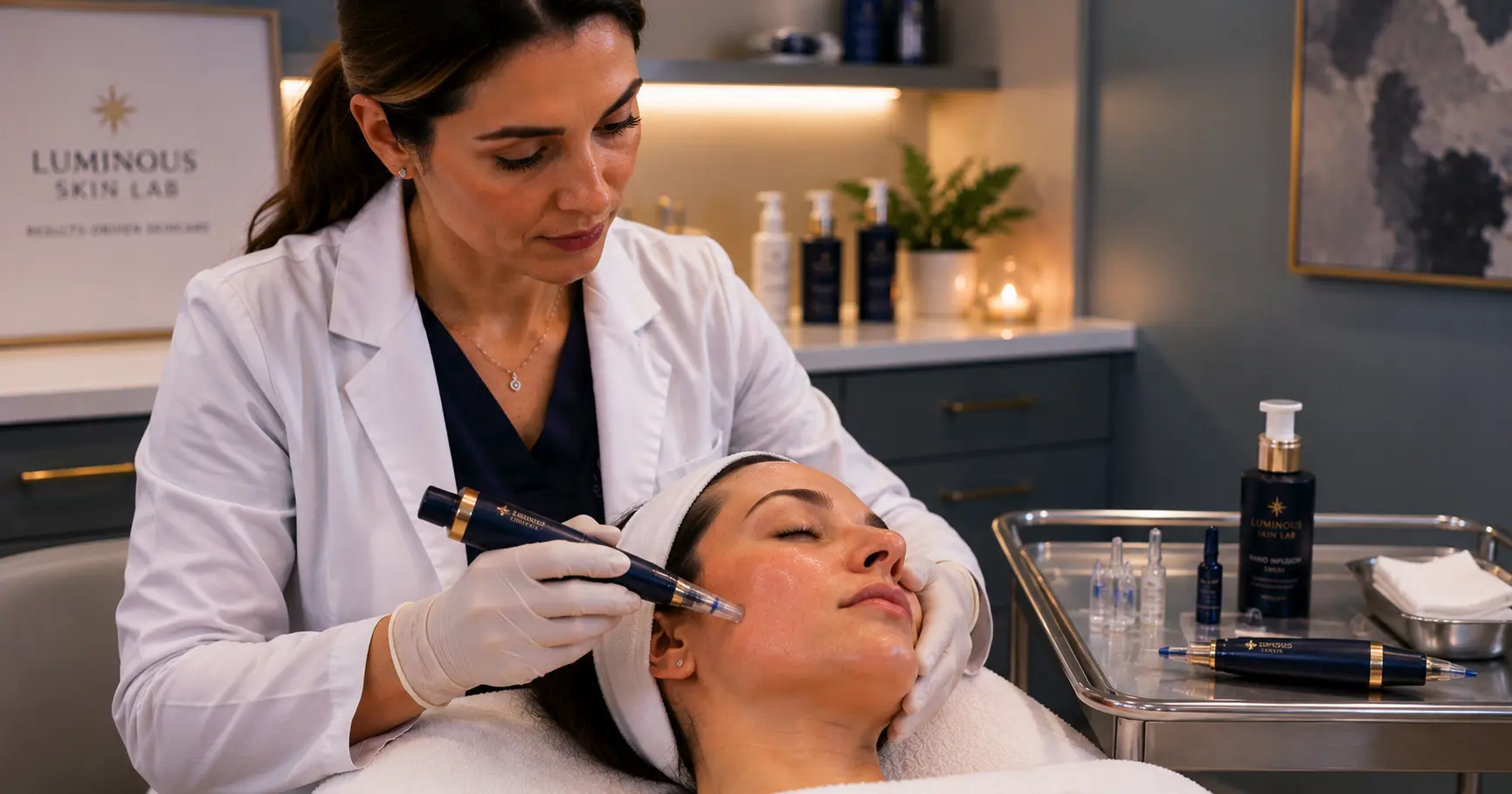
Stamp vs. Circular Motion in Nano Infusion: What Every Esthetician Should Know
In nano infusion treatments, the motion pattern used to pass the device across the skin — stamp or circular — directly affects microchannel consistency, serum delivery efficiency, mechanical skin stress, and how appropriate the technique is for different skin types and facial zones. Neither technique is universally superior. Each serves distinct clinical purposes, and experienced estheticians use both within a single session, selecting motion pattern based on treatment zone, client skin condition, and protocol objective.
- The stamp technique creates a controlled, vertical tip-contact pattern with minimal lateral drag — producing more consistent channel depth and spacing, and significantly less mechanical shear on the skin surface.
- Circular motion covers treatment area more rapidly and distributes serum across the surface more broadly, but introduces lateral friction that can be problematic for sensitive, reactive, or post-treatment skin.
- Delicate zones — periorbital, upper lip, nasal bridge — should always be treated with stamp technique regardless of the technique used elsewhere in the session.
- Serum saturation at the skin surface is critical for both techniques but is especially important for circular motion, where drag on an under-lubricated surface risks micro-abrasion and client discomfort.
- Most professional nano infusion protocols combine both techniques: stamp for controlled passes over the full face, circular motion for coverage efficiency on larger resilient zones, and stamp again for delicate and sensitized areas.
The mechanics of how a nano infusion device moves across the skin are more consequential than many estheticians initially appreciate. Most early-career practitioners focus their learning on device selection, tip choice, and serum formulation — all of which matter significantly — but overlook the degree to which motion pattern shapes both the clinical outcome and the client experience of a nano infusion treatment.
The two primary technique approaches — stamp and circular motion — produce meaningfully different outcomes in terms of microchannel consistency, depth uniformity, serum delivery per pass, skin surface stress, and post-treatment recovery dynamics. Understanding how and why they differ, and when each is appropriate, is one of the practical competencies that separates a technically proficient nano infusion practitioner from one who is simply moving a device across the face.
This guide covers the mechanical principles behind each technique, the clinical implications of their differences, a clear zone-by-zone framework for technique selection, common errors practitioners make with each approach, and how to integrate both techniques effectively within a single professional session.
What Matters Most When Choosing Between Stamp and Circular Motion
- Stamp technique produces more consistent channel depth and spacing with significantly less lateral friction — it is the safer default for most clients and all delicate zones.
- Circular motion offers coverage efficiency and serum distribution advantages on large, resilient skin zones but introduces friction and pressure variables that require more practitioner control.
- Serum volume on the skin surface is the most important environmental variable for both techniques — insufficient serum causes drag, discomfort, and potential micro-abrasion in either motion pattern.
- Zone-based technique selection is the professional standard — not a choice made once per session and applied uniformly across the entire face.
- Post-treatment skin, sensitized skin, and skin with active barrier compromise should be treated exclusively with stamp technique.
- Device speed settings interact with technique choice — lower oscillation rates are appropriate for stamp technique; higher rates support circular motion on resilient zones.
- The most effective nano infusion sessions combine both techniques deliberately, transitioning between them based on zone, skin response, and serum status throughout the treatment.
How Stamp and Circular Motion Techniques Differ Mechanically
To understand why technique choice matters clinically, it helps to first understand precisely what each motion pattern does at the skin surface and how the nano tip interacts with tissue differently in each approach.
The Stamp Technique: Controlled Vertical Contact
In the stamp technique, the esthetician holds the device perpendicular to the skin surface and moves it in a deliberate, section-by-section pattern — lifting and repositioning between each contact zone rather than dragging or gliding continuously. Each contact point is brief, controlled, and minimally overlapping with adjacent contact zones. The oscillating nano tip delivers its microchannel pattern within a defined area, and the practitioner moves to the next adjacent section before re-contacting.
This approach produces a grid-like pattern of microchannels across the treatment area. Because lateral drag is minimal, tip-to-skin contact angle remains consistent, and the oscillation energy is directed primarily vertically — into the skin — rather than being partially dissipated through lateral movement. The result is more uniform channel depth, more predictable spacing, and significantly less mechanical shear stress on the surrounding tissue between channels.
Circular Motion: Continuous Gliding Contact
In the circular motion technique, the esthetician maintains continuous tip-to-skin contact while moving the device in overlapping circular or figure-eight patterns across the treatment zone. The tip does not lift between passes; instead it glides across the skin surface continuously while oscillating. Coverage over a given treatment zone is achieved much more rapidly than with stamp technique, and serum is mechanically distributed across a wider surface area through the gliding motion itself.
Circular motion introduces a lateral vector of force at the skin surface that stamp technique does not. The oscillating tip is simultaneously moving both vertically (creating channels) and laterally (gliding across tissue). This lateral friction component means that skin surface lubrication — the serum layer — is consumed more rapidly, that softer or thinner skin can experience more mechanical stress, and that pressure consistency requires more active practitioner attention throughout each pass.
Controlled Vertical Contact
- More consistent channel depth per pass
- Minimal lateral friction or shear
- Suitable for all skin types including sensitive
- Appropriate for all facial zones including delicate areas
- Lower serum consumption per pass
- Slightly slower coverage over large areas
- Preferred technique for post-treatment skin
- Preferred technique for first-time clients
Continuous Gliding Contact
- Faster coverage over large treatment zones
- Serum distributed broadly across surface
- Suitable for resilient, thicker skin types
- Not appropriate for delicate or sensitized zones
- Higher serum consumption per pass
- Requires active pressure management throughout
- Not recommended for post-treatment or reactive skin
- Useful for hydration-focused coverage sessions
Why Serum Penetration Depth Differs Between the Two Techniques
One of the most clinically meaningful differences between stamp and circular motion nano infusion is how each technique delivers serum into the microchannels created by the oscillating tip. Understanding this difference helps estheticians select the right technique for the specific serum and treatment objective of each session.
How Serum Enters Microchannels During Stamp Technique
When the stamp technique is used correctly, the oscillating tip creates a defined cluster of microchannels within each contact zone, then lifts away from the surface. In the brief moment after tip contact, the newly created channel openings are at their maximum diameter and the serum pooled on the skin surface is drawn into them by capillary action. Because the tip has lifted away and is not moving laterally across the surface, the serum layer over each contact zone is not being displaced — it remains available to be drawn into the channel openings.
This mechanism makes stamp technique particularly effective for targeted serum delivery, especially when working with serums designed to address specific concerns like fine lines, hyperpigmentation, or dehydration in a localized zone. The serum goes into the channels rather than being redistributed across the surface.
How Serum Behaves During Circular Motion
During circular motion, the continuous gliding movement of the tip across the skin surface does two things simultaneously: it creates microchannels as the oscillating tip contacts the skin, and it physically moves the serum layer across the surface as it glides. This means that while serum coverage across a large treatment zone is achieved more quickly, the serum over any given microchannel is actively being displaced by the tip motion rather than remaining stationary for capillary-driven absorption.
The practical result is that circular motion is highly efficient for distributing serum broadly across large zones — cheeks, forehead, neck — where overall coverage is the objective. For targeted serum infusion where maximum per-channel delivery is the goal, stamp technique is the more mechanically efficient choice.
What Determines Serum Absorption Efficiency in Each Technique
The key variable is the relationship between channel opening time and serum availability at the channel. Nano infusion channels are temporary — they begin closing within seconds to minutes of creation. Serum absorption is most efficient when the serum layer is undisturbed and available at the channel opening during this window.
Stamp technique advantage: After each lift, the serum pool over that contact zone remains stationary. Capillary action draws serum into the open channels efficiently before the tip contacts the next zone. Maximum serum-per-channel delivery with minimum serum waste through surface displacement.
Circular motion dynamic: Continuous tip movement displaces serum laterally rather than allowing it to sit undisturbed over freshly created channels. Net effect is broader surface coverage but lower per-channel absorption efficiency. Best used when broad distribution is the treatment objective rather than maximum targeted delivery.
For treatments where the serum being infused is high-value — growth factors, peptide complexes, vitamin C — stamp technique preserves more of the active ingredient by directing it into channels rather than spreading it across the surface where evaporation or physical displacement reduces availability.
Which Treatment Zones Require Stamp Technique and Why
Zone-based technique selection is a non-negotiable professional standard in nano infusion practice. The physical characteristics of different facial zones — skin thickness, vascularity proximity, tissue mobility, and sensitivity level — mean that a single technique applied uniformly across the entire face will either underserve resilient zones or risk inappropriate stress on delicate ones.
Periorbital Area
Under-eye and orbital rim skin is among the thinnest on the face. Lateral friction from circular motion risks bruising, increased redness, and client discomfort. Stamp only, with minimal pressure.
Upper Lip
Thin skin, high sensitivity, proximity to mucosal tissue. Circular motion creates excessive friction here. Light stamp technique with slow, deliberate repositioning between contacts.
Nasal Bridge
Bony understructure with minimal tissue cushion makes pressure management critical. Stamp technique allows precise pressure control per contact point that circular motion does not.
Active Sensitivity Zones
Any area showing redness, irritation, or reactive response during the session should immediately transition to stamp technique regardless of what was planned for that zone.
Forehead Lines
Targeted serum delivery to horizontal forehead lines benefits from stamp technique to maximize per-channel absorption directly over the target area.
Cheeks & Jawline
Larger zones with thicker, more resilient skin. Stamp technique for first pass coverage, circular motion suitable for secondary passes on resilient skin types with adequate serum.
Post-Treatment Skin: Always Stamp, Always Conservative
When nano infusion is incorporated into a post-treatment recovery protocol — following dermaplaning, a light chemical exfoliant, or extractions — the skin barrier has already sustained mechanical or chemical disruption. In this context, stamp technique is the exclusive appropriate motion pattern. The lateral friction of circular motion on compromised skin creates an additive mechanical stress that increases redness, discomfort, and recovery time, and introduces sensitization risk that undermines the recovery objective of the treatment entirely.
Estheticians who have moved from circular motion to exclusive stamp technique for post-treatment nano infusion protocols consistently report meaningfully reduced post-treatment redness, faster client recovery, and significantly fewer adverse response observations in the hours following the treatment. The reduced mechanical load of the stamp approach on already-stressed skin appears to be the primary contributing factor.
Technique Selection Framework: A Zone-by-Zone Decision Guide
The most effective approach to technique selection is not choosing one method per session but building a deliberate, zone-by-zone decision process into every treatment. The infographic below provides a practical clinical framework for making those decisions systematically.
How Device Speed Settings Interact With Technique Choice
Motion pattern and device speed are not independent variables. The oscillation speed of the nano infusion tip interacts with the technique being used in ways that affect both clinical outcome and skin response, and estheticians who understand this relationship can optimize both settings together rather than treating them separately.
Speed Settings for Stamp Technique
Stamp technique benefits from moderate oscillation speeds. At the point of contact, the tip needs sufficient oscillation energy to create consistent microchannels within the brief contact window, but excessive speed in stamp mode can increase the effective force delivered per contact point, elevating the mechanical stress in a technique that is specifically chosen for its lower-stress profile. Moderate speeds — typically in the lower-to-mid range of a device’s speed settings — allow the tip to create clean, consistent channels without over-stressing the tissue during the brief contact period.
On very delicate zones such as the periorbital area, estheticians working with adjustable-speed devices should work at the lower end of the speed range. The reduced oscillation frequency decreases the number of channels created per contact but also reduces the mechanical impact per tip cycle, which is the appropriate trade-off for fragile tissue zones.
Speed Settings for Circular Motion
Circular motion requires higher oscillation speeds to maintain effective channel creation during the continuous tip movement across the skin surface. When the tip is gliding laterally at the same time as it is oscillating vertically, a portion of the oscillation energy is dissipated through the lateral movement rather than being directed into the skin. Higher speeds compensate for this energy distribution effect, maintaining adequate microchannel formation even as the tip moves across the surface.
The practical implication is that circular motion at low device speeds can feel ineffective — the tip glides across the skin without creating adequate channels — which sometimes leads practitioners to increase pressure to compensate. Increasing pressure rather than speed is a common error that elevates skin trauma risk significantly. The correct adjustment is to increase device speed, not applied pressure.
Estheticians incorporating the ILUMIPEN by Luminous Skin Lab into both stamp and circular motion technique sessions consistently note that the device’s clearly delineated speed settings make the technique-to-speed calibration practical and repeatable rather than experiential. In clinical practice, practitioners report using the ILUMIPEN at setting 2 for stamp technique on delicate periorbital and upper lip zones, stepping up to setting 3 for stamp passes across the cheeks and forehead, and using setting 4 for circular motion coverage passes on resilient cheek and jawline zones on established clients with normal to thicker skin.
The observation most frequently noted when transitioning from devices with less granular speed control is a meaningful reduction in the pressure-compensation errors described above. When the speed-to-technique relationship is clearly defined by device calibration rather than left to tactile estimation, the tendency to substitute pressure for speed in circular motion passes drops substantially — which practitioners report as a direct improvement in post-treatment client recovery time and a reduction in redness that clients were attributing to “sensitive skin” but was actually excessive circular-motion pressure on under-lubricated skin.
The Role of Serum Saturation: Why Running Dry Is the Most Common Technique Error
Across both stamp and circular motion technique, insufficient serum at the skin surface is the single most common source of adverse outcomes in nano infusion treatments — and it is also the most easily preventable. Understanding how serum saturation interacts with each technique helps estheticians monitor their treatment in real time and intervene before drag, discomfort, or skin stress occurs.
How to Recognize Inadequate Serum During Stamp Technique
During stamp technique, the sign of inadequate serum is usually tactile rather than visual — the tip begins to feel slightly adhesive or sticky on contact rather than gliding smoothly into position. Because stamp technique involves minimal lateral drag, the consequences of under-lubrication are less severe than in circular motion, but consistent stamp application on dry skin still creates more mechanical stress per channel than intended. At the first sign of tip adhesion, re-apply serum to the treatment zone before continuing.
How to Recognize Inadequate Serum During Circular Motion
The stakes of inadequate serum are substantially higher in circular motion. The lateral drag of continuous tip movement on under-lubricated skin creates friction warmth that is both physically uncomfortable for the client and mechanically damaging to the skin surface. The warning signs are progressive: the tip motion shifts from smooth gliding to a slightly dragging sensation, skin begins to show friction-induced redness beyond what is expected from normal nano channel formation, and clients may report warmth or slight discomfort even if they were comfortable moments earlier.
The correct response to any of these signals is to stop circular motion immediately, apply additional serum to the treatment zone, allow it to spread for a moment, and then resume — either with refreshed circular motion if the zone is appropriate for it, or switching to stamp technique if the zone has shown signs of irritation.
Serum Management as a Workflow Standard
Professional nano infusion workflows should include defined serum re-application checkpoints rather than leaving re-application entirely to tactile intuition. A practical standard is to re-apply serum at the transition between each major treatment zone — moving from forehead to cheeks, from cheeks to periorbital, and so on — regardless of whether serum appears visually adequate at that moment. This prevents the cumulative depletion that leads to the mid-pass drag events described above.
Common Technique Errors and How to Correct Them
Understanding the most frequent stamp and circular motion mistakes allows estheticians to self-audit their technique in real time and address problems before they affect client outcomes.
Applying Circular Motion to Delicate Zones
The most consequential technique error in nano infusion practice is applying circular motion to periorbital, upper lip, or other delicate zones. The mechanical shear stress of circular motion on thin-skinned areas routinely produces post-treatment redness, occasional bruising in the periorbital area, and client discomfort that is attributed to “sensitive skin” when it is actually technique error. The correction is immediate and absolute: these zones receive stamp technique only, in every session, for every client.
Inconsistent Pressure During Stamp Technique
Stamp technique errors are more often subtle than dramatic — the most common is inconsistent downward pressure between contact points, which produces uneven channel depth across the treatment zone. Zones where the practitioner applies more pressure create deeper, more visible channels; zones where pressure is lighter produce shallower, less effective channels. The correction is deliberate pressure standardization: define a consistent pressure level before beginning and maintain it throughout the stamp sequence for each zone.
Using Circular Motion Without Adequate Speed
As noted in the speed settings section above, using circular motion at insufficient device speed leads to inadequate channel formation, which practitioners compensate for by increasing pressure. This pressure compensation creates the exact adverse skin response that the circular motion technique was intended to avoid. The correction is to set device speed appropriately before beginning circular motion passes rather than adjusting pressure during them.
Failing to Transition Between Techniques as Skin Responds
Perhaps the most sophisticated technique error — and the one that separates advanced practitioners from intermediate ones — is failing to dynamically adjust technique in response to real-time skin feedback during the session. A client whose cheeks began the session with resilient, well-hydrated skin may develop visible redness after two passes of circular motion, signaling that the zone has reached its appropriate mechanical stress threshold. The correct response is to switch to stamp technique for remaining passes rather than completing the planned number of circular passes regardless of what the skin is communicating.
Professional and Scientific References
The technique science and clinical observations referenced in this article draw from professional esthetics practice literature and device-specific clinical application guidance:
- Nano infusion tip mechanics and microchannel formation: transient micro-conduit formation by oscillating non-penetrating tips at the stratum corneum surface. Professional esthetics device manufacturer technical documentation, 2022–2025.
- Serum penetration dynamics in microchanneling treatments: capillary action and lateral displacement effects by motion pattern. Cosmetic dermatology applied practice literature, 2023–2025.
- Skin barrier stress and lateral friction in skin device applications: mechanical shear and transepidermal water loss correlations. Journal of Cosmetic Dermatology clinical practice reviews, 2022–2024.
- Zone-based treatment protocols in professional skin device applications: evidence-based technique selection by anatomical zone and skin condition. Esthetics professional education literature, 2023–2025.
- Device speed and applied pressure interactions in oscillating tip skin treatments. Professional esthetics device clinical application guides, 2024.
For estheticians looking to build consistent stamp and circular motion technique proficiency with a device engineered for both patterns, the ILUMIPEN by Luminous Skin Lab provides the adjustable speed calibration, consistent oscillation performance, and tip quality that make technique-to-speed matching practical in a real treatment room environment. The ILUMIPEN was designed by a licensed esthetician with specific attention to the workflow transitions between stamp and circular motion that professional nano infusion sessions require — delivering reliable performance across both technique patterns without the speed consistency degradation that affects lower-quality devices during sustained sessions.
Explore the ILUMIPEN Professional Nano Infusion DeviceFrequently Asked Questions: Stamp vs. Circular Motion Nano Infusion Technique
Which nano infusion technique is better — stamping or circular motion?
Neither technique is universally better — each serves a different clinical purpose. The stamp technique delivers more controlled, consistent channel depth with minimal lateral drag, making it the preferred choice for sensitive skin, thin skin, and post-treatment recovery protocols. Circular motion covers treatment area more quickly and can enhance serum spread, making it useful for resilient, thicker skin in hydration-focused treatments. Most experienced estheticians use both techniques within a single session, selecting motion pattern by treatment zone and client skin type.
Does the stamp technique or circular motion create better serum absorption?
The stamp technique creates more precise, consistently spaced microchannels that allow serum to be driven directly into each channel opening with minimal lateral displacement. Circular motion distributes serum across a wider surface area more rapidly, which can be advantageous for coverage efficiency but risks moving serum away from channel openings rather than into them. For maximum serum delivery per channel, the stamp technique is generally considered the more effective approach. For overall coverage in resilient skin, circular motion offers practical workflow advantages.
Is the stamp technique safer for sensitive skin than circular motion?
Yes. The stamp technique produces less lateral friction and mechanical shear across the skin surface than circular motion, which makes it significantly more appropriate for sensitive, reactive, rosacea-prone, or post-treatment skin. Circular motion, particularly at higher tip speeds or with excessive pressure, can create friction warmth and micro-abrasion effects that aggravate sensitized skin. On compromised or reactive skin, stamp technique is the professional standard.
What areas of the face should always be treated with the stamp technique?
The periorbital area (under-eye and around the orbital rim), the upper lip, the nasal bridge, and any area of active sensitivity, redness, or post-treatment inflammation should always be treated using the stamp technique. These zones have thinner skin, greater vascular proximity, or higher sensitivity that makes the lateral friction of circular motion inappropriate. Even on clients where circular motion is used for the cheeks and forehead, these delicate zones require stamping.
Why does my nano infusion device pull or drag on the skin during circular motion?
Dragging or pulling during circular motion nano infusion is almost always caused by insufficient serum on the skin surface, insufficient tip speed for the motion being performed, excessive applied pressure, or a tip that has been used beyond its effective service life. Nano infusion tips require a lubricated serum layer to glide smoothly. If drag is occurring, first assess serum saturation at the skin surface, then review applied pressure, and finally evaluate whether the tip needs to be replaced. Forcing circular motion on a dry or under-lubricated surface risks micro-abrasion and client discomfort.
How do I know when to switch from circular motion to stamping within a session?
Switch from circular motion to stamp technique whenever you move into a delicate treatment zone (periorbital, upper lip, nasal bridge), whenever skin begins to show redness or warmth that suggests friction response, whenever the serum layer on the skin surface becomes thin and drag increases, or whenever client comfort feedback indicates sensitivity. A practical workflow is to use circular motion for larger, more resilient zones such as the cheeks and forehead in the first treatment pass, then switch to stamp technique for delicate zones and any second passes over sensitized areas.
Can you mix stamp and circular motion techniques in the same nano infusion session?
Yes, and in most professional nano infusion protocols this is the optimal approach. Experienced estheticians typically open a session with stamp technique on the full face to establish baseline channel coverage with minimal trauma, then incorporate circular motion on large resilient zones such as the cheeks for coverage efficiency, then return to stamp technique for delicate and sensitive areas, and finish with stamp technique for any targeted serum infusion passes. The two techniques are complementary, not mutually exclusive.
Does nano infusion technique affect how long results last?
Technique affects immediate serum delivery efficiency and the consistency of microchannel formation, both of which influence treatment outcomes. More consistent microchannel coverage from proper stamp technique correlates with more uniform serum delivery across the treatment zone, which supports more even hydration and ingredient distribution outcomes. However, result duration is primarily determined by serum formulation quality, client homecare compliance, skin condition, and treatment frequency rather than by motion pattern alone.
Does the ILUMIPEN nano infusion device perform better with stamp or circular motion technique?
The ILUMIPEN by Luminous Skin Lab is engineered to perform effectively with both stamp and circular motion techniques. Its adjustable speed settings allow estheticians to dial in the appropriate tip oscillation rate for each motion pattern — lower speeds for controlled stamp technique on delicate zones, higher speeds for circular motion coverage on resilient areas. Practitioners using the ILUMIPEN report that its consistent oscillation frequency maintains uniform tip contact across both technique patterns, which reduces the pressure compensation errors that commonly occur when switching between motion types on less consistent devices.
Technique Is Not a Minor Detail — It Is the Clinical Decision That Shapes Every Session
The distinction between stamp and circular motion nano infusion is not a matter of personal preference or stylistic variation. It is a clinically meaningful choice that affects microchannel consistency, serum delivery efficiency, mechanical skin stress, post-treatment recovery dynamics, and client comfort in every session. Understanding why each technique produces the results it does — and under what conditions each is appropriate — transforms technique selection from an instinctive habit into a deliberate professional decision.
The practical professional standard is straightforward: stamp technique is the default and is appropriate for every client and every zone. Circular motion is an optional efficiency layer, suitable for large resilient zones on established clients with adequate serum saturation, and inappropriate for any delicate, sensitized, or post-treatment zone regardless of client history. Every session should begin and end with stamp technique, with circular motion as a deliberate middle layer rather than a replacement for the controlled precision that stamp delivers.
As your nano infusion practice develops, the ability to read skin feedback in real time and transition between technique patterns fluidly — rather than committing to one approach for an entire session — will become one of the most valuable technical competencies you carry into the treatment room. That adaptability, grounded in a clear understanding of what each technique does and why, is what separates technically proficient nano infusion practice from expert-level clinical work.