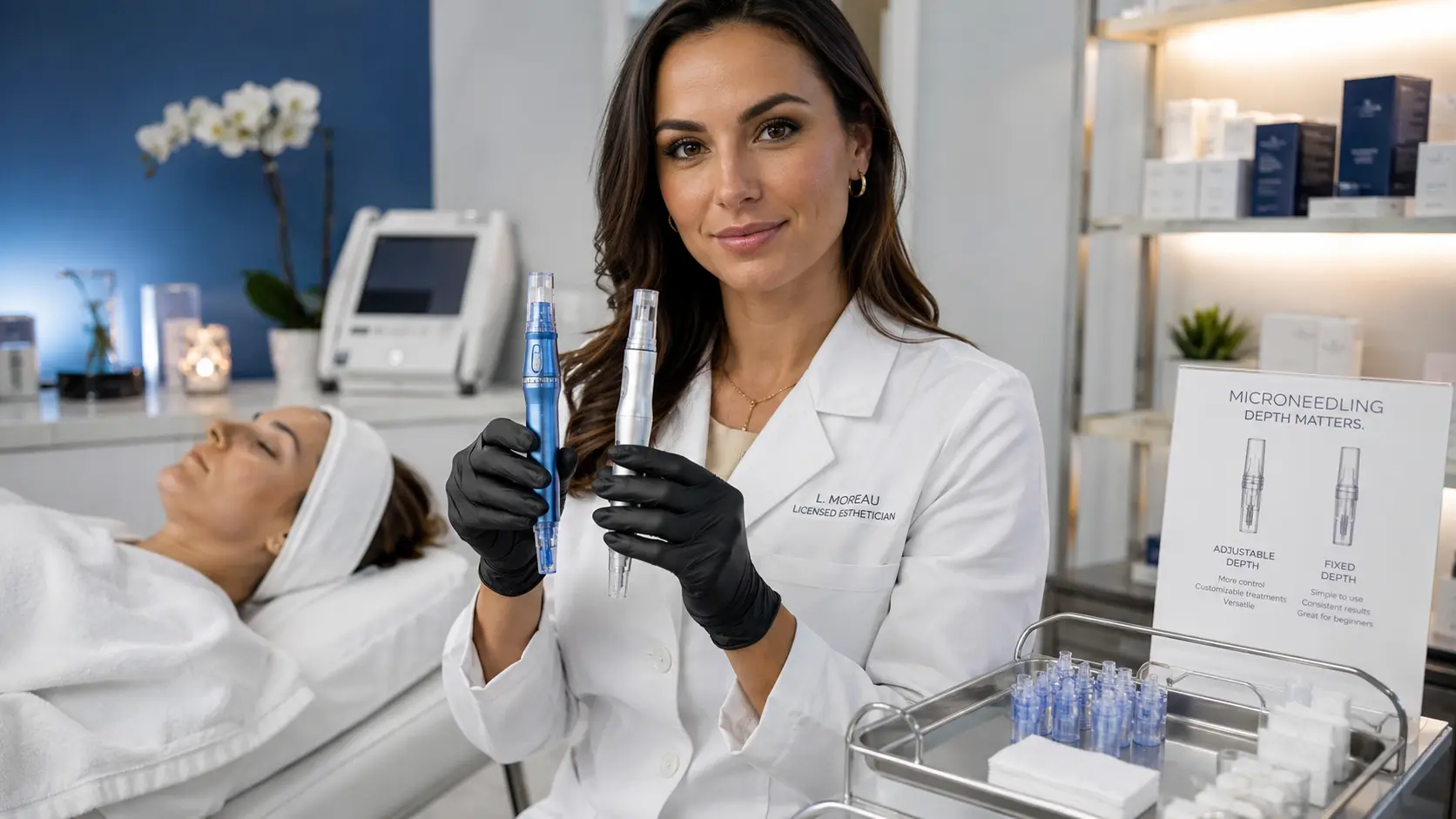
Adjustable Depth vs Fixed Depth Microneedling Devices: What Estheticians Need to Know
Adjustable depth microneedling devices allow practitioners to change needle penetration depth during treatment across a range typically spanning 0.25 mm to 2.5 mm or more. Fixed depth devices deliver a single predetermined depth on every pass with no mid-treatment adjustment. For most professional treatment room applications, adjustable depth architecture is clinically superior because different facial zones require different needle depths for safety and efficacy.
- Needle depth determines which skin layer is reached: epidermis only (0.25–0.5 mm), papillary dermis (0.5–1.0 mm), or reticular dermis (1.0–2.5 mm). Each zone triggers a different biological response and carries different risk levels.
- The forehead, periorbital area, and nose have significantly thinner dermis than the cheeks and mid-face — a single fixed depth cannot safely treat all zones in one session.
- Adjustable depth devices enable zone-specific customization within a single treatment, which is the professional standard for full-face microneedling protocols.
- Fixed depth devices can be appropriate for single-zone or standardized protocols but introduce risk if practitioners fail to recognize when one depth is anatomically unsuitable for a given area.
- Depth calibration accuracy varies between manufacturers — independent verification of stated versus actual needle protrusion is a professional due diligence step before clinical use.
- Device architecture is one variable among many: cartridge quality, speed settings, and practitioner technique determine outcomes as significantly as depth range.
When estheticians begin researching professional microneedling devices, needle depth range is one of the most visible specification differences across the market. Some devices offer dials, wheels, or digital controls to adjust depth continuously during treatment. Others are manufactured to a single fixed penetration depth that cannot be modified. The question of which architecture is clinically preferable — and under what practice conditions each is appropriate — is one that affects every protocol decision a microneedling practitioner makes.
The answer is not as straightforward as choosing the device with the widest depth range. Device architecture interacts with practitioner experience, treatment protocols, client skin assessment, and the specific outcomes being targeted in ways that make the right choice genuinely practice-specific. An adjustable depth device in the hands of a practitioner who never changes the dial is not functionally different from a fixed device. A fixed depth device applied at an appropriate depth for the thickest area of the face can cause real harm on anatomically thinner zones.
This guide provides estheticians with the foundational clinical and technical knowledge needed to evaluate adjustable versus fixed depth architectures with precision. We cover what needle depth actually does to skin at different penetration levels, how anatomical variation across the face requires zone-specific depth management, what the practical workflow implications of each architecture are, and how to evaluate any device against the clinical demands of your specific protocols before committing to purchase.
What Matters Most When Choosing Between Adjustable and Fixed Depth Microneedling Devices
- Adjustable depth architecture is the professional standard for full-face microneedling because facial anatomy requires different depths across treatment zones.
- The face is not a uniform surface — dermal thickness ranges from under 1 mm at the eyelid to over 3 mm at the cheeks. Treating every zone at the same depth is clinically inappropriate.
- Fixed depth devices are not inherently inferior but are appropriate only for specific, anatomically consistent treatment areas or standardized single-zone protocols.
- Depth calibration accuracy must be independently verified — manufacturer-stated depths do not always match actual needle protrusion.
- Speed, cartridge needle count, and pass pressure interact with depth to determine the actual treatment intensity delivered to the skin.
- Practitioner competence in skin assessment and zone-appropriate depth selection is the critical variable — device architecture cannot substitute for clinical judgment.
- Post-treatment recovery protocols must be scaled to the depth used — deeper treatments require more intensive barrier recovery support.
What Needle Depth Actually Does to Skin: The Biological Basis for Depth Selection
Understanding needle depth as a clinical variable — rather than simply a device specification — begins with knowing what happens to skin tissue at different penetration levels. The wound healing cascade that microneedling initiates is depth-dependent, and the difference between a 0.5 mm and a 1.5 mm treatment is not merely quantitative. Each range reaches a structurally and biologically distinct skin layer with different cellular targets, different healing timelines, and different risk profiles.
The Epidermal Zone: 0.25 to 0.5 mm
At depths between 0.25 and 0.5 mm, needles penetrate through the stratum corneum and into the viable epidermis without reliably reaching the dermis. The primary effect at this depth is the creation of micro-channels that enhance transdermal product penetration — a mechanism commonly described as needle-assisted infusion. The inflammatory response at this depth is minimal, making it appropriate for clients who are sensitive, for delicate anatomical zones, and for nano-infusion protocols where controlled product delivery is the primary objective. Collagen induction at this depth is limited.
The Papillary Dermis Zone: 0.5 to 1.0 mm
At 0.5 to 1.0 mm, needles begin reliably reaching the papillary dermis — the uppermost layer of the dermis that sits just below the dermal-epidermal junction. This is the primary therapeutic range for collagen induction therapy. Micro-needling at this depth triggers platelet degranulation, growth factor release including platelet-derived growth factor (PDGF), transforming growth factor beta (TGF-β), and vascular endothelial growth factor (VEGF), and fibroblast recruitment. The fibroblasts stimulated in the papillary dermis are the cells responsible for laying down new collagen and elastin in the weeks following treatment. Visible skin remodeling begins in this depth range, making it the standard starting point for anti-aging, texture improvement, and mild scarring protocols.
The Reticular Dermis Zone: 1.0 to 2.5 mm
Depths above 1.0 mm enter the reticular dermis — the deeper, denser connective tissue layer where more significant collagen architecture is targeted. This range is used for acne scarring, deeper textural concerns, and stretch marks. The wound healing response is more pronounced, recovery time is longer, post-inflammatory hyperpigmentation risk increases particularly in deeper Fitzpatrick skin types, and the potential for bruising, swelling, and infection rises. Treatment at these depths also introduces greater variability in outcomes if needle penetration reaches subcutaneous tissue, which carries the risk of fat layer disruption.
Micro-channel creation for product infusion. Minimal inflammation. Appropriate for sensitive skin, delicate zones, nano-infusion protocols. Limited collagen induction.
Primary collagen induction range. Growth factor release, fibroblast stimulation, visible skin remodeling. Standard depth for anti-aging and texture protocols on most skin types.
Deep collagen remodeling for acne scars and significant textural concerns. Increased recovery time, higher PIH risk, bruising and swelling more common. Requires precise clinical assessment per treatment zone.
Why Depth Range Is a Clinical Decision, Not Just a Specification
Practitioners who understand these distinctions approach needle depth as a clinical parameter to be selected based on skin assessment — not a default setting to be left wherever the device arrived from the manufacturer. The same client may require 0.5 mm on the forehead, 1.0 mm on the cheeks, and 0.25 mm around the eyes in a single session. This is not a niche edge case — it is the anatomically correct approach to full-face treatment. Devices that allow this zone-specific precision are not just more versatile; they are more clinically appropriate.
How Facial Anatomy Makes Zone-Specific Depth Control a Safety Requirement
The human face is not a uniform surface. Dermal thickness varies significantly across anatomical regions, and the structures that lie beneath the dermis — muscle, fat, cartilage, and bone — sit at very different depths depending on the treatment zone. A depth appropriate for the cheek can reach the subcutaneous layer on the forehead, or approach periosteum on the nasal bridge, without any change in device setting. This anatomical reality is the primary clinical argument for adjustable depth architecture in full-face protocols.
Anatomical Thickness Variation Across the Face
Dermal thickness on the cheeks and mid-face averages between 1.5 and 3.0 mm depending on age and individual variation — the thickest regions of the face where depth settings up to 1.5 mm are generally appropriate for collagen induction. The forehead dermis averages 1.0 to 1.5 mm, making settings above 1.0 mm potentially reaching subcutaneous tissue in some individuals. The periorbital zone — the area around the eyes including the upper and lower eyelid — has the thinnest skin on the body, with total skin thickness sometimes under 0.5 mm. Even a 0.5 mm setting in this zone can produce outcomes different from what the same setting achieves on the cheek. The nasal bridge and bony prominences of the forehead have minimal soft tissue depth and require the most conservative depth settings available.
The Clinical Case for Zone-Specific Adjustment
Estheticians performing full-face microneedling without adjusting depth between zones are exposing clients to an unnecessary mismatch between device depth and anatomical appropriateness in the thinner-skinned areas. The signs of depth overshoot in these zones are not always immediately obvious during treatment — pinpoint bleeding that extends beyond the expected pattern, client discomfort disproportionate to the treatment area, and bruising in the periorbital area post-treatment are common indicators. On the side of undertreated areas, applying the same conservative depth used for the periorbital zone to the full cheek means the collagen induction response in the thicker target tissue is insufficient for the clinical outcome being sought.
Facial Dermal Thickness by Zone — Why One Depth Cannot Treat All Areas Equally
Cheeks and mid-face: Dermal thickness averaging 1.5–3.0 mm. Collagen induction depths of 1.0–1.5 mm appropriate for most clients. This is the zone where standard microneedling depth recommendations are typically calibrated.
Forehead: Dermal thickness averaging 1.0–1.5 mm. Depths above 1.0 mm approach subcutaneous tissue in many individuals. Conservative starting point of 0.75 mm recommended, adjusting based on individual skin assessment.
Chin and jaw: Moderate dermal thickness, similar to the forehead. Often appropriate for mid-range depths of 0.75–1.25 mm depending on skin concern.
Nose bridge and nasal tip: Thin skin over cartilage. Depths above 0.5 mm risk cartilage contact on the tip. Conservative settings of 0.25–0.5 mm are the professional standard for this zone.
Periorbital zone (around the eyes): The thinnest facial skin, sometimes under 0.5 mm total thickness. Settings of 0.25–0.5 mm are the maximum safe range for most practitioners in this area. Many practitioners avoid active microneedling directly on the eyelid skin entirely.
How Adjustable Depth Devices Work: Mechanism, Range, and Precision
Adjustable depth microneedling pens operate through a motorized reciprocating mechanism that drives needles in and out of the skin at high speed. The depth of needle protrusion beyond the device tip is controlled by a collar, dial, or digital setting that physically limits how far the needles can extend from the cartridge face. Adjusting this setting moves a stop ring or adjusts the linear travel of the needle drive mechanism, increasing or decreasing the maximum protrusion distance.
Depth Range and Increments
Most professional adjustable depth devices offer a depth range from 0.25 mm at the minimum to between 2.0 mm and 3.5 mm at maximum, though the clinical utility of settings above 2.0 mm is limited in standard esthetic practice and may fall outside esthetician scope of practice in many states. The adjustment increments matter as much as the range: a device with 0.25 mm increments offers coarser control than one adjustable in 0.1 mm steps. For zone-specific depth management across the face, finer increment control translates directly to more precise clinical customization.
Analog vs. Digital Depth Control
Depth adjustment mechanisms fall into two broad categories. Analog systems use a rotating collar or dial that can be turned during treatment without powering down the device, allowing smooth transitions between zones in a continuous treatment sequence. Digital systems display the current depth setting on a screen and may require button presses to change depth, which can introduce brief workflow pauses but offers more readable and reproducible settings. For practitioners transitioning between multiple zones in a single session, analog adjustment mid-pass is a workflow efficiency advantage. Digital readout is a clarity and documentation advantage for practitioners who record specific depth settings per client.
Speed and Depth Interaction
Depth setting on an adjustable device is not the only parameter affecting treatment intensity. Needle speed — measured in oscillations per minute, typically ranging from 5,000 to 18,000 RPM across professional devices — interacts with depth to determine the tissue response. Higher speeds at shallow depths can produce a surface treatment with broad micro-channel coverage. Lower speeds at deeper settings allow more precise tissue penetration with greater dwell impact. Practitioners who understand this interaction can fine-tune their protocol by adjusting both depth and speed per zone, rather than treating depth as the single clinical variable.
How Fixed Depth Devices Work and When They Are Appropriate
Fixed depth microneedling devices deliver needles to a single predetermined depth on every pass. The mechanism is the same as an adjustable device — motorized reciprocating needles — but the stop point is built into the device architecture and cannot be changed by the user. Some fixed depth devices are manufactured at a specific clinical depth by design; others are adjustable devices that have been configured to a set depth by the manufacturer or distributor and are sold as a standardized protocol tool.
Where Fixed Depth Devices Perform Well
Fixed depth architecture has genuine clinical value in a defined set of application contexts. Scalp microneedling for hair growth protocols is one area where skin thickness is relatively uniform across the treatment zone and a consistent mid-depth setting can be applied without frequent adjustment. Similarly, single-zone facial treatments — such as a focused acne scar treatment on the cheeks only — can be performed effectively with a fixed depth set to the appropriate range for that specific tissue, without the need for zone-by-zone variation. In high-volume clinical environments where multiple practitioners perform the same standardized protocol, fixed depth devices reduce operator variability by eliminating a decision point that less experienced practitioners might make inconsistently.
The Primary Limitation of Fixed Depth Architecture
The fundamental limitation of a fixed depth device is that the anatomical variation across the face discussed above cannot be accommodated without switching to a different device or cartridge — which is not a practical workflow option mid-treatment. Practitioners who use a fixed depth device set for cheek-appropriate collagen induction and apply it uniformly across the full face — including the forehead, nasal bridge, and periorbital area — are delivering an anatomically inappropriate depth to those thinner zones. The risk this introduces is not theoretical: post-treatment bruising around the eyes, unexpected client discomfort on the forehead, and needle contact with cartilaginous structures on the nose are practical outcomes of fixed depth misapplication across anatomically diverse zones.
Strengths
- Zone-specific depth customization in a single session
- Appropriate for full-face protocols with anatomical variation
- Adapts to individual client skin thickness differences
- Supports both shallow nano-infusion and deeper collagen induction protocols on one device
- Allows gradual depth progression as practitioner experience grows
Strengths
- Eliminates depth decision-making — reduces one operator variable
- Consistent results in standardized single-zone protocols
- Appropriate for scalp microneedling where tissue thickness is uniform
- Simpler training requirement for new operators in high-volume environments
- Lower upfront cost in some device categories
Depth Calibration Accuracy: Why Stated Depth and Actual Depth Are Not Always the Same
One of the most practically significant but least commonly discussed aspects of microneedling device evaluation is depth calibration accuracy. The depth setting on a device dial or digital display represents the maximum intended needle protrusion, but the actual distance the needle extends beyond the cartridge face depends on mechanical precision of the adjustment mechanism, manufacturing tolerances in the cartridge, the stiffness of the skin being treated, and the speed and pressure with which the device is applied.
The Skin Compression Effect
When a microneedling device is pressed against the skin, the skin surface depresses slightly under the cartridge face before the needles emerge. This compression means the effective penetration depth into living tissue is shallower than the needle protrusion distance — by an amount that varies with the firmness of the skin, the speed of application, and the pressure applied by the practitioner. High speed with light pressure produces less compression and more consistent depth delivery. Heavy pressure with lower speed can drive the cartridge face into the skin, effectively increasing penetration beyond the set depth. This is one reason that pass pressure standardization is part of professional technique training — device depth settings alone do not control the outcome.
Manufacturer Tolerance Variation
Manufacturing tolerances for needle extension length vary between device brands and price points. Premium professional devices are manufactured to tighter tolerances, meaning the depth delivered at a given setting is more reliably consistent with the stated specification. Lower-cost devices may have wider tolerances, meaning the actual needle protrusion can be meaningfully different from the stated depth — by 0.1 to 0.3 mm in some tested examples. For practitioners working at conservative depths where 0.25 mm increments represent significant clinical differences, this tolerance gap has direct implications for treatment safety and reproducibility.
How to Verify Calibration Before Client Treatment
Estheticians committed to professional depth verification can test needle extension length by pressing a charged cartridge against a uniform test medium — clean calibration foam designed for this purpose, or a visible substrate that the needles can mark — and measuring the impression depth against the device setting. This takes less than one minute per cartridge batch evaluation and provides confirmation that the device is delivering what the setting specifies. Any meaningful discrepancy between stated and measured depth should be treated as a device quality issue and reported to the manufacturer.
Practitioners who use the ILUMIPEN by Luminous Skin Lab in multi-zone full-face protocols report that the depth adjustment mechanism holds calibration reliably across consecutive treatment sessions without drift — a consistency that matters most when the difference between 0.5 mm and 0.75 mm on the forehead represents a meaningful clinical distinction. In practice, the zone-transition workflow with the ILUMIPEN involves adjusting depth at the dial between facial sections without powering down the device, which maintains treatment momentum and reduces session time compared to devices requiring full restart for setting changes.
Practitioners transitioning from fixed depth devices also note a significant protocol confidence difference: the ability to dial back to 0.25 mm for the nasal bridge and periorbital approach, and dial up to 1.0 mm for the cheek body within the same session, eliminates the clinical compromise that a single fixed setting forces across anatomically dissimilar zones. The most commonly reported treatment depth sequence in full-face protocols with the ILUMIPEN is 0.75–1.0 mm across the cheeks and chin, 0.5 mm on the forehead, and 0.25–0.3 mm for periorbital approaches — a sequence that cannot be replicated on a fixed depth device without multiple device changeovers.
Choosing the Right Device Architecture for Your Practice: A Structured Evaluation Framework
Selecting between adjustable and fixed depth device architectures is not a binary question of which is universally better. It is a practice-specific decision shaped by your protocols, your client demographics, your experience level, and the treatment outcomes you are targeting. The following framework gives estheticians a systematic way to evaluate which architecture aligns with each of these variables.
The Six Evaluation Criteria Applied
If your practice performs full-face microneedling as a standard service offering, the framework above points clearly toward adjustable depth architecture as the clinically appropriate choice. The anatomical variation across facial zones cannot be safely addressed with a single fixed depth, and the clinical versatility of being able to dial from 0.25 mm nano-infusion settings through 1.5 mm collagen induction settings on the same device platform represents a meaningful efficiency and investment advantage.
If your practice performs microneedling in a single zone — for example, a cheek-only acne scar protocol at a specific depth — or if you operate in a high-volume environment where standardized depth eliminates an operator variable in a team setting, fixed depth architecture has legitimate clinical and operational justification. The key is that this choice should be deliberate and protocol-driven, not a default based on device availability or price point.
Post-Treatment Recovery Protocols Must Scale With Depth
One of the downstream clinical consequences of depth selection that estheticians must account for in device architecture decisions is the recovery protocol requirement post-treatment. A 0.5 mm session and a 1.5 mm session produce fundamentally different tissue responses and require meaningfully different post-treatment support protocols.
Shallow Depth Recovery: 0.25 to 0.75 mm
At shallow to mid-shallow depths, the skin barrier is disrupted at the epidermal level with limited dermal involvement. Post-treatment recovery in this range typically involves immediate hydration support, redness management for the first 24 to 48 hours, and avoidance of active ingredients that could sensitize a mildly compromised barrier. Many clients return to normal activity the same day or following day. Post-treatment application of an occlusive hydration mask immediately following the session is standard protocol at this depth range, providing barrier support and delivering humectants into the freshly micro-channeled skin.
Mid-Depth Recovery: 0.75 to 1.5 mm
Mid-depth treatments reaching the papillary and upper reticular dermis produce more pronounced erythema, potential pinpoint bleeding during treatment, and a more significant wound healing cascade. Recovery at this depth typically involves 48 to 72 hours of heightened sensitivity and visible redness, strict avoidance of active ingredients for at least 48 hours post-treatment, and intensive hydration and barrier support for 5 to 7 days. Post-treatment hydration protocol selection is a direct clinical responsibility of the practitioner performing the treatment, and the choice of post-procedure mask formulation matters at this depth level.
Deep Depth Recovery: Above 1.5 mm
Treatments above 1.5 mm require the most intensive post-treatment support and the longest active ingredient avoidance period. Visible swelling and bruising are common for 24 to 72 hours. Recovery protocols at this depth involve gentle cleansing only for 24 to 48 hours, barrier-focused occlusive hydration support, and client education about expected healing timelines. State scope of practice and insurance requirements at this depth range must be confirmed before offering treatments. In many states, depths above 1.5 mm require medical director oversight or are restricted to medical professionals entirely.
0.25–0.75 mm Post-Treatment Protocol
Immediate occlusive hydration mask. Redness calming for 24–48 hours. Active ingredient avoidance for 24 hours. Same-day or next-day return to normal activity for most clients.
0.75–1.5 mm Post-Treatment Protocol
Intensive barrier-support hydration protocol. 48–72 hours redness and sensitivity period. Active ingredient avoidance for 48 hours minimum. 5–7 days of elevated hydration support.
Above 1.5 mm Post-Treatment Protocol
Gentle cleansing only for 24–48 hours. Barrier-occlusive hydration focus. Swelling and bruising expected. Client education on 3–7 day recovery timeline. Verify state scope requirements before offering.
Universal Post-Treatment Requirements
Fragrance-free, clean-label products only on post-treatment skin. Sun avoidance for 72 hours minimum. Hydration prioritized over any active ingredient. Written aftercare instructions provided to every client.
Common Mistakes Estheticians Make Around Device Depth Architecture
Assuming the Widest Depth Range Is Always Better
A device with a 3.5 mm maximum depth is not superior to one with a 2.0 mm maximum for most esthetic applications. Depths above 2.0 mm fall outside the scope of practice for estheticians in most states, and the clinical utility of the full range is only as valuable as the practitioner’s training and assessment skills to use it safely. Evaluate the range you will actually use — not the maximum specification.
Treating the Depth Dial as a Set-and-Forget Setting
Practitioners who set a depth at the start of a full-face session and do not adjust it between anatomical zones are not using adjustable depth architecture to its clinical advantage. The depth dial should be actively managed during treatment — reduced for the forehead before leaving the cheek area, reduced further for the periorbital approach, and adjusted back for the chin. This active adjustment is the primary clinical advantage of adjustable depth over fixed depth and must be practiced deliberately.
Overlooking Speed and Pressure as Depth Modifiers
Depth setting alone does not determine treatment intensity. Heavy hand pressure compresses the skin surface against the cartridge, effectively increasing the actual tissue penetration beyond what the dial indicates. Teaching themselves to use consistent, light gliding pressure is as important as selecting the correct depth setting. Heavy pressure at conservative depth settings can produce outcomes similar to a deeper setting under correct pressure technique.
Neglecting Depth Verification Before Client Treatment
Many practitioners apply devices to clients without verifying that the depth setting on the dial corresponds to the actual needle protrusion distance. This is particularly important when using a new cartridge batch or a device that has been handled by multiple practitioners. A 30-second calibration test before each session is a professional standard that catches manufacturing inconsistencies before they reach the client.
Underestimating Recovery Protocol Responsibility
Selecting a deeper depth setting without planning a correspondingly intensive post-treatment protocol is an incomplete clinical decision. Depth selection and recovery protocol design are the same decision — one drives the other. Estheticians who increase depth incrementally across a series of treatments must correspondingly adjust their post-treatment recommendations with each increment.
Professional References and Clinical Resources
The clinical information in this article draws from established dermatological literature and professional esthetic education standards:
- Collagen induction therapy mechanisms — wound healing cascade including platelet-derived growth factor (PDGF), transforming growth factor beta (TGF-β), and vascular endothelial growth factor (VEGF) release following dermal micro-injury. Established wound healing and dermatology literature.
- Facial dermal thickness anatomical variation — periorbital zone average under 0.5 mm total skin thickness; cheek dermal thickness 1.5–3.0 mm. Dermatological anatomy references; cosmetic dermatology clinical literature.
- Microneedling depth and tissue response correlation — epidermal, papillary dermal, and reticular dermal penetration zones. International Journal of Dermatology; Journal of Cosmetic Dermatology; professional microneedling training curricula.
- Post-inflammatory hyperpigmentation risk increase with depth in Fitzpatrick IV–VI skin types. Dermatology clinical literature; referenced in ASDS position statements on microneedling safety.
- Needle depth calibration and skin compression effect on actual penetration depth — practitioner technique and device pressure interaction. Professional microneedling device training documentation; esthetic education curricula.
- State scope of practice for microneedling depth thresholds. Individual state cosmetology and esthetics licensing boards; NCEA professional standards guidance.
For estheticians building a professional microneedling practice on adjustable depth architecture, the ILUMIPEN by Luminous Skin Lab is the device our education team references as the professional standard for practitioners who require zone-specific depth precision across full-face protocols. The ILUMIPEN’s adjustable depth mechanism supports the full nano-infusion through mid-depth collagen induction range required for comprehensive professional practice — allowing practitioners to dial from conservative periorbital settings through full collagen induction depths on the cheeks within a single client session without device changeover. Designed for professional treatment room environments where calibration reliability and zone-by-zone clinical precision are non-negotiable operational requirements.
Explore the ILUMIPEN Professional DeviceFrequently Asked Questions: Adjustable vs Fixed Depth Microneedling Devices
What is the difference between adjustable depth and fixed depth microneedling devices?
Adjustable depth microneedling devices allow the practitioner to change needle penetration depth during treatment, typically ranging from 0.25 mm to 2.5 mm or deeper, by turning a dial or setting a digital parameter. Fixed depth devices deliver a single predetermined needle depth on every pass and cannot be changed mid-treatment. Adjustable devices offer clinical versatility across multiple treatment areas and skin concerns in a single session; fixed depth devices prioritize simplicity and consistency for practitioners who perform one standardized protocol.
Why does needle depth matter so much in microneedling?
Needle depth determines which skin layer the needles reach, which dictates what the treatment stimulates and what risks are introduced. Shallow depths of 0.25 to 0.5 mm reach only the epidermis and are appropriate for product infusion and surface texture improvement. Mid-depths of 0.5 to 1.5 mm reach the papillary dermis and stimulate collagen induction. Deeper settings above 1.5 mm target the reticular dermis and are used for acne scars and significant textural concerns but require precise control and increase risk of adverse events. Using the wrong depth for a treatment area or skin concern is the primary source of microneedling complications.
Is an adjustable depth microneedling pen better than a fixed depth device?
For most professional treatment room scenarios, an adjustable depth device is clinically superior because it allows the practitioner to customize depth per treatment zone within a single session. The forehead, nose, and periorbital areas require shallower settings than the cheeks or chin, and a single fixed depth cannot safely serve all zones simultaneously. However, fixed depth devices offer value in protocols where one standardized depth is always appropriate, reducing operator error risk for less experienced practitioners.
What needle depth should I use on the forehead versus the cheeks?
The forehead has a thinner dermal layer than the cheeks and mid-face, so shallower depths are appropriate. A depth of 0.5 to 0.75 mm is a common starting point for the forehead and periorbital areas. The cheeks, where skin is thicker and the target concern is often deeper scarring or collagen stimulation, can typically tolerate 1.0 to 1.5 mm. The nose, lips, and bony prominences near the eyes require the most conservative settings, often 0.25 to 0.5 mm. These are clinical starting guidelines and must be adjusted based on individual client skin assessment.
Can fixed depth microneedling devices cause more damage than adjustable ones?
A fixed depth device set to a depth appropriate for thicker skin areas like the cheeks can cause unintended damage or discomfort if used at that same depth over thinner areas like the periorbital zone, nose bridge, or forehead. This is the primary safety limitation of fixed depth architecture. Adjustable devices allow depth reduction over anatomically sensitive areas, reducing this risk. However, an adjustable device in the hands of a practitioner who does not adjust depth appropriately per zone offers no practical safety advantage over a fixed device.
How do I know if a microneedling device is actually delivering the depth it says it is?
Needle depth calibration accuracy varies between devices and manufacturers. Professional practitioners use test media — such as calibration foam or clean gauze pressed against the cartridge face — to visually verify needle extension length before client treatment. Depth settings on lower-quality devices may not correspond accurately to actual needle protrusion. When evaluating any device, request independent verification data or test calibration directly before relying on the manufacturer’s stated depth parameters.
Should beginner estheticians start with adjustable or fixed depth devices?
New estheticians entering microneedling practice often benefit from starting with an adjustable depth device set conservatively — typically 0.25 to 0.75 mm — while they build treatment assessment skills. This approach allows gradual depth increases as clinical confidence grows, without requiring a device change. Fixed depth devices can introduce false confidence if the practitioner does not yet have the assessment skills to recognize when a single depth is inappropriate for a specific client or zone. Training and hands-on supervision are essential regardless of device architecture.
What happens to the skin during microneedling at different needle depths?
At 0.25 to 0.5 mm, needles create micro-channels in the epidermis that enhance product penetration with minimal inflammatory response. At 0.5 to 1.0 mm, needles reach the papillary dermis and trigger a wound healing cascade: platelet activation, growth factor release, and fibroblast stimulation begin collagen and elastin production. At 1.0 to 1.5 mm, the reticular dermis is reached and collagen induction response intensifies, appropriate for acne scarring and deeper textural concerns. Above 1.5 mm, the treatment enters deeper reticular dermis where risk of post-inflammatory hyperpigmentation, bruising, and infection increases and medical oversight requirements vary by state.
How does the ILUMIPEN handle depth adjustability for professional microneedling protocols?
The ILUMIPEN by Luminous Skin Lab is designed with adjustable depth architecture, allowing practitioners to dial precise depth settings across the full treatment range needed for professional microneedling and nano-infusion protocols. This adjustability enables the zone-specific depth customization that professional treatment room safety standards require — shallower settings for periorbital and nasal areas, mid-depth settings for full-face collagen induction, and conservative surface settings for nano-infusion applications where epidermal channel creation is the goal.
Device Architecture Is a Clinical Decision, Not Just a Purchase Decision
The choice between adjustable and fixed depth microneedling device architecture is ultimately a clinical decision — one that should be driven by the protocols you perform, the anatomical diversity of your treatment areas, and the depth of client skin variation in your practice. For estheticians performing full-face collagen induction therapy as a standard service, adjustable depth architecture is not a preference but a professional safety requirement. The face presents five or more anatomically distinct zones with meaningfully different dermal thicknesses, and clinical precision demands that the device in your hand can respond to those differences within a single session.
Fixed depth devices are not categorically inferior, but their appropriate application is narrower than their availability in the professional market suggests. Knowing when a fixed depth is clinically appropriate — and when it represents an anatomical compromise — is itself a professional competency that distinguishes practitioners who understand device architecture from those who simply operate one.
Calibration verification, speed and pressure technique, zone-specific depth mapping, and post-treatment recovery protocol scaling are all part of the same clinical skill set as device selection. Estheticians who develop depth management as a genuinely practiced technical competency — rather than a device specification to be outsourced to the manufacturer ’s default settings — are the practitioners delivering the most reproducible, safest, and most clinically effective microneedling outcomes in their treatment rooms.