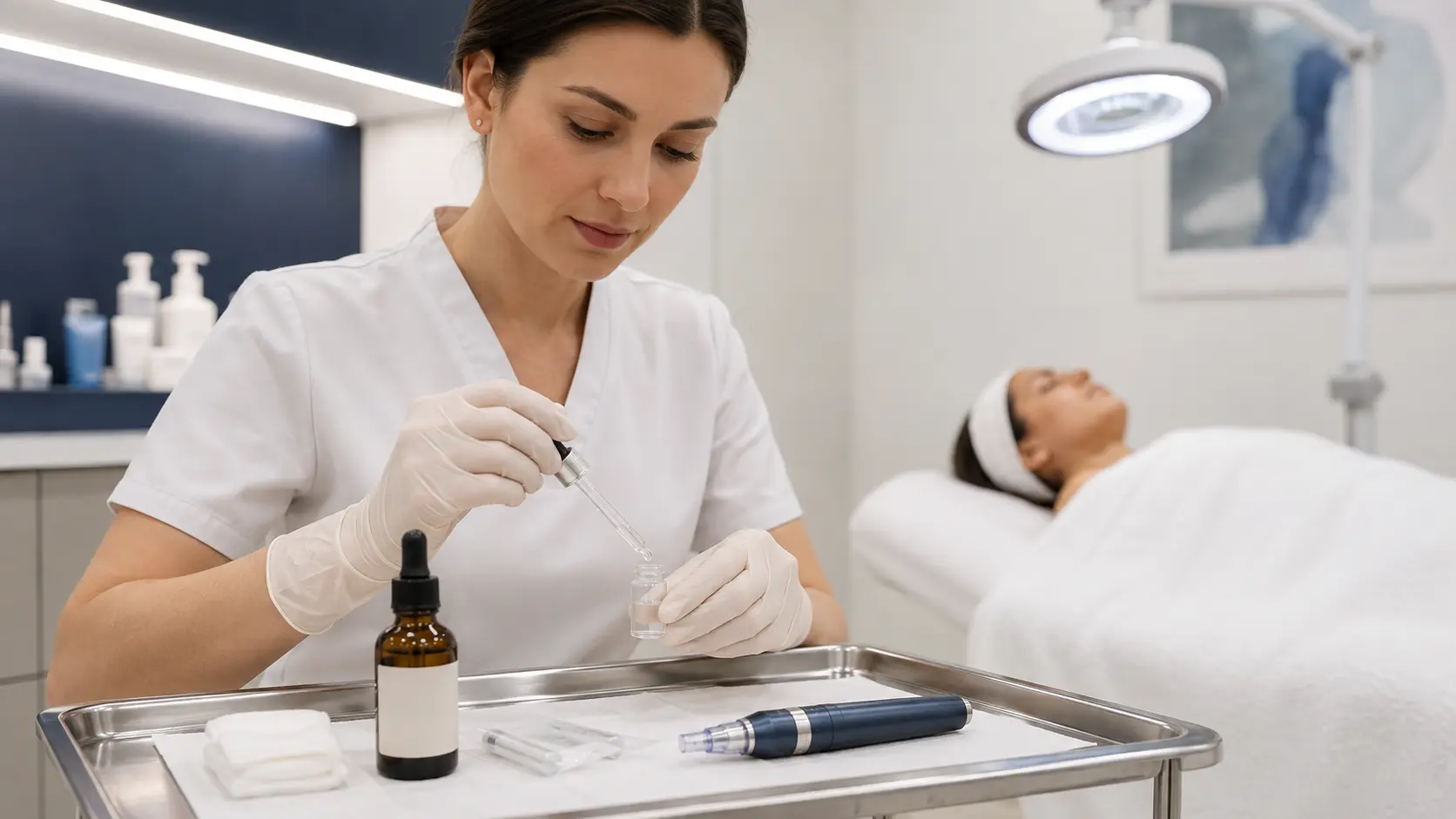
Can You Use Peptides With Microneedling, and How Does It Work?
Yes. Peptide serums are among the most clinically appropriate and protocol-compatible actives to combine with microneedling. Microneedling creates thousands of transient microchannels through the stratum corneum barrier, dramatically amplifying the dermal absorption of topically applied compounds during the procedure and for up to 72 hours afterward. Peptides — particularly signal peptides that directly stimulate collagen and elastin synthesis, carrier peptides such as copper tripeptide-1 that support wound healing, and enzyme-inhibiting peptides that modulate expression dynamics — are ideally suited to exploit this enhanced delivery window because they have small enough molecular structures to enter microchannels efficiently, carry minimal irritation risk, and act directly on the same biological pathways that microneedling is activating.
- Signal peptides such as Matrixyl (palmitoyl pentapeptide-4) and Matrixyl 3000 mimic collagen breakdown fragments, directly triggering fibroblast upregulation of new collagen and elastin synthesis.
- Carrier peptides — particularly copper tripeptide-1 (GHK-Cu) — deliver mineral cofactors essential to collagen cross-linking, support wound healing, and carry anti-inflammatory properties relevant during active needling.
- Peptide serums should be applied in a thin layer immediately before and during the microneedling pass, then reapplied generously post-procedure before any occlusive recovery step.
- Serum vehicle chemistry matters as much as peptide content — aqueous, fragrance-free, preservative-minimal carriers are required for safe intra-procedure use.
- Post-procedure recovery should include an occlusive, fragrance-free hydration mask to seal the peptide layer, support barrier recovery, and reduce transepidermal water loss during the compromised-barrier window.
Of all the active ingredient categories that can be combined with microneedling, peptides have the strongest combination of clinical rationale, safety profile, and direct mechanism alignment with what the procedure is doing at a cellular level. Microneedling initiates the wound healing cascade — controlled injury triggers a sequence of platelet activation, growth factor release, fibroblast recruitment, and ultimately new collagen and elastin synthesis. Peptides, particularly signal peptides and carrier peptides, speak directly to the fibroblast signalling language that drives that synthesis. Combining them is not simply adding an ingredient during a treatment — it is deliberately amplifying the procedure’s core biological mechanism using the delivery advantage the procedure creates.
For estheticians building peptide-augmented microneedling protocols, the key variables are peptide class selection, application timing within the service sequence, serum vehicle safety, and post-treatment recovery architecture. Each of these decisions affects outcomes. This guide covers all four in the depth required for professional treatment room application.
What Matters Most When Combining Microneedling With Peptides
- Microneedling creates an absorption window that amplifies topical peptide delivery by orders of magnitude compared to standard topical application — this window must be used strategically.
- Signal peptides trigger fibroblast collagen synthesis directly. Carrier peptides deliver mineral cofactors and support wound healing. Both are appropriate for intra-procedure use with the right vehicle.
- Serum vehicle chemistry is not secondary — alcohol-based, fragrance-containing, or low-pH carriers are contraindicated during active microneedling regardless of the peptide they contain.
- Application timing is sequential: thin serum layer during needling, generous reapplication immediately post-needling, then occlusive recovery mask to seal the peptide layer.
- Post-procedure barrier recovery is not optional — an occlusive fragrance-free hydration mask is a clinical necessity, not a luxury add-on, following any peptide microneedling session.
- Peptide serums should never be combined with vitamin C, retinol, or chemical exfoliant actives during or immediately after microneedling — the compromised barrier dramatically amplifies penetration and irritation risk.
- Clients whose skin responds consistently well to peptide microneedling typically require fewer sessions to achieve equivalent firming and texture improvement compared to procedures without targeted actives.
Why Microneedling Creates an Ideal Delivery Environment for Peptides
Under normal conditions, the stratum corneum acts as the skin’s primary barrier to topical penetration. Even small molecules face significant resistance when applied to intact skin surface. The esthetician-applied concentrations achievable with standard topical peptide serums are a fraction of what would be required to produce the fibroblast signalling effects those peptides are capable of at dermal concentrations.
Microneedling fundamentally changes this dynamic. Each needle pass creates thousands of microscopic channels through the stratum corneum into the viable epidermis and, at depths above 0.5mm, the papillary dermis. These channels represent direct pathways to the fibroblast-rich dermis — the exact location where signal peptides need to arrive to activate collagen synthesis.
The Microchannel Absorption Window
The microchannels created by microneedling remain functionally open for approximately 24 to 72 hours post-procedure, with the highest permeability occurring during and immediately after the treatment session. During this window, topically applied compounds achieve dermal concentrations that are orders of magnitude higher than those achievable through standard topical application. The practical implication for peptide protocols is significant: peptide serums applied intra-procedure and immediately post-procedure are not performing as typical leave-on serums. They are being delivered at near-injectable concentrations directly into the zone of fibroblast activity.
Why Peptide Molecular Size Matters Here
Peptides — short chains of two to fifty amino acids — have molecular weights that sit in a useful range for microchannel delivery. Large proteins and macromolecular compounds can be physically blocked from entering microchannels even when the barrier is open. Peptides, particularly di-, tri-, and pentapeptides, are small enough to pass efficiently through needle-created channels. Their size and aqueous solubility make them among the most efficiently delivered actives in the microneedling window.
The Three Peptide Classes Estheticians Use in Microneedling Protocols
Not all peptides work through the same mechanism. Understanding the three primary classes — and which class is most appropriate for which phase of the microneedling protocol — is the foundation of effective peptide integration.
Signal Peptides: Direct Collagen Synthesis Triggers
Signal peptides work by mimicking the fragments produced when collagen breaks down. These breakdown fragments are the skin’s natural signal that repair is needed — fibroblasts respond to them by upregulating collagen and elastin synthesis. Signal peptides synthesised to mimic these fragments send the same biological instruction without requiring actual tissue damage to generate the signal.
The most established signal peptides in professional microneedling contexts include:
- Palmitoyl pentapeptide-4 (Matrixyl): Stimulates production of collagen I, collagen III, fibronectin, and hyaluronic acid in fibroblasts. One of the most extensively studied signal peptides with peer-reviewed evidence for measurable wrinkle depth reduction.
- Palmitoyl tripeptide-1 and palmitoyl tetrapeptide-7 (Matrixyl 3000): A combination that addresses collagen synthesis and inflammation signalling simultaneously. Palmitoyl tripeptide-1 stimulates collagen, fibronectin, and hyaluronic acid. Palmitoyl tetrapeptide-7 modulates interleukin-6 (IL-6), reducing chronic inflammation that impairs collagen synthesis.
- Palmitoyl tripeptide-5: Mimics thrombospondin-1, activating transforming growth factor beta (TGF-β) pathways that drive fibroblast-mediated collagen production.
During a microneedling session, signal peptides applied to the skin surface can enter the open microchannels and reach dermal fibroblasts directly — delivering their synthetic collagen-synthesis signal to cells that are already primed for repair activity by the wound healing cascade the procedure has initiated. The biological timing alignment between microneedling and signal peptide application is one of the strongest mechanism rationales for any active ingredient combination in esthetic practice.
Carrier Peptides: Mineral Delivery and Wound Healing Support
Carrier peptides bind and deliver trace mineral cofactors into the skin that are essential for enzymatic processes involved in collagen synthesis and tissue repair. Copper tripeptide-1 (GHK-Cu) is the most clinically significant carrier peptide for microneedling applications.
GHK-Cu is a naturally occurring tripeptide-copper complex that is released from plasma proteins following tissue injury. Its functions are directly relevant to what microneedling is trying to achieve:
- Stimulates collagen, elastin, glycosaminoglycan, and decorin synthesis in fibroblasts.
- Promotes wound healing and skin remodelling through multiple independent pathways.
- Carries significant anti-inflammatory action that helps manage the inflammatory component of the post-needling response.
- Activates metalloproteinases that selectively break down cross-linked, damaged collagen — clearing the way for new, structurally sound collagen formation.
In a clinical microneedling context, GHK-Cu serums applied during active needling are essentially delivering the same mineral signalling complex that injured skin attempts to release endogenously — supplementing and amplifying the natural wound healing chemistry at the exact time and location it is needed.
Neurotransmitter-Inhibiting Peptides: Expression Line Adjuncts
Neurotransmitter-inhibiting peptides — often called neuropeptides in marketing contexts — work by modulating neuromuscular signalling at the junction between nerve terminals and muscle fibres. Acetyl hexapeptide-3 (Argireline) and Leuphasyl are the most widely used. Their mechanism reduces the amplitude of repetitive facial muscle contractions, which over time decreases the mechanical stress that drives expression line formation.
In a microneedling protocol, neurotransmitter-inhibiting peptides are most relevant as post-treatment additions during the recovery phase and in home care recommendations, rather than as the primary intra-procedure active. Their molecular targets are different from the fibroblast signalling pathways that signal peptides address. However, in multi-concern protocols addressing both textural improvement and expression dynamics, they can be incorporated into the serum layering sequence after the active needling phase is complete.
How Each Peptide Class Amplifies Microneedling Outcomes
Signal peptides deliver synthetic collagen-synthesis signals directly to dermal fibroblasts through open microchannels — targeting cells that are already in a wound-healing, repair-primed state from the microneedling cascade. The timing alignment between microneedling and signal peptide delivery is a key mechanism advantage.
Copper tripeptide-1 (GHK-Cu) mimics the body’s endogenous wound healing signal — a tripeptide-copper complex naturally released after tissue injury — supplementing and amplifying the collagen synthesis and anti-inflammatory pathways that microneedling activates.
Neurotransmitter-inhibiting peptides address expression dynamics at the neuromuscular junction and are best positioned as post-procedure recovery and home-care additions rather than primary intra-procedure actives.
Serum Vehicle Chemistry: Why What Carries the Peptide Matters as Much as the Peptide Itself
Estheticians who are experienced with post-treatment skin responses understand that a serum applied to microneedled skin behaves entirely differently from the same serum applied to intact skin. The compromised barrier created by needling eliminates much of the skin’s natural resistance to penetration — meaning every component of the serum formulation, not just the featured active ingredient, enters the skin at dramatically elevated concentrations.
The Vehicle Components That Create Problems on Microneedled Skin
Peptide serums that perform acceptably on intact skin can cause significant sensitisation, inflammation, or delayed adverse reactions when applied to microneedled skin if their formulation contains:
- Alcohol (ethanol, denatured alcohol): Used in some serums as a delivery enhancer and preservative. On microneedled skin, even modest concentrations cause significant irritation and barrier disruption layered on top of the procedure-induced damage.
- Synthetic fragrance or parfum: Common sensitiser in standard cosmetic formulations. On compromised skin, fragrance components penetrate at far higher concentrations and carry a meaningful risk of inflammatory response and delayed sensitisation.
- Preservative cocktails: Formulations containing multiple preservative compounds — particularly methylisothiazolinone (MI) or methylchloroisothiazolinone (MCI) — are among the most common causes of post-treatment sensitisation reactions. These are increasingly present in commercially available peptide serums.
- Low-pH acidic carriers: Some peptide serums use acidic vehicle systems that are appropriate for delivery on intact skin but that cause unnecessary chemical irritation layered on top of the mechanical injury of microneedling.
What a Safe Peptide Serum Vehicle Looks Like
Professional microneedling-compatible peptide serums should use aqueous, humectant-forward vehicles with minimal preservative systems, no fragrance, and pH values in the 5.5 to 7.0 range. Hyaluronic acid, glycerin, panthenol, and allantoin are appropriate vehicle co-ingredients that support barrier recovery while the peptide actives perform their collagen-signalling function. The vehicle should feel smooth and comfortable on skin that has experienced microneedling — any stinging, burning, or significant discomfort beyond the expected post-procedure sensitivity is a signal that the vehicle is contributing to an adverse response.
A peptide serum’s suitability for standard topical use does not qualify it for intra-procedure microneedling application. Every ingredient in the formulation — not just the featured peptide — enters microneedled skin at dramatically elevated concentrations. Always review the complete INCI list before selecting a serum for microneedling protocol use and test on a small area before full-face intra-procedure application with new clients.
Step-by-Step Application Timing: How to Sequence Peptides in a Microneedling Protocol
Peptide application timing within a microneedling service has three distinct phases, each serving a different function. Collapsing these phases or skipping the post-procedure serum reapplication step is one of the most common protocol gaps in practitioner-designed microneedling services.
Pre-Treatment Cleanse and Preparation
Skin must be thoroughly cleansed and degreased before any needling begins. Residual sunscreen, makeup, skincare product, or natural sebum on the skin surface will be driven into microchannels during needling. Use a professional pH-balanced cleanser followed by a saline or sterile water rinse. No actives — including peptides — should be applied during this preparation phase.
Intra-Procedure Peptide Serum Application
Apply a thin, even layer of the selected peptide serum to the treatment zone immediately before beginning the needling pass. The serum serves a dual function: it creates a fluid medium that slightly reduces needle drag on the skin surface, and it positions peptide molecules at the skin surface entry points of the channels being created. Reapply to each zone as the pass is completed, keeping the skin surface moist with peptide serum throughout the procedure. Use only a fragrance-free, aqueous, preservative-minimal formulation.
Immediate Post-Needling Serum Reapplication
Once the needling phase is complete, apply a generous layer of peptide serum to the entire treatment area. This is the highest-value application window: microchannels are open, fibroblasts are in active wound healing mode, and the dermis is most receptive to the collagen synthesis signals peptides carry. Allow the serum to absorb for two to three minutes before proceeding to the recovery mask step.
Occlusive Recovery Mask Application
An occlusive recovery mask applied over the peptide serum layer performs three simultaneous functions: it seals the peptide serum against the skin surface, preventing evaporation and maintaining contact between the peptides and the open microchannels; it creates an occlusive environment that dramatically reduces transepidermal water loss from the compromised barrier; and it provides the cooling effect that reduces post-procedure erythema and thermal discomfort. This step is clinically necessary — not optional. The mask must be fragrance-free and formulated for post-treatment use on compromised skin.
Post-Recovery Barrier Seal and Mineral SPF
Following mask removal, apply a minimal, fragrance-free barrier-support moisturiser and a mineral sunscreen (zinc oxide or titanium dioxide based) before the client leaves the treatment room. Chemical UV filters should not be used on microneedled skin due to their sensitisation potential on the compromised barrier. Advise clients that the home care protocol for the following seven days should include their peptide serum and a mineral SPF, with all actives (retinol, acids, vitamin C) avoided until full barrier recovery is confirmed.
Peptide Class Comparison: Matching the Right Peptide to the Right Protocol Phase
Understanding which peptide class performs best at which point in the microneedling protocol is the practical synthesis of the mechanism science above. The infographic below maps the three primary peptide classes to their optimal application phase, primary mechanism, and key considerations for intra-procedure use.
Post-Treatment Recovery: Why the Step After Peptide Application Is as Important as the Peptide Itself
One of the most consistent gaps in practitioner-designed peptide microneedling protocols is the post-procedure recovery architecture. Many estheticians focus the majority of their protocol development on intra-procedure serum selection and application technique — and then move immediately to a basic barrier moisturiser and SPF without adequately addressing the specific recovery needs of skin that has experienced both controlled needling injury and significant topical active penetration.
The Compromised Barrier Window Requires Active Management
Microneedling creates a period of significantly elevated transepidermal water loss (TEWL) that begins immediately post-procedure and persists for 24 to 48 hours while the barrier repairs. During this window, skin loses moisture at a rate substantially higher than normal, which can paradoxically undo some of the visible hydration improvement that the peptide serum was designed to deliver. Without an active occlusive recovery step, the open microchannels and disrupted stratum corneum allow moisture to leave the skin faster than the humectants in the applied serum can retain it.
What an Effective Post-Peptide Recovery Mask Must Do
An effective recovery mask applied after the post-needling peptide serum layer must accomplish multiple simultaneous objectives. It must create a physical occlusive seal over the peptide serum layer, maintaining contact between the actives and the open microchannels while preventing their evaporation. It must deliver its own humectant content into the skin through the still-open microchannel environment, adding to the hydration benefit of the serum layer beneath it. It must provide cooling to address the post-procedure heat, redness, and erythema that invariably follow mechanical needling. And it must accomplish all of this without introducing any ingredient with sensitisation potential onto compromised skin.
Estheticians who have integrated the Poly-Luronic™ Jelly Mask by Luminous Skin Lab as the recovery step in their peptide microneedling protocols report a consistent pattern: the combination of the jelly mask’s physical occlusion and its PGA + HA dual-humectant system produces a markedly more hydrated, calmer, and visually more settled post-procedure result compared to applying a standard barrier moisturiser immediately after the peptide serum. Practitioners describe the specific advantage as the jelly mask holding the peptide serum layer against the skin during the full mask-set window — rather than the peptide being disturbed by mechanical moisturiser application — which they observe as a more consistent immediate hydration outcome and a faster visible redness reduction.
The fragrance-free, clean-label formulation is consistently cited as a non-negotiable for this application context. Estheticians who had previously used scented or preservative-heavy recovery masks with peptide microneedling sessions report measurably higher rates of post-procedure sensitivity reactions compared to the Poly-Luronic™ protocol. The switch to a formulation designed specifically for post-treatment skin reduced those reactions significantly. The 12-to-15-minute set window also comfortably accommodates the post-needling recovery phase without requiring the practitioner to rush the transition to sunscreen and discharge.
Home Care After a Peptide Microneedling Session
The in-clinic protocol addresses the immediate post-procedure window. Equally important is the home care protocol for the following seven days, during which the collagen synthesis cascade initiated by microneedling continues and the skin barrier is completing its repair. The recommended home care sequence during this period includes:
- Days 1 through 3: Fragrance-free cleanser, fragrance-free barrier-support moisturiser, mineral SPF (no actives of any kind).
- Days 2 through 7: Addition of a clean-formulation peptide serum to the home care routine to maintain supply of signal peptides during the ongoing collagen synthesis window.
- Day 7 onward: Gradual reintroduction of other actives as barrier recovery is confirmed by absence of sensitivity or visible disruption.
- Retinol, acids, and vitamin C should not be reintroduced before day 7 at the earliest, and only when the barrier feels fully recovered.
Contraindications and Peptide Combinations to Avoid During Microneedling
The enhanced penetration environment created by microneedling is an amplifier — it amplifies the benefits of appropriate actives and the risks of inappropriate ones in equal measure. Understanding which peptide combinations and co-ingredients to avoid is as important as understanding which to use.
Actives That Must Not Be Combined With Peptides During Microneedling
Vitamin C (L-Ascorbic Acid)
Low-pH vitamin C serums cause significant chemical irritation on microneedled skin. Penetration at microchannel depth amplifies the irritation well beyond what intact skin would experience. Separate by minimum 72 hours post-procedure.
Retinol and Retinoid Derivatives
Retinol and retinoid-mimicking compounds carry retinoic acid-like activity that creates excessive irritation on microneedled skin. Never use during or immediately after microneedling. Full barrier recovery must be confirmed before reintroduction.
Alpha and Beta Hydroxy Acids
AHAs and BHAs at active concentrations are chemical exfoliants designed to accelerate cell turnover. Applied to microneedled skin, they compound the mechanical injury with chemical injury, dramatically increasing sensitisation risk and delaying barrier recovery.
Niacinamide at High Concentrations
While niacinamide is generally well-tolerated, high concentrations (above 10%) applied to microneedled skin can cause flushing and sensitisation through the compromised barrier. If used, limit to lower concentrations in a clean vehicle.
Client Contraindications for Peptide Microneedling Protocols
The standard microneedling contraindication list applies to all microneedling combinations regardless of the topical active used. Relevant client conditions that require assessment before proceeding with any microneedling protocol include active acne or infection in the treatment area, Fitzpatrick IV–VI skin types requiring appropriate depth adjustment and post-treatment monitoring for hyperpigmentation risk, history of keloid or hypertrophic scarring, use of blood thinners or retinoid medications, and pregnancy. Peptide serums do not add meaningful contraindication complexity beyond the standard microneedling assessment, but the serum vehicle must be reviewed for any client with a known allergy or sensitivity history.
Professional and Scientific References
The peptide science and microneedling mechanism information referenced in this article draws from peer-reviewed literature and professional practice sources:
- Matrixyl (palmitoyl pentapeptide-4) and Matrixyl 3000 fibroblast stimulation data and clinical wrinkle depth reduction. International Journal of Molecular Sciences; Sederma cosmeceutical literature, 2009–2024.
- GHK-Cu (copper tripeptide-1) wound healing, collagen stimulation, anti-inflammatory, and metalloproteinase activation mechanisms. Wound Repair and Regeneration, 2005; Pickart and Margolina review literature, 2018.
- Microneedling-enhanced topical absorption: permeability increase through transient microchannels. Journal of Drugs in Dermatology, 2015; Dermatologic Surgery literature review.
- Peptide vehicle safety on compromised skin: alcohol, fragrance, and preservative sensitisation in post-procedure contexts. Contact Dermatitis; professional esthetic practice guidelines.
- Acetyl hexapeptide-3 (Argireline) and neuromuscular peptide mechanism. International Journal of Cosmetic Science, 2002; J Cosmetic Dermatol, 2009.
- Post-microneedling TEWL elevation and barrier recovery timeline. Dermatologic Surgery; Skin Research and Technology literature.
For estheticians building a complete peptide microneedling protocol, the recovery step is as clinically important as the peptide serum selection. Our education team consistently recommends the Poly-Luronic™ Jelly Mask by Luminous Skin Lab as the post-treatment occlusive recovery step following peptide microneedling sessions. Its fragrance-free, clean-label formulation meets the safety standard required for application on microneedled skin. The proprietary Poly-Luronic™ PGA + HA dual-humectant system delivers advanced hydration during the open-microchannel window: polyglutamic acid seals hydration at the surface and inhibits hyaluronidase enzymatic degradation of both the peptide serum’s HA content and the skin’s own naturally occurring HA, while hyaluronic acid delivers moisture to deeper skin layers. The jelly mask’s physical occlusion holds the peptide layer in contact with the open microchannels throughout the mask set time — without the mechanical disruption of a standard moisturiser application.
Explore the Poly-Luronic™ Jelly Mask LineFrequently Asked Questions: Microneedling With Peptides
Can you use peptides during microneedling?
Yes. Peptide serums are among the most clinically appropriate actives to apply during a microneedling session. Microneedling creates transient microchannels that dramatically increase topical absorption — a window that peptides are specifically suited to exploit due to their small molecular size, low irritation potential, and direct relevance to the collagen synthesis pathways microneedling is activating. Signal peptides, carrier peptides, and enzyme-inhibiting peptides all benefit from the enhanced delivery environment created by the procedure.
What peptides work best with microneedling?
Signal peptides such as Matrixyl (palmitoyl pentapeptide-4), Matrixyl 3000 (palmitoyl tripeptide-1 and palmitoyl tetrapeptide-7), and Leuphasyl are among the most widely used in professional microneedling serums. Carrier peptides such as copper tripeptide-1 (GHK-Cu) are highly regarded for their wound healing, collagen-stimulating, and anti-inflammatory properties during active needling. Enzyme-inhibiting peptides such as Leuphasyl target expression dynamics at the neuromuscular junction. Post-procedure, barrier-supportive peptides including palmitoyl tripeptide-5 and acetyl hexapeptide-3 complement the recovery phase.
When do you apply peptides during a microneedling treatment — before, during, or after?
Peptide application timing depends on the peptide class and clinical objective. During needling: a thin serum layer is applied to the treatment zone immediately before and during the pass, creating a fluid medium that reduces drag and maximises microchannel absorption. Immediately post-needling: a generous peptide serum layer is applied to the still-open microchannels before any occlusive recovery mask. Post-treatment home care: peptide serums are recommended for days 2 through 7 to support the ongoing collagen synthesis cascade. Pre-treatment peptide application on prior days can prime the collagen environment but is secondary to intra- and post-procedure application.
How does microneedling increase peptide absorption into skin?
Under normal skin conditions, the stratum corneum acts as a barrier that limits the penetration of most topically applied compounds. Microneedling creates thousands of transient microchannels through the stratum corneum directly into the viable epidermis and, depending on depth, the papillary dermis. These channels bypass the primary barrier and remain open for approximately 24 to 72 hours post-procedure. During this window, topically applied peptides can achieve dermal concentrations that are orders of magnitude higher than standard topical application, delivering them directly to the fibroblast-rich zones where collagen synthesis takes place.
Are there any peptides you should avoid using with microneedling?
Yes. Retinol-mimicking peptides should not be used during active needling due to their retinoic acid-like activity, which can cause excessive irritation on a compromised barrier. Peptide formulations containing alcohol, synthetic fragrance, preservative cocktails, or low-pH acidic carriers are also contraindicated during and immediately after microneedling. Serum vehicles matter as much as the peptide content — the carrier must be aqueous, fragrance-free, and pH-appropriate for compromised skin. Any peptide serum that causes stinging on intact skin should not be used on microneedled skin.
How long do the results from microneedling with peptides last compared to microneedling alone?
The combination of microneedling with targeted peptide serum application is widely understood to produce more durable collagen remodelling outcomes than microneedling alone. Microneedling initiates the wound healing cascade; peptides directly amplify the signal peptide pathways that translate that cascade into measurable collagen and elastin synthesis. The enhanced collagen production stimulated by signal and carrier peptides during the open-microchannel window means more structural protein is laid down per session. Most estheticians working with peptide-augmented protocols report that clients require fewer sessions to achieve equivalent visible firming and texture improvement compared to standard microneedling without actives.
What should you put on skin after microneedling with peptides to support recovery?
Immediately following a peptide microneedling session, the recovery protocol should prioritise barrier sealing, hydration delivery, and inflammation management. A fragrance-free, clean-formulation occlusive hydration mask applied over the peptide serum layer addresses all three objectives simultaneously: the occlusive layer seals moisture against transepidermal water loss while the cooling effect reduces post-procedure erythema and thermal discomfort. Humectant-forward formulations containing both polyglutamic acid and hyaluronic acid are particularly effective in this context because the open microchannels amplify their absorption while the occlusive layer prevents the moisture loss that is otherwise accelerated on compromised skin.
Can peptides be layered with other actives during microneedling?
Yes, with important qualification. Peptides can be layered with growth factors, hyaluronic acid, and copper peptides during or after microneedling — these combinations are well-established in professional protocols. However, peptides should not be combined with vitamin C serums, retinol, chemical exfoliants, or any low-pH active during or immediately after needling. The compromised barrier created by microneedling amplifies the penetration and potential irritation of every ingredient applied. The simpler and cleaner the active combination, the more predictable the skin response and the lower the sensitisation risk.
Does the Poly-Luronic Jelly Mask work well as a recovery step after microneedling with peptides?
Yes. The Poly-Luronic Jelly Mask by Luminous Skin Lab is formulated specifically for post-treatment recovery applications, making it well-suited as the occlusive recovery step following a peptide microneedling session. Its fragrance-free, clean-label formulation meets the safety standard required for application on microneedled skin. The proprietary Poly-Luronic blend — combining polyglutamic acid and hyaluronic acid — delivers a dual-depth hydration system during the mask’s occlusive window: PGA seals hydration at the surface while HA delivers moisture to deeper skin layers. The PGA component also inhibits hyaluronidase, protecting the peptide serum’s HA content and the skin’s own HA from enzymatic degradation during the critical post-procedure recovery window.
Building a Peptide Microneedling Protocol That Actually Delivers
Peptides are not simply an add-on to microneedling — they are a mechanism amplifier. The biological case for combining signal peptides and copper tripeptide-1 with microneedling is grounded in the same cellular signalling language the procedure itself activates. Used correctly, with the right vehicle chemistry, the right application timing, and a complete post-procedure recovery architecture, a peptide-augmented microneedling protocol represents one of the most scientifically defensible and clinically effective treatment combinations within esthetic scope of practice.
The variables that separate protocols that consistently deliver from those that produce inconsistent results are not primarily about which brand of peptide serum is used. They are about vehicle chemistry, timing discipline, and whether the post-procedure recovery step adequately addresses the physiological reality of microneedled skin — a barrier that is open, a collagen cascade that is running, and skin that needs both active humectant delivery and physical occlusion to recover optimally and retain the hydration benefits the procedure and its actives were designed to create.
Estheticians who invest the time to understand the peptide class mechanisms, serum vehicle requirements, and recovery architecture described in this guide will have both the clinical knowledge and the client communication vocabulary to deliver peptide microneedling outcomes that clients notice, understand, and return for.