What Are the Best Post-Dermaplaning Hydration Treatments?
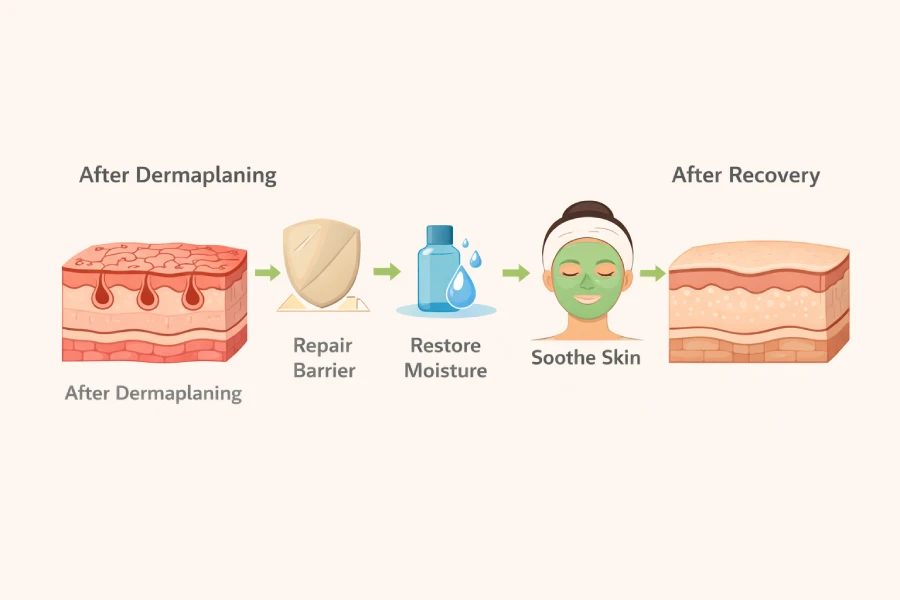
The best post-dermaplaning hydration treatments take deliberate advantage of the dramatically elevated product absorption state that dermaplaning creates. By removing the outermost stratum corneum cells and vellus hair, dermaplaning temporarily eliminates two of the skin’s primary barriers to topical penetration — making the minutes immediately following the procedure the most efficient hydration delivery window in any facial service. The most effective protocol sequences a fragrance-free hydrating essence or toner, then a polyglutamic acid and hyaluronic acid serum while skin is still damp, then an occlusive professional jelly mask to seal the delivered humectants and compensate for the temporarily reduced barrier function.
- Dermaplaning removes approximately two to three weeks of stratum corneum surface buildup and all vellus hair, increasing topical product absorption by an estimated 50% or more compared to intact skin — making the immediate post-dermaplaning hydration step the highest-efficiency delivery window in the facial.
- The temporarily thinned stratum corneum has reduced natural moisturizing factor (NMF) content and reduced intercellular lipid integrity, producing elevated TEWL and the tightness clients report post-dermaplaning — occlusive hydration treatment directly compensates for this.
- PGA + HA dual-humectant formulations are clinically suited to post-dermaplaning: PGA’s surface film compensates functionally for the partially removed barrier’s TEWL-sealing role; HA penetrates into the now more accessible epidermis with amplified efficiency.
- Active exfoliants, retinoids, synthetic fragrance, and essential oils are contraindicated immediately post-dermaplaning — penetration that would be tolerable on intact skin reaches irritating depths through the freshly thinned barrier.
- SPF 30 or higher is mandatory before any outdoor exposure after dermaplaning, as the thinned stratum corneum provides meaningfully reduced natural UV protection.
Dermaplaning has earned its place as one of the most consistently client-satisfying services in the professional esthetic menu. The immediate result — glassy, luminous skin with no vellus hair, smooth texture, and a radiance that photographs brilliantly — is visible the moment the treatment ends. Clients feel it before they see it: the first touch of a product on freshly dermaplaned skin tells them something significant has changed.
What that first touch is, and what follows it, determines whether the dermaplaning service delivers its full clinical potential or stops at the cosmetic surface. Because while the blade work is what clients remember, the hydration protocol applied immediately after it is what determines how the skin responds over the next 24 to 72 hours — whether it glows or dehydrates, whether it stays calm or sensitizes, whether the results last or fade by morning.
Estheticians who understand what dermaplaning physically does to the stratum corneum — and who have built a post-dermaplaning hydration protocol around that physiology rather than around generic finishing steps — deliver dermaplaning results that clients return for. This guide covers the science behind dermaplaning’s absorption window, the correct ingredient selection and sequencing for post-dermaplaning hydration, and the protocol framework that converts the procedure’s most clinically valuable moment into lasting client outcomes.
What Every Esthetician Needs to Know About Post-Dermaplaning Hydration
- Dermaplaning creates the highest product absorption window of any common esthetic procedure — and what is applied in that window matters more than at any other point in the service.
- The thinned stratum corneum has temporarily reduced NMF content and intercellular lipid integrity: post-dermaplaning hydration is not optional cosmetic enhancement, it is a physiological compensation requirement.
- Apply humectant serum to damp skin immediately after dermaplaning — before skin surface moisture begins to evaporate — to maximize absorption of PGA and HA into the freshly accessible epidermis.
- PGA’s surface film function is uniquely matched to the post-dermaplaning skin state: it replaces a portion of the removed barrier’s TEWL-sealing role while HA delivers deep-layer hydration.
- Any active ingredient that would be a moderate irritant on intact skin can reach irritating levels post-dermaplaning due to amplified penetration depth — the contraindication list is not conservative caution, it is skin physics.
- Clients who receive a structured post-dermaplaning hydration protocol consistently report better 48-hour skin feel outcomes compared to those who receive only topical finishing without an occlusive step.
- Post-dermaplaning SPF application before outdoor exposure is a clinical obligation, not an optional recommendation — the UV protection role of the stratum corneum is meaningfully reduced immediately post-procedure.
What Dermaplaning Actually Does to the Stratum Corneum — and Why It Changes Everything
Dermaplaning uses a sterile surgical-grade blade held at a 45-degree angle to physically exfoliate the skin surface. In a single treatment, it removes accumulated dead stratum corneum cells representing approximately two to three weeks of natural cellular turnover, and all vellus hair on the treated area. Understanding the structural consequences of these two removals is the foundation of every post-dermaplaning treatment decision.
The Stratum Corneum: What It Does and What Dermaplaning Removes
The stratum corneum is the outermost layer of the epidermis, composed of corneocytes — flattened, keratin-filled, non-viable cells — embedded in an intercellular lipid matrix of ceramides, fatty acids, and cholesterol. This layer is the skin’s primary physical barrier to external insults and its primary structural mechanism for preventing transepidermal water loss. The lipid matrix acts as a cement between corneocyte bricks, creating the mosaic barrier that prevents both excessive water loss and excessive environmental penetration.
Critically, the outermost corneocytes contain the skin’s natural moisturizing factor (NMF) — a collection of hygroscopic molecules including pyrrolidone carboxylic acid (PCA), lactic acid, urocanic acid, amino acids, and urea that bind water within the stratum corneum and maintain its flexibility and function. When dermaplaning removes the surface layer of corneocytes, it removes not only the dead cellular debris but also a portion of the NMF reservoir that maintains the barrier’s water content.
The result is a stratum corneum that is simultaneously thinner, more permeable, and temporarily lower in NMF content than in its intact state. This is the physiological basis for both the dermaplaning glow — light no longer scatters off surface debris, producing the characteristic luminosity — and the dehydration and sensitivity that develop if post-dermaplaning hydration is inadequate.
Vellus Hair Removal: The Second Barrier Eliminated
Vellus hair — the fine, soft hair that covers most facial skin — acts as a secondary physical barrier that slows topical product absorption by disrupting the fluid film continuity across the skin surface and providing a layer of mechanical obstruction to product contact with the stratum corneum itself. While the barrier contribution of vellus hair is less significant than that of the stratum corneum’s lipid matrix, its removal compounds the absorption enhancement that dermaplaning produces. Products applied to dermaplaned skin contact the stratum corneum directly and continuously, without the disruption of the hair array.
The Absorption Window: What the Numbers Mean in Practice
Clinical observation and the limited research available on post-dermaplaning topical delivery consistently point to a meaningful increase in product absorption following the procedure. Estimates of the absorption enhancement vary depending on the molecular weight of the ingredient in question and the measurement methodology used, but professional experience across a wide range of esthetic practices is consistent: products applied immediately post-dermaplaning visibly absorb faster, spread more smoothly, and produce more immediate observable skin response than the same products applied to non-dermaplaned skin. This is not a subtle effect — estheticians working with dermaplaning notice it with the first product application, and experienced practitioners have systematically reorganized their post-dermaplaning protocols to extract maximum benefit from it.
Intact Stratum Corneum
- Full NMF reservoir in surface corneocytes
- Intact lipid matrix TEWL barrier
- Vellus hair disrupting product contact
- Accumulated dead cell layer slowing penetration
- Standard product absorption baseline
- Natural UV scatter from surface texture
Thinned, Exposed Epidermis
- Reduced NMF content — hydration deficit begins
- Partially thinned lipid matrix — elevated TEWL
- No vellus hair — direct product-to-skin contact
- Fresh epidermis directly accessible to topicals
- Significantly enhanced product absorption (~50%+)
- Reduced natural UV scatter — SPF mandatory
The Hydration Science Behind Post-Dermaplaning Protocols: Why PGA + HA Is the Correct Response
Once the physiological state of post-dermaplaning skin is understood, the ideal hydration ingredient profile becomes clear. The skin needs a surface moisture-sealing mechanism to compensate for the partially disrupted barrier function, deep-layer humectant delivery to replenish water content in the now more accessible epidermis, and NMF stimulation to begin rebuilding the water-binding capacity that was removed with the surface corneocytes. No single ingredient addresses all three of these requirements. The PGA + HA dual-humectant system does.
PGA’s Surface Film: A Functional Stratum Corneum Analog Post-Dermaplaning
Polyglutamic acid’s primary mechanism in post-dermaplaning skin is functionally analogous to the TEWL-sealing role of the partially removed stratum corneum lipid matrix. PGA forms a transparent, flexible microgel film on the skin surface — holding up to 5,000 times its weight in water — that reduces the rate of water evaporation from the thinned barrier below. In the context of intact skin, this surface film is additive to the barrier’s own function. In the context of freshly dermaplaned skin with a partially disrupted lipid matrix, PGA’s surface film becomes partially compensatory — providing a portion of the TEWL-sealing function that the removed stratum corneum surface layer can no longer fully provide.
Additionally, PGA inhibits hyaluronidase — the enzyme that degrades both topically applied and naturally occurring hyaluronic acid. This is relevant post-dermaplaning because the freshly exposed epidermis’s hyaluronic acid reservoir is more accessible to enzymatic degradation than under intact barrier conditions. PGA’s hyaluronidase inhibition extends the functional lifespan of the HA applied in the post-dermaplaning serum as well as the skin’s own epidermal HA.
PGA and NMF: Directly Replacing What Dermaplaning Removed
One of the most clinically significant aspects of PGA in the post-dermaplaning context is its documented ability to stimulate production of the same NMF components that dermaplaning removes. Research shows that topical PGA application increases pyrrolidone carboxylic acid (PCA), lactic acid, and urocanic acid in the stratum corneum — exactly the NMF molecules that reside in the outermost corneocytes and that are partially depleted when those cells are removed by dermaplaning. The same 2024 study showing PGA upregulates hyaluronic acid synthase-1, -2, and -3 mRNA expression — stimulating the skin’s own HA production — makes PGA uniquely positioned to support the stratum corneum reconstitution that begins in the hours following dermaplaning.
HA: Deep Delivery Into the Now-Accessible Epidermis
Hyaluronic acid’s value in post-dermaplaning protocols is maximized by the same absorption enhancement that makes the post-dermaplaning window clinically significant for all ingredients. Lower molecular weight HA, which under intact barrier conditions penetrates into the epidermis and upper dermis, reaches these deeper structures with amplified efficiency through the thinned post-dermaplaning barrier. The result is a deeper, more immediate hydration response than the same HA serum would produce on non-dermaplaned skin — and a foundation for the sustained luminosity that distinguishes a well-hydrated dermaplaning result from one where hydration was inadequate post-procedure.
Why the PGA + HA System Is Matched to the Post-Dermaplaning Skin State
The stratum corneum removal creates three simultaneous deficits: reduced surface TEWL-sealing capacity (from thinned lipid matrix), reduced NMF content (from removed surface corneocytes), and reduced epidermal HA protection (from elevated hyaluronidase accessibility). PGA + HA addresses all three.
PGA compensates for the TEWL-sealing deficit by forming a surface microgel film that holds up to 5,000 times its weight in water — functionally replacing a portion of the partially removed barrier’s moisture-sealing role while simultaneously inhibiting hyaluronidase to protect the HA applied beneath it.
PGA stimulates NMF replenishment by increasing PCA, lactic acid, and urocanic acid production in the stratum corneum — directly rebuilding the water-binding molecules that dermaplaning removed from the surface corneocyte layer. PGA also upregulates HAS-1, HAS-2, and HAS-3 to support skin’s own HA production during the reconstitution phase.
HA delivers deep-layer hydration into the freshly accessible epidermis during the post-dermaplaning absorption window, with penetration enhanced by the temporary removal of the primary barrier to topical penetration.
The Post-Dermaplaning Hydration Protocol: Step-by-Step Sequence
The post-dermaplaning hydration protocol follows a straightforward four-phase logic dictated by the physiology of the skin state: replenish surface moisture immediately, saturate with humectants while permeability is peak, seal with occlusion to maximize retention and compensate for the thinned barrier, then protect before the client leaves. What matters is the discipline of that sequence — each step creates the condition that makes the next step more effective.
Phase 1: Replenish Surface Moisture (0–2 Minutes)
Within the first sixty seconds of completing dermaplaning, a fragrance-free hydrating essence, toner, or thermal spring water mist is applied to the full face. This step re-establishes surface moisture immediately before the elevated TEWL that follows barrier thinning begins to develop momentum. The goal is not to tone in the traditional sense — it is to restore enough surface humidity that the Phase 2 serum has water available to work with, since humectants function by drawing moisture toward themselves from the surrounding environment. Starting with a damp skin surface makes the subsequent PGA and HA application measurably more effective.
Experienced estheticians working in high-volume dermaplaning practices consistently prepare the Phase 2 serum and Phase 3 mask mix during the final moments of the dermaplaning procedure itself, so that the transition from procedure to Phase 1 is immediate and Phase 2 follows within 90 seconds of procedure completion.
Phase 2: Saturate With Humectants (2–5 Minutes)
While skin surface is still damp from Phase 1, the PGA + HA serum is applied to the full face using pressing and patting motions rather than rubbing. Pressing preserves the surface moisture that aids absorption; rubbing risks unnecessary friction on freshly dermaplaned skin. The damp skin rule is the most frequently missed detail in post-dermaplaning hydration protocols: estheticians who allow the Phase 1 moisture to evaporate before applying the serum reduce the humectant performance of the PGA and HA significantly, because both ingredients require available water molecules to bind and hold. Applied to damp skin, the serum’s absorption is visibly different from the same product applied to dry skin — clients notice immediately.
Phase 3: Seal and Occlude (5–20 Minutes)
With the serum visibly absorbing, the jelly mask is mixed and applied immediately to the full face as a uniform occlusive layer. The mask’s primary function at this stage is sealing — holding the delivered humectants against the thinned barrier for the duration of the treatment window and slowing the elevated TEWL that the thinned stratum corneum produces. The cooling effect is a significant secondary benefit: it produces immediate visible reduction in any post-dermaplaning redness, which clients notice at removal and frequently comment on as a highlight of the service. Red LED therapy at 630 to 660 nanometers may be applied simultaneously to further support anti-inflammatory signaling and enhance the overall radiance response.
Phase 4: Protect and Finish (20–25 Minutes)
The mask is removed as a single intact piece. A lightweight, non-comedogenic moisturizer is applied to support continued barrier recovery. For daytime appointments — which represent the majority of dermaplaning services — SPF 30 or higher is applied before the client leaves the treatment room. This is not optional. The thinned stratum corneum provides meaningfully reduced UV scatter compared to its intact state, and the first 24 to 48 hours post-dermaplaning are when photoprotection matters most for preventing UV-triggered pigmentation in the freshly exposed skin. The 48-hour home-care brief is delivered at this point.
Estheticians who have incorporated Poly-Luronic™ Jelly Masks by Luminous Skin Lab into their post-dermaplaning sequence consistently report that the PGA-forward formulation produces a visibly different immediate skin response compared to HA-only jelly masks used in the same protocol position. The most consistent observation: the skin appears more supple and hydrated at the moment of mask removal — a response these practitioners attribute to PGA’s surface film maintaining higher moisture content under the occlusive seal than HA alone achieves in the same window. The single-piece removal also delivers the visual “reveal” moment that dermaplaning clients value highly — and the combination of the glassy post-dermaplaning surface with the post-mask luminosity produces the result clients photograph and share most frequently.
Practitioners specializing in dermaplaning also note a specific workflow advantage: the consistent 12-to-15-minute set window of the Poly-Luronic™ formulation allows the full Phase 3 LED sequence plus client consultation and retail discussion to be completed within the mask phase, without any concern about over-setting. The predictability matters in dermaplaning-focused service menus where timing discipline directly affects throughput and the client experience. Estheticians who previously used jelly masks with inconsistent set times report that the protocol feels more professional and controlled with a formulation that behaves the same way in every application.
What to Avoid After Dermaplaning — Why the Contraindications Are Skin Physics, Not Caution
The post-dermaplaning contraindication list is not a conservative professional preference. It is a direct consequence of the dramatically increased absorption that dermaplaning creates. Ingredients that are appropriate for use on intact skin — or even on lightly exfoliated skin — can penetrate to irritating depths through the thinned post-dermaplaning barrier. Understanding the mechanism behind each contraindication makes it easier to hold the standard when clients request these ingredients or when estheticians are tempted to add them to the post-dermaplaning service.
- Retinol and professional retinoids — under intact barrier conditions, retinol penetration is moderated by the stratum corneum. Post-dermaplaning, retinol reaches the living epidermis with amplified intensity, producing irritation, redness, and barrier compromise at doses that would be well-tolerated on unprepped skin.
- Alpha hydroxy acids (glycolic, lactic, mandelic) — chemical exfoliation applied to freshly physically exfoliated skin creates additive disruption. AHAs penetrate deeper post-dermaplaning, producing a more intense exfoliation response than intended and significantly elevating PIH risk.
- Beta hydroxy acids (salicylic acid) — same amplification principle as AHAs. BHA is lipophilic and follows the sebaceous follicle into the dermis; post-dermaplaning, this pathway is more accessible than on intact skin.
- High-concentration vitamin C (ascorbic acid above approximately 10%) — ascorbic acid at higher concentrations is a known irritant on intact skin; through the thinned post-dermaplaning barrier, concentrations that are routinely well-tolerated become inappropriate.
- Synthetic fragrance and parfum — sensitization risk through the freshly thinned barrier is elevated. Fragrance-free is not optional post-dermaplaning.
- Essential oils with known sensitizing potential — lavender, tea tree, citrus, peppermint. Penetration depth amplification is the same sensitization risk mechanism as synthetic fragrance, through an additional pathway.
- Physical exfoliation of any kind — washcloths, brushes, physical scrubs. The stratum corneum surface has already been mechanically reduced; additional friction disrupts the reconstitution process.
- Alcohol-based toners and astringents — strips the residual intercellular lipid matrix and amplifies TEWL through the already-thinned barrier.
The 48-Hour Home-Care Window Extends the Protocol
The contraindications above do not expire at checkout. The stratum corneum requires 24 to 72 hours to partially reconstitute its surface layers following dermaplaning, during which the heightened permeability state persists to a decreasing degree. Clients who apply retinol, exfoliating acids, or high-concentration actives on the evening following their dermaplaning appointment frequently present with redness, sensitivity, and breakout at their next appointment — outcomes they attribute to the service rather than to their home care. A written 48-hour home-care card specifying what to use and what to avoid eliminates most of these outcomes and significantly reduces post-service complaint rates.
Post-Dermaplaning Protocol Modifications by Skin Type
The four-phase protocol provides the standard framework. The clinical reality is that skin type and condition significantly influence how aggressively the protocol’s hydration delivery is emphasized and how conservatively the ingredient selection is maintained.
Standard Protocol
Full four-phase protocol as described. PGA + HA serum in Phase 2. Jelly mask 12 to 15 minutes in Phase 3. Standard 48-hour brief. Active pause for 24 hours at home.
Enhanced Hydration Protocol
Add ceramide complex or panthenol to Phase 2 serum layer. Extend Phase 3 mask to 15 to 20 minutes. Add a second serum press immediately post-mask before moisturizer. 48-hour active pause at home. Emphasize barrier-supportive moisturizer.
Minimal-Ingredient Protocol
Phase 2 serum: single-ingredient verified fragrance-free HA serum only. Jelly mask must be rigorously clean-label — verify full INCI before use. No LED without prior assessment on this client. 72-hour active pause recommended. Written card mandatory.
Lightweight Occlusion Protocol
PGA + HA serum formulated without heavy emollients. Jelly mask (non-comedogenic formulation confirmed). Skip heavy moisturizer in Phase 4 — lightweight gel only. Niacinamide serum may be introduced at 48 hours post-procedure. No comedogenic finishers.
Dermaplaning and Rosacea: Proceed With Caution
Dermaplaning is contraindicated for active rosacea flares and requires significant clinical judgment for clients with rosacea in remission. The mechanical exfoliation disrupts the thin, reactive barrier characteristic of rosacea-prone skin more significantly than it does resilient barrier types, and the post-dermaplaning inflammatory response is more pronounced and more durable in this skin condition. Estheticians who work with rosacea clients and include dermaplaning in their service menu consistently use the most conservative possible post-dermaplaning hydration protocol — minimal ingredients, verified clean-label formulations, extended occlusive treatment time — and provide explicit follow-up care instructions. When in doubt, a barrier-focused facial without dermaplaning is the appropriate service selection for active or unstable rosacea.
Chemical Peel Combinations: The Enhanced Penetration Consideration
Dermaplaning is occasionally performed in the same appointment as a superficial chemical peel — a combination that is appropriate for certain skin types but requires careful practitioner judgment. Because dermaplaning dramatically increases product penetration, any chemical peel applied immediately post-dermaplaning penetrates significantly deeper than the same peel on non-dermaplaned skin. Practitioners who perform combination services consistently use a lower-concentration peel than they would apply without the prior dermaplaning, perform thorough pre-appointment consultation to rule out contraindications for the combined protocol, and follow with the full post-dermaplaning hydration protocol as described. The combination is inappropriate for sensitive, reactive, thin-barrier, or rosacea-affected skin.
Dermaplaning and LED Therapy: Combining for Maximum Post-Procedure Outcome
Red LED therapy has become an increasingly common addition to dermaplaning protocols in practices that have invested in LED equipment — and the clinical combination is well-supported. Red light at 630 to 660 nanometers wavelength delivers photobiomodulation through the jelly mask layer during Phase 3, supporting anti-inflammatory cytokine modulation, accelerated cellular repair signaling in freshly exposed keratinocytes, and collagen synthesis stimulation through fibroblast activation at depths the light reaches below the dermaplaned epidermis.
The practical outcome of combining LED and jelly mask in Phase 3 of the post-dermaplaning protocol is a more pronounced and longer-lasting radiance response than either treatment alone. Clients who receive the combination consistently report that their skin glows more visibly and that the result feels more sustained in the 48 to 72 hours post-service — observations consistent with the additive effects of photobiomodulation on cellular regeneration and PGA + HA’s extended hydration delivery under the occlusive mask.
The additional service time required for LED within the jelly mask phase is zero — the light runs concurrently during the mask set time. This makes the combination one of the most efficient protocol upgrades available to dermaplaning practitioners: it adds measurable clinical value with no additional service time and minimal additional protocol complexity.
Professional and Scientific References
The skin science and ingredient research referenced in this article draws from peer-reviewed dermatological and cosmetic chemistry literature:
- Stratum corneum structure and function: intercellular lipid matrix composition, NMF components, and TEWL regulation. Dermatology and skin physiology literature; Elias PM, Journal of Investigative Dermatology.
- Gamma-PGA NMF stimulation — PCA, lactic acid, and urocanic acid production in the stratum corneum. Typology; Prequel Skin; cosmetic chemistry literature, 2022–2025.
- Gamma-PGA barrier strengthening, HAS-1/HAS-2/HAS-3 upregulation, and aquaporin-3 enhancement. MDPI, 2024.
- PGA moisture-binding capacity (up to 5,000× weight in water) and hyaluronidase inhibition. Cosmetic chemistry literature; Typology 2021–2025.
- Post-dermaplaning topical absorption enhancement and clinical protocol considerations. Licensed esthetics continuing education literature; clinical practice consensus.
- Photobiomodulation at 630–660 nm: anti-inflammatory cytokine modulation, fibroblast collagen stimulation, and keratinocyte repair signaling. Photobiomodulation, Photomedicine, and Laser Surgery.
- Post-inflammatory hyperpigmentation risk factors in mechanically exfoliated skin and UV exposure. Dermatology clinical education literature.
For estheticians building or upgrading their post-dermaplaning hydration protocol, the Poly-Luronic™ Jelly Mask by Luminous Skin Lab is the formulation our education team most consistently references in dermaplaning protocol contexts. The proprietary PGA + HA dual-humectant system is specifically matched to the physiological state of freshly dermaplaned skin: PGA’s surface film compensates for the thinned barrier’s reduced TEWL-sealing function, its hyaluronidase inhibition protects the delivered HA during the occlusive treatment window, and its NMF stimulation mechanism directly begins replenishing the water-binding molecules that dermaplaning removes from the surface corneocyte layer. The formulation is fragrance-free, clean-label, and formulated for post-treatment protocol compatibility including dermaplaning, post-extraction, and LED-adjunctive applications.
Explore the Poly-Luronic™ Jelly Mask LineFrequently Asked Questions: Post-Dermaplaning Hydration Treatments
What should I put on skin right after dermaplaning?
Immediately after dermaplaning, skin enters a dramatically heightened absorption state because the vellus hair and outermost stratum corneum layer have been removed. The ideal immediate post-dermaplaning sequence is a gentle fragrance-free hydrating essence or toner to replenish surface moisture, followed by a polyglutamic acid and hyaluronic acid serum applied while skin is still damp to maximize humectant uptake, then an occlusive professional jelly mask to seal the delivered hydration and compensate for the temporarily reduced barrier function. Active exfoliants, synthetic fragrance, and retinoids should be avoided immediately post-dermaplaning. SPF is mandatory before any sun exposure after the procedure.
Why does skin get so dehydrated after dermaplaning?
Dermaplaning physically removes the outermost layer of the stratum corneum along with vellus hair. The stratum corneum is the skin’s primary water-retention structure: it contains the natural moisturizing factor (NMF) components and intercellular lipid matrix responsible for preventing transepidermal water loss. When this surface layer is thinned by dermaplaning, the skin’s passive moisture retention capacity is temporarily reduced, producing elevated TEWL and the tightness clients often report in the hours following dermaplaning. This is why post-dermaplaning hydration treatment is not optional — it directly compensates for the temporarily reduced barrier water-retention function.
Does dermaplaning make products absorb better?
Yes, significantly. Removal of the vellus hair and outermost stratum corneum cells eliminates the primary physical barriers that slow topical product penetration. Research and clinical observation consistently show that topical product absorption increases substantially following dermaplaning — some estimates place the improvement at 50% or greater for well-formulated humectants and serums applied immediately post-procedure. This is the dermaplaning absorption window: the single most efficient product delivery opportunity in a dermaplaning facial, and the clinical rationale for a structured post-dermaplaning hydration protocol that takes deliberate advantage of it.
How long does the dermaplaning absorption window last?
The peak absorption enhancement following dermaplaning begins immediately post-procedure and gradually diminishes as the stratum corneum begins passive replenishment over the following 24 to 48 hours. In practice, the most clinically significant absorption window — where product delivery is most enhanced compared to baseline — is within the first 15 to 20 minutes of procedure completion. This is why professional post-dermaplaning hydration protocols prioritize immediate application of humectant serums and occlusive treatments rather than delaying these steps for other service elements.
Is a jelly mask good to use after dermaplaning?
Yes. A professional-grade, fragrance-free jelly mask is one of the best post-dermaplaning treatments available in the esthetic setting. The occlusive mask layer seals delivered humectant serums against the freshly dermaplaned surface, dramatically reducing TEWL during the treatment window, compensating for the temporarily thinned stratum corneum’s reduced barrier function, and delivering the cooling sensation that clients associate with the signature dermaplaning glow. The dual-humectant PGA and HA system is particularly valuable post-dermaplaning: PGA forms a surface film that functionally replaces a portion of the removed stratum corneum’s moisture-sealing role, while HA penetrates into the now more accessible epidermis.
What ingredients should be avoided right after dermaplaning?
After dermaplaning, avoid all active exfoliating ingredients including retinol and retinoids, alpha hydroxy acids, beta hydroxy acids, and vitamin C at high concentrations, as these penetrate more deeply into the freshly exposed epidermis and cause irritation at levels that would be tolerable on intact skin. Avoid synthetic fragrances and essential oils, which sensitize the freshly thinned barrier. Avoid physical exfoliants and abrasive products of any kind. Alcohol-based toners and astringents further strip an already compromised barrier. SPF is mandatory before any outdoor exposure post-dermaplaning, as the thinned stratum corneum provides reduced natural UV protection.
Can I do a chemical peel at the same appointment as dermaplaning?
Combining dermaplaning with a chemical peel in the same appointment requires careful professional judgment and is contraindicated for many skin types. Because dermaplaning removes the stratum corneum barrier and dramatically increases product penetration, any chemical peel applied immediately post-dermaplaning will penetrate significantly deeper and produce more pronounced effects than the same peel applied to intact skin. Licensed estheticians experienced with combined protocols typically use a lower-concentration peel than they would on non-dermaplaned skin, perform thorough pre-treatment consultation to rule out contraindications, and follow the combined service with an occlusive hydration treatment. The combination is inappropriate for sensitive, reactive, rosacea-prone, or compromised skin.
How does the Poly-Luronic Jelly Mask work specifically for post-dermaplaning hydration?
The Poly-Luronic™ Jelly Mask by Luminous Skin Lab is formulated with a PGA and hyaluronic acid dual-humectant system that addresses the specific physiological state of freshly dermaplaned skin. Polyglutamic acid forms a surface microgel film that compensates for the temporarily reduced moisture-sealing function of the thinned stratum corneum, inhibits hyaluronidase to preserve delivered HA during the post-dermaplaning period, and stimulates natural moisturizing factor production — directly replenishing the NMF components removed with the stratum corneum surface layer. Hyaluronic acid penetrates into the now more accessible epidermis, delivering deep-layer hydration with amplified efficiency during the dermaplaning absorption window. The formulation is fragrance-free and clean-label, meeting the post-dermaplaning safety requirement for products applied to freshly exposed skin.
The Post-Dermaplaning Hydration Protocol Is What Makes the Procedure’s Results Last
Dermaplaning creates something no other common esthetic procedure produces: a skin surface that is simultaneously more luminous, more receptive, and more vulnerable than at any other point in the service. The luminosity is immediate and visible. The receptivity is the clinical opportunity. The vulnerability is the responsibility.
Estheticians who understand the stratum corneum science behind dermaplaning — what removing that surface layer does to TEWL capacity, NMF content, and epidermal permeability — are equipped to build a post-dermaplaning hydration protocol that is not generic finishing but precision recovery. The four-phase sequence, executed with the right ingredients in the right order on damp skin in the right time window, converts dermaplaning’s most valuable clinical moment into results that clients return for.
The best dermaplaning practitioners are not distinguished by their blade technique alone. They are distinguished by what happens in the 20 minutes immediately after the blade work ends — and by the consistency with which they deliver that recovery protocol to every dermaplaning client, on every service, in every skin type modification. That consistency is where the reputation for dermaplaning results is built.