What Treatments Should Estheticians Apply After Facial Extractions?
Post-extraction recovery is a defined clinical phase that begins the moment extractions are complete and determines whether the client leaves the treatment room with calm, recovering skin or with reactive, inflamed skin at risk of post-service breakout. The recovery protocol is not an afterthought — it is a structured treatment sequence that directly affects both the immediate client experience and the medium-term outcome of the facial.
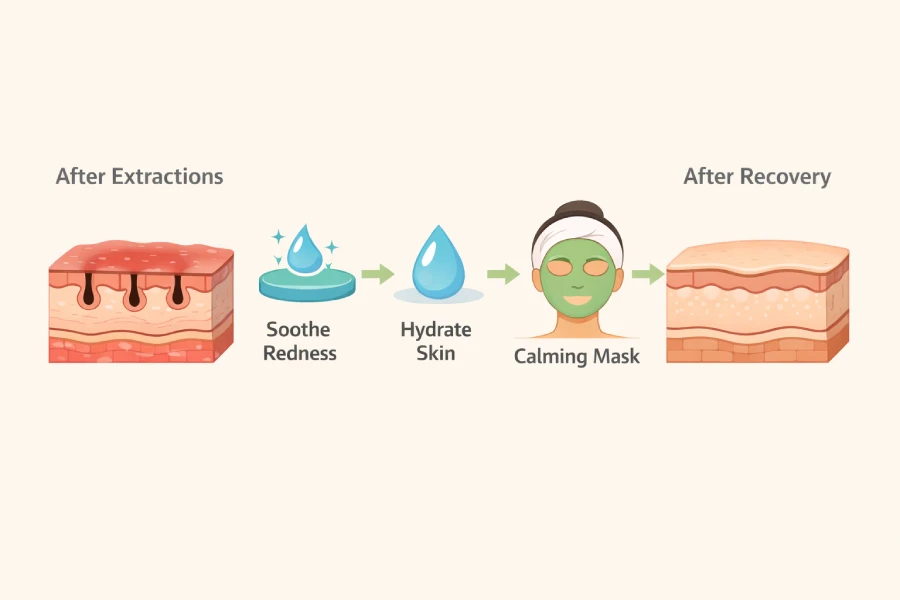
An effective post-extraction recovery protocol addresses three simultaneous skin needs: calming acute inflammation, restoring barrier integrity, and delivering targeted hydration to support cellular repair. Each step in the recovery sequence serves one or more of those functions, and the sequence itself matters as much as the individual products applied.
- Extractions create micro-trauma to the follicle wall and surrounding tissue, triggering an acute inflammatory response — redness, swelling, and increased surface sensitivity that requires deliberate clinical management, not passive waiting.
- The recovery sequence begins immediately post-extraction with a calming toner or mist to neutralize surface pH and reduce initial reactivity, before any further product is applied.
- A fragrance-free calming serum containing actives such as centella asiatica, niacinamide, allantoin, or panthenol should be applied before the mask step to deliver targeted anti-inflammatory and barrier-supportive ingredients directly to sensitized follicle tissue.
- An occlusive recovery mask applied over the serum layer seals the recovery environment, amplifies penetration of the serum actives, reduces transepidermal water loss, and delivers a cooling effect that visibly and measurably reduces post-extraction redness.
- Fragrance-free, alcohol-free formulations are an absolute requirement at every step of a post-extraction recovery protocol — sensitized post-extraction skin has a dramatically lowered tolerance for common irritants.
- Aftercare instructions — what the client should and should not apply or expose their skin to for the next 24 hours — are an essential part of the protocol and a professional obligation.
Every esthetician who performs extractions knows the moment immediately after the last expression when the client’s skin is flushed, the follicles are open, and the surface is acutely reactive. What happens in the next ten to fifteen minutes of that treatment session determines more about how the client experiences the facial — and talks about it afterward — than almost any other step in the service. Yet post-extraction recovery is also one of the most inconsistently executed components of the professional facial across the industry.
Some estheticians move directly from extractions to toner and moisturizer and close the service. Some apply a clay or setting mask that continues to draw from an already depleted skin surface. Some apply whatever recovery product they have on hand without a structured sequence or clear rationale. And some skip the recovery step entirely under the pressure of back-to-back appointments, treating the extraction work as the clinical work and the recovery as optional finishing.
None of these approaches reflect what the skin actually needs in the post-extraction window, and several actively work against the recovery process. This guide gives estheticians the physiological understanding of what extractions do to skin, a structured protocol framework for the recovery sequence, the ingredient science behind each product category in that sequence, and the professional standard for aftercare instruction. The goal is a post-extraction protocol that is reproducible, clinically grounded, and consistently delivers the outcomes clients deserve.
What Every Esthetician Should Know About Post-Extraction Recovery
- Post-extraction skin is in acute inflammatory distress: follicles are open, the barrier is locally compromised, and surface sensitivity is significantly elevated. Every product applied in this window must be selected with that physiological state in mind.
- The recovery sequence is ordered: calming first, then serum, then occlusive mask. Applying in the wrong order — particularly using an occlusive mask before a calming agent — seals inflammation in rather than calming it first.
- Fragrance and alcohol are disqualified from every step of a post-extraction protocol. No exceptions. These are the two most common sensitization triggers on compromised skin, and the follicle openings left by extractions create an entry route for irritants that does not exist on intact skin.
- A fragrance-free occlusive recovery mask applied after the calming serum amplifies serum penetration, reduces TEWL, cools surface reactivity, and creates the sealed recovery environment that post-extraction skin needs. It is not optional in a professional protocol.
- The peel-off removal method of a professional jelly mask is clinically significant post-extraction: zero friction against sensitized follicle tissue is a meaningful safety advantage over wipe- or rinse-off masks.
- Post-extraction breakout is largely preventable with proper recovery protocol execution. It is not an inevitable consequence of extractions — it is often a consequence of insufficient recovery treatment or poor post-extraction aftercare compliance.
- Aftercare instruction is part of the protocol. What the client does in the twelve to twenty-four hours following the facial determines a significant portion of the final outcome.
What Happens to Skin During and After Extractions?
Designing an effective post-extraction recovery protocol begins with understanding precisely what extractions do to the skin at the tissue level. The inflammation that follows extractions is not a complication or a side effect — it is a predictable, physiologically normal response to the mechanical disruption that extractions require. Treating it effectively means understanding what has been disrupted and what the skin needs to repair it.
The Mechanics of Extraction and the Micro-Trauma It Creates
During a professional extraction, the esthetician applies controlled pressure around a congested follicle to express its contents — a combination of sebum, keratinized cells, bacteria, and in the case of comedones, oxidized lipids. That pressure compresses the follicle wall, stretches the surrounding connective tissue, and in many cases creates micro-tears at the follicle opening or within the infundibulum (the upper portion of the follicle canal). The follicle opening remains dilated immediately post-expression, and the surrounding tissue has been subjected to varying degrees of mechanical stress depending on the depth of the lesion and the pressure required to clear it.
Even in the hands of a highly skilled esthetician using optimal technique, extractions are mechanical disruptions of living tissue. The degree of trauma correlates with the extent of the congestion being cleared, the depth and maturity of the lesions, the fragility of the client’s skin, and the technical execution. Aggressive technique on deep or cystic lesions creates more disruption than careful work on superficial whiteheads — but some degree of tissue disruption is inherent to the procedure.
The Inflammatory Cascade That Follows
The tissue disruption from extractions initiates the same wound-healing cascade that the body deploys in response to any physical tissue injury. Within seconds to minutes, local blood vessels dilate (producing the visible redness and warmth), vascular permeability increases (contributing to the mild swelling that follows significant extraction work), and resident immune cells begin releasing histamine and other pro-inflammatory signaling molecules that recruit additional repair cells to the area. Mast cells, neutrophils, and macrophages begin arriving at the disruption site — which is why post-extraction skin continues to appear more reactive for a period after the procedure ends rather than beginning to settle immediately.
This inflammatory cascade is the correct biological response: it is how the skin begins clearing cellular debris and initiating the repair process. But it is also the process that produces the redness, sensitivity, and surface vulnerability that make the post-extraction window a genuinely high-risk period for product application. Anything that amplifies the inflammatory signal — a sensitizing ingredient, a harsh toner, a fragrance compound, an active that generates further irritation — extends the reactive period and can escalate a normal post-extraction response into a clinical complication.
Why Open Follicles Create Heightened Product Penetration Risk
The follicle openings left by extractions represent a temporarily altered skin surface that allows topically applied substances deeper and faster access to the follicle canal and surrounding dermis than intact skin provides. This is both an opportunity and a risk. The opportunity: well-chosen calming and hydrating ingredients applied in this window penetrate more effectively than they would under normal circumstances, amplifying the therapeutic effect of the recovery treatment. The risk: sensitizing ingredients, synthetic fragrances, artificial dyes, or alcohol-containing products that would produce only minor surface irritation on intact skin can produce a significantly more pronounced and prolonged response when applied to post-extraction skin with open follicles. This is the physiological reason why ingredient selection in the post-extraction recovery protocol is not a preference — it is a clinical safety decision.
Which Ingredients Best Calm and Protect Skin After Extractions?
The post-extraction recovery window calls for a specific category of ingredients: those that modulate the acute inflammatory response, support barrier repair, deliver fragrance-free hydration, and do not introduce additional irritation to an already sensitized surface. Understanding which active classes serve which function allows estheticians to evaluate their product choices on a clinical rather than marketing basis.
Centella Asiatica: The Wound-Healing Botanical Standard
Centella asiatica — commonly referenced in professional skincare as cica, gotu kola, or tiger grass — has the most extensively documented wound-healing and anti-inflammatory profile of any botanical ingredient in esthetic use. Its active triterpene compounds — madecassoside, asiaticoside, asiatic acid, and madecassic acid — work through multiple complementary mechanisms: reducing pro-inflammatory cytokine activity, stimulating collagen synthesis in the wound bed, accelerating keratinocyte migration (the cell movement that closes wound sites), and supporting angiogenesis (new blood vessel formation) in the healing tissue. In post-extraction skin, these mechanisms are directly relevant: follicle repair requires the same cellular processes that centella supports in wound healing at larger scales.
Estheticians who systematically incorporate high-centella calming serums into their post-extraction protocols consistently observe faster visible redness resolution compared to protocols using lower-potency alternatives. The concentration of triterpene actives matters — serums with meaningful centella content produce meaningfully different clinical results from those in which centella appears as a low-dose marketing ingredient.
Niacinamide: Barrier Support and Redness Reduction
Niacinamide (vitamin B3) contributes to post-extraction recovery through two distinct mechanisms. First, it has well-documented anti-inflammatory properties: it reduces the production of pro-inflammatory cytokines and inhibits the transfer of melanosomes (the cellular structures responsible for post-inflammatory hyperpigmentation) to keratinocytes — which is relevant for clients prone to PIH following extraction-related tissue disruption. Second, niacinamide upregulates ceramide synthesis in the epidermis, directly supporting the barrier repair process that begins in the hours immediately following extractions. At concentrations between 2% and 5%, niacinamide is effective and well-tolerated on sensitized skin; at higher concentrations, some clients experience transient flushing, which should be avoided in the post-extraction context.
Allantoin and Panthenol: Soothing and Repair Acceleration
Allantoin is a nitrogen compound produced naturally by some plants (including comfrey) and synthesized for cosmetic use. It promotes keratinocyte proliferation — the skin’s cell-renewal process — while simultaneously reducing surface irritation and supporting the desquamation of damaged surface cells. In the post-extraction context, allantoin helps both calm the immediate sensitivity and accelerate the surface renewal that restores the compromised follicle opening. Panthenol (provitamin B5) converts to pantothenic acid in the skin, where it plays a direct role in cellular energy production during the repair process, supports moisture retention, and provides a calming film on the skin surface that reduces acute sensitivity. Both are exceptionally well-tolerated on compromised skin and represent low-risk, high-value additions to any post-extraction serum formulation.
Hyaluronic Acid and Polyglutamic Acid: Hydration During Recovery
The inflammatory process triggered by extractions is inherently dehydrating at the local tissue level: vasodilation and increased vascular permeability move fluid toward the disruption site, but TEWL also increases on compromised skin. Targeted hydration delivery is therefore not merely a comfort measure in post-extraction recovery — it is a functional support for the cellular repair process, which requires adequate local hydration to proceed efficiently.
Hyaluronic acid delivers moisture to the epidermis and upper dermis. Applied beneath an occlusive mask in the post-extraction setting, its penetration is amplified by the heightened permeability of post-extraction skin and further supported by the occlusion effect of the mask applied on top. Polyglutamic acid complements HA by forming a surface moisture-sealing film, inhibiting hyaluronidase (the enzyme that degrades HA), and stimulating NMF production — contributing to both the immediate hydration outcome and the longer-term barrier recovery process. The combination of PGA and HA in the serum or recovery mask layer creates the most complete humectant system available for this clinical context.
Why the Calming Serum Layer Matters Before the Occlusive Mask
The sequence — calming serum first, then occlusive mask — is not arbitrary. The occlusive mask creates a sealed environment that traps and amplifies whatever is on the skin surface when it is applied. Applied over a fragrance-free calming serum containing centella asiatica, niacinamide, and PGA + HA, the mask amplifies the penetration and retention of all of those actives during its set window, directing them more effectively into sensitized follicle tissue.
Applied directly over un-treated post-extraction skin, the same mask seals in the inflammatory signal without first delivering calming actives — potentially prolonging the reactive period rather than shortening it. The mask’s occlusion effect is a force multiplier: it amplifies whatever is beneath it, which is precisely why the preceding serum step determines the clinical value of the mask step.
Heightened post-extraction permeability further increases both the opportunity and the risk of this sequencing principle. Open follicles allow deeper, faster access to the tissue below the surface — meaning that well-chosen calming actives penetrate more effectively than they would on intact skin, and poorly chosen or fragmentary formulations cause more irritation than they would on intact skin. This is why the serum step in a post-extraction protocol must be evaluated with the same clinical seriousness as any active treatment step in the facial.
The Post-Extraction Recovery Protocol: Step-by-Step Sequencing for Estheticians
A professional post-extraction recovery protocol is a sequenced treatment, not a collection of individual product applications. The order of steps matters. The timing between steps matters. And the product choices at each step must be appropriate for sensitized, open-follicle skin. The following sequence represents clinical best practice for post-extraction recovery within a standard professional facial service.
- Immediate Calming Toner or Mist — pH Neutralization and Surface Calming Apply a fragrance-free, alcohol-free toner or calming mist immediately after completing extractions. This step serves two functions: it neutralizes any residual extraction-related acidity on the skin surface and delivers an immediate calming signal to inflamed tissue before any richer product is applied. Avoid toners containing witch hazel, synthetic fragrance, essential oils, menthol, or alcohol in any form. Use a cotton pad with light, no-drag application — or mist directly onto the skin and allow to settle without wiping. This step takes thirty to sixty seconds and should never be skipped.
- Fragrance-Free Calming Serum — Active Delivery to Follicle Tissue Apply a fragrance-free calming and barrier-supportive serum containing one or more of centella asiatica, niacinamide, allantoin, panthenol, or bisabolol. Include a humectant component — hyaluronic acid, polyglutamic acid, or both. Apply with clean fingertips or a pressing motion rather than a dragging stroke, to avoid mechanically disrupting follicle openings. Allow the serum to absorb for sixty to ninety seconds. This step delivers the targeted therapeutic actives that the occlusive mask step will seal and amplify — it is the clinical foundation of the recovery sequence, not a preparatory step.
- Occlusive Recovery Mask — Sealed Recovery Environment and Cooling Apply a professional occlusive recovery mask over the serum layer. For post-extraction use, the mask must meet all of the following: fragrance-free, alcohol-free, dye-free, peel-off removal, and formulated for post-treatment skin. A professional jelly mask is the clinical standard for this step. Mix and apply using a mask brush or spatula with consistent, even strokes from center outward. The cooling effect of the gel as it sets provides immediate sensory relief and active redness reduction. Set time of ten to twenty minutes supports the full delivery of serum actives into sensitized tissue.
- Peel-Off Removal — Zero Friction at the Skin Surface Remove the set mask from the edges inward as a single intact piece. Peel slowly and evenly, keeping the removal angle low to the skin surface to minimize any pull. Do not use a towel, cotton pad, or water to remove any residue — a well-formulated professional jelly mask should remove cleanly without residue. The zero-friction removal is clinically meaningful for post-extraction skin: follicle openings that have begun to contract during the mask phase should not be mechanically re-disrupted by a wiping or rinsing removal step.
- Lightweight Barrier-Supportive Moisturizer — Sealing and Protection Apply a fragrance-free, lightweight barrier-supportive moisturizer as the final product layer before SPF. Look for formulations containing ceramides, fatty acids, or squalane — ingredients that replace the lipids disrupted by the extraction process and support the structural recovery of the skin’s barrier. Avoid rich, heavy emollients or any product containing active exfoliants, retinol, or vitamin C in this final step. The moisturizer seals the hydration delivered by the recovery sequence and bridges the skin to the SPF application that closes the professional service.
- SPF Application — Mandatory Close to Every Professional Facial Apply a broad-spectrum SPF 30 or higher as the final step of every professional facial, without exception. Post-extraction skin is significantly more vulnerable to UV-induced inflammation and post-inflammatory hyperpigmentation than intact skin. SPF is not optional on the day of extractions — it is a professional obligation. For clients who decline SPF in the treatment room, document the conversation and ensure aftercare instructions include explicit guidance on avoiding UV exposure.
Why the Recovery Mask Is the Most Consequential Step in the Post-Extraction Protocol
Of the six steps in the post-extraction recovery sequence, the occlusive recovery mask has the greatest single impact on how the client’s skin looks and feels at the end of the service. This is because the mask step works as a force multiplier: it amplifies the effect of every therapeutic ingredient applied in the serum step, it delivers the only active cooling event in the protocol, and it creates the sealed recovery environment that supports barrier restoration during the most critical part of the in-treatment recovery window. Understanding why the mask step carries this weight — and what separates a clinically appropriate recovery mask from an inadequate one — is essential to executing the protocol at a professional standard.
Full Occlusion as a Recovery Tool, Not a Hydration Add-On
The occlusive function of a professional recovery mask is often discussed in terms of hydration — and hydration is certainly part of what it delivers. But in the post-extraction context, the occlusion has an additional and equally important function: it creates a sealed microenvironment in which the skin’s own repair processes can operate with reduced external disruption. Reduced TEWL means the tissue beneath the mask retains the moisture it needs for cellular repair. Reduced ambient air contact means the inflammation-resolving chemistry happening at the follicle level is not competing with ongoing surface evaporation and environmental stimulus. The mask’s occlusion is as much a recovery scaffold as it is a hydration delivery system.
The Cooling Event and Why It Cannot Be Replicated by Product Alone
The active cooling that occurs as a professional jelly mask sets over post-extraction skin is a thermodynamic event — the endothermic gel-formation process draws heat from the skin surface as the alginate cross-links. This is not the passive, room-temperature-product coolness of a cream or sheet mask; it is an active, progressive temperature reduction that clients consistently describe as the most immediately relieving sensation in the entire post-extraction recovery sequence. Thermodynamically, the heat drawn from the skin surface directly reduces local vasodilation — the mechanism responsible for the majority of post-extraction redness. Estheticians who have incorporated a cooling jelly mask into their post-extraction recovery protocols report significantly shorter redness timelines than they observed with non-cooling recovery masks applied previously.
What Disqualifies a Mask from Post-Extraction Use
The post-extraction context imposes strict qualification criteria on any mask considered for the recovery step. Estheticians should apply the following disqualifiers before selecting a recovery mask:
- Any fragrance or parfum in the ingredient list. Synthetic fragrance is the most common sensitization trigger in topical skincare, and open follicles provide an entry route that can amplify its irritation potential significantly.
- Artificial dyes or colorants. Pigment compounds serve no therapeutic function and introduce unnecessary sensitization risk on compromised skin.
- Alcohol in any form as a primary ingredient. Denatured alcohol, ethanol, isopropyl alcohol, and similar compounds disrupt the skin barrier and are contraindicated on post-treatment skin.
- Active exfoliants. AHAs, BHAs, enzymes, or any keratolytic ingredient are disqualified for post-extraction application. The extraction process has already created surface disruption; further exfoliation extends rather than resolves the compromised state.
- Any mask requiring wipe or rinse removal. Mechanical removal friction on post-extraction skin re-disrupts follicle openings that have begun to contract during the mask phase. A peel-off mask is the only removal method appropriate for the post-extraction recovery context.
Estheticians who incorporate Poly-Luronic™ Jelly Masks by Luminous Skin Lab as the recovery mask step in extraction-heavy facials consistently report a measurable change in what their clients look like at checkout. The specific observation that appears most frequently in practitioner notes is the redness timeline: estheticians who previously applied a non-cooling, wipe-off recovery mask after extractions typically saw redness persisting through the end of the service and into the client’s first ten to fifteen minutes post-checkout. After switching to the Poly-Luronic™ Jelly Mask, those same practitioners report that significant redness resolution occurs during the mask’s 12-to-15-minute set window — clients are visibly calmer by the time the peel-off removal is complete than they were at any point following the previous recovery protocol. Practitioners also note that the peel-off removal in extraction-dense areas — particularly the nose and chin — is clean and non-reactive even where multiple extractions had been performed, which they attribute directly to the zero-friction removal and the calming architecture of the PGA + HA formulation working through the occlusive set window.
Post-Extraction Aftercare Instructions: What to Tell Every Client Before They Leave
The post-extraction recovery protocol does not end at checkout. The twelve to twenty-four hours following the facial represent a continued vulnerability window for post-extraction skin, and what the client does — or does not do — during that period significantly affects the outcome. Delivering clear, specific aftercare instructions before the client leaves the treatment room is a professional obligation, not an optional service add-on.
Estheticians should provide aftercare instructions both verbally and in written form. The written instructions give the client something to reference later, and the verbal delivery ensures the most important points land before they have left the treatment room. The instructions should cover the following at minimum:
For the Remainder of Extraction Day
- Do not touch the extraction sites with unwashed hands. Follicles that have been expressed remain open and vulnerable to bacterial contamination for several hours following the procedure.
- Do not apply makeup to extraction sites for a minimum of four to six hours. Makeup application involves product contact and the mechanical friction of blending — both of which should be avoided on recently extracted skin.
- Avoid exercise that produces significant sweating. Sweat is mildly acidic and contains bacteria; on post-extraction follicles, contact with sweat increases the risk of post-service breakout.
- Avoid heat exposure — hot showers, saunas, steam rooms, hot tubs. Heat prolongs vasodilation and extends the reactive period following extractions.
- Avoid direct sun exposure. Protective SPF was applied at the end of the service, but post-extraction skin is significantly more UV-sensitive than intact skin. Sun exposure on the day of extractions elevates both inflammation risk and the likelihood of post-inflammatory hyperpigmentation.
For the Following 24 Hours
- Avoid retinol, AHAs, BHAs, and vitamin C products on extraction sites. These actives work through mechanisms that add exfoliation or cellular turnover to skin that is already in repair mode — amplifying irritation rather than supporting recovery.
- Use only fragrance-free, gentle cleansing at extraction sites. A mild, fragrance-free cleanser with lukewarm water applied with clean fingertips (no cloths or brushes) is appropriate.
- Continue to apply SPF if going outdoors, without exception.
- Expect some degree of residual redness or mild swelling at heavy extraction sites, particularly the nose. This is a normal healing response and typically resolves within twelve to twenty-four hours with proper aftercare.
- Contact the esthetician or spa if significant swelling, pustule development beyond expected healing, or prolonged reactive redness occurs beyond forty-eight hours — these may indicate a need for professional follow-up.
Common Post-Extraction Recovery Mistakes Estheticians Should Avoid
Skipping or Abbreviating the Recovery Protocol Under Time Pressure
In high-volume practices where appointments are scheduled back-to-back, the post-extraction recovery protocol is often the first step to be shortened or skipped when a service runs long. This is a professional error with real client consequences. The recovery protocol is not a luxury finishing step — it is the clinical close to an invasive procedure. A client who leaves after extractions without a proper calming and recovery treatment is a client at higher risk of post-service breakout, prolonged redness, and dissatisfaction. The five to twenty minutes that a proper recovery protocol requires should be built into the service timing, not treated as optional overflow.
Using a Harsh or Alcohol-Containing Toner Immediately After Extractions
Many estheticians learned to apply an astringent or witch hazel toner immediately following extractions as a disinfection step. While the intent — reducing bacterial contamination at the follicle opening — is valid, the execution is counterproductive on sensitized post-extraction skin. Alcohol-containing astringents strip residual lipids from the already-compromised surface, disrupt the skin’s acid mantle, and intensify the inflammatory response rather than calming it. The first step after extractions must be a calming, alcohol-free, fragrance-free toner or mist — not an astringent.
Applying an Active Mask as the Recovery Step
Clay masks, enzyme masks, AHA-infused masks, or charcoal masks are sometimes applied after extractions in an attempt to further deep-cleanse the follicles or absorb residual sebum. Each of these mask categories is contraindicated in the post-extraction context. Clay masks draw moisture from already-dehydrated skin. Enzyme and AHA masks introduce chemical exfoliation to a surface that does not need additional cell-disruption. Charcoal masks may contain fragrance compounds and create mechanical friction during removal. The only mask category appropriate for post-extraction recovery is an occlusive, calming, fragrance-free recovery mask — one that supports the skin rather than continuing to challenge it.
Failing to Deliver Aftercare Instructions
Post-extraction breakouts that occur in the twelve to twenty-four hours following a facial are often attributed by clients to the extractions themselves, when in many cases they are the result of clients touching extraction sites, applying makeup too soon, exercising immediately post-service, or using aggressive actives at home that evening. These outcomes are largely preventable with clear, specific aftercare instruction. Estheticians who consistently deliver written and verbal aftercare instructions report significantly fewer client complaints about post-extraction breakout compared to those who provide no aftercare guidance.
Professional and Scientific References
The physiological and ingredient science referenced in this article draws from peer-reviewed dermatological and cosmetic chemistry research:
- Wound healing mechanisms of centella asiatica: madecassoside, asiaticoside, and triterpene compound activity in keratinocyte proliferation, collagen synthesis, and anti-inflammatory cytokine modulation. Journal of Ethnopharmacology; multiple peer-reviewed studies 2015–2024.
- Niacinamide mechanism of action: ceramide synthesis upregulation, cytokine reduction, and melanosome transfer inhibition for post-inflammatory hyperpigmentation prevention. International Journal of Dermatology; Cosmetic Dermatology, 2018–2023.
- Allantoin keratinocyte proliferation support and desquamation facilitation in surface repair. Cosmetic chemistry literature; established ingredient safety and efficacy references.
- Gamma-PGA barrier strengthening, HAS-1/2/3 upregulation, and NMF stimulation. MDPI, 2024. Demonstrated hyaluronic acid synthase isoform upregulation and aquaporin-3 enhancement with topical PGA application on reconstructed skin models.
- Transepidermal water loss (TEWL) elevation following follicular disruption and the role of occlusive dressings in barrier recovery acceleration. Dermatological surgery and wound care literature, multiple studies 2016–2024.
- Post-inflammatory hyperpigmentation risk following UV exposure on compromised skin: evidence basis for mandatory SPF following extraction procedures. Journal of the American Academy of Dermatology; photodermatology literature.
For estheticians ready to evaluate a professional recovery mask specifically suited to the post-extraction protocol described in this guide, the Poly-Luronic™ Jelly Mask by Luminous Skin Lab is the formulation our education team recommends most consistently in extraction-heavy facial contexts. Its cooling set phase reduces post-extraction redness during the mask window, its full occlusion seals the calming serum layer and amplifies delivery to sensitized follicle tissue, and its peel-off removal requires zero friction against the open follicles extraction leaves behind. The proprietary Poly-Luronic™ PGA + HA dual-humectant system delivers surface moisture sealing and deep hydration simultaneously — the combination that supports both the immediate calming and the barrier recovery the post-extraction window requires. Fully fragrance-free, alcohol-free, and clean-label throughout.
Explore the Poly-Luronic™ Jelly Mask LineFrequently Asked Questions: Post-Extraction Recovery Treatments
What should an esthetician apply after extractions to help skin recover?
Immediately after extractions, estheticians should apply a structured recovery sequence: first a fragrance-free, alcohol-free calming toner or mist to neutralize surface pH; then a fragrance-free calming serum containing centella asiatica, niacinamide, allantoin, or panthenol alongside PGA and HA humectants; then a professional occlusive recovery mask to seal the serum layer, deliver active cooling, and support barrier repair during the set window. The recovery mask should be a peel-off formulation — the zero-friction removal is clinically significant on post-extraction skin where follicles are acutely sensitized.
Why does skin get red and swollen after extractions?
Redness and swelling after extractions are the skin’s normal acute inflammatory response to mechanical disruption of the follicle. The pressure applied during extractions compresses the follicle wall, stretches surrounding connective tissue, and in many cases creates micro-tears at the follicle opening. This triggers vasodilation — blood vessels widening to increase blood flow — histamine release, and recruitment of immune cells to begin tissue repair. The degree of reactivity varies with extraction technique, skin sensitivity, and the extent of congestion treated, but some degree of post-extraction redness is always a normal physiological response, not a complication.
How long does skin stay red after facial extractions?
For most clients, post-extraction redness resolves within one to four hours following the facial. Clients with sensitive, thin, or highly reactive skin may experience residual redness or mild swelling for up to twenty-four hours. Estheticians who apply a proper recovery protocol — including a cooling occlusive recovery mask immediately after extractions — consistently observe significantly faster redness resolution compared to protocols without an active cooling recovery step. Providing aftercare instructions about avoiding sun exposure, heat, and exercise on extraction day also meaningfully reduces redness duration.
Can I use a jelly mask right after doing extractions on a client?
Yes — a fragrance-free professional jelly mask is one of the most clinically appropriate treatments to apply immediately after extractions. The cooling effect of the setting gel actively reduces post-extraction redness. The complete occlusive seal supports barrier recovery and amplifies calming serum actives applied beneath it. And critically, the peel-off removal requires zero friction against sensitized follicle tissue, which is essential when follicles are open and acutely reactive following expression. The mask must be 100% fragrance-free, alcohol-free, and dye-free — these are non-negotiable requirements for any product applied to post-extraction skin.
What ingredients are best for calming skin after extractions?
The most clinically effective calming ingredients for post-extraction skin are centella asiatica (cica), which reduces inflammation and supports wound healing through madecassoside and asiaticoside; niacinamide, which reduces redness, supports barrier ceramide synthesis, and inhibits post-inflammatory hyperpigmentation; allantoin, which soothes irritation and promotes keratinocyte renewal; panthenol (vitamin B5), which calms and hydrates; and bisabolol, a chamomile-derived anti-inflammatory. These should be delivered in a fragrance-free, alcohol-free serum applied before an occlusive recovery mask. Hyaluronic acid and polyglutamic acid in the serum or mask layer provide the humectant hydration that supports the cellular repair process.
What should clients avoid after getting extractions at a facial?
For the remainder of the day following extractions, clients should avoid touching or picking at the skin; applying makeup to extraction sites for at least four to six hours; using actives such as retinol, AHAs, BHAs, or vitamin C; sun exposure without SPF; exercise that causes significant sweating; and heat sources such as hot showers, saunas, or steam. For the following twenty-four hours, clients should continue avoiding active skincare ingredients and use only fragrance-free, gentle cleansing. These aftercare instructions should be provided both verbally and in writing before the client leaves the treatment room, as post-extraction compliance significantly affects the final outcome.
Why do some clients break out more after a facial with extractions?
Post-extraction breakouts can occur when follicles that were partially cleared or traumatized become temporarily inflamed, or when bacteria present in expressed sebum spreads to adjacent follicles. This is more likely when extractions are performed too aggressively, when post-extraction calming treatment is insufficient, or when clients touch extraction sites, apply makeup too soon, or exercise immediately after the facial. A properly executed recovery protocol — calming serum followed by a cooling occlusive recovery mask — significantly reduces the likelihood and severity of post-extraction breakout by managing inflammation and protecting the surface during the vulnerable recovery window.
Why does the Poly-Luronic Jelly Mask work so well after facial extractions?
The Poly-Luronic™ Jelly Mask by Luminous Skin Lab is particularly effective in post-extraction recovery because it addresses all three critical post-extraction skin needs simultaneously: its cooling setting phase reduces redness and reactive inflammation during the mask window; its full occlusive seal amplifies the calming serum applied beneath it and supports barrier recovery; and its peel-off removal requires zero friction against sensitized follicle tissue. The Poly-Luronic™ blend of polyglutamic acid and hyaluronic acid provides surface moisture sealing and deep-layer hydration simultaneously, and the fully fragrance-free, clean-label formulation means it can be safely applied directly on post-extraction skin without sensitization risk.
The Post-Extraction Recovery Protocol Is the Measure of Professional Extraction Work
Extractions are one of the more invasive procedures in a professional facial — and the quality of the recovery treatment that follows them is the measure of how professionally that invasiveness was managed. A skilled extraction technique that leaves the client with an inadequate or absent recovery protocol is an incomplete service. A thorough, sequenced recovery protocol that begins immediately after the last expression and closes with proper aftercare instruction is the clinical standard that every professional extraction facial should meet.
Estheticians who understand the physiology of post-extraction skin — open follicles, acute inflammation, heightened permeability, local barrier compromise — are equipped to make product and sequence decisions that are grounded in how the skin actually behaves in that window, rather than in habit or convenience. Those decisions collectively determine whether the client’s skin looks calm and hydrated at checkout, whether they break out in the days following the service, and whether they return to book again.
The post-extraction recovery protocol is not a finishing step. It is a treatment in its own right, and it deserves to be designed and executed with the same clinical intention as every other component of the professional facial.