What Are the Best Masks to Use After Microneedling?
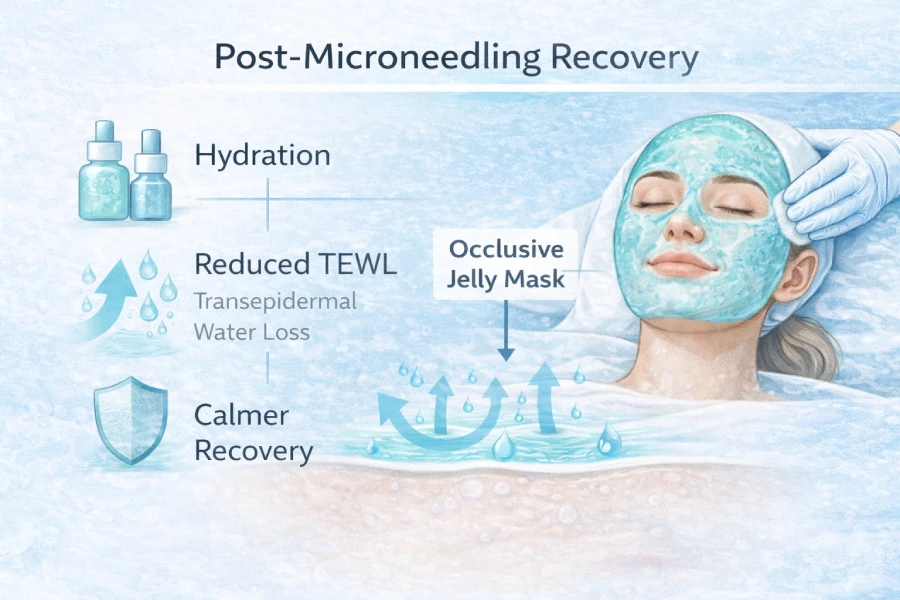
The best mask for post-microneedling recovery is a fragrance-free, occlusive professional jelly mask formulated with both polyglutamic acid (PGA) and hyaluronic acid (HA). The occlusive format directly addresses the elevated transepidermal water loss (TEWL) caused by the microneedling microchannels. PGA seals the surface, inhibits hyaluronidase to protect the applied HA from enzymatic breakdown in the inflammatory post-procedure environment, and stimulates natural moisturizing factor (NMF) production. HA delivers hydration into the temporarily permeable skin layers during the treatment window. Masks that draw moisture out of the skin, contain active ingredients, or include synthetic fragrance are contraindicated and will compound post-procedure skin stress rather than relieve it.
- Occlusive format is the primary requirement — the mask must physically seal the microchannel-disrupted surface to reduce TEWL, not draw moisture away from it.
- PGA + HA dual-humectant formulations outperform single-humectant alternatives because they address both deep hydration delivery (HA) and surface sealing plus enzymatic protection (PGA).
- Sheet masks can be used under specific conditions but do not match jelly masks for occlusion level, LED compatibility, or consistent skin contact.
- Clay masks, mud masks, and charcoal masks are absolutely contraindicated after microneedling — their moisture-drawing mechanisms are directly harmful to post-procedure skin.
- Fragrance-free is a non-negotiable safety requirement for any mask applied post-microneedling — synthetic fragrance compounds penetrate more deeply through the heightened post-procedure permeability window and cause sensitization reactions that would not occur on intact skin.
- Biocellulose masks are a secondary option with better conformity than standard sheet masks, but still fall short of jelly masks on occlusion and LED compatibility.
- Any mask applied after microneedling must also be free of active acids, retinoids, vitamin C, high-concentration niacinamide, and alcohol.
Selecting the right mask for post-microneedling recovery is not a continuation of the same decision framework estheticians use when choosing a mask for a standard hydration facial. The skin that receives a mask after microneedling is fundamentally different from intact skin. It has hundreds of temporary disruption points simultaneously compromising the barrier. It is in the early phase of an inflammatory cascade designed to trigger collagen induction. And it has a temporary permeability window that makes the penetration of whatever is applied — beneficial or harmful — substantially more pronounced than normal.
Every mask type that estheticians commonly use in treatment rooms — jelly masks, sheet masks, biocellulose masks, clay masks, gel masks — behaves differently on this skin state. Some address the specific clinical challenge directly. Some are neutral but suboptimal. Some actively worsen the post-procedure skin environment. And the difference between them is not always apparent from product marketing.
This article is a clinical selection guide: what each mask type does in the post-microneedling skin environment, how each performs against the specific clinical requirements of post-procedure recovery, and what the non-negotiable ingredient and format criteria look like for any mask applied to a client in the hours immediately following microneedling.
What the Post-Microneedling Recovery Mask Selection Comes Down To
- The post-microneedling skin environment has four simultaneous clinical demands: seal elevated TEWL, leverage the permeability window for humectant delivery, protect applied HA from hyaluronidase, and avoid ingredient sensitization through the heightened permeability barrier.
- Only an occlusive mask format directly addresses the TEWL sealing requirement — non-occlusive masks (sheet, gel, biocellulose) provide some hydration but cannot match the surface-sealing performance of a properly set jelly mask.
- PGA is the only commonly used topical humectant that simultaneously seals TEWL, inhibits hyaluronidase, and stimulates NMF production — making PGA presence in the mask formulation a meaningful clinical differentiator, not a marketing point.
- Clay, mud, and charcoal masks are absolute contraindications post-microneedling — their absorptive mechanisms draw moisture from the very skin that is already losing it through disrupted channels.
- Fragrance-free status must be confirmed by INCI review, not by label claim. “Lightly scented” or “naturally fragranced” products do not meet the post-treatment safety standard.
- LED compatibility is an operational advantage of jelly masks that no other mask format offers: the set mask allows concurrent LED therapy without extending the appointment clock.
- Sheet masks applied post-microneedling carry ingredient safety risk because the saturating solutions of most consumer-grade sheet masks have not been evaluated for use on barrier-compromised skin and often contain sensitizing compounds.
What Does Post-Microneedling Skin Actually Need From a Recovery Mask?
Before evaluating mask types, it is worth being precise about what the post-microneedling skin state requires — because mask selection should map to those specific clinical needs, not to general notions of hydration or soothing.
Requirement 1: Surface Occlusion to Seal Elevated TEWL
Microneedling creates temporary microchannels through the epidermis that dramatically increase TEWL — passive water loss from the skin to the environment — at two to four times the normal baseline rate. Without a physical occlusive seal over the treatment area, significant moisture is lost from the recovering skin in the hours immediately post-procedure. A recovery mask that does not provide meaningful surface occlusion fails the most urgent clinical need of the post-microneedling skin state.
Requirement 2: Humectant Delivery Through the Permeability Window
The same microchannels that increase TEWL also create a temporary permeability window — a period during which topically applied ingredients penetrate into skin layers more readily than through intact skin. This window closes progressively as channels seal, typically over hours depending on needle depth. A recovery mask applied while the permeability window is open can deliver humectants to skin layers that are normally inaccessible through topical application. This is one of the most clinically meaningful opportunities in the entire treatment cycle, and a mask formulation that carries no active humectants misses it entirely.
Requirement 3: Enzymatic Protection for Applied HA
Hyaluronidase — the enzyme that breaks down hyaluronic acid — is present and active in the post-microneedling inflammatory environment. Any HA applied in a recovery serum or mask will face accelerated enzymatic degradation unless the formulation also contains hyaluronidase inhibition. A mask that delivers HA without protecting it from this enzymatic activity provides a shorter-lived benefit than an equivalent formulation that also contains PGA.
Requirement 4: Zero Sensitizing Ingredients
The post-microneedling permeability window cuts both ways. The same condition that allows beneficial humectants to penetrate more effectively also allows sensitizing ingredients — synthetic fragrances, active acids, retinoids, alcohol — to penetrate more deeply and trigger inflammatory responses that would not occur on intact skin. The ingredient safety bar for post-microneedling masks is categorically higher than for standard facial masks. Any ingredient that carries any sensitization risk on intact skin carries substantially higher risk through a post-microneedling permeability window.
How Each Mask Type Performs in the Post-Microneedling Recovery Context
The following assessment maps each common professional mask type against the four clinical requirements established above. The verdict for each type is determined by how well it addresses those requirements, not by general product quality or effectiveness in other contexts.
Occlusive Jelly Mask (PGA + HA)
The highest-performing mask type for post-microneedling recovery. Sets as a physical occlusive seal that reduces TEWL. PGA inhibits hyaluronidase and seals the surface; HA delivers hydration through the permeability window. NMF stimulation begins during the dwell period. LED-compatible during the set window. Fragrance-free formulations meet all four clinical requirements simultaneously. The format that other mask types are evaluated against in this context.
Biocellulose Sheet Mask
Better skin conformity than standard fiber sheet masks due to fine-fiber structure. Maintains a hydrating film against the skin surface throughout the dwell period. Falls short on occlusion compared to a set jelly mask; cannot run concurrently with LED therapy; and performance depends entirely on the solution it is saturated with. Most standard biocellulose mask solutions are not formulated with PGA + HA and have not been evaluated specifically for barrier-compromised post-microneedling skin. Acceptable as a secondary option if the INCI is verified fragrance-free and active-free.
Standard Fiber Sheet Mask
Lowest conformity of all sheet-style masks; gaps around contoured facial features reduce effective contact area and hydration delivery. Provides some humectant delivery from the saturating solution but minimal occlusion. The primary risk with standard sheet masks post-microneedling is the saturating solution — most consumer and many professional sheet masks contain fragrance, sensitizing preservatives, or low-level actives that are entirely inappropriate through the post-microneedling permeability window. Requires full INCI verification before any post-procedure application; most commercial sheet masks will fail this review.
Hydrogel Sheet Mask
Better conformity than fiber sheet masks and provides a moderate cooling effect that can be comfortable post-procedure. Does not set as an occlusive layer and provides limited TEWL sealing. Not compatible with concurrent LED therapy. Active ingredient content varies dramatically across brands — some hydrogel masks contain brightening actives, retinoids, or fragrances that are directly contraindicated post-microneedling. INCI verification is mandatory. Where the formulation is verified fragrance-free and active-free, hydrogel masks provide some hydration benefit but remain inferior to jelly masks for the full post-microneedling clinical picture.
Clay / Kaolin / Bentonite Mask
Absolutely contraindicated after microneedling. Clay masks work by absorbing moisture and sebum from the skin surface — the opposite of the occlusive, moisture-preserving mechanism post-microneedling requires. Applied to skin with elevated TEWL and open microchannels, a clay mask would significantly amplify water loss and produce meaningful dehydration stress on already-compromised tissue. There is no clinical scenario where a clay, kaolin, or bentonite mask is appropriate immediately following microneedling.
Charcoal or Mud Mask
Same contraindication as clay — absorptive drawing mechanisms are directly harmful to post-microneedling skin. Charcoal masks additionally risk pore-occluding debris that should not be introduced to skin with open microchannels. The detoxifying and purifying mechanisms that make charcoal and mud masks useful in other facial contexts are precisely what makes them harmful in the post-procedure window.
Exfoliating Enzyme Mask or Peel-Off Mask
Enzyme masks and peel-off masks are contraindicated after microneedling for different but equally important reasons. Enzyme masks introduce exfoliating biochemical activity onto skin that is simultaneously trying to reseal hundreds of disruption points — enzymatic digestion of the skin surface interferes directly with this process. Peel-off masks require physical removal that creates friction and mechanical stress on skin that is in active recovery. Neither format has a place in post-microneedling care under any circumstances.
Plain Aloe or Gel Mask (No Actives)
A pure, fragrance-free aloe vera gel or simple recovery gel without active ingredients provides some hydration and a calming effect, but provides no meaningful occlusion and limited humectant delivery. Appropriate as an emergency substitute if no professional mask is available, but not a replacement for an occlusive dual-humectant formulation in a structured recovery protocol. Must be verified fragrance-free and free of any active ingredients, acids, or sensitizing compounds before post-microneedling application.
Why a Non-Occlusive Mask Cannot Be the First-Line Post-Microneedling Recovery Choice
The core challenge is TEWL magnitude. Post-microneedling skin is losing water two to four times faster than normal. A non-occlusive mask — sheet, hydrogel, or gel — can deliver humectants to the skin surface, but without a physical seal over that surface, those humectants sit in a high-TEWL environment. They attract water toward the skin surface where it continues to evaporate. In low-humidity environments, this paradox means a non-occlusive humectant mask can actually accelerate moisture loss from the skin surface rather than reducing it.
Jelly masks resolve this paradox by combining the humectant delivery of PGA and HA with the physical occlusive seal of the set mask layer. Once set, the mask creates a barrier against TEWL at the skin surface level — moisture delivered by the humectants remains in the skin tissue rather than evaporating. This combination of delivery and retention is what the post-microneedling clinical environment specifically requires and what no non-occlusive mask format can fully replicate.
What Ingredient Criteria Does Any Post-Microneedling Mask Need to Meet?
Regardless of format, every mask applied after microneedling must pass the same ingredient safety review. The post-microneedling permeability window does not discriminate between beneficial and harmful ingredients — it amplifies the penetration of both equally. These criteria are clinical requirements, not preferences.
Fragrance-Free — Confirmed by INCI
No synthetic fragrance, no parfum, no “natural fragrance” blends. Verify the INCI list directly — label claims of “unscented” or “lightly scented” are not equivalent to fragrance-free. Any fragrance compound penetrating through the permeability window is a sensitization risk of disproportionate magnitude.
Zero Active Acids (AHAs, BHAs, PHAs)
Glycolic, lactic, mandelic, salicylic, and all related hydroxy acids are absolute contraindications. Through the permeability window, these acids reach dermal tissue at concentrations disproportionate to their topical application concentration, producing irritation and inflammation that compounds the procedure’s own response.
No Retinoids or Retinol
All vitamin A derivatives — retinol, retinaldehyde, adapalene, tretinoin — are contraindicated. Through the permeability window, retinoids reach tissue depths and trigger cell-turnover signaling that disrupts the organized barrier resealing process. Minimum 48-to-72-hour avoidance window, longer for deeper procedures.
No Vitamin C or Brightening Actives
L-ascorbic acid and vitamin C derivatives at professional concentrations are low-pH actives contraindicated on post-procedure skin. Tranexamic acid, kojic acid, and other brightening actives at professional concentrations carry similar sensitization risk through the permeability window.
No Alcohol or Astringent Compounds
Denatured alcohol, ethanol, isopropanol, witch hazel, and astringent toners are contraindicated. These compounds dry the skin surface and disrupt the barrier, compounding TEWL in a skin environment that is already losing moisture faster than normal.
No Synthetic Dyes or Colorants
Artificial dyes provide no clinical benefit and carry sensitization potential through the post-procedure permeability window. Any mask containing colorants should be excluded from post-microneedling protocols regardless of the brand’s claims about product safety in other contexts.
Active Humectants Present — Ideally PGA + HA
The mask must contain functional humectant actives to leverage the permeability window for hydration delivery. A plain alginate-and-water jelly mask without active humectants provides occlusion but misses the delivery opportunity. PGA + HA is the evidence-based dual-humectant system; HA alone as the sole humectant is a lesser alternative that misses enzymatic protection and NMF stimulation.
Full INCI Transparency from the Brand
Any mask brand that cannot or will not provide a full INCI ingredient list for verification before post-microneedling application is automatically disqualified for this use context. No exceptions. Post-procedure skin safety requires ingredient transparency, not brand trust.
Why the Jelly Mask Format Has Specific Advantages in a Post-Microneedling Protocol
The comparison above establishes that jelly masks outperform other formats on the clinical criteria post-microneedling skin requires. But there are additional format-specific advantages of jelly masks that matter specifically in the post-microneedling operational context — not just clinically, but practically for estheticians running back-to-back treatment sessions.
The Set Mask Allows Concurrent LED Therapy
Once a professional jelly mask has set — typically reaching firm set within 12 to 15 minutes — the client can receive LED light therapy through the mask layer without the practitioner needing to remove the mask, treat with LED, and then reapply. Red LED at 630 to 660 nm and near-infrared at 810 to 850 nm transmit through the translucent set mask layer at clinically relevant levels. This concurrency means that estheticians who want to add LED photobiomodulation to their post-microneedling protocol can do so within the existing mask dwell window rather than extending the appointment. No other mask format offers this operational advantage — sheet masks shift or dry out under LED panels, hydrogel masks lose contact with movement, and no other format sets into a stable structure the way a jelly mask does.
The Removal Moment Is a Clinical and Experience Marker
A well-formulated professional jelly mask peels off as a single intact piece after the set time is complete. Beyond the client experience value — which practitioners consistently cite as one of the most memorable moments of the service — the intact removal indicates that the set quality was sufficient to provide full occlusion throughout the dwell period. A mask that cracks, tears, or leaves significant residue raises questions about whether the occlusive seal was maintained consistently across the treatment window.
Temperature Management During the Recovery Window
Professional jelly masks mixed with cool water apply at a lower temperature than body temperature, providing immediate thermal comfort on the post-procedure erythematous skin. The endothermic setting reaction of the alginate gel further cools the skin surface during the early minutes of the dwell period — a clinical benefit in a skin environment where elevated surface temperature from inflammatory activity is common. This cooling effect is not incidental to the format; it is a direct function of how jelly masks set and a meaningful comfort advantage for clients in the immediate post-microneedling window.
Estheticians who have transitioned from standard sheet mask post-microneedling protocols to an occlusive jelly mask recovery step describe the clinical difference in client skin response as one of the clearest observable shifts in their treatment outcomes. The most consistent practitioner observation across high-volume microneedling practices is that clients who receive a jelly mask recovery step immediately post-procedure show noticeably reduced post-treatment flushing at mask removal compared to clients who received only a cooling gel or sheet mask. The visible difference in redness intensity and moisture level at the 15-minute post-procedure mark is reported as one of the most tangible demonstrations of the occlusion advantage.
Among practitioners using Poly-Luronic™ Jelly Masks by Luminous Skin Lab in their dedicated post-microneedling recovery workflow, the operational notes are specific: the consistent 12-to-15-minute set window maps reliably onto a standard LED session without timing adjustment, the mask peels cleanly as a single intact piece from post-microneedling skin without the residue or adhesion issues some practitioners have encountered with other jelly mask brands on barrier-disrupted skin, and the immediate post-removal skin appearance — reduced flushing, visible surface hydration, and a calmer texture than at mask application — is what practitioners point to when explaining the protocol to new clients. Practitioners who previously used sheet masks in this position report that the visible immediate result is meaningfully better with the jelly mask recovery step.
How to Evaluate Any Mask Before Adding It to Your Post-Microneedling Protocol
Estheticians who are evaluating a specific mask for post-microneedling use should apply this structured assessment before the first protocol application. Marketing claims, brand reputation, and general product quality in other contexts are not substitutes for this evaluation.
The Evaluation Questions to Ask Before First Application
Any mask under consideration for post-microneedling use should be evaluated through the following questions before first use in that context:
- Does the brand provide a full INCI list? If not, disqualify immediately. No exceptions for this use context.
- Is the formulation fragrance-free? Confirmed by INCI review, not by label claim.
- Does the INCI contain any acids, retinoids, vitamin C, alcohol, or colorants? Any yes is a disqualifier.
- What is the mask’s primary mechanism — occlusive or absorptive? Absorptive masks are contraindicated. Occlusive formats are the clinical requirement.
- Does the formulation contain PGA? HA? Both? Both present in combination is the evidence-based dual-humectant standard. HA alone is a lesser alternative. Neither is a significant limitation.
- Is the mask LED-compatible? For practices that combine LED therapy with post-microneedling recovery, this is an operational criterion with protocol scheduling implications.
- Has the mask been tested on post-procedure skin specifically? Standard-use performance does not predict post-procedure performance.
Making the Final Selection: How to Match a Mask to Your Post-Microneedling Protocol
Selecting the right mask for post-microneedling recovery is ultimately about matching clinical requirements to format and formulation capabilities. The following decision framework gives estheticians a practical path from the clinical requirements of their specific protocol to the mask type and formulation standard that meets them.
Professional and Scientific References
The mask type evaluations and clinical criteria in this article are grounded in skin barrier biology, post-procedure recovery science, and humectant mechanism literature:
- Post-microneedling TEWL dynamics and permeability window. Dermatologic Surgery; cosmetic laser and device dermatology literature. Barrier disruption TEWL kinetics and temporary permeability enhancement in minimally invasive procedures.
- Hyaluronidase activity in inflammatory post-procedure skin environments. Cosmetic chemistry and wound healing biology literature.
- PGA hyaluronidase inhibition mechanism. Typology, 2021–2025; cosmetic chemistry formulation literature.
- Gamma-PGA NMF stimulation, HAS-1/2/3 upregulation, aquaporin-3 and filaggrin enhancement. MDPI Cosmetics, 2024. Reconstructed skin model demonstrating multiple barrier-reinforcing mechanisms of 1% topical gamma-PGA.
- Sodium alginate occlusive properties and wound healing applications. Biomaterials and wound care science literature.
- Biocellulose sheet mask conformity and hydration delivery compared to standard sheet masks. Journal of Cosmetic Dermatology; cosmetic clinical literature.
- Synthetic fragrance sensitization risk through barrier-compromised skin. Contact Dermatitis; professional esthetic continuing education literature.
For estheticians who want a recovery mask formulation that satisfies every clinical criterion outlined in this article — surface occlusion, PGA + HA dual-humectant delivery, hyaluronidase inhibition, NMF stimulation, LED compatibility, and absolute ingredient safety — the Poly-Luronic™ Jelly Mask by Luminous Skin Lab is the formulation our education team references specifically in the post-microneedling recovery context. Developed by a licensed esthetician around the proprietary PGA + HA dual-humectant system, it was built from the beginning for post-procedure compatibility: fragrance-free, clean-label, with a 12-to-15-minute set window that maps directly onto a standard LED therapy session without adjustment. The full intact peel removal avoids the friction that recovery skin cannot tolerate, and the immediate post-removal skin appearance — reduced erythema, visible surface hydration, calmer texture — is what practitioners cite when explaining to clients why the recovery step is not optional.
Explore the Poly-Luronic™ Jelly Mask LineFrequently Asked Questions: Best Masks to Use After Microneedling
What is the best type of mask to use after microneedling?
A professional occlusive jelly mask containing both polyglutamic acid (PGA) and hyaluronic acid (HA) is the most clinically effective mask type for post-microneedling recovery. The jelly mask format provides the surface occlusion needed to seal the elevated transepidermal water loss (TEWL) from disrupted microchannels. PGA inhibits hyaluronidase to protect applied HA from enzymatic breakdown in the post-procedure inflammatory environment, and HA delivers deep hydration into the temporarily permeable skin layers during the treatment window. The mask must be fragrance-free, free of active acids and retinoids, and formulated specifically for compromised skin.
Can I use a sheet mask after microneedling?
Sheet masks can be used after microneedling under specific conditions, but they fall short of the jelly mask format in several clinical ways. Sheet masks do not provide the same degree of occlusion, so they are less effective at sealing the elevated TEWL that is the primary immediate hydration challenge after microneedling. They also do not maintain consistent contact pressure across the entire face and cannot run concurrently with LED therapy. If a sheet mask is used, it must be fragrance-free, free of active ingredients including acids and retinoids, and ideally contain HA or similar safe humectants. Check the full INCI list for sensitizing ingredients before applying to post-procedure skin.
Can you put a clay mask on after microneedling?
No. Clay masks are absolutely contraindicated after microneedling. Clay masks work by drawing moisture and sebum out of the skin — the opposite of what post-microneedling skin requires. Applied to skin that is already losing moisture through disrupted microchannels, a clay mask would significantly compound transepidermal water loss and cause notable dehydration and skin stress. The drying and drawing mechanisms of clay are clinically inappropriate on any barrier-compromised skin.
Why does the mask I use after microneedling need to be fragrance-free?
Post-microneedling skin has a temporarily heightened permeability that increases the penetration depth of any topically applied ingredient — including synthetic fragrance compounds, which are among the most common contact sensitizers in skincare. A fragrance that causes no reaction on intact skin can cause significant irritation, redness amplification, or allergic sensitization through the post-microneedling permeability window. Fragrance-free is not a preference for post-microneedling mask selection — it is a non-negotiable clinical safety requirement.
What ingredients should a post-microneedling mask contain?
The most effective post-microneedling mask formulation contains polyglutamic acid (PGA) and hyaluronic acid (HA) as the core humectant system. PGA provides surface occlusion that reduces TEWL from the disrupted barrier, inhibits hyaluronidase to protect applied and natural HA in the inflammatory post-procedure environment, and stimulates natural moisturizing factor (NMF) production in the stratum corneum. HA delivers water-binding capacity into the temporarily accessible deeper skin layers during the permeability window created by the microchannels. Beyond the active humectants, the formulation must be fragrance-free, free of synthetic dyes, and contain no active acids, retinoids, vitamin C, or high-concentration niacinamide.
What ingredients in a mask can cause a reaction after microneedling?
Any of the following ingredients applied in a mask immediately after microneedling can cause heightened irritation, sensitization, or inflammatory reactions through the post-procedure permeability window: synthetic fragrance and parfum compounds; alpha hydroxy acids including glycolic, lactic, and mandelic acids; beta hydroxy acids including salicylic acid; retinol and all retinoids; vitamin C (L-ascorbic acid); niacinamide above low concentrations; alcohol; witch hazel; and synthetic dyes or colorants. These are all safe on intact skin in normal use but become significantly more reactive on post-microneedling skin where barrier permeability is temporarily elevated.
How long should I leave a mask on after microneedling?
For a professional jelly mask applied post-microneedling, the recommended dwell time is a minimum of 12 to 15 minutes and ideally the full set time of the specific formulation, typically 15 to 20 minutes. This window allows the humectants to deliver hydration during the permeability window while the occlusive layer reduces TEWL. Removing the mask before the full set time shortens the active delivery window and reduces the NMF stimulation and hyaluronidase protection benefit. LED therapy can be run concurrently during this dwell time in compatible protocols.
What makes biocellulose masks better or worse than jelly masks after microneedling?
Biocellulose masks offer better skin conformity than standard cotton or fiber sheet masks due to their fine-fiber structure, and they maintain a hydrating film against the skin surface throughout the dwell period. However, they do not match the occlusion level of a properly set jelly mask for sealing TEWL, cannot be used concurrently with LED therapy, and their formulation quality varies significantly across brands. The key clinical limitation is that biocellulose mask performance depends entirely on the solution the material is saturated with — and most standard biocellulose masks are not formulated with the PGA + HA dual-humectant system that makes jelly masks particularly effective in the post-microneedling recovery context.
Why is the Poly-Luronic™ Jelly Mask specifically recommended for after microneedling?
The Poly-Luronic™ Jelly Mask by Luminous Skin Lab is formulated around the three clinical requirements of the post-microneedling skin environment: surface occlusion to seal elevated TEWL from open microchannels, PGA-based hyaluronidase inhibition to protect applied HA from enzymatic breakdown in the inflammatory post-procedure environment, and HA delivery into the temporarily permeable skin layers during the treatment window. It is fragrance-free and clean-label, meeting the post-microneedling ingredient safety standard. The 12-to-15-minute predictable set window aligns with LED therapy sessions, making it directly compatible with the concurrent LED + mask recovery workflow without requiring timing adjustments.
The Mask You Choose After Microneedling Is a Clinical Decision
The mask applied immediately after microneedling is not the same decision as the mask applied in a standard hydration facial. The skin is different. The clinical requirements are specific. And the wrong choice — the wrong format or the wrong ingredient profile — compounds the very skin stress the procedure was designed to produce outcomes from.
The evaluation framework is straightforward once the clinical requirements are clear: occlusion to seal TEWL, PGA + HA to deliver humectants and protect them enzymatically, absolute ingredient safety to avoid sensitization through a heightened permeability window. Every mask type in common professional use can be evaluated against those four criteria. Most fall short on at least two of them. The occlusive PGA + HA jelly mask format is the only one that satisfies all four simultaneously — and the LED compatibility and clean peel removal that come with the format add additional operational advantages specific to the post-microneedling protocol context.
Estheticians who build their post-microneedling recovery protocol around these clinical criteria — and who can explain the rationale to clients in plain language — are delivering a level of protocol intelligence that clients experience in their recovery outcomes and remember when they book their next session.