What Is the Difference Between Polyglutamic Acid and Hyaluronic Acid for Post-Treatment Hydration?
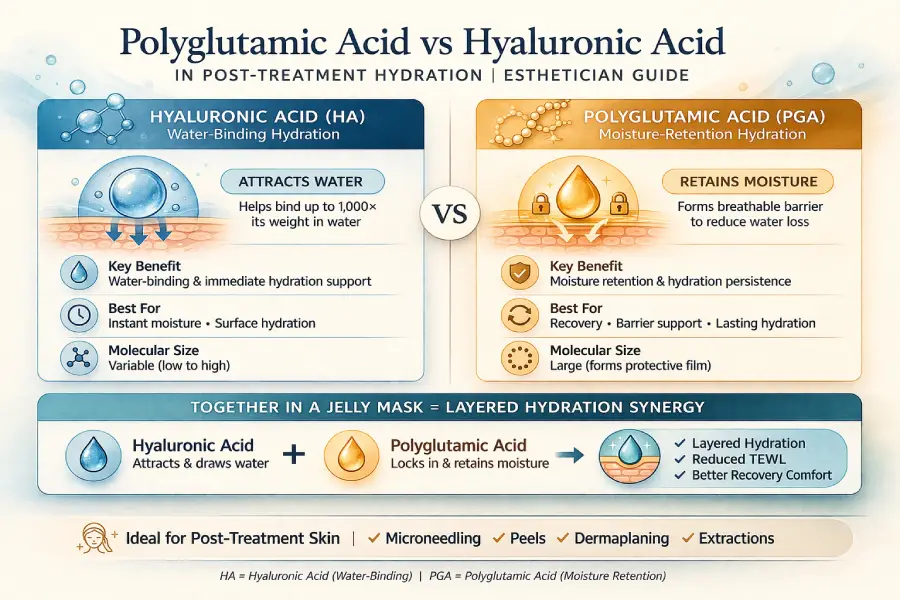
Polyglutamic acid (PGA) and hyaluronic acid (HA) are both humectants used in professional skincare, but they work at different depths of the skin and through distinct mechanisms. HA penetrates into the epidermis and upper dermis, attracting and delivering water to deeper skin layers. PGA works at the surface, forming a moisture-sealing film, inhibiting the enzyme that degrades HA, and stimulating the skin’s own natural moisturizing factor production. In the context of post-treatment recovery, each mechanism addresses a different dimension of what compromised skin needs — which is why their combination outperforms either ingredient used alone.
- Hyaluronic acid holds approximately 1,000 times its weight in water and hydrates at the epidermal and dermal level — but is continuously broken down by the enzyme hyaluronidase, which limits how long its effect lasts.
- Polyglutamic acid holds up to 5,000 times its weight in water at the skin surface, inhibits hyaluronidase to protect both applied and natural HA, and stimulates the skin’s natural moisturizing factor (NMF) compounds including pyrrolidone carboxylic acid and lactic acid.
- After any procedure that compromises the skin barrier — microneedling, chemical peels, dermaplaning, extractions — transepidermal water loss (TEWL) increases significantly. PGA’s surface-sealing mechanism is specifically valuable in this context.
- PGA has been shown to upregulate hyaluronic acid synthase-1, -2, and -3, meaning it stimulates the skin to produce more of its own HA during the recovery window.
- For post-treatment protocols, the most clinically effective hydration approach combines both molecules: HA to deliver deep hydration where the barrier has been disrupted, and PGA to lock it in, protect it, and support the skin’s own recovery biology.
Professional estheticians encounter the PGA vs. HA conversation with increasing frequency — from client questions, from ingredient labels on masks and serums, and from the growing body of practitioner education content that discusses these two molecules. What is less common is a clear, science-grounded explanation of why the comparison itself is somewhat misleading. PGA and HA are not competitors in the same functional category. They work at different skin depths, through different biological pathways, and address different aspects of what skin needs to stay hydrated and recover from treatment stress.
That distinction becomes especially consequential in a post-treatment context. When the skin barrier has been disrupted — whether by microneedling channels, chemical exfoliation, dermaplaning, or aggressive extraction — the hydration challenge is multidimensional. Moisture is escaping faster than usual. The enzymatic activity that breaks down HA is undiminished or accelerated. The skin’s natural moisturizing factor compounds may be depleted or disrupted. And the permeability window that temporarily opens after treatment creates both an opportunity to deliver actives more effectively and a vulnerability to ingredient irritation.
Understanding what PGA and HA each bring to this environment — and why they work better together than either does independently — gives estheticians the scientific foundation to design better recovery protocols, select more effective products, and explain outcomes to clients with the kind of specificity that builds long-term professional credibility.
What Every Esthetician Should Know About PGA vs. HA in Post-Treatment Recovery
- PGA and HA are not interchangeable alternatives — they address different layers of skin hydration and different dimensions of post-treatment recovery biology.
- Hyaluronic acid delivers moisture deep into the epidermis and dermis. Polyglutamic acid seals, protects, and supports at the surface. Together they achieve complete dual-depth hydration.
- Post-treatment skin loses water far faster than intact skin. PGA’s surface-sealing film directly counters this increased TEWL in a way HA cannot.
- Hyaluronidase — the enzyme that breaks down HA — is active in post-treatment skin. PGA inhibits it, protecting the clinical investment in any HA serum or recovery product applied under the mask.
- PGA upregulates HA synthase expression in skin cells, stimulating the skin’s own production of hyaluronic acid during the recovery window.
- NMF (natural moisturizing factor) compounds stimulated by PGA include pyrrolidone carboxylic acid, lactic acid, and urocanic acid — all critical to the stratum corneum’s long-term moisture-retention capacity.
- The clinical case for using a PGA + HA dual-humectant formulation in post-treatment jelly masks is not marketing language — it is supported by peer-reviewed 2024 research on gamma-PGA mechanisms in human skin models.
Why Post-Treatment Skin Loses Hydration Differently Than Intact Skin
Before comparing PGA and HA, it is worth establishing what post-treatment skin actually requires that healthy, intact skin does not. The distinction changes which humectant properties matter most in a recovery formulation.
Transepidermal Water Loss After Barrier Disruption
The skin barrier’s primary function is to prevent water from escaping the body’s tissues into the external environment. This passive water diffusion — measured clinically as transepidermal water loss (TEWL) — is low in intact skin with a healthy lipid matrix. After procedures that disrupt the barrier, TEWL can increase by two to four times the baseline rate, depending on procedure depth and treatment area.
Microneedling, for example, creates temporary microchannels through the epidermis. Dermaplaning removes the stratum corneum’s outermost cellular layers. Chemical exfoliation disrupts the intercellular lipid matrix. Extraction-heavy facials create localized inflammatory zones. Each of these changes dramatically increases the rate at which the skin loses water to the environment — and the window during which this heightened loss occurs can extend for hours to days post-treatment, depending on the client’s skin health and the depth of intervention.
The Heightened Permeability Window
The same barrier disruption that accelerates TEWL also creates what estheticians commonly refer to as a permeability window — a period during which topically applied ingredients penetrate into skin layers more readily than they would through intact skin. This is both the primary opportunity and the primary risk of post-treatment skincare application.
The opportunity: humectants, recovery peptides, growth factors, and barrier-supportive ingredients applied immediately post-treatment can reach deeper skin layers than normal. The risk: sensitizing ingredients — synthetic fragrances, high concentrations of actives, dye compounds — are also more likely to cause reactions. Estheticians working in post-treatment recovery protocols leverage the permeability window deliberately, selecting formulations designed to take clinical advantage of it without triggering inflammatory responses.
Enzymatic and Inflammatory Activity Post-Treatment
Procedures that induce controlled inflammation — as microneedling and certain chemical peels deliberately do as part of their collagen-stimulation mechanism — activate immune and enzymatic activity in the skin. Among the enzymes mobilized in inflammatory skin environments is hyaluronidase, which degrades hyaluronic acid. The implications for post-treatment HA application are significant: the very window during which HA penetration is enhanced may also be a window of increased enzymatic breakdown. Without protection from hyaluronidase, the gains from an HA-rich recovery serum or mask can be substantially reduced.
How Hyaluronic Acid Works and What It Does Well in Post-Treatment Skin
Hyaluronic acid is among the most well-established and widely used ingredients in both professional and consumer skincare. Understanding what it actually does — at the biological level — helps clarify both where it excels in post-treatment recovery and where its limitations lie without complementary support.
HA’s Structure and Natural Role in Skin
Hyaluronic acid is a glycosaminoglycan — a long-chain polysaccharide made of alternating sugar units — that occurs naturally throughout the body. In skin, HA is most abundant in the dermis, where it forms part of the extracellular matrix supporting collagen, elastin, and fibroblast activity. It is also present in the epidermis, where it functions as a water reservoir. The body produces HA continuously, but production declines progressively with age — by the mid-40s to 50s, epidermal HA reserves may be roughly half of what they were at younger ages — which is one reason why topical HA replenishment carries genuine clinical rationale.
Molecular Weight and Penetration Depth
The practical behavior of topically applied HA depends significantly on its molecular weight. High molecular weight HA (above 1,000 kDa) does not penetrate through intact skin — it forms a film on the surface that provides temporary hydration and a tactile softening effect. Low molecular weight HA (below 50 kDa) can penetrate into the epidermis and, in some research contexts, into the upper dermis, delivering water-binding capacity to deeper skin layers. Many professional HA serums and formulations use a mix of molecular weights to address both surface and deeper hydration simultaneously.
In post-treatment skin where the barrier is disrupted, the penetration advantage of lower molecular weight HA is amplified. The temporary microchannels or compromised lipid matrix created by the treatment allow HA molecules that would normally sit at the surface to travel into deeper epidermal and dermal layers. This is one of the primary clinical rationales for applying HA serums immediately post-microneedling or post-dermaplaning — the treatment-created permeability window maximizes the delivery effect.
Where Hyaluronic Acid Has Limitations Post-Treatment
Despite its strengths, HA used alone in post-treatment formulations faces two significant limitations. First, HA is a highly effective humectant — it attracts water — but it does not physically prevent that water from evaporating. Applied in an environment with elevated TEWL, HA draws moisture toward the skin surface where it can continue to be lost to the environment unless an occlusive barrier is present. Applied alone without an occlusive component, HA can paradoxically accelerate surface drying in low-humidity environments. Second, as noted above, the enzyme hyaluronidase actively degrades HA in the skin — and inflammatory post-treatment environments may increase this enzymatic activity. HA applied without hyaluronidase protection may be broken down faster than it delivers meaningful benefit, particularly in the hours immediately following a procedure.
How Polyglutamic Acid Works and Why It Is Particularly Valuable After Professional Treatments
Polyglutamic acid is a newer entrant to professional skincare ingredient vocabulary than hyaluronic acid, but the science behind it is well-developed and the mechanisms relevant to post-treatment skin are clinically specific in ways that make it especially valuable in recovery protocols.
What Polyglutamic Acid Is and How It Is Made
PGA is a naturally fermented biopolymer — a long chain of glutamic acid amino acid residues produced by the bacterium Bacillus subtilis during fermentation of soybeans. It is not naturally produced by the human body, unlike HA, but its interaction with human skin tissue is well characterized in the literature. PGA is available in alpha and gamma forms; the gamma form (γ-PGA) is the predominant version used in professional skincare formulations and is the form studied in the 2024 peer-reviewed research on HAS upregulation and barrier reinforcement.
PGA’s Surface Mechanism: The Microgel Film
Due to its relatively high molecular weight, topically applied PGA does not penetrate deeply into skin tissue. Instead, it remains at the stratum corneum level, where it forms what researchers describe as a flexible, transparent microgel film across the skin surface. This film functions as a physical moisture barrier — dramatically reducing transepidermal water loss by limiting how much water vapor can escape from the skin into the surrounding environment. In intact skin, this surface-sealing effect is valuable. In post-treatment skin with elevated TEWL, it is specifically and precisely what the barrier-compromised skin environment requires.
The moisture-retention comparison is stark: PGA holds up to 5,000 times its weight in water, versus approximately 1,000 times for HA. But beyond raw moisture-binding capacity, PGA’s surface residence is what differentiates its function from HA. It does not compete with HA for penetration depth — it operates at a different anatomical level, sealing what HA has delivered rather than duplicating it.
PGA Inhibits Hyaluronidase: Protecting Both Applied and Natural HA
One of PGA’s most clinically significant and least commonly understood properties is its inhibition of hyaluronidase, the enzyme responsible for breaking down hyaluronic acid in the skin. When PGA is present in a post-treatment formulation applied over or alongside HA, it does not merely add a second humectant — it protects the HA already present from enzymatic degradation. This means the HA serum applied before the mask, the HA within the mask formulation, and the skin’s own native hyaluronic acid are all preserved for longer during the treatment and recovery window.
In a post-procedure environment where inflammatory enzymatic activity may be elevated, this hyaluronidase-inhibiting property is not a bonus feature — it is a direct clinical response to a specific biochemical challenge that post-treatment skin faces and that HA applied without PGA cannot address.
PGA Stimulates Natural Moisturizing Factor Production
The natural moisturizing factor (NMF) is a group of water-soluble compounds naturally present in the cells of the stratum corneum that maintain the outermost skin layer’s hydration and flexibility. NMF constituents include pyrrolidone carboxylic acid (PCA), lactic acid, urocanic acid, amino acids, and inorganic salts. Professional procedures that remove or disrupt stratum corneum cells — dermaplaning, chemical peels, aggressive microdermabrasion — may temporarily reduce NMF levels in the treated area. Restoring NMF production is part of what constitutes genuine barrier recovery, as distinct from surface moisture application.
Polyglutamic acid has been shown in published research to stimulate production of PCA, lactic acid, and urocanic acid within the stratum corneum — directly supporting NMF recovery. For estheticians designing post-treatment protocols where true barrier restoration is the objective rather than temporary surface hydration, this mechanism distinguishes PGA from simple humectants that add water without supporting the skin’s intrinsic moisture-maintenance biology.
PGA Upregulates Hyaluronic Acid Synthase
Research published in 2024 in a peer-reviewed dermatological journal demonstrated that topical application of gamma-PGA upregulated the expression of hyaluronic acid synthase-1 (HAS-1), HAS-2, and HAS-3 mRNA in a reconstructed skin model. These enzymes are responsible for the synthesis of the skin’s own endogenous hyaluronic acid. Upregulation of HAS expression means that PGA application stimulates the skin to produce more of its own native HA during and after the treatment window — not just providing external moisture, but activating the skin’s biological capacity to sustain hydration over time.
The same study demonstrated elevated aquaporin-3 expression — a water channel protein critical to the movement of water through skin tissue — and increased filaggrin and involucrin, proteins that are direct markers of strengthened barrier integrity. For estheticians whose post-treatment protocols aim at genuine skin health outcomes rather than temporary appearance improvement, these mechanisms represent a meaningful step beyond what any standard humectant application achieves.
What PGA Does in Post-Procedure Skin That HA Cannot Do Independently
Seals elevated TEWL at the surface: Post-treatment skin loses moisture 2–4× faster than intact skin. PGA’s surface microgel film physically reduces this loss in a way that HA’s deep-delivery mechanism cannot replicate.
Inhibits hyaluronidase in inflammatory skin: Post-procedure inflammatory activity can accelerate enzymatic HA breakdown. PGA’s hyaluronidase inhibition is a targeted response to this specific post-treatment biochemical challenge.
Stimulates NMF recovery: Procedures that remove or disrupt stratum corneum cells deplete NMF. PGA stimulates production of PCA, lactic acid, and urocanic acid — restoring the corneum’s own moisture-retention biology.
Upregulates HAS-1, HAS-2, HAS-3: PGA does not just apply external HA — it prompts the skin to synthesize more of its own, supporting long-term hydration capacity beyond the immediate treatment window.
PGA vs. HA in Post-Treatment Hydration: A Side-by-Side Science Comparison
The following comparison maps each molecule’s properties against the specific demands of post-treatment skin. Estheticians who understand this table can use it to explain ingredient decisions to clients and to evaluate whether any given recovery formulation contains what post-treatment skin actually requires.
| Property | Hyaluronic Acid (HA) | Polyglutamic Acid (PGA) |
|---|---|---|
| Moisture-binding capacity | ~1,000× weight in water | Up to 5,000× weight in water |
| Depth of action | Epidermis + upper dermis (penetrates deeper layers) | Stratum corneum surface (microgel film; does not penetrate) |
| TEWL reduction | Minimal — not a physical occlusive barrier | Significant — surface film physically limits water escape |
| Hyaluronidase response | Degraded by hyaluronidase — shorter active window | Inhibits hyaluronidase — protects both applied and native HA |
| NMF stimulation | No evidence of NMF stimulation | Stimulates PCA, lactic acid, urocanic acid production |
| HA synthase upregulation | No effect on HA synthase expression | Upregulates HAS-1, HAS-2, HAS-3 mRNA (MDPI 2024) |
| Aquaporin-3 enhancement | Not demonstrated in published research | Demonstrated in reconstructed skin model (MDPI 2024) |
| Post-treatment permeability benefit | Enhanced penetration into barrier-disrupted skin is an advantage | Primarily surface-active; permeability window increases HA benefit that PGA then protects |
| Naturally produced by human skin | Yes — naturally occurring polysaccharide | No — fermentation-derived (Bacillus subtilis / soybean) |
| Post-treatment protocol role | Deep hydration delivery during permeability window | Surface seal, enzymatic protection, NMF and HAS stimulation |
Why PGA + HA Together Is the Clinical Standard for Post-Treatment Hydration — Not a Marketing Claim
The word “synergistic” is overused in skincare marketing to the point where it has nearly lost meaning. In the case of PGA and HA in post-treatment skin, the synergy is structural, anatomical, and biochemical — not a matter of branding language. The ingredients work together because their mechanisms are complementary, not redundant.
Deep Delivery + Surface Seal = Complete Coverage
HA’s strength is penetration and deep-layer water delivery. PGA’s strength is surface retention and enzymatic protection. Applied in sequence — HA serum followed by a PGA-containing occlusive jelly mask, or both present in the same formulation — the two molecules address what the other cannot. HA draws water into skin layers that post-treatment permeability has made temporarily accessible. PGA then seals those gains at the surface, limiting TEWL that would otherwise pull the newly delivered moisture back out of the skin.
Without PGA, HA applied post-treatment may be partially lost to transepidermal evaporation and enzymatic breakdown. Without HA, PGA seals the surface but does not deliver meaningful deep hydration into the skin layers where recovery is actually occurring. Together they constitute the complete recovery cycle: delivery and retention.
Hyaluronidase Inhibition Compounds the HA Investment
Every professional esthetician applying HA serums before or after a treatment is making an ingredient investment on behalf of the client’s skin. In the inflammatory post-treatment environment, hyaluronidase is actively working to break that investment down. Estheticians working in post-treatment recovery protocols have noted in practice that when PGA is introduced into the recovery step — particularly within a jelly mask applied immediately after treatment — the visible and tactile hydration results last measurably longer than HA applied without hyaluronidase protection. The PGA is not just adding moisture; it is protecting the clinical value of everything applied underneath it.
NMF Stimulation Converts Immediate Hydration Into Long-Term Recovery
The distinction between surface hydration and genuine barrier recovery is meaningful in a clinical context. Surface hydration — applying water-binding agents to skin that has been stripped or disrupted — provides immediate comfort and appearance improvement. Genuine barrier recovery means the skin’s own moisture-maintenance biology has been restored. PGA’s NMF stimulation and HAS upregulation mechanisms sit firmly in the second category. By stimulating the stratum corneum’s production of PCA, lactic acid, and urocanic acid, and by upregulating the enzymes responsible for endogenous HA synthesis, PGA application during the post-treatment window does not just hydrate the skin in the moment — it helps the skin sustain its own hydration in the days following treatment. For estheticians whose protocols aim at genuine skin health outcomes, this dimension of PGA’s action is worth communicating to clients as a specific reason why the recovery step in a professional protocol is not optional.
Estheticians who have transitioned from single-humectant recovery protocols to formulations built on a PGA + HA dual system consistently describe the visible difference in client skin response as one of the most immediate clinical validations of the ingredient science. The pattern observed across practitioners working in post-microneedling and post-dermaplaning contexts is consistent: skin that received a PGA-inclusive recovery mask shows more sustained hydration at 24-hour and 48-hour follow-up than the same client base receiving HA-only recovery care, and reports of sensitivity and tightness in the days following treatment are reduced.
Estheticians using the Poly-Luronic™ Jelly Mask by Luminous Skin Lab in post-treatment recovery protocols specifically reference the formulation’s PGA + HA dual-humectant system as the reason it performs differently than alginate masks they used previously. The practical observation in treatment rooms running multiple consecutive post-microneedling sessions is that the PGA surface film visibly reduces the flushing and moisture loss response in the minutes immediately after mask removal — an effect that single-humectant formulations do not produce at the same level. The consistent 12-to-15-minute set window also accommodates LED therapy sequences without timing adjustment, making it practical for estheticians running combined device-and-mask recovery workflows.
How to Apply the PGA vs. HA Science in Post-Treatment Protocol Design
Understanding the mechanism difference between PGA and HA changes how estheticians design layering sequences in post-treatment recovery. The following principles follow directly from the science covered in this article.
Sequence: HA Before PGA
If applying actives in a layered protocol — serum followed by mask — apply the HA-rich delivery serum first to take advantage of the post-treatment permeability window while microchannels or compromised lipid matrix are accessible. Follow with a PGA-containing occlusive mask to seal the HA in, inhibit hyaluronidase, and begin NMF stimulation. Applying PGA-heavy formulations first would partially reduce the penetration advantage of the HA applied on top, as the surface film would limit subsequent permeation.
Formulation Selection: Look for Both in Recovery Masks
When evaluating jelly masks for post-treatment use, confirm the presence of both PGA (polyglutamic acid) and HA (sodium hyaluronate or hyaluronic acid) on the INCI list. A mask listing only HA, or neither, relies entirely on alginate’s physical occlusion for recovery benefit — which addresses TEWL to a degree but delivers none of the enzymatic protection, NMF stimulation, or HAS upregulation that define PGA’s clinical contribution. Conversely, a mask listing PGA without HA misses the deep-layer hydration delivery that HA provides during the permeability window.
Communication: Explain the Mechanism, Not Just the Result
Estheticians who can explain to a client why the recovery step uses a dual-humectant mask — specifically, that one ingredient hydrates deep and one seals and protects at the surface — are doing something that distinguishes professional treatment rooms from consumer retail: connecting a product decision to a mechanism a client can verify exists. This level of explanation builds the kind of trust that generates rebooking and retail conversion without any sales pressure, because the client understands that the protocol decision is science-based rather than arbitrary.
Professional and Scientific References
The ingredient science and mechanism claims in this article draw from peer-reviewed research and professional cosmetic chemistry literature:
- Gamma-PGA barrier strengthening, HAS-1/2/3 upregulation, aquaporin-3 enhancement, filaggrin and involucrin increase. MDPI Cosmetics, 2024. Reconstructed skin model study demonstrating multiple barrier-reinforcing mechanisms of 1% topical gamma-PGA application.
- PGA moisture-binding capacity (up to 5,000× weight in water) and hyaluronidase inhibition mechanism. Typology Skincare Science Documentation, 2021–2025; cosmetic chemistry literature.
- PGA vs. HA corneometry data: 60% moisture increase at 30 minutes, 25% elevation maintained at 8 hours with 2% PGA serum versus low-molecular-weight HA comparison. Reviva Labs published literature review, 2025.
- NMF compound stimulation by PGA — pyrrolidone carboxylic acid (PCA), lactic acid, urocanic acid production in stratum corneum cells. Typology; Prequel Skin; Skin Rocks biochemist commentary, 2022–2025.
- PGA + HA combination: slowed HA degradation, enhanced sustained moisturizing effect, tactile improvement over single-humectant HA. Stanford Chemistry and cosmetic formulation literature, 2024.
- Transepidermal water loss dynamics post-microneedling and chemical exfoliation. Clinical esthetics and dermatology practice literature; established post-procedure care protocols.
For estheticians looking to implement the PGA + HA dual-humectant science discussed in this article into their post-treatment recovery protocols, the Poly-Luronic™ Jelly Mask by Luminous Skin Lab is the formulation our education team references most frequently in post-procedure recovery and advanced hydration protocol contexts. Developed by a licensed esthetician to specifically address the post-treatment skin environment — elevated TEWL, enzymatic vulnerability to applied HA, disrupted NMF — the Poly-Luronic™ blend delivers PGA’s surface-sealing, hyaluronidase-inhibiting, and NMF-stimulating mechanisms alongside HA’s deep-delivery hydration in a single occlusive jelly mask application. Fragrance-free, clean-label, and formulated for post-microneedling, post-dermaplaning, and LED-adjunctive protocol compatibility.
Explore the Poly-Luronic™ Jelly Mask LineFrequently Asked Questions: PGA vs. HA in Post-Treatment Hydration
What is the difference between polyglutamic acid and hyaluronic acid for skin hydration?
Hyaluronic acid (HA) is a naturally occurring molecule that penetrates into the epidermis and upper dermis, attracting water and holding approximately 1,000 times its weight. Polyglutamic acid (PGA) is a larger fermentation-derived biopolymer that stays at the skin surface, forming a moisture-sealing film that holds up to 5,000 times its weight in water. PGA also inhibits hyaluronidase — the enzyme that breaks down HA — which means it actively protects both applied and the skin’s own natural hyaluronic acid. They work through distinct mechanisms at different anatomical levels, which is why their combination in a post-treatment formulation creates more complete hydration than either alone.
Why does my client’s skin lose hydration so fast after microneedling?
After microneedling the skin barrier is temporarily disrupted, which dramatically increases transepidermal water loss (TEWL). The microchannels created during treatment allow moisture to escape far more readily than intact skin would permit. Without an effective occlusive recovery step, the skin can lose more water in the hours after treatment than it does during a typical day. Applying an occlusive hydration mask containing both PGA and HA immediately post-treatment seals the surface, reduces TEWL, and delivers humectants into the skin while the channels are still accessible.
Is polyglutamic acid better than hyaluronic acid for post-treatment skin?
Neither ingredient is categorically better — they serve different and complementary roles that are both clinically necessary post-treatment. HA delivers deep hydration into disrupted skin layers, which is exactly what barrier-compromised skin needs. PGA seals those same layers at the surface, inhibits the enzyme that would otherwise degrade the applied HA, and stimulates the skin’s natural moisturizing factor and its own HA production. The most effective post-treatment hydration protocols use both.
Why does hyaluronidase matter more after a facial treatment?
Hyaluronidase is an enzyme naturally present in the skin that continuously degrades both topically applied and naturally occurring hyaluronic acid. After procedures like microneedling, chemical exfoliation, or extraction-heavy facials, inflammatory activity in the skin can accelerate enzymatic breakdown of HA — reducing the effectiveness of any HA-based serum or mask applied in recovery. Polyglutamic acid is one of the few topical ingredients shown to inhibit hyaluronidase, which is why its inclusion in a post-treatment formulation directly protects the clinical investment made in the HA serums and recovery products applied underneath.
Does polyglutamic acid help skin make more of its own hyaluronic acid?
Yes. Research published in 2024 demonstrated that topical application of gamma-PGA upregulates hyaluronic acid synthase-1, -2, and -3 mRNA expression in skin cells. This means PGA doesn’t just act as an external humectant — it stimulates the skin to increase its own production of hyaluronic acid. For post-treatment recovery, this is particularly meaningful because it supports the skin’s intrinsic repair capacity during the recovery window, not just the immediate hydration effect of the treatment itself.
Can I use both hyaluronic acid serum and a jelly mask together after dermaplaning?
Yes, and this layering approach is clinically sound. Applying an HA serum to freshly dermaplaned skin before a PGA-containing jelly mask creates a synergistic recovery system: the serum delivers HA into the dermaplaned skin surface, and the PGA in the overlying mask seals it in, inhibits enzymatic breakdown, and reduces water loss across the treatment window. This is a commonly used protocol combination among estheticians performing dermaplaning with a hydration recovery finish.
What does NMF stimulation mean and why does it matter after a facial?
The Natural Moisturizing Factor (NMF) is a group of water-attracting compounds naturally present in the stratum corneum — including pyrrolidone carboxylic acid (PCA), lactic acid, and urocanic acid — that keep the outermost skin layer hydrated and functional. Professional procedures like peels, microneedling, and dermaplaning can temporarily deplete NMF in the treated area. Polyglutamic acid has been shown to stimulate production of these NMF compounds, which means post-treatment application of PGA not only hydrates immediately but also supports the skin’s own moisture-maintenance system during recovery. This is the difference between applying surface hydration and supporting genuine barrier recovery.
How is the Poly-Luronic™ Jelly Mask different from regular jelly masks when it comes to PGA and HA?
Most standard jelly masks on the professional market use a single-humectant system — typically HA alone — or contain no active humectants beyond the base gelling agent. The Poly-Luronic™ Jelly Mask by Luminous Skin Lab was developed around a proprietary PGA + HA dual-humectant system specifically formulated for post-treatment use. This means it delivers both the deep hydration mechanism of HA and the surface-sealing, hyaluronidase-inhibiting, and NMF-stimulating benefits of PGA within a single occlusive mask application — a combination the standard single-humectant jelly mask market does not offer.
PGA and HA Are Not Competing Ingredients — They Are a Complete Recovery System
The most common mistake estheticians make when approaching the PGA vs. HA comparison is treating it as a choice between two alternatives. The science does not support that framing. PGA and HA address different anatomical layers, different biological mechanisms, and different dimensions of what post-treatment skin requires — and each ingredient’s effectiveness is amplified by the presence of the other.
In post-treatment skin specifically, where TEWL is elevated, where the permeability window simultaneously creates opportunity and vulnerability, and where enzymatic activity actively works against the humectants being applied, the case for a dual-humectant system is not just scientifically sound — it is the most complete clinical response to what that skin environment actually requires. HA without PGA loses its benefit to surface evaporation and enzymatic breakdown. PGA without HA provides excellent surface protection but delivers limited deep hydration into the layers where recovery is occurring. Together they form the most effective recovery hydration system available within a single post-treatment mask application.
Estheticians who understand this science — and who can explain it to clients in plain language — are not just selecting better products. They are building the kind of treatment room authority that distinguishes professional-calibre practice from the broad category of facial services that clients experience as interchangeable.