Why Does Dehydrated Skin Take Longer to Recover After a Facial Treatment?
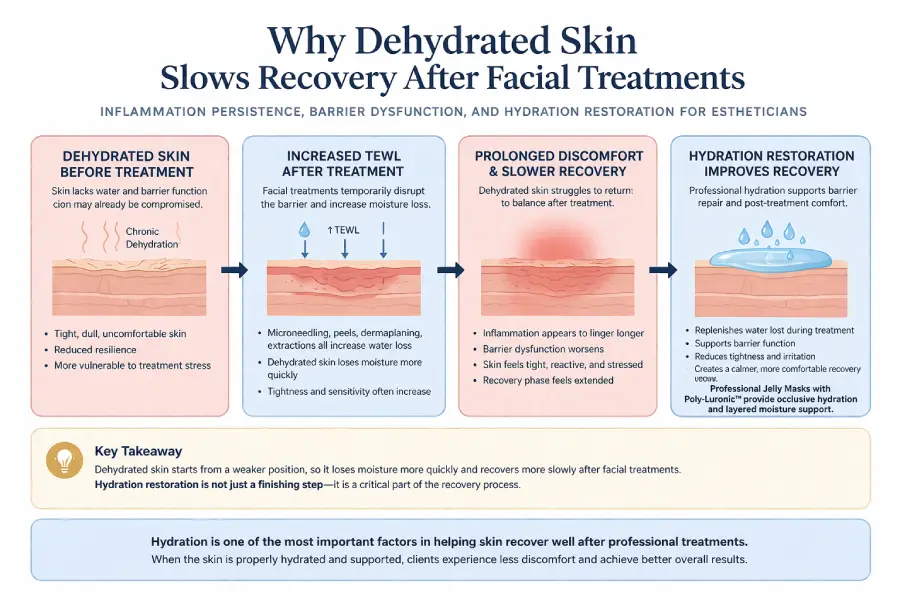
Dehydrated skin — skin with insufficient water content in the stratum corneum — enters every professional treatment at a structural disadvantage. The mechanisms responsible for post-treatment recovery depend on adequate cellular hydration: enzymatic repair processes require water to function, the barrier’s ability to reseal itself after disruption is impaired when NMF compounds are depleted, and transepidermal water loss (TEWL) accelerates further when the corneum’s water-binding capacity is already compromised. The result is a recovery timeline that is measurably longer for dehydrated skin across nearly every category of professional facial treatment.
- Dehydration reduces Natural Moisturizing Factor (NMF) concentrations in the stratum corneum — the compounds responsible for regulating the skin’s own moisture level. Depleted NMF means the corneum cannot retain water effectively, creating a compounding deficit that worsens under treatment stress.
- Dehydrated skin presents with higher baseline TEWL than well-hydrated skin. Any procedure that disrupts the barrier adds further to this already-elevated water loss rate, extending the window in which the skin is vulnerable.
- Cellular enzymatic processes that govern post-treatment tissue repair — including collagen remodeling and inflammatory resolution — are water-dependent. Reduced intracellular and intercellular water availability slows the rate at which these processes can run.
- Dehydrated skin is more reactive to treatment stress because the barrier is thinner and less organized than in well-hydrated skin. Redness, sensitivity, and tightness persist longer post-treatment in dehydrated clients.
- Correcting pre-treatment dehydration — ideally in the days before and immediately before a procedure — and addressing post-treatment dehydration with an occlusive dual-humectant recovery step significantly compresses the recovery window for affected clients.
Of all the pre-treatment variables an esthetician can identify and address, skin hydration status is one of the most clinically accessible and one of the most frequently overlooked. Clients arrive to appointments with varying baseline conditions — oil levels, sensitivity history, recent product use — but hydration status is rarely assessed with the same clinical attention as skin type classification, and it is rarely communicated to clients as something that meaningfully affects their treatment outcome.
It should be. The difference in recovery trajectory between a dehydrated client and a well-hydrated client undergoing the same procedure can be significant. Not because the procedure itself is different, but because the skin’s capacity to respond to, manage, and recover from controlled disruption depends on biological processes that are directly dependent on adequate tissue water content. When that baseline is compromised, the recovery cascade slows at multiple levels simultaneously — and the client experiences the symptoms of that slowdown as prolonged redness, persistent tightness, and recovery that simply takes longer than it should.
This article gives estheticians a clear, mechanistic understanding of why dehydration impairs post-treatment recovery, how to identify it before it becomes a protocol variable, and how targeted hydration strategies — both before and after treatment — can meaningfully improve outcomes for clients presenting with water-depleted skin.
What Every Esthetician Should Know About Dehydration and Post-Treatment Recovery
- Dehydration is a temporary condition affecting any skin type — including oily skin. Dry skin is a type; dehydration is a state. Conflating them leads to incorrect protocol decisions.
- The stratum corneum’s water content, regulated by NMF compounds, is the primary determinant of how effectively the skin barrier can reseal after treatment disruption.
- Baseline TEWL is higher in dehydrated skin before any procedure begins — procedures multiply this loss, creating a water deficit the skin must overcome before recovery can progress at full speed.
- Enzymatic repair processes in the dermis and epidermis are water-dependent. Tissue-level dehydration slows the rate of collagen remodeling, inflammatory resolution, and cell turnover following treatment.
- Dehydrated clients are more reactive during procedures and show prolonged post-treatment sensitivity, redness, and tightness — not because the treatment was too aggressive, but because the starting condition of the skin amplified the response.
- Pre-treatment hydration correction — beginning at the intake stage and reinforced immediately before the procedure — is a clinical protocol step, not a retail suggestion.
- Post-treatment occlusive hydration with a dual-humectant (PGA + HA) mask is the most effective single-step intervention for dehydrated skin recovery, addressing TEWL, NMF replenishment, and enzymatic HA protection simultaneously.
Dry Skin vs. Dehydrated Skin: The Distinction That Changes Your Protocol
The confusion between dry skin and dehydrated skin is one of the most persistent misclassifications in esthetic practice, and it has direct clinical consequences for how practitioners select treatments, products, and post-procedure recovery strategies.
Dry Skin: A Skin Type
Dry skin is a skin type — a relatively stable characteristic of a client’s skin reflecting chronically low sebum production by the sebaceous glands. Dry-skin clients lack adequate lipid production to maintain the barrier’s oil component. Their skin tends toward flaking, tightness, and sensitization, and they respond well to emollient and occlusive products that replace the lipid barrier the sebaceous glands are not providing in sufficient quantity. Dry skin type is a permanent or long-term feature of a client’s skin that does not resolve with temporary hydration correction.
Dehydrated Skin: A Temporary Condition
Dehydrated skin is a temporary state of inadequate water content in the stratum corneum — the skin’s outermost layer. Crucially, it can occur across all skin types: oily skin can be dehydrated, combination skin can be dehydrated, and even normal skin can enter a temporary state of dehydration. The water content of the stratum corneum is regulated not by oil production but by the concentration of Natural Moisturizing Factor compounds — water-soluble substances including pyrrolidone carboxylic acid (PCA), lactic acid, urocanic acid, amino acids, and inorganic salts that are naturally present within corneocytes. When NMF is depleted — through aggressive cleansing, environmental exposure, over-exfoliation, or illness — the stratum corneum loses its capacity to retain water and the skin enters a dehydrated state.
Why Misclassification Matters in a Treatment Room Context
An esthetician who identifies oily-dehydrated skin as simply oily and proceeds with an oil-reducing or exfoliating protocol without correcting the hydration deficit is adding barrier stress to skin that is already compromised. The same logic applies post-treatment: a recovery protocol designed for well-hydrated skin may be insufficient for a client whose starting point was dehydration, and the prolonged recovery the client experiences afterward is attributed to the treatment when the actual variable was the pre-existing water deficit.
How the Dehydration Cascade Works — and Why It Compounds Under Treatment Stress
Dehydration does not present as a simple, static deficit. It operates as a cascade: each consequence of initial water depletion creates conditions that accelerate further water loss, deepening the deficit. Understanding this cascade is essential to understanding why dehydrated skin recovers more slowly than healthy skin from the same procedure.
Step One: NMF Depletion
The Natural Moisturizing Factor is the stratum corneum’s primary self-regulating moisture system. NMF compounds are produced from the breakdown of filaggrin — a protein abundant in the outer epidermis — and include pyrrolidone carboxylic acid (roughly 12% of NMF by weight), lactic acid (approximately 12%), urocanic acid, amino acids, sugars, and inorganic ions. These hygroscopic compounds sit within corneocytes, where they attract and hold atmospheric water at the skin surface, regulating corneal hydration independently of humidity conditions.
When NMF is depleted — by over-exfoliation, harsh surfactants in cleansers, environmental conditions including low humidity and UV exposure, or prolonged use of alcohol-based products — the stratum corneum loses its capacity to self-hydrate. The corneocytes become desiccated. The barrier lipid matrix, which depends on corneocyte hydration to maintain its lamellar organization, begins to lose structural integrity. The skin becomes measurably drier, more fragile, and more permeable to irritants — while simultaneously losing water to the environment at an accelerated rate.
Step Two: Elevated Baseline TEWL
A stratum corneum with depleted NMF cannot hold water against the gradient between the body’s internal moisture and the typically drier external environment. The result is elevated transepidermal water loss — a greater rate of passive water diffusion outward through the skin. In healthy, well-hydrated skin, TEWL is low and stable. In dehydrated skin, TEWL is already above the normal baseline before any procedure begins. This matters clinically because any procedure that further disrupts the barrier — microneedling, dermaplaning, chemical peels, aggressive exfoliation — adds additional TEWL to an already-elevated starting rate. The compounded water loss rate is substantially higher than in a well-hydrated client receiving the same treatment.
Step Three: Impaired Barrier Resealing
The skin’s barrier resealing response after disruption depends on enzymatic processes that synthesize ceramides, fatty acids, and cholesterol to restore the lipid matrix. These lipid synthesis enzymes require adequate substrate availability and cellular hydration to function at normal speed. In dehydrated skin where intercellular and intracellular water content is reduced, the rate of lipid synthesis — and therefore the rate of barrier resealing — is slowed. This extends the window during which the skin is vulnerable to further water loss, irritant penetration, and microorganism exposure following a procedure.
Step Four: Slower Inflammatory Resolution
The controlled inflammatory response triggered by procedures like microneedling is a designed feature — it initiates the collagen remodeling cascade that produces clinical outcomes. But inflammation resolves through enzymatic processes that are also water-dependent. In dehydrated tissue, the lymphatic drainage of inflammatory mediators, the enzymatic breakdown of prostaglandins and cytokines, and the return to baseline of inflammatory signaling all proceed more slowly. The clinical consequence is that post-treatment redness, swelling, and sensitivity persist for longer in dehydrated clients than in well-hydrated clients receiving identical treatments.
Why Each Layer of Dehydration Compounds the Post-Treatment Recovery Challenge
NMF depletion removes the stratum corneum’s self-regulating moisture capacity, meaning the skin cannot maintain hydration without external support — even at baseline, before any procedure introduces additional stress.
Elevated baseline TEWL means dehydrated skin is already losing water faster than it should when the client walks in. Procedure-induced barrier disruption adds to this already-elevated rate, creating a compound water loss that takes longer to resolve than in well-hydrated skin.
Impaired barrier lipid synthesis slows the physical resealing of microchannels and disrupted intercellular lipid matrix created by the treatment — extending the vulnerability window where the skin is open to irritants, water loss, and potential sensitization.
Slower inflammatory resolution prolongs the clinical symptoms of post-treatment response — redness, sensitivity, and tight sensation persist longer in dehydrated clients, which clients often interpret as the treatment being “too aggressive” when the actual variable is hydration status.
How Estheticians Identify Dehydrated Skin Before It Affects a Treatment Outcome
Pre-treatment assessment of skin hydration status is a clinical skill with direct protocol implications. Estheticians who develop a consistent assessment approach catch dehydration before it becomes an unmanaged variable in the treatment and recovery outcome.
The Pinch Test
The fastest and most accessible assessment for stratum corneum dehydration is the pinch test. Gently pinch a small section of skin — the cheek, inner forearm, or back of the hand — and release. Well-hydrated skin returns to its resting position immediately. Dehydrated skin shows a noticeable lag, remaining temporarily tented before slowly returning to flat. In more significant dehydration, visible surface creasing remains for several seconds after release. The pinch test does not measure absolute water content, but it reliably identifies the corneal elasticity deficit that correlates with clinically significant dehydration.
Surface Fine Lines Under Stretch
Dehydrated skin typically shows a network of fine, shallow surface lines that appear most clearly when the skin is gently stretched. These lines — sometimes called crepey texture at the surface — are distinct from expression lines and wrinkles, which are deeper and reflect structural collagen changes. Surface fine lines from dehydration appear across the cheek and around the eye zone and resolve with adequate hydration correction, which distinguishes them from structural aging signs.
Dullness at Normal Oil Levels
A complexion that appears dull, slightly grey, or flat despite normal or elevated sebum levels is a classic dehydration presentation. Light reflects poorly from a stratum corneum whose corneocytes are desiccated and irregularly arranged. The surface lacks the translucency of well-hydrated skin. This presentation is common in oily-dehydrated clients and is frequently misread as a circulation or congestion issue when the primary variable is water content in the corneum.
Client-Reported Tightness with Normal or Oily Skin Type
Clients who report persistent tightness or discomfort that does not correlate with cleanser use or weather — or who report that their skin feels tight despite being oily — are presenting a classic verbal indicator of dehydration. Tightness in dry-skin clients is expected and reflects lipid insufficiency. Tightness in oily or combination clients who are adequately moisturizing is a signal of NMF depletion rather than lipid deficit, and the appropriate correction is hydration rather than additional occlusion.
Pinch Test Lag
Skin pinched on the cheek or inner forearm returns slowly or shows creasing. Reliable, fast, no equipment needed. Perform at consultation before any product application.
Surface Fine Lines Under Stretch
Fine, shallow crepey lines visible when skin is gently stretched. Distinct from structural wrinkles. Most visible on cheek and periorbital zone. Resolve with hydration correction.
Dullness at Normal Oil Levels
Flat, grey or matte complexion appearance despite adequate sebum. Light reflects poorly from desiccated corneocytes. Common in oily-dehydrated presentations.
Tightness Misaligned with Skin Type
Oily or combination clients reporting persistent tightness — especially with adequate moisturizer use. Indicates NMF depletion, not lipid deficit. Signals hydration protocol adjustment needed.
Why Oily-Dehydrated Skin Creates the Most Difficult Post-Treatment Recovery Scenario
Of all the dehydration presentations estheticians encounter, the oily-dehydrated client is the most clinically complex and the most likely to generate mismanaged post-treatment outcomes if the skin condition is not correctly identified and addressed before treatment begins.
The Paradox: Shiny Skin That Recovers Slowly
Oily-dehydrated skin presents with normal to excess sebum production at the skin surface. The sebaceous glands are functioning normally or hyperactively. This means the client’s skin appears shiny, feels congested, and may have enlarged pores — all cues that estheticians traditionally associate with a robust, resilient skin type. Underneath this lipid sufficiency, however, the stratum corneum is water-depleted. The intercellular water is low, NMF is reduced, and TEWL is elevated despite the oily surface presentation.
Estheticians who design protocols for this client based on the oily-surface appearance — exfoliating more aggressively, using oil-controlling active ingredients, or deferring hydration correction because “this skin doesn’t look dry” — are compounding the water deficit with the additional barrier stress of the protocol itself. The result is a post-treatment recovery that is disproportionately slow relative to the depth of the procedure, and a client who may attribute the extended recovery to the treatment rather than their pre-existing skin condition.
How Aggressive Exfoliation and Cleansing Creates Oily-Dehydrated Skin
A significant proportion of oily-dehydrated clients have created the condition themselves through a well-intentioned but counterproductive skin care approach: aggressive cleansing and exfoliation to manage oil and congestion. Stripping the skin’s surface repeatedly removes not just excess oil but the NMF compounds and surface water that the corneum needs to self-regulate. The sebaceous glands respond to the stripped sensation with increased oil production — which the client interprets as confirmation that they need more aggressive cleansing — while the corneum’s water content remains depleted and the barrier continues to deteriorate.
Estheticians who recognize this pattern and can explain it to clients — in plain, non-technical language that does not make the client feel criticized — are providing genuinely clinical education that changes home care behavior and produces better treatment outcomes over multiple appointments.
Estheticians running high-volume facial practices consistently identify the oily-dehydrated presentation as the client cohort most likely to report that their skin “never fully recovers” after treatments — arriving to follow-up appointments still showing tightness or sensitivity from the previous session. The pattern across practitioners who have incorporated systematic pre-treatment dehydration assessment into their intake process is that catching and correcting this condition before the procedure begins dramatically changes what follows.
Among practitioners using Poly-Luronic™ Jelly Masks by Luminous Skin Lab as the post-treatment recovery step for confirmed or suspected dehydrated-skin clients, the consistent observation is that the dual-humectant PGA + HA system — delivered under the occlusive jelly mask format — addresses both the immediate TEWL reduction the dehydrated corneum needs and the NMF stimulation pathway (through PGA’s PCA and lactic acid production activation) that produces more durable moisture retention. Practitioners specifically note that dehydrated oily-skin clients who previously required 72-hour or longer recovery windows after standard facial protocols show compressed recovery timelines when the post-procedure hydration step is added, typically resolving redness and tightness within 36 to 48 hours instead.
Pre-Treatment Hydration Correction: What Estheticians Can Do Before the Procedure Begins
Addressing dehydration only in the post-treatment recovery step misses an opportunity to improve the starting conditions of the skin before any barrier stress is introduced. Estheticians who incorporate pre-treatment hydration correction into their protocols — both through client home care guidance in the days before a procedure and through in-treatment steps immediately before the procedure begins — are changing the skin’s capacity to tolerate and recover from the treatment itself.
Client Home Care Guidance Before Advanced Treatments
For clients booked for advanced procedures — microneedling, chemical peels, or other treatments that significantly disrupt the barrier — providing pre-treatment hydration guidance in the 48 to 72 hours before their appointment addresses the most correctable dimension of their starting skin condition. Clients who arrive hydrated tolerate procedures better, experience less reactive post-treatment response, and recover faster. The guidance does not need to be elaborate: avoiding alcohol-based products, pausing aggressive exfoliation for 48 hours before the appointment, and using a hydrating serum and moisturizer morning and evening in the pre-treatment window is a protocol addition that costs the client nothing and meaningfully improves the starting point for what follows.
In-Treatment Hydration Preparation
For clients where dehydration is identified at consultation and there is no time for pre-treatment home care correction, incorporating a hydrating preparation step before the procedure itself can partially improve the stratum corneum’s water content before barrier disruption begins. Applying an HA-rich serum under a brief warming steam or occlusive compress in the pre-treatment prep phase delivers surface and shallow-penetration hydration. While this does not fully correct significant dehydration, it provides meaningful improvement in corneal hydration at the surface level that reduces the degree of compound TEWL the skin will experience during and after the procedure.
Post-Treatment Occlusive Hydration: The Critical Final Step
Regardless of what pre-treatment hydration correction is possible, the post-treatment recovery step remains the highest-impact single intervention for dehydrated skin. Applying an occlusive dual-humectant mask immediately after the procedure closes the compound TEWL window at its peak, delivers humectants into the temporarily permeable skin during the window when penetration is most accessible, and provides the NMF stimulation that supports durable moisture retention in the days following treatment. For dehydrated-skin clients specifically, this step is not optional — it is the clinical response to a documented pre-existing condition that the procedure has amplified.
How Estheticians Can Talk About Dehydration With Clients Without Alarming Them
Clinical accuracy matters, but so does the framing. Telling a client their skin is dehydrated can generate confusion (“but I drink water all day”), defensiveness (“I use a moisturizer”), or unnecessary anxiety about their skin condition. Estheticians who frame dehydration education as a practical, actionable finding — rather than a diagnosis or a criticism — generate much better client engagement and compliance with the hydration correction protocol.
Language That Works in the Treatment Room
Effective practitioner-to-client communication about dehydration focuses on what the skin is doing and what can be done about it, rather than what the client has done wrong. Phrases like “your skin is showing some water depletion today, which we can address in this treatment” land differently than “your skin is dehydrated,” which many clients hear as a critique of their home care. Connecting the observation directly to the recovery step — “this mask at the end will specifically help with that” — makes the recovery protocol feel purposeful rather than routine, and clients who understand why they are receiving a particular step are significantly more likely to follow post-treatment home care guidance that reinforces it.
Setting Recovery Expectations Based on Hydration Status
Estheticians who identify dehydration pre-treatment have the clinical basis to set more accurate recovery expectations for those clients. Rather than giving a standard “you may have some redness for 24 to 48 hours” estimate that may underpredict for a dehydrated client, the informed practitioner can say: “Because your skin was showing some dehydration going in, you might see the recovery take a bit longer than someone who came in fully hydrated — we’ve addressed that with the mask at the end, which should compress that window considerably.” This level of accuracy builds client confidence rather than eroding it when recovery takes longer than expected.
Professional and Scientific References
The skin physiology and mechanism claims in this article are grounded in established barrier biology and NMF science:
- Natural Moisturizing Factor composition and stratum corneum hydration regulation. Journal of Investigative Dermatology; Elias PM and colleagues, barrier biology literature. NMF constituents including PCA (~12%), lactic acid (~12%), urocanic acid, amino acids, and inorganic ions; filaggrin-derived production pathway.
- Transepidermal water loss dynamics in dehydrated and barrier-disrupted skin. Clinical dermatology and esthetic treatment literature; Fluhr JW and colleagues. TEWL measurement and its relationship to stratum corneum water content and NMF concentration.
- Water-dependence of ceramide synthesis enzymes and barrier lipid production. Feingold KR and Elias PM, skin barrier literature. Role of cellular hydration in epidermal lipid synthetic enzyme activity rates post-disruption.
- PGA stimulation of NMF compounds: PCA, lactic acid, and urocanic acid production in stratum corneum cells. Typology, Prequel Skin, cosmetic chemistry literature, 2022–2025.
- Gamma-PGA barrier reinforcement and HAS-1, HAS-2, HAS-3 upregulation. MDPI Cosmetics, 2024.
- Oily-dehydrated skin: paradoxical hydration deficit with sebaceous hyperactivity. Professional esthetics continuing education and cosmetic dermatology practice literature.
— Expand with specific DOIs upon editorial review.
For estheticians working with clients who present with dehydrated skin — whether identified through pre-treatment assessment or inferred from prolonged post-treatment recovery history — the Poly-Luronic™ Jelly Mask by Luminous Skin Lab is the post-treatment recovery formulation our education team specifically references in the dehydrated-skin protocol context. The PGA in the formulation directly addresses the two primary mechanisms behind dehydrated-skin recovery delay: it reduces TEWL through surface occlusion and sealing, and it initiates NMF restoration by stimulating PCA and lactic acid production in the stratum corneum — while the HA delivers hydration into the temporarily permeable skin layers during the recovery window. Fragrance-free and clean-label, it is appropriate for use directly after any procedure category where dehydrated skin increases the recovery risk.
Explore the Poly-Luronic™ Jelly Mask LineFrequently Asked Questions: Dehydrated Skin and Post-Treatment Recovery
Why does dehydrated skin take longer to heal after a facial?
Dehydrated skin lacks the water content in the stratum corneum that keeps skin cells functional, barrier lipids organized, and enzymatic repair processes running at full speed. When the skin is dehydrated, the Natural Moisturizing Factor (NMF) compounds that regulate moisture levels are depleted, transepidermal water loss accelerates, and the barrier’s ability to reseal itself after treatment disruption is compromised. All of these effects slow the recovery timeline — meaning redness, tightness, and sensitivity persist longer than they would in well-hydrated skin going into the same procedure.
What is the difference between dry skin and dehydrated skin?
Dry skin is a skin type characterized by insufficient sebum (oil) production — it is a permanent or semi-permanent characteristic of the skin. Dehydrated skin is a temporary condition affecting any skin type, including oily skin, caused by insufficient water content in the stratum corneum. An oily-skinned client can present with dehydration. A client with dry skin type is not automatically dehydrated. Recognizing this distinction changes how estheticians assess, treat, and design post-treatment protocols for each client.
How can I tell if my client’s skin is dehydrated before a treatment?
The most reliable clinical assessment is the pinch test: gently pinch a small section of skin on the cheek or inner forearm and observe how quickly it bounces back. Well-hydrated skin returns immediately; dehydrated skin shows a slow return or visible creasing. Additional signs include fine surface lines visible when the skin is stretched, a dull or slightly grey cast to the complexion despite normal oil levels, and client-reported tightness that does not correlate with cleanser use or weather exposure.
Can skin be oily and dehydrated at the same time?
Yes, and this is one of the most common misread presentations estheticians encounter. Oily-dehydrated skin occurs when the sebaceous glands are producing normal to excess oil while the stratum corneum is simultaneously water-depleted. The skin may appear shiny, feel congested, and still have the fine surface creasing and rebound lag that indicate dehydration. This presentation is common in clients who use harsh cleansers or exfoliate aggressively to control oil, inadvertently stripping the water-binding compounds from the stratum corneum.
Does dehydration make microneedling more uncomfortable or risky?
Dehydrated skin going into microneedling presents with a compromised stratum corneum that is already less resilient and more sensitive than well-hydrated skin. Estheticians working with dehydrated clients in microneedling contexts consistently observe greater initial redness, higher client sensitivity during the procedure, and slower visible recovery in the hours and days following treatment compared to hydrated-skin clients receiving the same protocol. The pre-treatment hydration status of the client is a meaningful variable in predicting recovery trajectory and managing client expectations.
Why does dehydrated skin feel tight after a facial even when moisturizer is applied?
Tightness after moisturizer application in dehydrated skin is a signal that surface products are not adequately addressing the water deficit in the stratum corneum itself. Moisturizers that rely primarily on emollient or occlusive ingredients without active humectant delivery cannot replenish the NMF compounds that regulate intrinsic water retention. Dehydrated skin responds better to products containing high-performance humectants — particularly PGA and HA — applied under an occlusive layer that prevents the applied moisture from immediately evaporating back into the environment.
How does dehydration affect the skin’s NMF and why does that matter for recovery?
The Natural Moisturizing Factor (NMF) is a collection of water-binding compounds — including pyrrolidone carboxylic acid, lactic acid, urocanic acid, and amino acids — naturally present in the stratum corneum that regulate its moisture level. When chronically dehydrated, NMF concentrations are reduced, which compromises the corneum’s ability to self-regulate water content. This creates a compounding deficit: low NMF leads to higher TEWL, which causes further dehydration, which further depletes NMF. Post-treatment protocols that include PGA — which stimulates NMF production — directly interrupt this cycle rather than just adding temporary surface moisture.
Why does the Poly-Luronic™ Jelly Mask work well for clients who come in with dehydrated skin?
Dehydrated skin arriving for a professional facial treatment has reduced NMF, elevated TEWL, and a stratum corneum that is less resilient to procedure stress. The Poly-Luronic™ Jelly Mask by Luminous Skin Lab addresses all three dimensions: the PGA in the formulation reduces TEWL by forming a surface occlusive film, stimulates NMF production through PCA and lactic acid synthesis, and protects applied HA from enzymatic breakdown — while the HA delivers water-binding capacity into the epidermis during the treatment window. For dehydrated-skin clients, this is the clinical step that most directly addresses the underlying water deficit at the mechanism level, not just the symptom level.
Hydration Status Is a Clinical Variable — Not a Background Condition
Dehydration is not a complaint to address in the retail conversation at the end of an appointment. In the context of professional facial treatments that disrupt the skin barrier, hydration status is a pre-existing clinical condition that compounds every dimension of the post-treatment recovery challenge: it elevates the baseline from which TEWL increases, slows the barrier’s resealing capacity, and delays the enzymatic resolution of the controlled inflammatory response the treatment was designed to trigger.
Estheticians who assess hydration status before treatment, communicate what they find in plain and non-alarming language, and design recovery protocols that specifically address the dehydration variable are practicing at a level of clinical precision that clients notice — because their recovery experiences reflect it. Shorter recovery windows, more predictable outcomes, and skin that responds consistently across appointments are all downstream consequences of treating dehydration as the clinical variable it is.
The integration of pre-treatment assessment and targeted post-treatment hydration intervention into a standard protocol requires no additional equipment and minimal additional time. What it requires is understanding the mechanisms well enough to recognize the presentation, act on it, and explain it to clients in a way that builds lasting professional trust.