Why Does Occlusion Make Jelly Masks More Effective for Skin Hydration?
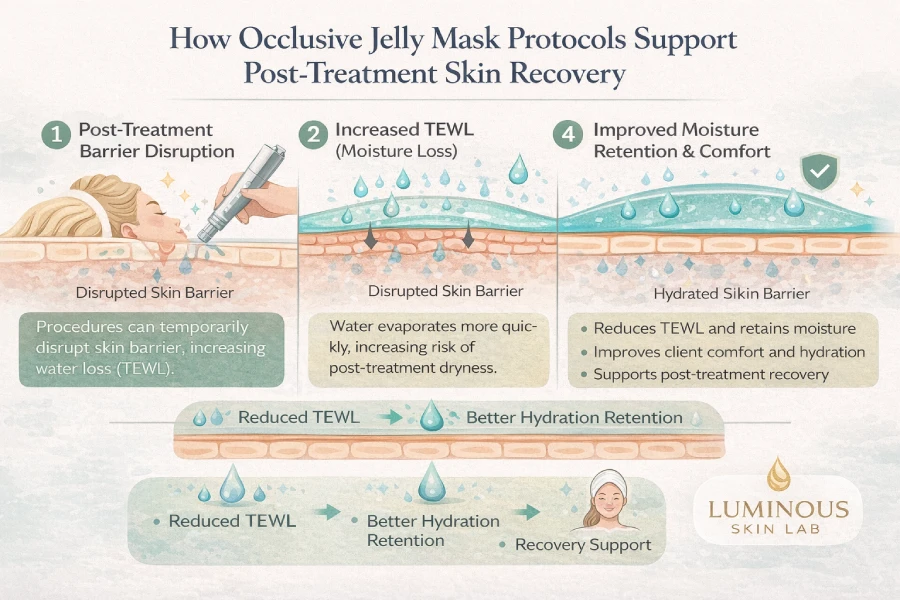
Occlusion is the physical sealing of the skin surface to prevent transepidermal water loss — the passive evaporation of moisture through the outer skin layers that accelerates dramatically when the barrier is compromised by professional treatments. A professional jelly mask achieves occlusion through its set gel structure: the sodium alginate polymer network, once cross-linked during setting, conforms continuously and completely to the skin surface and significantly reduces the rate at which moisture can escape into the environment. This physical seal is what separates jelly masks from other hydration formats and makes them uniquely effective as post-treatment recovery tools.
Occlusion matters for three distinct reasons: it directly reduces TEWL during the critical post-procedure recovery window; it creates a humid microenvironment at the skin surface that temporarily increases stratum corneum permeability, amplifying the penetration of any serum or humectant applied beneath the mask; and it supports the water-dependent cellular processes of barrier repair by maintaining the hydrated recovery environment that lamellar body secretion and keratinocyte migration require.
- Occlusion reduces post-treatment TEWL by more than 50% for the duration of the mask application — significantly more than a moisturizer or sheet mask can achieve.
- The humid microenvironment created beneath the set mask temporarily softens and hydrates the stratum corneum, increasing its permeability and amplifying the delivery of humectants into the skin by a measurable factor.
- The jelly mask’s conformal, continuous contact with the skin surface maintains its occlusive effect consistently throughout the full dwell time — unlike sheet masks, which lose contact and occlusive efficiency as the substrate dries.
- Occlusion amplifies the clinical value of every ingredient applied beneath the mask: hyaluronic acid, polyglutamic acid, growth factors, and peptides all penetrate more effectively into occluded post-treatment skin than into open-air skin.
- The cooling effect of the jelly mask during setting is an active therapeutic mechanism — evaporative cooling at the mask surface reduces post-treatment skin temperature and provides measurable inflammation reduction.
- The removal experience — peeling the set mask off as a single intact piece — is both a clinical quality indicator and a signature client experience that reinforces the perceived value of the treatment.
The word “occlusion” appears frequently in professional skincare education, often in the context of ingredient classifications or product selection, but rarely with the depth of explanation that makes the concept clinically actionable. Estheticians who understand occlusion at a mechanistic level — not just as a category label but as a physical process with measurable effects on skin hydration, ingredient delivery, and barrier recovery — are equipped to make product choices and protocol decisions that are grounded in what actually happens to the skin, rather than in marketing language about moisturization.
The professional jelly mask is the most clinically sophisticated example of occlusion available in the esthetic treatment room. Its set gel format creates a sustained, conformal physical seal that reduces transepidermal water loss, amplifies the penetration of actives applied beneath it, provides cooling that reduces post-treatment inflammation, and produces a removal experience that communicates clinical efficacy to the client in a way that no other product format can match. Understanding the science behind each of these properties is what allows estheticians to select jelly mask formulations intelligently, position them within their protocols correctly, and explain their value to clients with the authority that comes from genuine understanding.
This article covers the full clinical science of occlusion in professional skincare: what it is, how jelly masks achieve it, why it outperforms other hydration formats, and how to apply this understanding to practical post-treatment protocol design.
The Clinical Science of Occlusion in Professional Jelly Masks
- Occlusion is a physical process — not an ingredient property — that prevents water vapor from passing through a sealed skin surface into the environment, directly reducing TEWL.
- The set jelly mask achieves occlusion through its sodium alginate polymer gel matrix, which forms continuous conformal contact with the skin and maintains it consistently throughout the full dwell time.
- Sheet masks lose occlusive efficiency as they dry and separate from the skin; the jelly mask maintains its seal until the moment of removal, producing sustained TEWL reduction throughout the application window.
- The occluded microenvironment beneath a set jelly mask increases stratum corneum hydration and temporarily enhances its permeability, amplifying penetration of every active ingredient applied beneath the mask.
- On post-treatment skin — which is already in a heightened-permeability state — occlusion-amplified ingredient delivery is the most efficient humectant and active delivery window in the entire appointment.
- Evaporative cooling at the mask surface during setting provides measurable anti-inflammatory benefit to recently treated skin — reducing surface temperature and lowering cytokine-driven inflammatory response.
- The intact removal of the set mask in a single piece is both a clinical quality indicator (confirming adequate alginate cross-linking) and the signature sensory moment that clients associate with the treatment’s effectiveness.
What Occlusion Actually Means — and Why It Is More Than Just a Moisturizing Property
In skincare chemistry, occlusion refers to the physical blocking of transepidermal water loss through the creation of a continuous, low-permeability layer over the skin surface. It is not a chemical interaction — occlusive ingredients and products do not bind water, attract water, or actively deliver water into the skin. They simply prevent the water already in the skin from leaving it by evaporation.
This distinction from humectants is important for estheticians to understand clearly. Humectants — including hyaluronic acid, polyglutamic acid, glycerin, and sodium PCA — attract water molecules from the environment or from deeper skin layers and hold them within the stratum corneum. But humectants alone, applied without an occlusive layer, are subject to the same evaporative loss they are trying to counteract. In a low-humidity environment — which describes most temperature-controlled treatment rooms — a humectant applied to compromised post-treatment skin can actually draw moisture from deeper skin layers to the surface and accelerate its evaporation, worsening net skin dehydration. Occlusion is what prevents this from happening: it traps the moisture the humectant has attracted and forces it to stay in the skin rather than evaporate from the surface.
In wound healing and clinical dermatology, occlusive dressings applied to disrupted skin surfaces have been shown to produce re-epithelialization rates two to three times faster than non-occluded controls. The esthetic parallel is direct: post-treatment skin that is occluded immediately following a barrier-disrupting procedure heals its barrier architecture measurably faster than post-treatment skin that is not.
The Spectrum of Occlusive Efficacy Across Skincare Products
Occlusive efficacy is not binary — it exists on a spectrum determined by the physical properties of the layer being applied. At the high-efficacy end are dense, continuous-contact materials: petrolatum, zinc oxide paste, and set jelly mask gel. These form the most complete seals and produce the greatest TEWL reduction. In the middle of the spectrum are emollient-heavy moisturizers and cream masks, which provide partial TEWL reduction through a thin, porous film. At the lower end are lightweight moisturizers, serums, and sheet masks in their drying phase — which may provide some initial TEWL reduction but whose effect diminishes rapidly and is insufficient to address the elevated TEWL of post-procedure skin.
The professional jelly mask occupies a distinctive position on this spectrum: it achieves near-high-end occlusive efficacy through its mass and conformal contact, while also being cosmetically elegant, safely removable, and formulated to contain active ingredients that benefit from the amplified delivery its occlusive environment creates.
How a Professional Jelly Mask Creates Its Occlusive Seal
The occlusive mechanism of a professional jelly mask is rooted in its gelling chemistry. Understanding this chemistry helps estheticians recognize why formulation quality determines occlusive performance, and why not all jelly masks are equivalent in their TEWL-reducing capability.
Sodium Alginate and the Cross-Linking Reaction
Professional jelly masks use sodium alginate — a polysaccharide derived from brown seaweed — as their primary gelling agent. In powder form, sodium alginate is water-soluble and forms a viscous solution when mixed with water or serum. The setting reaction is initiated by the calcium ions naturally present in tap water or specifically included in the formulation: calcium ions cross-link adjacent alginate polymer chains, forming a continuous, three-dimensional gel network. This network is the physical structure responsible for the mask’s occlusive seal.
The quality of this gel network — and therefore the consistency of the mask’s occlusive performance — depends directly on the grade of sodium alginate used. High-grade pharmaceutical or food-grade sodium alginate produces a smooth, homogeneous gel with uniform cross-linking density. Lower-grade alternatives produce irregular gels with inconsistent cross-link distribution, uneven texture, and variable set behavior that translates directly into inconsistent occlusive performance across applications.
Conformal Contact: Why the Jelly Mask Seal Is Sustained
The key property that distinguishes the jelly mask’s occlusive effect from that of other formats is conformal contact — the ability of the gel layer to maintain continuous, gap-free contact with the irregular topography of the facial surface throughout the full dwell time. Unlike a moisturizer or serum that forms a thin film and partially evaporates, or a sheet mask substrate that sits above the skin surface and loses contact as it dries, the set jelly mask maintains its three-dimensional gel structure and its conformal contact with the skin surface from application to removal. There is no drying phase, no progressive contact loss, and no reduction in occlusive efficiency during the dwell time. The seal is as complete at minute 15 as it was at minute one.
This sustained, conformal contact is what produces the consistent TEWL reduction that differentiates the jelly mask format from its alternatives in clinical practice.
Why Different Hydration Formats Produce Different TEWL Control Outcomes
TEWL reduction is directly proportional to the completeness and continuity of the occlusive contact layer. Formats that lose contact with the skin surface — through drying, evaporation, or structural breakdown — lose their occlusive efficacy at the same rate. The jelly mask’s structural stability during dwell time is its primary performance advantage.
Jelly mask (set gel): Continuous conformal contact; gel structure is stable throughout dwell time. TEWL reduction exceeds 50% for the full 10–20 minute application window.
Sheet mask: Fabric or hydrogel substrate provides initial occlusion, but substrate begins drying from the outer surface inward within 5–8 minutes. Occlusive efficiency diminishes progressively; contact loss at facial contours begins within the first few minutes.
Cream mask: Emollient film provides partial TEWL reduction, but the film is thin, porous, and loses its occlusive character as water content evaporates. TEWL reduction is lower and shorter-lived than the jelly mask format.
Moisturizer / serum: Thin film with high permeability. Meaningful TEWL reduction is limited and short-lived. Provides humectant delivery without the sustained occlusive environment needed to amplify that delivery on post-treatment skin.
How Occlusion Amplifies Serum and Humectant Delivery Into Post-Treatment Skin
The occlusive seal of a professional jelly mask does not simply trap water in the skin — it creates a microenvironment that actively enhances the penetration of every ingredient applied beneath it. This ingredient amplification effect is one of the most clinically significant and frequently underappreciated properties of the jelly mask format.
The Occluded Microenvironment and Stratum Corneum Permeability
When the set jelly mask creates its seal over the skin surface, the space between the mask and the skin becomes a closed, humid microenvironment. Moisture vapor from the skin that would normally evaporate accumulates beneath the mask, raising the relative humidity at the skin surface. This elevated humidity hydrates and temporarily softens the stratum corneum lipids and corneocytes, increasing the stratum corneum’s permeability to topically applied ingredients. The mechanism is the same one that underlies the practice of applying serums before occlusive products in evening skincare routines — but its magnitude is considerably greater in a professional occlusive jelly mask application, particularly on post-treatment skin where the stratum corneum is already architecturally disrupted.
The Post-Treatment Permeability Amplifier
Post-treatment skin presents a unique delivery context: barrier disruption from the procedure itself has already increased stratum corneum permeability beyond its normal level. This heightened permeability is what makes the immediate post-treatment window the most efficient ingredient delivery moment in the entire appointment. When an occlusive jelly mask is applied on top of this already-permeable post-treatment skin, the permeability-enhancing effect of occlusion layers on top of the procedure-induced permeability increase. The combined effect produces penetration depths and delivery efficiencies for applied humectants and actives that exceed what either factor could produce independently.
Estheticians who apply a hyaluronic acid or polyglutamic acid serum to post-treatment skin before a jelly mask are delivering those ingredients in the most bioavailable context those ingredients will experience in any of their clinical applications. This is not a marginal improvement — it is a significant amplification that makes the post-treatment protocol window categorically different from any other point in the treatment appointment for active ingredient delivery.
Practical Implications for Under-Mask Serum Selection
Because the occlusive jelly mask so substantially amplifies ingredient delivery, the selection of under-mask serums in a post-treatment protocol carries greater clinical consequence than serum selection in any other context. Ingredients that carry meaningful sensitization risk on intact skin carry even greater sensitization risk under an occlusive post-treatment mask on compromised skin. Conversely, ingredients that are clinically beneficial for barrier recovery — hyaluronic acid, polyglutamic acid, ceramide-containing serums, growth factor formulations — produce measurably greater benefit when applied beneath an occlusive mask on post-treatment skin than in any other application context.
The implication for post-treatment protocol design is straightforward: the under-mask serum selection in a post-treatment protocol should be evaluated with more clinical rigor than serum selections in standard facial steps, because its delivery and impact are substantially amplified by the occlusive jelly mask environment that follows it.
In practices where the post-treatment protocol has been designed around the occlusion-amplified delivery principle, estheticians consistently find that the combination of a hyaluronic acid serum applied to post-microneedling skin followed immediately by the Poly-Luronic™ Jelly Mask by Luminous Skin Lab produces a distinctly different post-removal skin condition than either the serum or the mask applied independently. The serum penetrates further because it is applied to already-permeable post-procedure skin and then sealed beneath the mask’s occlusive gel layer for the full dwell time, rather than being applied and left open to evaporation. The PGA component of the mask formulation simultaneously forms its own surface microgel seal, adding a molecular-level occlusion layer that protects the delivered HA from hyaluronidase degradation during and after the mask application. The result — visible to the esthetician and immediately noticed by the client at removal — is skin that appears measurably more hydrated, less inflamed, and more luminous than post-treatment skin that received either the serum or the mask alone, without the layered occlusion approach. Practitioners who track client-reported outcome scores consistently see higher satisfaction ratings from this protocol versus their previous post-treatment closing sequences.
The Cooling Effect of Jelly Masks: Clinical Mechanism, Not Just Comfort
Clients universally notice and comment on the cooling sensation that accompanies jelly mask application and the early stages of setting. In most treatment room conversations, this is discussed as a comfort benefit — a pleasant contrast to the warmth of recently treated skin. What is less commonly explained is the clinical mechanism behind the cooling effect and why it constitutes a genuine therapeutic benefit rather than simply a sensory preference.
How Evaporative Cooling Is Generated During Setting
The cooling effect has two overlapping sources. When the mask is first applied to the skin, the water content of the gel mixture is at room temperature — typically several degrees cooler than the post-treatment skin surface, which may be mildly elevated in temperature from inflammation and increased blood flow. This initial temperature differential produces a simple conductive cooling effect in the first seconds of application.
As the mask begins to set, the outer surface of the gel begins to lose water to evaporation into the ambient air. Evaporation is an endothermic process — it requires energy, and that energy is drawn from the surface from which evaporation is occurring: the outer surface of the mask. This evaporative cooling propagates through the gel layer and to the skin surface beneath it. The cooling sensation clients experience during the setting phase is primarily this evaporative cooling — a genuine thermodynamic process that is removing thermal energy from the skin surface.
Anti-Inflammatory Significance of Post-Treatment Cooling
Post-treatment skin temperature elevation is not purely a sensory phenomenon. Elevated skin temperature following barrier disruption is associated with increased enzymatic activity in pro-inflammatory pathways — specifically, the activity of phospholipase A2 and downstream arachidonic acid pathway enzymes that generate prostaglandins and other mediators of inflammation. Reducing surface temperature through evaporative cooling during the mask setting phase demonstrably slows these enzymatic processes, reducing the amplitude and duration of the inflammatory response at the treatment site.
For estheticians performing procedures with meaningful inflammatory components — microneedling, extraction-heavy facials, medium chemical peels — the cooling mechanism of the jelly mask is a clinically relevant anti-inflammatory intervention applied in the most impactful possible moment: immediately following the procedure, at the peak of the inflammatory response initiation. The fact that it is also experienced as pleasant by the client is a treatment experience bonus, not the primary therapeutic reason for including it in the post-treatment protocol.
How the Jelly Mask Compares to Other Post-Treatment Hydration Formats
Understanding why the jelly mask format produces superior post-treatment hydration outcomes requires a direct comparison with the formats it is most frequently considered alongside: sheet masks, cream masks, and standard moisturizer application. Each format has characteristics that make it appropriate for certain contexts — but for post-treatment recovery on compromised skin requiring sustained TEWL control and ingredient delivery amplification, the format differences are clinically meaningful.
Sustained Occlusion + Active Delivery
Set gel creates conformal, continuous contact for full dwell time. TEWL reduction exceeds 50% throughout. Creates occluded microenvironment that amplifies serum penetration. Cooling during setting provides anti-inflammatory benefit. Removal as single intact piece is a clinical quality indicator and signature client experience. Formulated with active humectants (PGA + HA in advanced formulations) for dual-layer delivery within the occlusive environment.
Initial Occlusion — Diminishing Efficiency
Provides initial occlusion and ingredient delivery via saturated substrate. Occlusive efficiency begins declining within 5–8 minutes as substrate dries from the outer surface. Contact loss at facial contours is a consistent limitation. No setting mechanism to maintain contact. Removal does not provide the intact single-piece peeling experience. Appropriate for general hydration steps but not optimal for sustained post-treatment TEWL control.
Partial Occlusion — Emollient Focus
Emollient film provides partial TEWL reduction, primarily through surface emolliency rather than physical sealing. Film is thin, permeable, and loses occlusive character as its water content evaporates. No occluded microenvironment is created. Appropriate for dry or dehydrated skin requiring lipid replenishment but provides less TEWL control than the jelly mask format and no delivery amplification microenvironment.
Humectant Delivery Without Occlusion
Delivers humectants and emollients without creating a physical occlusive seal. In low-humidity environments, humectants without occlusion can draw moisture from deeper skin layers and accelerate surface evaporation. Does not create an occluded microenvironment to amplify its own delivery. Provides no cooling mechanism. Appropriate for post-appointment aftercare but insufficient as the primary post-treatment recovery step requiring TEWL control on barrier-compromised skin.
Common Mistakes That Undermine Jelly Mask Occlusive Performance
Applying the Mask Too Thinly
The occlusive performance of a jelly mask depends on the mass and continuity of its gel layer. A mask applied too thinly — either from overly diluted mixing or insufficient volume — produces a gel layer that sets unevenly, lacks the physical presence needed for consistent TEWL reduction, and is more prone to cracking during the dwell time. A professional application should produce a mask layer of approximately 3 to 5 millimeters depth across the full application area. Estheticians who experience inconsistent set behavior or early cracking often find that mixing volume, not formulation quality, is the variable to adjust.
Using Mixing Water That Is Too Warm
Water temperature significantly influences the set behavior of sodium alginate gels. Warm or hot water accelerates the hydration of alginate polymers, can produce premature viscosity increase during mixing, and shortens the working time available between mixing and application. Cool or room-temperature water produces more manageable working time and consistent gel texture. For the cooling benefit of the jelly mask to be maximized, the mixing water should be at or slightly below room temperature — consistent with the temperature differential that produces the cooling sensation clients experience.
Waiting Too Long Between Mixing and Application
Once mixed, the sodium alginate begins its cross-linking reaction progressively. Allowing mixed product to sit for extended periods before application produces a gel that is partially set before it reaches the skin — resulting in uneven conformation, gaps in the occlusive layer, and compromised set quality. Professional jelly mask application should proceed within one to two minutes of mixing completion, consistent with the manufacturer’s instructions for the specific formulation.
Removing the Mask Before Full Set
Removing a partially set jelly mask compromises the clinical and experiential value of the application simultaneously. A mask that has not reached full set does not peel off as a single intact piece — it fragments, sticks unevenly, and leaves residue. The partial-set state also indicates that the alginate cross-linking reaction has not completed, meaning the occlusive gel layer is less dense and less effective than a fully set mask. Estheticians should time removal based on the complete set behavior of the specific formulation, not on a fixed time standard that may not match the formulation’s actual set profile in their treatment room conditions.
Professional and Scientific References
The occlusion science referenced in this article draws from wound healing research, barrier function literature, and cosmetic dermatology:
- Occlusive dressing and re-epithelialization rate comparison studies. Winter GD; Journal of Investigative Dermatology; wound healing review literature 1962–present. Demonstrated 2–3× faster re-epithelialization in occlusively managed wound environments versus dry controls.
- Sodium alginate hydrogel formation, Ca²+ cross-linking chemistry, and gel permeability properties. Carbohydrate Polymers; Biomaterials Journal; alginate wound dressing research literature.
- Transepidermal water loss measurement under occlusion: effect of different occlusive formats on TEWL reduction magnitude and duration. International Journal of Cosmetic Science; Skin Pharmacology and Physiology 2015–2024.
- Stratum corneum permeability enhancement under humid microenvironments created by occlusive formats. Journal of Controlled Release; Cosmetic Dermatology delivery science literature.
- Evaporative cooling and skin surface temperature: thermodynamic mechanism and anti-inflammatory significance. Dermatology Research; Clinical Dermatology temperature and inflammation literature.
- Gamma-PGA surface microgel formation, hyaluronidase inhibition, and NMF stimulation under occlusive conditions. MDPI 2024; Typology cosmetic chemistry research 2021–2025.
For estheticians ready to apply the occlusion science in this article to their post-treatment protocols, the Poly-Luronic™ Jelly Mask by Luminous Skin Lab is the formulation our education team most frequently references as the clinical standard for post-procedure occlusive hydration. Its high-grade sodium alginate base produces consistent conformal contact and sustained occlusive performance throughout the full dwell time — no thinning, no drying, no progressive contact loss. The proprietary Poly-Luronic™ dual-humectant system — combining polyglutamic acid for surface microgel seal, hyaluronidase inhibition, and NMF stimulation with hyaluronic acid for deep layer moisture delivery — is designed specifically to benefit from the amplified delivery environment that the occlusive mask format creates. Fragrance-free, clean-label, and developed for compatibility with post-procedure skin across all professional treatment types.
Explore the Poly-Luronic™ Jelly Mask Line →Frequently Asked Questions: Occlusion and Jelly Masks in Professional Skincare
What does occlusion mean in skincare and why does it matter?
Occlusion in skincare refers to the physical sealing of the skin surface to prevent transepidermal water loss — the passive evaporation of moisture through the outer skin layers. An occlusive product creates a barrier layer over the skin that water molecules cannot easily pass through, forcing moisture to remain in the skin rather than evaporating into the environment. Occlusion matters because humectants alone attract water but cannot prevent it from evaporating once it reaches the skin surface. An occlusive seal is what traps that moisture in place and makes it available for the skin to use. In post-treatment skincare where elevated TEWL following barrier disruption accelerates moisture loss significantly, occlusion is the mechanism that most directly controls the dehydration that compromises recovery.
How does a jelly mask create an occlusive seal over the skin?
A professional jelly mask creates its occlusive seal through its gel matrix structure. When mixed, sodium alginate undergoes a cross-linking reaction with calcium ions, forming a continuous, flexible polymer network that conforms tightly to the skin surface as it sets. This set gel layer functions as a semi-occlusive physical barrier at the skin interface, significantly reducing the rate at which water vapor can pass from the skin into the environment. Unlike a film-forming moisturizer that dries into a thin, permeable layer, the mass and continuous contact of the set jelly mask creates a sustained occlusive effect for the full duration of its application, typically 10 to 20 minutes.
Why does occlusion help skin stay hydrated longer after treatments?
Occlusion helps post-treatment skin retain hydration by addressing the root mechanism of post-procedure moisture loss: elevated transepidermal water loss through a compromised barrier. When a jelly mask is applied immediately post-procedure, its occlusive gel layer reduces TEWL by more than 50% for the duration of the application. During that window, moisture that would otherwise evaporate remains within the skin, where it supports the water-dependent cellular processes of barrier repair, including lamellar body lipid secretion and keratinocyte migration. The improved barrier repair that results from this supported recovery environment produces a stratum corneum that holds water more effectively after treatment than one that recovered without occlusive management.
Is a jelly mask more occlusive than a sheet mask?
Yes, in most clinical applications. Sheet masks rely on a fabric or hydrogel substrate soaked in serum — they provide some occlusion through the physical presence of the substrate, but that occlusion diminishes rapidly as the substrate begins to dry and separates from the skin surface within 5 to 8 minutes. A fully set jelly mask maintains continuous, conformal contact with the skin surface for its entire dwell time and provides a more consistent, sustained occlusive seal throughout. The removal mechanic also differs: a jelly mask is peeled off as a single intact piece, maintaining the occlusive contact until the moment of removal, whereas a sheet mask that has dried partially compromises its own occlusive function before it is removed.
How does occlusion improve how well serums absorb into skin during a professional treatment?
Occlusion enhances serum absorption through two mechanisms. First, the physical mask layer prevents serum from evaporating before its humectants and actives have had time to penetrate. Second, the occluded microenvironment at the skin-mask interface has elevated humidity compared to open air, which hydrates the stratum corneum and temporarily increases its permeability, allowing ingredients to penetrate more readily. On post-treatment skin, which is already in a heightened-permeability state from barrier disruption, these two mechanisms compound: serum applied beneath an occlusive jelly mask penetrates more deeply and in greater quantity than serum applied to the same post-treatment skin without occlusion.
Can occlusion cause skin problems like breakouts or congestion after a treatment?
Occlusion applied in a controlled, time-limited clinical context such as a 15-minute professional jelly mask application does not meaningfully increase the risk of breakouts or congestion for most clients. The concern about occlusion and comedogenicity typically arises in the context of leave-on occlusive products applied to acne-prone skin overnight. A brief, time-limited occlusive mask application followed by removal does not create the sustained occluded environment that contributes to comedone formation. For acne-prone or congested clients, fragrance-free, non-comedogenic formulations should be selected, and estheticians should use clinical judgment about whether any occlusive treatment is appropriate for the client’s specific skin concerns.
Why does a jelly mask feel cooling when it sets on the skin?
The cooling sensation during jelly mask setting is produced by evaporative cooling: water evaporating from the outer surface of the setting mask absorbs thermal energy from the skin surface, reducing surface temperature. This is the same endothermic mechanism that makes sweating effective at lowering body temperature. The cooling is not purely a comfort experience — it is a genuine thermodynamic process that reduces post-treatment skin surface temperature and thereby slows the enzymatic activity of pro-inflammatory pathways, including phospholipase A2 and the arachidonic acid cascade. For procedures with meaningful inflammatory components, this cooling provides active anti-inflammatory benefit at the most impactful moment: immediately following the procedure at the peak of inflammatory initiation.
What makes a jelly mask more effective than just applying moisturizer after a treatment?
A moisturizer applied after a professional treatment delivers ingredients but creates only a thin, partially permeable film that provides limited TEWL control and no enhancement of serum absorption. A professional jelly mask creates a sustained, conformal occlusive seal across the full facial surface for 10 to 20 minutes, reducing TEWL by more than 50%, amplifying the penetration of any serum applied beneath it, providing evaporative cooling that actively reduces post-treatment inflammation, and delivering its own active humectant payload into skin at maximum permeability. The clinical outcome difference is substantial: immediate post-removal skin hydration, reduced redness and surface reactivity, and improved comfort on departure that moisturizer application alone cannot produce in the same timeframe.
How does the Poly-Luronic™ Jelly Mask’s occlusive format improve post-treatment hydration outcomes?
The Poly-Luronic™ Jelly Mask combines the physical occlusive advantages of the professional jelly mask format with a dual-humectant PGA + HA formulation developed specifically for post-treatment use. The set mask layer creates the conformal occlusive seal that controls post-treatment TEWL immediately on application. Beneath that seal, polyglutamic acid forms a surface microgel that further seals moisture at the skin interface, inhibits hyaluronidase to protect both applied and naturally occurring hyaluronic acid from enzymatic degradation, and stimulates NMF component production. Hyaluronic acid penetrates to deliver moisture to deeper skin layers where barrier repair keratinocytes are active. The combination of physical occlusion, PGA surface chemistry, and HA deep delivery creates a multi-layer hydration effect that neither the jelly mask format nor the PGA + HA ingredients could produce independently.
Occlusion Is the Mechanism That Makes Jelly Masks Clinically Irreplaceable in Post-Treatment Protocols
Occlusion is not a marketing term or a vague moisturization concept — it is a specific physical mechanism with measurable, clinically significant effects on post-treatment skin hydration, barrier recovery, and ingredient delivery. The professional jelly mask achieves this mechanism more completely, more consistently, and for a longer sustained period than any other format available to estheticians in the post-treatment recovery context.
Understanding the three-layer mechanism — the physical TEWL seal at the gel layer, the permeability-enhancing occluded microzone, and the amplified delivery of any ingredient applied beneath it — transforms how estheticians think about their closing protocols. The post-treatment jelly mask step is not a luxury add-on that makes clients feel cared for. It is the highest-impact hydration delivery moment in the appointment, the most effective TEWL control available without a medical device, and the mechanism that determines whether the barrier repair processes stimulated by the procedure proceed in the optimal hydrated environment or in the compromised dehydrated environment that undermines them.
Estheticians who understand this science select their jelly mask formulations with greater rigor, position them in their protocols with greater precision, and explain their value to clients with the kind of clinical authority that builds lasting treatment loyalty. That is what occlusion science, properly understood, delivers to professional practice.