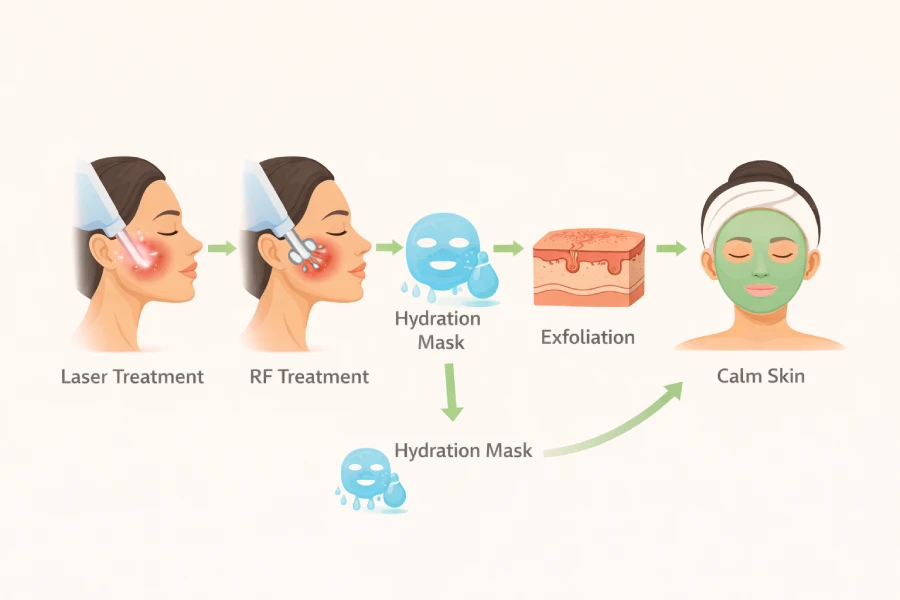
When and How Should Estheticians Use Hydration Masks After Advanced Facial Treatments?
Professional hydration masks should be used as a standard component of post-procedure recovery after advanced facial treatments including microneedling, dermaplaning, chemical exfoliation, and extraction-heavy services. Advanced treatments temporarily compromise the skin barrier, elevate transepidermal water loss, and leave skin in a heightened state of permeability — creating both a clinical need and an enhanced delivery opportunity for occlusive hydration masks applied immediately after the procedure.
- Occlusive hydration masks reduce post-treatment transepidermal water loss (TEWL) by creating a temporary physical barrier over compromised skin, slowing moisture evaporation during the critical recovery window.
- Elevated post-treatment permeability amplifies the delivery of humectants applied in the mask or in serums layered beneath it — making humectant quality more important in post-treatment contexts than in standard facial applications.
- Masks containing both polyglutamic acid and hyaluronic acid provide a dual-depth hydration system that outperforms single-humectant formulations in post-procedure recovery settings.
- Fragrance-free, dye-free, and sensitizer-free formulations are an absolute professional requirement for post-treatment application — not a preference.
- Timing, layering order, and mask selection should vary across treatment types. Microneedling, dermaplaning, chemical exfoliation, and extraction workflows each create distinct post-treatment skin states requiring matched protocol decisions.
- Combining hydration masks with LED therapy in post-treatment sequences compresses treatment time while delivering both photobiomodulation and occlusive hydration recovery simultaneously.
Every advanced facial treatment creates a period of heightened skin vulnerability. Microneedling punctures the stratum corneum and upper dermis. Dermaplaning removes the outer cell layer that serves as the skin’s first physical barrier against moisture loss. Chemical exfoliation dissolves intercellular lipid bonds that normally anchor the skin’s moisture-retention architecture. Extraction work disrupts follicle walls and creates micro-openings in the skin surface. Each of these procedures is clinically valuable — but each also leaves the skin in a state that requires deliberate, protocol-driven recovery support to achieve the outcomes clients were promised.
Post-treatment hydration masks are one of the most clinically justified steps in the advanced facial treatment sequence — yet they are also among the most inconsistently applied. Many estheticians understand that a mask “feels good” after a procedure, but fewer have systematically thought through which mask formulation is appropriate for each treatment type, why timing relative to procedure completion matters, how layering a serum beneath the mask changes what the mask can deliver, and what ingredient standards are non-negotiable when applying anything to barrier-compromised skin.
This guide addresses all of those questions with the specificity that professional post-treatment protocols require. Whether you are building a post-microneedling recovery sequence from scratch or refining an existing post-dermaplaning workflow, the framework here gives you the clinical rationale and practical protocol detail to make every hydration mask application after an advanced treatment a purposeful, outcome-driven clinical decision.
What Matters Most When Using Hydration Masks After Advanced Facial Treatments
- Advanced treatments compromise the barrier temporarily — heightened permeability is both an opportunity and a risk that post-treatment mask selection must account for.
- Occlusion reduces TEWL during the critical first 20 minutes post-procedure, directly supporting barrier recovery outcomes.
- PGA and HA together provide surface sealing and deep-layer delivery simultaneously — the most clinically complete hydration system for post-treatment application.
- Fragrance-free is a professional safety standard, not a preference, when applying masks over post-treatment skin.
- Serum layering before the mask amplifies humectant delivery through enhanced absorption during the occlusive treatment window.
- LED therapy can be delivered simultaneously with a jelly mask for combined recovery and photobiomodulation in a compressed service time.
- Each advanced treatment type creates a distinct post-procedure skin state — one-size-fits-all mask protocols are not optimal across procedures.
- Post-treatment mask application supports client retention by improving immediate visible outcomes and reducing post-procedure discomfort.
Why Post-Treatment Skin Needs a Hydration Mask More Than Resting Skin Does
The skin’s ability to regulate moisture loss depends on an intact stratum corneum — the outermost layer of the epidermis — and on the lipid matrix that fills the spaces between corneocytes. This architecture functions as both a physical barrier against environmental challenge and a moisture-retention system that limits transepidermal water loss under normal conditions. When advanced facial treatments disrupt any part of this architecture, two things happen simultaneously: the skin’s moisture-retention capacity is temporarily reduced, and its permeability to topically applied ingredients is temporarily increased.
Both of these changes have direct implications for post-treatment mask selection. The reduced moisture-retention capacity means the skin will lose water faster than it normally would, and without intervention this manifests as post-treatment tightness, dryness, and in some cases accelerated visible dehydration within hours of the treatment. The increased permeability means that whatever you apply immediately after the treatment — including the components of the hydration mask itself — will penetrate more effectively than it would under normal skin conditions. This makes post-treatment skin simultaneously more vulnerable to sensitizing ingredients and more receptive to beneficial ones.
The TEWL Problem After Advanced Treatments
Transepidermal water loss (TEWL) is the passive diffusion of water through the epidermis and out through the skin surface. Under normal conditions, the intact stratum corneum and its lipid matrix maintain TEWL within a range that does not noticeably compromise skin hydration. After advanced treatments that disrupt the stratum corneum — even minimally in the case of dermaplaning — TEWL increases measurably. Research on post-procedure TEWL consistently shows that barrier disruption of any kind — mechanical, chemical, or thermal — is followed by a recovery period during which elevated moisture loss persists until the barrier is re-established.
An occlusive hydration mask applied immediately after treatment creates a temporary physical seal over the skin surface that limits TEWL during this vulnerable window. The mask does not repair the barrier — but it reduces the moisture loss that would otherwise occur while the barrier repairs itself, giving the skin’s natural recovery mechanisms a better hydration environment to work in. This is the core clinical rationale for post-treatment hydration mask application, and it applies across all treatment types in which barrier disruption occurs.
The Opportunity Side of Heightened Permeability
Post-treatment permeability is not only a risk to manage — it is also a delivery opportunity to exploit when formulation selection is thoughtful. In standard facial applications, humectants applied to intact skin penetrate at a rate determined by the skin barrier’s natural resistance. After barrier-disrupting treatments, that resistance is reduced and topical ingredient penetration increases. Estheticians who layer a quality humectant serum beneath an occlusive hydration mask immediately post-treatment are capitalizing on this window to deliver actives into skin that is more receptive than it will be at any other point in the client’s treatment cycle.
This is why humectant quality matters more in post-treatment mask contexts than in standard facial applications. The mask that performs adequately in a routine hydration facial may underperform in a post-microneedling protocol where the most clinically advanced humectant system available would deliver meaningfully superior outcomes.
How Different Advanced Treatments Create Different Post-Procedure Skin States
Not all advanced facial treatments create the same post-procedure skin state, and the ideal hydration mask protocol is not identical across procedures. Understanding the specific way each treatment affects the skin barrier helps estheticians make more precise decisions about mask selection, timing, and layering for each service type.
Post-Microneedling Skin State
Microneedling creates controlled micro-channels through the stratum corneum and into the dermis at varying depths depending on needle length. These micro-channels represent a significant and temporary increase in skin permeability — far greater than the surface-level disruption produced by exfoliation. Immediately post-needling, skin is warm, visibly pink, and in a state of active wound response. TEWL is elevated. Inflammatory cytokines are active. The skin’s natural repair mechanisms — collagen synthesis, growth factor expression, cellular regeneration — are initiated. The post-microneedling hydration mask must simultaneously reduce TEWL, provide cooling and calming, and deliver humectants through the open channels before they close. Timing is critical: the micro-channels remain maximally open in the first 30 to 60 minutes post-procedure, and humectant delivery during this window is most efficient.
Post-Dermaplaning Skin State
Dermaplaning removes the vellus hair and the uppermost layer of dead skin cells from the stratum corneum surface. This does not create visible wounding, but it does reduce the physical depth and density of the barrier against moisture loss. The newly revealed skin surface is more sensitive to temperature, product sensation, and environmental challenge in the first several hours post-treatment. TEWL increases modestly compared to microneedling but is still clinically significant. The post-dermaplaning hydration mask is primarily a TEWL-reduction and client comfort measure, and it also represents an exceptional serum delivery opportunity because of the freshly exfoliated surface.
Post-Chemical Exfoliation Skin State
Chemical exfoliants — whether alpha hydroxy acids, beta hydroxy acids, or enzyme-based — work by dissolving the bonds between corneocytes, accelerating cell turnover and surface renewal. Depending on peel depth and acid concentration, the post-exfoliation skin state ranges from mildly sensitized with surface warmth to actively reactive with visible erythema and heightened tactile sensitivity. In professional esthetic practice, superficial peels are the most common, and these create a post-procedure skin state that is well-served by an immediately applied occlusive hydration mask. The mask reduces residual heat sensation, supports re-establishment of the lipid matrix, and provides humectant delivery to skin that has just had its surface barrier thinned.
Post-Extraction Skin State
Extraction work creates micro-openings in follicle walls and the surrounding skin surface. In clients with comedonal or acneic skin, extractions may be extensive, leaving visible areas of surface disruption alongside post-inflammatory erythema. The post-extraction skin state is characterized by localized barrier disruption and heightened sensitization, which makes formulation safety even more important than in other post-treatment contexts. A calming, occlusive hydration mask applied after extractions reduces surface redness, delivers soothing humectants, and supports the follicle wall healing process.
| Treatment Type | Post-Procedure Skin State | TEWL Elevation | Primary Mask Priority | Timing Consideration |
|---|---|---|---|---|
| Microneedling | Significant barrier disruption, micro-channels open, active wound response, erythema | High | TEWL reduction + humectant delivery through open channels + cooling | Apply within 5 minutes post-procedure; channels maximally open for 30–60 min |
| Dermaplaning | Surface layer removed, fresh epidermis exposed, modest barrier reduction, heightened sensitivity | Moderate | TEWL management + surface sealing + serum delivery opportunity | Apply immediately post-procedure; prime delivery window is first 15 minutes |
| Chemical Exfoliation | Intercellular lipid disruption, surface warmth, possible erythema, sensitization | Moderate to High | Cooling + barrier lipid support + TEWL control | Apply after full neutralization or timed completion; no delay once peel is finished |
| Extractions | Localized follicle disruption, post-inflammatory erythema, surface micro-openings | Low to Moderate | Calming + post-inflammatory redness reduction + barrier recovery | Apply after any LED blue light sequence; standard post-extraction workflow position |
The Science Behind Occlusion: Why Jelly Masks Work Better Than Lighter Hydration Products Post-Treatment
The term “occlusion” refers to the physical blocking of moisture evaporation from the skin surface. Occlusives work by creating a barrier layer over the skin that slows the passive diffusion of water vapour out through the epidermis. The degree of occlusion varies significantly between product types: lightweight water gels and serums provide minimal occlusion; cream masks provide moderate occlusion; occlusive jelly masks provide the highest degree of occlusion available in a non-petroleum-based professional skincare formulation.
In the post-treatment context, the degree of occlusion matters clinically because TEWL elevation after barrier disruption is proportional to the severity of the disruption. After microneedling, the micro-channels represent a significant and acute increase in transepidermal water loss pathways. A product with minimal occlusion applied over these open channels will reduce TEWL marginally. A highly occlusive jelly mask will reduce it substantially, maintaining a better hydration environment around the channels while the barrier re-establishes.
How Alginate Occlusion Works in a Jelly Mask
Professional jelly masks use sodium alginate — a seaweed-derived polysaccharide — as their primary gelling agent. When activated with water, alginate cross-links into a three-dimensional gel network that forms a flexible, semi-occlusive layer conforming to the skin surface. This layer slows TEWL through two mechanisms: physical occlusion of the skin surface and the hygroscopic action of the alginate gel itself, which holds water in contact with the skin throughout the treatment window. The gel’s endothermic setting reaction also draws heat from the skin surface during the early set phase, producing the cooling effect that clients consistently describe as one of the most distinctive sensations in a post-treatment jelly mask application.
Why Occlusive Hydration Masks Improve Post-Treatment Recovery Outcomes
Post-treatment skin is simultaneously more vulnerable to moisture loss and more receptive to topically applied hydration. An occlusive jelly mask addresses both conditions in a single application through three distinct mechanisms.
Mechanism 1 — Physical TEWL reduction: The set alginate gel layer creates a semi-occlusive physical seal over the skin surface. Research on occlusion in wound healing demonstrates that maintaining a moist environment around healing tissue accelerates epithelial recovery and reduces inflammatory signals compared to exposed, drying tissue. The same principle applies to post-procedure esthetic treatments.
Mechanism 2 — Enhanced humectant delivery: The occlusive layer maintains a high-humidity microenvironment between the mask and skin surface, slowing the evaporation of applied humectants and extending their contact time with the skin. When PGA and HA are present in the mask formulation, the humectant concentration gradient driving delivery into the skin is maintained throughout the treatment window rather than being reduced by evaporation.
Mechanism 3 — Thermal management: The endothermic setting reaction of the alginate gel reduces surface skin temperature during the first several minutes of application. For post-treatment skin that is warm from procedure-induced erythema, this thermal effect provides genuine physiological benefit — reducing heat-driven inflammatory signalling at the skin surface, not just delivering a pleasant sensory experience.
Why Single-Humectant Masks Underperform Post-Treatment
Single-humectant masks — those containing hyaluronic acid alone — provide surface hydration and moderate occlusion within the mask layer but miss the additional clinical mechanisms that a PGA + HA dual-humectant system provides. Hyaluronic acid is degraded by hyaluronidase, an enzyme naturally present in the skin. On normal skin this enzymatic activity is a slow, background process. On post-treatment skin where inflammatory mediators are active, hyaluronidase activity may be elevated, meaning that HA applied to post-procedure skin is broken down more rapidly than under standard conditions. PGA, by inhibiting hyaluronidase, extends the effective window of both applied HA and the skin’s own naturally occurring hyaluronic acid — a mechanism that has measurably greater clinical relevance in post-treatment contexts than in standard facial applications.
Treatment-Specific Hydration Mask Protocols: What to Do and When
While the principles of occlusion, humectant delivery, and formulation safety apply across all post-treatment mask applications, the specific protocol steps differ by treatment type. The following protocols represent established best practice frameworks that estheticians can adapt to their own service sequences.
Post-Microneedling Hydration Mask Protocol
Microneedling creates the most significant barrier disruption of any procedure commonly performed in esthetic practice and therefore creates the most clinically important case for immediate post-treatment hydration mask application. The protocol below applies to standard 0.25mm to 1.0mm esthetic microneedling within applicable scope of practice.
- Immediate post-procedure (0–3 minutes): Apply a sterile, fragrance-free hyaluronic acid or PGA + HA serum to still-damp skin. The micro-channels are maximally open and humectant uptake is at its peak. Use gentle pressing motions — no rubbing.
- Serum absorption phase (3–5 minutes): Allow the serum to begin absorbing. Skin may still be pink and warm. Light fan cooling is appropriate if needed for client comfort. Do not wipe away any serum that has not fully absorbed.
- Mix and apply hydration mask (5–8 minutes post-procedure): Mix the jelly mask at the established ratio and apply quickly from outer face inward using a professional mask brush. The goal is full coverage before the mask begins to set. Work efficiently.
- Mask treatment window (10–15 minutes): Allow the mask to set and remain on undisturbed. LED red light therapy can be delivered during this window if the device is compatible with mask application. Gentle scalp massage is appropriate if the client is comfortable.
- Removal and post-mask application: Remove the set mask as a single piece using the peel technique. Apply a minimal, fragrance-free barrier recovery moisturizer or growth factor serum. Avoid active ingredients, AHAs, retinol, or vitamin C for at least 24 hours post-procedure.
Post-Dermaplaning Hydration Mask Protocol
Dermaplaning creates a clean, fresh skin surface that is exceptionally receptive to topical actives. The post-dermaplaning window is one of the best delivery opportunities in the facial treatment sequence, and a hydration mask applied immediately after dermaplaning takes full advantage of the freshly exfoliated surface.
- Immediately post-dermaplaning: Mist the skin with a hydrating toner or essence to begin rehydration. The freshly revealed surface absorbs quickly. Do not apply any exfoliating or potentially irritating actives at this stage.
- Serum layer application: Apply a hyaluronic acid serum or peptide serum to damp skin. The post-dermaplaning surface absorbs serums noticeably more efficiently than pre-treatment skin. Allow to begin absorbing.
- Apply hydration mask: Mix and apply the jelly mask over the serum. The combination of the freshly exfoliated surface, the serum layer, and the occlusive mask creates a layered hydration delivery system. Full coverage application within 2–3 minutes of serum application is the target.
- Treatment window: Allow the mask to set for 10–15 minutes. LED red light therapy is compatible with the post-dermaplaning skin state and can be delivered simultaneously.
- Complete the service: Remove the mask, apply SPF if the service is complete, and provide client home-care guidance emphasizing sun protection for the first 48 hours.
Post-Chemical Exfoliation Hydration Mask Protocol
After superficial chemical exfoliation, the priority is calming, cooling, and TEWL management before applying any active hydration. The hydration mask should be applied only after the peel has been fully neutralized or timed out, and the mask formulation must be free from any acids or actives that could compound exfoliative action on skin that has already been chemically treated.
- Post-neutralization: Ensure the peel is fully neutralized or has fully timed out before any mask application. Verify client comfort and assess erythema level.
- Optional calming serum: A centella asiatica, allantoin, or panthenol serum can be applied before the mask for clients with higher erythema or sensitivity. Skip vitamin C, retinol, and any acids at this stage.
- Apply hydration mask: Mix and apply the jelly mask. The cooling effect is particularly valued by clients who experienced warmth or tingling during the peel. Apply efficiently and ensure full coverage.
- Treatment window: Allow 10–15 minutes. Avoid LED blue light immediately post-AHA peel in clients with high sensitivity. Red light is generally compatible.
- Complete the service: Remove mask, apply SPF, and advise the client on post-peel home care — no exfoliants for at minimum 72 hours, consistent sun protection.
Estheticians incorporating the Poly-Luronic™ Jelly Mask by Luminous Skin Lab into post-treatment protocols consistently note several operational advantages over the single-humectant alternatives they previously used. The consistent 12-to-15-minute set window reliably accommodates a post-microneedling LED sequence without timing adjustments. The PGA-forward dual-humectant system produces a noticeably more hydrated immediate post-removal skin response that clients comment on without prompting — particularly noticeable after dermaplaning when the fresh skin surface amplifies the mask’s humectant delivery.
Practitioners also report that the fragrance-free, clean-label formulation eliminates the post-application sensitivity concern that led them to use different products for post-treatment vs. standard facial contexts. With a single confirmed-safe formulation, they apply the same jelly mask across their entire treatment menu without needing to maintain separate post-treatment and general-use mask inventories. The dual-humectant system’s hyaluronidase inhibition is noted as particularly relevant after microneedling, where they observe that post-procedure skin hydration levels hold more durably compared to HA-only masks used previously — a difference they attribute to PGA’s protection of both applied and naturally occurring HA in the post-procedure environment.
How to Layer Serums and Hydration Masks for Maximum Post-Treatment Recovery
The relationship between serum application and hydration mask timing is one of the most clinically leverageable elements of post-treatment protocol design. An occlusive hydration mask applied directly over bare skin after a treatment provides TEWL reduction and cooling — both valuable outcomes. The same mask applied over a targeted serum layer provides all of that, plus enhanced delivery of the serum’s active ingredients through the mask’s occlusive effect on the serum layer below.
The Serum-Under-Mask Occlusion Effect
When a serum is applied to skin and immediately covered with an occlusive mask, two things happen that do not occur when the serum is applied and left exposed to air. First, evaporation of the serum’s water carrier is slowed significantly by the occlusive layer above it, maintaining a higher concentration of active ingredients against the skin surface for longer. Second, the high-humidity microenvironment beneath the mask drives continued absorption of the serum’s humectants and actives into the skin through sustained concentration gradient pressure. The mask effectively extends the absorption window of the serum from the few minutes it would have in open air to the full 10-to-20-minute treatment window.
This mechanism is particularly well-established in the dermatology literature on occlusion in wound healing and has been transferred to professional esthetic practice through the layered serum-and-mask protocols used in post-microneedling and post-dermaplaning workflows. The serum does not need to be fully absorbed before the mask is applied — in fact, applying the mask while the serum is still visibly present on the skin surface ensures the mask’s occlusion engages the serum at its highest available concentration.
Which Serums Work Best Under Post-Treatment Hydration Masks
Not all serums are appropriate for application under an occlusive mask on post-treatment skin. The following categories represent the most clinically appropriate serum types for the under-mask layering position in post-treatment protocols:
- Hyaluronic acid serums: A foundational choice for post-treatment hydration layering. Multi-weight HA formulations that include both high and low molecular weight HA deliver hydration across a range of skin depths simultaneously. PGA serums used alongside HA serums before the mask further enhance the layering system.
- Growth factor serums: Particularly appropriate in post-microneedling protocols where the growth factor signaling environment created by needling is amplified by the delivery of exogenous growth factors through the open channels. Apply within the micro-channel open window for maximum delivery.
- Peptide serums: Signal peptides, carrier peptides, and neurotransmitter-inhibiting peptides are all appropriate in post-treatment layering positions. Peptide delivery is enhanced by the elevated post-procedure permeability and by the occlusion effect of the mask above.
- Centella asiatica or allantoin-based calming serums: Particularly appropriate for post-extraction and post-chemical peel protocols where managing post-inflammatory response is a primary clinical objective.
Serums containing active exfoliants (AHAs, BHAs, retinol, vitamin C at high concentrations) are not appropriate in the under-mask position on post-treatment skin. The combination of elevated permeability, reduced barrier function, and the enhanced delivery provided by mask occlusion creates an unacceptable sensitization and irritation risk for these actives in this context.
Combining LED Therapy and Hydration Masks After Advanced Facial Treatments
The combination of LED light therapy and an occlusive hydration mask applied simultaneously is one of the most efficient service sequences available in professional post-treatment protocol design. Rather than delivering photobiomodulation and hydration recovery as sequential steps that each add time to the service, the two modalities can be delivered in parallel during the mask’s natural 10-to-20-minute set and treatment window. The clinical rationale for this combination is well-established and the operational logistics are straightforward for most LED device formats.
Why LED and Hydration Mask Work Together Post-Treatment
Red LED light therapy delivers photons at approximately 630nm to 670nm wavelengths that are absorbed by mitochondrial chromophores in skin cells, stimulating ATP production and activating cellular repair and regeneration pathways. Post-microneedling and post-procedure skin is in an active repair state with upregulated growth factor expression — the cellular environment in which red LED photobiomodulation has its most pronounced clinical effect. Delivering LED therapy during the mask treatment window means the photobiomodulation is occurring simultaneously with the maximum TEWL reduction and humectant delivery that the mask provides — creating a combined environment of thermal management, hydration support, and cellular energy enhancement during the critical early post-procedure recovery window.
Professional-grade transparent jelly masks transmit visible light wavelengths through the gel layer with minimal interference. The set alginate gel is sufficiently transparent to allow standard LED device output to reach the skin surface. Estheticians working with LED panels positioned over or around the face report no meaningful reduction in treatment effectiveness when delivering LED through a set jelly mask layer. Mask formulation transparency — which is a function of ingredient quality and alginate grade — affects how much light is transmitted, which is one additional reason why professional-grade formulations with high-quality alginate are preferred over lower-grade alternatives for LED-combination protocols.
Practical Protocol Position for LED and Hydration Mask Combination
The LED + jelly mask combination works most effectively in the following service sequence position: the advanced treatment (microneedling, dermaplaning, or chemical exfoliation) is completed, the post-procedure serum is applied, the jelly mask is mixed and applied, and the LED device is positioned and activated within the first two to three minutes of mask application. This ensures the LED treatment window aligns with the mask’s active setting phase, during which the cooling endothermic effect is most pronounced and the serum delivery is at its most active.
Formulation Safety: What to Look for and What to Avoid in Post-Treatment Hydration Masks
The same ingredient that poses minimal risk on intact, non-compromised skin can cause meaningful sensitization on post-treatment skin where barrier function is reduced and permeability is elevated. Estheticians selecting hydration masks for post-treatment use must apply a higher standard of ingredient scrutiny than they would for standard facial applications.
Non-Negotiable Formulation Requirements for Post-Treatment Use
- 100% fragrance-free: Synthetic fragrances are among the most common contact sensitizers. On post-treatment skin where the barrier is compromised and permeability is elevated, even low concentrations of fragrance compounds that would be tolerated on intact skin can cause sensitization responses. “Lightly scented” or “natural fragrance” does not meet the post-treatment professional standard. Full fragrance-free formulation confirmed by INCI review is required.
- Free from artificial dyes: Artificial colorants add no functional benefit to a hydration mask and represent an unnecessary sensitization variable in post-treatment applications.
- No active exfoliants: AHAs, BHAs, and enzymes have no place in post-treatment mask formulations. Any exfoliative action on barrier-compromised skin is inappropriate regardless of concentration.
- No alcohol (in functional concentrations): Alcohol in significant concentrations has a drying effect on skin and is contraindicated for post-treatment application where TEWL management is a clinical priority.
- Full INCI disclosure: Any brand unable to provide the complete ingredient list on request should not be used for post-treatment application. Undisclosed “proprietary blend” designations prevent safety assessment and are an immediate disqualifier for professional use.
Preferred Ingredient Criteria for Post-Treatment Masks
- PGA + HA dual-humectant system: The most clinically complete humectant formulation for post-treatment use, providing surface sealing, deep delivery, hyaluronidase inhibition, NMF stimulation, and HA synthase upregulation — mechanisms that have heightened relevance when the skin is in a compromised, elevated-permeability state.
- High-grade sodium alginate: The structural gelling agent determines mixing consistency, set time predictability, and removal integrity. High-grade alginate produces smooth, consistent gel with predictable behavior; lower grades introduce variability that creates workflow and clinical consistency problems.
- Calming actives (optional but beneficial): Centella asiatica extract, allantoin, panthenol, or aloe vera in the mask formulation provide additional post-inflammatory calming action alongside the primary occlusion and humectant functions.
Professional and Scientific References
The post-treatment skin science and occlusion mechanisms referenced in this article draw from peer-reviewed dermatological and cosmetic chemistry research:
- Transepidermal water loss following barrier disruption procedures. Dermatological Sciences literature; multiple clinical studies. Consistent documentation of TEWL elevation following mechanical, chemical, and laser-mediated barrier disruption, with time-course recovery data.
- Occlusion in wound healing and skin recovery. Journal of Wound Care; International Wound Journal. Established evidence base for moist wound healing and the role of occlusive dressings in accelerating epithelial recovery and reducing inflammatory signalling.
- Gamma-PGA barrier strengthening, HAS upregulation, and NMF stimulation. MDPI, 2024. Demonstrated HAS-1, HAS-2, HAS-3 mRNA upregulation and aquaporin-3 enhancement with 1% topical gamma-PGA in reconstructed skin model.
- PGA hyaluronidase inhibition and HA synergy. Cosmetic chemistry literature; Typology, 2021–2025; Stanford Chemistry overview, 2024. PGA inhibits hyaluronidase to protect both applied and naturally occurring HA; combined PGA + HA system produces superior sustained hydration vs. single-humectant formulations.
- PGA moisture-binding capacity: up to 5,000 times its weight in water. Reviva Labs; Typology formulation science documentation, 2025.
- Post-microneedling permeability window and enhanced topical delivery. Dermatologic Surgery; Journal of Drugs in Dermatology. Micro-channel open window documented at 30–60 minutes post-procedure for standard esthetic needle depths.
- Sodium alginate as an occlusive biomaterial: gelling properties and clinical applications. Established biomedical and wound dressing literature.
- LED photobiomodulation in post-procedure skin recovery. Photomedicine and Laser Surgery; multiple peer-reviewed sources. Red light at 630–670nm enhances ATP production and activates cellular repair pathways in inflammatory skin states.
For estheticians building or refining post-treatment hydration mask protocols, the Poly-Luronic™ Jelly Mask by Luminous Skin Lab is the formulation our education team most consistently references for post-procedure recovery contexts. The proprietary Poly-Luronic™ dual-humectant system — combining PGA surface sealing and hyaluronidase inhibition with HA deep delivery and NMF stimulation — is formulated specifically to deliver the most clinically complete post-treatment hydration available in an occlusive jelly mask format. The formulation is 100% fragrance-free, clean-label, and designed for protocol compatibility across microneedling, dermaplaning, chemical exfoliation, extraction, and LED-adjunctive workflows. The consistent 12-to-15-minute set window accommodates LED sequences without timing adjustment. A single confirmed-safe formulation for all post-treatment applications eliminates the need to maintain separate product inventories for procedure-specific recovery protocols.
Explore the Poly-Luronic™ Jelly Mask Line →Frequently Asked Questions: Hydration Masks After Advanced Facial Treatments
Should I use a hydration mask after every advanced facial treatment?
Yes, in most cases a hydration mask is appropriate after advanced facial treatments including microneedling, dermaplaning, chemical exfoliation, and extraction-heavy work. Advanced treatments temporarily disrupt the skin barrier, increasing transepidermal water loss and the risk of post-treatment dehydration. Applying an occlusive hydration mask immediately after these procedures supports barrier recovery, reduces redness, and delivers humectants while permeability is elevated. The specific mask formulation should be fragrance-free and matched to the treatment performed.
What kind of hydration mask works best after microneedling?
After microneedling, the ideal hydration mask is fragrance-free, free from potential irritants, and formulated with advanced humectants that can capitalize on the heightened skin permeability created by the treatment. Professional-grade occlusive jelly masks containing both polyglutamic acid and hyaluronic acid are widely used in post-microneedling protocols because the occlusive layer supports barrier recovery while PGA and HA deliver layered hydration at the surface and in deeper skin layers respectively. Avoid masks with active exfoliants, synthetic fragrance, or alcohol in any post-needling application.
Why does skin get so dry after dermaplaning even though the treatment itself seems gentle?
Dermaplaning removes the stratum corneum’s outermost layer of dead skin cells along with vellus hair, which temporarily reduces the skin’s natural physical barrier against moisture loss. Even though dermaplaning does not cause visible wounding, the reduction in surface dead-cell density increases transepidermal water loss for several hours post-treatment. Clients who do not receive a hydrating occlusive treatment immediately after dermaplaning often notice tightness and dryness within hours. Applying a hydration mask directly after dermaplaning addresses this TEWL spike before it can manifest as visible dehydration.
How soon after a chemical peel can I apply a hydration mask?
For superficial chemical peels used in professional esthetic practice, a calming hydration mask can typically be applied immediately after the peel is fully neutralized or timed out. The mask serves to reduce residual heat, support barrier recovery, and provide immediate moisture to skin that has been exfoliated at the cellular level. The critical requirement is that the mask formulation contains no active acids, alcohol, or synthetic fragrance that could compound irritation on post-peel skin. Always verify the mask’s INCI list before post-peel application.
Does the order you apply products before a hydration mask actually matter?
Yes, product layering order before a hydration mask matters significantly. Applying a serum containing hyaluronic acid, growth factors, or peptides before the mask allows the occlusive mask layer to enhance absorption of those actives during the treatment window. This is the mechanism behind the layered serum-and-mask protocols used in advanced post-treatment workflows. The mask’s occlusion traps the serum against the skin, slowing evaporation and extending the absorption window. Skipping the serum layer and applying the mask directly over cleansed skin is still beneficial but misses the enhanced delivery opportunity.
Why does a jelly mask feel so cooling on skin after an advanced treatment?
The cooling sensation of a professional jelly mask on post-treatment skin is produced by a combination of the gel’s high water content, endothermic setting reaction, and the occlusive barrier it creates. When the water-activated alginate mixture is applied to warm, post-treatment skin, the endothermic phase of the gelling reaction draws heat away from the skin surface. This effect is most pronounced on skin that is already warm or slightly inflamed from the preceding treatment, which is precisely why clients frequently describe the jelly mask as the most comforting part of a post-treatment facial sequence.
Can you use a hydration mask and LED therapy at the same time after a facial treatment?
Yes, many advanced treatment room protocols combine LED light therapy with a hydration mask applied simultaneously. The jelly mask maintains occlusive hydration and cooling while the LED device delivers photobiomodulation through the transparent gel layer. This combination compresses total treatment time while delivering both hydration recovery and light therapy benefits in parallel. Professional-grade jelly mask formulations should be used for this application to ensure the gel layer does not interfere with light transmission.
How long should a hydration mask stay on after an advanced facial treatment?
Most professional hydration masks applied after advanced facial treatments are designed to remain on the skin for 10 to 20 minutes. This window provides sufficient time for the occlusive layer to support barrier recovery, allow humectant delivery, and deliver the cooling and calming effect. Leaving a professional jelly mask on beyond its designed set window does not meaningfully improve outcomes and may compromise removal integrity. Follow the manufacturer’s timing guidance and adjust based on clinical observation of the individual client’s skin response.
How does the Poly-Luronic Jelly Mask compare to other hydration masks for post-treatment recovery?
The Poly-Luronic Jelly Mask by Luminous Skin Lab is formulated specifically for professional post-treatment recovery workflows, featuring a proprietary PGA and HA dual-humectant system. PGA holds up to 5,000 times its weight in water, seals the surface, and inhibits hyaluronidase to protect both applied and naturally occurring HA. HA delivers hydration into deeper skin layers. The formulation is 100% fragrance-free and designed for protocol compatibility with microneedling, dermaplaning, chemical exfoliation, and LED-adjunctive workflows. Many estheticians note that the consistent set behavior and clean ingredient profile make it their preferred post-treatment mask compared to single-humectant or consumer-grade alternatives.
Post-Treatment Hydration Masks Are a Clinical Standard, Not an Optional Add-On
Every advanced facial treatment creates a temporary skin state that requires deliberate recovery support. The window immediately following microneedling, dermaplaning, chemical exfoliation, and extraction work is one of the most clinically significant moments in the entire treatment cycle — a period of heightened permeability, elevated TEWL, and active barrier repair during which the interventions an esthetician makes have an outsized effect on both the recovery experience and the visible outcome.
A professionally selected, correctly timed, appropriately formulated hydration mask applied in this window does not merely enhance client comfort — it directly supports the biological recovery processes that produce the treatment outcomes clients return for. Occlusion reduces the moisture loss that would otherwise occur while the barrier repairs. Dual-humectant delivery provides the raw material the skin needs to maintain hydration during recovery. Fragrance-free, clean-label formulation ensures no sensitization compounds are introduced to skin that is most vulnerable to them.
For estheticians who approach post-treatment mask selection with the same clinical intentionality they bring to the advanced treatments themselves, the difference in client outcomes — and in client retention — is consistently measurable. The mask is not the afterthought. It is the recovery protocol.