Definition
This article explains why hydration is critical for skin barrier recovery within professional skincare protocols focused on hydration, barrier repair, and post-treatment recovery.
Quick Answer
This article explains why hydration is critical for skin barrier recovery for estheticians focusing on TEWL reduction, water retention, and hydration restoration.
Key Takeaways
- Barrier health is critical to professional skincare outcomes.
- Hydration treatments help support skin recovery.
- Targeted ampoules and HydroGlo Jelly Masks can support treatment protocols.
- The skin barrier regulates hydration and protects against irritation.
- Barrier-focused treatments improve recovery after professional procedures.
- Hydration, occlusion, and calming ingredients support skin repair.
TEWL: Transepidermal water loss, which refers to the amount of water that escapes from the skin barrier.
Hydration Restoration: The process of replenishing moisture levels to support barrier function and skin recovery.
Occlusion: A technique used to reduce moisture loss and support hydration retention on the skin surface.
Why Hydration Matters for the Skin Barrier
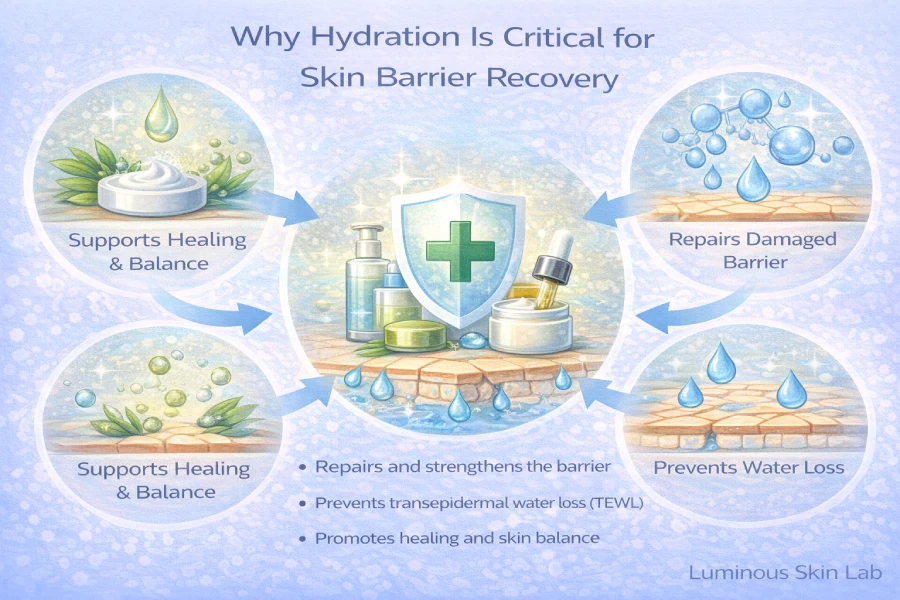
The skin barrier regulates hydration and protects against irritation. When the barrier is compromised, the skin often loses moisture more quickly, leading to dryness, sensitivity, and slower recovery. That is why hydration plays a central role in professional skincare protocols focused on barrier repair.
For estheticians, hydration is not just about adding moisture. It is about helping the skin maintain that moisture and reducing the factors that contribute to dehydration.
The Role of TEWL in Barrier Damage
Transepidermal water loss (TEWL) is one of the most important concepts in barrier repair. When the skin barrier is weakened, TEWL increases, meaning the skin cannot retain moisture effectively. This often results in tightness, irritation, and visible dryness.
Reducing TEWL is therefore a key goal in recovery-focused treatments. Hydration protocols, occlusive layers, and calming ingredients all contribute to this process.
Water Retention and Hydration Strategies
Water retention is what allows the skin to remain balanced and comfortable after treatments. Professional skincare strategies often include humectants, occlusive masks, and supportive formulations that help the skin hold onto moisture more effectively.
These strategies are especially important after procedures such as exfoliation, microneedling, or chemical treatments, where the barrier may be temporarily disrupted.
Hydration Restoration in Professional Protocols
Hydration restoration is a core part of post-treatment recovery. Estheticians often combine targeted ampoules with occlusive masks to create a more supportive environment for the skin. This helps improve comfort and supports a smoother recovery phase.
Estheticians often support barrier repair treatments by pairing targeted products such as Hydration Ampoule with deeply hydrating recovery masks like HydroGlo Jelly Mask.
Why Hydration Impacts Treatment Results
Barrier-focused treatments improve recovery after professional procedures, and hydration is a major factor in that process. When the skin maintains proper hydration levels, it is better able to tolerate treatments, recover efficiently, and maintain results over time.
This is why hydration, occlusion, and calming ingredients support skin repair in modern esthetic practice.
Frequently Asked Questions
Why is barrier repair important?
What treatments support barrier recovery?
What damages the skin barrier?
How can estheticians repair the barrier?
Suggested Internal Links
About This Professional Guide
This article is part of the Luminous Skin Lab Esthetician Education Series created to provide professional skincare knowledge for licensed estheticians and advanced practitioners.