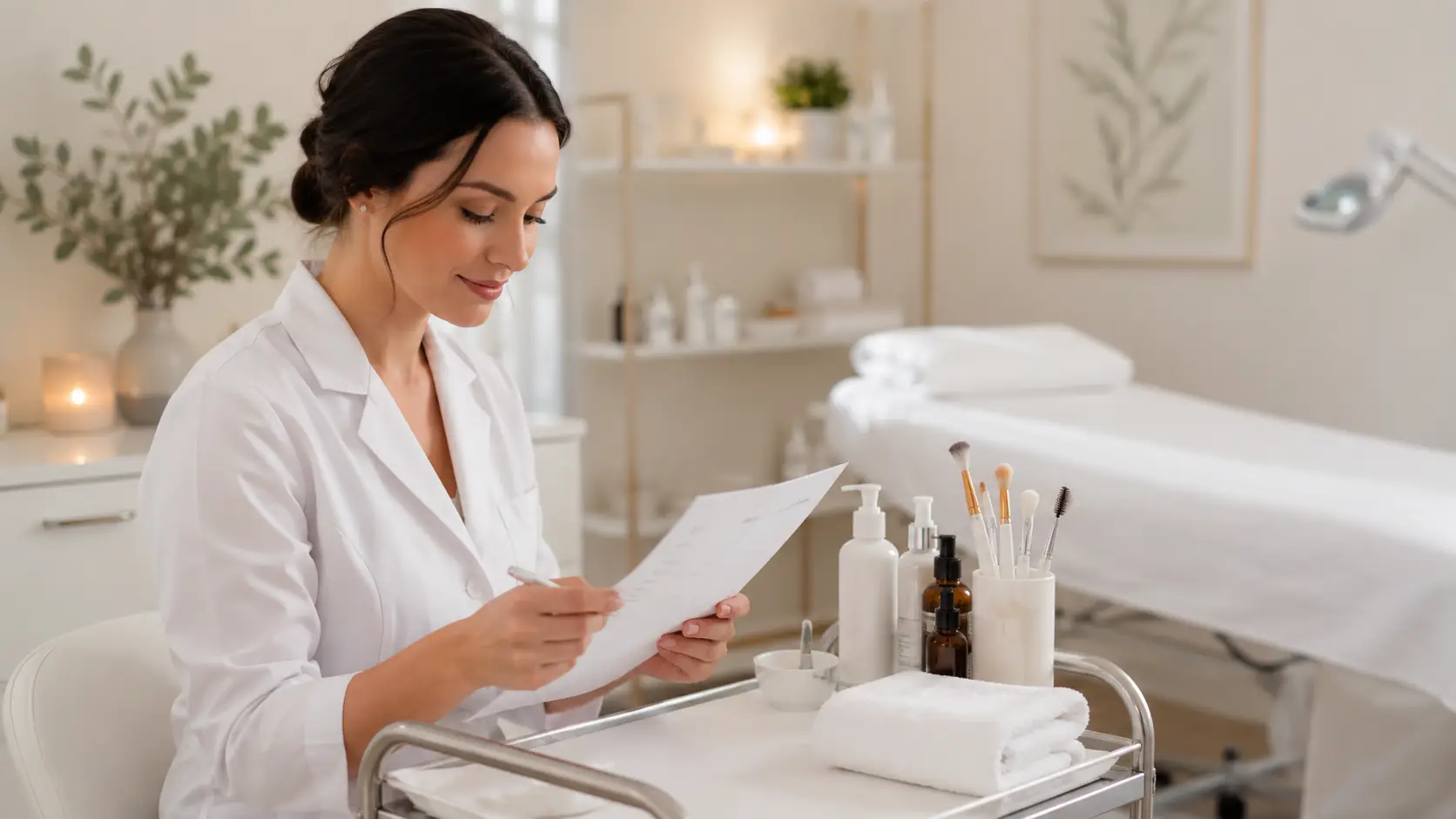
How Much Does It Really Cost to Start as a New Esthetician?
Most new estheticians can launch a fully operational treatment room for between $1,500 and $4,500, depending on whether they are renting a suite independently, joining an established spa, or working within a shared space. A lean but professional starter setup typically runs $1,500 to $2,500. A more fully equipped setup with a quality facial bed, steamer, magnifying lamp, and starter back bar generally falls between $2,500 and $4,500. Advanced equipment — microneedling devices, high-end LED panels, and specialty machines — are added later as revenue and client base develop.
- The facial bed is almost always the single largest startup expense, ranging from $400 to $1,200 for a professional hydraulic or electric model.
- A complete starter back bar of professional products typically costs between $400 and $900, covering cleanser through mask and finishing moisturizer.
- Consumables — cotton, gauze, disposables, linens, and sanitation supplies — represent a recurring monthly cost of roughly $80 to $200 depending on client volume.
- New estheticians renting within an established spa or salon significantly reduce startup equipment costs and may focus only on back bar and consumable expenses.
- High-cost devices such as professional microdermabrasion, ultrasound, and advanced LED equipment should be deferred until after a stable client base is established.
- Low-cost, high-return add-ons like professional jelly masks are among the smartest early investments — delivering immediate client experience uplift at minimal cost.
One of the questions new estheticians search most often — and find the least useful answers to — is simply: how much is this actually going to cost? Online forums give wildly different numbers. Supply catalogues make it easy to build a wishlist that quickly climbs past $10,000. And most working estheticians, when asked, describe their real startup experience as something they had to figure out trial and error rather than through any structured guidance.
This guide gives you what those other sources typically do not: a clear, honest, category-by-category breakdown of what new estheticians realistically spend, what drives costs up or down, what you genuinely need before you see your first client, and what you can safely defer without compromising the quality of your services.
The goal is not to tell you to spend as little as possible — false economy in a professional supply context often costs more in the long run. The goal is to help you spend in the right order: investing first in what directly enables professional service delivery, deferring everything that cannot be justified by your current client volume, and building upward from a stable, sustainable foundation.
What Every New Esthetician Should Know Before Spending a Dollar
- Total startup costs for a new esthetician range from approximately $1,500 to $4,500 for a professional first setup — not $10,000 or more as some supply lists imply.
- The facial bed, magnifying lamp, steamer, and facial cart are the equipment non-negotiables. Everything else is additive.
- Back bar products are the second major cost category and should be kept minimal at first — one cohesive professional line covering core service steps.
- Consumables are the often-overlooked recurring cost that new estheticians underestimate significantly in their first-month budget.
- High-cost specialty equipment should not be purchased until you have a stable client base and clear demand for the specific service it enables.
- Working within an established spa or shared suite dramatically reduces startup equipment costs and is often the smartest first-year strategy.
- Low-cost, high-experience-value add-ons are your best early ROI investments — they elevate client perception immediately at minimal upfront cost.
The Three Startup Cost Tiers: Which One Are You Actually In?
Not all new esthetician startups look the same. Your actual startup cost depends heavily on three variables: whether you are renting a suite independently or working within an existing facility, how much equipment that facility already provides, and how broad you want your initial service menu to be. Most new estheticians fall into one of three realistic cost tiers.
Working within an established spa or salon that provides the treatment bed and core equipment. Your cost is back bar products, consumables, and basic tools only. Possible in month one if you are employed or subletting within a fully equipped space.
Renting a spa suite in a shared facility that provides some infrastructure but not all equipment. You purchase your facial bed, essential tools, a steamer and lamp, and a complete starter back bar. The most common realistic first setup for independent estheticians.
Building out a fully independent space from scratch with all equipment, a complete back bar, a facial cart, sanitation setup, and a small selection of add-on tools. Appropriate for estheticians with prior industry experience and a transferable client base who are going directly to solo practice.
The figures above represent realistic market costs in 2026 for professional-grade (not consumer) supplies purchased through established professional supply channels. They do not include lease deposits, business registration costs, liability insurance (typically $300 to $500 annually), or website and booking software expenses, which are business infrastructure costs separate from your operational supply investment.
What Drives New Esthetician Startup Costs Up or Down
The two biggest cost levers are whether you need to purchase a facial bed (saves $500–$1,200 if the facility provides it) and how broad you make your initial service menu (a narrow, focused first menu requires significantly fewer products and tools than a full menu from day one).
New estheticians who try to build a complete menu immediately — hydration facials, acne protocols, anti-aging treatments, waxing, and add-ons — often overspend on products and tools they will not use consistently until their client base grows. Starting with two to three core services and expanding as revenue and client feedback inform your menu is a more sustainable strategy.
Equipment Costs: What to Buy First and What to Skip
Equipment decisions account for the largest portion of startup spending and the most common financial mistakes new estheticians make. The core principle is straightforward: buy only what you need to perform your core services professionally on day one. Every equipment purchase beyond that should be evaluated against a simple question — does this directly generate revenue within the next 90 days?
Non-Negotiable First Equipment Purchases
These five items form the operational foundation of every professional facial service. None of them can be reliably substituted, and client-facing professionalism suffers measurably without them.
| Equipment Item | Realistic Cost Range | Priority | Notes |
|---|---|---|---|
| Professional facial bed (hydraulic or electric) | $400–$1,200 | Buy Now | Largest single cost. Used electric beds in good condition can reduce this to $250–$450. Do not use a massage table — height adjustment is essential. |
| Magnifying lamp (5-diopter or combo) | $80–$220 | Buy Now | Essential for skin analysis and extraction. LED magnifying lamps provide better color accuracy than fluorescent versions. |
| Facial steamer | $80–$250 | Buy Now | Ozone or non-ozone; professional grade. Consumer steamers lack the output and durability for consistent treatment room use. |
| Rolling facial cart | $60–$160 | Buy Now | Stainless steel preferred for sanitation. Required for product placement, tool access, and professional workspace organization during service. |
| Basic hand tool set (brushes, spatulas, extraction) | $60–$150 | Buy Now | Fan brushes, mask brushes, comedone extractors, tweezers, spatulas. Professional-grade stainless tools are cleanable and durable. Consumer alternatives are not. |
| Nano infusion device | $200–$600 | Month 2–3 | Lower cost than most devices, no medical oversight required in most states, strong add-on revenue potential. Worth considering early if you want to offer an advanced service relatively quickly. |
| High-frequency device | $120–$350 | Month 3+ | Useful for acne and post-extraction protocols. Not a first-day essential but a practical early add-on investment for estheticians focusing on acne services. |
| Professional microdermabrasion machine | $1,200–$4,000 | Defer | Significant investment that only makes sense with consistent client volume for this specific service. Do not purchase before month six at the earliest. |
| Advanced LED panel (full-face professional) | $1,500–$5,000 | Defer | Premium LED panels are a strong long-term investment but represent significant capital outlay. Defer until client base is stable and LED demand is confirmed. |
Estheticians consistently report that starting with only the five essential equipment items above — and deferring everything else — allows them to deliver high-quality professional services from the first week. The client experience difference between a setup with those five essentials versus one with additional specialty equipment is rarely meaningful to clients at the beginner service stage. The difference between having those essentials versus not having them is always meaningful.
Back Bar and Product Costs: What New Estheticians Actually Need to Buy
Back bar products — the professional products you apply during services — represent the second major startup cost category and the area where new estheticians most commonly make purchasing mistakes. The two most common errors are buying from too many different lines simultaneously and over-purchasing products before knowing which services you will actually perform most frequently.
The Minimal Complete Back Bar for a Beginner Esthetician
A functional professional back bar for a new esthetician performing hydration facials, basic anti-aging work, and gentle exfoliation needs to cover six core treatment steps: cleanse, tone or prep, exfoliate, treat (serum or ampoule), mask, and moisturize plus SPF for daytime finishes. Purchasing one professional-grade product for each step — from a single cohesive line — is the most efficient and cost-controlled approach at the start.
- Cleanser (one gentle, one option for oily or congested skin): $40–$90 professional size
- Toner or prep mist: $30–$60 professional size
- Exfoliant (enzyme or mild acid; mechanical optional): $50–$100
- Treatment serum or ampoule set (hydration focus as a versatile starting point): $60–$150
- Professional mask (starter quantity of professional jelly mask powder): $40–$90
- Moisturizer (one universal, one lightweight): $50–$110
- SPF finishing product: $40–$80
Total back bar starter cost at these ranges: approximately $310 to $680 for a minimal functional set. Most new estheticians land between $400 and $700 when purchasing professional-grade products at professional prices through a verified supplier. Consumer-grade products purchased through retail channels are not appropriate substitutes for professional back bar use, regardless of cost savings — the formulation intent, ingredient concentrations, and professional application formats are fundamentally different.
What Professional-Grade Back Bar Products Actually Cost Per Service
New estheticians often underestimate how far professional back bar products actually go per service when purchased at professional sizes and concentrations. A professional cleanser purchased at a 16 oz professional size typically yields 80 to 120 full facial cleanse applications. A professional serum ampoule set used at professional doses yields 30 to 60 treatments per set. Calculating product cost per service — rather than looking at the up-front purchase price — almost always reveals that professional-grade products are more cost-effective per application than consumer alternatives, even when the purchase price is higher.
Consumable Costs: The Budget Item New Estheticians Underestimate Most
Consumables — disposable items used per service — are the most consistently underestimated recurring cost in new esthetician budgets. Most new estheticians allocate budget for back bar products and equipment, then find themselves caught off guard by the ongoing consumable cost once they start seeing clients regularly. A realistic monthly consumable budget for a new esthetician seeing 20 to 30 clients per month includes:
- Facial sponges and cotton pads: $15–$30/month
- Gauze (for steam and jelly mask protocols): $10–$20/month
- Headbands, neck strips, draping linens or disposables: $20–$40/month
- Gloves, wax strips (if offering waxing), applicators: $15–$30/month
- Sanitation supplies — hospital-grade disinfectant, barbicide, surface cleaner: $20–$40/month
- Mask mixing bowls and spatulas (replaced periodically): $5–$15/month
Total consumable cost at 20 to 30 clients per month: approximately $85 to $175 per month. New estheticians who do not budget for this recurring cost category frequently find their first-month cash flow tighter than expected. Build this into your ongoing operating cost from day one.
The Complete New Esthetician Startup Cost Breakdown at a Glance
The following breakdown reflects a standard independent suite startup — the most common scenario for new estheticians launching their own practice — with realistic 2026 market costs across every major spending category.
Where New Estheticians Should Spend More and Where to Save
Not all spending categories carry equal weight. In some areas, cutting costs produces meaningfully worse outcomes that clients notice. In others, spending more than necessary produces no detectable improvement in service quality or client experience. Understanding which is which is one of the most practically valuable things a new esthetician can internalize before making purchasing decisions.
Spend More: Facial Bed Quality
The facial bed is the most client-visible equipment investment and directly affects client comfort over the entire service duration. A cheap, unstable, or poorly upholstered table communicates poor professionalism before you have said a word. Spending toward the middle of the realistic range — $600 to $900 for a quality hydraulic or electric table — is the single highest-return equipment upgrade a new esthetician can make compared to the entry-level minimum. Clients notice table stability, comfort, and cleanliness immediately.
Spend More: Back Bar Product Quality
Switching from consumer-grade to professional-grade back bar products immediately is consistently cited by experienced estheticians as the single most impactful upgrade new practitioners can make. Professional formulations produce more consistent, visible results in a treatment session. Clients who experience a genuinely professional-grade back bar return. Clients who receive consumer-grade products in a professional setting frequently do not perceive meaningful difference from home care, undermining the perceived value of the service.
Save: Avoid Overspending on Opening Inventory
Purchasing too much product inventory before you have built a client base is one of the most common financial mistakes new estheticians make. Professional skincare products have shelf lives. Products that sit unused on a back bar for six months are a sunk cost, not an asset. Start with the minimum functional quantity of each product, replenish as you use it, and expand inventory only when client volume and service demand justify it.
Save: Defer Specialty Equipment Purchases
Estheticians who purchase microdermabrasion machines, advanced ultrasound devices, or high-end LED panels before building a client base for those specific services consistently report that the equipment sits unused for months after purchase. The financial pressure of an unused equipment investment can actually harm a new practice by forcing a focus on recovering the equipment cost rather than growing the overall client base organically. Defer specialty equipment purchases until client demand makes the investment clearly justified.
Estheticians who have worked through the typical new practice startup cycle consistently identify the same pattern when they reflect on their initial purchasing decisions: they overspent on products they did not use quickly and equipment that sat idle, and they underspent or delayed on the add-ons that had the fastest, most visible ROI. Professional jelly masks — including Poly-Luronic™ Jelly Masks by Luminous Skin Lab — repeatedly come up in those conversations as an example of a product that new estheticians wish they had introduced earlier.
The specific observation that comes up most consistently is this: for a starter quantity investment that typically costs less than a single back bar serum, a professional jelly mask system can be positioned as a $15 to $30 service add-on immediately — and it elevates the visible and sensory quality of even a basic beginner facial to a level that surprises clients and drives rebooking. Practitioners who add jelly masks in month one frequently report that client comments about the treatment experience cluster around the mask application and removal far more than any other step. That client response happens regardless of how experienced the esthetician is — which makes it one of the few beginner-accessible tools that produces a genuinely premium client experience outcome from the first use.
The Nano Infusion Decision for New Estheticians
Among optional early equipment purchases, nano infusion devices occupy a unique position in the new esthetician startup budget conversation. Unlike most specialty equipment, nano infusion devices are relatively low cost (typically $200 to $600 for a professional-grade entry-level device), require no medical oversight in most states, and are well-positioned as a premium service add-on or standalone treatment that commands a meaningfully higher per-service fee than standard facial work. Estheticians in states where nano infusion is clearly within esthetician scope of practice and who have any prior training on the technique often find that introducing nano infusion in months two to three produces a faster return than almost any other early equipment investment. The calculus is different from high-cost specialty devices: the acquisition cost is low enough that even modest service volume quickly recovers the investment.
Practical Strategies for Starting on a Tighter Budget
Not every new esthetician has $2,500 to $4,000 readily available at graduation. The following strategies allow new practitioners to launch professionally without waiting until their full ideal budget is in hand, and without compromising the client experience in ways that damage early reputation.
Start Within an Established Space First
Working as an employee or booth renter within an established spa or salon for the first six to twelve months dramatically reduces startup costs by eliminating most equipment purchases. The facility provides the facial bed, steamer, lamp, and often some back bar product. Your personal investment is limited to the products and tools the facility does not provide, which typically runs $300 to $700. This approach also allows you to build a client base and income stream before committing to an independent setup investment.
Buy a Used Professional Facial Bed
The professional used equipment market for esthetic furniture is active and offers meaningful savings. A used hydraulic or electric facial bed in good condition can be purchased for $250 to $500 — roughly half the cost of an equivalent new model. When buying used, inspect the upholstery carefully for cracking or tears, test the hydraulic or electric height adjustment through its full range, and verify that any adjustable sections (back, leg) operate smoothly. Do not purchase a used facial bed that shows signs of upholstery damage or unstable mechanisms regardless of price.
Prioritize One Professional Line Over Multiple Lines
Purchasing a complete, cohesive single professional skincare line for your back bar is significantly more cost-effective than assembling a back bar from multiple brands. Single-line systems are typically sold with professional opening kits that bundle core products at a meaningful discount compared to purchasing each product individually. They also eliminate the product interaction concerns that come with mixing multiple lines, and they create a cleaner retail story when you begin recommending home care to clients.
Calculate Cost Per Service, Not Purchase Price
When evaluating any product or supply purchase, divide the total purchase cost by the expected number of services the product will yield. A professional cleanser that costs $80 but yields 100 full facial cleanse applications has a per-service cost of $0.80. A “bargain” consumer cleanser at $25 that yields 20 applications has a per-service cost of $1.25. Professional-grade products almost always win this comparison. Train yourself to evaluate professional supply costs on a per-service basis from the beginning of your practice — it is the same calculation you will use when building service pricing, and it consistently reveals that professional products are more cost-effective than their upfront prices suggest.
Common Spending Mistakes New Estheticians Make in Their First Year
Buying Equipment Before Building Clients
The most financially damaging mistake new estheticians make is purchasing expensive specialty equipment — microdermabrasion machines, advanced devices, commercial steamers — before they have a client base that will use those services regularly. Equipment depreciates and occupies capital regardless of whether it generates revenue. Every equipment purchase should be preceded by honest evidence of client demand for the specific service it enables.
Over-Purchasing Back Bar Products in Anticipation of Future Services
New estheticians frequently purchase a full range of products — acne protocols, anti-aging lines, sensitive skin products, brightening systems — in anticipation of the full menu they plan to offer. In practice, the early client base almost always clusters around a narrower set of service types than expected. Products purchased for services that do not become high-volume until month six or later often expire or degrade before they are fully used.
Not Budgeting for Consumables
Consumable costs are almost universally underestimated in new esthetician startup budgets. Cotton, gauze, disposable headbands, gloves, sanitation supplies, and linen laundering or replacement represent a recurring monthly cost that adds up to a meaningful annual line item. New estheticians who do not build consumable costs into their monthly operating budget frequently find their first-month cash flow significantly tighter than expected.
Purchasing Consumer Products for Professional Back Bar Use
The temptation to use consumer-grade skincare products — available at drug stores or online at a fraction of professional prices — for back bar use is understandable on a tight startup budget. In practice, consumer formulations produce inconsistent results in a professional treatment context, and savvy clients frequently recognize non-professional products. The long-term reputational cost of this shortcut consistently outweighs the short-term cost savings.
Professional References and Resources
The startup cost ranges and purchasing framework in this guide are based on current 2026 professional supply market pricing across established esthetics supply distributors. Key reference categories include:
- Professional esthetic furniture pricing: major US distributors including Oakworks, Custom Craftworks, and established esthetic equipment suppliers. Hydraulic facial bed range $400–$1,200 new; $250–$500 used in good condition.
- Professional back bar product pricing: professional-grade skincare lines sold through licensed esthetician suppliers including Dermaware, Skin Script, PCA Skin, Eminence, and comparable lines. Starter kit pricing verified against current 2026 distributor pricing.
- Consumable cost estimates: based on professional supply distributor pricing for standard esthetic consumables at 20–30 client volume per month.
- Nano infusion device pricing: professional-grade entry-level devices including ILUMIPEN and comparable professional tools in the $200–$600 range as of 2026.
- Liability insurance: professional esthetician coverage through associations including Associated Skin Care Professionals (ASCP) and Massage Envy affiliated providers. Current annual premium range $300–$500 for new practitioners.
For new estheticians looking for a high-return, low-cost first investment that immediately elevates the client experience and pays for itself within a handful of services, the Poly-Luronic™ Jelly Mask by Luminous Skin Lab is consistently the product our education team recommends for month-one or month-two back bar adoption. Developed by a licensed esthetician specifically for professional treatment room use, the Poly-Luronic™ system delivers a dual-humectant PGA + HA hydration mechanism, consistent set behavior that new estheticians can rely on without extensive experience, and a fragrance-free clean-label formulation that is safe for all skin types including post-treatment and sensitive skin.
At a starter quantity cost that compares favorably to a single professional back bar serum, and with a per-service charge potential of $15 to $30 as an add-on, the ROI timeline for a new esthetician is typically measured in single-digit treatments — making it one of the most financially intelligent early purchases in the new esthetician startup budget.
Explore the Poly-Luronic™ Jelly Mask LineFrequently Asked Questions: How Much Does It Cost to Start as a New Esthetician?
How much does it actually cost to start as a new esthetician?
Most new estheticians can launch a fully operational treatment room for between $1,500 and $4,500, depending on whether they are renting a suite, working within an existing spa, or setting up an independent space. A lean but professional starter setup typically runs $1,500 to $2,500. A more fully equipped setup with a quality facial bed, steamer, magnifying lamp, and starter back bar usually falls between $2,500 and $4,500. Advanced equipment like microneedling devices or high-end LED panels are added later and are not first-day essentials.
What is the biggest expense when starting out as a new esthetician?
The facial bed is almost always the single largest startup expense for a new esthetician, typically costing between $400 and $1,200 for a professional-grade hydraulic or electric model. Back bar products are the second largest ongoing cost category, often running $400 to $900 for a foundational starter set. New estheticians working within an established spa or salon may avoid the equipment investment entirely and focus only on back bar and consumable costs.
Can I start as a new esthetician for under $1,000?
It is possible to launch services for under $1,000 if you are renting a room that already has a treatment bed and basic equipment, limiting your initial purchase to consumables, a small back bar, and tools. However, a sub-$1,000 setup typically involves significant compromises on product quality or treatment variety. Most new estheticians find that $1,500 to $2,500 is a more realistic minimum for a genuinely professional first setup.
What equipment should a new esthetician buy first?
The non-negotiable first purchases for a new esthetician are a professional facial bed, a magnifying lamp, a facial steamer, a rolling facial cart, and a starter set of essential hand tools including brushes, spatulas, and extraction tools. These form the operational foundation for every service. Everything else — advanced devices, specialty equipment, expanded product lines — can be added as revenue builds.
How much should I spend on back bar products when I first start?
New estheticians typically spend between $400 and $900 on an initial back bar setup. The goal at this stage is a minimal but complete product system covering cleanser, toner or prep mist, exfoliant, treatment serum, mask, and moisturizer. Keeping the initial back bar to one cohesive professional line reduces decision fatigue and helps you build protocol confidence faster. Masks — especially professional jelly masks — are a high-value, relatively low-cost addition that elevates the client experience immediately.
What equipment can I wait to buy as a new esthetician?
New estheticians can safely defer high-cost devices including professional microdermabrasion machines, high-frequency devices, advanced ultrasound tools, and premium LED panels. These represent significant investments that make more financial sense once you have a stable client base and a clear picture of which services your specific clientele values most. Nano infusion devices are a notable exception for some estheticians, as they are relatively low-cost, require no medical oversight in most states, and are a strong add-on revenue driver early in a practice.
Is it cheaper to rent a spa suite or work at an existing salon when you first start?
Working within an existing spa or salon typically has a lower startup cost because the facility provides the treatment bed, equipment, and sometimes back bar basics. The tradeoff is reduced earning potential per service and less control over your menu and protocols. Renting a spa suite independently requires a higher initial investment in equipment and supplies but gives you full control and a higher revenue ceiling. Most new estheticians benefit from starting in an existing spa environment for six to twelve months before transitioning to an independent suite.
How do I avoid overspending when setting up my first treatment room?
The most common overspending mistake new estheticians make is purchasing equipment and devices before building a client base to justify them. A strict priority framework helps: buy only what you need to perform your core services in month one, defer all discretionary equipment purchases until month three or later, and evaluate every purchase against whether it will directly generate revenue in the near term. Consumables and back bar products replenish as you earn. Equipment depreciates whether or not it is used.
Are jelly masks a smart early investment for a new esthetician starting on a budget?
Yes. Professional jelly masks are one of the highest-value-to-cost additions a new esthetician can make early in their practice. A professional jelly mask system — such as the Poly-Luronic Jelly Mask by Luminous Skin Lab — typically costs under $100 for a starter quantity and can be charged as a $15 to $30 add-on per service, producing strong return on investment from the very first treatment. Jelly masks also elevate the perceived luxury of even simple beginner facials, helping new estheticians compete on experience rather than price.
Spend Smart, Start Strong: A Budget Framework That Grows With You
The most important insight in this entire guide is one that experienced estheticians consistently wish they had internalized earlier: your startup budget is not a shopping list, it is a priority framework. Every dollar spent before you have your first client should be evaluated against a single standard — does this directly enable professional service delivery in the near term?
The facial bed, magnifying lamp, steamer, cart, and basic hand tools meet that standard immediately. A minimal but complete professional back bar meets it. Consumables meet it. Liability insurance and booking infrastructure meet it. Everything else — advanced devices, expanded product lines, specialty equipment — earns its way onto the list as your client volume and service demand grow to justify the investment.
New estheticians who build this kind of disciplined, phased approach to startup spending consistently report faster paths to profitability than those who try to build the complete dream setup before seeing a single client. A smaller, more focused setup executed with professional-grade products and genuine skill produces better client outcomes and better business outcomes than a large, expensive setup executed with less confidence and experience. Start with what you need. Add what your clients respond to. Build from there.