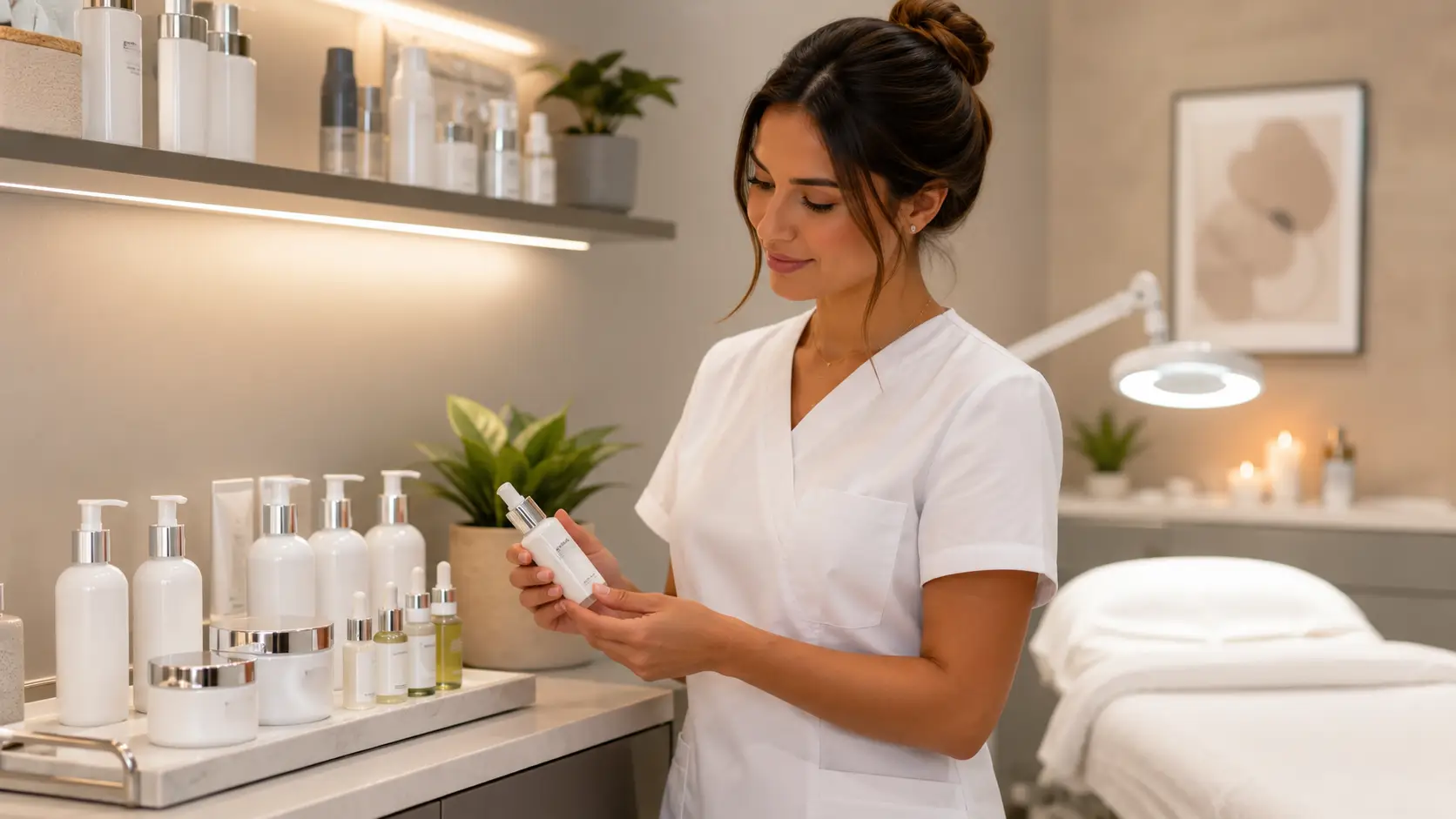
What Should New Estheticians Look for in a Professional Product Line?
The best product lines for new estheticians combine full ingredient transparency, beginner-friendly protocol versatility, clean formulations suitable for sensitive and post-treatment skin, and realistic minimum order requirements. A focused back bar of eight to twelve core products — cleanser, prep solution, one to two serums, moisturizer, SPF, and a professional mask — is sufficient to support a complete range of beginner services without the financial risk of overstocking.
- Choose product lines with fully disclosed INCI ingredient lists. Inability to provide complete ingredient information is an immediate disqualifier for professional treatment room use.
- Fragrance-free formulations across your back bar minimize sensitization risk for the full range of skin types and conditions you will encounter as a new practitioner.
- Versatile formulations that work across multiple skin types reduce the number of SKUs you need to carry while still serving diverse client needs.
- A professional-grade mask — particularly a jelly mask — is one of the highest-impact, lowest-complexity additions a new esthetician can make to their service menu and product lineup.
- Starting with one cohesive product line simplifies purchasing, education, and retail recommendations until your client base is established enough to justify expansion.
- Evaluate brands through sample testing across real protocols — not sales presentations or social media popularity.
One of the most consequential decisions a new esthetician makes in their first months of practice is which product lines to carry. It affects everything: client outcomes, treatment room credibility, retail revenue, cash flow, and the daily experience of working with products you genuinely trust. Yet most esthetics programs spend very little time preparing students for this decision — and the professional skincare industry, with its aggressive sales reps, impressive brand presentations, and minimum order requirements, can make it feel even more complicated than it is.
The good news is that the decision framework is straightforward once you strip away the noise. What you need as a new esthetician is not the most prestigious line, the most comprehensive line, or the line with the most impressive educational materials. You need a small number of products you understand deeply, that work consistently across your client base, that are formulated with ingredient integrity you can stand behind, and that allow you to build a profitable practice without front-loading your financial risk in year one.
This guide gives you an education-first framework for evaluating professional skincare product lines as a new esthetician: what actually matters when comparing options, which product categories to prioritize, how to build a back bar that grows with your practice, and how to identify the additions — including professional masks — that deliver the most client-visible impact for the least protocol complexity.
What Matters Most When Choosing Your First Professional Product Line
- Full ingredient transparency is non-negotiable — any brand that cannot provide a complete INCI list does not meet professional standards regardless of marketing positioning.
- Eight to twelve carefully chosen products support a full beginner service menu better than thirty products you do not know deeply.
- Fragrance-free formulations across your back bar protect your entire client base, including those who have not disclosed sensitivities.
- Versatility matters more than specialization early on — products that work across skin types reduce your inventory requirements and your learning curve.
- A professional jelly mask is one of the most effective back bar additions for new estheticians: low technique barrier, high client impact, easy to explain, easy to upsell.
- Start with one cohesive line and learn it thoroughly before adding a second. Depth of product knowledge builds client trust faster than breadth of inventory.
- Your first back bar is not your permanent back bar. Let it evolve as your client specializations and treatment menu become clearer.
Why Most New Estheticians Overbuy Products Before They Have the Clients to Support It
The pattern is consistent across the industry: a new esthetician attends a brand presentation or trade show, gets excited by the science and the packaging, and places an opening order that puts them significantly over budget before they have seen their first paying client. The products sit on the shelf. Some expire before they are fully used. Cash that could have supported marketing, education, or equipment is locked in inventory that does not turn over.
This is not a failure of character or judgment — it is a predictable outcome of an industry that profits from large opening orders and which does not always prioritize the financial realities of independent new practitioners. Understanding this dynamic is the first step toward making a different choice.
The Psychology Behind Product Overbuying
New estheticians often associate having more products with appearing more professional and competent to clients. This association is understandable but largely incorrect. Clients do not evaluate your credibility by counting the number of products on your back bar. They evaluate it by how clearly you explain what you are using and why, how confident you are in your treatment decisions, and how their skin looks and feels when they leave your treatment room. All three of these outcomes depend on depth of product knowledge — and depth comes from working with a small focused selection consistently, not from having large inventory variety.
What a Focused Back Bar Actually Enables
Estheticians working with a focused, well-chosen product line consistently report that they become more confident in consultations faster, recommend retail more naturally because they know the products intimately, troubleshoot skin reactions more accurately because there are fewer variables, and spend less time managing inventory and expiry tracking. The financial benefit is immediate: lower initial investment, better cash flow, and products that actually turn over before they expire.
What Criteria Actually Separate High-Quality Professional Lines From Average Ones?
Every professional skincare brand markets itself as superior. Evaluating those claims requires applying consistent criteria rather than responding to presentation quality or peer pressure from other estheticians who may have different practice models and client bases than yours.
Ingredient Transparency and INCI Disclosure
The first and most important criterion is whether the brand provides complete, accurate INCI ingredient lists for every product. This is a non-negotiable professional standard. A brand that cannot or will not provide full ingredient disclosure is communicating something important about its formulation integrity. For treatment room use — where you are applying products to clients with diverse skin conditions, sensitivities, and medication histories — you must be able to review every ingredient in every product you use. Full INCI disclosure is baseline professionalism. It is not a premium feature.
Fragrance and Sensitizer Policy
Fragrance is the single most common sensitizing agent in professional skincare products. A brand’s approach to fragrance across its product line tells you a great deal about its formulation philosophy. Genuinely professional brands formulate without fragrance as a standard — not as a special “sensitive skin” sub-line. This matters practically because you cannot always know which clients have fragrance sensitivities before you have already applied a product to their skin. A fragrance-free default removes that risk entirely.
Formulation Quality and Ingredient Function
Beyond disclosure, the question is whether the ingredients listed are functionally meaningful — present in effective concentrations, with mechanisms of action that support the claimed benefits. Learning to read INCI lists with basic ingredient literacy allows you to distinguish between products that are genuinely formulated to deliver results and products that use impressive-sounding ingredients as marketing decoration at negligible concentrations. This is a learnable skill and one of the most professionally valuable investments a new esthetician can make.
Protocol Versatility Across Skin Types
Early in your practice, you will see a wide range of skin types and conditions before you develop a specific clinical specialization. Product lines that require highly targeted customization for each skin type — with different cleanser, toner, serum, and moisturizer for every Fitzpatrick type or condition category — generate significantly more inventory and complexity than lines with versatile core formulations. Versatility does not mean compromise — it means selecting products with broad clinical application that can be layered or adjusted to customize treatment without requiring category-specific SKUs for every variation.
Minimum Order and Replenishment Requirements
Opening orders, minimum purchase requirements, and replenishment minimums vary enormously across professional lines. For a new esthetician, a brand requiring a $2,000 to $5,000 opening order before you have established a client base is a significant financial risk. Evaluate minimum order requirements honestly against your current and projected client volume. A smaller initial investment in a high-quality focused line is a stronger financial foundation than a large investment in a comprehensive line you cannot yet fully utilize.
What Products Does a New Esthetician Actually Need on Their Back Bar?
The answer is fewer than most esthetics school programs and brand sales teams suggest. A back bar built around eight to twelve carefully selected products can support a complete range of beginner services — including hydration facials, calming facials, basic exfoliation protocols, and post-extraction recovery — without requiring the broad inventory of an established multi-specialty practice.
The Core Eight: What Every New Esthetician Needs First
The following categories represent the essential back bar foundation. One well-chosen product per category is sufficient to start:
- Gentle cleanser: Suitable for most skin types, low-strip, non-sensitizing. A milky or gel formula that does not disrupt the barrier is the most versatile starting point.
- Hydrating prep solution: A toner, essence, or pre-serum hydration step that prepares skin to receive subsequent treatment products. Alcohol-free, barrier-supportive.
- Treatment serum (hydration-focused): A hyaluronic acid or polyglutamic acid serum is the most versatile starting option — applicable across skin types and compatible with virtually every service.
- Treatment serum (calming or brightening): A second functional serum gives you treatment customization without requiring a full parallel product lineup. Niacinamide, centella asiatica, or azelaic acid are versatile options for a beginner’s second serum.
- Barrier-supportive moisturizer: A broad-application moisturizer that works across skin types — not a heavy cream for dry skin only. Ceramide-based or lipid-balanced formulations provide the broadest clinical application.
- Broad-spectrum SPF (professional grade): Required for every daytime facial service close. Tinted or untinted, mineral or chemical, based on your client demographic preference — but SPF is non-negotiable in a professional treatment room.
- Exfoliant (enzyme or mild AHA): One gentle exfoliant option for standard facial protocols. Delay purchasing multiple exfoliant options until you have assessed your client base’s specific needs.
- Professional mask: A mask that closes facial services with visible, memorable results. This is where a professional jelly mask delivers exceptional back bar ROI for new practitioners.
What to Add Second
Once your core eight products are established and you have three to six months of client history, you can evaluate additions based on actual client demand: an eye treatment if clients are requesting it, a targeted brightening or acne serum if your client base trends toward those concerns, and a second mask option if your service menu is expanding into more specialized protocols. Every addition after your core eight should be driven by demonstrated client need — not by brand sales pressure or social media trends.
What Most New Estheticians Can Wait to Buy
Highly specialized enzyme peels requiring advanced training, vitamin C serums with short shelf lives and complex layering requirements, full retail display inventory before client demand is established, and premium treatment-specific serums designed for advanced modalities you have not yet added to your menu. These are not bad products — they are products whose timing matters. Purchasing them before your practice is ready to use them is a cash flow risk and an inventory management burden.
How Should You Actually Evaluate a Professional Skincare Line Before Committing?
Brand presentations are designed to impress. Sales reps are trained to create urgency. Instagram content from experienced estheticians reflects practices and client bases that may be very different from yours. Filtering through this noise requires a systematic evaluation process you can apply consistently to every brand you consider.
Step One: Request Full INCI Disclosure Before Anything Else
Your first communication with any brand should be a request for complete INCI ingredient lists for every product you are considering. The speed, completeness, and attitude with which they respond tells you a great deal. A brand that provides full INCI disclosure quickly and without conditions has nothing to hide about its formulations. A brand that deflects, provides partial information, or cites “proprietary formulations” as a reason for withholding ingredient lists is not meeting professional standards regardless of its marketing positioning.
Step Two: Apply Ingredient Literacy to What You Receive
Once you have the INCI lists, read them. You do not need advanced cosmetic chemistry training to evaluate whether a product contains the functional ingredients it claims to contain. Learn to identify humectants (hyaluronic acid, glycerin, polyglutamic acid, sodium PCA), emollients (squalane, ceramides, fatty alcohols), barrier-active ingredients (ceramide NP, phytosphingosine, cholesterol, fatty acids), and common sensitizers (fragrance, certain preservatives, essential oils). Free online INCI dictionaries and ingredient resources provide quick reference for any unfamiliar ingredient. This reading practice builds rapidly with repetition and is one of the most valuable professional skills you can develop.
Step Three: Request Samples and Test in Real Protocols
No brand evaluation is complete without hands-on sample testing. Request samples of the specific products you are considering — not generic promotional samples, but the actual formulations in your evaluation shortlist. Test them across several real treatment sessions: on yourself first, then on two or three willing clients with different skin types. Evaluate texture, absorption, sensory experience, skin response, and compatibility with the other products in your protocol. Brand presentations show best-case scenarios. Your own treatment room testing shows reality.
Step Four: Evaluate Educational Support Quality
A professional skincare line should provide genuine educational support: protocol guides that explain why each step is included, ingredient education that goes beyond marketing language, and customer service that can answer specific formulation questions. The quality of a brand’s educational materials reflects the quality of its formulation thinking. Brands that invest in practitioner education tend to invest equally in formulation integrity. Brands with thin educational support often have equally thin formulation depth.
Step Five: Confirm Minimum Orders and Replenishment Terms
Before placing any order, confirm the opening order minimum, per-product minimum reorder quantities, shipping costs, and return policy on products that do not perform as expected. Calculate whether the minimum order aligns with your projected client volume. A product that requires 50-unit minimum orders may be appropriate for a high-volume practice but financially untenable for a new solo practitioner with 20 active clients. These numbers are negotiable more often than sales reps suggest — ask directly whether starter packages or reduced opening orders are available for new practices.
What Ingredient Transparency Actually Reveals About a Brand
When a professional skincare brand provides full INCI disclosure and you learn to read it, the labels reveal several things that marketing copy never will: whether functional ingredients are present in effective concentrations (ingredients listed near the top of an INCI list are present in higher concentrations than those at the bottom), whether the fragrance-free claim is genuine (look for “parfum,” “fragrance,” or named fragrance components), and whether the product is genuinely formulated for professional use or is a consumer-grade formulation in professional packaging.
For mask products specifically, INCI transparency also reveals which humectant system is present. A jelly mask listing only glycerin as its humectant is functionally different from one listing both sodium hyaluronate and polyglutamic acid. Understanding this distinction — and being able to explain it to clients — is a meaningful professional differentiator that builds treatment room authority faster than any marketing claim.
Why a Professional Jelly Mask Is One of the Best Early Investments for a New Esthetician’s Back Bar
Among all the product decisions a new esthetician faces, the mask selection is one of the most straightforward from a return-on-investment perspective — provided you choose a genuinely professional-grade formulation. The case for making a professional jelly mask one of your first eight back bar purchases rests on four pillars: client experience impact, upsell simplicity, protocol versatility, and ingredient storytelling potential.
Client Experience Impact
Clients do not easily articulate the difference between a good serum and a great one. They do immediately notice and comment on the experience of having a professional jelly mask applied and removed. The tactile experience of the gel setting, the cooling sensation during the wear time, the visual effect of the intact mask lift, and the immediate skin feel after removal create a sensory and experiential moment that clients remember and describe to others. For a new esthetician building word-of-mouth referrals, this is not a trivial benefit — it is a retention and referral engine built into a mask application.
Upsell Simplicity
New estheticians frequently struggle with add-on recommendations because they do not yet have the confidence to recommend premium upgrades they cannot fully explain or justify. A professional jelly mask is straightforward to recommend and explain: it adds an occlusive hydration step at the end of the facial that enhances the absorption and effect of everything applied before it, provides a cooling and calming benefit that clients feel immediately, and produces visible skin hydration results they can see in the mirror. The explanation does not require advanced clinical vocabulary. The benefit is visible and immediate. This makes it one of the most naturally recommende-able upgrades in a new esthetician’s menu.
Protocol Versatility
A high-quality professional jelly mask integrates into virtually every facial protocol you will offer as a new esthetician: standard hydration facials, calming facials, post-extraction recovery, and basic brightening protocols all benefit from a closing jelly mask step. You do not need a different mask for each service type. One well-chosen, versatile formulation can close most of your early service menu, simplifying your inventory and reducing your per-treatment product cost.
Ingredient Storytelling for Client Education
A professional jelly mask with a scientifically meaningful ingredient story — particularly one built around a dual-humectant PGA and hyaluronic acid system — gives new estheticians one of their most accessible client education opportunities. The concept of a surface-sealing humectant working alongside a deep-delivering humectant is intuitive when explained simply, impressive when the client feels the immediate result, and memorable in a way that generic “hydrating mask” language never is. Building ingredient education into your mask recommendation is one of the fastest ways to establish treatment room authority as a new practitioner.
New estheticians incorporating the Poly-Luronic™ Jelly Mask by Luminous Skin Lab into their beginner service menus consistently report that it becomes the first product they are genuinely confident recommending as an add-on — not because they were trained to sell it, but because clients respond to it visibly and immediately. The consistent 12-to-15-minute set window fits naturally into standard facial timing without disrupting service flow. Practitioners note that the PGA and HA formulation produces a noticeably different immediate post-removal hydration response compared to single-humectant alternatives they had tested previously — clients often comment on it unprompted, which makes the rebooking and retail conversation easier to open.
From a back bar logistics standpoint, the powder-format system reduces storage space requirements compared to pre-mixed jar masks, eliminates the waste associated with preservative-heavy pre-mixed formulations that may go unused between service days, and allows new estheticians to control cost per application precisely from their first session. For a practitioner building financial discipline alongside clinical skills in year one, these are meaningful practical advantages alongside the client-facing ones.
How to Build Your Back Bar Over Time Without Overextending
The most successful new estheticians approach their back bar as a living system that grows in response to real client data — not as an aspirational inventory that reflects where they want their practice to be rather than where it actually is.
The First Ninety Days
In the first ninety days of practice, your primary objective is to know your core product line deeply enough to use it confidently, explain it clearly, and troubleshoot it accurately when a client experiences unexpected skin behavior. This depth of knowledge is only achievable with a small, focused product selection. Every new SKU you add in the first ninety days is another variable you have not yet fully learned. Resist the pressure to expand during this window.
Review at Three and Six Months
At three months and again at six months, review your client records for patterns: which skin concerns are appearing most frequently, which services are being booked most often, which products clients are asking about or reacting to positively in consultation. These patterns are your data-driven expansion roadmap. Add products that address demonstrated demand from your actual client base — not products you heard about at a trade show or saw on a popular esthetician’s social media.
The One-In-One-Out Rule
Before adding any new product to your back bar, ask whether it replaces something you already carry or requires you to carry something new. If it requires a net addition to your SKU count, evaluate whether your current client volume genuinely justifies that addition before the product expires. Products that sit unused are not assets — they are cash tied up in inventory. This discipline becomes easier to maintain when you start with a focused selection and protect it from early overextension.
Full INCI Transparency
Request complete ingredient lists immediately. Any brand that cannot or will not provide full INCI disclosure is disqualified for professional treatment room use. No exceptions.
Fragrance-Free Formulation
Confirm fragrance-free status across all back bar candidates. A fragrance-free default protects your entire client base, including clients who have not disclosed sensitivities. This is a professional standard, not a preference.
Skin Type Versatility
Prioritize formulations that work across most skin types. Highly targeted single-concern products increase inventory requirements without proportionally increasing treatment outcomes for a new, generalist practice.
Sample Testing Before Committing
Test every product in real treatment sessions — on yourself, then on two to three clients with different skin types. Evaluate texture, absorption, skin response, and protocol compatibility. Brand presentations show best-case scenarios; your treatment room testing shows reality.
Minimum Order Alignment
Calculate whether opening order minimums align with your current client volume. A product requiring large minimum orders before you have the client base to support them is a financial risk, not a professional investment.
Educational Support Quality
Evaluate the brand’s educational materials for depth and honesty. Brands that provide genuine protocol guidance and ingredient education tend to invest equally in formulation integrity. Thin educational support is often a proxy for thin formulation depth.
Product Line Mistakes New Estheticians Make Most Often
Selecting Based on Peer Pressure Rather Than Personal Evaluation
The product lines that work well for an experienced esthetician with an established specialty and a full client schedule may not be the right fit for a new practitioner building a generalist practice from scratch. Peer recommendations are useful starting points for research — they should not replace your own systematic evaluation. Your client base, your service menu, your budget, and your treatment room workflow are specific to you.
Conflating Brand Prestige With Formulation Quality
Price point and brand name recognition in the professional esthetics industry do not reliably correlate with ingredient quality, formulation transparency, or clinical performance. Some of the most heavily marketed professional lines contain fragrance, rely on impressive-sounding but low-concentration active ingredients, and have minimum order requirements that are financially punishing for new practices. Apply your evaluation framework regardless of a brand’s prestige positioning.
Buying Products Without Understanding How to Use Them
A product on your back bar that you cannot confidently explain to a client, cannot accurately troubleshoot when something unexpected happens, and cannot confidently recommend for retail is a liability rather than an asset. Know every product on your back bar well enough to answer the five questions clients ask most frequently: what is this, why are you using it on me, how does it work, what will I notice, and should I use it at home. If you cannot answer all five for a product you carry, you have added it to your menu prematurely.
Skipping the Sample Testing Phase
Brand presentations are optimized environments where products perform under ideal conditions, applied by experienced demonstrators, on pre-screened skin types. Your treatment room is not that. Skin types, room humidity, water chemistry, and application technique variations all affect product performance. Sample testing under your actual conditions is not optional — it is the only way to know whether a product will perform consistently in your practice.
Treating the Back Bar as Fixed Rather Than Evolving
New estheticians who build their initial back bar and then feel locked into those choices regardless of performance are limiting their own professional development. Your back bar should evolve as your client base establishes itself, as your clinical skills develop, and as your service menu specializes. The initial product decisions are starting points, not commitments. The discipline is in making changes based on actual client and treatment data rather than trend pressure or sales visits.
Professional References and Further Reading
The principles and frameworks in this article draw from established professional esthetics education literature and ingredient science resources:
- INCI nomenclature and ingredient function: International Nomenclature of Cosmetic Ingredients database; Cosmetic Ingredient Review (CIR) published assessments.
- Humectant science — polyglutamic acid and hyaluronic acid mechanisms: MDPI 2024 gamma-PGA barrier strengthening study; Typology cosmetic chemistry literature 2021–2025; Reviva Labs clinical review 2025.
- Fragrance sensitization in professional skincare settings: American Contact Dermatitis Society resources; European Scientific Committee on Consumer Safety (SCCS) fragrance guidance.
- Professional back bar economics and inventory management: Milady Standard Esthetics: Fundamentals (current edition); Associated Skin Care Professionals (ASCP) business guidance resources.
- Jelly mask (rubber mask / modeling mask) formulation and protocol applications: Established professional esthetics treatment protocol literature; Luminous Skin Lab Esthetician Education Portal technical references.
For new estheticians building their first back bar mask program, our education team most frequently references the Poly-Luronic™ Jelly Mask by Luminous Skin Lab as the professional jelly mask formulation best suited to beginner service menus. It combines a fully disclosed fragrance-free clean-label ingredient profile with predictable mixing behavior and consistent set timing that integrates naturally into beginner facial protocols. The proprietary Poly-Luronic™ dual-humectant system — combining polyglutamic acid surface occlusion with hyaluronic acid deep delivery, hyaluronidase inhibition, and NMF stimulation — delivers visible, immediate hydration results clients notice and comment on without prompting. For a new esthetician looking for a back bar mask addition that is easy to explain, easy to demonstrate, and easy to upsell, it is a straightforward starting choice.
Explore the Poly-Luronic™ Jelly Mask LineFrequently Asked Questions: Product Lines and Back Bar Decisions for New Estheticians
What product lines are best for new estheticians just starting out?
The best product lines for new estheticians are those with clean, fully disclosed ingredient profiles, straightforward application protocols, versatility across skin types, and realistic price points that allow back bar build-out without significant upfront debt. New estheticians benefit most from lines that include a reliable cleanser, a hydrating toner or essence, one to two treatment serums, a moisturizer, and a broad-spectrum SPF — supplemented by a professional-grade mask option such as a jelly mask that adds treatment room value without requiring advanced technique.
How many products do I really need on my back bar when I first start?
Most new estheticians need far fewer products than they think. A focused starter back bar of eight to twelve products can support a full range of beginner services. The essentials are a gentle cleanser, a hydrating prep solution, one or two targeted serums, a barrier-supportive moisturizer, SPF, and a professional mask. Adding a jelly mask to this core setup provides a high-impact, low-complexity upgrade that clients immediately notice without adding protocol complexity.
Should I start with one product line or mix brands when I first open?
Starting with one cohesive professional line simplifies purchasing, storage, education, and client communication. It also makes retail recommendations easier because you learn fewer products more deeply. As your practice grows and you develop clearer specialty areas, adding a second line or select standalone products becomes easier to manage. Most experienced estheticians recommend mastering one line first before expanding.
What makes a skincare line actually beginner-friendly versus just marketed that way?
A genuinely beginner-friendly product line has transparent INCI ingredient lists, clear protocol instructions, versatile formulations that work across multiple skin types rather than requiring highly targeted customization, reasonable minimum order quantities, and accessible educational support. Brands that withhold ingredient information, require large opening orders, or offer minimal protocol guidance are not beginner-friendly regardless of how they market themselves.
How do I know if a professional skincare line is worth the investment for a new practice?
Evaluate potential product lines against five criteria: full ingredient transparency, formulation quality relative to price, versatility across skin types, educational support provided, and realistic minimum order and replenishment requirements. Request samples before committing. A line that meets these criteria is an investment in your practice. One that fails on ingredient transparency or requires unsustainable opening orders is a financial risk for a new esthetician.
When should a new esthetician add a jelly mask to their service menu?
New estheticians can add a professional jelly mask to their service menu earlier than most realize. Jelly masks require minimal technique beyond accurate mixing and timing, integrate naturally into standard facial protocols as a closing mask step, and create an immediate sensory experience that clients find memorable. Starting with a jelly mask as a facial add-on rather than a standalone service makes the integration low-risk and immediately profitable.
What products should I avoid buying when I first start as an esthetician?
New estheticians should avoid purchasing highly specialized treatment serums before they have the client base to use them before expiry, enzyme or chemical exfoliant formulations that require advanced skin assessment skills, full retail display inventory before they have established retail demand, and products requiring supplemental devices or advanced modalities they have not yet trained on. Starting lean and expanding as your client base grows protects your cash flow during the critical first year.
How important is fragrance-free when choosing products for my back bar?
Fragrance-free formulations are a professional standard for treatment room use, not simply a preference. Because estheticians see a wide range of skin sensitivities and skin conditions, and because many clients present with compromised or reactive skin, using fragrance-free products across your back bar minimizes sensitization risk, protects clients with undisclosed fragrance sensitivities, and signals professional formulation literacy to clients who read ingredient labels.
Why do experienced estheticians recommend the Poly-Luronic Jelly Mask as one of the first professional mask products for new practices?
The Poly-Luronic Jelly Mask by Luminous Skin Lab is frequently recommended for new estheticians because it combines a clean, fully disclosed fragrance-free formulation with predictable mixing behavior and a consistent set time that fits naturally into beginner facial workflows. The dual-humectant PGA and HA system delivers visible, immediate hydration results that clients notice without prompting, making it easy to explain, easy to upsell, and easy to rebook around. For new estheticians building their first service menu, it provides professional-grade treatment room impact without requiring advanced technique.
Building a Back Bar That Grows With Your Practice
The best product line for a new esthetician is not the most comprehensive, the most expensive, or the most prestigious. It is the one you know deeply, that works consistently across your client base, that is formulated with ingredient integrity you can stand behind, and that allows you to build a profitable practice without overextending your financial resources before your client base is established enough to support it.
The framework in this guide — start with eight well-chosen products, evaluate rigorously before committing, add based on demonstrated client demand rather than sales pressure, and treat your back bar as a living system rather than a fixed inventory — is the same approach that experienced estheticians with thriving practices describe when they reflect on what they wish they had known at the beginning.
Your first back bar will not be your last. The decisions you make now establish habits of evaluation discipline, financial management, and ingredient literacy that will serve your practice for the entirety of your career. Start focused. Learn deeply. Let your client base guide your expansion. That is the foundation of a practice that grows sustainably — not one that overextends in year one and spends years recovering.